| Home |
 |
The Chairman
©2005 All content on site protected by copyright |
 (address
is not clickable)
(address
is not clickable)
 01/10/2006
Rational Herds, Reviewed by Victor Niederhoffer
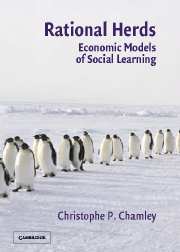
The beautiful and extraordinarily important book Rational Herds: Economic Models of Social Learning by Christophe Chamley treats topics important to decision-makers in life and markets, including how fast, delayed and divergent our learning is, herding, the convergence of beliefs, booms, bubbles and crashes, entries into business, diffusion of innovations, investments in knowledge, searching costs, the cost of information, the value of isolation versus joining (e.g., to stag hunt or not), regime switching, avalanches, variations in prices, limit orders versus market orders, and information delays in financial markets. Each chapter starts out with examples of social learning, simple models that illumine how rational agents might act in comparable situations, and extensions into more realistic and technical models that apply to special cases considered in the literature. The more familiar the reader is with probability theory, simulations, economics of utility, and normal distribution theory, the easier it will be for him to gain knowledge from the book, but a hard-working layman with a pencil and paper can gain insights into many fruitful areas even without this background.
The book begins with an example of social learning among penguins typical of its many suggestive examples for market decision-makers. The penguins, after much hard winter work without food, move in a group to the edge of a cliff overlooking an ocean full of food. Possibly lurking in the water are killer sharks, whales and seals. The penguins as a group would be much better served if one of them would test the waters. But for the individual penguin, death might result. Action must be taken or else they'll all starve to death. The penguins solve the problem by pushing a particularly vigorous individual off the cliff. If he survives, they all jump in.
Comparable situations occur whenever danger or discomfort threatens a group and the first person to test the water might risk harm or, worse yet, social disapproval for being a non-conformist. We all face this, for example, when we see a fight and know that we can break it up if only group action can be taken, or when we are in a crowded room where the heating or ventilation isn't proper, or when we're in an establishment where the service is poor. We face this in the market when we have to test the waters before a trend is set, before an announcement has been released, before a new industry or market has come into favor, or before a change in interest rates has occurred. The book will help you decide how long to wait in such situations, and to analyze the attempts of others to substitute for you or coordinate with you.
Many of the basic models in the book start with binary choices such as the identification of a taxi as red or yellow, or the prediction of a market move as up or down. Consider the following situation: 70% of all months are up. Now, a study is made, e.g. of times when interest rates were very high, that shows the market is more likely that other months to decline. However, only 60% of similar predictions are accurate. Now there are two likelihoods that can result:
- The prediction applied to the 70% base can be wrong. This combined event has a 70% x 40% = 28% likelihood.
- The prediction can be accurately applied to the 30% of months that are declines. This combined event has a 30% x 60% = 18% likelihood.
Thus, the probability of a rise is now 28/46 = 61%, down from the original 70%. But despite the forecast based on interest rates, the correct prediction is still for a rise. No change in decision will be forthcoming. But now, suppose that a second study is made, and it also predicts a decline. But such a study also has only a 60% chance of being accurate. Applying this to the new 61% base probability of a rise, the likelihood of a rise is 61% x 40% = 24% and likelihood of a decline is 39% x 60% = 23%. Now it's about 50 /50 as to whether the market will rise or not. And with a third prediction based on another study forecasting a decline with better than a 50% probability of being accurate, the weights would swing to a decline forecast. Everyone who followed such a decision strategy, or learned of the studies, or believed that others were acting on the basis of correct decision-making, would follow the third forecast and change his action to selling Thus, depending on the delay and decisiveness of action, an avalanche, cascade or crash might occur.
There are hundreds of fascinating examples of group decision making given in Chamley's excellent book that will illuminate all your thinking about social behavior. Some of my favorites involve studies of the value of conformity, when to go out in the rain, when to get out of a booming market, when to follow an expert, the value of the risky market order or the conforming limit order, the value of experience (old-timers versus beginners), when to attack a currency, how much credibility to place on initial reports (the white van problem), the accuracy of group behavior, when it pays to coordinate or go it alone. and the path of truth. The book will change the way you think about groups and will have you rereading to to better appreciate these key areas.
01/17/2006
Peter Gardiner Comments on Chamley's
Rational Herds
It is no surprise at all that Chamley's book should be valuable after the Chair's recommendation. But that it should be so incandescently stimulative (and corroborative) at the same time counts as one of the great intellectual treats in memory. I can't help cast out, like a kettle full of boiling oil and popping kernels, a few newly formed questions:
- Are there actually 'discrete limits' to 'history' as defined?
- If so, is there any periodicity to them?
- Does the 'state of nature' change with them?
- Are there private signals, which, in aggregate, systematically convey information about an imminent state (of nature) change?
- How does the option value associated with defecting (i.e. waiting to invest) change with time as a function of the distance form the last period at which all private signals convey no information?
- Are these rates (of option value change) constant or variable?
- If the conclusions of the simple BHW model and of other learning models convincingly show that social learning is (by definition or axiom) 'self defeating...when individuals use public information rationally,' [p 61] and that (Propostion 4.3) 'When agents have a binary signal, an information cascade occurs after some finite date, almost surely,' then what unit of time should a state of nature (with normal distribution) be chosen for, especially if E (theta) = - var?
- Since herding is certain, and when herding occurs the value of private signal 's' is negligible, if we suppose that history is discrete (closes and opens) and periodic (daily, plus event dates, plus sub periods) , then what measure shall indicate the existence of a herd and the elimination of social learning?
- Since the variance (precision) provides an index of Expectation, shall we then take it that as variance decreases in any period, we have, ipso facto, a herd, and therefore a potential for a future 'cascade'? (e.g. when VIC is low)
- If so, how can we measure the extent of such a cascade from the signature of its 'mother' herd?
I could go on and on. This book is a volcano.
Martin Lindkvist adds:
The site for Financial Economics Workshop, a finance course at NYU, contains lecture notes and research papers pertaining to many of the chapters of Chamley's book.
Dr. Kim Zussman wonders:
There is a card game, at a casino where the dealer, Lo Rates, hands you single cards. They are either green or red (win or lose). The deck he is dealing from is under the table, and he shuffles it out of sight after every deal. You think it is one deck with many cards, and after many tries you notice green 70% of the time.
After dinner you go back to the same table and it is a different dealer, Hy Interest. Hy is still reaching under the table for cards, but after many tries you count green 40% of the time.
You are not sure whether Hy is using a different deck than Lo, or they are both using the same decks and you just got different cards. How do you determine if they were using the same or different decks?