S&P -56.25
USB -0.12
S&P +33.75
USB +0.01
S&P +78.25
USB +0.14
S&P -32.75
USB +0.01
S&P -41.50
USB -0.10
S&P -36.75
USB -0.07
S&P -45.25
USB -1.09
S&P +61.00
USB -0.04
Dec
12
Comments on free trade, from Stefan Jovanovich
December 12, 2025 | Leave a Comment
"Free trade" never loses an argument; it is like being in favor of virtue. Even the worst sinner knows that vice is not to be publicly defended. The difficult for those of us in the bleachers is that we have never been able to avoid asking the follow-on question: if you don't like tariffs as taxes, what do you want to have instead? Adam Smith's answers were (1) domestic excises - the sugar is allowed to arrive untaxed and then have a tax levied when it is sold and (2) occupancy taxes - to be measured by how many windows a building had. What is never mentioned, of course, is that Smith was completely in support of the navigation acts; Britain would have "free trade" but only on cargoes carried on British ships that traveled directly to British ports. His specific comment on that question was: “Defense is of much more importance than opulence.”
William Huggins writes:
i'm all ears to hear what national security threat the us is responding to with their 50% tariff on aluminum processed where there is an abundance of clean energy to do so and (until recently) all but perfectly aligned nat sec interests with the processor?
Stefan Jovanovich responds:
The answer offered by the authors and voters who made the Constitution the national law was "protection". I offer this only as an historical explanation, not advocacy, since those of us who live on popcorn and waiting from spring (what Rogers Hornsby said he did after the baseball season ended) have abandoned all attempts to understand what is called "policy", whether monetary or otherwise.
Art Cooper asks:
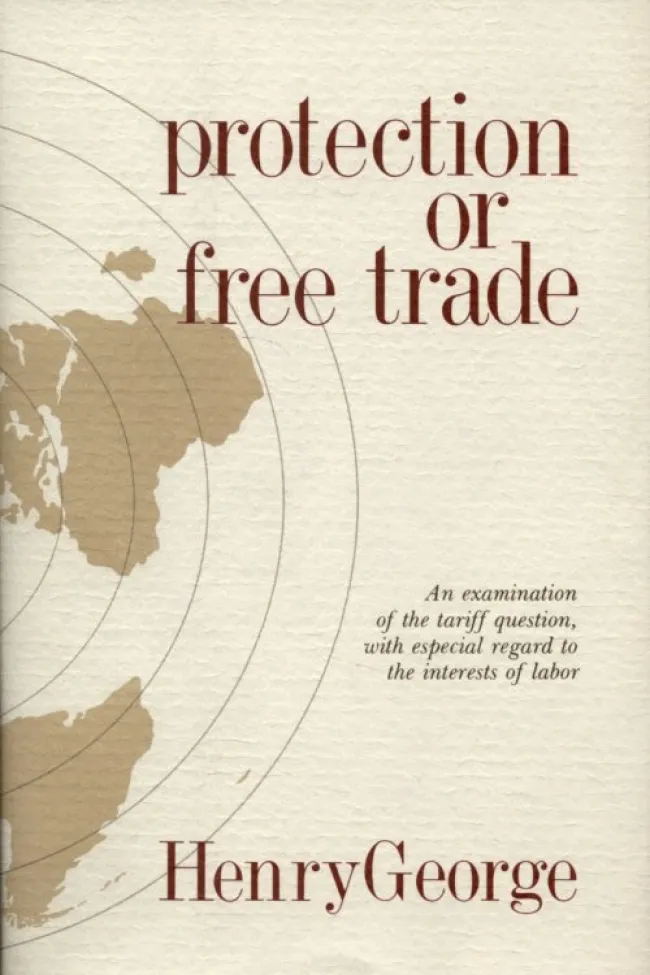
May I have your thoughts on Henry George's advocacy for the replacement of all other taxes by a land value tax?
Henry Gifford comments:
I think Henry George’s idea has a lot of merit, and not just because I heard that my father once taught at The Henry George School of Economics.
More than one calculation has shown that the cost of complying with tax laws in the US is about equal to the amount of taxes paid. If a land value tax eliminated all other taxes, almost all that cost would be saved. But, this would disadvantage the government because vague and complicated laws can be used by the strong against the weak, something not many in government want to see the end of.
Then there is the issue of jobs. The existing tax systems create a huge number of jobs, most of which would go away with a greatly simplified tax. Sure, those people could find more useful endeavors, increasing wealth for all, but if politicians started talking like that a lot of other things would be seen as folly.
Disagreements about the value of land could be handled like the ancient Greeks did – anyone claiming a lower value for their property can be challenged to sell it at that lower price.
A similar situation exists with the part of building design laws that regulate the energy efficiency of new buildings that get built. Now the laws run to hundreds of pages, which makes them very difficult to enforce. The vagueness gives the government people more power, as they interpret the laws as they see fit, or as they are paid under the table to do. For a time I was advocating a simple energy code: limit the size of the heating and cooling systems installed per the size of the building (you-tube: “The Perfect Energy Code”). Governments around the US were loathe to adopt a simplified energy code, because then jobs would be “lost” and the power to make arbitrary decisions would be reduced and the laws would actually be enforceable. A simplified tax collecting system will probably always be unpopular for similar reasons, despite what I think is a lot to recommend it.
Stefan Jovanovich responds:
Smith agreed with Henry George. He thought a land tax had all the attributes of a good tax, unlike income and employment taxes, which were the worst possible ones. Even tariffs had some virtues compared to those that required citizens to tell the state everything.
Dec
11
Brilliant Marketing, from Peter Ringel
December 11, 2025 | Leave a Comment
I rarely use a squawk box. But on a day like FOMC I do. I don't trade news, mkt is usually earlier. I use it more like an alarm clock. So Y/D I tuned in and so did all the other zillion retailies.
They have a tiered model, there the premium is real-time (+ latency…hmmm) and the rest is delayed. A few major news like FOMC are real-time also on the free tier.
So seconds before the FOMC announcement, at the moment of highest attention by potential future paying customers, they piped in an add:
In the voice of Trump (surely AI generated):
"You are not on the premium feed. You are missing out. Lets make the news great again“
Brilliant
(not an endorsement of news trading )
Dec
11
Why free trade is better
December 11, 2025 | Leave a Comment
why it's better to have another entity produce things:

A free market operates on Ricardo’s principle of comparative advantage, where trade exists because no country is self-sufficient. Countries either lack resources (e.g., India importing crude from the Middle East), infrastructure (e.g., the US importing pharmaceuticals from India), or expertise (e.g., the US and China importing electronic chips from Taiwan). Countries should specialize in producing goods and services with lower opportunity costs and export them, while freely importing others. This leads to better quality and lower costs for consumers.
4 Quotes on Free Trade from Classical Economists
Nothing is more usual, among states which have made some advances in commerce, than to look on the progress of their neighbours with a suspicious eye, to consider all trading states as their rivals, and to suppose that it is impossible for any of them to flourish, but at their expence. In opposition to this narrow and malignant opinion, I will venture to assert, that the encrease of riches and commerce in any one nation, instead of hurting, commonly promotes the riches and commerce of all its neighbours; and that a state can scarcely carry its trade and industry very far, where all the surrounding states are buried in ignorance, sloth, and barbarism.
Dec
10
The fifty rounds, and more
December 10, 2025 | Leave a Comment
the fifties are the new rounds always to be breached from below.
is the fed chair fed with answers that will bull and bear and how can he hurt trump?
sherlock holmes, alan pinkerton and wikipedia hear completely opposite varsions of the Molly Maguires. the first two are reliably, the third is woke trash.
Dec
10
Ye Outside Fools!
December 10, 2025 | Leave a Comment
Is not our business quite as good as that of those who lend their names to float the foreign loans of countries which are in a state of semi-bankruptcy, and which will fail to pay as soon as they can get no further loans? It certainly does much less harm. They catch the real investor, we but clear the weaker speculators out.
Ye Outside Fools! Glimpses Inside the Stock Exchange, by Erasmus Pinto, broker, 1876.
Dec
9
Interesting AI read, from Big Al
December 9, 2025 | Leave a Comment
The Structural Collapse: How Google’s Integrated Stack Is Dismantling the OpenAI Thesis
Shanaka Anslem Perera
Nov 22, 2025
A leaked internal memo reveals the tectonic shift reshaping artificial intelligence, where platform economics are defeating venture-backed innovation at the exact moment markets assumed the opposite.
Carder Dimitroff writes:
My Australian daughter is a Google employee. She recently completed Google's 3-month AI training program in the US. From what I understand, Google's AI capabilities are big. When demonstrated to Google's large-cap clients, they were surprised.
Based on her comments, I've concluded that AI technologies will displace accountants, engineers, lawyers, financial analysts, medical staff, educators, sales, and more.
Obviously, leaders in those disciplines will continue to do well. While most normal positions can be eliminated, there must be a human somewhere in the mix. There's an ongoing need to manage the architecture of the questions and review AI responses. Anyone who wants to remain in the game may wish to develop expertise in leadership, program management, systems management, and communication.
Then again, there will be an ongoing need for the crafts. They will reap while others weep.
Musk is right. Work will become optional. But he was not the first.
Dec
7
Andrew Carnegie
December 7, 2025 | Leave a Comment
Andrew Carnegie learned telegraphy by heart.
In 1849, Carnegie became a telegraph messenger boy in the Pittsburgh Office of the Ohio Telegraph Company, at $2.50 per week ($94 by 2024 inflation) following the recommendation of his uncle. He was a hard worker and would memorize all of the locations of Pittsburgh's businesses and the faces of important men. He made many connections this way. He also paid close attention to his work and quickly learned to distinguish the different sounds the incoming telegraph signals produced. He developed the ability to translate signals by ear, without using the paper slip. Within a year he was promoted to an operator.
Dec
6
Sancho Panza proverbs, from Nils Poertner
December 6, 2025 | Leave a Comment
Sancho Panza's Porverbs and others that occur in Don Quixote
half of the proverbs contain the word "ass" in it - like this one which I found timely:
When the broom sprouts, the ass is born to eat it.
Dec
4
Previous 20-day high
December 4, 2025 | Leave a Comment
previous 20-day high at 6875 on 11-12. must be broken soon.
Dec
4
A large piece of history from the age of sail
December 4, 2025 | Leave a Comment
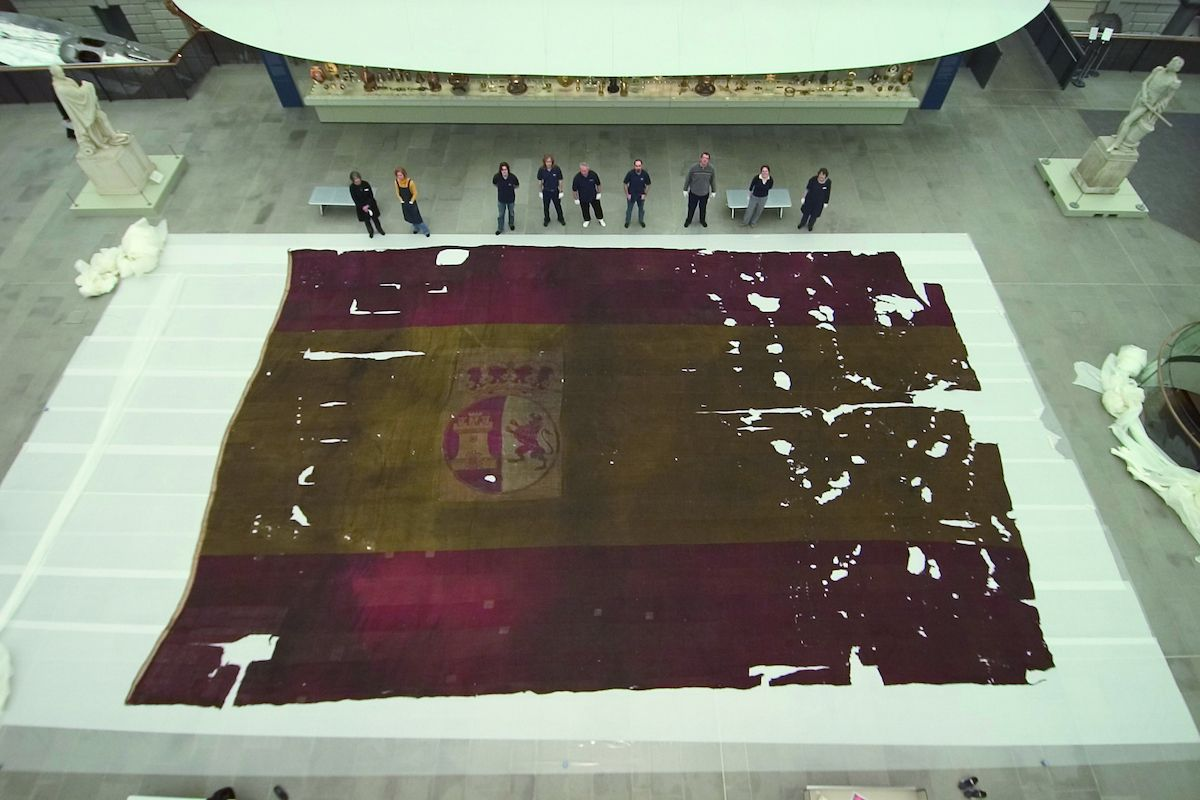
The Battle of Trafalgar and the Ensign of the San Ildefonso: A Testament to Naval Supremacy
The Battle of Trafalgar, fought on October 21, 1805, marked a defining moment in history, securing Britain’s unchallenged supremacy as a naval power. Under the brilliant leadership of Admiral Horatio Nelson, the British Royal Navy triumphed over a larger Franco-Spanish fleet, despite being outnumbered in both manpower and firepower. This clash not only demonstrated tactical brilliance but also symbolized the resilience and innovation of the British naval force.
One of the most remarkable artifacts from this legendary battle is the massive ensign flown by the Spanish warship San Ildefonso. This flag, an enduring symbol of Trafalgar's legacy, provides an extraordinary glimpse into the scale and intensity of 19th-century naval warfare.
Measuring an astonishing 33 feet wide and 47.5 feet long, the San Ildefonso’s flag is a colossal piece of history. Made of wool, it served as the ship’s battle ensign—a flag so large that it could be seen through the dense smoke of cannon fire, ensuring that allies and enemies alike could identify the ship’s status.
Dec
2
A sea wolf and a cowboy
December 2, 2025 | Leave a Comment

Cochrane: Britannia's Sea Wolf, by Donald Thomas, completely exonerates Cochrane from the insider trading scandal. Cochrane made less than 1/4 of a %, and much of the conviction against him depended upon the identification of a red versus green coat.
Monte Walsh has everything a western should have and is easily more exciting and deep than anything of Lamour. Why is it so neglected?
Jack Schaefer was a journalist and writer known for his authentic and memorable characters set in the American West. Schaefer received the Western Literature Association's Distinguished Achievement Award in 1975 and the Saddleman Award in 1986 from the Western Writers of America. His popular Western novels include Shane (1949) and Monte Walsh (1963).
Nov
30
Sometimes those elevator door buttons actually work, from Henry Gifford
November 30, 2025 | 1 Comment

Once upon a time I measured how much electricity it takes to ride on an elevator – I measured about 50 elevators – and seem to be the only person who ever measured that and got the results published. Before, there were numerous scholarly papers published on elevator energy use, all guesses or estimates or computer models (same thing), very “scholarly” because they had footnotes referencing other published guesses and because you paid a lot of money for someone to do that “research”. Several multinational elevator companies were selling energy efficient elevators, but none of the companies knew how much energy a ride took – they had “data” on how much their elevator used in one year vs. an ordinary elevator – an unspecified number of rides, unspecified number of stops (floors), unspecified weight in the cab, etc. All just made up “data”. Surprise, none of the manufacturers wanted me to measure their elevator.
Read the full post with additional comments.
Nov
29
American Colossus; “very bull”
November 29, 2025 | Leave a Comment

American Colossus: The Triumph of Capitalism, 1865-1900 summarizes the work of Rockefeller, Carnegie and Morgan in building America and pictures a battle between Adam Smith and Thomas Jefferson.
Also:
Why We Run: A Natural History, by Bernd Heinrich
In Why We Run, Heinrich considers the flight endurance of birds, the antelope's running prowess and limitations, and the ultra-endurance of camels to understand how human physiology can or cannot replicate these adaptations. With his characteristic blend of scientific inquiry and philosophical musings, Heinrich offers an original and provocative work combining the rigors of science with the passion of running.
26 days and 0.50 away from last 20-day high very bull.
Nov
28
Lucky charms, from M. Humbert
November 28, 2025 | Leave a Comment

Anyone have any favorite good luck charms/rituals to help with trading results?
Peter Ringel writes:
some of the old floor traders, we had on this list, reported how superstitious some of the traders were. Cloths, bathroom time…
Asindu Drileba comments:
Lucky charms may sound delusional but they are actually more common than we think. They are more like placebos. I take pill X, my headache goes away. (But pill X is made from wheat flour and a bitter "filler" and has exactly zero pharmaceutical contents, yet it works).
Have you ever pushed the button that opens the door of an elevator? Well, those buttons are completely fake! Elevator doors are pre-programmed to open and close at hard coded intervals. Pushing the button does nothing. They simply exist to give people a sense of control.
Nils Poertner writes:
To have a strong belief one can learn (from mkts or others) is a good start.
ie allowing for mistakes to happen, not fretting them. (many cultures are guilt-ridden, like the German culture on so many fronts. All it takes is sometimes to muster up enough courage and learn from mistakes and don't judge).
Zubin Al Genubi offers:
I'm reading Kidding Ourselves, Hidden Power of Self Deception, by Hallinan, in which he describes real physical and psychological effects of psychosomatic causes such as death, hallucinations. You see what you want to see. You are and become what you believe yourself to be. It affects health, performance, money. He also describes how a feeling of lack of control can be debilitating and even deadly. Some feel a lack of control in that they don't control the market, but one can easily (physically at least) click the keys to buy and sell any time.
From scientific studies: Our results suggest that the activation of a superstition can indeed yield performance-improving effects.
Nov
26
Give Thanks for Pilgrims — and McDonalds, by Victor Niederhoffer and Laurel Kenner
November 26, 2025 | 1 Comment
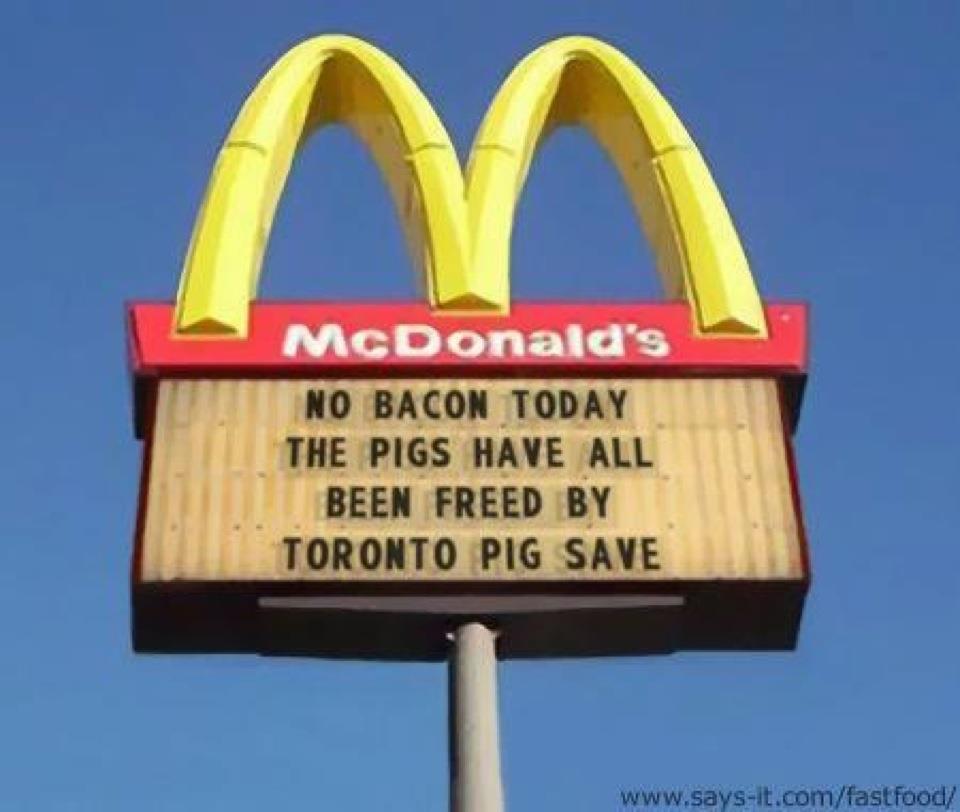 Thanksgiving is about sharing prosperity, and it's a good time to think about where prosperity comes from. The Pilgrims figured it out in 1623. We'll retell that story as we celebrate the way it lives on in countless U.S. families and companies today. And in particular at one company, McDonald's (MCD, news, msgs), that in its humdrum way beautifully demonstrates the source of prosperity and the American way of life.
The Pilgrims started with so little. They had to hide in England because the authorities considered them dangerous. They fled to Holland but found themselves compelled to take menial jobs. On the way to America, many of the company died. They lost their way to Virginia and landed in Massachusetts just as winter set in. The Virginia Co., their backers in London, went bankrupt and couldn't send relief supplies.
To cope with want, the Pilgrims made the same mistake that so many countries do even today: They divided all their land, efforts, supplies and produce in common, to each according to his need.
As always in such systems, need surpassed supply.
The Pilgrims spent their first three years in America suffering from hunger, illness, cold and infighting. People stole from the common stores "despite being well whipped," according to William Bradford's "Of Plymouth Plantation."
Bradford, governor of Plymouth Colony, records what happened next: "They began to think how they might raise as much corn as they could, that they might not continue to languish in misery. After much debate, the Governor decided that each settler should plant corn for themselves."
Under the Land Division of 1623, each family received one acre per family member to farm. That year, three times as many acres were planted as the year before. Prosperity was not long in coming.
The Pilgrims turned from their Old World system of common ownership to incentives. They didn't go that way out of ideological conviction, but because they didn't have the luxury of waiting for support to come to them.
How many families in America tell the same tale? "When we came here, we worked hard and our lives were better."
But that wasn't the end of the story. Before the switch to incentives, the hungry settlers were at each other's throats. Hard workers resented receiving the same portions of food as those who were not able to do even a quarter of the work they did. Young men resented having to work without compensation to feed other men's wives and children. Mature men resented receiving the same allotments as did the younger and meaner sort. Women resented being forced to do laundry and other chores for men other than their husbands. Many people felt too sick to work.
But when they were allowed to farm their own plots, the most amazing thing happened. Everybody — the sick, the women and even the children — went out willingly into the fields to work. People started to respect and like one another again. It wasn't that they were bad people, Bradford explained; it's just human nature. Adam Smith came to the same conclusion later, and Friedrich Hayek updated Smith's ideas for the 20th century. But we don't need to go back to New England for understanding. Similar outcomes can be seen at McDonald's every day.
For centuries, people on the lower rungs of the social ladder weren't able to eat meat. They ate grains and beans. But people like beef. And chicken.
When McDonald's started popping up in every neighborhood, all of a sudden there was an affordable place for families to eat. Previously, one of the main differences between the upper and lower classes was that the rich could eat out. Even if the poor could afford the tab, they couldn't hire baby sitters, and they couldn't bring their kids to the elegant establishments designed for the rich because they would have disturbed the other diners.
Most kids don't like fancy restaurants anyway. They want fries, not polenta with wild mushrooms. They want fried codfish, not turbot. They want burgers, not lamb chops.
How many people has McDonald's made happy? How many families has it brought together? How many Happy Meals have been eaten there? How many kids have enjoyed the playgrounds? How many tired workers have been able to catch a quick meal? How many women are able to pursue careers and other productive activities and dreams because McDonald's has freed them from the task of having to cook every night?
The Pilgrims might have served 200 or 300 American Indians at their Thanksgiving feast. McDonald's serves 26 million customers a day at 13,700 U.S. restaurants.
For the traveler, McDonald's is a home away from home, offering so much for so little. The restrooms are clean. And McDonald's serves hot strong organic coffee in smooth cups of some wonderful material that keeps liquids hot without burning the hand, shaped to fit into the cup holders that just happen to be in your car, with carefully designed tops that permit just the right amount to be sipped.
No regulator, no fascist dictator, no socialist planner decreed sip tops or cup holders. But how many late-night drivers have died for the lack of a good cup of coffee? What could be more munificent than saving lives?
And the story doesn't end there. Consider the employees of McDonald's. How many people have worked there and learned the most important lesson in America: The customer is always right?
The anti-this-and-that people who demonstrate against profit incentives and free markets like to single out McDonald's as a symbol of modern capitalism. (They don't mean that in a nice way.) As the McLibel Support Campaign puts it: "(McDonald's) has pioneered many business practices that have been taken up by others, and have come to represent a symbol of the way that society is going –'McDonaldization.'" But when have you ever seen an unhappy customer at McDonald's? There couldn't be too many of them, because about 10% of America eats there each day. Given the choice of cooking at home or going to other restaurants — and competition ensures that there are other restaurants — people go to McDonald's because they trust they'll find good food, quick service and value for money. What could be more munificent, more representative of sharing the fruits of hard work than McDonald's?
McDonald's and the Pilgrims are the essence of America. The people work hard, motivated by the chance for profits. They provide a welcome to others, whether to Indians joining in harvest celebrations, or to customers looking to satisfy their hunger. Their work results in high quality, low costs and family togetherness.
Those humdrum, everyday attributes are what makes America great. That's what we should be celebrating. It's the source of all our munificence, from the first Thanksgiving to today.
Nov
26
Speculator & Son
November 26, 2025 | 3 Comments


Nov
25
Book recommendation from Zubin Al Genubi
November 25, 2025 | Leave a Comment

Zapped: From Infrared to X-rays, the Curious History of Invisible Light
From beloved popular science writer Bob Berman, ZAPPED tells the story of all the light we cannot see, tracing infrared, microwaves, ultraviolet, X-rays, gamma rays, radio waves and other forms of radiation from their historic, world-altering discoveries in the 19th century to their central role in our modern way of life, setting the record straight on health costs (and benefits) and exploring the consequences of our newest technologies.
Nils Poertner suggests:
The HoHo Dojo, by Billy Strean.
Laughter and humor are therapeutic allies in healing.
Nov
24
The world in your breakfast
November 24, 2025 | Leave a Comment
An earlier and more illuminating version of I, Pencil from The Marvels of Modern Industry by William Norman Mitchell 1940:
Have you ever thought of all the work and plans and endless pains in far distant places which were necessary to supply so simple a thing as your breakfast? If you have, you doubtless found that even to enumerate these services constituted a lesson in world geography. There were, perhaps, grapefruit from Texas, sugar from Cuba, syrup from Vermont, toast made from flour milled in Buffalo, possibly from wheat from the valley of the Red River of the North. Butter and cream came from Wisconsin farms, bacon from Iowa, and coffee from distant Brazil. If you looked farther you may have found that this simple meal was served with plates of Bavarian make, on a cloth which was the product of Belgian skill, covering a table fashioned in Carolina hills from Honduras wood, with varnished finish made from gum brought from Algiers. Fork and spoon came from New England where they were fashioned from silver from Nevada's mines, while the knife blade possibly was made of Sheffield steel from iron ore mined in Sweden or war-torn Spain, and by its silvery and stainless sheen indicated that it had drawn upon the nickel from Canadian mines and the chromites of Rhodesian Veldts. And so on, in ever widening spread, until the whole world is drawn into a tangled web and bound on the common mission of serving you your breakfast!
Nov
23
Suprises, from Nils Poertner
November 23, 2025 | Leave a Comment
Whether it is the "Mambani win", Brexit, Covid, Ukraine war, whatever - had someone told me 6 months before that this could happen - the answer would have been "no-way…" whereas in 20-20 hindsight - it is always like "oh yes, there were obvious signs."
Zubin Al Genubi responds:
History is made on the edges by outliers which shifts the averages way over in its direction.
Nov
22
Getting back to normal with Jobs data, from Bill Rafter
November 22, 2025 | Leave a Comment
Chart: Full-time vs, Part-time Employment Growth Rates
Nov
22
Thanksgiving soon
November 22, 2025 | Leave a Comment
a little thankagiving treat coming shortly. dog stole a bone and hiding it over weekend.
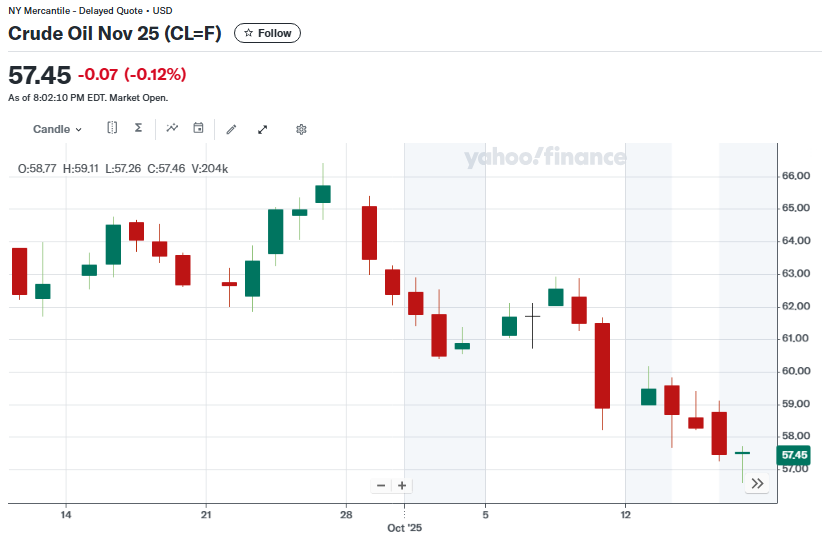
OIL AT $58. don't have necessary data for inflation numbers. an appropriate vestige of remainng use for input-output but on prices not output.
Nov
21
VIX Intraday Range, from Cagdas Tuna
November 21, 2025 | 1 Comment
Yesterday's range in VIX was one of the widest & wildest one I have seen in a very long time that happened without any major news. Wednesday close to Thursday low 18% decline followed by 46% rally to the day's high. Is there anyone who can check the occurrences in the past and how SPX traded in the following days of such a massive range explosion?
Asindu Drileba responds:
The Chairman's book, Practical Speculation, has a detailed analysis of the multivariate relationship between the VIX and the SPY. Unfortunately I forgot the page, and I am currently not close to my copy. [see pages 107-110] But it has something to do with how the fluctuations around the average of the VIX affects the SPY.
Paolo Pezzutti does some counting:
#VIX +11.71% at 26.43
Highest close since 24 April
Since 2020 VIX>26 has occurred 290 times.
After 4 days the Emini S&P Futures:
+27.01 pts Mean, 63.4% Wins, 1.63 Profit Factor
Larry Williams cuts to the chase:
Vix goes up when stocks go down they are inverse of each other—no magic there are all.
Nov
21
Sheep shearing, Humbert Q.
November 21, 2025 | Leave a Comment

Sheep needs to be regularly sheared to take off some extra wool- it is actually good for them- healthy!
Henry Gifford adds:
Back in the day sheep didn’t have people handy to shear them. A farmer told me that over the past few hundred years sheep have been bred to grow more wool, thus they need people now, but before that change the sheep didn’t grow as much wool.
Steve Ellison writes:
The S&P 500 reaching its lower 50-day Bollinger band on Thursday might indeed indicate some modicum of panic, as might VIX being well above its upper 50-day Bollinger band.
I have thought sentiment was quite restrained this year given that the S&P 500 was at a record high as recently as October 28. Bears have outnumbered bulls in the AAII survey for the past two weeks. And the publishing of a book titled 1929 was very well publicized. I perceive that out in the general population there is a lot of fear about AI; lots of scaremongering about AI eliminating nearly all white collar jobs.
Cagdas Tuna comments:
Many years ago when I was a teenager, I heard this from the head of top brokerage firm in Turkiye and he said "It is not news until it matters." Circle funding of AI companies and its effect on jobs have been long discussed at least by the people I follow on social media but it has had no impact until yesterday. So can we say it has become news now?
Nov
20
That’s enough
November 20, 2025 | Leave a Comment

that's enuf lobagolaing at 6542
Mixed Identity : LoBagola, the Black-Jewish African Prince
An African savage’s own story chronicles the adventures of LoBagola, a self-proclaimed “Black-Jewish Prince,” as he traveled from his pretended “African birth place” to Great Britain and America.
LoBagola was, in truth, the alter ego of the Baltimore-born African-American, Joseph Howard Lee, who grew up in a life of poverty and deep racial discrimination. In response, Lee fabricated much of this autobiography, initially published as authentic by the leading New York publishing house of Knopf.
Gemini:
In the lore of investors, a LoBagola refers to a market pattern observed by famed speculator Victor Niederhoffer. It is likened to an elephant stampede: the market surges in one direction and then quickly returns along the same path, moving "back and forth".
Nov
20
Following the Equator
November 20, 2025 | Leave a Comment

Following the Equator has a good chapter on thugism and thugee is still part of culture i've found.
Thugee became known to the British authorities in India about 1810, but its wide prevalence was not suspected; it was not regarded as a serious matter, and no systematic measures were taken for its suppression until about 1830. About that time Major Sleeman captured Eugene Sue's Thug-chief, "Feringhea," and got him to turn King's evidence. The revelations were so stupefying that Sleeman was not able to believe them. Sleeman thought he knew every criminal within his jurisdiction, and that the worst of them were merely thieves ; but Feringhea told him that he was in reality living in the midst of a swarm of professional murderers ; that they had been all about him for many years, and that they buried their dead close by. These seemed insane tales; but Feringhea said come and see — and he took him to a grave and dug up a hundred bodies, and told him all the circumstances of the killings, and named the Thugs who had done the work. It was a staggering business.
Nov
19
A good time to buy
November 19, 2025 | Leave a Comment
a good time to buy. gentlemen haven't liked stocks now at 6630.
just getting started at 6650.
Nov
19
Market lesson, from Jeff Watson
November 19, 2025 | 1 Comment
Ben Mallah is a real player in the real estate market and offers a palate cleanser that applies to any market.
Ben Mallah puts a recently renovated house up for auction. The video documents the preparation and the auction process itself, including discussions with the auctioneer and potential buyers. Viewers will see the property's features and the bidding unfold.
Nov
17
Corporate earnings, from Zubin Al Genubi
November 17, 2025 | Leave a Comment
I see they are down [at least through Q2]:
FRED: Corporate Profits After Tax (without IVA and CCAdj)
Steve Ellison responds:
Interesting. S&P 500 earnings per share were up both year to date and year over year. And Q3 so far looks better than Q2.
S&P source spreadsheet: Click link to download file: S&P 500 Earnings.
Big Al wonders:
So maybe the big firms are doing better than the smaller ones?
Nils Poertner remembers:
Investment Bank earnings 2007…My very cerebral friend Maurice at the time: "IBs are cheap - look at their PE ratios."
Nov
15
Tax receipts, from Larry Williams
November 15, 2025 | Leave a Comment
Federal government current tax receipts: Taxes on production and imports: Customs duties

Asindu Drileba writes:
I remember when Trump spoke at a recent market open. (NYSE market opens at around 4:30pm in Uganda). Crypto closed very bullish on that day. Every time he mentioned "Tax Cuts" the market blipped some more. Laffer Curve at work?
Rich Bubb adds:
I was idea hunting and found Wisdom from Larry Williams:
Larry Williams: Why Gold, Bitcoin, and Stocks Are Flashing Warning Signs
Nov
13
The $38 Trillion Question, from Humbert X.
November 13, 2025 | Leave a Comment
The $38 Trillion Question: An Interview with Stanford Professor Hanno Lustig
Hanno Lustig: I started thinking about the valuation of government debt by looking at the valuation of all Treasuries. What do we have to believe to get to a number like $38 trillion? You must believe there will be a huge fiscal correction, because ultimately the value of debt should be backed by future primary government surpluses. When you do the numbers, you realize that either bond investors are pricing in a huge fiscal correction that seems impossible, or Treasuries are significantly overpriced.

Carder Dimitroff notes:
The interest on debt is approaching $1 trillion per year and continues to compound. Interest costs currently exceed Department of Defense spending.
Larry Williams disagrees:
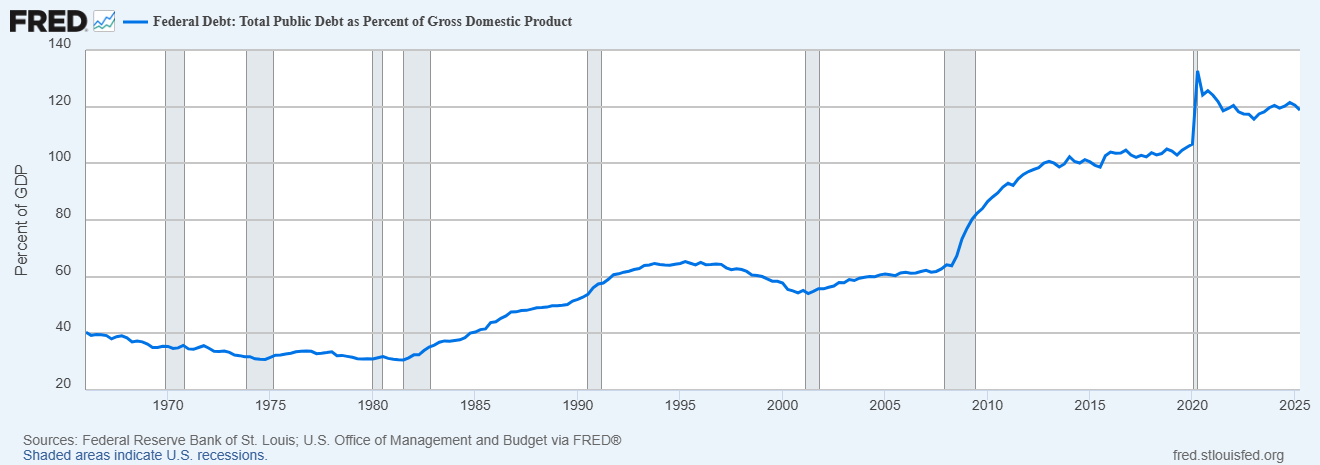
Meaningless measure look at debt vs gdp
Carder Dimitroff responds:
Yes, that makes sense. However, from a different perspective, it becomes meaningful under the One Beautiful Budget Bill when automatic sequestrations are implemented. Unless new legislation is passed, sequestrations will result in Medicare cuts and other reductions in expenditures. Current projections suggest sequestration will present in early 2026.
Big Al checks with FRED:
Nils Poertner writes:
recession + zero short term rates + lots of QE ….leading to a lot more public debt
maybe that is more likely path.
Stefan Jovanovich offers some history:
This chart shows the solvency ratios that can be found from the Census and other data [by decade 1880 to 2020] - how much "we the people" have in money divided by how much the American governments promise to pay.
Nov
12
David Hand’s probability lever, from Nils Poertner
November 12, 2025 | Leave a Comment
intellectual support / motivation to look at more extreme scenarios from time to time (extreme only appearing in the moment of course).
Hand writing: The Improbability Principle
The law of the probability lever is to do with choosing models. With poor assumptions even highly likely events can seem very improbable. Small changes in initial conditions can have an extremely large effect on outcomes.
Nov
11
Deutsche Bank sums it up, from Humbertus B.
November 11, 2025 | Leave a Comment
Long-Term Asset Return Study - The Ultimate Guide to Long-Term Investing
This study examines how asset classes have performed across a wide range of macroeconomic, policy, and valuation environments. Drawing on data that in some cases stretches back to the 18th century, we analyse both nominal and real returns to understand how different assets have behaved under varying conditions. We explore correlations with key drivers such as real and nominal GDP growth, inflation, interest rates, bond yields, debt and deficit levels, and more — with the goal of helping investors tilt the odds in their favour.
Nov
10
Best indicators for inflation, from Asindu Drileba
November 10, 2025 | Leave a Comment
The more goods cost, the more money visa makes since the fees they charge Issuing banks & acquiring banks are based on a percentage basis. So, higher prices (inflation) –> better predicted revenues for Visa? Inspired by a nice documentary on the history of VISA.
I wonder what the best indicator for inflation would be for testing this? CPI? Oil?

Cagdas Tuna writes:
I was thinking as to find a similar indicator for economic slow turn, spending cuts. It came to my mind to follow sales slips. I live in Malta which is a very tech friendly country for spending habits such as Apple/Google Pay availabilities, many digital banks access etc. I often asked if I need a receipt that I usually don’t. It depends for every country but if there is a rule for stores/restaurants to keep at least a copy for each transaction then it might be the indicator to follow. It might be used for inflation as well but of course needs detailed information.
Pamela Van Giessen comments:
To the best of my knowledge, merchants are not required to keep receipts. We track each sale but it will be the credit card processor or platform such as Square that holds the credit card or Apple or Google pay receipts. I can’t imagine that merchants would be willing to share their sales data. I know I wouldn’t.
Visa doesn’t care how much goods cost. They get their nearly 3% processing fee (+ .10 or .15 per transaction) whether there are 20 transactions for $100/ea or 40 transactions for $50/ea. In fact, they make more $ on a higher volume of transactions.
I don’t think tracking Visa or MC, etc could be a meaningful prediction of inflation as all the credit card companies continuously fight for market share. Note that they all send out multiple credit card offers to everyone all the time. Then, you have a store like Costco that only accepts their credit card (Citibank).
Additionally, there are people who use primarily cash. Those $ would be left out. You may say that cash use is low, and maybe it is. What I can tell you is that today at a market 80% of my sales were cash and that was likely the case for all the other merchants at this market. Older people especially use cash a lot. Just like drug dealers.
I have a theory that the cash economy is much bigger than everyone thinks. Insight into that might be more interesting.
Carder Dimitroff responds:
After considering Panela's cash sales point, I remembered that several companies required customers to switch from credit card payments to bank transfers. Additionally, several small establishments offer incentives for customers to pay in cash. They may be attempting to simplify their accounting and tax reporting. I do know that the federal government has immediate access to individual credit card transactions.
Pamela Van Giessen adds:
I thought it was the Fed that used to report on aggregated credit card data.
The other challenge with using credit card financials is that the credit card processors raise their % cut all the time. This is not due to actual inflation; it is due to them having a government protected moat that allows them to take more and more whenever they want because merchants are stuck with the whole system and consumers don’t realize that they will pay for the service — in increased prices. Every time Square, PayPal, etc., send me notices that they will be increasing fees, I increase my prices. I guess that is a kind of proxy for inflation but it’s a lousy sort of financial market induced inflation not based on anything more than their desire for more profits. I am all about free markets but the credit card processing biz is not even close to a free market.
The government using credit card processing to surveil us may be one reason I see more and more people using cash.
Larry Williams suggests:
Stock market is good predictor of inflation.
Nov
9
Prestigious consulting firm, from Nils Poertner
November 9, 2025 | Leave a Comment

Came to our financial firm 2007 and gave a 100 page presentation full of bullet points and cartesian logic (why housing boom will last). Either 3,5, or 9 bullet points per page.
At the end of the presentation I was tempted to go over to the presenter and ask him "why do you love your wife? (I didn't). The answer might have been bullet points.
Pamela Van Giessen writes:
Michael Korda tells in his memoir, Another Life, of the time that Simon & Schuster hired probably the same prestigious consulting firm to study how to improve revenues/profitability. Prestigious consulting firm (after taking the prestigious consulting firm fee) told the publishing company that they should publish more bestsellers.
Laurel Kenner comments:
I bet the prestigious firm concluded with ‘Key Takeaways’ as a final insult to the intelligence of the client.
Asindu Drileba writes:
I heard that people pay consultancy firms not for their knowledge, but for the fact that executives use them as a scape goat. If an executive wants to pursue policy X. They simply hire a consultancy to recommend policy X. If policy X ends up as a disaster (legally, morally or financially). They can simply say "Policy X was an idea from XYZ consultancy", we had nothing to do with it.
Peter Ringel adds:
a variation of this are fighting owners/ partners about policy. If decision pipelines are blocked, external council is used. Like a neutral arbitrator. I think, these are the main situations externals are used. Usually a good reason to short the entity, especially outside of markets. If they don't have the capability to decide and act on strategy in-house, it‘s a red flag.
Henry Gifford responds:
Even better is hiring a licensed engineer to instruct everyone to do something stupid that they know won’t work, so everyone who did as the engineer decided is blameless.
Jeff Watson offers:
A consultant is a person who knows 1000 ways to make love to a woman…..but he doesn’t know any women.
Nov
8
Tevye the Dairy Man
November 8, 2025 | Leave a Comment
"Tevye the Dairy Man" - one of my favs in High school.
In those days I was not the same person I am now. That is, I was the same Tevye, but different. As they say, the same old woman but under a different veil was then - may this never happen to you - as poor as poor can be, although, to tell the truth, I am by far no rich man today. You and I together should this summer earn what I would need to be as rich as Brodsky, but as compared to those days I am today a well-to-do man with my own horse and wagon, with a couple of, knock on wood, milch cows and another cow that is due to calve any day now. It would be a sin to complain, we have cheese and butter and fresh cream every day, all earned with our own labor, we all work, nobody is idle. My wife, bless her, milks the cows, the children carry the jugs and churn the butter, while I myself, as you see, drive to the market early every morning and call at every Boiberik dacha. I get to meet this person, that person, all the important people from Yehupetz, I chat a while with them and this makes me feel that I am also worth something in the world, that I am, as they say, no "lame tailor".
Tevye the Dairyman and the Other Stories, by Sholom Aleichem.
Nov
7
Ten days since an ATH
November 7, 2025 | Leave a Comment
10 days since all-time high. very bullish.
Steve Ellison comments on CAPE:
[Click chart for original post on X.]

6637-6660 is an important level for the ES December contract; not breaching this level (yet) in today's selloff is short-term bullish in my opinion, but the second highest valuation in history means the longer-term risk is high.
And I'm not sure exactly what the "rolling historical average" is, but by my calculation, the 30-year average CAPE is 28, which might make 40 somewhat less overvalued.
Nov
6
Percentages versus discrete values, from Duncan Coker
November 6, 2025 | 1 Comment
I notice how journalist select for stories to use percentages versus discrete values to server their own interests and the "public" is easily confused. Today, they pick the number nearing 1T to describe Mr. Tesla's pay which seems high. But they could have framed the story as he could be raising his ownership to 12% to 25% of a company he founded. Not much of a story there. Other places like crime statistics they usually go with the %. As in violent crime has risen 100%, this could mean 1 homicide to 2. Without the data with percent's the conclusions are obfuscatory. Percents can never go down more than 99.9%, but they can rise by an infinite amount. This fact also leaves much room for spurious selection.
Nov
4
Edmund Clarence Stedman, from Stefan Jovanovich
November 4, 2025 | Leave a Comment
Edmund Clarence Stedman was the editor of this history, The New York Stock Exchange, quoted below on this site.
From Grok:
Edmund Clarence Stedman (1833–1908) was a prominent American poet, literary critic, and essayist, often dubbed the "Bard of Wall Street" for his successful dual career in literature and finance. Born in Hartford, Connecticut, on October 8, 1833, he was orphaned young after his father's death from tuberculosis and raised by relatives. He briefly attended Yale University (expelled after two years but later honored with a degree) before launching into journalism in the 1850s, working for outlets like the New York Tribune and New York World, including as a Civil War correspondent. He studied law and briefly served as private secretary to U.S. Attorney General Edward Bates.
Connection to the New York Stock Exchange
Stedman's ties to the New York Stock Exchange (NYSE) spanned over three decades, from 1865 to 1900, where he worked as a banker and stockbroker on Wall Street. This financial role provided stability amid his literary endeavors, allowing him to support his family while pursuing poetry and criticism. After retiring from the Exchange in 1900, he remained deeply involved in its institutional history. In 1905, at age 71, he served as editor of the landmark publication The New York Stock Exchange: Its History, Its Contribution to National Prosperity, and Its Relation to American Finance at the Outset of the Twentieth Century, a comprehensive two-volume work commissioned by the Stock Exchange Historical Company. Co-edited with Alexander N. Easton and others, it chronicled the NYSE's evolution from its founding in 1792 under the Buttonwood Agreement through its role in American economic growth. The book, limited to 3,000 copies (with a rare signed edition of 50 for select members), is a key historical resource on early 20th-century finance.
Literary and Other Achievements
Parallel to his NYSE career, Stedman produced influential works like Poems, Lyrical and Idyllic (1860), Victorian Poets (1875), and massive anthologies such as A Library of American Literature (1888–1890, 11 volumes) and An American Anthology (1900). He also dabbled in science, proposing an early rigid airship design in 1879. Elected to the American Academy of Arts and Letters in 1904, he died in New York City on January 18, 1908, from heart disease, survived by two sons.
Nov
2
Optimism fulfilled
November 2, 2025 | Leave a Comment
The New York Stock Exchange
Its history, its contribution to national prosperity, and its relation to American finance at the outset of the twentieth century
Edmund Clarence Stedman, Editor
Stock Exchange Historical Company
New York, 1905
From the preface:
The present writer remembers the impression left upon an educated Englishman, a well-known publicist, who made a visit to Wall Street some eighteen years ago. He had been taken through the largest commercial structures in the vicinity, and even to the Stock Exchange itself, without giving expression to unusual interest. But on returning to his friend's offices, upon the upper floor of a building in the rear of the Exchange, he saw a sight that instantly gave him a realization of the extent of our peopled territory, and of the meaning of the Stock Exchange as the focus to which all currents of American purpose and energy converge. It was shortly before the time when the wires of New York's electric system were buried, by enactment, out of sight. Through the air, over New Street, hundreds, seemingly thousands, of these wires stretched toward the Exchange. No bird could fly through their network, a man could almost walk upon them; in fact, they darkened the street and the windows below their level. The visitor's host suggested that those going north, west, south were carrying messages to and from scores of inland cities and towns — financial ganglia of this land of national wealth and effort — names of which were mentioned. Certain wires were transcontinental, communicating with the towns of the Pacific States. Others served the uses of Montreal, Toronto and kindred points in the Great Dominion. Finally, the competing ocean cables were of course laden with incessant "arbitrage" and other messages to and from London, Paris and Berlin. This ocular demonstration of the relations of the New York Exchange to the Republic in its entirety, and even to the world overseas, proved almost startling to the English traveller. He asserted that within this central field of financial energy and intercommunication it was impossible not to have the imagination aroused, and the reason convinced of the enormous interests of which Wall Street, through its representative Exchange, is the ceaseless regulator. With philosophic impartiality, he predicted the time when even the largest money centres of the old world would become more or less subsidiary to this dominant market of the Western hemisphere.
Oct
30
Demand, Supply, and Electricity Prices, from Carder Dimitroff
October 30, 2025 | Leave a Comment
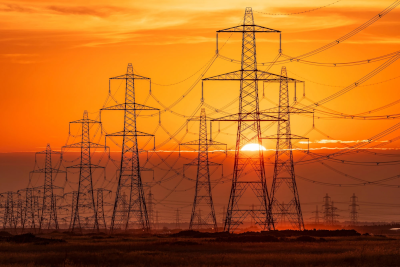
Funded by the U.S. Department of Energy, five scientists associated with California's Lawrence Berkeley National Laboratory claim that data centers are not a significant cause of retail electricity price increases. Counterintuitively, they suggest that data centers could have a beneficial effect in lowering costs. But more research is needed.
Factors influencing recent trends in retail electricity prices in the United States
Summarizing their "Ten Key Findings":
4.1. National-average retail electricity prices have tracked inflation in recent years.
4.2. State-level retail electricity price trends vary widely.
4.3. Residential customers and investor-owned utilities experienced greater increases.
4.4. Load growth has tended to depress retail electricity prices in recent years.
4.5. Behind-the-meter solar was associated with higher prices.
4.6. Utility-scale wind and solar are not—alone—broadly related to recent price increases.
4.7. State renewables portfolio standards are associated with recent price increases.
4.8. Exposure to natural gas price risk increases electricity prices when gas prices rise.
4.9. Hurricanes, storms, and wildfires have increased retail prices.
4.10. Several other variables appear to have limited statistical explanatory power.
Oct
29
An attempt
October 29, 2025 | Leave a Comment
An attempt by chair to halt margin of victory in 2026 for opposition.
Oct
29
The latest from Laurel Kenner
October 29, 2025 | 1 Comment
70++ Trades the Miners
Laurel Kenner
When China suggested Oct. 9 it would strangle rare earth metal exports to the U.S., U.S. mining stocks looked like the easiest way to make a killing since the Internet bubble in 1999.
Being arrogant enough to believe myself among the few who saw the opportunity, I bought a mining stock targeted by Goldman Sachs for a 100% gain.
The stock rose. Then swooned. I sold.
It quickly rose past the earlier high. I bought again. It tumbled below where I had sold the first time.
Greed had led me to forget old investment wisdom. Such as a warning against trying to get even, from Max Gunther’s 1985 “The Zurich Axioms.” Entitled “Stubbornness”, the 11th Major Axiom accurately describes my trade.
I also should have remembered advice from Nick Colas, head of DataTrekResearch, who made his bones at Credit Suisse and Steve Cohen’s SAC Capital. It’s my job, he explained years ago, to know things before they land in the media.
Meaning that if someone is giving tips to news outlets, keep in mind that he inevitably will take better care of his interests than yours.
Read the full post:
Oct
28
Entertaining valuation exercise, from Big Al
October 28, 2025 | Leave a Comment
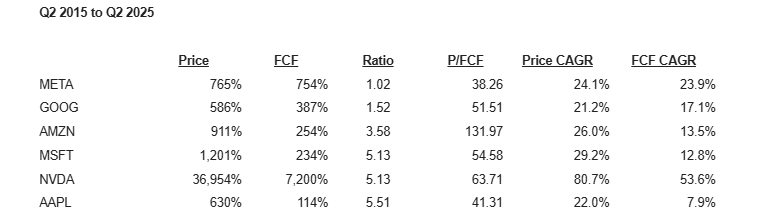
Looking at some of the megacaps and comparing their share price growth and FCF growth between Q2 2015 and Q2 2025. The price/FCF figures are the most recent.
Oct
27
State debt, from Jeff Watson
October 27, 2025 | Leave a Comment
Here’s an interesting breakdown and analysis of the debt of individual states. All the usual subjects are near the top.
Report ranks every state’s debt, from California’s $497 billion to South Dakota’s $2 billion
State governments had $2.7 trillion in debt at the end of 2023, a new Reason Foundation analysis finds. This state debt is equivalent to approximately $8,000 per person nationally.
On a per capita basis, Connecticut had the highest state debt, with $26,187 of debt per state resident at the end of 2023. With $22,968 in debt per resident, New Jersey was the only other state with more than $20,000 in liabilities per capita.
Reason Foundation finds 13 states—Connecticut, New Jersey, Hawaii, Delaware, Illinois, Massachusetts, Wyoming, Alaska, North Dakota, California, Washington, New York, and Vermont—had more than $10,000 in debt per resident.
Oct
26
The forgotten janitor who discovered the logic of the mind, from B. Humbert
October 26, 2025 | Leave a Comment
AI relevant:
Finding Peter Putnam
The forgotten janitor who discovered the logic of the mind
Every game needs a goal. In a Turing machine, goals are imposed from the outside. For true induction, the process itself should create its own goals. And there was a key constraint: Putnam realized that the dynamics he had in mind would only work mathematically if the system had just one goal governing all its behavior.
That’s when it hit him: The goal is to repeat. Repetition isn’t a goal that has to be programmed in from the outside; it’s baked into the very nature of things—to exist from one moment to the next is to repeat your existence. “This goal function,” Putnam wrote, “appears pre-encoded in the nature of being itself.”
Stefan Jovanovich offers, with a bit of irony:
From Grok:
Peter Putnam (1927–1987) was an American physicist and theoretical neuroscientist whose work anticipated many modern concepts in cognitive science, artificial intelligence, and philosophy of mind. He studied under prominent figures like Albert Einstein, Niels Bohr, and John Archibald Wheeler, and his ideas influenced early developments in computational theory of mind, though he remained largely unpublished and obscure during his lifetime. Putnam's writings, now digitized and discussed in recent scholarship (particularly following the 2025 rediscovery and publication of his papers), propose a functional model of the nervous system that integrates physics, game theory, and neuropsychology. His theory emphasizes how the brain achieves order and learning through mechanisms like Hebbian plasticity, distributed neural networks, and conflict resolution—ideas that predate similar concepts in predictive processing and reinforcement learning. Putnam's work is not a single, neatly packaged "theory of repetition" but rather a core principle woven throughout his model of cognition and behavior. Repetition serves as a foundational "goal function" for existence, learning, and induction (the process of generalizing from specific experiences).
Oct
25
Second favorite Hungarian, from Venkatesh Medabalimi
October 25, 2025 | Leave a Comment
György Buzsáki is my second favorite Hungarian [after Paul Erdős]. Brain Prize winner, he is from a later cohort. One of the few neuroscientists with a good theory for the Brain, a field that was ~mostly into measuring neural responses in parts of the brain to external stimuli and then telling a story around it. A great talk by him for the interested:
Ways to think about the brain: Emergence of cognition from action | ISTA Lecture with Gyorgy Buzsaki
Oct
24
The gentlemen don’t believe
October 24, 2025 | Leave a Comment
a new all time high at 6825 but the gentlemen don't believe it as it drops 20 points in the last 30 min.
Oct
24
Another Historical Analogy, from Stefan Jovanovich
October 24, 2025 | Leave a Comment
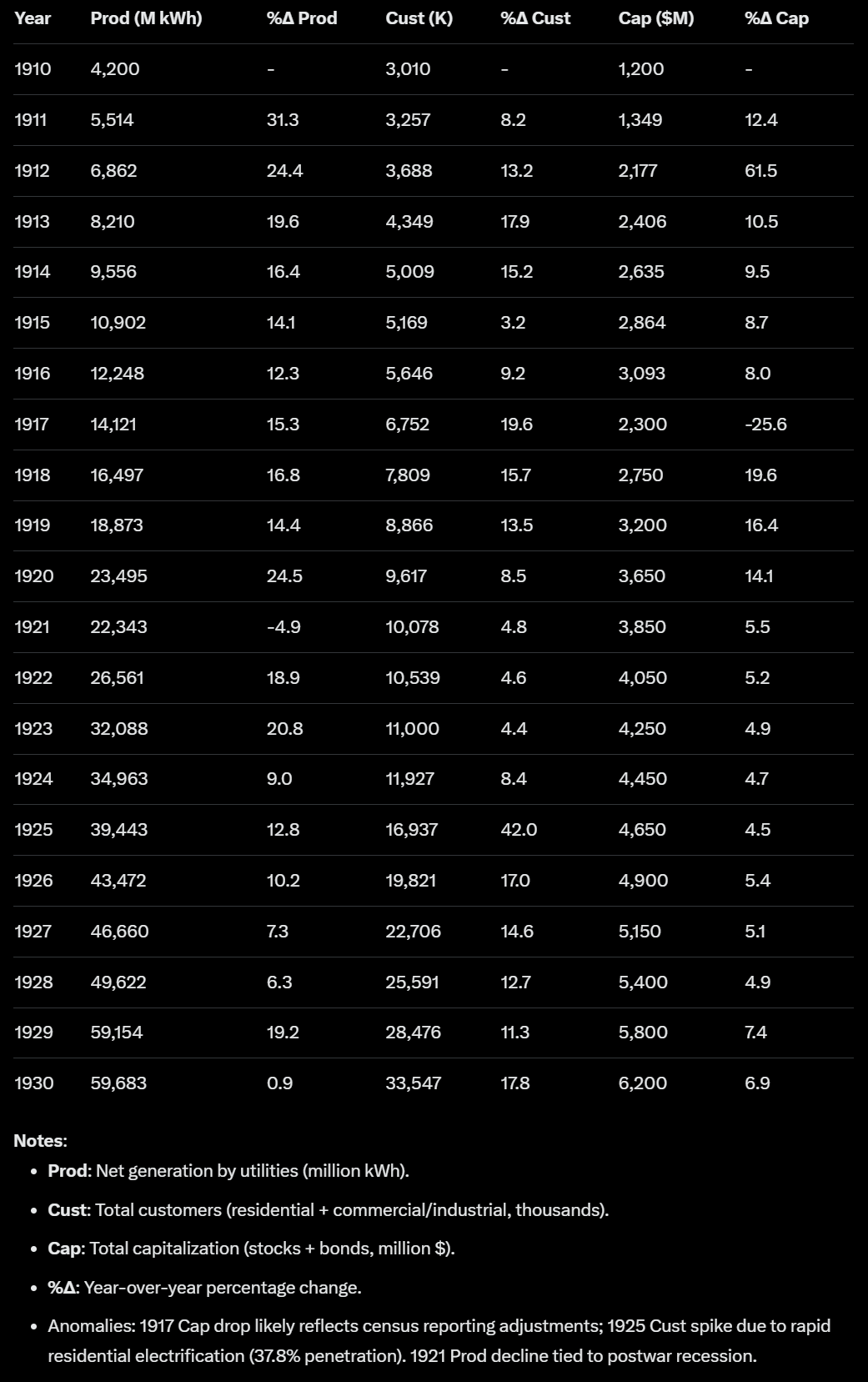
Grok and I have produced this summary of the growth of the electric utilities industry in the United States from 1910 to 1930. [Click on chart for full view.]
Bud Conrad comments:
Not sure what you take from this data. Electrification was probably more important than AI. Its growth rate was big at first in %, but slowed. Recessions were big downturns. What do you apply to today?
Steve Ellison writes:
My grandmother was a telephone operator in the 1920s. It was a high-tech industry at the time.
Carder Dimitroff clarifies:
The definition of an "electric utility" changed over time.
Big Al suggests:
An excellent series available on Prime:
Shock and Awe: The Story of Electricity
Professor Jim Al-Khalili tells the electrifying story of our quest to master nature's most mysterious force: electricity.
Books I haven't read yet, which get lots of stars:
The Power Makers: Steam, Electricity, and the Men Who Invented Modern America
The power revolution is not a tale of machines, however, but of men: inventors such as James Watt, Elihu Thomson, and Nikola Tesla; entrepreneurs such as George Westinghouse; savvy businessmen such as J.P. Morgan, Samuel Insull, and Charles Coffin of General Electric. Striding among them like a colossus is the figure of Thomas Edison, who was creative genius and business visionary at once.
Empires of Light: Edison, Tesla, Westinghouse, and the Race to Electrify the World
In the final decades of the nineteenth century, three brilliant and visionary titans of America’s Gilded Age—Thomas Edison, Nikola Tesla, and George Westinghouse—battled bitterly as each vied to create a vast and powerful electrical empire. In Empires of Light, historian Jill Jonnes portrays this extraordinary trio and their riveting and ruthless world of cutting-edge science, invention, intrigue, money, death, and hard-eyed Wall Street millionaires.
Oct
23
Regional US banks, from Nils Poertner
October 23, 2025 | Leave a Comment
As a European, I am asking: Are US regional banks in trouble (maybe even some larger banks - incl Investment banks). Dodgy consumer loans, then those silly "AI-related" loans? Am agnostic here - I suspect the typical analyst from JPM down the road won't enlighten us here.
Paul O'Leary comments:
No. Looks like over-reaction to a couple credit blips. Then algos pile on and observers who don’t follow the sector conjure up doom scenarios. Zion Bancorp - the main sinner, lost $1B in market cap for a $50mm write down.
Nils Poertner responds:
Hear you, Paul. If enough people would start to worry now, I would worry less (let us see).
Cagdas Tuna adds:
We are at a level any reaction will be exaggerated. If market adds $200bln to NVDA market cap with additional $1blnn revenue then $50m loss will have the same effect on a smaller company's share.
Oct
22
Government shutdown question, from Cagdas Tuna
October 22, 2025 | Leave a Comment
Are the furloughed government employees going to be counted as unemployed? I believe they will be which will be considered as a huge green light for 50bps rate cut in the December FOMC. This shutdown is the perfect storm for Trump’s “Fire Powell and get rates to 0%” scenario.
Bill Rafter responds:
The requirements for being “Unemployed” are that (a) the person is not working , and (b) that person is “looking for work”. I believe the latter qualification would disqualify those furloughed from being considered as unemployed. Not only the shutdown [will delay BLS releases], but the recently nominated BLS head, E.J. Antoni has withdrawn his name from nomination. So BLS is headless.
Alex Castaldo comments:
That is good news for all statisticians, I am sure he is a wonderful guy but he had a reputation for mistakes in calculations.
Oct
22
The Tipster
October 22, 2025 | Leave a Comment
The Tipster:
As he walked, a great sense of loneliness came over him.
He was back in Wall Street. At the head of the Street was old Trinity; to the right the subTreasury; to the left the Stock Exchange.
From Maiden Lane to the Lane of the Ticker — such had been his life.
"If I could only buy some Cosmopolitan Traction!" he said. Then he walked forlornly northward, to the great Bridge, on his way to Brooklyn to eat with Griggs, the ruined grocery-man.
from Wall Street Stories by Lefevre circa 1895 and similar to many who i've known and similar to many get-rich ads of today.
Oct
21
Oil and PPI
October 21, 2025 | Leave a Comment
correlation between the price move of oil in the last month and the ppi rep. it's hard to believe that any except chauncey chair would be worrying about inflation with oil at $56 per barrel.
Oct
21
Trading the transition to AV1, from Asindu Drileba
October 21, 2025 | Leave a Comment
AV1 is a new video compression format that may reduce the size of a video file by up to 50%. The big advantage is that videos will be up to half the size, with the exact same image and audio quality.
Two big consequences may ensue (when AV1 is fully adopted):
- Internet bills for streaming Netflix will reduce.
A 2 GB movie will only cost 1 GB from the perspective of a customer paying their Internet Service Provider. So more frequent subscriptions?
- Netflix will cut its bandwidth costs by 50%. So the profit margin (respective to bandwidth costs) will go up by 50% if users fully adopt AV1?
Currently, AV1 is only available on select hardware chips (listed table on Wikipedia) Maybe as users get new devices, use of AV1 will grow. This will likely happen gradually over several years (maybe half a decade). But an obvious winner would be Netflix & YouTube (Google Stock). Maybe bandwidth is so cheap it won't make a dent in the business revenues? But all major companies seem very enthusiastic about implementing AV1. Maybe bandwidth has it's (less talked about) variant of Moore's law. Where after a few years it gets easier to move stuff around the internet.
Cagdas Tuna wonders:
How many nuclear plants we need to feed that endless “technology”?
Nils Poertner asks:
How would you express this into a trade idea, Asindu? I find it easy to put ideas into a trade - it encourages deeper thinking and gives a feedback when wrong. eg, I was bullish housing London property 2007, but short-term it didn't really work out at all! longerterm yes. it was fuzzy thinking of my behalf.
Asindu Drileba answers:
Going long $NFLX since the business is largely about streaming video. The same pattern occurred in Tesla when the cost of efficient batteries dropped by like 90%. So margins automatically go up. (in theory) Tesla could have still gone under due to debt or something else. So, of course it may may fail (most likely)
Another big draw back is that such "qualitative" insights cannot be tested in the past. Maybe a good analogy would be to go long Starbucks $SBUX if you think the price of coffee wil drop the next 5 years by 50%.
So the ideas may be generalized to:
- Find key Ingredient company X uses in thier products
- Find out if the drop in key ingredient's price over 5 years improves profit margin over X years -> positively impacts stock prices.
This general idea, may then be tested across several industries for example:
- MacDonalds (drop in price of beef)
- TSMC, ASML, INTEL, NVDA (drop price of silver) as silver is very essential in chip manufacturing.
Hopefully testing this across multiple industries on different historical accounts may yield some consistent patterns.
Nils Poertner responds:
Good to write it down in a trading journal and look in a few months what happened. Started writing hand-written letters to friends now. In our digital age, everyone incl me, is going for speed, but deeper thinking - also quality in thinking /research is underrated. Intuitively speaking - we are prob getting some unexpected moves coming, as well.
Oct
20
Calming musical interlude for spicy markets, from Big Al
October 20, 2025 | 1 Comment
I first heard this piece as a teenager, sitting in the theater
watching Barry Lyndon, and I was transfixed:
The Messiaen Trio performs Schubert's Trio No. 2 in E-flat Major, D. 929
I did not know this Mendelssohn work until today and I wondered if
somebody said to her, "Oh yeah? Well, try it in heels!"
Yuja Wang Mendelssohn Songs Without Words Op 67 No 2
Peter Ringel writes:
my emergency high vola setup always includes Chopin. everything to stay off tilt.
Big Al responds:
Gotta love Chopin for the workday playlist.
Chopin: 24 Preludes, Op. 28, Vladimir Ashkenazy
Another discovery for me (fades out but still enjoyable):
Interpreti Veneziani, Antonio Vivaldi RV711 Gelido in Ogni Vena, Davide Amadio
Oct
19
Le Chiffre attacks, from Asindu Drileba
October 19, 2025 | Leave a Comment

In Casino Royal (2006) there is a speculator called Le Chiffre. He would manage money for war lords & other "underground" clients. He would take positions in markets, and then "manipulate them". For example in this clip, he takes a short position in an airlines company, then later bombs a plane belonging to it.
This year, I am starting to think that Le Chiffre is real. Someone opened a crypto account on Hyperliquid (decentralized exchange) and made an $88m profit from short positions that very day.
Cagdas Tuna responds:
Good catch! I have been reading these whales news since March-April 2025 mostly tied to Trump’s policy shifts. It is not difficult to guess who those Le Chiffres might be related to!
Peter Ringel writes:
I wanted to place 1 Nov in my calendar - as a new Mkt Risk date based on Trumps post. Only to realize, I placed this date regarding tariffs before. This makes this old news to some degree. And all of this is potentially an overreaction / a play.
Ed. - lagniappe: Forget Sean Connery, Watch James Bond Make His Real Debut on TV
Before Connery registered his license to kill in the 1962 hit Dr. No, millions of viewers were introduced to Barry Nelson’s “Bond, Jimmy Bond” in a 1954 episode of the CBS anthology series Climax! The show’s producers secured the rights to adapt Ian Fleming’s just-published debut Bond novel, Casino Royale, during their first season.
Since the Climax! version of Casino Royale is only 50 minutes, the plot has obviously been shortened considerably. And yet, if you’ve read the book or, more likely, seen the 2006 movie version that launched Craig’s Bond career, you’ll recognize the basic narrative, even though none of the familiar 007 flourishes are in place. In fact, Nelson doesn’t enjoy “00” status at all — he’s merely identified as a “Combined Intelligence” agent who is tasked with competing head-to-head against the mysterious Le Chiffre (Peter Lorre) in a rousing game of baccarat.
Jeff Watson does some research:
James Bond, the complete list…there are more than you think:
Please list every James Bond on film, TV, and radio. Grok: Alright, here goes-starting with the big-screen Bonds: Sean Connery, George Lazenby, Roger Moore, Timothy Dalton, Pierce Brosnan, Daniel Craig. Then David Niven in the 1967 spoof Casino Royale. On TV, there's Barry Nelson from a 1954 Climax! episode of Casino Royale. Radio Bonds? Bob Holness in a 1956 BBC Casino Royale adaptation, Tom Hiddleston in a 2014 Heart of the Matter series, and Toby Stephens in various BBC radio dramas.
Oct
18
Lessons from The Godfather
October 18, 2025 | 1 Comment

many accomlished and very successful specs and investors have told me that the most helpful book for the young spec to read is The Godfather (and the movies, part 1 and part 2). what advice would you say is the most helpful in these works?
one lesson that is very improtant is never interfere with a relative's marriage and never say anything bad about a relative's spouse.
family and loyalty are keys to success.
never let the others know what you are thinking. and above all never disagree with the boss in front of rivals.
Big Al adds:
The Offer is a really enjoyable derivative work.
Oct
17
George B Shaw, from Nils Poertner
October 17, 2025 | Leave a Comment

You see things; and you say 'Why?' But I dream things that never were; and I say 'Why not?'
- George Bernard Shaw
English Cyperpunk /hacker I met in 2005 had this quote on his screen - and I recall him talking about some digital ccy back then (little did I know back then, was so busy structuring CDOs and keeping up with the Jones.
If we want to nail mkts in coming years and have some fun, it def pays to surround ourselves with ppl outside trad finance (group think!) - from the art, music, acting world, hacker etc…whatever.
There is a certain type of fatalism in the West as well (David Hand, the British statistician, speaks about it as well in his "miracle" book. It has something to do how we perceive the world.)
Oct
16
Hubris is going to a New All Time High, from Sushil Kedia
October 16, 2025 | Leave a Comment
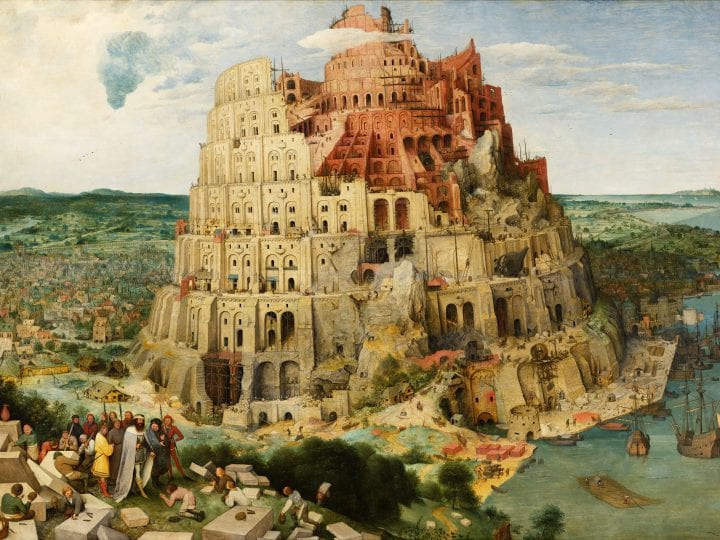
Saudi Arabia has announced the Rise Tower that is likely to have a height twice that of Burj Khalifa! 2000 meters up from the ground! It is likely to cost 5 Billion Dollars. One is left wondering in a world where everyone manages to almost manages to get decent enough sleep every night with Trillion Dollar deficits, what is Hubris doing having been left so far behind!
Nils Poertner writes:
Wondering what to make of this though, Sunil. Saudi Arabia's main stock Index (TASII peaked in 2006. and never fully recovered properly. Any idea how to express it into some trading idea so we can test our hypothesis?
William Huggins comments:
The 2006 Saudis run is very similar to the soul al manakh run up 20 years before. In particular for Saudis though, it's a market that forbid ahoet selling so when the bulls got started there was no guardrail until they simply could find no bigger fool.
Nils Poertner responds:
Thanks William. Maybe one needs to look at oil (bearish oil story?) - oil doesn't move forever and then it moves a lot. (not an oil trader though - just something that came to mind)
Alex Castaldo offers:
For those too young to remember the events of 1981:
The Souk al-Manakh Crash
From 1978 to 1981, Kuwait’s two stock markets, one the conservatively regulated “official” market and the other the unregulated Souk al-Manakh, exploded in size, growing to the point where the amount of capital actively traded exceeded that of every other country in the world except the United States and Japan. A year later, the system collapsed in an instant, causing huge real losses to the economy and financial disruption lasting nearly a decade. This Commentary examines the emergence of the Souk, the simple financial innovation that evolved to solve its rapidly increasing need for liquidity and credit, and the herculean efforts to solve the tangled problems resulting from the collapse. Two lessons of Kuwait’s crisis are that it is difficult to separate the banking and unregulated financial sectors and that regulators need detailed data on the transactions being conducted at all financial institutions to give them the understanding of the entire network they must have to maintain financial stability. If Kuwaiti officials had had transaction-by-transaction data on the trades being made in both the regulated and unregulated stock markets, then the Kuwaiti crisis and its aftermath might not have been so severe.
Oct
13
Advice from the past, from Humbert X.
October 13, 2025 | Leave a Comment

Stock market advice from 1944 - how would one test it?
This Is the Road to Stock Market Success
Page 30:
If one cannot profit by trading in the highest grade issues — one certainly cannot profit by trading in "cats and dogs". If our industrial giants cannot advance — what prospects arc there in the stability of others? Although this sounds logical there are exceptions, and the "time element" has much to do with the selection.
At the top of a Bull market, when uncertain as to whether the upward movement is exhausting itself or not, it is comparatively safer to have your money in investment, rather than speculative, issues. Of course, it is most advisable to be out of the market entirely at such periods. Investment stocks are not the leader in a Bear movement and, therefore, it is safer to have your money invested in this category — and to watch the market closely. If the speculative and "cheap" stocks begin to decline — you can still dispose of your investment issues without much loss — as they follow rather than lead the Bear movement. Likewise, when you note that investment stocks stand still — and "cats and dogs" or even the better grade issues advance — it should put you on your guard as the market may be "topping" and in line for a good reaction. The 1937 Bear market was foretold by investment stocks in November, 1936. They refused to go higher.
Larry Williams comments:
I learn so much from his writings, such as comparative strength and targets.
[Ed. - Note on the photo:
In 1943, when World War II came, Helen Hanzelin, a Merrill Lynch, Pierce, Fenner, & Beane telephone clerk, became the first woman to work on the NYSE Trading Floor.
Another three dozen women answered the country’s call to duty and filled vacant posts vacated by soldiers sent overseas on the trading floor but were booted out when the war ended, and men returned home.
Women of the New York Stock Exchange ]
Oct
12
Counting and measuring, from A. Humbert
October 12, 2025 | Leave a Comment
We use quantitative tools - "counting" - to measure and analyze markets, and I enjoy coming across scientific measurements that are new to me and also amazing in scope, such as the sverdrup. The sverdrup is a unit describing the volume of water transport in ocean currents. One sverdrup is a volume flux of one million cubic meters per second (1 Sv = 10^6 m^3 per second). Named after Harald Sverdrup.

From the web:
The strongest ocean current measured in sverdrups is the Antarctic Circumpolar Current (ACC), the largest and most powerful current system on Earth. The ACC is a wind-driven current that flows clockwise around Antarctica, uninterrupted by landmasses.
Measurements of the ACC's volume transport vary, but all figures show it is in a class of its own:
Estimates of the ACC's mean transport range from 100 to over 170 sverdrups (Sv). One study found an average transport of 173.3 Sv through the Drake Passage, the current's narrowest choke point. To put this in perspective, this is over 100 times the combined flow of all the world's rivers.
The graphic shows how relatively narrow the Drake Passage is.
We certainly measure volume in markets. Are there specific flows and currents? Choke points?
Asindu Drileba writes:
In a book recommended by The Chair, This is the Road to Stock Market Success, the author mentions that (paraphrased), "When the trading volume of a stock changes by a large amount, yet the price doesn't move by much, it is time to get out of the market."
Oct
9
Jewish Hungarian, from Nils Poertner
October 9, 2025 | Leave a Comment
What is it with Hungarian Jewish who came to the US - so many of them achieved great things. My book shelf is full of them, Darvas (Trading), S Meisner (Acting)…..even my trading platform Interactive Brokers was founded by one (Thomas Peterffy).
Maybe a combo of rare language ??/ culture + hardship first + grid + ability to flourish in the US gave them superpower. Soros, I guess was (Jewish) Hungarian as well.
Venkatesh Medabalimi asks:
Where is my no.1 Hungarian? May I remind everyone about Paul Erdős.
Laurel Kenner offers:
An amusing book on the subject: Made in Hungary : Or Made by Hungarians, by György Bolgár.
Nils Poertner responds:
Thanks both. Found this on Erdős:
Paul Erdős: The Oddball’s Oddball
He would appear on the doorstep of fellow mathematicians without warning–a frail, disheveled, elderly man, hopped up on amphetamines and wearing a ratty raincoat–and announce, in a thick Hungarian accent, “My mind is open.” For a day, or a week or a month, the man or woman who answered the knock would have to take nonstop care of this helpless guest who couldn’t figure out how to cut a grapefruit or wash his underwear–and in return would be permitted the exhausting, exhilarating experience of following the thought processes of Paul Erdős, the most prolific and arguably the cleverest mathematician of the century.
Oct
8
Charles Ranlett Flint
October 8, 2025 | Leave a Comment
a key figure of the 1900s, according to Sobel:
Charles Ranlett Flint (January 24, 1850 – February 26, 1934) was the founder of the Computing-Tabulating-Recording Company which later became IBM. For his financial dealings, he earned the moniker "Father of Trusts". He was an avid sportsman and member of the syndicate that built the yacht Vigilant, that was the U.S. defender of the eighth America's Cup and was the owner of the yacht Gracie.
Oct
7
Miscellany
October 7, 2025 | Leave a Comment
Asindu Drileba has been watching the Daily Spec calendar:
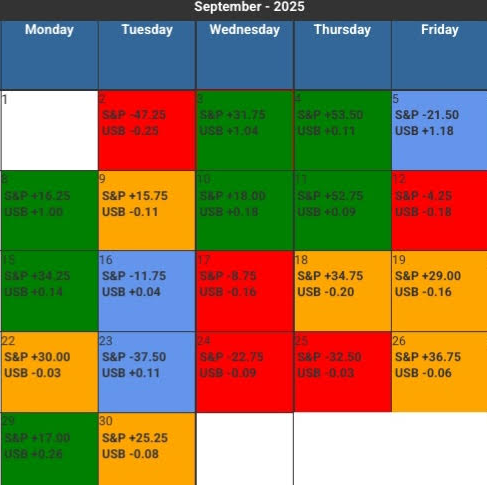
After being hammered in Aug, Orange did well in Sept. It transitioned to a positive day in the S&P 5/6 times.
Nils Poertner is getting wisdom from the classics:
The most certain sign of wisdom is cheerfulness.
- Michel de Montaigne
some type of cheerfulness def relevant for us in markets /trading - in particular when social moods go south / ppl fall for chatboxes (overuse it !) and confuse with reality etc.
Big Al is going for history:
This is the audio version:
The History of the United States Navy
but I am also watching the video version for free on Amazon Prime. The author:
Craig Lee Symonds (born 31 December 1946, in Long Beach, California) was the Distinguished Visiting Ernest J. King Professor of Maritime History for the academic years 2017–2020 at the U.S. Naval War College in Newport, Rhode Island. He is also Professor Emeritus at the U. S. Naval Academy, where he served as chairman of the history department. He is a distinguished historian of the American Civil War, World War II, and maritime history. His book Lincoln and His Admirals won the Lincoln Prize. His book Neptune: The Allied Invasion of Europe and the D-Day Landings was the 2015 recipient of the Samuel Eliot Morison Award for Naval Literature, and his book Nimitz at War: Command Leadership from Pearl Harbor to Tokyo Bay won the Gilder-Lehrman Military History prize.
Oct
5
The Pursuit of Wealth
October 5, 2025 | Leave a Comment

The Pursuit of Wealth by Robert Sobel is a quirky but informative history of wealth creation, introducing such things as the use of ice, and beer, and cattle as drivers of wealth. there is a very good discussion of the start of Merrill Lynch, also the history of IBM.
An epic saga that recounts the turbulent history of money. The Pursuit of Wealth is a fascinating 5,000 year journey through the evolution of money and investing. From risk versus return in Mesopotamia through today's rough-and-tumble, high-stakes stock markets, this behind-the-scenes tale will intrigue both financial historians and history-minded investors alike.
The Ancient World — The Imperial Age of Alexander and Rome — The European Middle Ages: The Birth of a New Economic Age — The Italian Bankers and their Clients — The Atlantic Age — Europe's American Empires — The English Advantage — The American Paths to Wealth — Industrial Wealth — The Mechanization of Agriculture — Infrastructure and Wealth — Emperor Wheat and King Cotton — Gold, Silver, and the Civil War — The Impact of the Transcontinentals — The Arrival of Big Business — The Government-Industrial Complex, 1914-1929 — The Great Bull Market of the 1920s — The Old and the New in Post-World War II America — The Revival of the Securities Markets — Creating Wealth During the Great Inflation — The Democratization of Wealth.
Oct
3
Where am i wrong, from Larry Williams
October 3, 2025 | 2 Comments
Zero sum game: for every $ that wins the same amount will be lost. REALLY? you bought at 7 sold to me at 10 I sell at 20 and the contract goes off the board and delivered at 22 who lost? We lost that we could have made more $$ but where is a net loss?
Steve Ellison comments:
Adverse selection can make us all feel like losers. If I sold at 10, I should have held to 22. Or I should have put on more size. If I bought at 7, and it went to 5, that would have been even worse.
Jeff Watson goes literary:
But Yossarian still didn't understand either how Milo could buy eggs in Malta for seven cents apiece and sell them at a profit in Pianosa for five cents.
[ … ]
Milo chortled proudly. "I don't buy eggs from Malta," he confessed… "I buy them in Sicily at one cent apiece and transfer them to Malta secretly at four and a half cents apiece in order to get the price of eggs up to seven cents when people come to Malta looking for them."
"Then you do make a profit for yourself," Yossarian declared.
"Of course I do. But it all goes to the syndicate. And everybody has a share. Don't you understand? It's exactly what happens with those plum tomatoes I sell to Colonel Cathcart."
"Buy," Yossarian corrected him. "You don't sell plum tomatoes to Colonel Cathcart and Colonel Korn. You buy plum tomatoes from them."
"No, sell," Milo corrected Yossarian. "I distribute my plum tomatoes in markets all over Pianosa under an assumed name so that Colonel Cathcart and Colonel Korn can buy them up from me under their assumed names at four cents apiece and sell them back to me the next day at five cents apiece. They make a profit of one cent apiece, I make a profit of three and a half cents apiece, and everybody comes out ahead."
Oct
2
Academic panic
October 2, 2025 | Leave a Comment
a tragedy from not followinig drift
UChicago Lost Money on Crypto, Then Froze Research When Federal Funding Was Cut
While Stanford responded to the federal funding research freeze by halting administrative hiring and protecting research, the University of Chicago panicked.
Oct
1
Lebanon, from Nils Poertner
October 1, 2025 | Leave a Comment
Lebanese traders from the 1980s tell me how chaotic that decade was - high vol ever day - for yrs. Survival was key! Started reading every bit about it in the last few weeks. (The thing that Stefan is right about is that the self-image we have in West and realtiy - there is a huge gap for sure!! Am not speaking about military though - I meant anything else)
The Lebanese Economic Crisis: How It Happened; the Challenges that Lie Ahead
September 27, 2021
Lebanon is experiencing one of the worst economic collapses in recent history. The currency has lost more than 90 percent of its value; an estimated three in four Lebanese citizens are now below the poverty line, and the country is beset by food, gas, and medical shortages. The power grid can barely maintain electricity for cities, with frequent blackouts occurring. Finally, the country had to default on its debt payment, launching its debt crisis. The debt crisis didn’t come suddenly, but was building up over time due to economic decisions made by previous governments. To understand how this crisis came to be, an examination of Lebanon’s modern history is in order, starting with the civil war in 1975.
Larry Williams writes:
Chaotic? In 1973 Shearson AmEx had me go there to lecture an teach trading - some high flyer commodity mooches had come in and lost lots of $$ for some locals who did not understand margin calls. The high flyers from Chicago were found gutted on a barb wire fence out in the country! The war broke out we could not get out for about a week so hung low then finally bribed our way home.
Nils Poertner responds:
my 2 cents are on Larry and all savvy Lebanese traders going forward. Good idea to live in more rural areas in the US, UK etc to see things unfolding as well. And keeping the internal chatter to a minimum (as always).

Stefan Jovanovich analogizes:
If LW disagrees, he will, I hope, correct this latest folly from the List's history channel wannabe. The reason the Oregon Trail came first was that it was the one safe destination for the missionaries. The Indians of the rain forest coastal Northwest were the tribes with no history of revolt against the Brits, Russians and Americans. The wars on the Plains started when some smart money decided that they could colonize the spaces between Council Bluffs and the Dalles. That analogy comes to mind every time I look at the modern history of the adventures of the Americans in Lebanon.
Larry Williams offers:
My brother on law who is better read than I am an a deeper thinker says this is a good read on the western adventure:
The Undiscovered Country: Triumph, Tragedy, and the Shaping of the American West
Sep
29
Declines from 20-day highs
September 29, 2025 | Leave a Comment
since 01-01-2001 there have been 6341 days where the sp was open — on 1303 of those days, sp closed at 20-day high.
535 of those days witnessed a decline in sp from a 20-day high 5 days ago, a highly bullish event.
Sep
28
Scaling problems in ship design, from Nils Poertner
September 28, 2025 | Leave a Comment
Scale effects and full-scale ship hydrodynamics: A review
Scaling problems in ship design refer to the difficulties of translating performance data from a small-scale model to a full-scale ship, as physical forces like viscosity and wave drag do not scale proportionally with size.
Crypto space here? Trading strategies that work in niche mkts or early on, may not work when they are larger /more mature etc.
Henry Gifford writes:
The problems with water include the size of water droplets – they won’t form larger than a certain size – and Reynolds Number, which has to do with viscosity (mentioned below), and how to calculate it. Basically, a certain flow velocity in a small pipe (or river) will be turbulent, while in a larger pipe it might not.
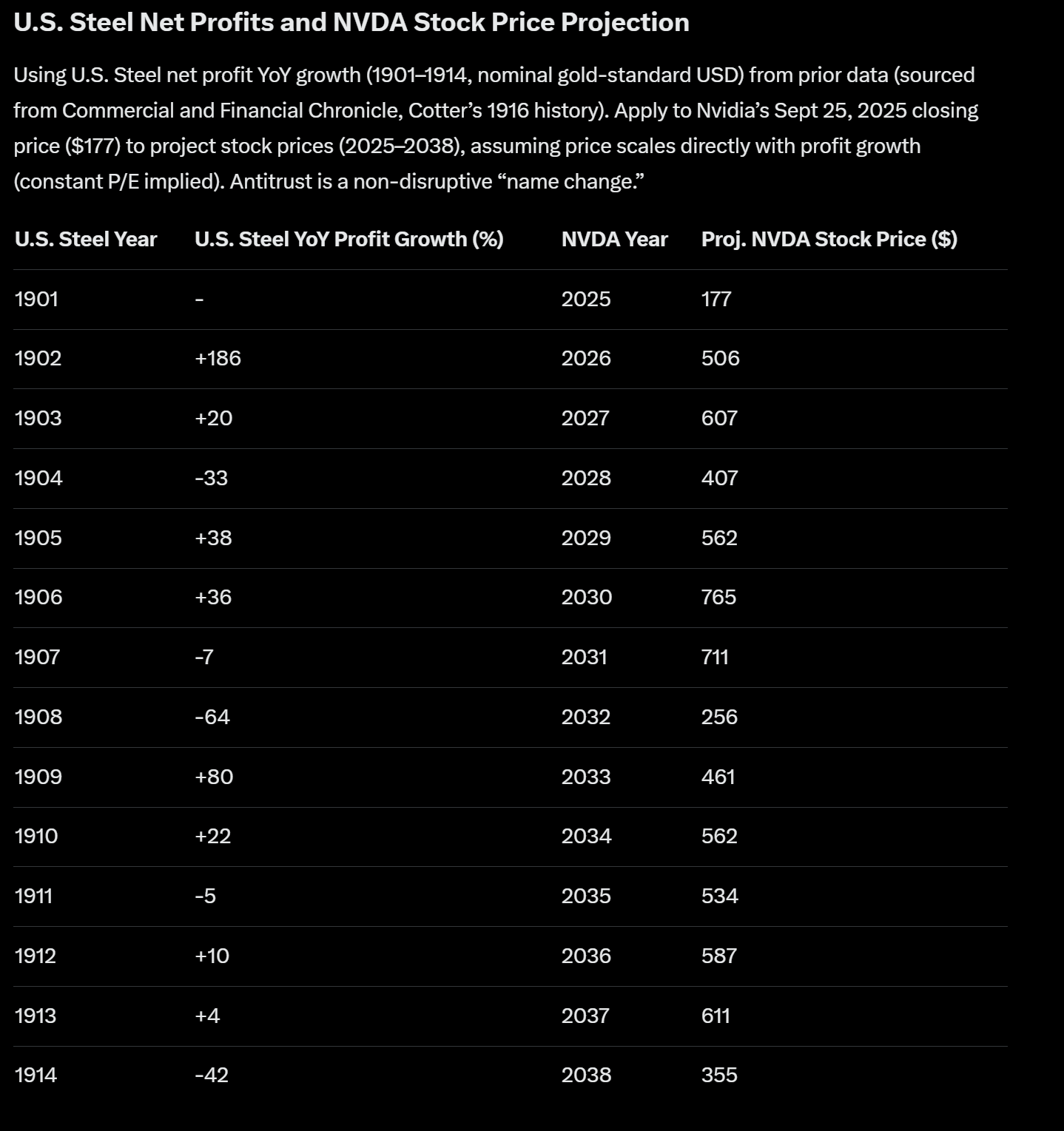
Movies that use models of ships to show dramatic events with ships always show water droplets that are way, way too large, making it obvious to those who notice that they are looking at a model.
Nils Poertner responds:
Makes a lot of sense, Henry, thanks! (Equity sell-side analysts love to scale things (to the point it makes no sense anymore). Wile E. Coyote moment for NVDA et al coming soon perhaps.
Stefan Jovanovich predicts:
Grok - our FO's new member (he/she/it works for free like Harry Potter's Dobby) - thinks the moment will be 2031-32. [Click on chart at right.] We take the current AI events as a direct comparison to the creation of U.S. Steel.
Sep
27
An increase in output bearish?
September 27, 2025 | Leave a Comment
what is the evidence that an increase in output, e.g., gdp, is bear for sp? (aside from ignoramos at fed)
[as of Friday, 26 Sept] it's been 5 days since last all-time high on sep 21 at 2712.
Sep
26
A clever counting device, from Humbert B.
September 26, 2025 | Leave a Comment

The Curta is a very clever counting device as demonstrated in this video.
It was invented by Curt Herzstark.
In 1943, perhaps influenced by the fact that his father was a liberal Jew, the Nazis arrested him for "helping Jews and subversive elements" and "indecent contacts with Aryan women" and sent him to the Buchenwald concentration camp. However, the reports of the army about the precision-production of the firm and especially about the technical expertise of Herzstark led the Nazis to treat him as an "intelligence-slave".
Inevitably, one comes back around to the abacus:
Learning how to calculate with the abacus may improve capacity for mental calculation. Abacus-based mental calculation (AMC), which was derived from the abacus, is the act of performing calculations, including addition, subtraction, multiplication, and division, in the mind by manipulating an imagined abacus. It is a high-level cognitive skill that runs calculations with an effective algorithm. People doing long-term AMC training show higher numerical memory capacity and experience more effectively connected neural pathways. They are able to retrieve memory to deal with complex processes. AMC involves both visuospatial and visuomotor processing that generate the visual abacus and move the imaginary beads. Since it only requires that the final position of beads be remembered, it takes less memory and less computation time.
Sep
25
Insights from A Year in the Maine Woods
September 25, 2025 | Leave a Comment

A Year in the Maine Woods insights: "whenever i have an idea, i must act on it as soon as possible. conditions are never ideal, and if one waits long enough for ideal conditions, then the hypothesis slips away."
"Of all the animals that migrate, we are surely among the most restless. But humans retain the influence of the geophysical habitat in which they pass their formative years. And often, it seems we are drawn back to our childhood homes, if not physically then mentally; it not out of love, then out of curiosity; if not by necessity, then by desire."
you often get more insights from nature about markets than from markets themselves.
[Below from the Author's Note - Ed.]
By the time I was ten years old, I had lived for six years as a refugee in a northern German forest. My family survived on very little. But I had a lot — I had a pet crow, and I could collect beetles. Sometimes lately I have begun to wonder if it is still possible to taste the world up close as I did as a child. I long to see nature again as I did then — fresh, clear, timeless, and shrouded in magic. Would it be possible to rediscover the vividness that I now experience only as brief, tantalizing flashbacks?
Sep
23
Health care costs, from Nils Poertner
September 23, 2025 | Leave a Comment
health care costs, our Achilles heel.
Health Insurance Costs for Businesses to Rise by Most in 15 Years
Insurers say that the rising premiums are driven by growing healthcare costs
(on a personal note: no-one is really fully healthy, not even kids normally! science uses a lot of Aristotelian logic (which is an either/or logic) but there are limits to it - and we take it way beyond its usefulness. Nature does not have those clear mental compartments - it is way more fluid /dynamic).
Steve Ellison writes:
Until the public announcement that Warren Buffett had bought shares in UnitedHealth, health care was by far the worst performing of the 11 S&P 500 sectors in 2025.
Nils Poertner responds:
Yes, the whole sector / subindex looks bullish (XLV). (the type of logic in the West (logic from Aristoteles) that dominates MODERN SCIENCE cripples our society. Why? Because in many cases, whatever the doctor says, "it is not" - it is only an image of something abstract (like the apple painting by Rene Magritte).
Pamela Van Giessen comments:
We overconsume healthcare because we pay so much for insurance and/or our employers give it to us in lieu of salary so we want to get all we can for “free.” We’ve been conditioned to believe that if we visit doctors (though now we see PAs) and get “check ups” and “tests” regularly and take pills to manage our bodies and minds in perpetuity that we won’t get seriously ill. Has got to be the biggest subscription scam ever perpetuated on a society.
Perhaps some spec would like to pull out the data and do some forensic financial analysis of all those hospital system balance sheets. I think that fully 1/3rd or more of hospital systems are owned by private equity firms and the bulk of non-profit hospital systems are extracting meaningful sums from the business regardless of how “healthy” their margins look on their financial statements. From an equity perspective the biz may have looked lousy but I can promise that it is extraordinarily profitable for the inside players.
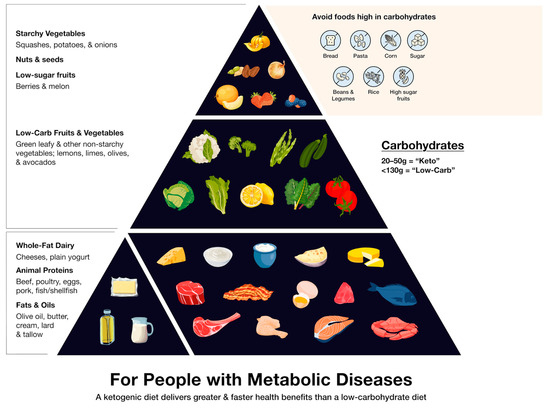
Jeffrey Hirsch adds:
Not only is it a total scam, but it gets in the way of real needed pharmaceutical/medical care and completely ignores metabolic healthcare via lifestyle and diet changes.
Too bad RFK is all wrapped up in his vaccine crusade to focus on the real USA health crisis with obesity and metabolic health, which causes diabetes, heart disease, cancer and cognitive decline. I think the covid vax is total BS as are others. But MMR and most childhood vaccines save lives. We had a measles outbreak in Rockland County a few years back because some communities did not vaccinate.
We should also flip the old USDA Food upside down. The chart is from my Doc’s paper. And my doc's site is Dr. Tro Kalayjian).
Sep
22
Get ready to rumble, from Carder Dimitroff
September 22, 2025 | Leave a Comment
Holtec is thinking about restarting the Indian Point Nuclear Power Station. It is located on the Hudson River, about 30 miles north of Manhattan.
Holtec eyes restarting another nuclear plant – this time in New York
Although the company has not made any major moves yet, Holtec International is eyeing the restart of the Indian Point Energy Center in New Jersey, a 2,000 MW nuclear plant that ceased operations in 2021 and is currently being decommissioned.
Several groups will likely oppose Indian Point. Several others will be in favor.
Sep
19
Dow theory, from Steve Ellison
September 19, 2025 | 1 Comment
This is a bit disturbing: According to classic Dow Theory, the Transports have not confirmed any new highs in the Industrials since November 25, 2024. If fewer goods are moving, is the economy really growing?

Archives
- August 2026
- July 2026
- June 2026
- May 2026
- April 2026
- March 2026
- February 2026
- January 2026
- December 2025
- November 2025
- October 2025
- September 2025
- August 2025
- July 2025
- June 2025
- May 2025
- April 2025
- March 2025
- February 2025
- January 2025
- December 2024
- November 2024
- October 2024
- September 2024
- August 2024
- July 2024
- June 2024
- May 2024
- April 2024
- March 2024
- February 2024
- January 2024
- December 2023
- November 2023
- October 2023
- September 2023
- August 2023
- July 2023
- June 2023
- May 2023
- April 2023
- March 2023
- February 2023
- January 2023
- December 2022
- November 2022
- October 2022
- September 2022
- August 2022
- July 2022
- June 2022
- May 2022
- April 2022
- March 2022
- February 2022
- January 2022
- December 2021
- November 2021
- October 2021
- September 2021
- August 2021
- July 2021
- June 2021
- May 2021
- April 2021
- March 2021
- February 2021
- January 2021
- December 2020
- November 2020
- October 2020
- September 2020
- August 2020
- July 2020
- June 2020
- May 2020
- April 2020
- March 2020
- February 2020
- January 2020
- December 2019
- November 2019
- October 2019
- September 2019
- August 2019
- July 2019
- June 2019
- May 2019
- April 2019
- March 2019
- February 2019
- January 2019
- December 2018
- November 2018
- October 2018
- September 2018
- August 2018
- July 2018
- June 2018
- May 2018
- April 2018
- March 2018
- February 2018
- January 2018
- December 2017
- November 2017
- October 2017
- September 2017
- August 2017
- July 2017
- June 2017
- May 2017
- April 2017
- March 2017
- February 2017
- January 2017
- December 2016
- November 2016
- October 2016
- September 2016
- August 2016
- July 2016
- June 2016
- May 2016
- April 2016
- March 2016
- February 2016
- January 2016
- December 2015
- November 2015
- October 2015
- September 2015
- August 2015
- July 2015
- June 2015
- May 2015
- April 2015
- March 2015
- February 2015
- January 2015
- December 2014
- November 2014
- October 2014
- September 2014
- August 2014
- July 2014
- June 2014
- May 2014
- April 2014
- March 2014
- February 2014
- January 2014
- December 2013
- November 2013
- October 2013
- September 2013
- August 2013
- July 2013
- June 2013
- May 2013
- April 2013
- March 2013
- February 2013
- January 2013
- December 2012
- November 2012
- October 2012
- September 2012
- August 2012
- July 2012
- June 2012
- May 2012
- April 2012
- March 2012
- February 2012
- January 2012
- December 2011
- November 2011
- October 2011
- September 2011
- August 2011
- July 2011
- June 2011
- May 2011
- April 2011
- March 2011
- February 2011
- January 2011
- December 2010
- November 2010
- October 2010
- September 2010
- August 2010
- July 2010
- June 2010
- May 2010
- April 2010
- March 2010
- February 2010
- January 2010
- December 2009
- November 2009
- October 2009
- September 2009
- August 2009
- July 2009
- June 2009
- May 2009
- April 2009
- March 2009
- February 2009
- January 2009
- December 2008
- November 2008
- October 2008
- September 2008
- August 2008
- July 2008
- June 2008
- May 2008
- April 2008
- March 2008
- February 2008
- January 2008
- December 2007
- November 2007
- October 2007
- September 2007
- August 2007
- July 2007
- June 2007
- May 2007
- April 2007
- March 2007
- February 2007
- January 2007
- December 2006
- November 2006
- October 2006
- September 2006
- August 2006
- Older Archives
Resources & Links
- The Letters Prize
- Vic’s NYC Junto
- Our Reading List
- Laurel Kenner's Glassery
- Masteroftheuniverse Weblog
- Programming in 60 Seconds
- The Objectivist Center
- Foundation for Economic Education
- Tigerchess
- Dick Sears' G.T. Index
- FLOW
- Pre-2007 Victor Niederhoffer Posts
- Pre-2007 Daily Speculations
- Laurel & Vics' Worldly Investor Articles
