S&P +17.50
USB +0.01
S&P +10.50
USB +0.10
S&P -52.00
USB -0.14
S&P +29.25
USB +0.06
S&P -200.50
USB -0.17
S&P +15.50
USB -0.08
S&P -23.25
USB +0.09
S&P -114.25
USB -0.07
S&P +117.50
USB +1.04
S&P +39.00
USB -0.10
S&P +129.00
USB +0.06
S&P -39.25
USB +0.20
S&P -94.50
USB -0.05
S&P +78.00
USB +0.11
Jun
19
Orange Is the New Green, from Humbert Z.
June 19, 2026 | Leave a Comment
The move from oil to electricity is driven by cost, risk, and security, not idealism—and it is redirecting where capital flows.
The energy transition is sold as a moral cause. It is really a trade. Economics, geopolitics, and risk are the forces that move capital, and the irony is that the biggest accelerants were never meant to decarbonize anything. The invasion of Iraq and the energy shocks of great-power rivalry each drove home the same lesson: no modern economy can afford to depend on a single, contested commodity. That lesson is now redrawing the map of capital flows.
Oil has never been a free market. It is indispensable and structurally constrained. Production is concentrated, capital-intensive, and exposed at every stage—extraction, transport chokepoints, and refining. Its price responds to geopolitics as much as to supply and demand. Call it what it is: a commodity that has never traded freely.
Electrons beat molecules. Electricity is the opposite—adaptable and decentralizing quickly. Regulated, yes, but its inputs keep multiplying: natural gas, nuclear, hydro, wind, solar, and storage, all feeding one grid. That diversity eliminates single points of failure and lets an economy swap one source for another, something oil never allowed. The more a country runs on electrons instead of molecules, the harder it is to hold hostage.
Hydrogen is often touted as the successor to hydrocarbons. For most uses, it is less efficient and far more infrastructure-intensive than electrification. The real fight is not hydrogen versus oil. It is electrons versus molecules.
Read the full post with additional comments.
Jun
17
The best intuition for convexity, from Asindu Drileba
June 17, 2026 | Leave a Comment
A convex function can be thought of as one where the output (in this case prices) accelerates with time. Case study of NVIDIA stock:
1999 - $0.04 (ipo price)
2022 - $14.64 (366x gain, 23 year holding period)
2026 - $211 (5,275x gain, 4 years extra holding period)
Total overview:
27 year holding period
$1 turns to $5,275
14.8% of the holding period (4/27 years) accounts for 93% of the total gains today ((5,275 -366)/5,275)
If you sold NVDA in 2022 you would have missed out on 93% of the gains — even though you held it for 23 years (from the ipo price). What's even crazier is that, if you just held it for only 4 more years (only 14.8% longer) (2022 to 2026), you would have made $5,275 instead of $366 from a $1 investment.
An interesting reason to consider buy and hold or following the drift. I also found it to be a very good illustration of a convex function applied to thinking about market.
William Huggins comments:
that analysis misses out on the notion that someone buying in 2022 would not have achieved (x5275 less x366 = x4909), instead they would achieve closer to (x5275 divided by x366 = x14.4). the vast majority of the gains on nvda were long gone by the time this most recent order of magnitude came around. there is no way anyone buying in now could achieve a similar x10 on nvda in the next 4 years without them becoming, singularly, more than half of US market cap.
Jeff Watson points out:
Unfortunately, hindsight is 20/20.
Asindu Drileba responds:
that analysis misses out on the notion that someone buying in 2022
You are right in your case. Buying in 2022 would only yield about 14x. But as I described, I was referring to only holding for an extra 4 years, from the IPO.
- holding from IPO price to 2022 - 366x
- holding from IPO price to 2026 - 5,275x
The difference of just holding for 4 extra years from IPO price, is what makes the difference. The idea is that the biggest moves might happen towards the end of the holding period. And that by getting out early, you miss out on more than you think.
Stefan Jovanovich offers:
The doctor-daughter has a husband who does tape outs for Nvidia.
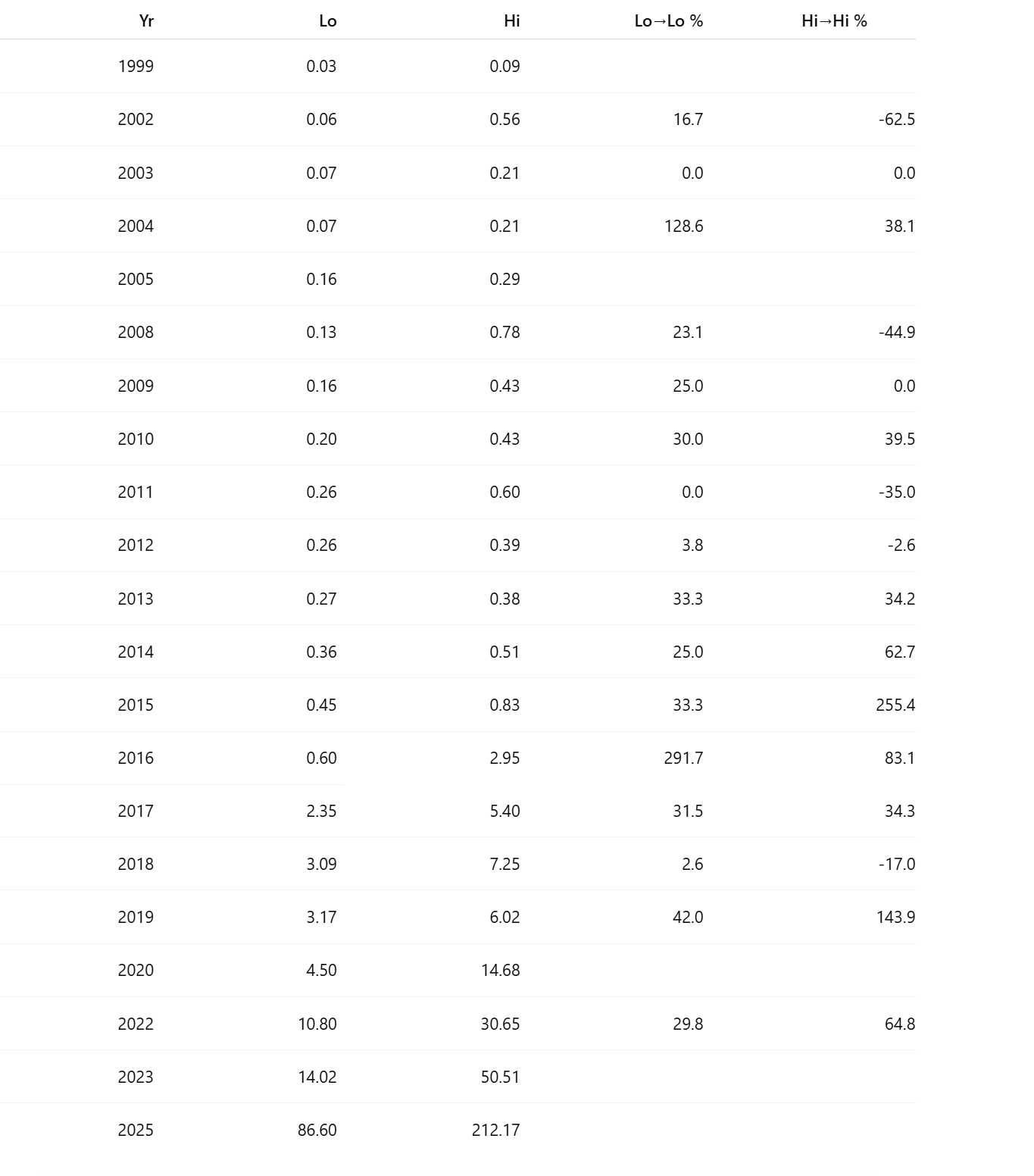
Asindu's narrative is a wonderful story; but it is not the history of how people behaved as owners of NVDA. The SIL aka SEF15 was the oddball in his lab because, unlike the older veterans, he did not immediately convert his incentive shares into cash once they could be sold. The chart [click for full view] is a year-over-year Hi-Lo price history for the stock; it explains why the veterans were not fools, why some of you are smart enough to be able to trade, and why the SIL puts up with me because I told him to keep every share. The years that are omitted are those where stock-splits made the calculations too hard for ChatGPT and me.
Jun
14
Where in the world is Aubrey Niederhoffer?
June 14, 2026 | 1 Comment
A 19-year-old Thiel fellow just raised $7.3 million to build an African ‘super app’

If he hadn’t dropped out, Aubrey Niederhoffer would be nearing the end of his sophomore year at UC Berkeley. Instead, the 19-year-old from the New York area is living in Lagos, where he just launched his food delivery app, Swoop. The 28-person company just booked $7.3 million in seed funding, and the teenager was named to the prestigious Thiel Fellowship.
The Thiel Fellowship, founded by billionaire investor Peter Thiel in 2011, offers young people $250,000 to skip or drop out of college and “build new things.” Notable recipients include Figma CEO and cofounder Dylan Field, Ethereum cocreator Vitalik Buterin, and at least one early employee at Elon Musk’s Department of Government Efficiency.
In an interview, Niederhoffer recounted how he grew interested in Africa while playing the online geography game GeoGuessr as a tween. When he was 15, he started a recruiting company focused on the labor pool in Eswatini, and would visit the southern African country during breaks from school.
Jun
12
Jane Street AI training data center, from Humbert X.
June 12, 2026 | Leave a Comment
Dwarkesh Goes Inside Jane Street's Latest AI Data Center (video)
Twenty years ago, our "cluster" was just 6 Dells stacked on the floor of our office. Today, come tour our new Texas datacenter: 4,032 GPUs, liquid cooled.
Asindu Drileba writes:
Their hiring is surprisingly very meritocratic, if you can solve any of their monthly puzzles, they will unconditionally grant you an interview & likely a job offer.
For the current offer: Jane Street: Puzzles
And an archive of previous puzzles (with solutions).
Oliver Joseph comments:
For those who are computer science oriented their podcast signals and threads is lots of fun I recommend it. In particular they interview Daniel Pontecorvo on their facilities in general. Some of the solutions they have come up are very interesting and reminded me of some solutions we used in the music world. For example they use a raised platform to run air, data and electricity to workstations on casters so they can move workstations often. This is how we would rig up outdoor tours. Racks and amps on casters and modular raised stages were safer and faster to set up.
Of course I always enjoy time in server rooms. While I’ve never had the pleasure of working on one quite like the one you have linked. “Started with six dells on the floor” It’s a great lesson never despise small beginnings.
Jun
10
Can Stock Indexes Afford to Ignore SpaceX?
Another side to the argument deserves more scrutiny than it receives amid enthusiasm for technological innovation and market capitalization milestones. Institutional incentives have changed radically since index inclusion became a major event. And the mechanism by which being a component of a stock index has become important is beyond merely symbolic. The growth of passive investing now triggers billions of dollars in mechanical purchases from index funds and exchange-traded funds benchmarked to major indices. In effect, index decision committees now exercise considerable influence in private capital allocation decisions that were once determined more organically through decentralized management decisions and market processes.
Jun
9
Rule of 16, from Zubin Al Genubi
June 9, 2026 | Leave a Comment
The 1-Day Expected Move calculation is the practical application of the "Rule of 16" described by Euan Sinclair and other volatility traders.
The Rule of 16 is a mathematical heuristic used to convert annualized implied volatility (the number you see on a quote screen, like 16%) into a daily expected move. The rule is derived from the "square root of time" principle in the standard deviation formula. Since there are approximately 252 trading days in a year, and the square root of 252 is roughly 15.87 (which traders round to 16). Divide VIX by 16 and get the percent expected daily move.
Or consider Parkinson absolute volatility, Expected Daily Absolute Range. By scaling the current VIX using the Parkinson volatility framework, calculate the total expected intraday path length - the absolute breadth from the high print to the low print of the session, independent of the previous day's close.
Useful but occasionally very wrong, like Friday. But a midday update of abs vol after Vix jump provided a fairly good bottom number.
Jun
7
Opinion - After the Crude Premium: Pricing the Product Shock, from Humbert Z.
June 7, 2026 | Leave a Comment
The market spent three months pricing the barrel. The next 90 to 180 days will be decided by the products refined from it.
Crude shock is now understood; product shock is not. Since the effective closure of the Strait of Hormuz, attention has shifted to crude oil. Brent peaked at roughly $138 in early April and now trades in the low $100s, with WTI in the high $90s and the Brent–WTI spread near $10–$12 a barrel, wider than its customary $4–$6. That is the visible price. The less visible, more consequential story over the next 90 to 180 days is what happens to the products refined from crude — jet fuel, gasoline, diesel, and fuel oil. Crude can be rerouted; refined products are produced by configured refineries, and refineries sit at the far end of a supply chain measured in weeks, not hours.
“Energy independent” describes volume, not chemistry. The United States produces more crude than it consumes, but the crude it produces is the wrong type for the products it needs. Shale oil recovered by fracking is very light and sweet; it yields LPG, naphtha, gasoline, and some kerosene, but little of the middle distillates — diesel and jet — and almost none of the residual fuel oil that a complex economy runs on. Those heavier products require medium and heavy sour crude: the grades that flow from the Persian Gulf, Canada, and Latin America, and that Gulf Coast refineries were built to process. The Hormuz closure removes medium and sour barrels from the global pool — precisely the barrels whose yield is weighted toward diesel and fuel oil. That puts a premium on the heavy crude the US can still reach — and Canada is the backbone of it: heavy, sour Western Canadian barrels piped straight to US refineries, by far the largest single source of US crude imports. With Venezuela unable to raise output quickly and Mexican volumes in slow decline, Canadian crude and the sour grades released from the Strategic Petroleum Reserve must carry more of the load. So even as crude prices ease from their peak, the product slate can tighten because the marginal barrel lost is the one that produced the scarce products.
Jun
4
Cy Young’s Rules, from Stefan Jovanovich
June 4, 2026 | Leave a Comment
Cy Young's Rules For Pitching Success
1. Pitchers, like poets, are born, not made.
2. Cultivate good habits: Let liquor severely alone, fight shy of cigarettes and be moderate in indulgence of tobacco, coffee and tea. A player should try to get along without any stimulants at all. Water, pure cool water is good enough for any man.
3. A man who is not willing to work from dewy morn until weary eve should not think about becoming a pitcher.
4. Learn to be patient and cool. These traits can be cultivated.
5. Take the slumps that come your way, ride over them and look forward.
6. Until you can put the ball over the pan whenever you choose, you have not acquired the command necessary to make a first-class pitcher. Therefore start to acquire command.
Published in "Baseball Magazine", 1908.
Jun
2
Food prices in UK (or Europe), from Nils Poertner
June 2, 2026 | Leave a Comment
Looking at longer dated charts (eg. Wheat, Oil etc…) and knowing how easily every new government in the UK will yield to public moods makes me think. (There were calls by politicians to cap food prices.) Maybe not immediately relevant, but perhaps later this year or next.
Call for food price caps ‘completely preposterous’, says M&S boss
Stuart Machin argues government should reduce tax and regulatory burden on supermarkets instead
Jun
1
Book reccy, from Zubin Al Genubi
June 1, 2026 | Leave a Comment
Who We Are and How We Got Here: Ancient DNA and the New Science of the Human Past, by David Reich
Highly recommended. Turns ancient history on its head. Absolutely fascinating.

Big Al adds:
He does an interesting quick summary of current paleogenetics:
Your ancestors aren't who you think they are | David Reich
Over the last 15 years, data on ancient DNA has upended the old story of human history. In this full-length interview, geneticist David Reich explains how new findings have challenged the family tree model of ancestry and revealed a past shaped by migration, interbreeding, disappearance, and constant change.
From Neanderthals and Denisovans to the myths of purity that still shape modern identity, Reich shows how the last decade of research has rewritten what we thought we knew about human origins. The result is a much stranger, more dynamic picture of the human story, one that forces us to rethink ancestry, evolution, and the deep history of who we are.
May
30
Ras Laffan repriced LNG’s geopolitical risk premium, and the market structure that existed through 2025 can no longer be assumed.
On March 18 and 19, 2026, Iranian missile and drone strikes on QatarEnergy’s Ras Laffan Industrial City damaged two of fourteen LNG trains and one of two gas-to-liquids facilities. The result is the largest single supply disruption in LNG’s history: roughly 12.8 MTPA — about 17% of Qatari export capacity — sidelined for three to five years. Replacement gas turbines for the refrigeration compressors have lead times of two to four years from three global manufacturers. QatarEnergy declared force majeure to buyers in China, South Korea, Italy, and Belgium; Shell declared force majeure downstream; and Omani trading house OQ did the same for Bangladesh. As of late May, force majeure has been extended through mid-August for some buyers, and the Strait of Hormuz remains largely closed to tanker traffic under a fragile U.S.–Iran ceasefire.
The 2025 trade matrix is the appropriate reference for determining where LNG lands.
The baseline. In 2025, global LNG trade totaled approximately 426 MTPA. Asia accounted for 63.6% (271 MTPA), Europe for 29.3%, the Middle East and Africa for 4.2%, and the Americas for 2.8%. On the supply side, the Atlantic basin produced 41.3% (176 MTPA), the Pacific 35.9% (153), and the Middle East 22.8% (97). The country-level figures behind these shares were concentrated: the United States, Australia, and Qatar each exported between 78 and 85 MT in 2024, while on the import side, China, Japan, and South Korea each imported between 47 and 79 MT. The headline reading was that Asia was the diversified buyer — 56.5% Pacific, 30.3% Middle East, 13.3% Atlantic — Europe was Atlantic-captive (92.8%), and the Pacific basin’s entire output flowed to Asia. That matrix described an integrated market at the macro level; in practice, it was three regional sub-markets stitched together by arbitrage.
Where the shock lands hardest. Asia’s 30.3% share of Middle East supply — long treated as a supply-security buffer — has been revealed to be a concentrated tail risk, yet resilience within Asia is asymmetric. China and South Korea both sit on QatarEnergy’s force majeure list, and their long-term oil-indexed sale-and-purchase agreements (SPAs) do not pay out at $18 JKM. South Korea has no real alternatives; China does and is using them. Europe’s exposure is structurally different: only 9 MTPA flowed from the Middle East in 2025, but Europe’s higher spot share means it absorbs the global price shock regardless of direct exposure. TTF traded around $14.80/MMBtu in late April, roughly 35% above pre-conflict levels; JKM traded in the high $16s to low $18s through May.
Where the buffer is — and isn’t. The Pacific basin has no spare capacity. Its 153 MTPA ran flat-out to Asia in 2025, and LNG Canada’s Kitimat ramp has not yet meaningfully changed that arithmetic. The Atlantic basin — the U.S. Gulf in particular — becomes the swing supplier, but the swing is tighter than headlines suggest. U.S. LNG exports averaged 17.6 bcf/d in February 2026, roughly 3 bcf/d (about 22 MTPA annualized) above year-ago levels as Plaquemines and Corpus Christi III ramped — the first meaningful offset to the Gulf disruption, though existing terminals are now running essentially at nameplate. Henry Hub has remained range-bound, and the stability is structural rather than coincidental. U.S. LNG export prices are indexed to Henry Hub plus liquefaction tolling fees, and the great majority of U.S. liquefaction is already committed under long-term offtake contracts. With no surplus capacity to respond to a higher-priced global market, international arbitrage cannot pull additional U.S. volumes through, and therefore cannot pull Henry Hub higher; the spread accrues instead to the off-takers holding Henry Hub-indexed cargoes that they sell into JKM and TTF markets trading at multiples of their input cost. The new wave of U.S. projects under construction — Plaquemines, Corpus Christi III, Rio Grande, Port Arthur, and Golden Pass — is now pricing into a different world than the one for which their final investment decisions (FIDs) were made.
Where the demand response is taking the strain. The shock has been absorbed less by supply replacement than by buyer behavior, and Asia and Europe are responding very differently. Chinese LNG imports for January through April totaled 18.0 MT, down roughly 10% year-over-year and the lowest since 2019. Chinese buyers are actively re-offering Qatari long-term cargoes into the European spot market (Kemp, LSEG Commodities Forum, May 2026). China can do this because Qatari LNG accounted for only about 15% of total Chinese gas imports in 2024 — pipeline gas from Turkmenistan, Russia, Kazakhstan, Myanmar, and Uzbekistan supplied roughly 53 MTPA, with Australian LNG adding another 26 — and because 47% of Chinese gas demand is industrial, allowing manufacturing-margin demand destruction that Europe’s household-and-power-dominated load cannot easily match. South Korea, with no comparable buffer, is bearing the brunt of the disruption directly. Europe, meanwhile, has paradoxically deferred LNG purchases despite storage at 36.7% on May 18, compared with a 10-year norm of 45–49%. EU LNG send-out in April was essentially flat year-over-year at 131 TWh, well below the technical capacity of 238 TWh. The European bet is on price retracement; if it does not arrive, the summer refill window will be tight.
The Hormuz dimension compounds the kinetic damage. Of the roughly 84 MTPA of Qatar and UAE LNG sent through the Strait of Hormuz in 2024, 12.8 MTPA represents the kinetic loss, expected to take three to five years to recover; the balance is suspended by the chokepoint closure and will return as the Strait reopens. The market is therefore pricing two recoveries on different timelines and writing the security premium against the worst of them. The premium on Middle Eastern LNG will remain higher than the 2025 cost stack assumed, regardless of how quickly the kinetic damage is repaired — buyers signing 20-year SPAs after March 2026 will not include the same indemnity language, and lenders underwriting new Middle Eastern liquefaction will not assume the same return profile.
Russia is the latent alternative — held by politics, not geology. Russia sits on some of the world’s largest unmonetized gas reserves and remains the most consequential variable not yet in the trade matrix. Russian LNG exports totaled 33.5 MT in 2024 — primarily from Yamal LNG on the Arctic peninsula and Sakhalin-2 in the Pacific, with Arctic LNG 2 largely sidelined by Western sanctions on shipping, equipment, and finance. About half of Yamal LNG continues to flow to Europe under pre-existing contracts. Pipeline gas to Europe collapsed from roughly 150 bcm in 2021 to about 25 bcm in 2024, following the 2022 invasion of Ukraine and the January 1, 2025, expiration of the Ukraine transit corridor. Power of Siberia 1 to China reached approximately 31 bcm in 2024, on track for its 38 bcm design capacity, with a contractually agreed expansion to 44 bcm.
The proposed Power of Siberia 2 — a 50 bcm/yr line from Yamal to China via Mongolia — is the single largest piece of latent supply in global gas. Moscow signed a legally binding memorandum with Beijing in September 2025 and had hoped the Iran war would push final commitment at the May 20–21, 2026 Putin–Xi summit. It did not. Talks remain stalled over pricing (China wants gas close to Russia’s domestic rates; Russia wants European-style market indexation), financing terms, and Beijing’s reluctance to deepen single-supplier dependence after Hormuz had demonstrated that risk in reverse. Chinese industry sources estimate construction at eight to ten years even after FID. Russia therefore has the resource base to displace a meaningful share of the post-Ras Laffan market, but its three near-term levers — Arctic LNG 2, Yamal LNG expansion, and Power of Siberia 2 — are all gated by political rather than physical constraints.
The expansion question. Qatar’s North Field East and North Field South projects — together adding roughly 48 MTPA between 2026 and 2030 — remain on the books, with the first NFE train still nominally targeted for Q3 2026, pending infrastructure integrity assessments. Whether that schedule holds is now the central question for global supply growth through 2028. Every quarter of slippage shifts pricing power to U.S. Gulf and Australian producers and improves the marginal economics of projects further out: Mozambique, the GTA project off Senegal–Mauritania, and Alaska LNG if it reaches FID.
Local pressures point in the same direction. Peru is reexamining export priorities as Camisea reserves face roughly two decades at current rates, and Australia is debating reserving east-coast gas for domestic use. The Qatar event accelerates the same logic globally — producing nations will price domestic supply and energy-security considerations more aggressively into export decisions, and importing nations will think more carefully about their exposure to chokepoints.
Repricing the security premium. The 2025 matrix described a market in which geography determined trade flows, contract structure allocated risk, and basin diversification served as a form of supply security. Ras Laffan demonstrated that the same geographic rigidity that defines LNG also concentrates geopolitical risk in specific producers and chokepoints. LNG remains the indispensable mechanism for monetizing stranded gas, and roughly 150 MTPA of liquefaction under construction suggests that demand will continue to absorb it. But it is now priced with a security premium that the 2025 cost stack did not anticipate. Even a sanctions realignment would not relax that premium quickly: LNG export terminals take years to design and build and require billions of dollars of capital, underpinned by long-term offtake contracts that sanctioned producers cannot readily attract. For Atlantic producers, that premium accrues as netback; for Asian importers, as the cost of holding redundancy; for Europe, as the cost of structural exposure to a global spot market whose marginal supplier just sat behind a chokepoint that closed.
Note: Figures are in million tonnes per annum (MTPA). The 2025 trade matrix is the author’s construction. Country-level 2024 reference figures and the demand-side analysis of Chinese imports, European storage, and U.S. export ramp draw heavily on John Kemp’s May 21, 2026, presentation to the LSEG Commodities Forum (Base Research), with underlying data from GIIGNL, Gas Infrastructure Europe, China General Administration of Customs, and the U.S. Energy Information Administration. The Russia section draws on Gazprom export disclosures and contemporaneous reporting on the May 20–21, 2026, Putin–Xi summit. Price data are current as of late May 2026.
May
28
List member Duncan Coker’s music
May 28, 2026 | Leave a Comment

Late bloomer: Boulder singer-songwriter Duncan Coker drops long-awaited debut
Longtime Boulder singer-songwriter Duncan Coker has been honing his craft ever since he picked up his first guitar as a New Jersey teenager four decades ago. It was a Fender Squier, and it opened the door to a love for performing that’s going strong to this day.
After years of exclusively playing live, Coker felt the time was finally right to hit the studio and share his music in another format on his self-titled debut album, released in February.
It wasn’t his first time recording, though. Coker released an acoustic single in 2018, but says his latest material is his most well-rounded. He felt ready to lay it down in the studio, even if the path took longer than anticipated.
“I’m feeling now, in my mid-50s, very creative and prolific — like, I’m writing a lot. It just took me a while. It’s part of your life journey,” he says. “I’m really glad I waited to put out material that I was really proud of. I guess I peaked late in life.”
Duncan Coker Band live:
Duncan Coker Band - Rodeo Girl - LIVE@LUNCH on KRFC RadioVision
Duncan's music site:
May
26
A deck of cards, from Jeff Watson
May 26, 2026 | Leave a Comment

A standard deck of cards contains 52! combinations after riffle shuffling at least 7 times to ensure randomness. Expressed as a number, there are 8.06×10^67 total combinations. To put this in perspective, there are 4.37×10^17 seconds since the big bang. It is estimated there are 5×10^18 grains of sand and 10^50 atoms on earth. There are 10^46 molecules in all of the oceans. The estimated number of stars in the observable universe is 10^23. It’s a certainty that two entire 52 card decks have never ever matched, let alone more than once. They never will. Here’s another way of looking at it, if a billion people shuffled a deck of cards every second since the big bang, it would total 2×10^32 shuffles, which is still 10^22 less than the total. All of that said, there are some elegant propositional bets that can be derived from this material.
Nils Poertner responds:
Yes - incredible numbers. LIfe itself is a miracle (I don't buy into this bing bang thing) - but would not be able to bet against the odds you described here.
Asindu Drileba offers:
Leo Susskind explains that many constants in physics need to be fine tuned for the universe to exist in the way we see it. Some cannot be deviated by as low as 5%. All these constants needed to be fine tuned concurrently. Otherwise, stars would not even form.
Big Al writes:
If you assume that order matters, then when dealing cards for a game of Texas Holdem at a 9-seat table (18 hole cards and 5 community cards), there are 52!/29! possible permutations. That's roughly 9 x 10^36, or 9 x (1 billion)^4. Which means that, though possible, it is highly unlikely that any game (at a fair table) has ever been dealt the same way twice.
May
23
Sentiment, from Steve Ellison
May 23, 2026 | Leave a Comment
Here is my three-year graph of AAII's sentiment survey. I ignore the neutral voters and calculate the bullish percentage as = Bullish / (Bullish + Bearish).
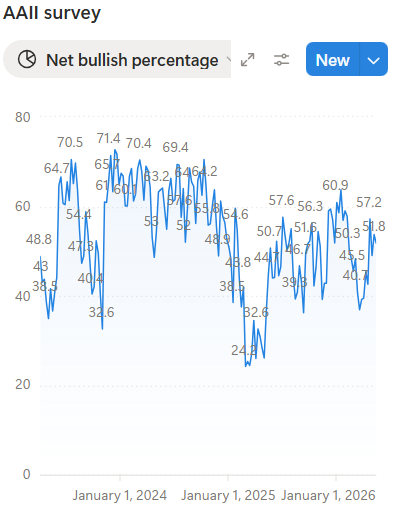
Sentiment as measured by this survey is middle-of-the-road, and has not had any extreme readings since the tariff tantrum in April 2025. The recent high was 63.7% on January 14, 2026, which fell short of a few 70-plus readings in 2023-24.
Jeffrey Hirsch writes:
This is cool Steve. I’ve been looking at trend and shape in addition to level with sentiment indicators as well as some of my seasonals and other analogs. The sentiment turns in Investors intelligence Bullish %-Bearish Percent and the VIX off the March Lows were not from as extreme levels as 2025 and others, but the shape of the sharp trend reversal was there.
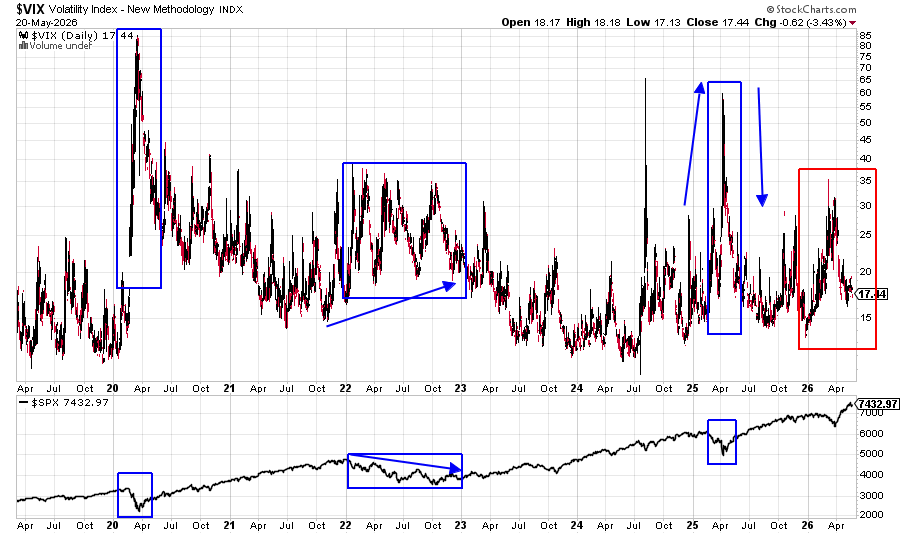
VIX for example only got to about 35 intraday and was in that nervous area of 20-30 where bear markets fester for most of March then it fell below 20 sharply after spiking quickly to 35. Same V in your AAII chart here. So perhaps correction end vs bear or near bear bottom. Also note the trend of higher lows during the 2022 bear market.
May
19
Artificial Intelligence, Real Misallocation
Artificial intelligence may well be the most important technological development of the coming decade-and that is exactly why the current capital surge around it warrants skepticism. History is littered with transformative innovations that were nonetheless disastrously overbuilt and mispriced in their early phases. Austrian Business Cycle Theory was never a children’s story in which every boom ends with clowns, ashes, and worthless machinery; its real claim is subtler and nastier. When the price of time is falsified-when interest rates are pushed below their natural rate-often proxied, however imperfectly, by modern estimates of the neutral rate-entrepreneurs are encouraged to undertake projects that are more roundabout, more capital-intensive, and more time-sensitive than underlying saving and final demand can actually support. The neutral rate is a policy construct; the natural rate is an economic reality. Some of those projects may still embody genuine innovation.
The problem is not that AI must be fake; it is that a very real technological advance can be financed, priced, and physically built in ways that are wildly uneconomic.
May
16
A dream group
May 16, 2026 | Leave a Comment
i dreamed that galton, sherlock holmes, and gilbert and sullivan attend a performance of mikado together.
The Mikado 1966, D'Oyly Carte Opera Company, Gilbert & Sullivan
May
14
Study of Deception, from Sushil Kedia
May 14, 2026 | Leave a Comment

The Chair has emphasized the value of studying and understanding deception endlessly, I believe.
Now, if I wish to focus and devote my energies to be thoroughly studious about it, I urge my requests below are not misunderstood as a lazy desire, but an earnest and keen wish to be methodical about it.
What would the Spec-list citizens recommend as the ideal list of:
a) Movies to watch,
b) Books to read.
One thing that hit me suddenly some weeks ago is that nature devised deception as a tool to economize the struggle for propagation of this world and its entities into the future. Without deception a Tiger would run endlessly, perhaps consuming more calories in capturing its prey, than it would get in eating the prey, as one example.
What are the other utilities the matured, experienced minds on this competent list and other curious minds as me feel that deception provides?
Another layer of study that makes me curious is, when our own mind as defined by Edward De Bono, as a self organizing pattern seeking system is the personal deception machinery that takes us into deviant behaviour from data, stats on the table and rigorous study then how does the autonomous deception inflicted by our mind engage with the deceptions inflicted upon this world by the high and mighty? Are the mighty studying how the hoi pollois is living in self deceiving modes and then playing it?
What more rigorous questions will the list members be happy to throw at someone who is now hungry to study deception, in depth? Please provide your questions too for me to compile into a list of questions to ponder over, gather information and insights on.
William Huggins writes:
it would seem the heart of the matter is one's ability to "hack" the target's heuristics. concealment/distraction plays an important role in this. the obvious benefit of deception being a misallocation (from the allocator's pov) of energy that can be exploited by the deceptive.
Nils Poertner comments:
What traders do in their free time and are already good at is of interest to me. (eg. someone reading crime novels, can find patterns here, another one practises Judo, finds patterns of deception there, and then you can go from there. Work with what you have already)
Big Al offers:
An interesting story with possibly multiple levels of deception:
The Rosenhan experiment or Thud experiment was a disputed study regarding the validity of psychiatric diagnosis. For the experiment, participants submitted themselves for evaluation at various psychiatric institutions and feigned hallucinations in order to be accepted, but acted normally from then onward. Each was diagnosed with a psychiatric disorder and given antipsychotic medication. The study was arranged by psychologist David Rosenhan, a Stanford University professor, and published by the journal Science in 1973 with the title On Being Sane In Insane Places.
Asindu Drileba adds:
When it comes to movies, my favorite movie to do with deception is The Conversation (1974) by Francis Ford Coppola. As for books, on my "yet to read" list I have The Confidence Game by Maria Konnikova. You see, "conman" comes from the phrase "confidence man".
I have studied several scammers like SBF, Madoff, Enron executives. What I have noticed is that deception never looks like "deception" it often looks like opportunity. The "confidence man" entrapped their victims by having "good visuals", dressing well & moving amongst those in high circles.
SBF was branded as a type of prodigy, Madoff was the chairman of Nasdaq, Enron guys where The Smartest Guys In The Room (you should watch this one, just for the fantastic music playlist), Jeffrey Epstein displayed the all patterns. Take away? Beware of bombastic talk, especially one that boosts your confidence in an investment.
Rich Bubb writes:
Not exactly a movie-to-watch, a former co-worker recommended I watch "Lie To Me" series. I'd be interested to see if anyone has trained and AI system to visually detect micro-expressions. The thought is that if somebody/-ies is the 'prey', maybe AI could detect deceptive interactions better than me. I have tried to teach myself to recognize micro-expressions. It's nice to know when I'm being lied to.
Oliver Joseph writes:
I'm a big fan of Joe Navarro's work. "What Every Body is Saying" is classic. There is a certain amount of gamesmanship in deception and its detection which he elegantly describes. Of course there are certain "strong signs" like pupil dilation that are impossible for normal human beings to conceal. Sussing out the meaning and separating the signal from the noise is part of the game, a problem everyone on the spec list is used to dealing with I'm sure. I myself as a former car dealer am quite unfamiliar with deception and its detection and so eagerly await further recommendations.
May
11
ChatGPT moment for robotics?, from Humbert Q.
May 11, 2026 | Leave a Comment
I've Covered Robots for Years. This One Is Different
From sorting chicken nuggets to screwing in lightbulbs, Eka’s robotic claw feels like we're approaching a ChatGPT moment for the physical world.
Dendi Suhubdy offers deep analysis:
I have put some thought into that:
The Perception–Planning Gap: What's Actually Hard About Visual AI in 2026
The thesis I want to defend in this piece is structural: perception in pixels is largely solved at the representation level; perception for action is not, and the gap between the two is the central unsolved problem of visual AI in 2026. Frontier vision-language models can pass medical-board questions and explain radiographs at attending-physician level. Frontier robots, after a decade of foundation-model progress, still cannot reliably load an arbitrary dishwasher. Moravec’s paradox is not a quaint historical observation; it is the daily lived experience of every embodied-AI lab.
Big Al responds:
Thanks for sharing. Much I don't understand, but when I scroll down to the summary, I think I get the general ideas. I hadn't thought about the challenge of having effective testing/evaluation standards.
Asindu Drileba writes:
I thought this was going to be about humanoid robots (like Figure & Optimus). That still have very many problems. Industrial robotics how ever has always been making mind blowing, but quiet progress.
Good case studies are Amazon (robots operating in a warehouse about 10 years ago, its now way better), and Tesla, also 10 years back.
The reason is that the edge cases of these industrial robots are very few and can be comprehensively thought about. I think this robot ChatGPT moment already occurred in industry & manufacturing.
May
10
A tug-of-war within America’s deregulated power markets, from Humbert X.
May 10, 2026 | Leave a Comment
Today, we are witnessing a tug-of-war within America’s deregulated power markets. It's between those advocating for free-market operations and state policymakers intervening in those markets. In the process, consumers of all kinds are paying unnecessarily high prices. Let me explain:
In deregulated power markets, energy producers are theoretically dispatched in economic order based on their production costs, excluding owners' capital costs. The last producer to clear the market sets the market-clearing price. In general, this order begins with producers with the lowest marginal costs—such as wind and solar—and ends with the least efficient assets that use the highest-cost fuel: typically oil, coal, or inefficient natural gas plants.
When markets attract more cost-leading producers, costlier assets are sidelined, and market-clearing prices fall. Even if cost leaders offer intermittent availability, consumers benefit on average because their aggregate energy costs decline.
Data centers consume massive amounts of electricity (and water). The global buildout of thousands of new data centers has increased demand for power generation. As a result, power markets now reward higher-cost producers that rely on expensive fuels. Consequently, market-clearing prices are rising, and consumers are paying more. As clearing prices rise, cost leaders' margins also increase.
A potential solution to higher power prices is to increase the number of cost-leading producers. Even if new cost leaders offer intermittent production, the strategy benefits consumers through lower average clearing prices, though backup sourcing merits consideration. This approach creates winners and losers: owners of costlier production assets lose when average clearing prices fall. Consequently, the costliest market participants oppose the introduction of new cost leaders.
In January 2025, the Trump administration began implementing policies to restrict investments in cost-leading production. The administration rescinded permits for wind projects and, by April 2026, had negotiated about $2 billion in payouts to compensate investors to walk away from permitted and partially completed offshore wind projects. Additionally, since August 2025, the Pentagon has delayed reviews of165 onshore wind projects (30 GW of capacity), citing unspecified national security concerns.
When energy policy restricts cost-leading producers from participating in markets, consumers pay higher energy prices. This dynamic creates competing interests: while owners of costlier generation assets benefit from reduced competition, all electricity consumers—including data center operators—face higher costs.
The solution is straightforward: remove the barriers. Instead of spending $2 billion in taxpayer dollars to prevent investment, use those same funds (or none) to let the market allocate resources based on market forces. If permitted, capital will flow to cost-leading producers in response to the buildout and rising prices.
Bud Conrad writes:
I'll add some less-discussed items: We all know that about 20% less oil is flowing out of the Strait. But the Ukraine war is hidden behind the I run daily policy changes. Both the Russian and Ukraine sides have escalated massively since the beginning of April by doubling their daily barrage of drones and missiles. Specifically, the energy generation systems of both sides are being attacked, and the relatively less noticed is that Russian refineries and ports have been getting hammered. The result is that, while Russia has reserves, its ability to deliver amid already reduced supplies has been damaged. Nobody knows how much, but multiple cities deep into Russia have been attacked with huge clouds of smoke. St. Petersburg ports and some cities 2,000 Km into Russia have been damaged.
It takes up to 2 months to get tankers from the Persian Gulf to customers. So to restart, it will take something like that time, from the Strait opening. Oil production from most Gulf states has been attacked and stopped, and it will take more than months to restart. The US Strategic Petroleum Reserve is adding supply but cannot continue much longer, since it was already depleted, in an attempt to keep prices low to weaken Russia during the Ukraine war. In the tit for tat between Zalen ski and Moscow, Russia asked for a ceasefire on the Memorial Parade March 9 (Tomorrow), which has already been rejected by Ukraine, and Russia has announced plans to attack the center of Kiev with Oreshiks.
The pressure for oil prices to go much higher seems obvious.
May
7
Consumer sentiment, from Steve Ellison
May 7, 2026 | Leave a Comment
The US consumer sentiment surveys have become completely politicized and useless for economic analysis. When Biden was president, respondents who preferred the Republicans said they felt very bad about the economy. After Trump was elected, they felt very optimistic. Respondents who preferred the Democrats did the opposite. And yet bad consumer sentiment as expressed in surveys never turned into action. Consumers did not actually reduce spending.
Larry Williams suggests:
Use this one then:
May
5
The Strategy of Conflict, from Nils Poertner
May 5, 2026 | 1 Comment
The Strategy of Conflict (pdf), by Thomas C. Schelling
At the beginning of the book he says that some ppl just thrive on conflicts - the more the better basically. That is true within corporations as well, everywhere we can see it on world stage.
– THE RETARDED SCIENCE OF INTERNATIONAL STRATEGY
Among diverse theories of conflict—corresponding to the diverse meanings of the word “conflict” — a main dividing line is between those that treat conflict as a pathological state and seek its causes and treatment, and those that take conflict for granted and study the behavior associated with it. Among the latter there is a further division between those that examine the participants in a conflict in all their complexity—with regard to both “rational” and “irrational” behavior, conscious and unconscious, and to motivations as well as to calculations—and those that focus on the more rational, conscious, artful kind of behavior. Crudely speaking, the latter treat conflict as a kind of contest, in which the participants are trying to “win.”
May
4
What Makes a Trading Strategy Work?
In quant trading finding an alpha is not enough.
What is the edge you have that others do not?
A backtest is not the hard part.
The hard part is explaining why the opportunity exists, why others have not competed it away, and why it should continue to exist in the future.
In practice, most real strategy edges come from one or more of these: …
Some good discussion in the comments also. In response to a question about spinoffs:
Tad Haley Spinoffs are one of the best examples of an opportunity that can be visible without being equally tradable.
The edge is often not in spotting the situation. It is in understanding who has to sell, who cannot own it, who can actually fund and hold it, and how long the implementation friction lasts.
That brings in mandate and tolerance, liquidity, balance sheet, and constraints all at once. Information still matters, especially in separating flow-driven weakness from real fundamental weakness, but a lot of the opportunity exists because the natural ownership base is temporarily broken.
Larry Williams responds:
Is it really that complex? You find out what fundamental conditions drive a market. Maybe it's supply, maybe it's good earnings, and take advantage of that impact.
Zubin Al Genubi comments:
Its good to understand market structure in addition to stats. Structure is changing from a few years ago.
Nils Poertner adds:
Excellent, Yes Zubin. Also the trader may change and develop a bit of an ego after yrs of success….that is why trading requires constant shedding of false personality.
Asindu Drileba writes:
I have also come across three recurring reasons why some edges still exist.
Liquidity: So common in the Bitcoin markets, more in smaller cryptos markets. I have heard people with serious AUM complain about how the can't deploy $30m positions. But small specs don't have this problem.
Impatience: Even though some long term strategies like following the drift, indexing, work people are impatient, often demanding salary like consistency from the market like Robert Bacon suggests.
High stress strategies: Some people are patient, though can't handle strategies that are profitable, but have a very high frequency of losses. I have suggested some (buy) options strategies to my friends, but they just can't endure the 70% to 90% losing rates.
Larry Williams writes:
The big edge is to think forward, to see the future before other people do there are fundamental facts to this game, like insider buying. Mister Brush has written so much about. There are advantages, and they're very simple.
Apr
28
How to account on the principle of ever changing cycles?, from Asindu Drileba
April 28, 2026 | Leave a Comment
This principle outlines the idea that markets change their behaviour. For example:
- the 13th business day of the month made money for 5 years ( lost for some days in the year, but overall ended the year profitable)
then the market changes and
- the same 13th business day of the month loses money for 5 years ( won for some days in the year, but overall ended the year at a loss)
If you tested the data set for the last 10 years as a single block, (5 years losing + 5 years winning) the regularity would completely cancel out. The only thing I can think of is testing data sets in chunks of say 1 year, but over 10 years. and avoiding large blocks in general. Any suggestions?
Steve Ellison writes:
I agree with the idea of shortening the lookback period. I remember the Chair suggesting 60 days as a typical lookback period, but obviously you would need a much longer lookback for an event that only occurred once per month.
I would also suggest assessing, if there really is an edge here, why? In this example, which market participants have reasons to sell (buy) on the 11th and 12th days of the month that override price sensitivity, such that others come in to buy (sell) on the 13th day? There is a lot more noise than signal in market price movements, and some of the noise may appear statistically significant if you torture the data long enough, but without an underlying reason, a regularity is unlikely to continue.
Jeffrey Hirsch responds:
The 11th and 12th trading days of the month – what we refer to in the Almanac as the mid-Month spike is driven by automatic payroll deductions bi-monthly or every 2 weeks into 401Ks and other retirement accounts where fund managers are required by law to invest. I discussed this with Steve Eisman on his podcast, The Real Eisman Playbook, recently where he comes in and helps me prove the point. It starts at the 19-minute mark and runs for about 2 minutes.
20:37: mutual funds are only allowed to have a certain amount of cash. So generally, let's say 5%. They're not allowed to have more than 5%. So, if all of a sudden people are putting money in because of their 401k, they got to buy. It's not optional.
Asindu Drileba adds:
I was playing with Google's decision tree Python library called YDF. (it's shockingly easy to use)
I simply used days of the month as features against, up or down days. Mid month dates showed very strong regularities (some up to 60% up days). I never understood why they occurred, until I remembered Mr. Hirsch talking about payrolls hitting brokerage accounts. What's different is that I found these in crypto. But it was harder to trade than I thought.
Larry R Williams writes:
It's been that way for years: the eleventh trading day of the month in stocks is usually a rally day, going way back to the 1980s when I first started trading this.
Apr
27
More on Sun Tzu, from Stefan Jovanovich
April 27, 2026 | Leave a Comment
Since Americans have been messing with the rest of the world ever since 1775 (our first act of rebellion was to invade Quebec), could we begin looking for historical parallels from our own history before we get to the Turning Points view? The first reference to The Art of War in U.S. military literature does not appear until the 1939 article in U.S. Naval Institute Proceedings (“The Constancy of Fundamental Military Considerations”). I realize that it is now one of the fundamental texts that is part of the military coursework, but those of us who were raised in the textbook business have learned to appreciate how little of what people actually do and think about money and power can be traced back to what they read in school. The List may want to consider looking back to the specifics of our country's history in the 1850s for a useful parallel to current events.
Viewed through that lens, President Trump seems to be following very closely Millard Fillmore's Whig plan to divorce the United States from the opinions of the rest of the "civilized" world and have our tariffs answer all questions about the price of the dollar in foreign exchange. By 1851 the United States of America was the world's largest exporter of what were considered to be the world's two most important commodities: gold and cotton fiber. In 1852 you had Admiral Perry setting out for Japan, the French being told to surrender all claims to Hawaii (they had occupied Honolulu in 1849), Taylor's Clayton-Bulwer Treaty being vigorously enforced, and a pro forma apology for the failure of the second Narciso López Filibuster expedition to Cuba was combined with a pointed declaration to both Britain and France by Secretary of State Edward Everett that Cuba was "almost essential" to U.S. safety. Central Europe did engage Americans public attention; Kossuth was invited to come and address Congress. But it was not at all comparable to the Zelensky show under the Biden Administration; the Europeans, and the Austrians in particular, were told that the U.S. had no interest at all - financial or otherwise - in Central European affairs.
There is only one reason this parallel does not fit rather neatly. A decade later the U.S. would be in a Civil War. Fillmore, Pierce and Buchanan all have to be blamed for it by all the people who get paid to look backwards. No doubt the same future textbooks that will look to Sun Tzu for wisdom will be grading Donald J. Trump with the same terrible marks that the first New Yorker President has gotten. But it does help to remember that during Sun Tzu’s traditional lifetime (c. 544–496 BC, late Spring and Autumn period), "the war" he writes about was entirely about the civil war among the vassal states of Zhou. There were no "foreign" wars during this period according to the records of the Zuo Zhuan.
(Correction: Martin Van Buren was the first New Yorker to become President. Millard Fillmore was the second.)
Apr
23
The Art of War by Sun Tzu, from Q. Humbert (Updated)
April 23, 2026 | 1 Comment

Good book to re-read. Are all those crisis meetings are just choreography? In order to "sell" something unpopular (a war) to the managed masses in the West (or whatever system there is in Iran respectively). Humanitarian aid talks often precede wars as well.
Jeffrey Hirsch offers:
Art of the Deal. Seasonality edition
Nils Poertner responds:
Top notch analysis! (I'm wondering though, we in the West value transactions and deal making a lot - whereas in some countries, which are more religious…they may rather die than surrender).
Steve Ellison writes:
I just borrowed The Art of the Deal from the library because the Chair's brother says that the President's thinking process is all laid out in that book, and one ought not to react to his statements at face value because they are negotiating positions.
Jeffrey Hirsch adds:
Ever since Liberation day and the tariff tumble last year have had the President’s truth social posts as the only lock screen alert coming through my phone.

Kiran Kaur comments:
Free markets used to be a natural hand that would correct markets when they were inflated, avoiding catastrophes. But now we have the hand of government that removes the natural corrections that are supposed to occur and take out zombie companies. We have a few actors taking meetings behind closed doors to set the cycles, using regulation as a key mechanism. its nice for us because we are close to the liquidity that sets the rest of the markets.. Have you read Edward Chancellor's The Price of Time?
Asindu Drileba writes:
One opinion I heard recently is that, this conflict is actually doing exactly what "they" want. The constant talk of colonising Canada & previous "take over" of Venezuela is because these are oil rich countries. The conspiracy is as follows:
Shut down the strait.
Make Middle Eastern oil suffer logistics issues (price oil higher?)
Oil from Americas moved ok (priced cheaper?)
Demand for Americas oil increases. Subsequently, demand for USD also increases.
Finally weaken & decapitate BRICS.
Does this make sense? Or is it imaginary 5D chess?
Kiran Kaur responds:
Absolutely the most sane analysis i can imagine. Especially after reading the blueprint of the genius act and the user's guide to global trade. Increasing demand for us debt, oil, and the dollar, while decreasing dependencies on global players are agendas directly mentioned in both of those papers.
Apr
21
Ellen Langer experiment, from Q. Humbert
April 21, 2026 | Leave a Comment
2014 NYT reports about the Professor Ellen Langer experiment on how the mindset affects aging (or can reverse it).
Back in the 1980s, Senior citizens (some of them on crutches) were invited into a hotel with furniture /music reminding them at the time they were young - and they weren't allowed to speak about illnesses or their challenges. And their ailments improved, some started walking more effortlessly / dancing etc. Interesting anomaly (in this case how the mind affects the body and vice versa).
In trading we are looking for anomalies as well (coz there is the juice!!, whereas ordinary folks tend to brush off anomalies as a mistake.)
Apr
20
Podcast series on Trafalgar, from Big Al
April 20, 2026 | Leave a Comment
The Royal Navy is one of the themes of the list, not least because of the Chair's love of the Aubrey-Maturin novels by Patrick O'Brian.
I have posted about a podcast I enjoy, The Rest Is History, and they did a nice three-parter on the Battle of Trafalgar. The newest information for me was the first episode, being the story of how the Royal Navy became the amazing fighting force that it was by 1805.
The episodes:
243. Trafalgar: A World at War
244. Trafalgar: Countdown to Annihilation
Apr
18
How Costly Is Permitting in Housing Development?
Evan Soltas, Jonathan Gruber
February 2026
Permitting costs are widely cited, but little analyzed, as a key burden on housing development in leading U.S. cities. We measure them using an implicit market for “ready-to-issue” permits in Los Angeles, where landowners can prepay permitting costs and sell pre-approved land to developers at a premium. Using a repeat-listing difference-in-differences estimator, we find developers pay 50 percent more ($48 per square foot) for pre-approved land. Comparing similar proposed developments, pre-approval raises the probability of completing construction within four years of site acquisition by 10 percentage points (30 percent). Permitting can explain one third of the gap in Los Angeles between home prices and construction costs.
Apr
17
What made America great, from Larry Williams
April 17, 2026 | Leave a Comment
"While you may make many mistakes," J. P. Morgan's father advised his son,"never be a bear on your country or you will surely go broke."
Apr
16
What can’t happen, from Steve Ellison
April 16, 2026 | Leave a Comment
In 2007 some pairs trades moved 25 standard deviations from their historical norms. If markets were truly random walks, such events would have had miniscule probabilities of ever occurring even had the stock market been in existence since the Big Bang.
As Augustin Lebron said in his excellent book The Laws of Trading, the more market participants assume some event can't happen, the more certain it becomes that the event will happen. Remember when house prices never went down?
William Huggins responds:
that 25 st devs quip just shows you what the spread of their calibration set was, and where the real problem was imo - assuming recent stability was some established fact (one of the problems with exponential weight decay)
Nils Poertner recalls:
Italian friend of mine (big hitter at US bank) had a burn out in 2007, and his wife checked him into a monastery (ora and labora Benedectiner type). Ora is contemplative - it is receiving (not thinking, thinking, thinking) it is what we don't know. Whether you have "AI" or "science models" it is like standing in a room full of mirrors and putting more mirrors into them and thinking one knows the future.
William Huggins writes:
My favourite way out of echo chambering one's self (and to avoid the lure of gurus as this august list taught me forever ago) comes from 17th century Japanese poet Matsuo Basho: "Do not seek to follow in the footsteps of the wise. Seek what they sought". In any competitive domain (markets, chess, etc), you have to learn how to think like a master rather than proverbially copying some smart kid's homework.
An overreliance on historical data instead of trying to imagine what could (quite reasonably) be, is one of the contributing factors that led the 2007/8 crash. In their August 2007 conference call (see pg 21), AIG's Joe Cassano told analysts (regarding their CDS business), "it is hard for us, and without being flippant, to even see a scenario within any realm of reason that would see us losing $1 in any of those transactions".
25 st devs indeed…
Larry R Williams adds:
People talking and over talking their book is a massive clue. Like tom lee this and last year.
Apr
14
Two new trends, from X. Humbert
April 14, 2026 | Leave a Comment
Two new trends will likely emerge from the Iranian caper: renewable energy and nuclear power. Smart money will aggressively pursue renewable energy assets (including derivatives). Sovereigns will likely pursue nuclear power assets if they can afford the price tags.
Humbert A. responds:
An interesting thesis, The Economist had an interesting article in their 3/21/26 edition entitled "Burnout" of most interest in your line of thinking was a graph that showed Daily Wholesale electricity prices in 2026 in euros per MWh for France Italy Germany and Spain. The Economist posited Spain and Frances wholesale prices adjusted to the downside more quickly than Germany or Italy based on investments they had made in renewables and diversifying their sources of electricity. Your thesis seems to follow a general trend of dis-integration we have seen for some years now with supply chains. How far up and down stream can we disintegrate? Also BTW what does NFW mean I am assuming Not for web but I am new here.
Henry Gifford writes:
I have heard a lot about investing in renewable energy, but am not clear on how to do it. For actual real renewables I think of hydroelectric (dams with generators turned by the water) and geothermal (heat from hot springs generating electricity or heating buildings, not electricity powered equipment that cools the groundwater to heat a building, which the federal government treats as a form of renewable energy despite it using electricity) and solar panels and wind turbines.
No new rivers are likely to be discovered, and here in the US dams are being removed at a steady and fairly rapid clip to help the fish, etc. No new hot springs are likely to be discovered, as the best way to find them is to check road maps for places with the words “hot springs” as part of the name.
Solar panels can heat water to heat a building or heat water for showers and faucets, but many of them don’t work, especially here in the US, as the technical skills just don’t exist. In Europe they are sold as part of a boiler system, and come complete with electronics and pipe connections and clear instructions. Many of them work. They are installed by local plumbers and manufactured by giant companies such as Viessman and Buderis, who also sell boilers here in the US, but without the solar components, due to lack of demand and lack of expertise. Outside of the US and Europe these solar systems are virtually unknown in some areas, and super popular in other areas, especially areas where outdoor temperatures do not drop below the freezing temperature of water.
Solar panels that produce electricity are of course popular here in the US. The last time there was a market price for those systems, about 15 years ago, the systems cost $9.00 per summer noon watt of capacity. This is for the whole system, including panels, mounting racks, electronics to convert the DC the panels produce to AC at the correct voltage and phase to connect to the grid, wires, labor, permits, etc. If angled at latitude degrees from horizontal, oriented South, and never shaded, these systems produce, on an annual basis, an amount of electricity equal to about 1,200 times what they produce at noon during the summer. Sure, Arizona gets a lot of sun, but the panels don’t like the high temperature there. Seattle gets less sun, but the panels like the temperature there better. Thus for all the lower 48 states the output is fairly close to the 1,200 noon-hour equivalent. After losses in the wires and the electronics, one watt of capacity produces about 1,000 watt-hours of electricity. That 1,000 watt-hours is called a kilowatt hour by the utility company, and sold for an average of $0.09 at the time the systems sold for $9.00/watt. This makes the simple payback (no allowance for maintenance, change of value of electricity, change of value of money, etc.) the result of dividing $9.00 by $0.09. As this is very politically incorrect division, I will leave that to others. But, the payback is frustratingly long, especially as the panels only last for 20 to 25 years and start degrading the day they are manufactured, and the electronics might only last half that long.
One might wonder; if the payback is so terrible, why are they so popular? Because you are paying for them. And, because you are paying for them, very few are installed facing exactly South, angled at latitude degrees from horizontal, and never shaded, which of course makes the payback much longer than the math above implies. Even a small bit of shading, such as from a telephone wire, lowers the voltage of all the panels in an array, and can damage the panels, although the in-laws won’t notice and you will still pay the same amount.
The crazy long payback is why you don’t see them installed on roofs of warehouses and big box stores, where they can be oriented perfectly, angled perfectly, never shaded, and can offset the purchase of electricity at the much higher commercial rates those utility customers pay.
So, with such a horrible payback, the whole arrangement is as financially sound as a soup kitchen or a homeless shelter. Sure, lots of people bring home lots of money from those operations, but how would one go about investing in the soup kitchen “industry”? Solar electric panels are now heavily subsidized at both the installation end and the manufacturing end, thus any investment depends heavily on the winds of politics, not on any actual value added or created.
For wind turbines, the small ones mounted on buildings and lampposts are mostly for show. The only study I ever saw about how much electricity they produce said the measured amount was 0.2% of the claimed amount, but that study was based on a very few measured measurements.
I suspect very large utility scale wind turbines have a very good payback, but I have no idea how to sort out the claims made. Perhaps someone can invest in the companies that make and install those, but recent politics put a halt to large projects when they were 80% complete, which will probably bankrupt companies in that industry.
I still scratch my head when people talk about investing in renewable energy. If anyone has any ideas, please let us know – I think it certainly is the future in the not-too-distant future.
Zubin Al Genubi writes:
In Hawaii lots of people have solar panels. Electricity is .22 during the day but .64 from 5-9pm. I was going to get a battery and charge it with everyone else's panels and harvest the differential. Seems like battery tech is an idea.
Asindu Drileba comments:
Yes, it seems for seasonal renewable energy like wind, solar etc. The overarching strategy is to invest in battery tech (people with relevant patents & Lithium miners). Since the energy needs to be stored anyways. Maybe the FIT etf can satisfy this?
Some people like Lyn Alden have suggested that people have some Uranium ETFs. However, for stuff like hydro and geo-thermal, maybe a copper futures allocation since everything with a turbine has use for it.
The risk with commodities is that a large repository maybe discovered that will make prices fall. Investing in corporations with relevant patents for battery tech seems safer. But I also think a small commodities allocation (Uranium, Copper, Lithium miners) is worth it.
Humbert A. writes:
Our family looked at making an investment in solar. The project was on the small side right under 100 acres we were operating in a state in the U.S. that at the time had very attractive tax incentives. The most attractive option on the menu was a land lease which when the dust settled we decided it still wasn’t worth it. Our thinking was why convert 100 acres of perfectly good mushroom hunting ground into an unsightly solar array? This of course in addition to the actual math already mentioned.
Our experience however in our other operations, automobile retail our utility provider had a very interesting program we did take advantage of. Without going into needless detail it was a program where we had been paying into with our utility and we were able to make an investment in some approved “green project” solar investment was on the menu and with car lots in our region very attractive. Our is region prone to hail and extreme heat solar panels could shade and protect the inventory and in our case potentially reduce insurance cost in an event (it’s not uncommon to carry separate policies on New and Used vehicles thus having to pay two or even three deductibles in an event) we opted however for upgrading to LED lot lighting.
At least in the U.S. I tend to think successful investment in renewables will be more decentralized. For example the recent success of the Generac gas systems. Households through various utility and tax schemes will make emotional decisions to make their families energy use more diverse and secure at great cost to them and great benefit to the retailer. Essentially solving the problem at the household level Europe is trying to solve at the national level. Behind every blade of grass in America is an alternative energy generator.
Apr
12
The “attention economy”, from D. Humbert
April 12, 2026 | Leave a Comment
Media ("attention economy") marginalizes positive stories of ordinary people building solutions from the ground up. That is why trading + media exposure during the day needs to be balanced in off hours to see that ((helping the neighbour, inviting to parties, gardening, anything that gives us joy). And this will be even more important in coming years (as social moods probably drops a lot…initially felt in Europe / Asia and later in the US. The US is not long convexity it is also short IMO).
Steve Ellison writes:
I have always followed Livermore's admonition to neither seek out nor follow tips, not even those from the brilliant members of this list. On X, I follow a number of accounts that I find add value by providing economic and market insight, but some of my favorite recent follows have been people who talk more about psychology and mindset than about particular markets.
For example, Ben Calusinski has some very interesting ideas. One is that authenticity is the one thing that AI can never replace. Another is that you have access to more information than any human in recorded history, simply by being alive today, so there is no excuse to not succeed. Possibly related to Mr. Humbert's point, Mr. Calusinski envisions a future in which 90% of the population is so dopamine-addicted by their devices that they achieve nothing, but a person who resists the siren call of social media and actually builds something, ideally something that aligns well with their authentic self, can do quite well.
Apr
8
I was thinking of designing a custom Consumer Price Index:
Oil
Copper
Wheat
Sugar
Anything important missing? or something that needs to be removed? My aim was to add something that is actually used everyday by ordinary people around the world.
Larry Williams asks:
Why? There are several very good ones already
https://doi.org/10.26509/frbc-ec-201002, Michael F. Bryan, and Brent H. Meyer
The Sticky Price Consumer Price Index (CPI) is calculated from a subset of goods and services included in the CPI that change price relatively infrequently. Because these goods and services change price relatively infrequently, they are thought to incorporate expectations about future inflation to a greater degree than prices that change on a more frequent basis. One possible explanation for sticky prices could be the costs firms incur when changing price.
Asindu Drileba responds:
Why a custom CPI? I honestly have no reason. It's more of a fishing expedition. The goal is to have a small list (under 10) of commodities and see if it produces some regularities.
It seems there are two kinds of commodities: Those that make people angry when the price goes up (life gets harder) like Oil, Sugar, Wheat. Those that make people happy (or indifferent), when the price goes up. Gold. I was thinking of making a small custom CPI based off 1). Which is why I excluded Gold. I was thinking of adding currencies to 1) like USD/EUR, USD/JPY & USD/CNY. Then maybe see what (this CPI) it may be good for.
Larry Williams contributes:
Add a booze stock.
Ed Kozun writes:
I agree in the past on the booze stock, but it sure seems like trends are changing and a lot of people are walking away from the sauce.
Larry Williams again:
Mary jane stock?
Zubin Al Genubi suggests:
Beer, wine, gas, hamburgers.
Ed Kozun ponders:
You’ve got my thinking about these indexes and what they are useful for and can you strip it down to essentials to think about pain points for “ordinary.”
1. any staple grain
2. residential energy per kWh.
3. cooking fuel(cost of making that grain into a meal)
4. Urban public transport ticket price.
5. Basic medicine. What cost does amoxicillin turn an infection into something that is not financially manageable.
Asindu Drileba continues:
Inflation usually doesn't affect wealthy people. (unless it's at levels of post WWI Germany, Mugabe's Zimbabwe & 1970s Cambodia). Petrol doubling in price may be annoying, but it won't change their behaviour.
As for the "others". Inflation causes 2 things. (these are untested suspicions)
Belt tightening. Spending on priorities first and less on luxuries. Will Live Nation stock be affected? Since less people go for concerts during periods of high inflation?
Will it still be worth it to buy the exact same iPhone as of last year that simply has a different name? Less visits to LVMH brands?
Red queen effects. People spending/borrowing more to stay in the same place. Payment processors collect more (since goods are the same, but transaction volume in $ goes up?)?
More leverage in markets (bigger "Open to High" & "Open to Low" ranges due to vol)? This may be more true in crypto where users are given up to 125x Leverage In some cases.
Apr
5
Thinking Sideways, from Nils Poertner
April 5, 2026 | Leave a Comment
Video: Jennifer Shahade On The Hidden Cost of Thinking Too Far Ahead

Ordered the book written by a 2 times US female Chess player- it is about the dangers in thinking too far ahead (high IQ ppl like to do that and miss out the important turns when situations change…and keep getting too carried away). Good book for our special times IMO.
Thinking Sideways: How to Think Like a Chess Player and Win at Life
In Thinking Sideways, Shahade shows you don't have to be a great chess player to think more like a chess player. From building mind palaces to crafting decision trees, she reveals the most useful strategies from the ancient game that we can use in our daily lives. Drawing on examples from business, sports, and psychology, as well as her own experiences touring the world as a chess and poker player, Shahade transforms our understanding of what success looks like, and how to achieve it for ourselves.
Apr
3
Continued VFR into IMC, from Humbert B.
April 3, 2026 | Leave a Comment

In terms of trading, this makes me think of when rapid changes in market conditions push the trader's P&L into the red, and the trader gets tunnel vision and makes bad decisions.
Analysis of the helicopter crash by experienced pilot:
What REALLY Happened To Kobe Bryant's Helicopter?
The key issue is Continued VFR into IMC:
Continued VFR into IMC is when an aircraft operating under visual flight rules intentionally or unintentionally enters into instrument meteorological conditions. Flying an aircraft without visual reference to the ground can lead to a phenomenon known as spatial disorientation, which can cause the pilot to misperceive the angle, altitude, and speed at which the aircraft is traveling. This is considered a very serious safety hazard in general aviation. According to AOPA's Nall Report, approximately 4% of general aviation accidents are weather related, yet these accidents account for more than 25% of all fatalities.
Measures to reduce continued VFR into IMC accidents include improved preflight decision-making, enhanced weather awareness tools, simulator-based training and recurrent instrument practice for pilots who normally fly under VFR.
Nils Poertner responds:
Spot on. Good to slow down now anyway, walk slowly, speak softly, take good breaks. Have a dog and a cat nearby - they both remind me to not get too serious about things and slow down.
Mar
30
Delmonico’s memories, from Steve Ellison
March 30, 2026 | Leave a Comment

I remember a number of Spec Party dinners in Delmonico's, and I had a very educational conversation with then-81-year-old Yale Hirsch at one of them.
America’s Original Steakhouse Is Expanding - After Nearly 200 Years
When Delmonico’s first opened around the corner from Wall Street in 1837, it coincided with a financial panic, bank failures and the popping of a real-estate bubble. But the steakhouse survived. And in the coming years, it would serve famous customers such as Abraham Lincoln and Mark Twain.
Now, nearly two centuries later, the restaurant that calls itself the first fine-dining spot in the U.S. is poised to open its second outpost in Midtown Manhattan next year.
Jeffrey Hirsch responds:
Thanks for the memory Steve!
Mar
29
Women, men, and change, from Humbert X.
March 29, 2026 | Leave a Comment
Noticed when societies go a bit off kilter, women are much easier to talk to sometimes (Can't believe I ever say this). Or maybe women are less interest to go extreme in the first place (family, home, other values more important). I mean how many lawyers in the city of London make it to the top and are female. Or run hedge funds. Or go for 100km races. Anyway, big changes in societies come when men change - maybe we will see that soon.
Jeffrey Hirsch responds:
Interesting observations. My wife and I actually just watched the Louis Theroux documentary Inside the Manosphere - it’s a fascinating (if often cringey) look at these societal shifts. With two sons (18 and 21), I can see the validity of the motivation behind some of these trends, even if the execution is often extreme or 'trashy.'
I’d highly recommend Scott Galloway’s new book, Notes on Being a Man, as a counter-balance. It covers similar ground but with a focus on being a 'mensch' rather than a hustler. I actually gave copies to my sons this week after I finished it with a note about what fine young men they already are. It’s a great read.
Mar
27
Self-importance in trading, from Nils Poertner
March 27, 2026 | 1 Comment
Self-importance really does weaken humans.
Got a call from 2 (mediocre), young traders. Asked them how they do. They are really in their heads 90pc of their time as their thoughts go in circles (missing out on nuances in markets / changing patterns now.)
Inner dialogue
"How I am doing?"
"Whether am up or down with someone else"
"My career path"
"My degree from this or that famous school" who cares I thought!
"My P/L" or "L"…
etc etc etc
Complete self absorption. Recipe for disaster.
Sushil Kedia responds:
The purpose of all work is to annihilate and subsume the sense of self by focusing as deeply as one can on the task at hand.
Financial Markets have the fastest feedback mechanism and thus any trader is constantly suffering feedback he is right, he is wrong, he is right, he is right, he is wrong, he is wrong, he is wrong.
The speed with which financial markets will make saints out any man is unparalleled as compared to any other work. Those who will realize and learn sooner, will know that no one can hope to be paid at all, forget about getting paid consistently without adding value. To add value one has to be other-centric. When markets are panicking absorb that panic with your cash. When markets are euphoric to the extreme absorb that euphoria by giving away your securities. That's just one example of adding value. When bid-ask has gotten significantly wider than usual, fill up the void. That's just another example of adding value.
All amateurs, with or without articulating to themselves these basic tenets that in no economic activity anyone can get paid without adding value, do grow up.
The whole idea of data reigns supreme amongst all sensorial inputs and that testing matters more than anything is the opposite of self absorbed judgemental behaviour.
Let baptism happen by the fire. No one burns, but just gets baptised.
Mar
26
AI use by firms, from B. Humbert
March 26, 2026 | Leave a Comment
NBER Working Paper Series: Firm Data On AI
We present the first representative international data on firm-level AI use. We survey almost 6000 CFOs, CEOs and executives from stratified firm samples across the US, UK, Germany and Australia. We find four key facts. First, around 70% of firms actively use AI, particularly younger, more productive firms. Second, while over two thirds of top executives regularly use AI, their average use is only 1.5 hours a week, with one quarter reporting no AI use. Third, firms report little impact of AI over the last 3 years, with over 80% of firms reporting no impact on either employment or productivity. Fourth, firms predict sizable impacts over the next 3 years, forecasting AI will boost productivity by 1.4%, increase output by 0.8% and cut employment by 0.7%. We also survey individual employees who predict a 0.5% increase in employment in the next 3 years as a result of AI. This contrast implies a sizable gap in expectations, with senior executives predicting reductions in employment from AI and employees predicting net job creation.
Mar
24
Nobody asked me, but…
March 24, 2026 | Leave a Comment
1) Jay Gould was a hero not a villain.
2) Gilbert and Sullivan: Opera Explained is my favorite nite time listen.
Mar
22
Specs in other disciplines, Nils Poertner
March 22, 2026 | Leave a Comment
The moment specs apply their approach (test ideas, challenge group beliefs, count, be curious etc etc) to other disciplines - eg medicine, botanics, anything really.
One can easily see that one has learned "cliche-thinking" in university/school. And that most normies never leave that cliche thinking. That is fine with me. Gell-Mann effect is real as well. Good to keep it tight and focus on markets though.
Oliver Joseph writes:
To challenge established thinking in any human endeavor whether hard or soft sciences will in my mind invariably produce push back, most of the time. While perhaps a bit hyped right now the K-means algorithm offers in my mind an interesting way to conceptualize group think. In a simplified market context x1= Bull x2= Bear K=2 Bull vs Bear When a local minimum is reached for a cluster often time depending on the data set it makes sense and is workable however there are times where you must reinitialize based on your understanding of the dataset and the results your getting. If we are driving towards a conclusion in a field of endeavor we will reach a local minimum for a variety of reasons. Sometimes what works just works of course conversely sometimes we will converge to a local minimum that does not match our understanding of the dataset. Until we converge we don’t know. Darwin's theory of natural selection represents one such conceptual reinitialization in my mind (with the unfortunate delay in the theories convergence due to many years spent looking at barnacles). There is profound wisdom in the comment by George Soros “buy the lie”. An understanding that the prevailing conclusion is wrong but due to various frictions that exist in the conclusion generator the music will keep playing. Of course until the risks involved in staying with the group's conclusion exceed those of breaking off from convention. The higher the stakes the more pushback from the conventional crowd. Or perhaps Gustave Le Bon:
For it must not be supposed that merely because the justness of an idea has been proved it can be productive of effective action even on cultivated minds. This fact may be quickly appreciated by noting how slight is the influence of the clearest demonstration on the majority of men.
I often ask myself, what barnacles am I staring at?
Mar
19
Requiem for a permabear, from Steve Ellison
March 19, 2026 | Leave a Comment
[Paul Ehrlich's] predictions were not premature but just flat wrong. Not wrong as in they were a little off but wrong as in completely and entirely wrong not even close. However, that is not the part that people are missing.
Ehrlich thinking wormed its way into [so] much thinking and dominates large parts of polite society thinking today. Europe hands out advanced degrees in 'degrowth' and while no one would say it is an advanced degree in Ehrlich's wrongness, his ideas permeate polite society.
It boggles the mind that his ideas which are so universally wrong have such life under a different brand.
William Huggins writes:
It's always useful to understand why a prediction is wrong, rather than simply lambasting anyone with enough guts to take on the humbling task of estimating the outcome of mankind's war against entropy. In this case, Ehrlich, like Malthus, made his predictions on the basis of "the system as we know it, from accumulated data". This made his understanding slow to recognize a new data regime where in both cases, agricultural yields were set to boom as a result of new techs. one of the big contributors to lifting the ceiling on food production between 1960-2010 (+1/3 to +1/2) was the widespread application of chemical fertilizers (from Haber-Bosch, which cratered the cost of nitrogen), while India and much of the rest of Asia began applying Norman Borlaug's seed improvements (plants able to process more fertilizer…). Echoing Malthus' timing right as the British agricultural revolution was hitting its stride, Ehrlich's book came out just as these developments were really kicking into high gear.
The bigger issue appears to be blind spots regarding what "can't happen" (failure of imagination?). Last generation's notion of peak oil was informed by similar thinking but along came improvements in the economics of fracking. While the long-term drop in agricultural commodity prices seems to reinforce the idea that tomorrow is a brighter day, it has been built on processes which are themselves vulnerable to disruption (globalized hydro-carbon trade being the most proximate example) so imo there is also a converse risk in assuming stability.
on that note, is anyone else (long Canada)-(short everyone else) since the attack on Iran? easy macro trade on the stability of oil exports.
Peter Ringel comments:
the problem is, in Europe the base line is Malthusian. always has. Odds are, the inteligencia here has not even heard of Borlaug. And if, then rejected based on the Holy Church of Green. A variation of the idea, that has the world in its grip. Short the continent. Already based on that.
Mar
18
More on intuition, from Denise K. Shull
March 18, 2026 | Leave a Comment
Yes it certainly can be trained – from a note I wrote on intuition a couple of weeks ago:
One of the biggest mental shifts that your work has given me is how I understand intuition. It stopped feeling mystical or vague and became a real internal compass. I really started to see intuition as lived experience, emotional 'data', pattern recognition, and self-awareness integrating in real time. Paradoxically…this has made me calmer rather than more impulsive. I tend to trust myself more, take better risks, and stay aligned with my process more consistently.
- Toby Donovan, CITI, Director, Commodities Trading
His experience exemplifies what the founder of a large hedge fund said on Thursday. “Your brain is picking something up. Are you in touch with that internal conversation?"
Academic researchers also describe the value of intuition. Valerie Reyna, Professor of Human Development and Psychology at Cornell University, the Director of the Human Neuroscience Institute, and the co-director of the Center for Behavioral Economics and Decision Research, directly links intuition to probability, and risk judgment, saying that “intuitive reasoning contributes to performance in hard, fast-paced probability tasks.”
In her fuzzy trace theory, gist-based intuition provides an advanced form of cognition that often outperforms verbatim, analytical processing. She shows how reliance on intuition can grow and yield better decisions than strict adherence to probability calculus, especially when the key is extracting the bottom-line meaning.
Mar
17
The T35 is an index that tracks the largest 35 stocks on the Tel-Aviv Stock exchange. I noticed that the T35 skyrockets during episodes of political aggression. On combing through the actual stocks, it turns out that the largest cap stock (about 10% of the index) is ESLT, a defence contractor.
Gold spikes usually before confirmed acts of political aggression. Oil also has some relationship with that political aggression in the middle east. The T35, mostly ESLT driven also has a relationship with war.
Might some combination of these make a good multivariate predictor?
Spike in Gold predicting a spike in ESLT (T35)?
Spike in ESLT predicting spike Oil?
Big Al writes:
It was often thought that the move of the TASE on Sunday was a predictor for the S&P on at least Monday. However, the TASE stopped Sunday trading in January and shifted from a Sunday-Thursday week to a Monday-Friday week.
Mar
16
Soundness, Trust, and the Real Case Against Fiat Money, by Peter C. Earle
March 16, 2026 | Leave a Comment
Soundness, Trust, and the Real Case Against Fiat Money
Fiat currency may be unsound, poorly managed, or politically abused, but it is not counterfeit by nature, and conflating monetary soundness with legal authenticity undermines any attempt at economic debate. Counterfeiting has a precise meaning: the unauthorized creation of money or financial instruments that falsely purport to be genuine. The defining features are deception and impersonation: a counterfeit bill pretends to be issued by an authority that did not, in fact, issue it. Counterfeiting is a crime under the legal theory that it undermines trust in the monetary system by introducing fraudulent claims that mimic legitimate ones.
Mar
15
Keith Jarrett, from Nils Poertner
March 15, 2026 | 1 Comment
Keith Jarrett – The Köln Concert [Full Album 1975]
Keith Jarrett - quite an unusual artist, music almost from another planet. He believed ppl who like music often listen to it in the car But ppl who understand - don't!
Big Al adds:
Famous story:
TLDR: They got the wrong piano and it had many flaws. Jarrett was exhausted when he arrived and at first refused to play that piano, but the 18-year-old girl who was the organizer convinced him to go ahead. He was forced to improvise within the constraints of the crappy instrument. The recording of the concert went on to become one of the best selling jazz albums of all time and consistently makes "best albums ever" lists.
Adam Grimes writes:
Keith Jarrett is on my top 3 list of living pianists. (Which might be surprising when you find who the others are.)
I've always respected his technique, melodic sense, but more than anything his sense of time is literally impeccable. Also worth noting that he suffered a stroke and the world has lost this voice. A few links off the beaten path. (I'd encourage you to listen to the Blue Note recordings and also of course the famous Köln concert.) But here are two you might not encounter.
I think this will go on record as one of the greatest artistic utterances mankid ever produced. (If posterity cares, that is):
and, melodic sense, and time… wow:
Keith Jarrett - Old Man River (Live from Antibes) - Transcription

Nils Poertner responds:
Terrific, Adam. Whether Musician or Speculator: We got an "Intuitive Mind" which has something vital to say. But it can't come to our "Thinking Mind" as the latter is constantly chatting…this music reminds me / relaxes me.
Oliver Joseph comments:
Keith Jarrett is a great artist and a huge inspiration. A wonderful counterpoint to the above story of the busted baby Bösendorfer at the Köln concert is the album Staircase. Jarrett had gone to record a track at Davout Studio in Paris and really liked the Piano and stuck around and recorded the album with the extra studio time they had. In particular the track Staircase part 3 is just amazing to me. It is a very beautiful and simple piece.
Mar
12
Pigeons in espionage, from Humbert X.
March 12, 2026 | Leave a Comment
The Rest Is History podcast episode
‘If it became necessary immediately to discard every line and method of communications used on the front, except one, and it were left to me to select that one method, I should unhesitatingly choose the pigeons’, wrote Major General Fowler, Chief of Signals and Communications of the British Army, after the First World War.
The book:
Operation Columba–The Secret Pigeon Service: The Untold Story of World War II Resistance in Europe

Between 1941 and 1944, British intelligence dropped sixteen thousand homing pigeons in an arc across Nazi-occupied Europe, from Bordeaux, France to Copenhagen, Denmark, as part of a spy operation code-named Columba. Returning to MI14, the secret government branch in charge of the "Special Pigeon Service," the birds carried messages that offered a glimpse of life under the Germans in rural France, Holland, and Belgium. Written on tiny pieces of rice paper tucked into canisters and tied to the birds’ legs, these messages were sometimes comic, often tragic, and occasionally invaluable—reporting details of German troop movements and fortifications, new Nazi weapons, radar systems, and even the deployment of the feared V-1 and V-2 rockets used to terrorize London.
Gyve Bones adds:
Recently watched a dramatization of this story of WWI in the Ardennes Forest, about the Lost Battalion of US Army that carried out their offensive orders too well, penetrating too far without the units supposedly on their flanks, and became isolated and surrounded by Germans, and their only means of communication with HQ was carrier pigeons, carried in cage backpack by the communications guy. It was a sort of inverse Battle of the Bulge, where the allied offensive bulged in and got cut off, but analogous to the situation of the 101st isolated and surrounded in Bastogne.
Excellent made for TV movie:
The Lost Battalion (2001)
Mar
9
Rates vs inflation, Larry Williams
March 9, 2026 | 1 Comment
As promised, rates drive inflation:
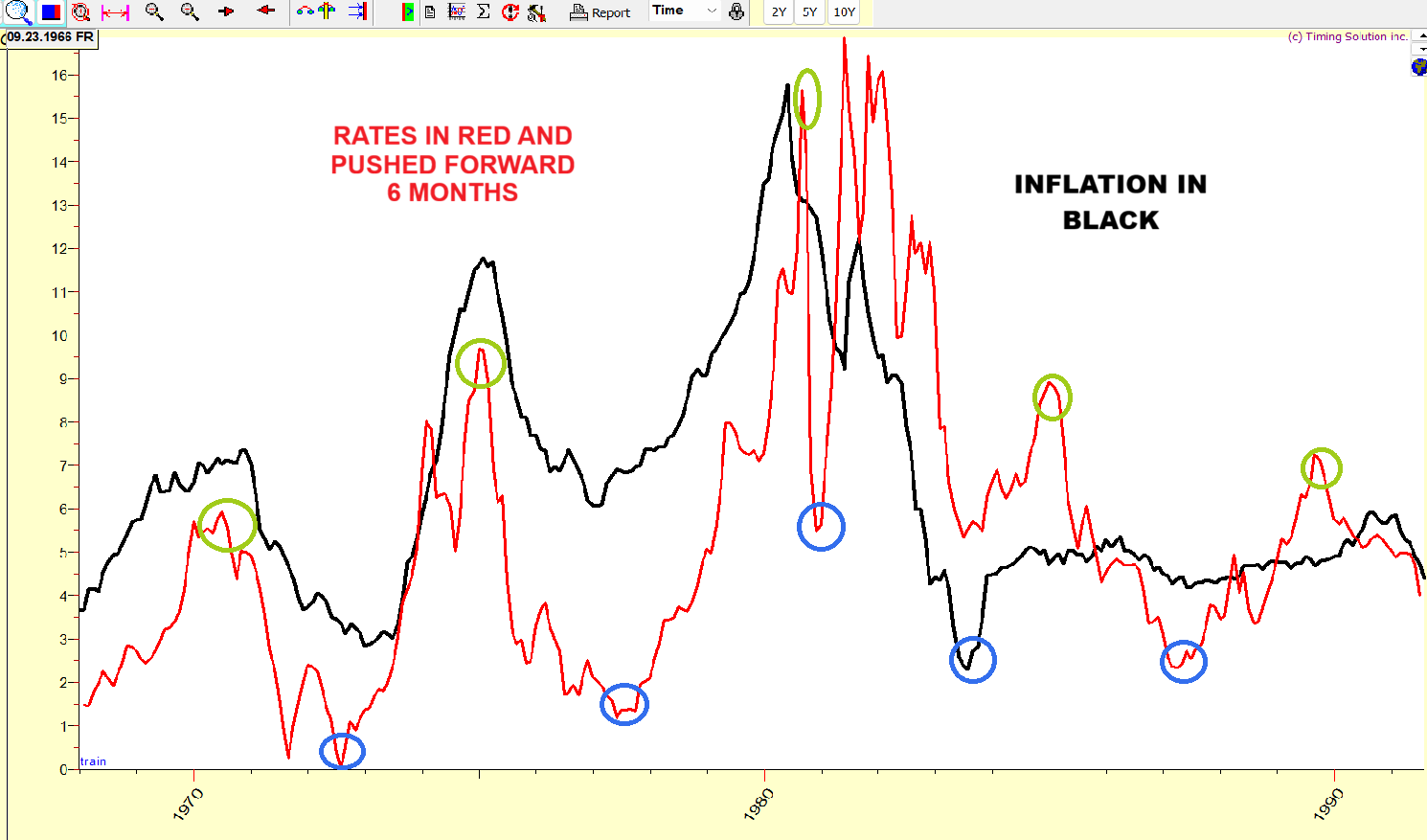
Nils Poertner writes:
With a bit of imagination, one could see that we may get to zero (or even negative short-term rates in the US)
Larry Williams adds:
Zero rates in Japan did not lead to inflation as most econ minds claimed it would.
William Huggins offers:
Richard Koo from Nomura explains why that was - and it has nothing at all to do with the notion that interest rates -cause- inflation.
Larry Williams asks:
Great post thanks.
Inflation is a result of 1) people raising prices and 2) people paying up so what causes that?
William Huggins responds:
as econ understands things (in the MV = PY framework), inflation would be a rise in P, which can result from a shock to any of the other three variables. the most common oversight though is that V is affected by how people behave too - the willingness to extend (or deny) credit has a huge impact on whether or not a transaction (PY) even takes place.
economic historians have long noted the relationship between M and changes in PY which shows up when Mansa Musa dumps a ton (actually several tons) of gold into the Egyptian economy in the 14th century, when the Spanish flood Europe with Inca and Aztec gold (and again when they "discover" Potosi), and during various state-induced hyperinflationary periods in the 20th century (USSR, Germany, Hungary, etc). but as the US from 1873-1893 shows, changes in V (which almost halved during that period) can influence inflation too which was negative for the period, despite increasing M and Y throughout.
overall, the record shows that big increases in the money supply (as in 2020/21) tend to set off inflation with a bit of a lag (digestion time) unless there are equally significant countervailing forces. the big assumption monetarists make (that Koo questions) is that people -will- borrow as rates come down. his argument (for those who didn't watch) is that if you have negative equity, borrowing at any rate is insanity - the whole mechanism of juicing aggregate demand by lowering interest rates relies on the idea that people who can will. as Koo/Japan points out, there is a limit to such linear thinking.
Mar
8
Albert Einstein said, from Zubin Al Genubi
March 8, 2026 | Leave a Comment
The ordinary human being does not live long enough to draw any substantial benefit from his own experience. And no one, it seems, can benefit by the experiences of others. Being both a father and teacher, I know we can teach our children nothing…Each must learn its lesson anew.
—Albert Einstein, October 26, 1929
Mar
4
The US data center buildout looks increasingly supply-constrained, not because of capital, but because of infrastructure. Announced projects far exceed what can realistically be delivered on current timelines. New capacity requires a rare intersection of:

Proximity to internet hubs.
Reliable, large-scale power (plus generators/transformers with multi-year lead times).
Viable cooling and water.
State/local support in communities that are already pushing back on load growth and land use.
Access to critical, long-lead-time equipment currently has multi-year queues.
Finding sites that clear all five hurdles is getting harder in the US and across most Western markets. This is solvable, but on a 5–10 year grid and permitting timelines, not on 12–18 month tech timelines.
Near-term, not many operational changes, but the narrative probably does. When the market internalizes that a meaningful slice of “announced” capacity is delayed or won’t get built, I’d expect:
Incumbent capacity with grid access to gain pricing power.
Late-stage greenfield and some capex-heavy stories to be repriced.
Utilities, grid upgrade plays, and on-site power to screen better than marginal new-build data center names.
High-level takeaway: AI demand is real; the binding constraint is infrastructure. The gap between slide-deck capacity and physically deliverable capacity is likely where the mispricing lies.
Mar
3
FED interest rate decisions are often associated with the SPY.
1) Interest rate decrease –> Increase in SPY
2) Interest rate increase –> Decrease in SPY
Polymarket has a market for FED decisions. Could a combination of Long SPY & Polymarket contracts (betting on rates increasing) provide some kind of arbitrage opportunity?
Larry Williams responds:
This not correct Interest rate hikes are bullish for stocks—most the time. [See chart below.]
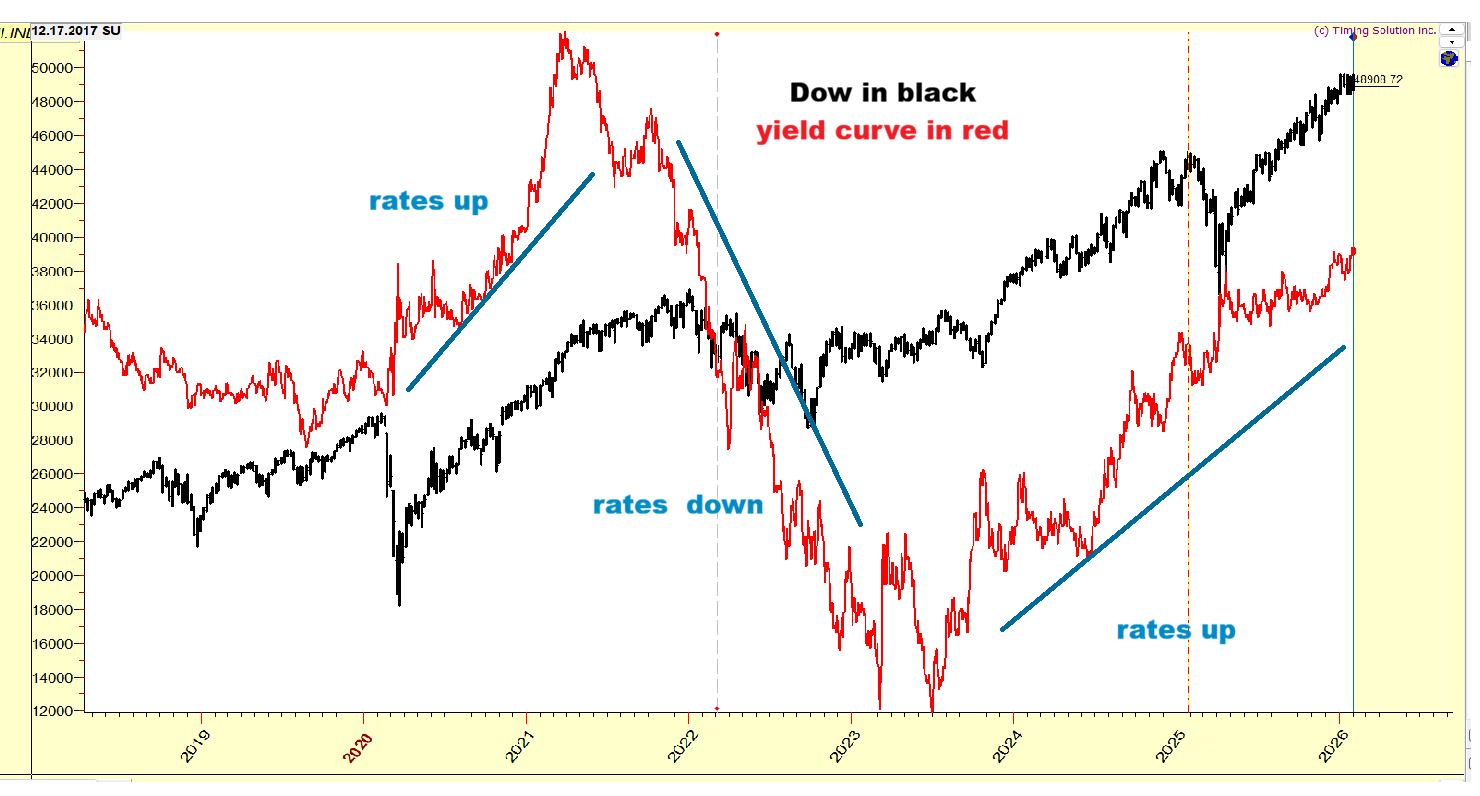
William Huggins writes:
the most important issue with any arbitrage situation is the volume at price is not unlimited, meaning there is a functional "size" to the exploit. my intuition is that such inefficiencies can persist for structural reasons until that size crosses some operator's threshold at which point they trade it until it holds back against the efficient exploit horizon. i don't know what the market depth is like on polymarket but i also suspect the liquidity that such a trade would count on could evaporate such faster than SPY.
Asindu Drileba asks:
[Larry's] pattern indicates:
- Rate increases -> Stock Market up
- Rate decrease -> Stock market down
But for longer periods i.e several subsequent days after.
Since the Polymarket contracts actually expire (resolve) on the day of the announcement. I was thinking this was a strategy that would close on the day of rate announcements. Are stocks also mostly bullish *on the same day* for announcements of a rate increase? (and vice versa)
Feb
28
Gold, from Peter C. Earle
February 28, 2026 | Leave a Comment
Gold at $5,000 is not a rally. It’s a verdict.
These prices are not expressions of optimism about growth or productivity; they are expressions of doubt about currencies, governments, and institutions charged with preserving economic stability.
Feb
26
Statistics in astronomy: John Michell, from Humbert X.
February 26, 2026 | Leave a Comment
I was not familiar with John Michell (1724–1793) until I read that he did a statistical analysis to show that double stars seen in the night sky were far too numerous to exist by chance and thus must be actual binary star systems. He also essentially posited black holes - in the 18th century!
Michell was the first person to apply the new mathematics of statistics to the study of the stars, and demonstrated in a 1767 paper that many more stars occur in pairs or groups than a perfectly random distribution could account for. He focused his investigation on the Pleiades cluster, and calculated that the likelihood of finding such a close grouping of stars was about one in half a million. He concluded that the stars in these double or multiple star systems might be drawn to one another by gravitational pull, thus providing the first evidence for the existence of binary stars and star clusters. His work on double stars may have influenced his friend William Herschel's research on the same topic.
Feb
23
Book recommendation for Chair Vic, from Zubin Al Genubi
February 23, 2026 | Leave a Comment
On Growth and Form, by D'Arcy Thompson
The quest of physical causes merges with another great Aristotelian theme—the search for relations between things apparently disconnected, and for ‘similitude in things to common view unlike’. Newton did not show the cause of the apple falling, but he showed a similitude between the apple and the stars. By doing so he turned old facts into new knowledge; and was well content if he could bring diverse phenomena under ‘two or three Principles of Motion’.
The author's goal was to show organic forms exist in conformity with physical and mathematical laws. This was Chair Victor Niederhoffer's genius: to take similitudes from trees, surfing, checkers and give mathematical form to the chaos of the markets. The search for causes is in vain. Quantifying a relationship can provide meals for a lifetime.
All we can do meanwhile is to analyse, bit by bit, those parts of the whole to which the ordinary laws of the physical forces more or less obviously and clearly and indubitably apply. But even the ordinary laws of the physical forces are by no means simple and plain. In the winding up of a clock (so Kelvin once said), and in the properties of matter which it involves, there is enough and more than enough of mystery for our limited understanding: ‘a watchspring is much farther beyond our understanding than a gaseous nebula.’ We learn and learn, but never know all, about the smallest, humblest thing.
This famous quote is by the astronomer Johannes Kepler:
Plurimum amo analogias, fidelissimos meos magistros, omnium Naturae arcanorum conscios
Here is the translation from Latin to English:
I love analogies most of all, my most faithful teachers, acquainted with all the secrets of Nature.
Feb
18
Vol in percent versus dollars, from Zubin Al Genubi
February 18, 2026 | Leave a Comment
More on the points vs % argument. % vol or Vix is misleading and inaccurate measurement of vol. A better measure is abs vol in points/$ because we live and measure ultimately in dollars.
Accordingly at 7000 abs vol is 350% of what is was a few years ago at 2000. Trading has to adjust accordingly to maintain the same portfolio volatility of returns. Thus leverage, targets, systems, time have to adjust to match.
Adam Grimes disagrees:
because we live and measure ultimately in dollars
This does not strike me as coherent. Returns are the only reasonable way to understand market movements. Just imagine a portfolio of two assets, one at $1 and the other at $100,000 (or other arbitrarily wide handles). The only way to think about those is to normalize for price via %, so it follows that volatility would be equally incoherent measured in points. (Sorry for the Finance 001 example, but I think 'Explain It Like I'm Five Years Old' cuts through a lot of confusion.)
% and vol measured as vol of %'s (i.e., returns) is the only thing that makes actual sense here unless I'm misunderstanding the argument. What am I missing?
Accordingly at 7000 abs vol is 350% of what is was a few years ago at 2000.
Scratching my head here. "So what?" and "of course" are the only things I could manage to say here.
I'm probably missing something, though. What is it? (btw VIX sucks as much as any other clunky measurement of implied vol. I'll agree with you on that one, but I don't think that's your point.)
Zubin Al Genubi responds:
1 ES contract used to move 7 points as an average range 20 years ago. You made or lost $350. 1 contract now moves 50 or 100 points a day, same percentage, but your account is up or down $5000. The volatility in your account in dollars is higher than 20 years ago. If you lost 1% in 2000, its $600, but 1% now is $3500 per contact. You don't see too many 2% days like before. Abs vol is up while Vix or % vol is down. Its apples and oranges.
The trading style, research should change. Straight percentages for expectations, returns, targets don't work like they used to, especially using historical data. Silver now has micro contract because $5000 a dollar too is high volatility in dollars with $20 or more ranges. I guess I'm suggesting using abs vol as a better measure of vol.
Appropriate here, Feynman in 6 Not so easy pieces, cites Wyle on symmetry, "Suppose we build a certain piece of apparatus, and then build another apparatus five times bigger in every part, will it work exactly the same way? The answer is, in this case, no!" My point is the market does not the same way as it did 25 years ago in large part because it is bigger. The fact that the laws of physics are not unchanged under a change of scale was discovered by Galileo. He realized that the strengths of materials were not in exactly the right proportion to their sizes. [Ibid]
Adam Grimes writes:
I'm sorry, but I still find these points trivially obvious. Of course nominal price swings are bigger because price levels are higher, so of course holding a single contract would result in larger dollar swings. Who's holding a single contract? Position size takes care of all of this.
And I don't think the physical analogs add anything beyond confusion. Physical properties scale differently. For instance volume scales as cube and surface area as square. This is why we could not have a science fiction 100 ft tall lobster in reality…because of material constraints. There's no market analog to this. A 1% move is a 1% move. There's no hidden non linearity there.
If your claim is that markets don't move the same they did 25 years ago I would challenge that claim. What's the evidence for this? Statistically there's always the issue of non-stationarity but it seems to me you're claiming there's something more meaningful here. What am I missing?
Asindu Drileba comments:
I think Zubin is simply trying to say that he had found measuring volume in dollar terms (absolute terms) more relevant than measuring it in percentage terms.
Richard Hamming has an interesting talk, You get what you measure
Here us a good summary:
You may think that the title means if you measure accurately you will get an accurate measurement, and if not then not; it refers to a much more subtle thing - the way you choose to measure things controls to a large extent what happens. I repeat the story Eddington told about the fisherman who went fishing with a net. They examined the size of the fish they caught and concluded there was a minimum size to the fish in the sea. The instrument you use clearly affects what you see.
I for example, completely stopped measuring market returns in percentage terms a few years ago. I now exclusively use log returns. Why did I stop using percentages? The problem with percentages is that they are not equal to each other (ignoring the negative sign). (a 50% move) + ( a -50% move ) does not give you 0 in dollar terms. But what you get is 0% in percentage terms. Percentages are not symmetrical. Does this mean they don't measure growth? They actually do. But they simply should not be compared. As the absolute values may mean something different.
- A 0% return percentage may (erroneously)
indicate that you have broken even.
- The same 0% percent return may also show that you are actually loosing money in absolute (dollar) terms
Adam Grimes writes:
Of course log returns are well known, and this is more finance 101. There are several qualities that make them more attractive for some analyses. (just dont mix percents and log returns!)
But that's not the same as measuring market movements in raw dollars (which is the only reasonable companion to volatility measured in absolute dollars (or points).
And as for measuring what you see, methodology (and perhaps even experimenter expectations) greatly affecting outcomes and conclusions, we're on the same page there. This is fascinating territory for discussion and I'd welcome it.
But his point about volatility only extends to someone trading a single contract in 2001 and also trading a single contract today. That is irrelevant.
If there's something at work here and legitimately some way the market "doesn't move the same way" it did decades ago… I'm all ears and very interested. Always looking to learn more about what I don't know or might be missing.
Zubin Al Genubi does some counting:
There were 31 days in 2006 and 67 days in the last year with percent moves >1%. This is due to Big Tech being 32% of ES with higher beta and the speed and intraday persistence of algorithmic trading. Lastly, it 'feels' different. A 120 point drop trades different than a 13 point drop in 2002.
Stated quantitatively, now nearly half of our trading days have abs vol hi-lo >1% while in 2006 only a quarter of days had abs vol >1%. That is a big difference and clearly explains why trading is different (better) now. Today is just 1 of the many such days.
Cagdas Tuna adds:
All futures contracts of index products have adjusted to gross notional value of underlying stocks. At the same time VIX contract specifications and notional value it can represent almost remain unchanged. Although calculation method of VIX is the same, the number of futures contracts hedgers need to cover notional values they trade in underlying assets are totally different.
Adam Grimes writes:
Stated quantitatively, now nearly half of our trading days have abs vol hi-lo >1% while in 2006 only a quarter of days had abs vol >1%.
I'm sorry but I have to be direct. I find this annoying. You have moved the goalposts and are now making a completely different argument. You began advocating for measuring volatility in absolute dollars and now you are using a percentage measure. You are literally using the metric you said was wrong to support your argument that the metric is wrong.
Furthermore, your data are bad. It's simply a volatile measure. Volatility is volatile. Here's a look at the FULL history of the ES futures [first chart] (back-adjusted so this may not be fully accurate, but I think the % adjustment fixes the back-adjustment distortion) counting the number of trading days in each calendar year that had abs(high-low) / close > 1%. It's simply an unstable measure and I don't know what is to be drawn from this.
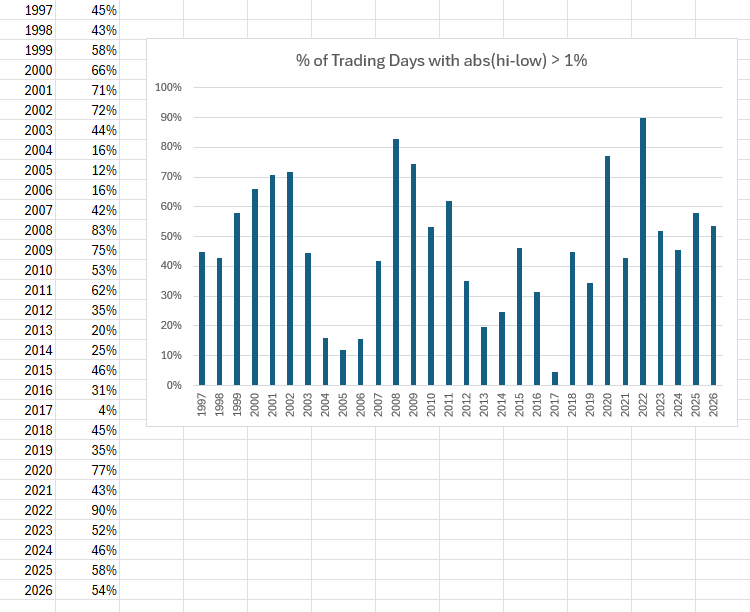
If your argument is that there are more days with "surprise" distortions, this is maybe nominally true, but better measured with better tools. I use a tool that expresses each day in terms of the mean average absolute closing difference [second chart]. Taking an arbitrary bound of 3 for that, the argument that this year is on track to show more surprise shocks than usual is true (but also reflective of a generally lower baseline).
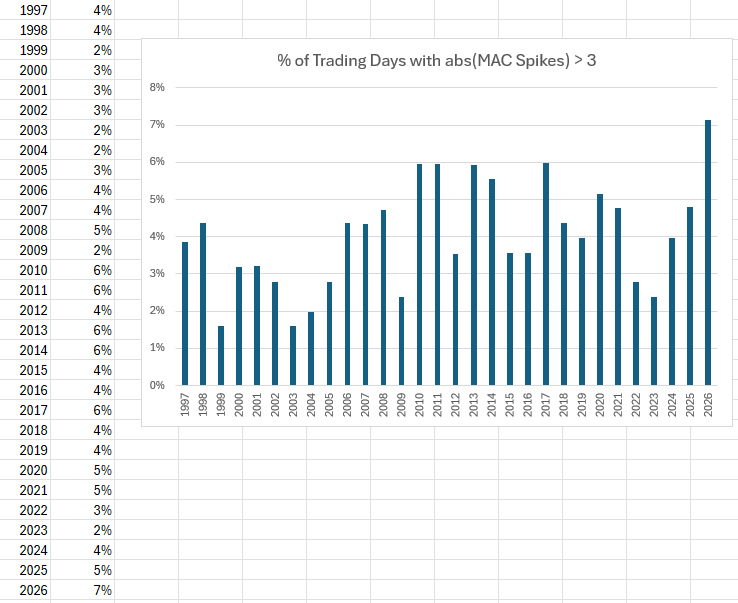
You've flipped to percentage measures and we're left with hand waving "it feels different now." That's a different claim and it's qualitative, perhaps has value, but not in supporting your original claim.
I'll reiterate my position: percentage measures are the only thing that make sense. Point values are arbitrary and can be easily handled via position sizing (within the limits of granularity of instruments vs account size.) I don't think this is revolutionary or controversial. This is truly finance 101.
Feb
15
6950, from Ani Sachdev [Updated]
February 15, 2026 | 1 Comment
I counted the number of crossings of the ES future past 6950. I counted the using the nearest expiry future. I counted using 30 min increments. Since October 29, 2025:
ES crossed from close to close across 6950, 78 times. 39 times up, 39 times down - true Logbola.
ES traded through and touched 6950 at any time at least 154 times (counted when there was low < 6950 < high).
Curious if any specs have used data like this to predict future prices.
Zubin Al writes:
14 hourly crosses night and open [Friday, 13 Feb.].
Cagdas Tuna comments:
I find the fact that whether call it NY Fed or Blackrock or other main street banks whoever single handedly controls and manage to keep VIX below 20 that is ultimate power controls the US stock market.
Larry Williams responds:
No one is holding anything down—or up—my vix fix is essentially same as $vix it cannot be controlled.
Cagdas Tuna is skeptical:
Yes, nothing is controlled!
Zubin Al Genubi prefers market dynamics:
Vix suppression is caused by: 1) heavy ODTE trade, while VIX is calculated on options 23-37 days out; 2) dispersion in SP index (dispersion meaning Mag 7 vs other 493; see RTY almost up 2%); 3) Big fund/ETF imbalances balancing deltas; 4) mean reversion of VIX/and buy the dip, which can break down at some point.
Larry Williams gets cosmic:
The universe is always expanding, Hawking proved. Stocks are part of that.
Feb
11
New Fed Chair Not So Bearish, from Jeffrey Hirsch
February 11, 2026 | Leave a Comment
…we present the S&P 500’s performance following a change in leadership at the Fed. Historically, performance is not all that bearish. Aside from the 3 months later interval, all other interval’s frequency of advance (% Higher) are above our standard 60% bullish threshold and average performance is positive.
Going one additional step, let’s say Eugene Meyer was not responsible for the Great Depression and Alan Greenspan probably did not cause the market’s crash in 1987. Bad timing, perhaps? Removing them from the data essentially removes the most bearish data. Average performance across all intervals goes up and is positive while frequency of gains also improves noticeably and performance 1-year later jumps to an average gain of 12.7%, with the S&P 500 higher 90% of the time.
Feb
10
Stops, from Zubin Al Genubi
February 10, 2026 | Leave a Comment

We should never get stopped out of a trade just because we have lost money. We exit trades if we no longer like them—losing money, while deeply unpleasant, should never be the sole criterion for exiting.
Peter Penha responds:
The last stop I left was a stop loss in Platinum futures sub $800 and the market took the contract down $65 and stopped me out, made one lower print $5 below me, and then came back up. Probably was the low print post March 2020.
I have had horrific experience with Schwab/thinkorswim…they once sold me out (partially) of calls on Sugar that were deep in the money at a make believe bid price way off market and below intrinsic value. When I challenged them noting that equity markets were open and they could easily have raised cash in many liquid ways - they told me they reserve the right to do what they want. I have multiple snapshots of them marking positions below intrinsic value, and lately while I was long silver futures they would mark my long Sugar contract to zero (I would see a negative futures cash position equivalent to the notional value of my long position).
I have been thinking of Marty Zweig and how he did very well leaving trailing stops on individual stocks and need to find my copy and revisit Winning on Wall Street and see how he did it (successfully).
Rich Bubb writes:
I AI'd trailing stops info thru Gemini.
The rule-of-thumb I currently/usually use is 8%-15% TSL% (trailing stop loss %). And typically use a lower-is-better TSL%. The volatility and economic tea leaves divination determine the TSL%. If I have less conviction in a position, I'll reduce TSL% to (sometimes) let the Market tell me how wrong I initially was.
And I got burned at the start of Great Recession, where I had TSL%s way-too relaxed; upper teens TSL%. The TSL%s all worked, but by then I'd lost about 15%+. Painful lesson.
Feb
8
CIO predicts 2026, too
February 8, 2026 | Leave a Comment
Expect Equity Markets to Broaden in 2026, Led by Small Caps, International
Both fiscal and monetary stimulus should boost earnings in the U.S. and abroad, with dollar weakness continuing to underpin international stocks.
Nils Poertner comments:
Back in High School, they gave a 1 pager of Latin and we had 1 hour to translate it (since it is an ancient language I was spending a lot of time to see what this all meant.) We all know English more or less. These days, I read a 1 pager in English (like this page) in 1 minute. My modern brain actually agrees with the whole article. Yummy. In reality there are probably a lot of cliches in it….
Zubin Al Genubi writes:
AI is about training data otherwise it gets stale and cliched. Like a person reading the same newspaper every day. Google has lots of data. Musk is merging SpaceX with AI because as internet provider he will have access to unlimited global data. I wonder what their contract disclosures say about data privacy.
Steve Ellison responds:
"Expect"? I have seen the broadening occurring since November. There was an extended non-confirmation of Dow Theory last summer into fall as the Industrials were making new highs, but the Transports remained below their November 2024 high. Not only did the Transports finally make an all time high, now they are making new highs before the Industrials do. Similarly, the equal-weighted S&P 500 ETF RSP, which was badly lagging the cap-weighted SPY in the 2025 rally off the "Liberation Day" tariff lows, made a new high yesterday while the cap-weighted index only partially regained some of its losses from earlier in the week.
I said on X [6 Feb.], "Lots of strength in the broader market. While technology stocks were selling off the last few days, the Industrial, Materials, Consumer Staples, and Energy sector ETFs all made new highs".
Feb
7
Filming Electrons at 1 Quadrillion FPS, from Jeff Watson
February 7, 2026 | Leave a Comment
Veritasium: Filming Electrons at 1 Quadrillion FPS
Explore slow motion like never before, from century-old strobe techniques to a quadrillion FPS camera. Witness light's journey through objects and the movement of electrons within molecules. Discover how scientists use sound and incredibly short laser pulses to capture these breathtaking moments.
Feb
5
6 new lows, from Zubin Al Genubi
February 5, 2026 | Leave a Comment
The last few down swings each had 6 new lows before a bottom. Today, marking a new low for this swing after hours will end up a new low number 5 by the end of tomorrow.
Steve Ellison writes:
Interesting. I have been experimenting with multi-level point and figure charts. Using a box size of 1.4% (a long-term average true daily range) and a 3-box reversal, SPY is still within 4.2% of its all-time high and hence in an uptrend. Drill down with smaller box sizes and shorter time intervals, and interesting price structures appear. At a 1/4 ATR box size, today's close was at a similar level to the Jan. 20 low.
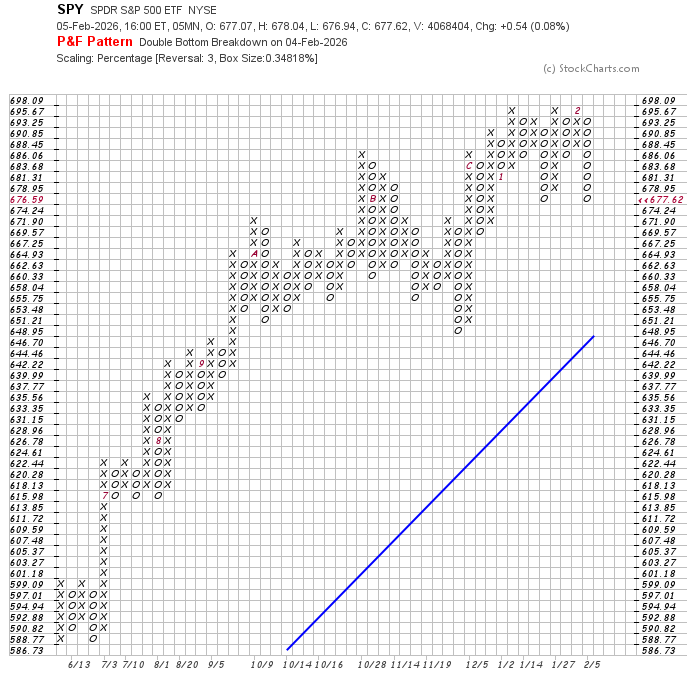
Lots of sector rotation under the surface. If 2025 was the year of the magnificent 7 and the flatlining 493, this year may be the opposite. While technology was getting beaten down this week, the Industrial, Materials, Consumer Staples, and Energy sector ETFs all made new highs.
Zubin Al Genubi adds:
Lots of late night shenanigans going on. Asian markets trading open in late thin US futures creating imbalances. Price action appears algo driven.
Nils Poertner comments:
I like the pattern with 6 new lows. Well spotted. Otoh, if the pattern does not repeat the surprise for mkts is bigger. nature offers "patterns" and "break of patterns" and both are relevant - else it would be a museum.
Cagdas Tuna predicts:
Then it is going to be a rough year for market cap weighted indices in US.
Peter Ringel writes:
While I would always give a study, like Big Al‘s more weight to remove opinion. I wonder, if there is a January effect regarding regime type or sector or general trading type. Not necessary % performance. Will the rest if the year trade like January? Would give a 2015 type year.
Nils Poertner responds:
yes. for practical purpose, it may be easier to trade mkts which receive less attention by the wider financial community /media.
Feb
5
Gaming tournament going on between AI versions, from Big Al
February 5, 2026 | Leave a Comment
Liv Boree, poker pro, interviews Deep Mind guy:
Why Google Made ChatGPT, Gemini & Claude Play 900,000 hands of Poker…
…before going on to earn a First Class Honours degree in Physics with Astrophysics at the University of Manchester. During this time she played lead guitar in heavy metal bands Dissonance and Nemhaim and modelled for a number of alternative clothing brands such as Alchemy Gothic.
Victor Niederhoffer comments:
especially if you live in denmark
Feb
4
2026 Bullish Confirmation, from Larry Williams
February 4, 2026 | Leave a Comment
Yale Hirsch and his son Jeff have shown that a positive change, from the last trading day of the year to the 5th trading day of the new year, portends a bullish year (positive first 5-day percent change).*
Consider this … in the last 76 years of trading, the S&P 500 has declined for the year 20 times or 26% of the time. In other words, 74% of the time, there has been a yearly gain.
Jeff’s numbers show that in those last 76 years, 49 years showed a positive first 5-day percent change. Only 8 of those years went on to close down for the year. That’s an 84% bias for the year to close higher when we have a positive first 5-day percent change.
My add-on to Yale’s and Jeff’s work was to look at the years that gained 1.2% or more in the first 5 days of trading. There were 28 such years. Of those years, only 2 were down for the year. That’s a 93% bias for the year to close higher. What an improvement from the average 74%!
In 2026, the first 5-day** change for the Dow Jones 30 was +3%.
In 2026, the first 5-day** change for the S&P 500 was +1.6%.
Those 28 years had an average annual return of 14%. The remaining years had an annual gain of 5.3%. I see this as excellent confirmation of the bullishness of my Forecast 2026 Report.
Cagdas Tuna writes:
There is no need for a statistical analysis to assume any given year will be positive for US indices. It is almost guaranteed to be positive every year. No offense to any list member.
Larry Williams responds:
Wrong 24% of time we close down for the year.
Michael Brush is surprised:
Wow did not know it was that high.
Larry Williams agrees:
I was taken back by it as well.
Asindu Drileba asks:
2026 is bullish? But Senator, you said you expect a recession in 2026 with 100% certainty. Is this a contradiction? Or maybe its possible for the market to be bullish even during a recession?
Larry Williams answers:
Yes, there was a projection made a year ago for a 2026 sell off —in the last 12 months data changed—large improvements in fundamentals and hopefully I got a little better understanding of long term cycles. New Data matters.
Nils Poertner writes:
Asindu- there would be simply too many variables out to make that statement with such a certainty in advance. Just impossible. It remains a probability game. Used to subscribe to some cycle research that claimed to have things figured out yrs in advance. quite pricey subscription. it was HOOK, LINE and SINKER (for me).
Denise Shull comments:
New Data matters.
Indeed it does. Wonder why it’s challenging for many to incorporate?
Nils Poertner responds:
Good question. On this note… (Pure) data analysts believe pattern matching on large datasets will solve our problems. But what if the really vital information isn't being collected? What if it's invisible to our trained systems?
Feb
3
The Autobiography of Mark Twain
February 3, 2026 | Leave a Comment

The Autobiography of Mark Twain contains a litany of people who cheated him and losses on his investments near the end of his life.
Nothing ever happened to Mark Twain in a small way. His adventures were invariably fraught with drama. Success and failure for him were equally spectacular. And so he roared down the years, feuding with publishers, being a sucker for inventors, always learning wisdom at the point of ruin, and always relishing the absurd spectacle of humankind, which he regarded with a blend of vitriol and affection.
Feb
2
Dollar Weakens as Markets Reprice US Political Risk, from Peter C. Earle
February 2, 2026 | Leave a Comment
For decades, US dollar dominance rested on a simple but profound foundation. Predictable institutions made the dollar stable, on the belief — sometimes overstated — that the United States would not deliberately undermine its own currency. That belief is now visibly eroding.
The dollar has fallen to its weakest level in nearly four years, not because of a recession or crisis at home, but because investors are increasingly uneasy about the direction of American policy. Against a basket of other currencies, the US dollar is approaching the lows seen during the COVID pandemic as markets are beginning to price in something more corrosive than cyclical weakness. Political and institutional risk is emanating from Washington itself.
Dollar Weakens as Markets Reprice US Political Risk
Feb
1
Does January predict the next 11 months?, from Big Al
February 1, 2026 | Leave a Comment
In this quick study the answer is no.
Jeffrey Hirsch has a different take:
From my newsletter issue published last night:
Jan
31
A strange glut of silver, from Laurel Kenner
January 31, 2026 | Leave a Comment

With silver at $110 an ounce, it seemed like a good idea to raid the family heirlooms.
But my friendly coin dealer wasn’t having any. He’s buying nothing but Eagle coins. The usual buyers — industry, mints, and jewelers — don’t have the capacity to handle the inflow.
Read the full post on Laurel's Substack: Nobody Asked Me, But…A strange glut of silver
Jan
30
Another volatility measure, from Zubin Al Genubi
January 30, 2026 | 1 Comment
Take a price corridor by forming a double barrier (rounds might be nice) delta up and delta down from the initial spot price. When the barrier is touched, we note the exit time, t1, and reset the barrier around the current price. This generates a sequence of exit times t1, t2,…,tn from which we want to estimate volatility. This shows how fast price moved.
Peter Ringel writes:
TY, this looks like a clever approach. I do something similar with zigzag vol and time. It is computational heavier. Yours sounds lighter. Will try it.
Jan
29
Tycoons, artisans, and interchangeable parts
January 29, 2026 | Leave a Comment
The Tycoons: How Andrew Carnegie, John D. Rockefeller, Jay Gould, and J. P. Morgan Invented the American Supereconomy has unusually informative chapter on machine tools, but the rest of the book is the standard hateful stuff about carnegie and gould.
The Industrial Revolution in the Connecticut River Valley
The Connecticut River valley played an important role in the formation of the Industrial Revolution as artisans and mechanics, often spurred on by resourcefulness and isolation, created new tools and new patterns of work in the many mills and shops along the Connecticut’s tributaries.
The American Precision Museum is located in the renovated 1846 Robbins & Lawrence factory on South Main Street in Windsor, Vermont. The building is said to be the first U.S. factory at which precision interchangeable parts were made, giving birth to the precision machine tool industry.
Jan
28
Triage in medicine, from Nils Poertner
January 28, 2026 | Leave a Comment
process of rapidly sorting and prioritizing patients based on the severity of their condition and the urgency of their need for care, especially during emergencies
Amateur /untrained person coming to a traffic accident (w multiple casualties) would rush to help those who cry the loudest (eg maybe just a broken arm) whilst neglecting those who need urgent attention (eg unconscious - about to pass out).
Analogy to speculation? Ordinary investors (ie untrained) getting hooked to "loud" and in your face "stories" in mass fin media - but perhaps neglecting the vital, more silent trends in mkts - which would help them make money over time.
Jan
27
Ralph Vince’s latest, from Larry Williams
January 27, 2026 | Leave a Comment

Ralph Vince's newest book. Not about the markets.
The Theology of Lust follows Ricky “Pork Chop” White — a wounded, self-mythologizing erotic savant — as he stumbles through desire, regret, and violent entanglements, trying to turn raw masculinity into something redemptive. It’s a darkly funny, psychologically unfiltered journey where erotic obsession, betrayal, and a lurking murder plot converge on one man’s desperate attempt to find some sort of salvation out of the mess he calls a life.
Asindu Drileba writes:
Nice! I remember Ralph Vince mentioned that one of his favourite books was The Bible. There is a strange relationship between speculation, theology & computers(artificial intelligence) that no one has comprehensively talk about. Hopefully, I will learn more about theology from this book.
Peter Ringel comments:
When I read the senator writing "the greatest project of his life", I immediately feared, that he fell victim to French, Spanish or Portuguese girls. The title seems to confirm this.
Larry Williams responds:
Good guess but not quite Ralph has a new steal proof coin coming out the book is a year old but was just translated to English from French.
Steve Ellison recalls:
We had a long-ago list member who would frequently draw parallels between never-ending market arguments such as fundamental vs. technical analysis and the European religious wars of the 1600s or theological debates such as predestination vs. free will.
Jan
26
Americana: A 400-Year History of American Capitalism
January 26, 2026 | Leave a Comment

the best history of business and America with new takes on founding and inventions.
Americana: A 400-Year History of American Capitalism
Bhu Srinivasan boldly takes on four centuries of American enterprise, revealing the unexpected connections that link them. We learn how Andrew Carnegie's early job as a telegraph messenger boy paved the way for his leadership of the steel empire that would make him one of the nation's richest men; how the gunmaker Remington reinvented itself in the postwar years to sell typewriters; how the inner workings of the Mafia mirrored the trend of consolidation and regulation in more traditional business; and how a 1950s infrastructure bill triggered a series of events that produced one of America's most enduring brands: KFC. Reliving the heady early days of Silicon Valley, we are reminded that the start-up is an idea as old as America itself.
Jan
25
The Chair’s quest, from Peter Ringel
January 25, 2026 | Leave a Comment
Vic gives out a quest (a research quest).
I swear, I did see Vic's X post only afterwards. I too was thinking about the levels / rounds and how to test them today during my drive. Probably everybody is tired of starring at the same levels and so the mind wonders and wanders.
I am thinking of this approach:
utilize volume profile / volume per price level
(here a buffer bin can be applied / granularity from tick to x points)
(this will become important)
slice / bin the time series in segments of x
x needs to be defined,
I am thinking simple price ranges right now
normalize the segments
create a summary volume profile of all the segments ( an average or total sum )
plot it and hope something stands out
then a deeper statistical analysis of the volume profile, which is a frequency distribution
another approach could be to look at the "rejection power" of a price level after a crossing / touching event.
the crossing / touching events are often fuzzy in time
maybe remove time here a la range bars
after the event qualify the price range traveled for a fix time interval
so price-no-time vs price-time
Zubin Al Genubi writes:
The sample generally is biased bullish. Maybe take a look at bear regimes to see how hypothesis hold up. Also need to use unadjusted prices to retain rounds.
Peter Ringel responds:
TY. I am also thinking cash and virgin levels (around ATHs). the question of prices vs percentages will come up here too again.
If one sticks to prices and assumes an underlying behavioural cause of rounds, there probably are regimes with more or less black and white borders (fast transition) from 50 with weight to 100 with weight to maybe back to 50 in low volatility environments. Also the question, what difference does it make, if the index is 7000 vs 700.
William Huggins suggests:
it may be worth seeing if there are "liquidity cliffs" at rounds rather than sticky prices (order clustering as opposed to price clustering)
Peter Ringel adds:
The open interest at rounds at the option chain is usually noticeable higher vs all other steps.
Now I am thinking to look at the waning of these. Are they getting eaten up. Would explain the multiple crossings of a round needed till we get new ATHs.
Jan
24
Rise and fall of Charles Schwab
January 24, 2026 | Leave a Comment

Steel Titan: The Life of Charles M. Schwab
How did Schwab progress from day laborer to titan of industry? Why did Andrew Carnegie and J.P. Morgan select him to manage their multimillion-dollar enterprises? And how did he forfeit their confidence and lose the presidency of U.S. Steel? Drawing upon previously undiscovered sources, Robert Hessen answers these questions in the first biography of Schwab.
4.4 out of 5 stars
Charles Schwab made made ingenious contributions to Carnegie Steel and shortly after at the age of 35 became pres of US Steel. he was subject to such criticism during his tenure and eventually bought Bethlehem Steel.
Jan
23
Alternative to value at risk
January 23, 2026 | Leave a Comment
alternative to value at risk invented by the Japanese quality of control scholar Taguchi.
Loss functions and constraints improve sea surface height prediction
In order to understand currents, tides and other ocean dynamics, scientists need to accurately capture sea surface height, or a snapshot of the ocean's surface, including peaks and valleys due to changes in wind, currents and temperature, at any given moment. In order to more accurately forecast ocean circulation and other processes, climate variability, air-sea interactions and extreme weather events, researchers need to be able to accurately predict sea surface height into the future.
The Taguchi loss function is graphical depiction of loss developed by the Japanese business statistician Genichi Taguchi to describe a phenomenon affecting the value of products produced by a company. Praised by Dr. W. Edwards Deming (the business guru of the 1980s American quality movement), it made clear the concept that quality does not suddenly plummet when, for instance, a machinist exceeds a rigid blueprint tolerance. Instead 'loss' in value progressively increases as variation increases from the intended condition. This was considered a breakthrough in describing quality, and helped fuel the continuous improvement movement.
Archives
- June 2026
- May 2026
- April 2026
- March 2026
- February 2026
- January 2026
- December 2025
- November 2025
- October 2025
- September 2025
- August 2025
- July 2025
- June 2025
- May 2025
- April 2025
- March 2025
- February 2025
- January 2025
- December 2024
- November 2024
- October 2024
- September 2024
- August 2024
- July 2024
- June 2024
- May 2024
- April 2024
- March 2024
- February 2024
- January 2024
- December 2023
- November 2023
- October 2023
- September 2023
- August 2023
- July 2023
- June 2023
- May 2023
- April 2023
- March 2023
- February 2023
- January 2023
- December 2022
- November 2022
- October 2022
- September 2022
- August 2022
- July 2022
- June 2022
- May 2022
- April 2022
- March 2022
- February 2022
- January 2022
- December 2021
- November 2021
- October 2021
- September 2021
- August 2021
- July 2021
- June 2021
- May 2021
- April 2021
- March 2021
- February 2021
- January 2021
- December 2020
- November 2020
- October 2020
- September 2020
- August 2020
- July 2020
- June 2020
- May 2020
- April 2020
- March 2020
- February 2020
- January 2020
- December 2019
- November 2019
- October 2019
- September 2019
- August 2019
- July 2019
- June 2019
- May 2019
- April 2019
- March 2019
- February 2019
- January 2019
- December 2018
- November 2018
- October 2018
- September 2018
- August 2018
- July 2018
- June 2018
- May 2018
- April 2018
- March 2018
- February 2018
- January 2018
- December 2017
- November 2017
- October 2017
- September 2017
- August 2017
- July 2017
- June 2017
- May 2017
- April 2017
- March 2017
- February 2017
- January 2017
- December 2016
- November 2016
- October 2016
- September 2016
- August 2016
- July 2016
- June 2016
- May 2016
- April 2016
- March 2016
- February 2016
- January 2016
- December 2015
- November 2015
- October 2015
- September 2015
- August 2015
- July 2015
- June 2015
- May 2015
- April 2015
- March 2015
- February 2015
- January 2015
- December 2014
- November 2014
- October 2014
- September 2014
- August 2014
- July 2014
- June 2014
- May 2014
- April 2014
- March 2014
- February 2014
- January 2014
- December 2013
- November 2013
- October 2013
- September 2013
- August 2013
- July 2013
- June 2013
- May 2013
- April 2013
- March 2013
- February 2013
- January 2013
- December 2012
- November 2012
- October 2012
- September 2012
- August 2012
- July 2012
- June 2012
- May 2012
- April 2012
- March 2012
- February 2012
- January 2012
- December 2011
- November 2011
- October 2011
- September 2011
- August 2011
- July 2011
- June 2011
- May 2011
- April 2011
- March 2011
- February 2011
- January 2011
- December 2010
- November 2010
- October 2010
- September 2010
- August 2010
- July 2010
- June 2010
- May 2010
- April 2010
- March 2010
- February 2010
- January 2010
- December 2009
- November 2009
- October 2009
- September 2009
- August 2009
- July 2009
- June 2009
- May 2009
- April 2009
- March 2009
- February 2009
- January 2009
- December 2008
- November 2008
- October 2008
- September 2008
- August 2008
- July 2008
- June 2008
- May 2008
- April 2008
- March 2008
- February 2008
- January 2008
- December 2007
- November 2007
- October 2007
- September 2007
- August 2007
- July 2007
- June 2007
- May 2007
- April 2007
- March 2007
- February 2007
- January 2007
- December 2006
- November 2006
- October 2006
- September 2006
- August 2006
- Older Archives
Resources & Links
- The Letters Prize
- Vic’s NYC Junto
- Our Reading List
- Laurel Kenner's Glassery
- Masteroftheuniverse Weblog
- Programming in 60 Seconds
- The Objectivist Center
- Foundation for Economic Education
- Tigerchess
- Dick Sears' G.T. Index
- FLOW
- Pre-2007 Victor Niederhoffer Posts
- Pre-2007 Daily Speculations
- Laurel & Vics' Worldly Investor Articles
