 |
Daily Speculations
The Web
Site of Victor
Niederhoffer & Laurel Kenner
Dedicated to the scientific method, free markets, deflating ballyhoo,
creating value, and laughter;
a forum for us
to use our meager abilities to make the world of specinvestments a better
place.
Photos © Larry Fletcher
2004
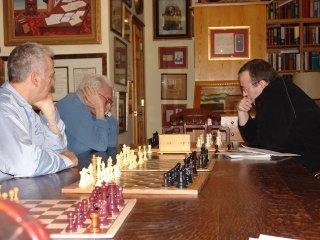
Victor Niederhoffer, Art Bisquier and Nigel Davies go to the boards
(2/23/4)) |
|
Home
| |
|
Write to us at:
 (address
is not clickable) (address
is not clickable) |
The Chairman and the Grandmaster
Victor Niederhoffer and Nigel Davies
10/17/2004
Seizing the Initiative: A Talk Between Victor Niederhoffer and Nigel Davies
Victor Niederhoffer: A Southern cotton trader who runs a large hedge fund and is given to liberal causes and Prechter
analysis likes to say that when you have a position and it goes against you,
and then comes back, you should stay with it instead of exiting the way
that there is
a substantial tendency to do, as 99 out of 100 people do. "Oh my gosh, I'm in the
land of the living." Like all such statements this should be tested. Who
knows -- one of the shibboleths might be correct.
This came to the fore today when an excellent board game player suggested
he'd be lightening in a similar position that was way against and now looked
like it was catching up. I could almost hear the, "Whew, I'm almost even," in his
e-mail. I told him something that might have been helpful for his board games
also: If you have the initiative you have to go for the win. Once you let it go,
it's gone.
The
Grandmaster
comments
 Lasker's
Manual of chess explains at length that the player with the
advantage MUST attack, but I don't think it's quite as simple
as that. A player must know he has the advantage, and this
calls not only for knowledge but the way someone's temperament
may color their judgment. I think we can look for factors in
any position that confirm what we want to believe. I think
that this has quite far reaching implications for both
chessplayers and traders. Optimists will focus on the good
sides of a situation and commit heavily to the attack,
pessimists will operate with safety in mind and try to see how
they can deal with their opponent's threats. Which is better?
Both have their advantages. Petrosian became World Champion
with a quite pessimistic outlook, rarely losing and almost
never having a bad tournament. The very optimistic Bent Larsen
on the other hand won many tournaments (probably much more
prize money) but had more than his fair share of disasters.
Lasker's
Manual of chess explains at length that the player with the
advantage MUST attack, but I don't think it's quite as simple
as that. A player must know he has the advantage, and this
calls not only for knowledge but the way someone's temperament
may color their judgment. I think we can look for factors in
any position that confirm what we want to believe. I think
that this has quite far reaching implications for both
chessplayers and traders. Optimists will focus on the good
sides of a situation and commit heavily to the attack,
pessimists will operate with safety in mind and try to see how
they can deal with their opponent's threats. Which is better?
Both have their advantages. Petrosian became World Champion
with a quite pessimistic outlook, rarely losing and almost
never having a bad tournament. The very optimistic Bent Larsen
on the other hand won many tournaments (probably much more
prize money) but had more than his fair share of disasters.
Perhaps it boils down to the kind of competition you play in. It is
noticeable that Western Grandmasters (Larsen, Timman, Miles for example) have
tended to be optimistic and uneven, perhaps because volatility (finishing first
or last) is much better than consistency (always finishing fourth). On the other
hand consistency was vital for Soviet players for them to battle their way
through all the internal qualifying tournaments. What is the best approach for a
trader? Would it not depend on the kind of tournaments you play in?
High risk and high return may be the best way in some competitions, low risk
and consistency may be better for others. I would guess that the 'nature of the
tournament' is dictated by the intestinal fortitude and expectations of the
investors or backers.
Victor Niederhoffer adds: Had a
discussion with Art Bisguier, winner of every U.S. National Chess Title from
Juniors to Seniors about the importance of seizing the initiative as it relates
to board games, racket sports and trading.
Many factors to consider. Key is the strength of the opponent. If opponent is
strong, then your only chance is to seize the initiative when you have it.
Otherwise, you'll get ground into defeat. Art says the major mistake he sees
weaker players make against strong is having a certain edge at the beginning of
a game, and then pulling in the horns and not taking it.
Of course, the market mistress you play against is very strong. And the only
one that can grind is her. So you have to grab it in market from that context.
Another key variable is whether you're playing a match game or a tournament.
Responding to Nigel’s point about Petrosian's game, Art pointed out that Pet
would much rather win a match 5 to 0 with 5 draws then 9 to 2 with one draw. But
of course in the latter situation the market player comes up with much more
winnings.
The key contribution I would add to my point about seizing the initiative is
that when someone gives you the initiative, it's usually at a price of setting
himself up for a gain if you don’t take it. Every opportunity you give your
opponent sets up an advantage for you if he doesn’t take it. Example: hitting a
lob in tennis. If your opponent doesn’t smash it, then you can move back to
position and your opponent is deep. If you're stronger to start with then your
opponent is gone.
Art adds the analogy to chess where every pawn move forward creates a
weakness so that there must be a offensive and total reason for aggressive pawn
moves. Most people see the paradigm arise in football or basketball games where
a team is ahead near the end and often moves to a running game late in the game
only to have the team's edge dissipated when they play more conservatively.
In general, I would conclude that in market situations it is very hard to get
the edge. When you have it and don’t run with it, you are setting up the
certainty that the better foundation that the market mistress usually has
against you will lead you to ultimate destruction. Perhaps the most direct
application of this is to let your profits run when you are on a streak.
The Grandmaster responds: A nice addition
to Lasker's statements about the advantage ('He who has the advantage must
attack') is the principle of proportion, i.e. that the strength of the attack
should be in proportion to the advantage held (see Lasker's Manual of Chess for
details). Here again there can be a difference in style/temperament that goes
beyond a knowledge that you have the advantage. Petrosian's games usually
feature a large number of preparatory moves and a distinct tendency not to burn
his bridges in pursuing an attack. Tal on the other hand would tend to commit
heavily. So whilst both players may recognize that they have the advantage and
play for an attack, their 'position size' would be quite different. This in
itself would explain Tal's fierce rate of scoring but higher 'risk of ruin' in a
tournament. Two games in the same opening nicely illustrate the difference
between the restless dynamism of Tal and the more careful and compact approach
of Petrosian. Tal plays in expansive style, sacrificing a knight on move 13.
Petrosian uses the positive sides (queenside pawn majority, e5 square) of his
position much more quietly.
Gurgenidze,B - Tal,M [A78] URS-ch24 Moscow (1), 1957
1.d4 Nf6 2.c4 c5 3.d5 e6 4.Nc3 exd5 5.cxd5 d6 6.Nf3 g6 7.e4 Bg7 8.Be2 0-0
9.0-0 Re8 10.Nd2 Na6 11.Re1 Nc7 12.a4 b6 13.Qc2 Ng4 14.h3 Nxf2 15.Kxf2 Qh4+
16.Kf1 Bd4 17.Nd1 Qxh3 18.Bf3 Qh2 19.Ne3 f5 20.Ndc4 fxe4 21.Bxe4 Ba6 22.Bf3 Re5
23.Ra3 Rae8 24.Bd2 Nxd5 25.Bxd5+ Rxd5 26.Ke2 Bxe3 27.Rxe3 Bxc4+ 0-1
Donner,J - Petrosian,T [A63] Gothenburg Interzonal Gothenburg (21), 1955
1.d4 Nf6 2.c4 c5 3.d5 e6 4.Nc3 exd5 5.cxd5 d6 6.Nf3 g6 7.Nd2 Nbd7 8.g3 Bg7
9.Bg2 0-0 10.0-0 Qe7 11.h3 b6 12.a4 Ba6 13.Re1 Ne8 14.Nb5 Bxb5 15.axb5 Nc7
16.Qb3 Nf6 17.Nb1 Rfb8 18.Nc3 a6 19.Be3 axb5 20.Nxb5 Nxb5 21.Qxb5 Nd7 22.Bd2 h5
23.Bc3 Qd8 24.f4 h4 25.g4 Bxc3 26.bxc3 Ra5 27.Qc6 Nf8 28.e4 Rc8 29.Qb7 Rb8
30.Qc6 b5 31.Rxa5 Qxa5 32.Re3 b4 33.Qxd6 Rb6 34.Qc7 bxc3 35.Re1 c2 36.Rf1 Qb4
37.Kh2 Rb7 38.Qc8 Rd7 39.Qa8 Qd2 40.Qa3 c4 41.Qa1 Rb7 0-1
In trading terms a similar scenario might be seen should two traders want to
buy the same stock or futures contract. One sees a price decline as an
opportunity to pile in, the other takes part of his more modest position on the
decline hoping to buy the rest cheaper. The first trader takes a greater risk
should the merchandise go down further (eg to zero!) whereas the second will not
profit as much should he be right.
10/18/04
Daniel Flam adds:
Nigel was talking about Petrosian vs Tal - how Tal was careless etc...
well... GM Leko was over cautious enough in game 12, and lost his
chance at being WC.... so sometimes, underbetting is as bad as
overbetting... optimal F again?
For more of Victor Niederhoffer's writings,
click here>>>
For more from
Grandmaster Nigel Davies>>>