
|
|
|
|
 |
Daily Speculations The Web Site of Victor Niederhoffer & Laurel Kenner Dedicated to the scientific method, free markets, deflating ballyhoo, creating value, and laughter; a forum for us to use our meager abilities to make the world of specinvestments a better place. |
Write to us at:
 (address is not clickable)
The Grandmaster
Nigel Davies
3/18/2005
Point Count Chess
I don't play bridge but bought a secondhand copy this morning to understand the basis for "Point Count Chess." This kind of methodology would seem to have interesting applications to trading, but what number of points should one ascribe to different factors when trying to read the market's hand?
From the intro:
"The basis of this method is my old ditty: 'An opening bid facing an opening bid will prduce game.' Translated into figures, a partnership holding of 26 points will normally produce game.
"Now every time you have 26 points, I don't want you to go out and hock your Grandpa's portrait to make a bet with the local bookmaker on coming home with the game. Many a 26 pointer has gone down to defeat. Such mishap should be accepted with equanimity. The finger of scorn is not to be pointed at some unfortunate player to the tune of, 'There goes a man with 26 points who failed to contract for game!' Nor should the scarlet letter be branded upone the forehead of an otherwise virtuous young lady, who contracted for game with somewhat less than the required count only to be set a trick or two."
Victor Niederhoffer comments
One of the strange aspects of regression equations (used for explanation or prediction ) of the form
a + bx equals y
is that if a and b are displaced by a small amount or rounded to come up with a new prediction, the correlation between y and the new prediction is very high. Thus, a simple point count, or a rounded simple prediction, often does better statistically and practically than a complicated formula. Therefore, the point count method for our field might be much more a propos than it seems.
A good way to investigate this is by simulation and I hereby ask the world's most facile simulator, Mr Tom Downing, who is doing very able work for us on all fronts, to do same for this general problem and report the results to our good readers.
Photos © Larry Fletcher
2004
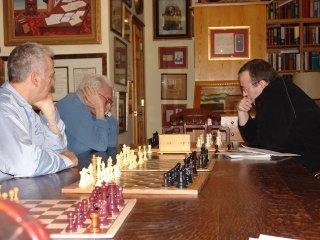
Nigel Davies takes
on fellow Grandmaster Art Bisguier as Victor Niederhoffer looks on. (2/23/4)
Nigel Davies is a trader and an International Chess Grandmaster residing in the United Kingdom. Visit his Web site at www.tigerchess.com.