Nov
8
A Circuit Describing Price Action in Markets, from Victor Niederhoffer
November 8, 2012 |
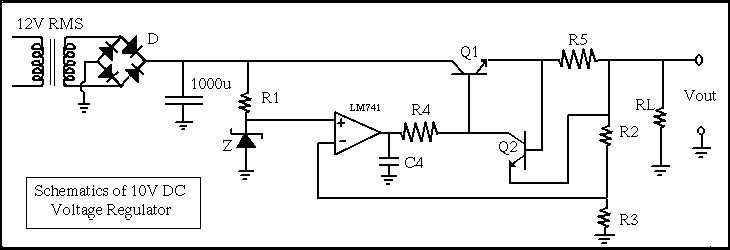 One has found that there is an electronics circuit that almost always retrospectively provides a great description of price action in markets. I wonder if there is an electronics circuit that compresses the voltage output keeping it in a range, sort of like the finger in the dike, but then after the compression is over on the negative side, e.g after the negative feedback is taken away, the voltage doesn't immediately lead to tremendous negative voltage. I seem to remember such a circuit with op amps.
Jon Longtin writes:
There are a variety of electronic circuits that perform such a role, depending on the application. One common application is a voltage regulator, which provides a (nearly) constant voltage, regardless of the load applied to it. The circuit monitors the actual voltage currently being provided and compares to a pre-set reference value. The difference between the actual and desired (setpoint) values is called the error, and is used to adjust the current provided to the circuit to bring the voltage back to the setpoint value. For example if the load increases (more electricity demand) the load voltage will drop and the voltage regulator will provide more current to bring the voltage back up. Same goes for a decrease in load.
There are some limitations and compromises in such a circuit. First is there is a finite amount of current that the power supply/voltage regulator can be provided, and if the error signal requests more than this amount, the output will not be maintained. Also of importance is the time response: a circuit with a very fast time response will respond more quickly to fluctuations in the load, but can also result in so-called parasitic oscillations, in which the output oscillates after a fast change in load is made. By contrast a longer time response provides a slower response to a variation, but tends to damp oscillations. This same behavior, of course, is seen in countless financial indicators, and is part of the art in deciding, e.g., how many prior data points to include in a signal.
A somewhat more complex version of the above, and perhaps more closely aligned with the behavior of a market signal, is an audio "compressor/limiter". This is a device that constantly monitors the volume (magnitude or voltage) of an audio signal and makes adjustments as needed. A limiter is the simpler of the two and simply sets a threshold above which a loud signal will be attenuated. The attenuation is not (usually) a brick-wall however; rather a signal that exceeds the threshold value is gently attenuated to preserve fidelity without overloading the audio or amplifier circuitry. A compressor is a more complicated animal and provides both attenuation for loud signals AND amplification for quieter ones. In essence a HI/LO range or window is established on the unit, and signals exceeding the HI limit are attenuated, while signals below the LO limit are amplified. This resulting output then (generally) falls within the HI/LO range. This is used extensively (too much!) in commercial music. Humans naturally pay attention to louder sounds (ever notice how the volume universally jumps when commercials come on TV? They are trying to grab your attention with the louder volume). Pop music attempts to achieve the same by using aggressive compression to provide the loudest average volume for program material without exceeding the maximum values set by broadcast stations or audio equipment. The result, however is that the music sounds "squished" and doesn't "breath" because the dynamic range of the content has been reduced considerably. With such devices there are a variety of adjustments to determine the thresholds, time before taking action (the attack time) and how gradually or strongly to attenuate (amplify) signals that exceed the envelop range.
Here' s a fairly decent article that describes this in more detail.
Incidentally both of the above are examples of a large branch of engineering called Controls Engineering. The idea, as Vic stated, is to monitor the output by using feedback and make adjustments accordingly. There are countless different algorithms and approaches, as well as very sophisticated mathematical models (people build careers on this) to best do the job. Like most complex things, there is no single approach that works best for every problem, but rather involves a balance of performance, cost, and reliability.
I highly suspect such algorithms have already found their way into many trading strategies, one way or another.
If interested, I can suggest some references for further reading (though I am not a Controls person myself).
Bill Rafter writes:
Think of your voltage regulator as a mean-reversion device. If a lot of this is being done, then your trading strategy must morph into simply following the mean.
In light of recent changes in the investment climate we suggest that one should tighten up controls in which one is long a given market. Perhaps that might also or alternatively mean (a la Ralph) tightening the size of the positions. The result will be taking less risk and incurring less return, but taking additional risk would seemingly not be rewarded in the current milieu.
Jim Sogi writes:
Dr. Longtin's description of compressors and limiters was
fascinating. A compressor on my guitar signal chain prolongs the
sustain on a signal in addition to smoothing out the volume spikes and has less fade as the signal weakens. With added volume, one gets a
nice controlled feedback.
Sometimes in the markets one sees a sustained range with the spikes being attenuated reminiscent of a nice guitar sustain.
On a different note, one curious thing is that people cannot discern differences in absolute volume. It's very hard to hear the differences
in volume between two signals unless they are placed side by side.
Comments
1 Comment so far
Archives
- June 2026
- May 2026
- April 2026
- March 2026
- February 2026
- January 2026
- December 2025
- November 2025
- October 2025
- September 2025
- August 2025
- July 2025
- June 2025
- May 2025
- April 2025
- March 2025
- February 2025
- January 2025
- December 2024
- November 2024
- October 2024
- September 2024
- August 2024
- July 2024
- June 2024
- May 2024
- April 2024
- March 2024
- February 2024
- January 2024
- December 2023
- November 2023
- October 2023
- September 2023
- August 2023
- July 2023
- June 2023
- May 2023
- April 2023
- March 2023
- February 2023
- January 2023
- December 2022
- November 2022
- October 2022
- September 2022
- August 2022
- July 2022
- June 2022
- May 2022
- April 2022
- March 2022
- February 2022
- January 2022
- December 2021
- November 2021
- October 2021
- September 2021
- August 2021
- July 2021
- June 2021
- May 2021
- April 2021
- March 2021
- February 2021
- January 2021
- December 2020
- November 2020
- October 2020
- September 2020
- August 2020
- July 2020
- June 2020
- May 2020
- April 2020
- March 2020
- February 2020
- January 2020
- December 2019
- November 2019
- October 2019
- September 2019
- August 2019
- July 2019
- June 2019
- May 2019
- April 2019
- March 2019
- February 2019
- January 2019
- December 2018
- November 2018
- October 2018
- September 2018
- August 2018
- July 2018
- June 2018
- May 2018
- April 2018
- March 2018
- February 2018
- January 2018
- December 2017
- November 2017
- October 2017
- September 2017
- August 2017
- July 2017
- June 2017
- May 2017
- April 2017
- March 2017
- February 2017
- January 2017
- December 2016
- November 2016
- October 2016
- September 2016
- August 2016
- July 2016
- June 2016
- May 2016
- April 2016
- March 2016
- February 2016
- January 2016
- December 2015
- November 2015
- October 2015
- September 2015
- August 2015
- July 2015
- June 2015
- May 2015
- April 2015
- March 2015
- February 2015
- January 2015
- December 2014
- November 2014
- October 2014
- September 2014
- August 2014
- July 2014
- June 2014
- May 2014
- April 2014
- March 2014
- February 2014
- January 2014
- December 2013
- November 2013
- October 2013
- September 2013
- August 2013
- July 2013
- June 2013
- May 2013
- April 2013
- March 2013
- February 2013
- January 2013
- December 2012
- November 2012
- October 2012
- September 2012
- August 2012
- July 2012
- June 2012
- May 2012
- April 2012
- March 2012
- February 2012
- January 2012
- December 2011
- November 2011
- October 2011
- September 2011
- August 2011
- July 2011
- June 2011
- May 2011
- April 2011
- March 2011
- February 2011
- January 2011
- December 2010
- November 2010
- October 2010
- September 2010
- August 2010
- July 2010
- June 2010
- May 2010
- April 2010
- March 2010
- February 2010
- January 2010
- December 2009
- November 2009
- October 2009
- September 2009
- August 2009
- July 2009
- June 2009
- May 2009
- April 2009
- March 2009
- February 2009
- January 2009
- December 2008
- November 2008
- October 2008
- September 2008
- August 2008
- July 2008
- June 2008
- May 2008
- April 2008
- March 2008
- February 2008
- January 2008
- December 2007
- November 2007
- October 2007
- September 2007
- August 2007
- July 2007
- June 2007
- May 2007
- April 2007
- March 2007
- February 2007
- January 2007
- December 2006
- November 2006
- October 2006
- September 2006
- August 2006
- Older Archives
Resources & Links
- The Letters Prize
- Pre-2007 Victor Niederhoffer Posts
- Vic’s NYC Junto
- Reading List
- Programming in 60 Seconds
- The Objectivist Center
- Foundation for Economic Education
- Tigerchess
- Dick Sears' G.T. Index
- Pre-2007 Daily Speculations
- Laurel & Vics' Worldly Investor Articles

It is one of the largest sand dune fields in the United States. The bright white sand dunes are always changing, always moving, like waves on the ocean. Driven by strong winds, the sand moves and covers everything in its path. It is like a huge sea of sand.