Feb
28
Balls, Body and Swing: An Evolutionary Article, from Bo Keely
February 28, 2011 |
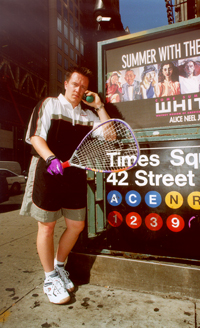
Sports equipment evolves the player…movement… and final strategy.
In the beginning, 1971, the racquetball was mush, and the strokes slow to push it around the old courts in winning rallies. The pros, like me, were string beans wielding tiny racquets.
Then in the 80s, the ball quickened and the strokes changed to power, with deeper contact and a bullwhip crack.
In the 90s, the pace of play was frightfully heightened by the superball with big-head racquets, crisper strokes, and squat players.
There have been three epochs. The early, lanky champs with push strokes were Bill Schmidtke, Bud Muehleisen, and Charley Brumfield. The intermediary fireplugs with power swings on a relatively fast ball were Mike Yellen, Dave Peck and Marty Hogan. The current bulldog elite are Sudsy Monchik, Jason Manino and the better of the rest who explode on shots like weightlifters at a bar. The power serve increasingly dominates over time, and the rally length and millisecond to ponder between shots decrease in proportion to ball speed.
The ball begot the stroke begot the player, and that's the history of racquetball. And, likely, any sport, military or industry evolves with equipment.
What can you do about this trend to improve your game? My play girdles all the game eras, so these solutions are from observations of ball, racquet and champ body developments, and matching my molasses stroke against the diverge of three swings of the 'Big Three' players in successive eras– Marty Hogan, Sudsy Monchik and Cliff Swain.
Each champ adapted with a stroke to meet the speedier ball, yet with commonalities. These shared elements are: 1) Fast set-up on the shot; 2) Quick swing, tending from linear toward circular; 3) Deep contact to allow the speeding ball; 4) Stroke power for ball velocity; 5) A closed racquet face to counteract the approaching topspin ball scooting along the hardwood.
The three model strokes by yesterday's and today's 'Big Three' players embrace all these requisites, with a gripping consistency near the butt low on the handle. This gives leverage a la holding a hammer handle bottom, 'closes' the racquet face to off-set an oncoming topspin, and allows a deeper contact where the face automatically squares to meet the ball.
 The trade-off of power boost for loss of accuracy is no longer debatable: the name of the new game is power, not bulls eye. To the contrary, I first honed accuracy as a novice, and gradually increased power, as portrayed in a daily practice Heads Up! drill with the Michigan State University hockey, wrestling and football teams. One player sat with his back against the front wall facing the service line, as the other dropped and killed the shot to a halo region around his head. The idea was to simulate tournament pressure and not blink. Eventually someone got bonked and the roles were reversed.
Now look at the three almighty unalike strokes of the Big Three, and match the salient points of quick set-up, quick swing, deep contact and power. These stroke variations in biological evolution (don't blink) are called adaptive radiation, so let's briefly look at each.
Marty Hogan's young stroke was ridiculed by the era's masters as an awkward use of raw power, even as they ate crow. Hogan's fulfills the requirements for a modern stroke by using a pendulum swing that contacts the ball deeper heretofore than anyone. 'The pendulum starts way up, 'as high as I can reach on the back swing,' he says. The mechanics are the more an arc uplift of, say, a clock pendulum, the greater the swing power. Marty boosts this force by suppinating (laying back so the palm is up) the wrist at the top of the forehand, and pronating (flexing the wrist approximately the opposite direction) at the top of the backhand back swing. It allows a very deep hitting zone -an extreme off the rear foot- that translates into a split-second extra set-up time with a stronger report. At his level, shades make the difference in brilliance.
Sudsy Monchik takes a new swing that, like predecessor Hogan, engendered a new crop of strokes across the country. 'Compact, close to the body and explosive, like a bull tossing its head,' he describes his swing. The grip for his forehand and backhand, as noted, is low on the handle with an extremely closed face. The swing is best described as classical explosive with precise timing. The odd thing is Sudsy may run the court in a crouched position as if in a horizontal mine shaft, chasing and hitting faster than most uprights.
Cliff Swain's success with a dissimilar stroke relies on early racquet preparation. His teaching clinic preamble and conclusion is, 'I hate to harp, but get your racquet up and back early'. Cliff is a praying mantis on the court, stalking prey, ball, and leaping to score. Where Hogan gains a precious instant with a deep contact, and Sudsy by scampering in a squat, Swain has already made a back swing- low, wrist cocked- like a gunslinger who replies without flinch, 'That was my draw, do you want to see it again?'
When the smoke clears on equipment, stroke and body type evolution, adaptive radiation is the driving force. This is the process in which one species gives rise to multiple species that exploit different niches, in a relatively short period of time. The changing ball has produced new anatomical champs exploiting forced new strategies.
Who's responsible for the speeded ball? The answer is the reason baseball prevailed over softball, sponge ping-pong paddles won out, and basketballs are highly pressurized. The ball manufacturers ultimately control a sport's evolution, racket makers fall in step… and it's all due to public capability and culpability The manufacturers hype action in sport to convince participants it's more fun, pressurized balls wear out and break sooner, and a fast game is easier for beginners, youngsters, elderly, and particularly ladies whom the males follow buying more balls.
The tendency in recent decades in all sports is away from analysis toward frenzy. The process is rapid and ongoing. My fellow animals, swing with the champs, and win!
Comments
Archives
- June 2026
- May 2026
- April 2026
- March 2026
- February 2026
- January 2026
- December 2025
- November 2025
- October 2025
- September 2025
- August 2025
- July 2025
- June 2025
- May 2025
- April 2025
- March 2025
- February 2025
- January 2025
- December 2024
- November 2024
- October 2024
- September 2024
- August 2024
- July 2024
- June 2024
- May 2024
- April 2024
- March 2024
- February 2024
- January 2024
- December 2023
- November 2023
- October 2023
- September 2023
- August 2023
- July 2023
- June 2023
- May 2023
- April 2023
- March 2023
- February 2023
- January 2023
- December 2022
- November 2022
- October 2022
- September 2022
- August 2022
- July 2022
- June 2022
- May 2022
- April 2022
- March 2022
- February 2022
- January 2022
- December 2021
- November 2021
- October 2021
- September 2021
- August 2021
- July 2021
- June 2021
- May 2021
- April 2021
- March 2021
- February 2021
- January 2021
- December 2020
- November 2020
- October 2020
- September 2020
- August 2020
- July 2020
- June 2020
- May 2020
- April 2020
- March 2020
- February 2020
- January 2020
- December 2019
- November 2019
- October 2019
- September 2019
- August 2019
- July 2019
- June 2019
- May 2019
- April 2019
- March 2019
- February 2019
- January 2019
- December 2018
- November 2018
- October 2018
- September 2018
- August 2018
- July 2018
- June 2018
- May 2018
- April 2018
- March 2018
- February 2018
- January 2018
- December 2017
- November 2017
- October 2017
- September 2017
- August 2017
- July 2017
- June 2017
- May 2017
- April 2017
- March 2017
- February 2017
- January 2017
- December 2016
- November 2016
- October 2016
- September 2016
- August 2016
- July 2016
- June 2016
- May 2016
- April 2016
- March 2016
- February 2016
- January 2016
- December 2015
- November 2015
- October 2015
- September 2015
- August 2015
- July 2015
- June 2015
- May 2015
- April 2015
- March 2015
- February 2015
- January 2015
- December 2014
- November 2014
- October 2014
- September 2014
- August 2014
- July 2014
- June 2014
- May 2014
- April 2014
- March 2014
- February 2014
- January 2014
- December 2013
- November 2013
- October 2013
- September 2013
- August 2013
- July 2013
- June 2013
- May 2013
- April 2013
- March 2013
- February 2013
- January 2013
- December 2012
- November 2012
- October 2012
- September 2012
- August 2012
- July 2012
- June 2012
- May 2012
- April 2012
- March 2012
- February 2012
- January 2012
- December 2011
- November 2011
- October 2011
- September 2011
- August 2011
- July 2011
- June 2011
- May 2011
- April 2011
- March 2011
- February 2011
- January 2011
- December 2010
- November 2010
- October 2010
- September 2010
- August 2010
- July 2010
- June 2010
- May 2010
- April 2010
- March 2010
- February 2010
- January 2010
- December 2009
- November 2009
- October 2009
- September 2009
- August 2009
- July 2009
- June 2009
- May 2009
- April 2009
- March 2009
- February 2009
- January 2009
- December 2008
- November 2008
- October 2008
- September 2008
- August 2008
- July 2008
- June 2008
- May 2008
- April 2008
- March 2008
- February 2008
- January 2008
- December 2007
- November 2007
- October 2007
- September 2007
- August 2007
- July 2007
- June 2007
- May 2007
- April 2007
- March 2007
- February 2007
- January 2007
- December 2006
- November 2006
- October 2006
- September 2006
- August 2006
- Older Archives
Resources & Links
- The Letters Prize
- Pre-2007 Victor Niederhoffer Posts
- Vic’s NYC Junto
- Reading List
- Programming in 60 Seconds
- The Objectivist Center
- Foundation for Economic Education
- Tigerchess
- Dick Sears' G.T. Index
- Pre-2007 Daily Speculations
- Laurel & Vics' Worldly Investor Articles
