Jun
18
Is Checkers a Solved Game? from Charles Pennington
June 18, 2010 | 3 Comments
 I was having a discussion with a colleague on the topic of Chess vs. Checkers. Somewhere I had the impression that Checkers had been "solved" –that it is ultimately an elaborate version of tic-tac-toe, i.e. there is a well-defined correct move to make in every situation. Chess though is different, as I understood it–there is no known correct way of playing in every situation, either because it can't be known in principle or because the computers just haven't found it yet. Can someone set me straight on this topic? (Background: I haven't played chess or checkers in over 30 years, but I am quite good at tic-tac-toe.
Nigel Davies weighs in:
As I understand it there is no 'solution' as such to either game and that with checkers in particular it is quite easy to make it considerably harder by playing on a larger board and with more pieces (one can also play 'big chess', though this looks somewhat artificial to my eye). With regard to board games being 'computer proof' it's also worth checking out Shogi and (especially) Go where computers are still rather mediocre compared to the best humans.
From the point of view of educating children all of these games are wonderful in that they can teach the young to falsify their own ideas. In order to play 'well' one must find out what's wrong with a move before playing it on the board.
One major consideration in the choice of game might be the number of opponents to be found. In the West at least I believe this is where chess shows to advantage.
Hope this helps.
Pitt T. Maner III writes:
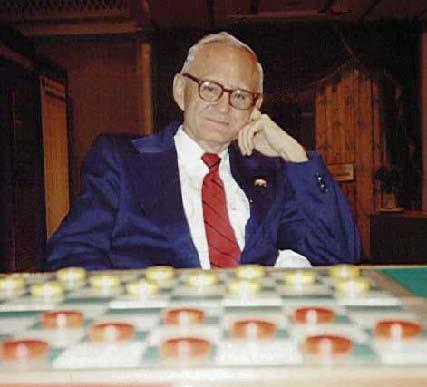 Dr. Schaeffer wrote an appreciation of one of the best checker players ever, Marion Tinsley, who actually liked the challenge of facing a computer (nicknamed Chinook).
After Chinook's first game against Tinsley in 1990, we started analyzing the game. Tinsley began recounting the history of the line we played, recalling games he played in the 1940's! The move sequences flowed easily from him without hesitation, sometimes annotated with the name of the opponent, date or place where the game was played! 1947 was as vivid in his memory as if it were only yesterday. The second facet to his play was his incredible sixth sense. A glance at a position was sufficient to tell Tinsley everything he needed to know. For example, in 1990 Chinook was playing Tinsley the 10th game of a 14 game match (won by Tinsley 1-0 with 13 draws). I reached out to play Chinook's 10th move. I no sooner released the piece when Tinsley looked up in surprise and said "You're going to regret that". Being inexperienced in the ways of the great Tinsley, I sat there silently thinking "What do you know? My program is searching 20 moves deep and says it has an advantage". Several moves later, Chinook's assessment dropped to equality. A few moves later, it said Tinsley was better. Later Chinook said it was in trouble. Finally, things became so bad we resigned. In his notes to the game, Tinsley revealed that he had seen to the end of the game and knew he was going to win on move 11, one move after our mistake. Chinook needed to look ahead 60 moves to know that its 10th move was a loser. In my experience with tournament chess and checker players, the sixth sense is experience. It is well-known how intensely Tinsley studied the game, analyzing anything from a Grandmaster game to a game between novices. His uncanny ability to know good from bad and safe from dangerous, is the direct result of all his hard work. Strong chess players have the same ability, but perhaps it is not quite as evident as it was with Tinsley .
Nigel Davies writes:
Seems like we get a whisker away from quite deep philosophical questions. My personal belief is that the goal of 'replacing humanity' in the cause of 'efficiency' is a deeply flawed one. It always feels to me like the attempt to show that computers can 'play' these games much better makes our attempts at self-improvement appear futile, an idea which many people will buy into. Is it too fanciful to suggest that they represent a 'greater goal' of being looked after by machines whilst humans have mindless 'fun'? Nigel Davies
David Hillman writes:
This is not unlike giving up the warm, tactile sensation of the paper page in a book for the slick plastic of a Kindle, or the daily newspaper's beautiful scent of cheap pulp and ink replaced by the netbook's display. The aromas of silicone and polymers do not mix as kindly with the scent of espresso wafting on the morning air. My own livelihood is derived from computer-based industrial productivity and efficiency systems, but my life is kept on a yellow legal pad with a #2 pencil. Balance, always balance. To paraphrase Queen, "we need it all and we need it now." The Deep Blue's, Chinook's, etc. may be wondrous, but there is simply no mineral nor petrochemical-based substitute for the hug of a happy child, for the lap of a caring spouse upon which to lay one's head at the end of a bad day, or for the twinkle in a grand-master's eye across the chessboard when he mates you in 6 moves.
Nigel Davies responds:
I don't think it's the same thing David. An analogy with having a kindle versus a book would be to play chess against a human via your PC. Having computers do the playing and trying to demonstrate their 'superiority' is more like having them write the books, and purportedly do it more efficiently than humans; fewer words for the same meaning perhaps, 'War and Peace' reduced to 10 pages.
Chris Tucker agrees:
I agree with you completely Alan, my point is just that programmers are not out to replace us completely (yet, anyway), but they are out to codify decision making. Games are a good place to do this because the rules and possible moves are very limited, even though the number of possible outcomes can be astronomical. The arena is structured and they can test and validate their ideas within this framework. The idea of game playing is much deeper, philosophically, (as Nigel suggests) than most care to admit. I will leave that bit for you two to explore. Machines that can replace the humanity of squaring off with an opponent do not exist, there are simply too many levels of interaction there.
Nigel Davies replies:
Chris, there is no decision making in the programs or any attempt to replicate human thinking, they simply use brute force to analyze all the possibilities (with chess slapping in a primitive evaluation function) and the mathematical limitations of the games enable them to get away with it and 'win'. Perhaps when they started out the intention was to create 'artificial intelligence', but I don't see that this claim can be maintained given the route they have taken. Looks like an ego driven attempt to 'beat mankind' of the type which enables a car to go quicker than someone on two legs.
Dave Bacon addresses the original question:
I believe Checkers on a standard sized board has indeed been solved. The reference is Science, Sept. 2007, Vol. 317. no. 5844, pp. 1518 - 1522.
“Checkers Is Solved” Jonathan Schaeffer, Neil Burch, Yngvi Björnsson, Akihiro Kishimoto, Martin Müller, Robert Lake, Paul Lu, Steve Sutphen
The game of checkers has roughly 500 billion billion possible positions (5 x 10^20). The task of solving the game, determining the final result in a game with no mistakes made by either player, is daunting. Since 1989, almost continuously, dozens of computers have been working on solving checkers, applying state-of-the-art artificial intelligence techniques to the proving process. This paper announces that checkers is now solved: Perfect play by both sides leads to a draw. This is the most challenging popular game to be solved to date, roughly one million times as complex as Connect Four. Artificial intelligence technology has been used to generate strong heuristic-based game-playing programs, such as Deep Blue for chess. Solving a game takes this to the next level by replacing the heuristics with perfection.
Jun
6
Time Horizons, Cycles, Digging, from Chris Tucker
June 6, 2010 | Leave a Comment
Recently I have been discussing lengthening my time horizons with my mentor and was tickled to find this post by GM Davies while perusing other blogs by people who post to Daily Spec. I am definitely one who is seduced by instant gratification and it is difficult for me to sit on a position for any length of time unless my indicators are emphatic about it. One evening after pondering over the theory of ever changing cycles and this post from Mr. Sogi, I found myself looking at all sorts of time intervals in charts to find the structures/setups that I prefer to trade. Lo and behold I have found that many times when a setup I like to trade is not evident in my usual time frames, if I dig a bit and look at odd frames such as one or four minute bar charts instead of two or three, or, say, 34 tick charts instead of 50, 25 or 10, then indications that were invisible in the "normal" or default charts tend to jump out at me. The same thing happens when I look at larger time frames.
One of the beautiful things about the charting tools I use is that they are flexible in this regard and allow me to be creative. Tracking down the cycle that is currently in play is a lot of work but has proven profitable. Kudos to Mr. Sogi and GM Davies for getting me thinking. Kudos to Chair for providing outlet for this incredibly diverse effusion of ideas, and for many other things not least of which is being a tremendous inspiration.
Jun
3
Patrick O’Brian Reccomendations, from Vince Fulco
June 3, 2010 | Leave a Comment
 If one were to begin the series of Patrick O' Brian books, should they be read in the order in which they were written? I'm finding good prices for some of the later books and looking to get through 1 or 2 while I am out of the country for a few weeks without internet access and distractions.
Gibbons Burke comments:
Yes, the series should be read in order, though some recommend that some readers may find that the second book of the series is a better introduction to the canon because there are more scenes on land.
I found it tremendously helpful reading the novels the first time through to have a dictionary and a pocket atlas readily available. Dean King's "A Sea of Words" is a most helpful companion to the series, as are his book of maps detailing the voyages in the novels, "Harbors & High Seas".
Google maps would be an even better resource these days. An iPad with the novels loaded into the Kindle app (they're not yet available in iBookstore), or audiobooks in the iPod app, combined with the Maps app, and the built-in dictionary would be a great way to circumnavigate the canon. Capt. Aubrey, who was ever interested in the latest go-fast sailing tech, might even approve, though it is likely O'Brian would express contempt.
Chris Tucker writes:
When Victor first introduced me to the books I mentioned that I had a bone to pick with him about them and that is that I was staying up until all hours of the night reading and I wasn't getting enough sleep. He wisely recommended that I try books on CD and listen to them while driving or whenever I had time to do so and so I forgave him for depriving me of sleep. I took advantage of the local library to get ahold of the recordings because they are a bit pricey.
If using a library, I find that tapes are actually better than CDs because if there is bad patch on a tape you may miss a few words or perhaps still here them but with derogated quality, but with a CD you may miss an entire track or two. Also important to note if listening to this series on CD or tape, Chair highly recommends, and I emphatically second, that you listen to the series as read by Patrick Tull, who manages to add to the already incredible drama that O'Brian evokes. Books read by Tull are available at RecordedBooks.com here.
Jun
2
Cutting Losses and Moving On, from Paolo Pezzutti
June 2, 2010 | 4 Comments
 An excellent trader once told me that relationships are like trades. "Paolo", he said, "If it does not work, it is time to close it and move to the next one…". It is the concept of stop loss, of having the strength to recognize failure and accept its consequences, of learning from our own mistakes without feeling frustrated and miserable. In two words, it means being mature and responsible.
As a trader, I tend not to close my losing positions; it is my main problem. I think this is common to many "wanna-be traders". I want to wait for prices to go back where they were, I do not easily accept taking a loss. Most of the times this works well especially in a choppy environment, but if you find yourself in a fast market you can be badly hit.
Similarily, in life I care much about the friendships and relationships I establish. I feel "betrayed" when I lose a friend who is important to me. It happened recently, when a dear friend decided to discontinue any type of contact with me. At the beginning with some justifications. Eventually not even answering phone calls and emails. I know that with every ending there is a new beginning, that maybe I didn't realize what kind of person this was in the first place, that I may have contributed to the situation, that I don't need this person to be happy. However, you are aware there is something of you that has gone away and will not come back. It is complicity what you miss the most. It is the awareness of having wasted emotional energies on a losing investment. "Paolo, it is a closed book. It is time for the next trade" he told me. I know this is right, but I miss this friend.
Chris Tucker advises:
Paolo, You are not a "wanna-be trader" any more than you are a "wanna-be friend". In both endeavors we are all learners all the time. Setbacks will occur in all facets of our lives and they can be painful, sometimes extremely so, but they are not a reason to condemn ourselves or to give up. It's normal to feel frustrated and miserable as long as you don't dwell there for too long. Nor do I believe that you have wasted your emotional energy. Energy that is put into something or someone you care about is never wasted, it's just that sometimes it fails to yield the benefits we expected. So I don't see you as a "wanna-be trader" but as a "trader in training", just like the rest of us, even the spectacular successes. I find that devoting my focus to finding the lessons to be learned from such things not only helps to assuage the pain associated with them, but also prepares me better for similar scenarios in the future. Perhaps you can ask yourself questions like "What can I learn from this?" or "What positive outcome can there be to this?"
Apr
29
The Gentleman’s Prelude, from Don Chu
April 29, 2010 | 5 Comments
 The Princess Bride Swordfight Scene shows a gentlemen's prelude, and how concealed ambidexterity can be a secret weapon, but can also backfire.
You will see Inigo Montoya very chivalrously allowing the Dread Pirate Roberts, aka Westley, to catch his breath after scaling a sheer cliff wall before beginning their swordfight.
Then as concealed ambidexterity is applied and revealed by both fencers one after another, the tables turn and turn yet again. But really the chivalrous Spaniard's eventual loss was sealed the moment he allowed Westley to clamber up over the cliff edge.
Chivalry, malevolence or (unjustified) pride in one's abilities?
Chris Tucker adds:
"The Princess Bride" is a movie that Aubrey simply must see. I love this movie; so do my kids. We find ourselves quoting Inigo at work frequently. "I do notta suppose you coulda speed things up?" or "I'm going to do him left-handed" or "You know what a hurry we're in!" or "It's the only way I can be satisfied" or "Inconceivable!" or "You keep on using that word. I do notta think it means what you think it means." Mandy Patinkin is priceless!
Bill Rafter adds:
"Never try to outwit a Sicilian," and "Do I have to get a new giant?"
Russ Sears writes:
My high school aged daughter tells me it is quoted all the time around her clique. Quoting it is the inside joke/ litmus test for those with verbal IQ versus those clueless.
Apr
28
Snow in April, An Afternoon’s Tale, from Chris Tucker
April 28, 2010 | Leave a Comment
 It is chilly as we step out onto the front lawn. The sky is a bit dark and the clouds skirting by overhead carry a hint of menace. And it is snowing. But the flakes are large and pink. There is a constant stream of them fluttering in the breeze as they drop from the blossoms of the big cherry tree that overhangs the driveway. There is a thick carpet of pink fluff covering the grass and blowing in swirls down the street.
The kids and I don helmets and mount our bicycles for a trek around the neighborhood. The wind bites as it cuts right through my normally cozy sweatshirt. As we climb a small hill I look over my shoulder and notice my son has stopped and is looking down at something on the pavement. It's a squirrel that has been struck by a car and luckily is thoroughly dead. My son looks down with curiosity and obvious empathy for the poor creatures plight. "Dad!" my daughter shouts, "Can we cut it open? I wanna see its brains!", this last with a bit more glee than I care to see in such a situation. "Don't touch it" I say, "you can get very sick". "Can I run it over?" she asks. "I already did by accident" my son moans. I drag them away and we zoom down the incline with the chill wind at our backs. We round a couple of turns and begin the climb up the tiny but steep hill with the big cherry tree on top that signals our yard ahead. Again I look back to see how my son is managing and I see that he is off his bike and crying loudly. I dash back and ask him how he has hurt himself, "What happened? Are you okay?". He is inconsolable, sobbing and squealing, tears pouring down his face, his chest heaving. "What is it Jack?". "Its not me", he moans between sobs. "Its because of the squirrel". Mom rushes out the front door to console him. We stand together for a moment amidst the swirling cherry blossom snow.
We get inside, I wrap both hands around a hot mug of tea and we sit at the kitchen table. "I really wanted to see its brains!" my daughter squeals with obvious delight and a wicked smile. "I think when I grow up I'll be a doctor 'cause then I can do a surgery and see someone's brains!" My poor son sits with his face in his hands, still gasping a bit and trying to catch his breath, mom hovering over him to see how she can help.
As he regains his composure I am struck by how completely different they are. And how much like their dad.
Scott Brooks writes:
Great story, Chris!
One of the great pleasures we have had on the Brooks Farms is to dissect the animals we've harvested. I know this squirrel was not killed by you guys, but getting a plastic bag and dissecting the squirrel could have very well put your son at ease. Get some surgical gloves or plastic gloves from the local drug store or big box store and make it a learning experience.
Use it as an opportunity to explain to your kids anatomy, the science of life and how the animal kingdom operates. I explained to my children how the death of an animal is no tragedy and is just part of the whole cycle of life in this world.
I should write more about that someday soon to add clarity to that somewhat vague last sentence, but it's 4:23 am and I have to wake the kids up shortly so we can go out turkey hunting and partake of the many life lessons that are involved in hunting, harvesting, dressing eating and "recycling" of the wild game that are on our farm.
Apr
28
On Taking Down a Tree, from Chris Tucker
April 28, 2010 | 2 Comments
 Last summer I had to take down a large Birch tree that had died from infestation of Bronze Birch Borers. The tree overhung the site where I was preparing to build a shed and I decided to remove it first to prevent damaging my new creation.
Upon climbing the tree in preparation for its removal I found myself reflecting on trading metaphors. There are tremendous risks in being high in a tree with a powerful chainsaw.
When one gets very high in the branches of a tree one finds it is critical to take the effects of the prevailing wind into account before doing anything. The wind can determine which part of the tree to remove first and where to drop the debris.
I think about safety first and at all times during the operation. I wear a climbing harness and attach myself to the trunk of the tree in two places with two separate lines. I pay close attention to where I place my feet and hands.
Familiarize yourself with the tree. Is it recently dead or has it been for some time? Can it be climbed safely or should it be taken down from below or from a cherry picker? A recently green tree will support large weights on a one inch diameter branch, a dry or rotten tree will do no such thing. Can you drop branches safely or are you too close to the house? Sometimes each piece has to be secured prior to cutting and lowered carefully with a line.
Use a ladder to get into the tree. Tie the ladder off to the tree in a way that prevents it from wobbling or rotating. In markets, sometimes one must stand on others shoulders to get oneself in place.
Have the necessary tools with you before you climb. It is time and energy consuming to have to go back for them. And not having the proper tool can induce you to use the wrong one rather than go all the way down and back to do it right.
Be familiar with your tools and know how to use them and care for them. Powerful tools, like leverage, allow you to do big jobs quickly but they bring powerful risks. It is amazing the number of ways a chainsaw can ruin your day. Chainsaws can bounce back out of the cut right at you so it is important to keep your face and body off to one side when cutting. Chains can break and fly back as well and fly or wrap in entirely unexpected directions. Be aware of the damage that your tools can do to you, not just the tree. Pay attention to them and treat them with the respect they deserve. Try to make allowances for the unpredicted. I've seen a chain fly off the saw and become entangled around the large branch it just removed and very nearly pull the user out of the tree.
Secure heavy tools to you or to the tree with a line strong enough to hoist them but light enough to part if the tool becomes ensnared in falling debris.
Never start using a heavy power tool until you have secure footing. I usually rest my weight into the harness and let my lifelines support me, using my feet to keep me stable.
Take your time. Being rushed will get you hurt.
Never bite off more than you can chew. When removing large portions of the tree with a single cut, they can behave in unpredictable ways, such as twisting or bouncing the tree or grabbing your lifeline and pulling it down with them. Once a very heavy piece begins to fall, there is absolutely nothing you can do to stop it.
Never extend your reach beyond what is comfortable. Using a tool at more than arms length puts you in a position that prevents you from reacting quickly if something goes wrong. It puts undue stress on you and the tool. It removes whatever leverage you have on the tool. It also prevents you from "feeling" properly through the tool. When using a power tool you receive signals about the material you are cutting and the nature of the stresses on that material. You can always tell when a branch is about to go if you are listening carefully to the tool. That feedback is denegrated by reaching too far or by using only one hand.
Several years ago a friend was cutting off a tremendous horizontal limb from a large oak. He was on a ladder extended to its maximum height and leaned up against the limb. The ladder was resting on the limb between the trunk and the cut and as the limb came off, this stub end jumped up and the ladder fell away beneath it. My friend tossed the saw and grabbed the three foot thick trunk and tried to hold on but slid down and finally fell off, shattering his femur and tearing up his chest and the insides of his arms. Had he and the ladder been secured to the tree he probably would not have fallen.
What have I missed?
Scott Brooks adds:
Hunting is considered by many to be a dangerous activity, what with a bunch of guys running around with shotguns or rifles. However, there are very few actual injuries from shooting accidents. The main cause of accidents are not the inanimate objects that send forth projectiles, but another inanimate object…tree stands.
Every year, people who feel that they are immune from the laws of gravity climb into stands and sit or stand waiting for their prey to wander by. And every year there are people who are stunned to find out that the laws of gravity are much more brutal and punishing than they thought.
There are only two types of tree stand hunters: Those that have fallen and those that haven't fallen yet. No matter how much you think you'll be able to hang on, or how adept your dexterity, you simply can't react fast enough to ward off an accident or mechanical failure.
I can personally attest to the feeling of bile rising in my throat from the fear of lost balance while perched 15 up in the air…and that was when I was wearing a safety strap.
I have a standing rule on my land. If you climb up into a tree stand, you must not only wear a safety strap, but it must be the first thing you put on when you get into the stand, and the last thing you take off when you climb down. I have asked (told) people to leave my farm because I caught them up in a tree without a safety strap.
So why even climb a tree stand if it has that much risk? It's about risk vs. return. I love the return I get from arrowing a nice buck. Same is true with trading. I love it when I get a great return for my clients. But the reality is that it's important to wear a safety strap when trading. Just as I profited in my poker playing days by taking a slow grind it out approach (never going all in), I do the same with trading. I'm satisfied with the inferior returns of a non-leveraged portfolio. My theory is that the more you leverage, the higher you're climbing and the thinner your safety strap gets.
All of my bad losses and sleepless nights have come from leveraging or taking too much risk.
That's why I'm a pretty boring guy these days.
Jim Sogi comments:
Professional tree trimmers all use a belay. Mountain climbers also belay themselves for protection or to 'hedge' their position in case of a fall.
Ken Drees writes:
Never lend your chainsaw to someone who doesn't use them much. As in don't give stock advice to people or just give them advice that is general in nature–this saves on friends. Always remember torque and twist. If you don't read and predict how the cut will behave, rethink it. I have seen trees twist and pull the wrong direction, seen limbs bind back on the saw and have trees fall off course because of hidden dead spots. Be ready for the twist of the market as it takes your trade and bends it slightly the wrong way. Once I saw a dead tree being taken down by a friend. This large straight tree as it was falling broke apart into 3 huge sections. The trunk part closest to the ground went the right way and the other two in tangents like a V. Market wise–don't mess around with a junk-trade–its just not worth it and you can get hurt. And lastly don't drink beer before operating a chainsaw, nor chop wood with only shorts on, or put your hot saw down in a pile of dead leaves.
Pitt T. Maner III adds:
 Ok, this is a little bit like what I have been doing the past 2 years–namely Health and Safety oversight for pipeline and tank construction workers… guess who the least favorite person on the jobsite is?
There are probably better business analogies than below but here it goes (this is the short list! and not complete by any means, OSHA website would be a good resource):
1. I would have a health and safety plan in place with contact numbers and how to get to the hospital. Is there a written plan of action for each step of the process with the risks involved and the ways to mitigate the risk. (Investment plan)
2. Use a "buddy system". Have a friend nearby that can help you in case of an emergency. Have a 1st Aid Kit and someone Red Cross trained in 1st Aid and CPR. (Mentors and advice of others)
3. Survey the tree to make sure there are no hazards you have missed. Electrical lines. Red ants. Poisonous plants. etc. Ask yourself what is the worse thing that could happen (What could go wrong with your investment? What could come back to bite you?)
4. Inspect your equipment. Is your climbing harness worn anywhere? Are the lanyards of the proper length? (Guys have died or hurt themselves badly by not having the proper length on the lanyard, yeah they had their fall protection on it just didn't stop them in time from hitting the ground). Is the ladder rated for your weight? Do you have a GFCI if you are using an electric chan saw? Do you have cut resistant gloves? Do you have on hearing and eye protection? Level D OSHA clothes?
5. If it is hot or cold you need to take a break. Drink water. If you get tired you are more likely to make a mistake. (Take regular breaks from the computer screen)
6. Do you have enough light? Night time operations are doubly dangerous for workers. You need visibility. (Transparency in your investments)
7. Have you set up for disposing of the branches and such. You don't want the city to fine you unnecessarily for yard trash. (Tax consequences)
8. Wouldn't it be cheaper given the risks to have a professional service do it? (ETFs/mutual funds vs. individual management)
9. Are you sure the tree won't fall on someone else's property or their fence? (What are the liability issues?)
10. If I do get hurt what will the effects be to my family and others? Do I have the skills, knowledge, and physical abilities necessary to do the job right and do I understand the risks? Am I in a good state of mind and able to stay calm and not get angry if something doesn't work out right? Do I have a fear of heights?
We always carry a card around in the wallet for safety reference and it sort of boils down to 3 steps: 1) Assess; 2) Analyze; and then 3) Act.
It sounds like overkill but an effective safety "culture" within companies has been shown to dramatically reduce injuries, deaths and all sorts of economic and emotional costs. And it is a good idea to teach everyone at home how to stay safe too. If you do not have a sense of vulnerability then you are susceptible to hurting yourself or others around you.
Russ Sears comments:
In the last four years I took down three cedar trees that were dying. Here are a few things I did that were missing from the lists above.
1. Limit the access to the area. Shut down the drive-way, no extra people or kids allowed etc. Tree cutting is not a spectator sport. The trading room is sacred. No extra people or kids. Never show off.
2. Notify the neighbors when near their property. Likewise no kids. They let me know if they would be outside etc. I worked around their schedule. When working with others money, its all about them, not you.
3. Call the buried cable hot-line to have it marked before. Know the hidden risks and try to avoid them.
4. Have lots of rope. Extra rope tied to the tree and other trees can help prevent the tree from going the wrong way onto the house. Controlled slack on a large trade is a must.
5. Keep the area clean, limbs dragged away as they are cut. You never know when you may need that exit.
6. Rent what you do not have, but get the right size saw above all. It may cost more, but do it right.
7. Have patience. Take it in small pieces. It is only impressive in the vast woods when it all comes down at once. In your yard it will only be damage. Know your size. And do not try to meet a schedule. Pay that extra day's rent, Leave the stump up till next weekend. Do not try to swing for the fences to meet some arbitrary goal.
Vincent Andres writes:
All valuable advice in this tree thread! Not to say it's missing, but I often add an iron chain as a line (with mountain climbing equipment).
Among dangerous things a falling tree is able to do, having the foliage act like a spring is a rather vicious one. The tree falls nicely with its big round green foliage, everything seems OK, but the green foliage is slowly compressed/crushed (for 2 or 3 seconds) and then the compressed unbroken foliage uncompresses and moves the 3 ton trunk in whichever direction. If you're in the way you're killed without even noticing it. (Certainly a market analogy here!)Folded branches are also a very classic cause of injures.
Many things can happen when cutting trees– unexpected things, so as a general rule, better be largely too cautious then slightly too incautious. Even if other people do not understand, you are in the tree with the chainsaw, not them.
Apr
16
The Volcano, Jeff Watson
April 16, 2010 | Leave a Comment
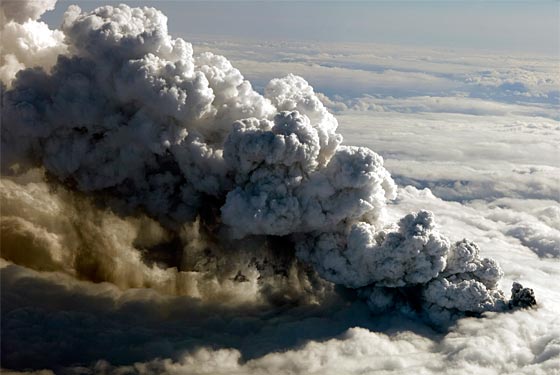 Volcanoes appear to shift grain prices when they are Mt. St. Helens-Krakatoa size, or the ash plume and the deposit covers significant amounts of arable land . Some cold weather grains such as barley, rye, and oats like the cooler weather with the tropicals suffering accordingly. The grain market seems to be yawning over this eruption so far. Lack of initial movement in the grain markets over a catalytic events is pretty common, like when the Russians bought most of our crop in 72-73, or when Chernobyl blew up. It took a couple of days for the market to react with Chernobyl, and when it happened, the action and reaction was the most violent ever in the history of the grain trade. The wheat market during Chernobyl was much like an earthquake, with many aftershocks for weeks after, even after the apparent damage was priced into the market. The nearby spreads were like tectonic plates crashing into one another for at least a year after Chernobyl, as late as early 1988 in my opinion.
Chris Tucker adds:
From wiki, why volcanic ash clouds cause flights to be canceled or rerouted:
Volcanic ash jams machinery. This poses a great danger to aircraft flying near ash clouds. There are many instances of damage to jet aircraft as a result of an ash encounter. Engines quit as fuel and water systems become fouled, requiring repair. After the Galunggung, Indonesia volcanic event in 1982, a British Airways Boeing 747 flew through an ash cloud that fouled all 4 engines, stopping them. The plane descended from 36,000 feet (11,000 m) to 12,000 feet (3,700 m) before the crew could manage to restart the engines.[16] In April 2010, many flights across the United Kingdom were cancelled as National Air Traffic Services closed airspace due to the presence of volcanic ash in the upper atmosphere from the eruption of the Icelandic volcano Eyjafjallajökull.[17] As a result of the eruption, significant flight delays also occurred in other parts of Europe.[18]
Victor Niederhoffer comments:
The eruption is canceling flights. Is it good for grains like in the previous 10 centuries?
Pitt T. Maner III writes:
CNBC just reported that this particular volcano erupted about 200 years ago and kept erupting for 2 years (need to verify this).
Past geological performance is no guarantee of future results.
A lot would seem to depend on the volume of ejecta, the particulate size (time aloft), duration of eruption as noted, and carrying currents and other meterological parameters and timing of events during year. So the percentage and total volume of ejecta into the upper atmosphere from the Icelandic volcano as it relates to the 20 or so other active volcanoes would be useful info—so far the volume seems relatively small.
During the time period this volcano last erupted (as Mr. Tucker discussed) it was unseasonably cold in 1822 in the US. Whether that would be related to volcanic activity requires a lot of investigation (and more data) and may not be possible to determine. Its, however, an interesting coincidence.
1) From a 1985 Lakeland Register article in which a researcher went back into old archived National Weather Service records:
"First the West Coast and then the east were hit by cold weather in 1822 and 1828, respectively, the latter frost killing cotton, corn and citrus."
2) And per the New York Times (1879) some people built a shanty in the middle of the Hudson River in the winter of 1822. Prodigious amounts of wood were used to keep warm.
3) Translation of Icelandic obsevations from 1820s. Ash fall resumes in June 1822. 1822 is like last week in Iceland!
The eruption in Eyjafjallajökull began in the evening of Dec. the 19th, 1821. At that time people spotted fire up on the glacier. In the morning they could see a white cloud above the glacier that stretched ever upwards, slowly darkening, ending as a thick plume of ash. As day turned to night, the plume lessened for a while, then grew again, this time with lightning and thunder. From the 21st to the 27th the ash fall was mostly steady, most of the time in a NE-ly wind and the west part of the glacier became black from the ash. Ash fell mainly around Ytri-(Outer-)Eyjafjöll and in Eastern Landeyjar. West of the glacier rumble could be heard and rivers grew greatly in volume. A glacial flood broke forth to the north-west into R. Markarfljót and filled the valley between Langanes and upper Fljótshlíð. [Literal translation would be inner-Fljótshlíð.] Grass meadows of the farms of the farms Eyvindarmúli and Árkvörn flooded, with livestock saved at the last moment. Fragments from the glacier were spread all over down to the sands west of Steinholt and took uo to two years to melt down. The ash fall was reduced greatly with the new year of 1822, but rumbles and crackles continued." Ash fall began again in latest June, mostly under Eyjafjöll. The eruption finally ended in the beginning of year 1823.
Chris Tucker adds:
It seems to me that the last six months have produced an unprecedented (at least in my minute experience) amount of seismic and volcanic activity. Almost as if someone has turned up the burner on the ring of fire. This is a very interesting interactive map of recent seismic activity. I recommend clicking on the "See Large Screen View" button in the upper right corner. I wonder what it might portend.
Apr
13
Through Experience — Wisdom, from Chris Tucker
April 13, 2010 | 2 Comments
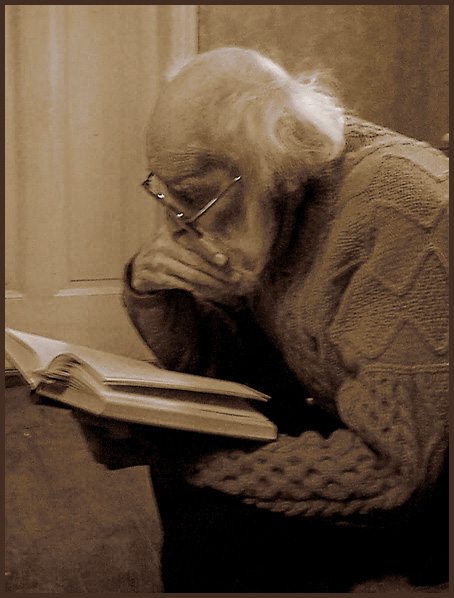 I believe that many (if not most) of life's lessons can only be learned through experience. Yes, one can learn about the dangers of using a chainsaw by observation and some instruction and manage to not hurt oneself, but one doesn't truly understand or know a chainsaw until one has one in ones own hands and feels the wrath of which it is capable up close and personal. There are so many trials that await us for which we come sorely prepared. Lessons about integrity, character, discipline, trust and courage (especially courage, I think) only truly sink in when they have been put to the test. Don't get me wrong, I read constantly about people I would like to emulate, whose lessons I would like to have handed to me more or less gratis. Would that it were so easy. But I have never learned anything truly worth knowing about trading (or being a man, or friend, or lover, or father) that I didn't learn thoroughly until I had a position on and, win or lose, gotten myself into the thick of things.
That is not to say that I haven't learned things from reading. On the contrary, if I thought that were the case I wouldn't be here with you now. I think one of the problems that holds us back as a species is that not only are we constantly learning, but also constantly forgetting important lessons. And the critical ones need to be chiseled away at constantly throughout one's lifetime. With a little help, sometimes you can learn a few of them early, set them deeply in your psyche and keep them with you.
Nick White writes:
Excellent points. I wholeheartedly agree that actual involvement in life is a must, and that theorising about problems is of limited value until you've actually faced them. I would argue that a healthy dose of erudition encourages wide participation in the "right" activities, while (hopefully and presumably) minimising involvement in the "wrong"ones. You're more willing to put yourself in real-world activities because you have some preparation for them and want to test your assumptions. But, then, I'm assuming rationality on our part; my apologies.
This neatly leads us into the realm of probability and expectation: perhaps we can generalise that the more personally harmful an effect might be, the more one should be taught/ learn about the activity through vicarious means (advice, books, etc etc) rather than direct experimentation? I don't think this necessarily involves attempts to understand "tail risk" (which we can't really know anyway); it's a question of expected return (admittedly, we then get down to how each person "values" an outcome, once they've assigned a probability to it). This comes back to my point about the necessity of being a good empiricist / skeptic in order to squeeze the juice out of life. Sum of probability of outcomes * expectation from identified outcomes. Hedge according to the variance. Build in plenty of redundancy for the possibility of unimaginable, outsize risks. It's not perfect, and fraught with difficulties, but it might at least provide a sign post to better results than not doing it.
The other excellent point you raise is how we might better transition and generalise book-smarts / domain-dependent expertise into life as a whole? There have been hundreds of papers on this point (eg, one might be a widely published expert in academic statistics, but fails to apply those skills in the "real world" when given a real-life problem– the expertise doesn't translate, or is non-functional). I think that is where your first point on putting one's learned skills to the test is essential. It helps to consciously apply what's been learned.
In sum: learn about a field or proposed activity as much as possible with your hypothesised utility. If you have even a small chance of doing non-trivial damage vs the expected payoff, then– should you still wish to proceed– learn from a source how you can minimise or avoid the negative payoff to maximise your positive expected return. Perform or non-perform. Report the results. Then try and apply the lessons learned to other fields…I think we have to consciously work harder on this "translation" effort.
Apr
4
Fine Dining and Human Evolution, from Chris Tucker
April 4, 2010 | Leave a Comment
 From the Life Science & Exploration Society an Epicurean Event:
The Origins of "Modern" Humans in East Africa: New Research in the Turkana Basin, Kenya
part of the Distinguished Lecture Series this one by Dr. John Shea, held this Monday at Mirabelle Restaurant at Three Village Inn, 150 Main St., Stony Brook, New York.Monday, April 5, 2010 Five Course Dinner, $115.00 per person
Mirabelle is our favorite restaurant, and I can recommend Chef Guy Reuge's French cuisine to the most discerning palettes. Here is a pdf of the brochure at Mirabelle Restaurant at Three Village Inn.
Mar
27
The Pilot is Dead…I Need Help, from Chris Tucker
March 27, 2010 | 3 Comments
 On April 12th, 2009 a Beech King Air 200, N55DW with one pilot and four passengers aboard departed Marco Island, FL for Jackson, MS. Shortly after takeoff a voice came on the Miami Center frequency and stated "I've gotta declare an emergency, my pilot's unconscious. I need help up here." and then "My pilot's deceased…I need help". The passenger, Doug White was sitting in the right seat to get a good view. His wife and two daughters were in the back. Luckily, Doug was a private pilot, but with low time (little experience) and no experience in a twin engine or turboprop aircraft of this complexity. The aircraft was in a 2000 ft. per minute climb as directed by the autopilot, but Doug was unsure of how to stop it.
Very quickly, air traffic controllers at Miami Center grabbed a fellow controller, Lisa Grimm, from another area who had some flight experience, brought her down to the sector and got her talking to Doug while the controller working the sector, Nate Henkels, intervened now and then to fire off instructions to the many aircraft he was also working. At the same time, controller Jessica Anays coordinated furiously with the surrounding sectors to get traffic rerouted out of and around their sector. Lisa succeeded in convincing Doug to disengage the auto-pilot and hand fly the King Air. "Alright" Doug said, "I disengaged it. I'm flyin' the airplane by hand." She calmed him down and together they managed to get him descending and turning and headed for Fort Meyers International Airport. "How you doin up there?" she querried. "oh, we're havin' a hoot" came the reply in Doug's thick southern drawl.
At Fort Meyers Approach Control, controller Brian Norton was on his way out the door to go home when his supervisor came running out to grab him and bring him back because of his pilot experience. Controller Dan Favino called a pilot friend of his in Danbury, CT, Kari Sorenson, who had experience in this type of aircraft and the two of them relayed instructions on configuring the King Air to Brian who passed them on to Doug. Doug succeeded in landing the aircraft safely and in an audibly shaken voice said "We're down buddy, thank you". Controller Carey Meadows then relayed instructions to Doug and assisted him in getting the engines shut down.
Doug left this event last easter and continued his aviation education and added a commercial IFR multi-engine rating to his pilots license. He was then seen several times flying the same aircraft (N559DW) back and forth to Haiti delivering aid after the earthquakes there. It was my incredible privilege to be present in Orlando this Tuesday when these controllers were honored by our union, the National Air Traffic Controllers Association (NATCA). The Archie League Medal of Safety Awards, named after Archie League, the first U.S. air traffic controller, are bestowed by NATCA upon controllers for service that results in saving lives from dangerous situations. At this years ceremony, these controllers recieved Archie Awards as well as a Presidents Award for service above and beyond the call of duty.
I strongly encourage people to watch the last video on this page titled "NATCA President's Award / Doug White Presentation "where pilot Doug White joins the controllers on stage and speaks movingly about his experience that day. Hearing him speak was truly inspiring, there were several hundred people in the room and not a dry eye in the house. He made us laugh and cry at the same time as he expounded upon the individual initiative and teamwork that crystallized in minutes and saved his life and those of his family. I have never been so proud in all my life. There is a condensed version of the incident itself as it unfolded on the same page two blocks up titled "Southern Region - Lisa Grimm (and etc.)" where you can hear the radio transmissions of Doug and the controllers with text of their conversations. The video players on this page are a little difficult to manipulate, but if you can grab the slider and forward the Presidents Award video to start at 6:00 or so you will begin at the best part.
photograph of a Beech King Air 200 Instrument Panel
YouTube video of RADAR overlay with full audio (38 minutes), the aircraft N559DW is the white block of data.
Mar
3
Unveiling the Beauty of Statistics, from Chris Tucker
March 3, 2010 | Leave a Comment
 Hans Rosling, cofounder of Médecins sans Frontièrs (Doctors without Borders) Sweden, uses his ebullience and amazing visualization software to display global trends and to break concepts about the modern/developing world dichotomy in this fascinating talk given to the U.S. Department of State in the summer of 2009. I highly recommend this 20 minute video which feels like three minutes.
"Unveiling the beauty of statistics for a fact based world" is the banner for his software called gapminder, which is free and can be used by anyone with an Internet connection. Google bought the software and offers free tools for embedding it in a website with your data here at code.google.
Mar
1
Central Park after the Snowfall, from Marion Dreyfus
March 1, 2010 | 1 Comment
 I got off the bus and walked through the Central Park snowscape at 57th and 6th. Fairy time.
Little kids with their brilliantly colored toboggans or inverted large plastic frisbees in cherry, lime green, turquoise and violet flopped down the tiniest slopes, shrilly screaming with delight. People were running the track, as per usual, enclosed in their huffing and timing. Many teams of families and friends were building snowmen, and I saw at least three snow caves, which we always advise people to build in the chilly North, if they are caught in a snowstorm or are lost in the woods and there is available snow.
I watched four energetic bunches of people on tamped-down 'slopes,' some of the adults sitting on the plastic garbage-can covers (so they looked) behind their tots.
Against the stark, clean white of the snow, the strong verticals of brown-etched black tree trunks heavy with the best snowball-making snow (but also the most perilous, as the death of a man from a falling overburdened branch demonstrated to us all if we heard the news), the colorful gear and costumes of the skaters, it was a wonder place.
The children far off made the scene evocative of those daguerreotype postcards of the first decade of the 20th century–rich and wonderful, especially with the high-prancing horse-drawn hansoms every few minutes. Two offered a free fa-la-la through the park, but I declined, entranced with everything around, far more scenic than anything in the summer months.
Stopped to talk with a chilled but friendly NBC cameraman next to his sound and light transmission truck right opposite the old–now closed, preparatory to a March reopen under new and hopefully solvent management–Tavern on the Green, shorn of its usual razzle-dazzle lights, but now looking cozier for the absence of limousines and cabs and liveried doormen. Now it is just a cozy restaurant nestled in the snow banks of the park. The TV guys, they told me, were forbidden to take shots of anything untoward: Only reportage on weather and snow conditions. No reports on branches falling and ending someone's breathing in an eye-blink.
Dogs on leashes stood on their hind legs like African prairie dogs to salute the large igloo being built opposite the Tavern. The cave/igloo was now the height of a medium daddy, and his son was inside the stuccoed white igloo, the top of his head just-just visible in the 'atrium' open-air unfinished dome, adding incrementally to the enclosure.
A family of 4 kids and tony UWS parents stopped to discuss the activities in the park, and one noticed the kids wore sleek, aerated bike helmets to prevent damage to their noggins should the boys decide to go tobogganing.
Everywhere, people smiled and spoke with one another, accessible as ever in extremis of weather or misadventure. Everywhere, the overhead shiny crisp sun found its echo in the sunny dispositions of the tots and parents, walkers, runners and horse-drawn, rug-covered buggies.
Who said childhood is finished?
Chris Tucker adds:
Spent the better part of this weekend at the local high school which features a large bowl around the baseball field. This provides natural stadium seating in the warmer months, and a wonderful, wide slope for sledding, boarding and tubing when the snow permits. Yesterday a large group of us got together for the fun, some brought beer, juice boxes and a hibachi and cooked up dogs for anyone that became peckish. Today we went out early as it was getting warm and we didn't want to ride slush and mud. But the hill was in good shape on the big side and a kid sized shovel that I keep in the truck kept the tracks in prime condition. The kids love going over jumps, as I did too at that age, but after my first try earlier in the season I decided my jump days were over. The neck and back just don't seem to appreciate the impact like they used to. There is a huge variety of toys available for this. We have seen traditional tobogans (though not this weekend), flat boogie type boards, true surf boogie boards which work just as well, saucers, boats, sleds with plastic runners, traditional Flexible Flyers, sheets of hard plastic, snow boards, tubes of all shapes and sizes (best for adults as they absorb a lot of the shock) and cardboard boxes, which work but have a short half life. The most squealing occurs either when there is a race, moms or dads go down on tummies with kids piled on their backs, or we make a chain with several vehicles and riders. The grown ups tend to make more noises of delight then the kids when we do this last bit. Tons of fun and no TV or video games in sight.
Feb
15
Backcountry Skiing: Skills for Ski Touring, from Jim Sogi
February 15, 2010 | Leave a Comment
 I've been hooked by a perfect day back country touring in the Wasatch Mountains. It was like a big win on the first trade. I'm hooked for life. Back-country Skiing: Skills for Ski Touring and Ski Mountaineering by Martin Volken, Scott Schell and Margaret Wheeler (Kindle) is an excellent introduction to the sport covering equipment, basic avalanche safety, planning, and basic skills. There are some very interesting sections on group dynamics and decision making on which your life sometime hinges. There are many paths to the truths, and this book holds some universal applications to life and trading. Decision making and quantifying risk and mitigating the risk are a large part of avalanche safety. Human factors tend to be the cause of 90% avalanche fatalities. The human element include things like:
1. The negative event feedback loop which inures one to constant danger;
2. Back to the barn syndrome;
3. The false perception that stress is external when in fact it is internal.
4. Unwillingness to listen to others;
5. Overconfidence;
6. Limited observations;
7. Tunnel vision and narrow thinking;
8. Heuristic traps: familiarity, group think, getting locked into the plan,
expert halo.
The study of avalanches offers some interesting analogies to market analysis. The genius of Chair's use of analogy to find market ideas can be applied here. Skiers using the science of avalanches makes use of a technique of digging pits and examining the layers of snow. Here you can see some examples of snow pits and back country skiing in one of my favorite places, Valdez, Alaska. Avalanches are caused by the condition of the snowpack layers and current forces acting on it. Statistical analysis is powerful tool, however the study of averages and distributions has limitations. Study of actual recent data and its effect on current and future prices and vice verse should be done in a scientific method to augment study of distributions. This might be considered quantifying TA ideas of support and resistance, breakdown areas and the like. The market is affected by the T&S, order book, prior executions, open interest. This data is available or can be derived through simple arithmetic and scientifically tested. Market avalanches are due in part to the condition of the recent market action. Its a whole new worthwhile area for study.
Chris Tucker writes:
I have found similar useful ideas from Ed Viesturs' book No Shortcuts to the Top. Viesturs incredible training regimen and focus on safety have made him one of the most prolific and successful mountaineers in the world. His mantra: "Getting to the summit is optional, getting to the bottom is not" has kept him alive and enabled him to come back time and time again, even at the cost of sometimes being considered "shy" when others go forward. Others opinions bounce off him, if something doesn't feel right to him he will not press. I recall a description of a climb where two climbers precede ahead of him to traverse a very large and steep snow/ice pack. Viesturs took a few steps and felt that the pack was "loaded" (under heavy stress due to its weight and condition) and might come loose at any moment. He opted to pass on his summit attempt and waited for the others to do so. The fact that they succeeded in traversing the pack safely did not phase him in the least. He was content with his decision to remain safe. And yet he has summited Everest seven times and was the 12th person in the world to summit all fourteen peaks over 8000 meters.
Jan
21
Biography of Gouverneur Morris, from Stefan Jovanovich
January 21, 2010 | Leave a Comment
 I am reading Theodore Roosevelt's biography of Gouverneur Morris; the book is proof, if one needed any, that Roosevelt was a true Renaissance man, even if his politics were almost as lunatic as Morgan feared.
Morris was not only the actual author of our Federal Constitution but also the greatest political observer among the Founding Fathers. At a time when Jefferson, Thomas Paine and others were celebrating the Revolution of 1789, Morris was deeply saddened by what he saw first-hand in Paris; and he urged President Washington to avoid favoring the Revolutionary government against the British.
But, if Morris thought the French Revolution was destined to failure and folly, he never lost his appreciation for France. Neither should we. It is footless for any of us, at this late date, to continue to take the Band of Brothers version of the Normandy campaign as an accurate military history. The Free French, along with the Poles and the Canadians (whose contributions are also conveniently forgotten) did more of the actual ground fighting in the Falaise Pocket than Americans did; and they paid a terrible price for it. General Leclerc , who understood and practiced tank warfare better than Patton did, was a brave enough man to understand that the Vietnamese wanted the same freedoms that Americans had fought for in their own revolution and that "anti-Communism" could not, by itself, be sufficient justification for the continuation of direct colonial rule. But for his untimely death (much like our own General Abrams' being struck down by cancer), it is likely that the Indo-Chinese wars would not have happened as they did.
P.S. It is also worth noting that the people of Normandy have never once complained about the thousands of civilians who were killed by largely indiscriminate high level bombing by the American Air Force before, during and after the D-Day landings. Instead, they thank us every year for what our soldiers, sailors and airmen did to liberate their country. Perhaps it is time we thanked them as well.
Chris Tucker writes:
Rallyn and I spent our honeymoon in France and loved every minute of it. Of that, a week in Provence, stayed in Gourdes and had delightful wines from a small local vineyard called La Canorgue in Bonnieux. Decided to go hunt them down, beautiful, beautiful drive, found them, sign on gate says "Back in ten minutes". We wait, proprietor arrives in a few, takes us into her little shop and is just lovely. We buy a bunch of bottles to take home and enjoy a splendid day roving around the countryside, visiting the market in Aix-en-Provence and the lavender at the Cistercian Abbey at Sénanque. Also Avignon, the Pont du Gard. Amazing, history fills every square inch, beautiful country, beautiful architecture, beautiful people that know how to enjoy life.
Flash forward a few years. We are at home watching "A Good Year" and slowly it dawns on me that I've been to the vineyard in the film. Château La Canorgue is the vineyard, just as I remembered it. Wonderful. The film isn't awful either, although the trading scenes in the beginning leave quite a bit to be desired. Crowe's character is a heavy hitter in London. Albert Finney is spectacular.
Jan
11
An Air Traffic Controller’s Checklist, from Chris Tucker
January 11, 2010 | Leave a Comment
 As an air traffic controller and pilot it was only a matter of time before I chimed in here. Victor has, once again, brought up a veritable feast of food for thought here and I will be mulling over this post for some time to come.
Checklists are important in aviation for a few reasons. Task load is high in aviation and the most important role of a checklist is to ensure that a critical step is not skipped, forgotten, overlooked or done in the wrong sequence. High task load arises from the fact that aviation systems tend to be very, very complex and sequence of events is critical in and of itself so lists keep things in the right order. Lists take a complicated set of instructions and break them down into simple steps. Lists can build teamwork and improve execution. Some interesting tidbits. A & P's (Airframe and Powerplant Mechanics), the folks that keep aircraft flying, are required to inventory their toolkits prior to and after maintenance procedures to ensure that they haven't left any tools in the aircraft as this can have disasterous effects. I have heard anecdotally that some surgeries require the same procedure as, in the not so distant past, it was not terribly uncommon to discover that instruments had been left inside the patient.
It is important when formulating checklists to find a balance between not being too general and too minute. Steps that are too broad in scope increase the risk that critical steps may be omitted, these types of ideas are good for setting up strategy, not tactics. Lists that are too long or whose steps are phrased in too lengthy a manner tend to be glanced over and not given their due attention. This happens to be a problem with the checklists we use in air traffic control when releasing control of a sector to the controller relieving us. Good controllers know how to cover the important information with proper emphasis and how to roll up the "does not apply" stuff into a catch-all at the end of the briefing. It is important when working with others to know how to use emphasis to ensure that you have conveyed the criticality of the information you are delivering. The FAA is forever focusing on covering its legal rear end without working on discovering the meat, the nature of the truly important stuff. Although recent initiatives seem to be working toward a thoughtful approach toward these problems.
As a pilot and controller it was, again, only a matter of time before I began taking proven memes from my industry and applying them to trading. Many of the procedures that Chair outlines are strategic, like having workarounds ready for equipment failures, getting enough sleep, eating healthy, understanding your goals or defining your method. One may be well advised to have strategic checklists and tactical checklists and to realize that they may overlap a bit. In addition to my basic concept or framework, I have three trading checklists that I use tactically for entering, maintaining and exiting trades. Some of the steps I use include:
1. predefining my total risk.
2. ensuring that I am using one of the rules I have created that justify entering a trade. (Same for exits.) This is designed to keep my impulses in line.
3. creating a plan for the trade that includes money management, position sizing and some thoughts about how to exit. Thus my exit checklist has some flexibilities built in with other parts, like total risk, inviolable.
4. prior to execution, double checking that I have entered the correct instrument and expiration, and correct number of shares or contracts. A simple typo can be devastating.
5. making sure that I am familiar with the specifications and margin requirements of the instrument.
6. calculating the amount of profit or loss each point (or basis) rise or drop will cause and ensuring that my predefined risk limits trigger an exit, regardless of other rules. My theory here is that I can always re-enter the position if my original theory is reiterated or reinforced. I have listened carefully to Chair about the use of stops and must respectfully submit that when my position needs defending, my purposes tend to be best served by the clearness of head that arises from nullifying the position either partially or completely and reanalyzing at that point. I lack the sangfroid that comes with experience and know that this method works for me and I accept the costs associated with it. And this is, after all, my emergency escape route.
7. maintenance or surveillance of a trade can include rules for increasing position size to press my advantage in a trade or getting smaller to tactically retreat.
8. logging trades along with reasons in a journal, with technical specifics and a discussion of my thinking. Upon exit, I always include a sub heading titled LESSONS to spell out lessons learned. I place the ones I deem important in bold typeface so they pop out at me when skimming through the journal for my re-edification.
The use of checklists has given my trading a feeling of professionalism that it lacked in the past. I no longer feel that I am trading on the fly or for ill defined reasons. I have Chair and this auspicious body to thank for most of that.
Lastly, here is an interesting bit about checklists from Afterburner Inc.
Jan
6
Coronal Mass Emissions, from Phil McDonnell
January 6, 2010 | Leave a Comment
 The work by Krivelyova and Robotti on geomagnetic activity and market returns is fascinating.
They find outperformance vs buy and hold, but concede that factoring in transaction costs equates it back to buy and hold performance.
I'd be curious to hear critique of this paper or similar research (e.g. Dowling, Lucey; Kelly, Meschke).
The paper by Krivelyova and Robotti is another Atlanta Fed paper that has been discussed here in the past. When I did a followup using their data sources the only correlations that appeared significant were the Coronal Mass Emissions (CME). There did not seem to be much there for the basic sunspot and geomagnetic data. The CMEs only seem to have a Terrestrial effect when actual Solar matter is ejected and it hits us. CMEs visibly show up as auroras and radio and electrical interference. My test was only using a linear model not the somewhat more sophisticated cosine transform used by the authors. In any event neither study showed a strong effect.
Remember that a statistically significant effect is not necessarily strong enough to make money, especially after vig. Note that Golden Slacks has its own entitlement program that extracts $100 million a day in trading profits in order to do G_d's work. The rest of us contribute to that.
Chris Tucker writes:
Current space weather (read solar events) is always available at NOAA for those interested.
Jeff Watson adds:
I like Solen.info for solar activity much better than NOAA.
It seems that the sun has been quiet the past couple of years and solar activity should be picking up soon because we're supposed to be in a new cycle. Some believe this reduced activity might be part of a supercycle that the sun exhibits every 222 years or so. Needless to say, all indexes from the J index, K index to the A index all point in this direction.
Jan
2
What We Can Learn From Learning Morse Code, from Chris Tucker
January 2, 2010 | Leave a Comment
 I was thinking about Morse Code today and recalled that when learning the code it was actually counter productive to try to begin learning by listening to characters transmitted at a reduced speed and then progressively picking up the pace. Seasoned hams are familiar with either the Farnsworth or Koch methods. to quote Wikipedia:
People learning Morse code using the Farnsworth method, named for Donald R. "Russ" Farnsworth, also known by his call sign, W6TTB, are taught to send and receive letters and other symbols at their full target speed, that is with normal relative timing of the dots, dashes and spaces within each symbol for that speed. However, initially exaggerated spaces between symbols and words are used, to give "thinking time" to make the sound "shape" of the letters and symbols easier to learn. The spacing can then be reduced with practice and familiarity. Another popular teaching method is the Koch method, named after German psychologist Ludwig Koch, which uses the full target speed from the outset, but begins with just two characters. Once strings containing those two characters can be copied with 90% accuracy, an additional character is added, and so on until the full character set is mastered.
The point being that learning the code by hearing it at its normal (high) speed from the outset is easier than having to learn how to ramp up your speed as you progress. I was thinking that if you had a trading simulator that operates at speeds faster than real time, then you could learn to recognize set ups more quickly and perhaps be more agile when it comes to actual trading in real time.
Counters and algo writers may find dichotomic search interesting as well.
Jeff Watson writes:
When I first learned the code back in 1967, I didn't use the Farnsworth or Koch methods. An 80 year old guy (got his ticket in 1918) taught me the code by sending at high speed (40+ words per minute) and combining all the dits and dahs into entire words and making me learn whole words from the sound. He would not let me copy the code on paper, making me learn it in my head and drilling it in. Whereas a person could learn the code using the aforementioned techniques in a couple of weeks and be able to easily copy the minimum of five words per minute (required for the Novice license at that time), it took me five months of practicing code every day to learn and get dialed in, but I was copying code at 38 words per minute right out of the chute. He told me that the method I learned was the same method that they used to train the old telegraph operators in the 1880s.
To this day, I don't write my code on paper, instead copying it in my head, without the use of any computers or other such heresy. With 43 years of practice, code (CW) is like a second language to me. There is a certain elegance in in using the code, and there are many old-school diehards such as I who refuse to give up using CW. With the advent of electronic keyers and computer technology, it is possible to send code perfectly spaced and without personality. Using old-fashioned straight keys and Bugs, one was able to develop a personalized style of sending code, and the code would have an accent, an individual swing of sorts. One could identify the sender just by listening to his CW. I still use my old Vibroplex, and refuse to go to a keyer, where all functions are on a chip. There is also computer software that will copy code very fast, but it only works with the perfectly spaced code from a keyer. We know who the people using artificial cheat methods are.
There are many of us tradition-bound hams and many youngsters who still use code on the amateur frequencies. We are a rare bunch, with only an estimated 30,000 of us left in the world. I wouldn't count CW out as of yet, because it is still the best communication method when conditions are noisy or bad. Voice might be distorted to the point of being unintelligible, but CW will usually get through. On a personal note, I am rarely on SSB, AM, or FM, preferring to use CW for my communication needs. In fact, the only time I get on voice is when the International Space Station or the Space Shuttle has an operator on 2 Meters, and it is passing overhead. I will give them a shout. It's pretty cool to talk to someone orbiting the earth. It's also cool to send a CW signal up to the moon and bounce the signal off the moon and work people anywhere in the hemisphere.
Jeff Watson, surfer, speculator, poker player and art connoisseur, blogs as MasterOfTheUniverse.
Dec
30
The Final Unfinished Voyage, from Chris Tucker
December 30, 2009 | Leave a Comment
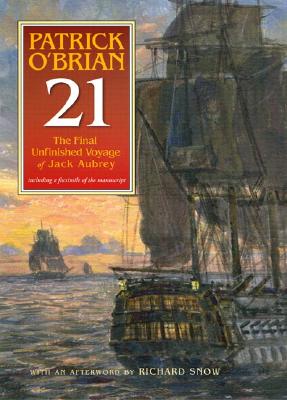 Finished 21,: The Final Unfinished Voyage of Jack Aubrey just prior to Christmas. Now I am at a complete loss. Jack and Stephen have been with me these many months now and I can still here Jack bellowing uncontrollably at "Why is it called the Dog Watch?" "Because it is cur-tailed, my dear" I find myself using words like prodigious and capital. But mostly I think of a lasting and profound friendship, the complications, the difficulties and the comfort of such a close bond and the force of the trust between the two. One strives toward the ideals of fellowship and heroism that O'Brian evokes; hopes that one could jump, dauntlessly, without a moments hesitation into the breach like Jack to save his friend. Or Stephen, who never did any of his business without thinking of how Jack would be affected. Jack's profound expertise at sea and in battle, and his foolishness on land. Stephen's deftness with scalpel or intel and lubberly ways at sea. Or Stephen's seemingly never ending quest to gain the affections of the unattainable Diana. Or to catch sight of the southern albatross, or a particular beetle. Or his ruthless cunning and awesome sense of vengeance when betrayed or slighted. His bitter hatred of Napoleon and all he stands for. I can hear Tull's performance of Stephen clearly, the drama profound: "Draw man, draw! Or I shall slit you where you stand!" The roar of the canon as the gun crews work there lethal machines. The view from the foretop crosstrees, the wind humming in the rigging, the rush as Surprise slices through the water, her crew like clockwork, expert seamen, orders followed even before they are uttered. The perfection of a well founded vessel and closely nit and thoroughly trained crew. Mr. Pullings, Babbington, Barret Bonden, Mr. Reid, and Mr. Hanson all flawlessly loyal to their captain. Preserved Killick with his nose pinched, tut tutting over wine or blood spilled on the number one uniform or whining like an old maid "which its comin', ain't it?" when chastised for the not bringing the blasted coffee on the double but appearing miraculously at his captains shoulder under the light of the binacle in the wee hours in icy spray with a piping hot mug and a sandwich. Or Corelli or Mozart drifting up from the cabin as Jack and Stephen find their way through a new piece. Or the terrible hardships that men like these lived through on a regular basis. The state of medicine in their time. The unspeakable violence and bloodshed and slaughter that the crew dove into to a man behind their captain, the roar of Awkward Davies, boarding axe in each hand. What a remarkable, wonderful, fulfilling epic journey. What a beautiful, beautiful friendship. Delightful to the last drop. Now I shall have to start again. Hornblower can wait.
Dec
16
Battle of the Bulge, from Scott Brooks
December 16, 2009 | 14 Comments
 December 16th is the 65th anniversary of the Battle of the Bulge. Many historians consider this the turning point of the war.
I would love to hear people who are more knowledgeable about military history write on this subject. A simple exercise in counting tells us that there aren't many of these warriors left.
They, and all veterans of American wars, deserve our utmost respect and, if you're lucky enough to know one, maybe a handshake, a warm smile, and a thank you.
I am very grateful to those that have served and would like to extent my personal warm wishes and a thank you to those who were there in the Ardennes 65 year ago.
Chris Tucker replies:
My grandfather's brother Uncle Rube (Reuben Henry Tucker III) was the commander of the 82nd Airborne Divisions 504th Parachute Infantry Regiment or as the Germans in Sicily called them "Those Devils in Baggy Pants". Their exploits in The Bulge are chronicled at this Wikipedia entry.
I only met Rube a couple of times as he passed when I was very young, but he was loved and respected by everyone that knew him. In the film "A Bridge Too Far" a character played by Robert Redford is a montage of two commanders, my uncle and Major Julian Cook. Rube distinguished himself throughout the war. To quote the wiki entry on him:
Lt Gen James M. Gavin, who originally commanded the 505th Parachute Infantry Regiment, and later the Commanding General of the 82nd Airborne Division, stated in his book, "On to Berlin", "The 504th was commanded by a tough, superb combat leader, Colonel Reuben H. Tucker was probably the best regimental commander of the war.
Interestingly, Gavin would admit that Tucker "was famous for screwing up everything that had to do with administration. One story going around was that when Tucker left Italy, he had an orange crate full of official charges against his soldiers and he just threw the whole crate into the ocean. Ridgway and I talked about it and we decided we just couldn't promote Tucker." (from 9/28/82 interview of Gavin by Clay Blair)
Colonel Tucker was one of the most decorated officers in the United States Army. He was awarded two Distinguished Service Crosses, the United States' second highest medal for bravery, one of which was personally awarded by President Franklin D. Roosevelt during a visit to Castelvetrano, Sicily, in December 1943, for extraordinary heroism under hostile fire in Italy in September.
Stefan Jovanovich comments:
 The only historians who consider the Battle of the Bulge "the turning point of the war" are those who believe in the Band of Brothers version. Hitler launched the offensive in the Ardennes because he thought it would scare the British and Americans into suing for a separate peace and that would allow the Germans to have one more chance to halt the advance of the Red Army. What is remarkable about the Battle of the Bulge is how close the Germans came. All they needed was another week of bad weather to keep away the Allied air cover. After Bradley woke up to the fact that something was happening (it took him over a day from the time he heard the news until he returned to his headquarters), his assessment was that the Allied had to pull back towards Paris. (One of Eisenhower's many great accomplishments is that he ignored Bradley's hysteria and ordered Patton north to support the 101st.)
The turning point, if any, in the European part of WW II was Kursk. The war diaries of the Germans soldiers are consistent; those in the West still thought they had a chance to win until the Allies finally crossed the Rhine. The Germans in Italy actually thought they were winning; and, given Clark's performance, they probably were. But, in the East, no German with any sense thought the war could be won after the summer of 1943. The best evidence is how people acted. The largest single civilian migration in modern history remains the flight westward by Germans and others in 1944 and 1945 in hopes of escaping the Red Army.
Alston Mabry writes:
"Turning point" arguments are always fun. The Bulge would rank lower down the list (a tense operational showdown, but not a strategic turning point), and Kursk would definitely be at the top, along with the air campaign in the West.
The Allied air effort, though causing significant industrial damage, actually reached a low point in fall 1943 because of the loss rate, but then had an extended "bull run" (including the introduction of the P-51 in early 1944) which devastated the Luftwaffe and established Allied air supremacy in the West. The Red Army was the hammer, while the USAAF and the RAF were the anvil.
Dec
10
How We Live Now, from Stefan Jovanovich
December 10, 2009 | 1 Comment
 An interesting passage from the great Frenchman Frederic Bastiat (1801-1850):
Peter is the possessor of the only plow which is to be had in France; John and James wish to borrow it. John, by his honesty, his property, and good reputation, offers security. He inspires confidence; he has credit. James inspires little or no confidence. It naturally happens that Peter lends his plow to John.
But now, according to the Socialist plan, the state interferes, and says to Peter, "Lend your plow to James, I will be security for its return, and this security will be better than that of John, for he has no one to be responsible for him but himself; and I, although it is true that I have nothing, dispose of the fortune of the taxpayers, and it is with their money that, in case of need, I shall pay you the principal and interest." Consequently, Peter lends his plow to James: this is what is seen.
And the socialists rub their hands, and say, "See how well our plan has answered. Thanks to the intervention of the state, poor James has a plow. He will no longer be obliged to dig the ground; he is on the road to make a fortune. It is a good thing for him, and an advantage to the nation as a whole."
Indeed, it is no such thing; it is no advantage to the nation, for there is something behind which is not seen.
It is not seen, that the plow is in the hands of James, only because it is not in those of John.
It is not seen, that if James farms instead of digging, John will be reduced to the necessity of digging instead of farming.
That, consequently, what was considered an increase of loan, is nothing but a displacement of loan. Besides, it is not seen that this displacement implies two acts of deep injustice.
It is an injustice to John, who, after having deserved and obtained credit by his honesty and activity, sees himself robbed of it.
It is an injustice to the taxpayers, who are made to pay a debt which is no concern of theirs.
Chris Tucker adds:
What is not seen is that John, by the nature of his character as shown by his other virtues, would probably do a better job of farming than James and so, in my opinion, there is a probable loss of production by letting James use the plow and therefore a loss of utility to the state. And there is significant moral hazard in that lending to James demonstrates to all that one not need do the things (work) that inspire confidence thus creating a culture of entitlement. The list goes on and on.
Nov
25
Inflation –- Thanksgiving Variety, from Marion Dreyfus
November 25, 2009 | Leave a Comment
 He flew in to join me for the holiday, remarking how strange it was that so few people were flying on this busiest travel day of the year: The day before Thanksgiving. Just as Black Friday is the busiest shopping day of the year, immediately following a table laden with pies and feathers, berries and jelly, casseroles and native produce. Why was there not airport pandemonium? It was clear what was happening. It wasn’t that fewer people were traveling.
Millions were still hopping up to relatives and loved ones anywhere-but-nearby. They were just dialing down their travel plans. The announcers on newscasts confirmed my suspicions — that people had traded planes for buses, cars and trains rather than the higher-ticket (if arguably faster) birds with wings of metal. And if they arrived here in the Big Apple in large numbers — while at a medical symposium, I noted over 1,000 cute, pony-tailed cheerleaders (of both genders) domiciling at the Hilton, here to dance and flounce at the time-honored Macy’s Thanksgiving Day Parade, an annual tribute to cartoon characters and beloved memorial mascots, gathered from many states — they usually made their way to the West side for the Night Before the parade 'inflation ritual.' The police cordon; the civilians swarm.
We walked uptown to the American Museum of Natural History, where flotillas of floats were laid out under tent-sized sturdy netting as these characters from Walt Disney, Hans Christian Andersen, Charles Schulz and Pixar Studios slowly gained girth and hefted height. Dwarfed armies of Macy’s crews inflated these beloved characters as the evening wore on.
The floats are inflated on West 77th Street, thronged with masses of parents and pint-sized midgety kids wondering why they were being dragged along in a steady mist below the sightlines of what was transpiring over their parents’ heads; and on West 81st Street, parenthesizing the magisterial towers of the stone museum where once Margaret Mead held peremptory sway.
 Befriending a genial and cool police officer, we were able to sweet-talk our way across the cordon onto the best viewing side, uptown West 81st Street, assuring all constables that we had ‘invitations’ to parties on the block.
Time was, this hallowed inflation went on all night, starting quite late, and proceeding until dawn. Some of us had had real parties then, before those friends had moved to cheaper digs, and had gaily run down from our hosts to get an egg-salad bagel or a lox-cheese croissant being handed out to anyone foolhardy and insomniac enough to still hang around in the darkest of the wee hours across from Central Park.
That’s all changed. The Macy’s people said they now began to blow up the thick PVC floats beginning before 2 pm on Wednesday, the better to have delighted children ooh and aah as they caught a glimpse of Snoopy, macho Popeye or brave Buzz Lightyear.
Halloween (at least in the canyons of New York) now officially belongs to gender-bending adults in contrived masquerade and finery. Thanksgiving’s parade still belongs, happily, to the kidlets. No snarky sophistication welcome, thank you very much.
Though the merchants along the length of the three-sided block all remained open late, not many were buying — except in the spiffy UGG boot shop next to the Reebok Sports Club emporium of beautiful people determined to remain beautiful. Cafes and eateries were pretty packed for some 10 blocks around, among them, us, consuming Hunan Cottage fare; but regular merchandise was not flying off shelves, as tired kids clung to adult hands, and prams with many sets of twins or two-sies trundled along into the back of people’s knees.
As extra inducement to wonder, backdrop to the proceedings of huffing and puffing machinery dutifully inflating two-storey tall balloons, the Hayden Planetarium is magically lit with an ethereal red light inside the huge plate glass wall facing Columbus Avenue, and a glowing, eerie azure on the side facing West 81st.
Clever entrepreneurs in tacky costumes hawked photos, posing with the kiddies for a few dollars a throw, annoying purists. But evading arrest by the indulgent police. Cotton candy in tight Saran Wrap swaddling still repelled grown-up eaters of real food. Junk food was squeezed in many smeared, pudgy fingers.
From the thousands of kids and parents from New Jersey, Connecticut, Massachusetts and upstate NY, you couldn’t tell there was a recession in the land.
Even so, we knew from even a few bantering exchanges with the night’s bright, brief visitors that this was surely the only inflation these hard-working parents were remotely fond of.
Christopher Tucker writes:
Air traffic in NYC was mild yesterday and this morning, apart from a few flurries. Tuesday evening was unusually busy, although it was nothing compared to the air traffic pre-2007 or pre 9/11. In the "old days" traffic the night before Thanksgiving would leave controllers sweating and cursing, leaving fodder for a year's worth of storytelling. This year and last were tepid at best, giving us a happy rest. Sunday is still up in the air, if you will.
Nov
23
Igon Values, from Victor Niederhoffer
November 23, 2009 | 2 Comments
 My second-oldest daughter Katie's post on Igon Values is very relevant to our field. Who are the useful idiots in our field and how can their self-serving posings be used for profit? Let us start in the Midwest. Or the islands.
Alston Mabry adds:
I thought the "igon values" thing was a joke, but upon reading Pinker's review of Gladwell, I find it isn't. For one who writes about research, as Gladwell does, to not be able to sit down and work linear algebra problems is fine (me neither), but to not know that there is a word, "eigenvalue", which may arise in conversation with scientists — that's embarrassing.
The issue of "igon values" bears on the more general issue of knowledge production and dissemination. I like watching science shows, but even when I'm watching a high-quality show like NOVA, I'm wondering, "Where are the folks, with the same level of expertise, who think at least some of this is crap? What is their critique?" It often seems that a well-communicated disagreement can help the audience understand more of what's important. And actually, a good example is Pinker's review of Gladwell.
In most or all fields of research, one could assemble a group of experts who have similar training and knowledge, but who disagree on important points in the field, especially at the boundaries of discovery. Then you have popular writers trying to understand and condense some field into book form — but if the experts don't agree, how can the popularizers possibly be "right"?
Stefan Jovanovich writes:
Mr. Mabry is far too kind. Scientists talk their books all the time. A scientific reputation is made by presenting a theory that is striking, original and difficult to evaluate. That theory becomes the scientist's brand. His/her future in academia is tied to the success of that brand. Few, if any scientists, are crazy/honest/selfless enough to challenge the truth of their brand. Hence, Heisenberg's comment that "the progress of science can be measured by professors' funerals."
In science, practitioners would rarely be lying about what they are doing. But in markets, who tells the "truth," unless that truth is consistent with the talker's book? Then there is the sheer volume of new "knowledge" produced on a daily basis. How does one cope?
Bruno Ombreux writes:
 Here is a suggestion. I believe it is linked to the Igon.
I am halfway through a book that is dealing with all these issues: Scientific Method in Practice by Hugh G. Gauch. It sheds light and fosters reflections on such things as scientific questions and methods, disproving or proving hypotheses…
It is a book about science. Since good trading is a science, this is a book about good trading too. Good trading is necessarily scientific, because good trading requires good predictions. Only science can yield good predictions. If trading is not scientific, it can't be good.
This is also a philosophical book. After a few chapters, I have enough philosophical ammunition to completely destroy the Black Swan school, on epistemological grounds. The Black Swan ideas that we cannot have models that work, that variance is either infinite or undetermined, are just as naive, and far less nuanced, version of David Hume's radical skepticism. In one sentence: we can't know anything. Scientific Method in Practice advises not to waste time arguing with radical skeptics. They are not targeting science, but common sense. Common sense is literally what humans can sense in common. In this case, we all can measure variances. Common sense is a key presupposition of science. Without common sense, there can be no science. Without science, there cannot be any debate between scientists and radical skeptics, since the later are saying in effect that the former don't exist.
Incidentally, the fat tails debate wonderfully illustrates one problem mentioned in the book, that is the underdetermination of theory by data. Observing fat tails, I can find offhand a bunch of explanations:
- power law
- slowly converging normal
- Student
- truncated Levy flight
- mixture
- Markov switching model
- Agent-based dynamics
The same evidence produces a handful of theories. We are confronted to the issue of theory choice. In this case, I would start by getting rid of those that don't make predictions. Power laws would be the first casualty.
 Now, on to another book recommendation: a first-year course in linear algebra and as such is related to the original topic. "Igon values for dummies," if you want. And it is free. This is a useful book for traders, because it is impossible to understand any recent article on economics or statistics without at least a passing knowledge of linear algebra.
I don't think mastery of Igon values is required to trade well, but other concepts can be very useful. For instance, the notion of projections, covered in chapter 3.VI, really helped me understand multicollinearity in regressions. Multicollinearity is the rule in financial time series. Often, its presence is not a problem, but you'd better know about it and when it can be a problem.
Combining this book's chapter 3.VI.2 about Gram-Schmidt Orthogonalization, with chapter 3.2.3 of this other free book, one gets a clear understanding of multicollinearity.
Jack Tierney writes:
 Being unfamiliar with eigenvalues (whether spelled correctly or not) led me to follow the threads in Katie's article. Those threads, in turn, led to still others. I finally landed on this.
The author laments the increasing propensity of Rhodes Scholars to go into the world of finance as opposed to some of the nobler scientific fields that once claimed so many of those blessed by old Cecil's beneficence.
"This break in an almost century-old pattern coincided with great increases in occupational earnings differentials, which have continued to grow, seemingly exponentially…the differentials in earnings…were often rationalized by Rhodes scholars as reasonable additional compensation to balance the lower standing of business jobs among their peers. "When differentials could become a hundredfold or far more — and as investment banking and similar firms started to recruit young Rhodes scholars who had degrees in math, physics or even history, English and theology — the yawning prospective wealth chasm understandably became impossible for many to ignore…"
So there we have it. Offer enough money and even the brightest will sell out. Let a dilettante like Gladwell emulate them, though, and the wrath of the informed will be merciless (just follow some of the threads and you'll discover that Kate's handling of Gladwell was relatively humane).
However, numerous responses seemed refer to the incalculable worth of the scientific method and were it adhered to, we would all be much better off and far less likely to be exposed to the ditherings of Gladwell et al.
Back in '93 a remarkable book written by a woman embittered by her brother's courtroom experiences hit the best seller list. It was "Whores of the Court" and detailed the lengths to which those supposedly trained in the scientific method quite easily (and lucratively) sold their conclusions. Each side could present "experts" with similarly impressive credentials; each side had access to the same evidentiary material; yet their conclusions could not
have been more different.
It might be legitimately argued that psychiatrists/psychologists aren't scientists in the pure sense of the word. Currently, however, we have scientists whose credentials most definitely measure up. Yet on issues ranging from the efficacy of ethanol to global warming to the amount of oil left within the earth's crust, their conclusions couldn't be more disparate. To put it bluntly, our scientists' opinions are for sale and this is occurring as government policy is
more and more determined by their conclusions.
Whose opinions are the most sought after and well rewarded (at least through speaking engagements, articles in the mainstream journals, and in research grants)? Generally, those whose views are the most dire or the least apocalyptic. This, in itself, is a sad development. But increasingly scientists whose expertise lay elsewhere are chiming in on one side or the other. As a result we are faced with promotions that announce that "X Number of PhDs Support Global Warming Theory", or "Y Number of PhDs Claim Peak Oil is a Sham."
I am increasingly exposed to individuals who claim (and firmly believe) that their opinion is as good as anyone else's, that it's unnecessary to study both sides of an issue, that it is quite OK to shout down a speaker whose views diverge from yours, and that it's quite alright to do whatever it takes to get whatever it is one wants.
In such a world, is Gladwell to be condemned or lauded? Are the newly minted Rhodes Scholars so misguided in pursuing wealth? Are scientists who missed the gravy train to be faulted for making a last mad dash for the gold ring on the caboose? Was Linus Pauling correct in observing that peers are nothing more than people who pee together?
Alston Mabry adds:
This post reminded me of the book "Psychology of Intelligence Analysis" which contains these guidelines:
"Start out by making certain you are asking–or being asked–the right questions."
"Relying only on information that is automatically delivered to you will probably not solve all your analytical problems."
"Do not be misled by the fact that so much evidence supports your preconceived idea of which is the most likely hypothesis. That same evidence may be consistent with several different hypotheses."
"Proceed by trying to reject hypotheses rather than confirm them. The most likely hypothesis is usually the one with the least evidence against it, not the one with the most evidence for it."
Chris Tucker replies:
Wow. Some great reading in that book. Thanks, Al. This is from Chap. 2 "Why Can't We See What Is There To Be Seen?":
People tend to think of perception as a passive process. We see, hear, smell, taste or feel stimuli that impinge upon our senses. We think that if we are at all objective, we record what is actually there. Yet perception is demonstrably an active rather than a passive process; it constructs rather than records "reality." Perception implies understanding as well as awareness. It is a process of inference in which people construct their own version of reality on the basis of information provided through the five senses.
This is so important in my line of air traffic control. I am constantly telling trainees that listening is not something that happens to them, it is something one must actively engage in. Upon hearing a pilot read back a clearance, whether it be an altitude, heading, speed or route, one must pay close attention to what is said and to check it against what is expected to be heard. It is common for trainees to simply assume that they heard the correct readback and disconcerting to them when it is pointed out that this was not the case. We spend a great deal of time teaching them how to listen attentively.
Another facet that I have mentioned before is teaching them to get the data from the scope — to look at groundspeeds and recognize overtakes, to look at altitudes and calculate rates of climb or descent, to look at aircraft types and make hypotheses about expected performance, to look at routes and destinations and see who has to get below whom, and to create plans based on all of these. And then to observe and check hypotheses, again and again to make sure that what one expected to happen is really happening. And if not, how to take steps to create the reality one intends.
The key to improvement in these areas is a combination of repeated exposure and active thinking about the available data. Exposure alone can make some tasks become automatic, but active thinking and attentiveness can accelerate learning and skill acquisition.
Phil McDonell comments:
Gladwell self styles as a translator from the arcane indecipherable world of science to the everyday world of business and laymen. A good translator must understand the vocabulary of the original source language and must have a command of the vocabulary of the target language. However a command of the two relevant vocabularies is not sufficient. If it were computers would be the best translators.
What Gladwell lacks is semantic comprehension. It is often not sufficient to merely translate the words without a deeper understanding of the content. His Igon Value mistake is a glaring example.
Clearly his substitution of Igon Value for eigenvalue comes from only hearing the word as opposed to actually reading it in a book. Perhaps someone explained it in a phone or lunch conversation and Gladwell seized on it as an interesting buzz word.
Eigenvalues are actually a very beautiful construct in linear algebra. A simple intuitive way to look at them is the amount by which a quantity is stretched in a certain dimension. Suppose a stock or mutual fund has a beta of 2 and an alpha of zero. The equation is:
stock return = 2 * market return + zero
The eigenvalue for the above system is simply 2 because it stretches the market return by a factor of two.
The idea generalizes to 2 or more dimensions. Each dimension of a linear system has its own eigenvalue. If you have ever looked at yourself in a fun house mirror then you can understand this idea. The mirror that makes you look tall and thin has a stretching eigenvalue in the vertical direction and a shrinking eigenvalue (<1) in the horizontal direction.
Like the fun house mirror a matrix can be thought of as a transformation or mapping of one image to another. If one takes the eigenvalues of a matrix and multiplies them together the product acts much like a volume just as length times width of a rectangle gives the area. In Linear Algebra this volume is called the determinant. If any of the eigenvalues is zero then one of the dimensions has collapsed. It also means the determinant will be zero, the system of equations cannot be solved and any regression will be meaningless.
I have never seen any financial model take into account a determinant. Yet there seems to be a grudging acceptance of the idea that when a financial panic hits all the correlations approach 1 as people seek liquidity by whatever means necessary. Rather than simply look at risk from a simple beta model or VAR approach perhaps the proper way to model disaster is the determinant where all the risk are multiplied together.
Dr. McDonnell is the author of Optimal Portfolio Modeling, Wiley, 2008
Nov
20
Bad Form, by Christopher B. Tucker
November 20, 2009 | 3 Comments
 Much has been said of the behavior of Elizabeth Lambert during a women's soccer conference tournament game against BYU. For my part I find it shocking that a college student can behave with such shameful form and somehow think that it is acceptable. What kind of coach allows this? How do parents raise a child to such an ignominious state? ESPN clip on YouTube. NY Times article.
Nick White comments:
The BYU girls played a good strategy. I know nothing about these teams, but I'm imagining the delightful Elizabeth would have been identified prior to the game as one of New Mexico's key players and likely worth containing. BYU either knew or quickly discovered that Lambert had a temper, so they kept taunting and provoking her, knowing full well that she would likely respond more violently and graphically and get herself removed. In other words, BYU perhaps couldn't contain Lambert through their play, so they used her own proclivity for reaction to get her to take herself out. This is a useful tactic.
I would also bet that Ms. Lambert is one of the more forthright, driven and ambitious players on her team. People who take themselves more seriously are easier marks for this kind of tactic. The rigidity of their internal value system causes them to respond disproportionately to the perceived offense.
How often (perhaps intraday) does this very setup show itself in the market?
Oct
31
Projection, from Chris Tucker
October 31, 2009 | Leave a Comment
 One of the basic skills an air traffic controller learns is the art of projection. That is, determining in one's mind where aircraft will be at some time in the future. This is a necessary skill and requires some to time to grasp as one must deal with a multitude of different types of aircraft operating at different speeds, in different attitudes, with varying degrees of acceleration and deceleration and with different effects from wind. It is fairly simple for an experienced controller to see that two aircraft whose courses will cross may or may not be in conflict based on their current and anticipated speeds. But it takes a while for trainees to get it. They tend to focus on what they see now, not the way things will be. After one is able to see where the aircraft will be, one must learn to see them where one wants them to be. This is how plans take shape and solutions are discovered. One of the consequences of an ability to project and plan is a strengthening grasp of what we call "the picture". It is a need to keep the forest constantly in sight while navigating through the trees. Having "the picture" at all times is essential and during busy or complex periods instructors will constantly gauge a trainee's grasp of it. If this grasp begins to slip too much the instructor will take over and get things in order before giving the radio back to the trainee. In order to allow a trainee to grow, it is necessary to let him confront his limits and exceed them in a controlled way, with knowledge that the teacher is there to take over if things go awry. But he must be allowed to take things just a bit too far, and each subsequent exposure allows him to push a little farther. It is a very interesting thing confronting "the wall" in air traffic training, because this is exactly what it feels like. Overcoming the wall requires, literally, a mental push. A directed force of will to not "lose it" and just keep working. Forcing oneself to move forward one step at a time while the world seems to be going to hell in a handbasket is a difficult process and one must confront the wall several times before one learns how to push through it. But the reward is something like seeing the light. That is how we refer to it as well, we say about a trainee who is succeeding that "the light came on". It's a joy to see. The parallels to trading are manifest.
Oct
12
I’m Done with *This* Guy, from Chris Tucker
October 12, 2009 | Leave a Comment
In the film "My Cousin Vinny", after displaying his wholly unexpected talent for eviscerating the testimony from each of the prosecutions witnesses, Vinny remarks "I'm done with this guy".
Being "done" with a trade should not be confused with being done with a particular security. I find, however, that in my own trading when I finish a trade and move on, I have a tendency to wholly disregard the vehicle I was just trading and go looking for other fish to fry. This, of course, tends to be a mistake. I'm not sure what biases are at play here, it seems like some sort of completion bias. (The closest thing I could find to it is the Zeigarnik effect which states that people remember uncompleted or interrupted tasks better than completed tasks).
I find this phenomenon occurs in my trading regardless of whether my last trade was a winner or not.
Sep
21
Court Jester of Physics, from Chris Tucker
September 21, 2009 | 2 Comments
As my wife is now studying, of all things, nuclear physics, I am currently reading "The Fly in the Cathedral: How a Group of Cambridge Scientists Won the International Race to Split the Atom" by Brian Cathcart .
The physical sciences have always been dear to my heart and so I am having fun helping her with her homework. {What is the deBroglie wavelength of a baseball thrown at 30 meters/second (about 67 and a half miles/hour)? Can such wave characteristics be detected? What is the deBroglie wavelength of a proton traveling at one tenth of the speed of light?}
I took particular joy in the authors description of George Gamow, a brilliant theorist who is known for explaining alpha decay via a theory of quantum mechanical tunneling, which is one of the strangest aspects of quantum mechanics and the one that I find most interesting (along with Heisenberg's Uncertainty Principle).
To quote Cathcart: "Meanwhile Gamow was establishing himself as the court jester of the institute, always staging practical jokes, writing poems and songs and organizing parties where people played parlour games - a favorite involved everyone lying on their backs and passing balloons around with their feet. He was the soul of the party and people loved his talk all the more because of the breathtaking liberties he took with language. Although he spoke neither German nor English nor Danish with any accuracy [Ed.: he was Russian] he did not hesitate to hold forth in all of them and the letters he wrote in this period bear witness to the anarchy of his vocabulary and syntax."
"Anarchy of his vocabulary" indeed! My wife is excited about and interested in the material and I am happy to see her unexpected diversion in this direction (she is a Librarian by trade). For those interested, the course she is taking is here, and if you page down to the "Lecture Links" and then click any one of the dates and then scroll through the material in the window on the left you can get an idea of what she is up against. We have our studying cut out for us.
Sep
9
Get Home-itis, from Chris Tucker
September 9, 2009 | 2 Comments

Flying is a risky proposition at all times, there are just so many, many ways to err in a completely unforgiving manner. One of the things that kills a lot of private pilots is "Get Home-itis". The need to get back can easily overpowers ones good judgment. "Perhaps if I hurry I'll beat that storm" or "visibility isn't really that bad, I've flown in worse" or "Yeah, icing conditions have been reported, but if we fly high enough I'm sure we can avoid it" and even (yes, pilots actually make this mistake) "I think we should have enough fuel to get back, no need to top off the tanks, Let's Go!" Good pilots are constantly reading about and discussing the mistakes that have killed other pilots. Not because we are morbid, but because there are always valuable lessons to be found in them.
The need to "get back" in pilots I think is synonymous with the need for traders to do the same. Wanting badly to get back to even can prevent one from focusing on the higher priority goal of doing it safely or at least with a modicum of judgment.
Alston Mabry adds:
One of the differences between the markets and an activity like flying is that in flying, if you decide to be prudent and land the plane rather than brave the worsening weather, you never know what would have happened. You might have been perfectly safe.
But in markets, you get to see what would have happened. With a catch: The deceptive part being that you don't know how you would have reacted along the way. "I could have been up 50% if I'd just bought the index in early March!" Except that if you had bought the index, you might have sold to capture the first 15%.
Aug
3
Know Your Limits, from Chris Tucker
August 3, 2009 | 4 Comments
Recently I did a search of Daily Speculations for "Ever changing cycles" and waded through the gold mine of thoughts that it yielded. I was caught up by the Chair's "Knowing Your Limits" from May of 2007.
 When flying airplanes there are a plethora of limits that must be obeyed. Especially speed limits. Many, many speed limits. During the take off roll of a commercial airliner, the pilot not flying is responsible for watching certain things but most importantly the airspeed indicator. He will make audible calls to the pilot flying. If the aircraft has an engine failure or some other failure that requires an aborted take off, this must occur prior to reaching a speed called "V1". At speeds prior to V1 the aircraft is still capable of stopping safely without going off the end of the runway. V1 is calculated for each runway and can change due to temperature and humidity. If V1 is exceeded, the aircraft will continue accelerating to V2 (minimum safe take off speed) and to Vr (rotate, or lift the nose) even if an engine is lost prior to V2 (in a multi-engine aircraft of course). Once an aircraft is airborne, pilots will want to maintain either Vx (best angle of climb, used for obstacle clearance) or Vy (best rate of climb) for the climb out, then at certain speeds flaps and slats can be retracted. The list goes on. One of the first speeds that all pilots learn is the stall speed for the aircraft they are flying, or Vs. At speeds below Vs the airflow over the wings will separate from the wing causing a loss of lift or stall. Most airlines prohibit operation of an aircraft at speeds below 15% above the stall speed. Pilots are not permitted to exceed 250 KIAS (knots indicated airspeed) below an altitude of 10,000 feet.
Controllers routinely assign speeds to aircraft to maintain safe spacing. It is common to assign jets speeds ranging from 250 to 320 knots. Once aircraft reach altitudes of about 26,000 feet they will typically stop using indicated airspeeds to control their speeds but switch to Mach number, a ratio of true airspeed to the speed of sound . Aircraft must use a Mach meter at higher altitudes because they must be sure not to exceed M mo or maximum operating mach number or the critical Mach number for the aircraft, this is a speed at which, although the aircraft has not exceeded the speed of sound, the airflow over certain parts of the wing may do so locally causing a shock wave to form and a dramatic increase in drag and possible disturbances to control surfaces (ailerons, rudders etc.) ability to perform.
As an aircraft approaches its service ceiling it is no longer able to climb at a rate that will produce gains in operating efficiency.
Aircraft limits are hard and fast based on the laws of physics. Limits in speculation are much more subjective and one has to develop a feel for ones own limitations and expand beyond them incrementally so as not to do too much damage in the process.
Speculators are subjected to a degradation in performance if certain of their limits are exceeded. I can clearly recall making a trade in which I exceeded my personal size limit and the feeling of utter incapacitation when it went against me. Other limits can be number of trades on at one time or number of markets watched. What limits have you discovered that hamper your performance?
Vin Humbert elaborates:
A limit that comes to mind where you feel that sense of hopelessness that apparently pilots feel when the plane is not under their control anymore comes when you exceed your margin carrying capability. Or worse yet, when the marks on your positions have no relation to underlying related moves but are manipulated against you to force you out of a position. This is guaranteed to happen when there is inadequate liquidity in your market of choice relative to your position size. Wisdom comes too late in many cases.
Chris Tucker continues:
Obstacle clearance speeds are dynamic, that is to say that they vary with windspeed and direction and with density altitude so must be calculated based on these things for the runway in question. Take a peak at V speeds and Airspeed indicator for interesting reading.
Chris Cooper writes:
I have recently started learning to fly helicopters, and there are more critical speeds not listed in the references given. For example, every helicopter pilot wants to know the best autorotation speed, which is the speed you shoot for when your engine fails. With the right speed you can keep the main rotor turning [and the helicopter slowly descending], but if you mess that one up [so the rotor speed falls below a critical value], you fall out of the sky.
Jul
22
Pascal’s Wager Revisited, by Chris Tucker
July 22, 2009 | 23 Comments
"I don't know if there is a God or not, but there is no downside to believing in him and there's nothing but downside in rejecting him" — restatement of Pascal's Wager
Although the logic of this statement sounds good, It seems to me that the last part of the statement is one that is based on dogma and fear of consequences. Is it true? Is there really nothing but downside in rejecting God? Why? How so? Hellfire and eternal damnation? In my mind these are human constructs and cannot be taken at face value. I certainly will not attempt to persuade someone to change his beliefs, but I take issue with an argument that attempts to persuade by instilling fear.
Scott Brooks replies:
Religious dogma aside — e.g. jihad and dying in the service of your God like the Crusaders or modern suicide bombers — there is no downside to believing in God.
If that is the case, then how does that statement evoke fear?
If God is kind and benevolent, then there is no downside to believing in him. If he is a malevolent God, then "he is what is what he is" and the statement is a point in fact. If the statement is a point in fact, why blame the statement for the fear it invokes?
Chris Tucker explains:
I will accept that that religion has done much good. I merely meant to say that it doesn't appeal to me personally and so any argument I make will be biased in that direction. But when I hear "There's nothing but downside in rejecting him" I simply disagree. I don't see why that is a true statement, just a statement that says rejecting God is bad and you will most certainly pay for it. It is the subtle threat implicit in the statement that gets my hackles up. It is this fear of eternal consequences I reject.
Corban Bates says:
I understand how the "there's nothing but downside in rejecting him" claim can be made when looking at it from an afterlife perspective. There are many different religions in the world, and only one (if any) will turn out to be right. Applying statistics, the people of each religion have a certain chance that their religion turns out to be the right one and they enjoy their wonderful afterlife. All of the others will turn out to be wrong and spend eternity in some other not-so-great place. So although each religion has only only a small chance of being right, at least they have some chance. If you do not believe in anything, the chances of you having a good afterlife are 0%. So from an afterlife perspective, I see how you could make the claim that there is nothing but downside in rejecting religion. If you do not currently believe in anything, why not just pick a religion and hope for the best? If the one you pick turns out to be wrong, you're going to the same place you were going before you picked. And if absolutely nothing happens to us after we die, this will not change whether you believed in anything or not.
Nigel Davies responds:
I see the problem with this theory being not in Pascal's logic but in his implicit assumptions about the nature of existence.
Laurence Glazier says:
The issue of whether God exists has long proved a welcome distraction, and flight, from the more important project of whether we exist, as unified individuals, as opposed to rivers of fleeting whims, or espousers of popular memes. It is hard to face the existential terror, but believers and non-believers at least have common consent to the inevitability of their physical deaths. For those to whom religion is insufficient, art, though not a comfort, may be a salve and a psychological tool. Where logical thinking ends, psychological thinking begins.
Jul
19
Oklahoma BBQ in Texas, from Chris Tucker
July 19, 2009 | Leave a Comment
Just back from a family reunion in Surfside Beach, TX. My sister's husband is an erstwhile chef at Rosie's Rib Joint in Tulsa and he did us proud on Tuesday with a huge beef brisket that he smoked up fine and brought down frozen. I was surprised that the freezing had little ill effect on the meat; still tender sweet and tangy. Outstanding.
I never frequented Rosie's or the Rib Crib when I lived in Tulsa, my crowd always preferred crossing the tracks and running up to Wilson's back when they had only the one location. Wax paper on a tray, no plates, just darned good food. Mr. Wilson and his crew always made us feel at home.
Jul
6
World Science Festival, from Christopher Tucker
July 6, 2009 | Leave a Comment
A few weeks ago my wife found a brochure for the World Science Festival Street Fair in Washington Square Park and suggested we take the kids into New York for the day to check it out. We were tremendously surprised and delighted with what we found:
A selection of high school competitors from the FIRST Robotics Competition demonstrating their fascinating machines and letting young kids interact with them. My children delighted in tossing balls at the robots and watching them scoop them up or spit them out in various ingenious ways. We particularly enjoyed this as our neighbor's son had been a member of one of the teams that won the New York/New Jersey regional competition.
An exhibit from the NY Botanical Gardens that let the kids plant their own flower and take it home. They also had mortars and pestle and let kids make their own flour from wheat seeds.
A group of students and teachers from Rutgers University's Dynamic Physics Demos. There were magnets supercooled with liquid nitrogen ( a big hit in its own right ), demonstrations of the science behind a bed of nails (one demonstrator lies on a bed of nails, places another face down on his chest and another demonstrator jumps on top!), huge smoke rings that flew out of garbage cans propelled by sound waves.
Tons of interactive exhibits and demonstrations for the kids.
Music, magic shows, juggling.
Incredible large prints of glorious images from the From Earth to the Universe collection. "These astronomical photographs showcase the most dramatic views of our Universe including planets, comets, stars, nebulae, and galaxies." The Math Midway, a small interactive fair in its own right with lots of cool hands on activities which all demonstrated some basic principle of mathematics.
The kids rode the square wheeled tricycle and got a big kick out of large three dimensional tessellation puzzles and the Mysterious Harmonograph. The website has a great gallery and you can check out some of the exhibits by clicking on "Activities". Dominick Tao of the NY Times did a nice write up of Math Midway here.
My entire family had a great time and I can highly recommend this event for anyone interested in getting their kids turned on by science and math. There are plenty of exhibits geared toward young children, so you don't have to leave the little ones at home. The street fair is a small part of a larger event, The New York Science Festival which was founded by the husband and wife team, Columbia physicist Brian Greene and television producer Tracy Day. Last years debut of the festival was such a rousing success that most of the events for this year sold out in short order. I encourage you to sign up on the website for advance notice of next years dates.
Mar
15
I Am an Air Traffic Controller, from Christopher Tucker
March 15, 2009 | 8 Comments
 I am an Air Traffic Controller in New York at the NYARTCC (New York Air Route Traffic Control Center) and have been doing it for just over twenty years. I am a speculator as well and find the challenges of speculation far more abundant, subtle and difficult to meet than those of ATC. I can say that I love my job as it provides satisfaction on multiple levels. It is very rewarding from a problem/solution point of view, as complex scenarios in ATC can be solved with simple, sometimes truly elegant solutions. The more elegant the more rewarding.
The initial challenges in learning ATC involve acquiring knowledge of different aircraft types and their performance characteristics. For instance certain types of Cessna Citations are very, very slow but can climb to very high altitudes so a typical strategy for dealing with them might be to climb them and let following traffic run past underneath. But the absolute fastest civilian aircraft out there is also a Cessna Citation so it is crucial that you know which kind you are dealing with. Heavy jets tend to be fast, Boeing aircraft tend to outclimb Airbus aircraft by a large factor (which is why all controllers prefer Boeing as they can get out of the way faster), newer aircraft with highly efficient wings cannot descend quickly while going slow so that has to be taken into account when setting up an intrail operation where arrivals must be descended as well as slowed down.
It is important to teach trainees to get rid of their expectations and just see the data. Getting used to capturing the data from the screen is difficult; for instance, a controller might notice two aircraft in trail on the same airway and not notice a severe overtake especially if he expects the front aircraft to be faster. A saying we have at our facility is “The faster aircraft will always overtake the slower aircraft regardless of type.” Once controllers learn to “see traffic” (meaning conflicts) they have to learn how to solve the conflicts, preferably in the simplest, most advantageous manner. It can be as simple as stopping someone's climb/descent to pass below/above converging traffic or issuing speed assignments to insure constant spacing. But busy sectors with complex traffic require more.
Being able to work a heavy, complex traffic requires many things: the ability to communicate effectively with pilots and other controllers, ambiguity must be eliminated. Timing is important, prioritizing (arrivals must come down, departures can tolerate a delayed climb), an ability to run through possible solutions and quickly choose the best one is a skill that requires good training and lots of practice (I like to ask trainees on occasion to come up with five solutions to a problem whose best solution is obvious), being able to make a bad situation work after having made a poor decision is a necessary skill, that having been said, the ability to plan ahead is probably the most important skill in ATC (as in trading, plan the trade, trade the plan). A good plan will usually prevent boneheaded moves and their ensuing madness. The ability to maintain some semblance of calm during busy stressful periods is also important in ATC as in trading. I try to teach trainess to talk painfully slowly when busy as this tends to slow their breathing and calm them down with the additional and important benefit of making sure they are heard correctly the first time, preventing the need to repeat themselves.
I am constantly finding parallels between working traffic and speculating, but ATC is easy for me now and I fear speculating will never be. That won’t stop me though! For those with an abiding curiosity about the somewhat mystical world of Air Traffic Control, I can recommend liveatc.net where you can look for ATC radio frequencies near you and listen in on controllers and pilots in real time. The “Top 30 Live ATC Feeds” is a good place to start. Also of interest, for those who have the stomach for it, is a fascinating documentary of the events of 9/11 called “Chasing Planes” which is a special feature on the two disc limited edition of the film United 93.
Aug
15
Bearish Open Interest Divergence in Bonds, from Anatoly Veltman
August 15, 2008 | 2 Comments
 Today, I want to open the following idea for discussion: I noticed that Bond O.I. has diverged bearishly in recent days. (Definition is simple: O.I. is declining, while Price is moving into new highs.). I eyeballed a daily chart covering about 40 trading days, since June Bond left the board June 19th . It appears that on 75% of those 40 trading days the Price and the O.I. went either both up or both down! To flip this observation: on only 25% of the days the Price and O.I. diverged! What surprised me: Price since that date is 3%+ higher, while O.I. since then is 3%+ lower! (O.I. has now fallen to its lowest in almost a year!). Does that mean that one should fade current rally, once one gets Sell signal from one's other indicators? Note: I'm also intrigued by the fact of continuing bullish pattern of "O.I. down on down-days, up on up-days." How does one reconcile the two?

Christopher Tucker asks:
Shouldn't one fade any rally when one gets a sell signal from one's "other" indicators?
Nigel Davies extends:
 We've this kind of issue with cycles. The parameters are intuitively obvious to the human mind but the very devil to explain in a way that a computer can understand.
There is the same problem on the chessboard, for example in understanding positional elements such as pawn structure. Humans are able to divine what is important in a position whilst the computer will assign the weights it was programmed to do even when these things are unimportant. The problem is that it cannot take a holistic view, it can only work on already disected parts.
Besides the Senator's book I think it's worth reading Dee Belveal on this. But once again it's not going to be something that lends itself readily to 'testing' via quant methods because the parameters are very difficult to define. I suggest instead that one adopts the approach chess masters use, and that is to play through all the games by hand in order to acquire a 'feel'.
BTW, I'm indebted to Anatoly for posting in the way that a games player can finally understand.
Manuel Bravochico adds:
I just got back from my monthly luncheon with my friend. He used to manage a restaurant before trading. About all he knows how to do on a computer is flip through charts looking for momentum. He amassed a small fortune and has compounded at the highest rate of return — although with some 50% drawdowns — that I’ve seen, north of 60% since 1999. Verified.
I keep asking him how he does it. He always gives me the same answer, “the chart just looks good.” He has a “general” set of rules that I have never been able to program over the years. At the elite level — Rentech excluded — most trading I think cannot be programmed, i.e. a holistic process unable in this age to be programmed.
Shmuel Layla writes:
The way I deal with false divergence signals that start occurring in the course of a Trend is not by looking at other confirming indicators, but rather by looking for the occurrence of a divergence on a higher time frame corresponding to a different set of peaks and valleys that has yet to resolve itself. I then find that the “local” divergence has more reliability. This is fractal trading for the mathematically challenged such as I. This works on volume charts of the ES contract. Maybe other issues with stronger trending properties require a more sophisticated solution. For the time being there is sufficient liquidity for me in the ES.
Rocky Humbert muses:
Anatoly’s post is indeed thought-provoking. It hits on many different issues. One approach might be to adjust position size to reflect confidence: i.e. you don’t have to go “all in” on every hand that you play. Certainly, this is how some gamblers might handle the problem.
Taking his question literally, however, I continue to argue that increasing open-interest reflects a coincident indicator of trend persistence, rather than an indicator of absolute direction. For an illustration of this phenomenon, look at the bond contract from March 2006 to May 2006 when the contract fell from 112 to 106 and the aggregate open interest increased from about 0.6m to 0.9m.
As the bond contract has been range-bound for the past year, this would be consistent with a declining open-interest. Of course there are other fundamental deleveraging explanations for declining open-interest too.
Anatoly Veltman responds:
Rocky, you picked a remarkable 2006 example! It really helps to understand one of your points: that the reason for currently stagnating O.I. is that bonds have been mired in a boring range (as opposed to the clear chart breakdown in spring of 2006). However, I will always take issue with outright scepticism about using O.I. to derive signals, at times. If not used properly, as in my own hand-picked current bond example, it sure may be of little use. But I know, and have utilized throughout my career, so many fantastic opportunities where I was able to make use of O.I. for prediction/confirmation.
« go back —Archives
- June 2026
- May 2026
- April 2026
- March 2026
- February 2026
- January 2026
- December 2025
- November 2025
- October 2025
- September 2025
- August 2025
- July 2025
- June 2025
- May 2025
- April 2025
- March 2025
- February 2025
- January 2025
- December 2024
- November 2024
- October 2024
- September 2024
- August 2024
- July 2024
- June 2024
- May 2024
- April 2024
- March 2024
- February 2024
- January 2024
- December 2023
- November 2023
- October 2023
- September 2023
- August 2023
- July 2023
- June 2023
- May 2023
- April 2023
- March 2023
- February 2023
- January 2023
- December 2022
- November 2022
- October 2022
- September 2022
- August 2022
- July 2022
- June 2022
- May 2022
- April 2022
- March 2022
- February 2022
- January 2022
- December 2021
- November 2021
- October 2021
- September 2021
- August 2021
- July 2021
- June 2021
- May 2021
- April 2021
- March 2021
- February 2021
- January 2021
- December 2020
- November 2020
- October 2020
- September 2020
- August 2020
- July 2020
- June 2020
- May 2020
- April 2020
- March 2020
- February 2020
- January 2020
- December 2019
- November 2019
- October 2019
- September 2019
- August 2019
- July 2019
- June 2019
- May 2019
- April 2019
- March 2019
- February 2019
- January 2019
- December 2018
- November 2018
- October 2018
- September 2018
- August 2018
- July 2018
- June 2018
- May 2018
- April 2018
- March 2018
- February 2018
- January 2018
- December 2017
- November 2017
- October 2017
- September 2017
- August 2017
- July 2017
- June 2017
- May 2017
- April 2017
- March 2017
- February 2017
- January 2017
- December 2016
- November 2016
- October 2016
- September 2016
- August 2016
- July 2016
- June 2016
- May 2016
- April 2016
- March 2016
- February 2016
- January 2016
- December 2015
- November 2015
- October 2015
- September 2015
- August 2015
- July 2015
- June 2015
- May 2015
- April 2015
- March 2015
- February 2015
- January 2015
- December 2014
- November 2014
- October 2014
- September 2014
- August 2014
- July 2014
- June 2014
- May 2014
- April 2014
- March 2014
- February 2014
- January 2014
- December 2013
- November 2013
- October 2013
- September 2013
- August 2013
- July 2013
- June 2013
- May 2013
- April 2013
- March 2013
- February 2013
- January 2013
- December 2012
- November 2012
- October 2012
- September 2012
- August 2012
- July 2012
- June 2012
- May 2012
- April 2012
- March 2012
- February 2012
- January 2012
- December 2011
- November 2011
- October 2011
- September 2011
- August 2011
- July 2011
- June 2011
- May 2011
- April 2011
- March 2011
- February 2011
- January 2011
- December 2010
- November 2010
- October 2010
- September 2010
- August 2010
- July 2010
- June 2010
- May 2010
- April 2010
- March 2010
- February 2010
- January 2010
- December 2009
- November 2009
- October 2009
- September 2009
- August 2009
- July 2009
- June 2009
- May 2009
- April 2009
- March 2009
- February 2009
- January 2009
- December 2008
- November 2008
- October 2008
- September 2008
- August 2008
- July 2008
- June 2008
- May 2008
- April 2008
- March 2008
- February 2008
- January 2008
- December 2007
- November 2007
- October 2007
- September 2007
- August 2007
- July 2007
- June 2007
- May 2007
- April 2007
- March 2007
- February 2007
- January 2007
- December 2006
- November 2006
- October 2006
- September 2006
- August 2006
- Older Archives
Resources & Links
- The Letters Prize
- Pre-2007 Victor Niederhoffer Posts
- Vic’s NYC Junto
- Reading List
- Programming in 60 Seconds
- The Objectivist Center
- Foundation for Economic Education
- Tigerchess
- Dick Sears' G.T. Index
- Pre-2007 Daily Speculations
- Laurel & Vics' Worldly Investor Articles
