Nov
16
Stein’s Law
November 16, 2021 | Leave a Comment
p taking cold bath and doing stretching exercises
Rocky Humbert writes:
countless macro parallels - fiscal, monetary and social - to the 1960's. few of us remember that period, fewer of us were market participants during that period, and none of us kept our punched cards. rocky says good time to review Stein's Law.
Vic replies:
very nice to hear from rocky. a man of wisdom and poignancy and profits. p's law may augment.
i still have my punch cards and cassettes from the 60's. now i will look up steins law. from 25 years ago, whenever i heard from rocky who was named by a white shoe flexion many years ago, it was to point out how trend following was about to or had recently buried me.
stein's law appears to be that a big trend will stop because it can't go on forever. however, there is a law of consilience and beauty i will quote from p shortly and until the nikkei hits 30,000 there is no beauty.
thus i think that rocky's message to me form 25 years ago is resonant but different. i believe he warns me and my meager followers not to be overly bullish.
a quote from P's forthcoming book Time and Beauty. "the connection between beautiful images and ease of grasping and understanding serves as basis for the brain design known as cognition. this is why art occurred in cavemen."
It was robert rubin who gave rocky his name because he was part of the rocket scientists at that white shoe firm and even then the treasury secretary was flexionically in the clouds.
the boys on investicon have a system. buy to sell higher and sell to buy lower. one could wait a long time like 50 years for the latter to work. reminds me of the only time Lorie sold futures some time in 1986. he had a 200 point loss and bailed out on oct 19 1987. never sold short again.
the amazing thing was that the palindrome during the 12 years of our association was bearish on stocks 90% of the time. yet he made money. perhaps the two tennis cans and the back ache were the key.
Mar
6
Gold in Perspective, from Larry Williams
March 6, 2019 | 1 Comment
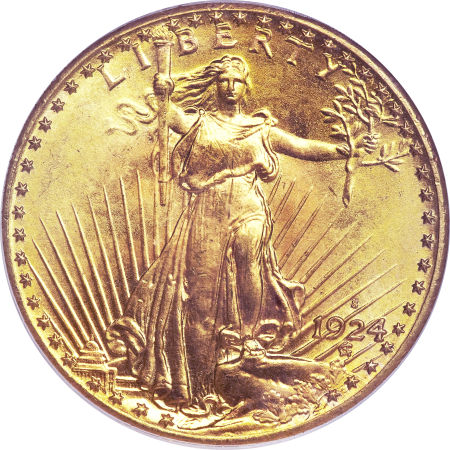 I see I can buy a 1924 mint condition GOLD double eagle for $1,300 on ebay.
Had I invested that $20 in 1924 until now at 5% I would have $2,060…at 7% 12,373.
Rocky Humbert writes:
I rarely post these days, but I think Larry's post need a rebuttal.
On January 22, 1924, the constituents of the Dow Jones Industrial Average were: American Can, Anaconda Copper, Studebaker, American Car & Foundry, Baldwin Locomotive Works, US Rubber, American Locomotive, Central Leather, US Steel, American Smelting, GE, Utah Copper, American Sugar, Mack Trucks, Western Union, AT&T, Republic Iron, Westinghouse Electric, American Tobacco, Sears Roebuck.
There was no way to invest in the index in 1924, and commissions were fixed and were likely to be more than 2% of the investment value. So, the odds of investing in a company that went bankrupt over the ensuing 90 years was significantly more than 50%. Additionally, it was illegal to hold gold from about 1933 to 1974….
There is no doubt that violating Federal Law and holding gold would have underperformed a diversified portfolio of stocks. However, the appropriate comparison is what cash, net of income tax, would have returned over this period. And here again calculating that is trickier than one might expect, because hundreds of banks failed in the 1930's and there was no FDIC insurance. And the Treasury didn't begin auctioning Tbills until 1929!
My point is not that gold was a good investment. My point is that the actual realized after-tax return that you would have gotten with the alternatives is also entirely unclear — except with 20/20 hindsight!!! So the best comparison would be, what is today's purchasing power of a US $20 bill that you stuck in a drawer versus the purchasing power of that gold coin… and I suspect the answer is that the gold coin did better than the $20 bill.
There is only one free lunch and that is diversification.
What? I can't use hindsight?? You spoil sports.
My one assumption is I would have rolled into all the new DJIA 30 stocks as they were added and subracted
Dec
27
Holiday Markets, from Rocky Humbert
December 27, 2018 | Leave a Comment
It's definitional that you only know the "low" in hindsight. I can't remember ever seeing a "one day bounce" after a puke of this sort–rather, the first green close produces additional up moves — since there are a ton of people waiting for the first green close to pile on (or cover shorts). All of this is short term stuff–but it will very likely result in a 4 to 8 percent rally off the low. Then you'll hear all of the pundits talking about the "retest". Blah blah blah.
I never own enough when it's going up. And I always own too much when it's going down. But I have my discipline and I stick to it. Kind of like always picking Choice B on a multiple choice exam. Always better to be consistent than to be smart. And it's only lunch time–so today's green could easily still fizzle.
Dec
3
Ever Since the CFA Exams, from Victor Niederhoffer
December 3, 2017 | Leave a Comment
 Ever since the CFA exams I have noticed a tendency for Wall Street research to deteriorate. A Gresham's Law appears to be operating. The articles like the white shoe one I mentioned are chock full of seemingly sapient stuff that are scientifically flawed amid reference to Shiller p/e data with their 10 year averaging and data when no earnings were reported etc. They refuse to take account of interest rates and use technical analysis and charts for suggestive but random conclusions. It is sad to see this deterioration as literacy increases as predicted by Nock.
Alston Mabry writes:
I find that if I'm really serious about an individual ticker, one of the few places where I can get at least trailheads to research is the earnings conference call, not for the company's answers but more for the analyst's questions, assuming there are analysts on the call who are at least somewhat skeptical. Not that I dig into individual tickers that much anymore.
anonymous writes:
Vic's point of Gresham's Law happens everywhere, but especially in situations where there are credentials given that appear to have value. IMO the CFA society exists (as does the CMT) primarily to enhance the status of its anointed ones (for a price), and for the side benefit of providing income to the society heads.
Al is right: There is no original thinking and virtually no research. But there is a benefit to us thinking ones: If all of what passes for research is bot-written drivel, released over some time period, a case can be made for trends to exist based on the gradual release of the drivel. That would support the contention that what really drives certain markets is momentum and sentiment.
Never complain about the weaknesses of your opponents; exploit them.
Allen Gilespie adds:
In an effort to defend free thinking CFAs from the white shoe firms, I have attached and included a link to my most recent annual analysis on the Dow Jones Industrial Index built on Ben Graham's method's with an added modern twist and nod to Richard Russell in a world of QE. I have also include my white paper on Bitcoin, Banking, and Bernanke in a World of Monetary Chaos from 2013. Prior year reports available to those with a Bloomberg under DIA US equity. Given that the economy now includes industrial businesses and network/software type businesses like MSFT and V I think there is a delta between book value, average ratio and earnings methods due to network value theory and excessive monetary inflation. I am calling this new valuation framework my Gold, Bitcoin, Dow Theory whereby one bitcoin plus one gold coin = one Dow share. Obviously, figuring out the key ratios is key, but in short, the theory is that gold and tangible book on the Dow should trade on a ratio. There will then be the goodwill book value which gets measure by crytpo, so in combination they will equal the value of shares in fiat. In short, there is value but that value is dependent on the value of money, assets, earnings, and interest rates. We live in a world of fiat, hard, and crypto currencies. In short, I think QE is the same as John Law effort to demonitize gold but then cryptos broke out - you can inflate values but the market will find a way to make proper measurements. I have started making all price targets in dollars, gold and bitcoin equivalents - when money is mispriced it is hard to know the value of anything and all secular bear markets are the result of a breakdown in the monetary system (greenbacks - bi-metal system - gold standard - Bretton Woods - Quasi-Free float - Crypto) - bear just don't understand how they play (sometime values decline (deflation) (1929-1932), sometimes they inflate (1966-1982) so nominal prices hold but you loose purchasing power, and sometimes you hyperinflate your values go up but you gotta find a better currency (cyrpto).
The Dow Jones Industrial Average - Fintrust Investment Advisors
Bitcoin, Banking and Bernanke - Fintrust Investment Advisors
Rocky Humbert writes:
Spurious correlation. The first CFA exam was administered on June 15, 1963 to 278 men and 6 women. In 2017, the pass rate for CFA-I was 43% out of 189,000 candidates. The average starting salary for most CFA's is under $100k.
See page 55 of From Practice to Profession: A History of The Financial Analysts Federation and the Investment Profession
"CFA Says Pass Rate for Level 2 Climbs to 47%, Highest Since 2006"
Russ Sears writes:
While I agree with much of what Rocky states, what appears to be missing from the thread is that the motive for much "rresearsh" is often CYB (cover. your. behind) Designatona helps but the real cause and effect of such proliferation is litigation and regulation.
Gordon Haave writes:
I'm a CFA and I agree with Vic and Jeff. Almost anything written by a CFA is formulaic and uninteresting.
I get an email once a week from the CFA society linking to all the things on Seeking Alpha that were written by CFA's and they are almost universally worthless.
Rocky Humbert writes:
Wait a second. The hypothesis proffered by Vic was that "ever since the CFA exams I have noticed a tendency for wall street research to deteriorate. A greshams law appears to be operating."
We are in agreement that virtually all of the research is unhelpful or rubbish. But it is incorrect to to attribute this to the CFA exam or to suggest that this is anew phenomenon. At the very least, it is due to the fact that customers of wall street firms do not pay for the "product." And the price of the product has finally converged to the value. Do you remember Henry Blodgett? Mary Meeker? That was 20 years ago. This isn't news.
Additionally, back in the early 1990's and long before the front-running scandals, David Silfen formed an internal prop group to invest based on GS analyst research. The results were abysmal and the group was disbanded.
Russ Sears writes:
While I agree with much of what Rocky states What appears to be missing from the thread is that the motive for much "rresearsh" is often CYB (cover. your. behind) Designatona help but the real cause and effect of such proliferation is litigation and regulation.
Paul Marino writes:
I agree with you Russ, but in a world where you can pay to know if Fed Powell likes his morning egg hard boiled or over easy I'm a little over easy myself. Bernanke was an oatmeal man. This is Flexionic activity written by Gov's and the Operator's will take every advantage over the common man.
Allen Gillespie writes:
In an effort to defend free thinking CFAs from the white shoe firms, I have attached and included a link to my most recent annual analysis on the Dow Jones Industrial Index built on Ben Graham's method's with an added modern twist and nod to Richard Russell in a world of QE. I have also include my white paper on Bitcoin, Banking, and Bernanke from 2013. Prior year reports available to those with a Bloomberg under DIA equity. Given that the economy now includes industrial businesses and network/software type businesses like MSFT and V I think there is a delta between book value, average ratio and earnings methods due to network value theory and excessive monetary inflation. I am calling this new valuation framework my Gold, Bitcoin, Dow Theory whereby one bitcoin plus one gold coin = one Dow share. Obviously, figuring out the key ratios is key, but in short, the theory is that gold and tangible book on the Dow will normalize and the delta goes to crytpo, so in combination they will equal the value of shares in fiat. In short, there is value but that value is dependent on the value of money, assets, earnings, and interest rates. We live in a world of fiat, hard, and crypto currencies. In short, I think QE is the same as John Law effort to demonitize gold but then cryptos broke out - you can inflate values but the market will find a way to make proper measurements. I have started making all price targets in dollars, gold and bitcoin equivalents - when money is mispriced it is hard to know the value of anything and all secular bear markets are the result of a breakdown in the monetary system (greenbacks - bi-metal system - gold standard - Bretton Woods - Quasi-Free float - Crypto) - bear just don't understand how they play (sometime values decline (deflation) (1929-1932), sometimes they inflate (1966-1982) so nominal prices hold but you loose purchasing power, and sometimes you hyperinflate your values go up but you gotta find a better currency (cyrpto).
anonymous writes:
David Simon made a related point to all this with regard to journalism. (He worked for the Baltimore Sun before writing The Wire.) As seasoned journalists who knew their beat were replaced by cheaper fresh faces who can still write words, skepticism and quality deteriorated.
Nov
30
BTCorrelation, from Kim Zussman
November 30, 2017 | 2 Comments
 WSJ featured a chart of BTC vs other bubbles. Usually there is a correlate–such as the desk top computer and tech stocks, gold and political uncertainty (sic), etc.
The only things I can think of that correlate with BTC's trajectory are the frequency of NK nuke tests and due-process free salacious executions of key members of the deep state.
Others?
Andy Aitken writes:
A key characteristic of a bubble is that the people in it don't recognize that they are in it.
The bubble proclamations about bitcoin seem to come from those who have missed out (i.e., they're "too smart" to participate), as well as from those that stand to lose something. Despite Anatoly's misquoting of me, in response to Jamie Dimon calling bitcoin a fraud, I did not call Jamie Dimon a fraud. I wrote that bitcoin said that Dimon is a fraud. Bitcoin is still less than a $150B market cap, less than a third the size of one company (Cisco) at the height of the internet craze. Which turned out to have not been a "craze". The most chiliastic augurs of a connected humanity, portents of Teilhard de Chardin's noosphere reified, were too conservative. Just 15 years later, there are quite a few tech-oriented companies that have surpassed CSCO's peak valuation, and everyone is tied to the net 24/7 through pocket supercomputers.
In my view, the bubble that is barely acknowledged is the vast scope, size, and scale of the state (not just the government), and its rapacious intrusion into our private lives. This precarious bubble continues to inflate on the premise that there is no diminishing marginal utility of additional units of state power. The gap grows between the linear growth in expectations and the logarithmic returns. If this is a bubble, then bitcoin represents its antithesis.
Rocky Humbert writes:
Andy, Bubble schmubble. There are sardines for trading and sardines for eating. I submit that the most important trait for successful investors/speculators is knowing the difference. And not becoming an idealogue, philosopher or believer. I suggest that you read the Harvard paper that I posted two days ago a bit more carefully. As the paper reports and I've learned from experience, these moves go much further and last much longer than reasonable people expect. Especially for bitcoin (and real estate markets) since the supply/new issuance is very limited. And since you mentioned Cisco, I believe its high tick war around 85; 17 years later the stock is trading at 38. During its final blowoff phase, the stock appreciated by about 800% and the only trade was to be long. Until it wasn't. And then the only trade was to be short — for about two decades (with most of the move occuring during the first 24 months). Same thing with the Nikkei in 1990. Gold in 1979. Etc. And I feel comfortable predicting that the same thing will be true for BTC but from a final blowoff top of who-knows-where. Lastly, here's a rocky challege: Name one major currency whose value routinely moves around by 20% intra-day? (Other than a government engineered revaluation, of course.) Anyone? Anyone? Of course, it's Bitcoin.
Andy Aitken replies:
I've been emailed personally by several people on the List who asked what I guess they thought were questions I hadn't considered or couldn't answer.
I've responded with thorough emails with numerous academic and non-academic references, and never received a "thanks" or even an acknowledgement of my time spent. The fact is that I have pulled out many times my investment, and yet those with the strongest opinions have nothing at stake (at least in terms of money, the need to be right is very much in evidence), with no more relevance to the market price than a bucket shop price shouter. I have less certitude about the future price than they do. But what do I know?
I really don't care if people think I am ridiculous or stupid. I'll take my profits while they opinionate. Your benchmark of price stability (USD) has declined in purchasing power by 99.5% since the creation of the Fed just over 100 years ago. This was after a long period of purchasing power stability, or even of productivity-driven deflation. Ah, but those fluctuations in prices (e.g. 1907)! They drove a free people to put the management of their currency in the hands of technocrats. My grandfather retired as a bank vice president about 55 years ago, never having earned more than $10K a year. And yet he and his family lived an upper middle class life, with no mortgage on the brick house on a tree-lined street, cars bought with cash, and a child who went to an expensive private college.
What sort of price stability is this? I hold gold and trade it, and even expect a rally in it, but I think we all know that the CBs would kill any "bubble" in gold, though such a "bubble" might be very much justified. If the state and its extension, the CME, kill bitcoin as Anatoly hopes, then another cryptocurrency (or something like it) will replace it.
There are already several that could replace it. It is a mistake to equate bitcoin with cryptocurrency.
There is the beginning of something here that all lovers of freedom should welcome, even if its name is not bitcoin.
Jason Pilfer writes:
Victor had a quote about Dimon I recall that sums up many of these bitcoin bubble threads.
"Sounds like one of the non-falsifiable predictions from the adventurous traveler or so many of his ilk that don't have the constraint of having to make a profit with trading.vic"
I admire Andy's instructive tenacity and hope to see more. There remains quite a chasm to bridge. I've argued in the past that cryptos are an ongoing disruption rather than simply a new currency coming into an old framework. Many of the predictions would be more relevant if bitcoin were simply a global fiat currency.
The chartism and top/bottom calling entirely misses the reason why cryptos came into being, are incredibly popular and accelerating in adoption and appeal.
The bubble discussion is weary and likely tied to the ongoing global FOMO effect, yesterday I ran across this Fortune link from two years ago about how to short the megabubble when bitcoin was 1/10th today's price
Not much has changed.
The higher level discussion about CME impact is insightful and appreciated.
Oct
10
Superb Interactive Asset Allocation Tool/Visualizer, from Rocky Humbert
October 10, 2017 | Leave a Comment
I stumbled upon this tool on the RA website. It's by far the best one I've seen (for free). It allows you to see historical risk/reward for different asset classes over different time periods, efficient horizons, expected future returns, various blends, mixes, blah blah blah. It really is superb.
Sep
28
Tbills Outperform Stocks Over the Long Run. Man Bites Dog. Provocative Academic Paper, from anonymous
September 28, 2017 | 3 Comments
The NY Times and Bloomberg wrote about this new paper (August 2017) that purports to show that Tbills outperform almost all stocks over the long run–and that a tiny number of stocks account for all of the returns. I just read it. I recommend that you read it too–since it is counter intuitive.
I see several unrealistic/unspecified methodologies in this paper including (1) equal weight holdings from IPO to delisting of every stock; (2) no clear explanation for how the capital from mergers, acquisitions and spinoffs are handled; (3) where the new investor capital comes from to buy fresh IPO's and where the cash goes when a company is acquired for cash. I also didn't study his statistics carefully. Since most every company goes through a life cycle, it's intuitive that most will disappear or be acquired/acquire, so I need a better explanation for the investor's portfolio management/cash to really understand the practical. What other problems or unique insights do you see in this paper? Something just feels wrong here.
Do Stocks Outperform Treasury Bills?
Hendrik Bessembinder, Arizona State University. Revised August 2017.
Abstract:
Most common stocks do not. Slightly more than four out of every seven common stocks that have appeared in the CRSP database since 1926 have lifetime buy-and-hold returns, inclusive of reinvested dividends, less than those on one-month Treasuries. When stated in terms of lifetime dollar wealth creation, the entire gain in the U.S. stock market since 1926 is attributable to the best-performing four percent of listed companies. These results highlight the important role of positive skewness in the cross-sectional distribution of stock returns. The skewness of multiperiod returns arises both from positive skewness in monthly returns and because the compounding of random returns induces skewness. The results help to explain why active strategies, which tend to be poorly diversified, most often underperform market averages.
Victor Niederhoffer writes:
This ridiculous paper from anti stock which I haven't read and goes counter to the carefully worked and accurate work of the triumphal trio duly reported in all their yearbooks is an absurdity. Of course most stocks will underperform. That's the nature of cross sectional returns. The distribution has quite a few good winners. It's probably true of a normal distribution also. Certainly for the kind reported in the NYSE year book. Certainly for the stocks in any variant of the pareto distributions. How far will they go to undermine the value of equities. It's so absurd I can't begin to say how it would apply to most any real life distribution in any field like IQ's.
Stefan Jovanovich writes:
Index investing works because it allows people to avoid the risks of trading; and most of us are lousy traders.
Enterprise ownership beats public investment in terms of ROI (not "Radio on Internet"); but the public markets offer the only way for entrepreneurs to cash out. We still own one of our start-ups; its annual payout as ROI has been greater than 40% annually for the last 38 years. But, we cannot not "cash out" by selling it to someone else. The actual market for private businesses that makes hundreds of thousands, not millions, does not exist. We have been able to "retire" - i.e. extend the life of the business beyond the time we directly manage it - by doing a private variation on an ESOP; our former employee now runs it as a part owner.
As for the tug of war between "capital" and labor, we have been lucky enough to escape Marxism almost entirely. The cash flow from the business is distributed using the New England whaling ship model of "shares". Keith, the captain and part owner, sails out into the unknown every month and we get our cut on what the barrels that he lands in New Bedford. What we all share - Keith, Eddy and her Mom, your pontificating correspondent, and everyone else in the crew - is a 19th century American sense of equality. We are all equal members of the enterprise in dignity and responsibility and everyone understands that what people "make" is a function of talent and timing, not innate worth.
P.S. Every business failure in my life has been a situation where the people in charge (including me) thought that talk about the business as "family" and a mission statement on the web site would do the trick. It didn't; it can't.
Rocky Humbert writes:
I read his paper again and was able to tease one critically important fact out of it.
Page 15 and table 2A/Panel C: 70.5 % of the stocks that are in the largest decile by market cap outperformed the Tbill with a 1 decade horizon. And 81.3% of those stocks had a positive return. It's only for the smallest market cap groups that a substantial percentage substantially underperformed Tbills. Look at that table carefully and you can look at your own portfolio and it all makes sense.
In essence — if you own the biggest companies, you have beaten the Tbill (as we know from experience), but if you own the smallest market cap stocks, you have not. This makes intuitive sense since there are only two kinds of small cap stocks — those that start small and end up big. And those who were once big and are on their way to 0. It's a rare and bizarre company that starts small and always stays small!
The press reports and paper abstract are written in a bearish sensationalistic manner. For whatever reason, he chose not to include the key point mentioned above in his abstract. Now that I found this fact, I feel like everything else is noise — except for reinforcing one lesson that I've discovered anectodally: individual price momentum on the way down matters. If you have a stock that was once a $100 billion market cap and is unfortunately now a $10 Billion market cap, you should take your tax loss and reinvest whatever is left in another stock. And not wait for it to go to zero…and definitely not keep averaging down. In contrast, if you bought a $50 Billion market cap stock and it's now a $100 Billion market cap stock, don't sell it because it went up a lot. The skew and history suggest that it will continue to do well. (Until it doesn't).
Sep
6
Do You Read Chinese? Do You Hold Bitcoin? from Rocky Humbert
September 6, 2017 | 1 Comment
 It's clear that the People's Bank of China (PBOC) just cracked down on the initial offerings of cybercurrencies (as did the SEC). But it's possible that they just made all virtual currencies illegal. If someone can read Chinese, they can provide much better insights than Google Translate…
Google translate says: The tokens or "virtual currency" used in coinage financing are not issued by the monetary authorities, do not have legal and monetary properties such as indemnity and coercion, do not have legal status equivalent to money, and can not and should not be circulated as a currency in the market use.
anonymous writes:
In China, what are said to be not allowed are always allowed for somebody, or are done by many regardless; and what are said to be allowed are always not allowed for somebody, or may not be done by many regardless.
Sep
4
My Question, from David Lillienfeld
September 4, 2017 | Leave a Comment
/https%3A%2F%2Fblueprint-api-production.s3.amazonaws.com%2Fuploads%2Fcard%2Fimage%2F574706%2F9ae45d95-fc22-47dd-b5f7-0426894a2201.jpg) Forget the unemployment numbers.
Forget the unemployment numbers.
The question I've got is how much of a bump to the GDP is generated by the rebuilding of Houston and the rest of Texas hit by the recent inundation?
anonymous writes:
This will help: "The Parable of the Broken Window"
George Devaux writes:
I am not sure about the truth of the parable.
Consider that for years people transferred wealth to insurance companies. The insurance companies put liabilities on their balance sheets, and used the cash to generate net wealth.
With the event, the insurance companies transfer cash to the people (and reduce the liabilities on the insurance companies) to restore the destructed wealth. The insurance companies retain the net wealth.
In the longer term, people having seen the destruction build differently. The people are also more prone to secure insurance. The insurance companies use their collective wisdom to innovate solutions or at least improvements that reduce future destruction.
In summary, destruction forces improvements.
Russ Sears writes:
Banks and insurance companies cause the multiplier effect. the higher the leverage, the higher the multiplier effect is. Holding more reserves and surplus slows the speed of money. Hence rather than just GDP, it should have an "inflationary" effect as the speed of money increases. Prices also increase because of demand and supply shocks. We've already seen the effect on gasoline.
Rocky Humbert writes:
This is actually a complex analysis with many feedback loops. It is possible, but not necessarily true that short-term US GDP will increase due to the hurricane rebuild. Nor is it necessarily true that this will be inflationary, however, certain prices (such as local lumber and wallboard) will likely increase. I believe that the primary determinant on short-term and longer-term US GDP is what activities and investments and jobs will be sacrificed/diverted to the hurricane rebuild; what income will be temporarily or permanently lost; and what the relative multiplier effects are between these alternative uses of capital and labor and the hurricane rebuild. Furthermore, if the economy were in a recession with a high unemployment rate, the effect on GDP would probably be greater than the effect in a modestly expanding economy with a low unemployment rate.
For illustration, if my house was destroyed by a hurricane, and even if I have flood insurance, I will surely still have uncovered losses. I will therefore likely immediately reduce other spending, such as a trip to Disney World and eating out at restaurants and buying new clothes. I might also delay the purchase of a new car and other big ticket items because I will need to buy replacement furniture. More generally, local businesses will likely be disrupted — and productive local service employees will be laid off for days/weeks/months — resulting in less economic activity in the region — offset by an increased need for carpenters, plumbers, and tradesmen.
There is a debate among economists about the real multiplier effect from infrastructure spending. But even that debate assumes that the infrastructure will be upgraded and improved — not simply hauled away and replaced. But the multiplier effect is beyond the question on the table. The bottom line is: it's complicated…..
Aug
10
Trump’s ‘Fire and Fury’ Comments, from Charles Pennington
August 10, 2017 | Leave a Comment
I've been trying to figure out what a President is *supposed* to say when a foreign power threatens:
"WSJ: Trump's 'Fire and Fury' Comments: Statement by William J. Perry"
Andy Aiken comments:
"We do not make empty threats, because empty threats weaken our credibility, and weaken the strength of threats that we do intend to carry out. As Theodore Roosevelt said, "speak softly but carry a big stick."
So is Perry speaking of Trump when he writes this, or Obama, GWB, and Clinton? The Nork nuke deal hatched by WJC, Jimmy Carter, and Madeleine Albright was the framework for the Iran nuclear deal. Both were deeply flawed miscalculations, modern versions of "peace in our time". What came of Obama's "red line" in Syria? His pronouncement was counterproductive blabber. Perry himself was probably behind that empty threat.
Rocky Humbert writes:
Well he was certainly not speaking of Reagan — who directly and openly challenged the existing Soviet military doctrines (pre-gorbachev):
From "Reagan and The Cold War":
What struck Reagan about Communism was its weakness. Communists ruled by fear and intimidation. He believed that policies of peaceful coexistence or of passively containing the Soviet Union would be disastrous. The Communists would over time use the Western fear of war, especially nuclear war, to undermine the confidence of free peoples. They practiced "salami slice" tactics of intimidation and bluff to gain marginal advantages that would eventually accumulate to a victory in the Cold War or allow the Communists to win a final showdown. Reagan sought to turn the tables on Moscow and its allies by advocating an all-out fight against the growing encroachment of Communism in this nation and throughout the world.
By all-out fight, Reagan did not mean military action, although if that was required of the United States in particular circumstances—e.g., Korea, Vietnam—the United States should have fought to win. The key front in the Cold War, in Reagan's assessment, was actually the Soviet economy. Marxism was a materialist philosophy, and its chief claim to practical allegiance around the world was its supposed ability to produce economic plenty (and thereby, social justice). In fact, Reagan believed that democracy and capitalism had decisive, natural advantages over totalitarian systems and centrally-planned economies. Reagan sought to confront the Soviet Union simultaneously with various forms of economic pressure: nearly-open ended American military spending; threats to the security of the Soviet empire (especially in Eastern Europe and Afghanistan) through direct and indirect American support to resistance movements; losses of foreign currency that the Soviets had expected from sales of oil and natural gas; and a cutoff of Western aid and technology.
Reagan argued that the Cold War would end only when there was a fundamental change in the Soviet system, and not just in Soviet policies. The strategy of economic warfare was designed to force such a change, by bringing to the fore a new generation of Soviet leaders who would finally recognize the bankruptcy of communist ideology and move toward a true political rapprochement with the West. The United States, in turn, would promote democracy throughout the world as a magnet and an example to all the peoples oppressed by dictatorships of whatever stripe.
Jun
28
The Death of Malls, from Ken Drees
June 28, 2017 | 4 Comments
 My father (RIP) joked back in the 1980s that when our local northeast Ohio mall died that it would make a great prison. At the time we laughed because we never thought the mall would ever lose its appeal–I mean it had an Orange Julius store in it–what could be better than that? Well that mall did die and it still is just one huge boarded up bereft eyesore. The mall up the road 3 miles in the next town just lost its Sears anchor –recent December announcement. And this mall will be the next to die. Another 5 miles up the road in a better neighborhood is a mall that had to restrict unchaperoned teens on weekends due to a mass teen flash mob that went wilding–terrorizing the people actually shopping. It will be the next to go–people do not want to be harassed in a captive space when they go out to shop. The trend seems to be more of these outside based shopping plazas where you walk outside and stroll from store to store and enjoy open air and green space, etc. The "everything under one roof" concept seems to be going away.
What will eventually develop out of these dinosaur chunks of dead mall space in prime locations in less that prime towns? These towns lost middle america–maybe prisons, or halfway houses, or a la Trump–new job training centers, or low rent housing for displaced illegal aliens, or detention centers for questionable illegals, or new factory centers for returning blue collar jobs. I do not know the answer.
anonymous writes:
The dead mall long standing empty property and another one about 20 miles away were bought by Amazon to be turned into warehousing distribution centers . Both will be high tech built for drone delivery. Not many flesh and blood workers to be getting jobs in these places. However, the building trades will be quite busy and there will be contractor dislocations and shortages of cement and rebar, etc to be anticipated.
Rocky Humbert writes:
It is arguable that this country has way too much retail space. It is arguable that Class A malls will survive, but Class C malls (that still look like the 1950's) will fail. It is arguable that population movements will render some malls unprofitable. It is arguable that the valuations of REITS are too high relative to their growth prospects and trend in interest rates. But the "Anchor Tenant" is a legacy of a bygone era….
Lastly, I will speculate that people who live in large urban centers (especially New York City) have little understanding of the social phenomenon of malls– and how they are the climate-controlled "main street" in many places.
May
15
Henrik Cronqvist, Stephan Siegel, and Frank Yu:
Value versus Growth Investing: Why Do Different Investors Have Different Styles? [39 page PDF ]
Abstract:
We find that several factors explain an individual investor's style, i.e., the value versus growth orientation of the investor's stock portfolio. First, we find that an investor's style has a biological basis and is partially ingrained in an investor from birth. Second, we show that an investor's hedging demands as well as behavioral biases explain investment style. Finally, an investor's style is explained by life course theory in that experiences, both earlier and later in life, are related to investment style. Investors with adverse macroeconomic experiences (e.g., growing up during the Great Depression or entering the labor market during an economic recession) or who grow up in a lower socioeconomic status rearing environment have a stronger value orientation several decades later. Our research contributes a new perspective to the long-standing value and growth debate in finance.
Victor Niederhoffer writes:
This is why we count and do prospective studies versus retrospective ones, and why we eschew paying attention to work form Yale professors who average earnings over 10 years , many of which were not reported until 6months after the earnings were or were not reported, with retrospectively selected stocks.
Rocky Humbert writes:
Vic, by your own admission and work, if the stock market declines massively this year, it increases the probability of a greater-than-average return in the future. And by extension, if the stock market rises massively this year, it increases the probability of a lower-than-average return in the future. Why don't you extend this logic (which is both fundamental and technical) to relative valuation (i.e. growth v value) ; perhaps because your data set is lacking one of the largest multi-year examples (1997-1999) in history?
Also please explain how dismissing Shiller (or anyone else's argument) strengthens your argument– which I interpret as being a blanket belief that "fast growing company stocks outperform inexpensive slow-growing stocks." I can provide you with many strong academic studies that have documented this phenomenon in the past; as well as good studies that demonstrate momentum, small cap and other factors have historically outperformed. I would also like to better understand how you define a prospective study — since I find your use of the term confusing in this context.
As others have noted, this list has increasingly veered from its mission and why I joined; because the direction and rigor comes from the top, this exchange provides an excellent opportunity to reorient — unless you'd rather demur and focus on longevity.
Since when is this kind of thing true for future returns in a random walk?
Russ Sears writes:
The stock market declines massively this year, it increases the probability of a greater-than-average return in the future. And by extension, if the stock market rises massively this year, it increases the probability of a lower-than-average return in the future. There is a subtlety in this statement that I think should be pointed out, it is time. A quick hard drop increases the chance of a quick high return next year. However it is not symmetric with time. A large risk may lower expected return over a much longer period of time. Knowledge and therefore increases in wealth stays with us longer than destruction.
Victor Niederhoffer writes:
Since when is this kind of thing true for future returns in a random walk?
May
9
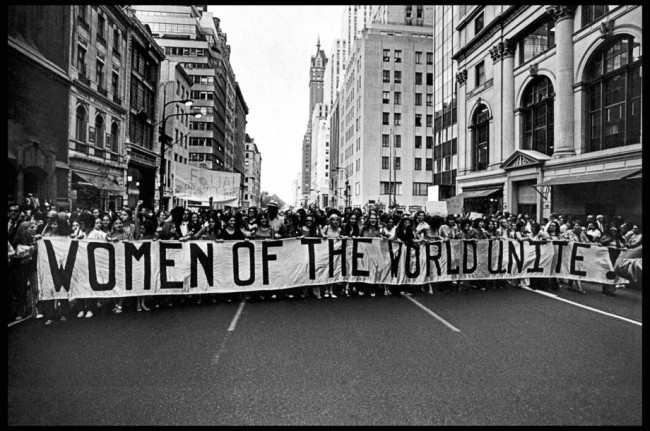 I believe "African Studies", "Feminist Studies", "Women's Studies", "Social Justice", "HR Specialist", and so many more add no real value to the world.
Gordon Haave writes:
I disagree, those majors also open up the opportunity for community activist type jobs.
Thurston Trowell writes:
So people should get finance degrees and MBAs and go on to become analysts and managers of mutual funds and hedge funds, at least 88% of whom lag the markets each year? In your view, exactly how are these wealth sapping leaches on society diverting peoples' hard earned retirement savings into their own bank accounts and grand villas in Connecticut adding more "real value to the world" than the African Studies major?
Scott Brooks reacts:
As usual, you jump to conclusions and ascribe things to what I wrote that I never said or wrote. It makes me think that you're part of the media who spins what people say to fit their desired narrative in order to demean those that dare disagree with their "exulted enligntened world view". Heck, it's almost like you're trying to smear and label me as some unworthy disgusting deplorable person.
But, that might only be the case if you were one of those media people. But let's look at what you said and deconstruct your faulty logic about the evils of financial people and what value to they bring to the world?
Let's keep this simple: How many people do these financial employ? How much revenue do they create from their efforts of adding value to the lives of other people (whether you see it as value or not…..people voluntarily see it as value since they keep giving these financial people money…..at least I know my clients do).
Personally, I employ 8 full time and 2 part time people, all of whom make very good money. I'd say that's pretty good. There are ~ 50 financial advisors flying to STL in a few weeks (on their dime) to spend 2 days with me so I can train them to better serve their clients, grow their businesses. Further, I will be training them on how to grow their staffing (creating jobs) as their businesses grow. I'd say that puts me and my services in demand. I'm the guy who donates money to the people who think they are doing good deeds in their communities. I'm the guy who pays the taxes that are forcibly taken from me to "support" (read: create dependence on the government) those poor souls (read: people who will vote for the polilticians who take my money and give it to the poor souls). I'd say that makes me pretty valuable.
As a matter of fact, I'd go so far as to say that the "do-gooders" of the world and they people they serve are completely dependent on the value I create so that I can donate to their services (or allow their "revered government" to take from me and give to them. Those with a degree in African Studies can do…….what? Hope to get a job teaching African Studies at some university to students who can do…..what? Hope to get a job at some university teaching African Studies to students who can do…..what? And so on, and so on, and so on, etc. etc. etc. And feel free to replace "African Studies" with "Feminist studies" or any other such worthless degree. If we eliminated African/Feminist/ studies (and other BS degrees) from universities….what would happen? I submit that the world would immediately become a better place. Of course, you may not like it because it would be a world filled with more financial people and businessmen and media types. Heck, we might even see the rise of the worst possible mashup of those things…….a media businessman who specializes in writing financial articles.
Rocky Humbert responds:
Shame on you. It saddens me that you, as a devoutly religious man, views the world in such mundane economic terms, rather than philosophical or existential terms. I suspect that hostile prose distorts your true beliefs. One's college major and one's college means little. Whether it's in physic or math or basket weaving. It's a piece of paper. And only to academics and archaically minded professionals does it have any meaning at all. How one conducts one's life means everything. Defining one's worth to the world is for only oneself and one's creator to measure.
Russ Sears writes:
Having a degree gives others insight into what the graduate values.
I will agree that the usefulness of what you learn can only be determined by the person using that knowledge.
Few art majors would have the ability or desire even if they had the skills to commit the time to engineering a bridge for example, but the engineering team may need an art major to enhance a bridge's aesthetics.
Apr
20
Dell, from Rocky Humbert
April 20, 2017 | Leave a Comment
 Take a look at the late, great Dell computer. I started shorting it in the late 1990s using a statistical/valuation methodology that was predicated on volatility and the near certainty of a substantial correction. I was correct in that I eventually made money, but the mark-to-markets (and "risk adjusted return") were dismal. I don't use that strategy anymore…
Remember also that nearly every company (GE being one of the exceptions but for the grace of the Fed) eventually disappears either through acquisition, merger, or bankruptcy. So if you only look once every decade or two, and leave a GTC order to buy everything down 50%, you are very likely to get filled. But you are also likely to own a portfolio of losers.
Apr
9
≈50 Tomahawk Missiles into Syria, from Rocky Humbert
April 9, 2017 | 3 Comments
Some historical context is necessary. Let us remember that much of the current Syria situation can be attributed to Obama's "red line" and his naive agreement to have the Russians remove all chemical weapons. Does anyone remember that? Let us also remember that the flood of Syrian refugees is a direct result of the former too. Wouldn't it be nice if everyone could just "get along" and sing Kumbaya? Perhaps in our next life. But not in this one.
The missile strike is a calculated political signal; not a military one. It's how one sets the table for negotiations — not so much in Syria, which is now a lost cause — but much more importantly in North Korea and other places. And on that subject, Gordon and the others will surely change their views if and when Kim tests a Nuclear-tipped ICBM capable of hitting of San Francisco….
Stefan Jovanovich writes:
Kim and I may be hopelessly biased; we think the United States' only sensible policy in the Middle East is to insure the survival and prosperity of Israel. To do that, the U.S. and the Israelis have to choose which side of the ongoing civil war among Muslims is the better bet.
It is not a difficult choice; the Sunni majority countries are the only ones that are not absolutely focused on the destruction of the Great and Little Satans.
What the missile strike - by its size and focus - has done is show the Sunni countries (many of whom just happened to be visiting the White House recently) that President Trump is not someone who believes in military gestures. He is actually willing to break things permanently. That air base is gone.
The fact that the missiles were in the air as the President sat down to dinner with the one country in the world - other than the U.S. - that can destroy North Korea's nuclear threat is, of course, a mere coincidence.
anonymous writes:
Just like everyone else, you're entitled to your opinion, but please excuse us for questioning another unilateral action in the Middle East that does little to serve US interests. If anything, I would expect it to accelerate nuclear programs in both North Korea AND Iran.
You should be asking yourself who gains from this action, and why Little Marco and McCain are ecstatic about the news. I understand that anything that helps Israel is probably fine in your book, but I find it curious that noone seems to be questioning why a rational actor like Assad would be gassing people on the verge of a peace process.
A civil war has been going on in the WH between the populist platform that Trump ran on, and the globalist policies of the existing state apparatus via the proxy of Kushner. Based on these recent events in Syria, Bannon being stripped from the NSC, and the latest news that he and others may be out completely, things are not headed in the right direction for anyone who actually voted for change last election.
And so it goes…
anonymous responds:
Your conclusions about how North Korea and Iran will view this are interesting — but are diametrically opposite to how I and many others may view this.
One must ask the question, why would Assad use chemical weapons right now? This is very odd timing, don't you think?
The only plausible explanation was as a test of Trump. And Trump's response was a calculated signal to the world.
You can argue what the signal meant. And you can reasonably argue that it's a bad message.
But for me, it meant several (good) things:
1) International standards (Geneva Convention) matter and we are not going to rely entirely on the "international community" or the UN or useless financial sanctions.
2) Violating deals and treaties have real consequences. This is a signal to Iran regarding their Nuclear accord with Obama.
3) We are not afraid to use force and we will not be intimidated by the playground bully.
Ultimately, you have to decide whether there is good and evil in the world and if there is, who are the "good guys" and who are the "bad guys" in the world. I will readily admit (and here I am being an idealogue) that I am one of the good guys. And I want the good guys to prevail in the least bloody way. And that means carrying a big stick.
Mar
30
One Sees Obstacles to Reforms, from Victor Niederhoffer
March 30, 2017 | 2 Comments
One sees that everything is topsy turvy with the service reform that repubs are now pointing to. Apparently the agrarian reformers have put a framework in place where a new plan must be revenue neutral or else it has to subject to whatever non-reconciliation is. To the layman that means it's a lot easier to get a revenue neutral plan in. Washington loves that because gov spending won't be decreased. But the fly in the ointment is that any proposal to reduce service rates will generate enormous increased revenues through growth and compliance and proper business activities rather than those designed to reduce payments to the service. Supposedly the "non partisan" budget office made the congress agree that there can't be dynamic scoring. So the Lafferian correlation between reductions in service rates and growth can't be taken into consideration. Thus, the whole thing has an improper foundation, a twisted acorn that must grow into a twisted oak. I've found that all things built on improper foundations eventually crumble.
Rocky Humbert writes:
Since taking office, I count that to-date, Trump has eliminated over 90 government regulations; some of which are very significant and positive from an economic growth perspective (if one is inclined to view the cost/benefit ratio of such regulations as high).
Rocky wonders whether Vic has any hot water in his Connecticut manse. Why? Because he always seems to have a bucket of cold water at the ready.
Ralph Vince adds:
And further to Rocky's point comma it is estimated that these regulations costing economy about to trillion dollars a year. That's one eighth of our economy. Cut that in half reduce half of these regulations and you see an immediate 6% bump in GDP. In my case I have spent over 150 hours in the last month simply wrestling with the regulations caused by Dodd-Frank. Those who oppose the president on the political scale to sew an ideological grounds but in the nuts and bolts world of trying to get anything done and America the regulations are stultifying.
That 6% bump in GDP is before any kind of multiplier is put on it. Can again go back and look at any of the great social programs have been started and worked successfully in America from Social Security to Medicare to Medicaid they all coincide with double-digit GDP growth, something I personally and looking for between now and January of 2019. Taking a machete to the Jungle of regulations anyone trying to start or run a business or even so much as take out a mortgage has to contend with, as the numbers illustrate goes a long way towards getting his towards that double-digit growth, and possibly then some type of healthcare plan in America. People have been flying to this putting the cart before the horse.
Kim Zussman shares the article:
"How to Engineer a Trump Boom"
Cut taxes, deregulate, build roads, bridges and airports—and don't start a 1930-style trade war.
By ROBERT J. BARRO
Stefan Jovanovich writes:
Mr. Barro is looking through the large end of the historical telescope. Trade wars only occur when countries are already having shooting wars; they begin and end when one country loses all its money. The 20th century's "trade war" began in 1914 and only ended in 1945.
What "explains" the 1920s is that the one country in the world that had any money - the United States - decided that it could afford to accept other countries' central banks' valuations of their domestic currencies. What explains the 1930s is that Herbert Hoover and Franklin Roosevelt both agreed that the way to solve the collapse of the Wall Street credit bubble was for the U.S. to join the rest of the civilized world and undertake its own default on its domestic currency.
When economists now say that countries can inflate their way out of their debts, they are referring to the magic of the defaults of nearly all the international loans issued after the Great War. No one got paid back because the valuations accepted for the initial loans (mostly from the U.S.) were as fictional as the current Venezuelan exchange rate; and the Americans decided that having the U.S. Treasury own all its citizens' money was the ideal way to revive American credit exchanges.
Academically trained economists insist on treating political economy as a science, yet they believe, without evidence, that international trade was "free" after World War I. They see a world without quotas, currency controls and imperial preferences after 1918 as a kind of mystic vision that is true regardless of any actual facts. They believe this version of history with even more fervor than LDS believe in the story of Joseph Smith and the golden plates. The Mormons, God Bless Them, consider their gospel a matter of faith; Professor Barro and his colleagues must pretend that it is all somehow Reed Smoot's fault.
Feb
21
Forecasting Factor & Smart Beta Returns (Hint: History is Worse Than Useless), from Rocky Humbert
February 21, 2017 | Leave a Comment
Rob Arnott et al has released a new paper on Smart Beta, a topic that has gotten some air time here. His observations have analogs to other investing styles too.
Feb
13
Article of the Day, from Alston Mabry
February 13, 2017 | Leave a Comment
Here is a nice piece for skeptics:
"Who Will Debunk The Debunkers?" By Daniel Engber
In 2012, network scientist and data theorist Samuel Arbesman published a disturbing thesis: What we think of as established knowledge decays over time. According to his book "The Half-Life of Facts," certain kinds of propositions that may seem bulletproof today will be forgotten by next Tuesday; one's reality can end up out of date. Take, for example, the story of Popeye and his spinach.
Popeye loved his leafy greens and used them to obtain his super strength, Arbesman's book explained, because the cartoon's creators knew that spinach has a lot of iron. Indeed, the character would be a major evangelist for spinach in the 1930s, and it's said he helped increase the green's consumption in the U.S. by one-third. But this "fact" about the iron content of spinach was already on the verge of being obsolete, Arbesman said: In 1937, scientists realized that the original measurement of the iron in 100 grams of spinach — 35 milligrams — was off by a factor of 10. That's because a German chemist named Erich von Wolff had misplaced a decimal point in his notebook back in 1870, and the goof persisted in the literature for more than half a century.
By the time nutritionists caught up with this mistake, the damage had been done. The spinach-iron myth stuck around in spite of new and better knowledge, wrote Arbesman, because "it's a lot easier to spread the first thing you find, or the fact that sounds correct, than to delve deeply into the literature in search of the correct fact."
Arbesman was not the first to tell the cautionary tale of the missing decimal point. The same parable of sloppy science, and its dire implications, appeared in a book called "Follies and Fallacies in Medicine," a classic work of evidence-based skepticism first published in 1989.1 It also appeared in a volume of "Magnificent Mistakes in Mathematics," a guide to "The Practice of Statistics in the Life Sciences" and an article in an academic journal called "The Consequence of Errors." And that's just to name a few.
All these tellings and retellings miss one important fact: The story of the spinach myth is itself apocryphal….
Rocky Humbert writes:
Could this be a case of the myth of the myth, i.e. the metamyth.
Mr. Isomorphisms writes:
Myths are interesting as social and (il)logical phenomena, but a good rule of thumb is that anything written by a network scientist is not worth your time. It's my opinion– that Ditto Santa Fe Institute, complexity science, cognitive science. (It's been remarked that any science which needs to call itself "____ science" is protesting too much–but this is wrong because it would exclude food science, life science, brain science, and natural science.)
Feb
7
The Unemployables, from J.T Holley
February 7, 2017 | 1 Comment
Let's not forget that some people only work for 5-6 months and stop after they make 8000 grand so that they can get the earned income credit. They then take the remaining 6 months off. It's a crazy loophole that exists.
Says the man on disability.
It sure feels like 10-15% of folks are just flat out unemployable.
anonymous writes:
The gist of your last remark shows up in anecdotes and studies of the current labor market. The quality/skill set/attitude/demeanor of job applicants is a frequent cause for lamentation.
The latest NFIB (small biz) report says 89% of firms hiring/trying to hire see few or zero qualified applicants. And 15% of all businesses say finding qualified workers is their single biggest problem. Both numbers are high relative to history.
Rocky Humbert writes:
There are many different ways to slice and dice these complex issues. It can be argued that the root cause is the labor force is now unqualified. It can also be argued that employers are reaping what they've sown by investing less into the workforce.
Where you stand depends on where you sit.
Personally, I think this is a secular evolution with plenty of blame to go around. The key variable is that the median job tenure has been declining for years. No longer is a job at IBM or GM or GE a career that spans a lifetime. This phenomenon can be sourced to Jack Welch at GE. It spread throughout the corporate landscape (including to the Bob Rubin/Steve Friedman era at Goldman Sachs).
Some economists will say that this is a healthy sign of a dynamic labor force. Some economists will say that it's a consequence of the absence of defined benefit plans and union power. Some will say its the Gig Economy. It was part and parcel of the loss of job security and the solid American middle class.
But it is also clear that if an employer expects a short employment duration, he is less inclined to invest in his workforce (i.e. training/education) etc.
Marion Dreyfus writes:
That uptick of .1% is a reflection of hope–people who stopped hunting a job now feel hopeful enough to set foot to pavement. I stopped for months, and notice I started looking again this past month. Many are like me.
Nov
28
First Brexit, then Trump, now France: the Trend Continues, from Rocky Humbert
November 28, 2016 | Leave a Comment
 Readers of the Dailyspec who follow the trend should note the French presidential primary result:
From the WSJ:
Francois Fillion, a former prime minister who compares himself to Ronald Reagan and Margaret Thatcher, resoundingly defeated Bordeaux Mayor Alain Juppe in the runoff [election] primary Sunday, garnering 66.5% of votes.
Just two weeks ago, polls had shown Juppe, a centrist with bipartisan appeal with a comfortable lead.
Fool me once. Shame on you. Fool me twice. Shame on me. Fool me three times, shame on the pollsters and media.
Scott Brooks writes:
The pendulum is swinging hard away from the leftists.
Soon the non-leftists will screw things up and it will swing the other way.
The left (including the MSM) are like cockroaches…..not even the nuclear bomb of Trump can wipe them out.
Ralph Vince writes:
I think we're witnessing something bigger than a pendulum swinging — I think we're watching a major, glacial, cultural shift going on now, around the planet large than politics, where the last vestiges of the last century are being slowly self-lulled into extinction, and many other things going on.
I think the "ZIRP minus minus" world, the survival of the ending of easing, and other "perfect storm" factors are colliding to make for an explosive rise in asset values sans a corresponding rise in rates, that may persist for decades.
The greatest free-market transference of wealth in human history is already upon is for those willing to assume risk, to be followed by legions of those who must assume ever-greater risk. Never has there been such powerful feedback and driving mechanisms that have fallen into place.
And as I've said here, I think most people are on the wrong side of this, which further buttresses the case. As I mentioned yesterday, the "Snowflake" generation (who I regard as the new "greatest generation") are modern-day Spartans of productivity, trained in it from birth. I have infiltrated their camps, I have gone in and worked with them for months at a time, wanting to learn this-or-that (and getting paid to o it) telling myself that when I leave, I leave knowing what they know (oh, yes indeed this coerced humility from me!) and I walked out the doors with heir brains in mason jars, amazed at their work ethic, embarrassed by my own in comparison. Every preceding generation had "no such thing as dumb questions," but theirs.
What an engine, what a perfect storm, what a cultural cusp we are upon.
Oct
31
Rational Decision-Making Under Uncertainty, from Patrick Boyle
October 31, 2016 | 1 Comment
 This is a paper by Victor Haghani of LTCM fame on bet sizing observing and analysing how people place bets on a coin flip that is biased to come up heads 60% of the time.
Ralph Vince writes:
It's a very interesting paper, and to many might be surprising. A couple of comments:
1. It assumes someone's criterion in wagering on this is to maximize what someone makes. This is certainly not the case in capital markets, where (the rather nebulous) risk-adjusted return is king, specfically: "Optimal F: Calculating the Expected Growth-Optimal Fraction for Discretely-Distributed Outcomes"
2. Even what the authors and Thorp himself claim are the amounts to wager so as to maximize expected gain, their answer is not quite aggressive enough! The amounts the refer to are asymptotic, as the number of trials ever-increases. The author himself points to a horizon of 300 plays in half an hour, and the actual optimal wager (which would, int hat time period, yield a greater return than the authors or Thorp point to) is slightly more aggressive, and can be determined from the above paper.
Not trying to toot my own horn (it needs no tooting, and besides, my horn will do a lot, but tooting it won't do) but the paper is inaccurate on these two points.
Jim Sogi writes:
Thank you for the interesting article. The other night at our band practice, the bass player's wife, who works at a public school, asked me if I was taking my money out of the market. She had heard a number of people were worried about the election and a market drop if either candidate was elected. I told her the market would probably go up, though it might jump around a bit. I thought that was interesting. Its an example of the public doing the wrong thing, for the wrong reasons. It reflects peoples fear about uncertainty about the election. It helps explain some of the market action recently.
Rocky Humbert writes:
Mr. Sogi's anecdote and conclusion is a textbook example of Confirmation Bias — which is the tendency to search for, interpret, favor and recall information in a way that confirms one's preexisting beliefs or hypotheses.
To wit: On what basis does Mr. Sogi conclude that the bass player's wife represents the "public" — as distinct from Mr. Sogi himself being the "public" ??!!
How the stock market will perform over the next 30 or 60 days has very little to do with the study of a coin that is heavily loaded to land on heads. At best, the stock market's performance over the next 30 days is only slightly better than 50:50.
Alston Mabry writes:
Just had to do a quick sim of their betting game.

Oct
31
Israel, from Victor Niederhoffer
October 31, 2016 | Leave a Comment
 One likes to use Israel open to close for prediction of US markets the next day over the weekend. This must be counted out. Strange to see it down 7% year to date versus our S&P up 4% year to date.
Anatoly Veltman writes:
A few considerations:
1. A short term indicator - intraday trend Sunday morning as predictor of the intraday trend Sunday evening - may well be valid. One better know make-up of participation "over there". Are foreign "actively trading funds" significant participants?
The above notwithstanding, and to address the second observed anomaly
2. Longer term trends may be cyclical, and they may also be lagging. Being "surprised" with 11% discrepancy is not everything (yet). What was the delta in FX for the same period? (I'm assuming their index is in shekels). Maybe shekel also depreciated 11%, and under-performance is actually 22%…Interest rate differentials and trends are another variable. Finally, U.S. aid and geopolitical threats loom huge over any Israel forecast.
I wonder if anyone can weigh in on "Dem vs. Rep" impact on Israel's future.
Rocky Humbert writes:
Please. Two stocks, Teva Pharma and Perrigo Pharma account for 20% of the TA-100 index. Both stocks have declined massively over the past 12 months and can account for the index underperformance.
As anyone who is sentient should know, the bio, pharma, and generic drug stocks have performed horribly over the past twelve months — beginning with Valiant and Shkreli and Hilliary's tweet — and more recently on bad R&D and earnings news and speculation about the end of price-hike-led earnings growth. When I was buying the drug stocks during the last Hillary-scare, the pe multiples were 9x to 12x. The multiples today are 15x to 23x — even after the declines.
Someone should tell the "public" …
TA-100 Index: The TA-100 Index, typically referred to as the Tel Aviv 100, is a stock market index of the 100 most highly capitalised companies listed on the Tel Aviv Stock Exchange…
David Lillienfeld writes:
It seems likely to me that the generic manufacturers are going to come under a lot of pricing pressure moving forward. The ethicals? I'm not so sure. Yes, there's looking to be a potential product failure on Regeneron's cholesterol drug, likely partly because of price, but almost half of all drug development today is for orphan drugs—and I haven't seen much in the way of push back from the market with regard to them. Lots of kvetching, no changes in purchases.
One of the "wake-up calls" for the industry has been what happened with Gilead's Hep C franchise. (When Gilead bought Parmassett, from whom it got this franchise, everyone thought they grossly overpaid—not unlike Pfizer and Wyeth for Lipitor. It was the deal of the century thus far—for Gilead.) It made a lot of money—short term. There was lots of grousing about the high cost, never mind that it was curative in ways that existing treatments were not, i.e., it was cost-effective even if insurers didn't appreciate the fact immediately. What few understood was that most of that revenue—and profits—resulted from a backlog of patients, now emptied, through which Gilead had to recover its costs and pays the piper for past failed efforts. Did it overcharge beyond that? Depends whom you ask.
There were other viral diseases (Gilead's specialty) it was supposed to have turned its attentions to, as well as (finally) some performance from its oncology unit. About 6-7 weeks ago, though, I noticed that construction on the Gilead campus had slowed. Not stopped, though. I tried speaking with people that I know there, make that knew there, and heard that a couple of retired and have fallen off the grid. One was pretty disgusted and turned up at Genentech—and was unwilling to talk except to say that he was still detoxing.
Look at pharma companies like BioMarin and Ultragenyx and you might find companies with lots of pricing power. Also lots of waiting-to-be acquired power. Will they be hauled in front of a Congressional committee? Perhaps, but I doubt it. That's the nature of an orphan drug—and I don't see that changing anytime soon. The costs of development (fixed costs) are almost as high as for those intended for more common conditions. Yes, there are fewer patients, but they may also be harder to find (= expense). And there are the drug failures. Go ask Bristol-Myers Squibb about the impact of those—BMS is in the process of hacking off a good portion of its R&D department after a major failed trial/program.
Two thoughts: First, stay away from cancer immunotherapy. Yes, someone will win big there—maybe. No one has any clue as to whom/if. In 5 years, probably a different story, but at the moment, not ready for prime-time. (If you like to gamble, go to Vegas or Macau.) Think of this area as the equal of NASH. Maybe Intercept will be a big winner. I'm not so sure. One thing is clear—there's an increasing amount of roadkill on that highway.
So yes, Rocky, the generic manufacturers are challenged—and given the size of the generics marketplace and some of the price hikes that have taken place, I don't see that ending any time soon.
But the pharma space still offers opportunities, just not with the larger companies.
Oct
10
New Word: TRUMPTURE, from Leo Jia
October 10, 2016 | Leave a Comment
 "The Coming Anti-National Revolution" by Robert J. Shiller:
For the past several centuries, the world has experienced a sequence of intellectual revolutions against oppression of one sort or another. These revolutions operate in the minds of humans and are spread – eventually to most of the world – not by war (which tends to involve multiple causes), but by language and communications technology. Ultimately, the ideas they advance – unlike the causes of war – become noncontroversial.
I think the next such revolution, likely sometime in the twenty-first century, will challenge the economic implications of the nation-state. It will focus on the injustice that follows from the fact that, entirely by chance, some are born in poor countries and others in rich countries. As more people work for multinational firms and meet and get to know more people from other countries, our sense of justice is being affected.
Indeed a likely big wave in the comin' decades. Any further thoughts?
Rocky Humbert writes:
Shiller may have gotten this 100% backwards. If my perception of the global and popular mood is correct, then the pendulum may be about to start moving in the opposite direction. The Brexit/Trump meme is the instant when the acceleration of the globalist/intellectual elite/HYP is changing sign. (Stefan can elaborate–but I am unaware of any of these so-called revolutions being wholesale wealth transfers…without bullets flying.)
As a footnote, I am surprised that anyone claims to be surprised by the most recent lewd Trump video–it is entirely consistent with the persona that he projects. In my 30 years on Wall Street, I've heard and seen much much worse. Similarly, the Wiki document dump on Hillary's speeches confirmed the perceptions that her detractors have.
Lastly, someone posted an article about the wisdom of crowds and confidence. And that confident observers (as a group) make the best predictions. I have gone on record and remain confident that Trump will be the next president. I do not share Mark Cuban's belief that this will result in a stock market "crash" — but on the edges, none of this is particularly bullish. The most interesting question for me is whether when Trump wins and if the markets get turbulent, will the Fed blink in December? Given the number of HYP's there, and their collective beliefs…
Back to Shiller. The UN will be the first globalist institution to suffer Trumpture. (Trumpture is the rupture of a bubble by Trump. If the NY Post and Drudge pick this up, I will be most pleased.)
HYP=harvard/yale/princeton. For full disclosure, I'm a Yalie.
Jul
12
Italian Banks, from Stef Estebiza
July 12, 2016 | Leave a Comment
 Merkel does not see a banking crisis in Italy. She is waiting for Italy to intervene and save the banks with BAIL-IN and only after be able to save Deutsche bank with bail out. It would serve an avalanche for Deutsche bank …
Stefan Jovanovich writes:
Does anyone think that the world's central banks can "control" the relative prices of their national currencies? I don't; but I have the luxury of being completely ignorant about what and how GZ and others do in the trading of IOUs. I just see it as analogous to what the national Treasuries tried and failed to do with bi-metallism; no matter how much they huffed and puffed, they could never bring their official ratios for the prices of gold and silver into balance with what people bet they were worth.
If central banks cannot, in fact, "control" the exchange ratios of their own legal tender, they certainly can "control" the price of their domestic debts. No one doubts that the Fed or the Bank of Japan or the Bank of China or the Bank of England can determine what their national Treasuries will pay as interest on the country's central government's new borrowings and outstanding debt.
Can the European central bank prevent the Bank of Italy from funding whatever additional borrowings the Italian central government wants to make? Even those of us who are completely ignorant know that the answer is not going to be determined by "the law" but by the same politics that always govern essentially closed systems of interest. To put it in 18th century parliamentary terms, will the interests of the owners of the sugar islands and the city merchants who did their finance win out once again or will there be another tax revolt in the commons? So many people everywhere in Europe now get their money direct from the EU just as so many people in England got theirs from the Navy; but that is of no benefit to the people who are on the local government and private payrolls. They want their own payouts.
I confess I do not understand the notion of "peak" debt. The direct liabilities of the central governments are "high" but they are insignificant compared to the off-balance sheet promises that have been made for future retirement, medical and welfare payments. Governments can keep rolling over their debts and adding to them as long as they want; they have a zero interest credit card from their central banks. The only risk is that the professional scolds will (1) demand a "strict accounting" that brings those never-never plan obligations onto the country's official balance sheets AND (2) decide that the poor will have to go first in terms of "belt-tightening" (after all, they are all fat and should go on a diet).
Rocky Humbert responds:
Stefan's post reminds of Ben Graham's quote: "In the short run, the market is a voting machine, but in the long run, it is a weighing machine."
In the short run, the Bank of Italy, or any Central Bank or any Government or any enterprise for that matter, can do whatever they choose. In the long run, unsustainable policies are reflected in the exchange rate; or the cost of capital; or the access to capital; or in the wealth of a nation.
Right now, the ECB's policies have seemingly altered both the signals from markets and what defines "long run." I am not unique in making these observations of course.
My database shows that from May 1973 to September 1982, the Italian Lire declined from 800L/$ to about 2000L/$ — and it traded in a extremely wide band (+/- 50%) subsequently — until the conversion to the Euro. In the post-Gold Standard world, the Lire (and for that matter, most paper currency purchasing power) have always moved in one direction: down.
The current Euro regime is unprecedented in all of our lifetimes– it's creating all sorts of novel imbalances — both similar to and different from previous fixed exchange rate periods (which always resulted in violent or gentle devaluation). The biggest imbalance of all is being created by the ECB's QE buying of sovereign debt — which essentially allows the Bank of Italy to be immune from the discipline of the market. I don't know how this will resolve, but the Greek experience of the past years is one possibility.
The discussion about Scott's annuities are not unrelated. We have been in a protracted period of inflationary quiescence. When inflation and interest rates are low, people focus on "income income income." But when inflation is high, people focus on preserving their purchasing power. The most dangerous mistake any investor can make is taking for granted certain embedded truths — which turn out not to be a truth, but rather an assumption.
Jul
11
Order Ticket #1, from Rocky Humbert
July 11, 2016 | Leave a Comment
Crude:
(BUY) 2 CL Aug16 @45.40
(BUY) 4 CL Aug16 @45.25
(BUY) 4 CL Aug16 @45.05
Bonds:
(BUY) 5 ZB Sep16 @176-01
Jun
28
Blackwell’s Bet, from Jeff Watson
June 28, 2016 | 2 Comments
An interesting reading for people who deal with probability. The last sentence of this article, "Blackwell's Bet", sums it up nicely: "It's unexpected and ironic that an unrelated random variable can be used to predict that which appears to be completely unpredictable."
Rocky Humbert writes:
I would posit something that is market relevant. The envelopes contain positive integer amounts of money.
For simplicity, let's say you open envelope X and find that it contains $5. And we are trying to guess envelope Y.
There are are only 5 possible amounts that are smaller than X: $5, 4, 3, 2, 1.
But there are infinite number of possible amounts in envelope Y that are greater than X: 5, 6, 7, 8…. to infinity.
Since we know nothing about the distribution, is it not reasonable to surmise that Y probably is in that much bigger universe (between 5 and infinity)?
This is intuitive. Not mathematical. The same thing is true for people who trade on the long side. Prices can rise an infinite amount. But they can only decline to zero. Hence, there is a natural edge to trading from the long side ceteris paribus.
Jun
22
Monetary Policy Transmission Mechanisms, from Rocky Humbert
June 22, 2016 | 1 Comment
 During yesterday's Yellen testimony, a Senator asked a profound economics question that we should all be considering:
In essence, he probed Yellen whether the sole effect of monetary easing is to shift forward consumption and investment–that's it's all about timing–and that after nearly a decade of ultra-low interest rates, whether all of the forward consumption and investment had been exhausted.Yellen somewhat demurred–acknowledging that economists agree that there is a shift, but that there are other lasting effects–notably in the housing market.
I was surprised by Yellen's response, especially with respect to investment (not consumption).
Do businessmen lower their hurdle rate on investment based on the market cost of capital? When companies issue new debt and buy back their stock is that an illustration of this effect? And if a company is planning to make a capital investment, does it look at the valuation of its stock as one element of the Capx decision. For example, if a company is considering building a new plant, surely the ability to finance at 3% versus 9% affects the decision…as does the implied cost of capital in its stock price??
Perhaps the counter argument is that this ignores the final demand for goods that come out of the new plant. And it ignores the potential overinvestment and malinvestment that will eventually occur when interest rates are "too low".
But if the Senator is right — then it's not going to be pretty…
Stefan Martinek writes:
Ludwig von Mises ("Human Action") would agree with the Senator:
Resource misallocations => liquidation.
Alan Millhone writes:
whether the sole effect of monetary easing is to shift forward consumption and investment — that's it's all about timing — and that after nearly a decade of ultra-low interest rates, whether all of the forward consumption and investment had been exhausted.
From the cheat seats, this has been the theory of choice for a while. Of course cheap financing moves future consumption into the present. The problem is that every form of consumption has absolute limits unrelated to cost: We only really need one house, and moving is a pain no matter how cheap the financing is; we bought two new vehicles in the last two years, and my prediction is that we will not be in the market for another one for a long time, no matter how cheap the financing is; if Macy's puts shirts on sale for 50%, I might go buy some, but it won't fundamentally change the rate at which I consume shirts.
Add in the profound effects of China+globalization (and India and other countries as well) as an inflation sink, a strong downward vector on global wages, and a powerful upward vector on productive capacity, and it doesn't seem surprising at all that we are kind of muddling along. The real action globally is the chance for poor people to get less poor. The next big phase will be China and India developing and expanding new patterns of consumption.
Eyeballing the data, M2 fell by about 30% from 1929 to 1932. The Bernank's pledge was that no matter how bad things got in the Great Recession, a contraction in money supply was not going to make things worse, and the Fed kept that promise, as far as I can tell, though some argue they acted too slowly.
So here we are with negative interest rates, sub-replacement birth rates, seemingly endless productive capacity, the interweb allowing the cheap utilization of all sorts of physical and human capital…what's not to like?
Question: When a company buys back the last share of its stock, who then owns the company?
Stefan Jovanovich writes:
A corporation does not legally exist without shareholders. The last share of its own stock a company can buy is #2. I have often wondered why Buffett did not follow Henry Singleton's model and use B-H's cash to buy in shares when the stock price was down and keep doing it until he is the last shareholder standing. The snarky explanations I have ever come come up with are (1) buy-backs would screw up his successful tax evasion use of the state insurance laws regulating accounting for reserves, and (2) he has calculated that saving the cash for large acquisitions is a better use of his talents, since he is not a particularly gifted trader.
Gregory Van Kipnis writes:
Had I been Yellen and asked the question and felt free from political retribution I would have answered:
It's not so much a question of bringing forward as it is increasing the set of investment and consumption opportunities which would exceed the hurdle rate (cost of capital in the case of investment) and consumer time preferences (the marginal rate of substitution of present and future consumption). However, nothing occurs in a static environment where only one variable (interest rates) change. If pessimism, risk, and the profit margins associated with investments are worsening at the same pace as interest rates are declining, there will be little positive response from lower interest rates. Take note, however, that economic activity would be a lot more depressed were interest rates not lower. As for the outlook for confidence and profit margins much of that is being adversely impacted by fiscal, administrative and political policies.
Jun
17
A Query, from Victor Niederhoffer
June 17, 2016 | 3 Comments
 What is the reference to the famous cricket match where a bowler was up for the last pitch and bunted the ball. They protested "this isn't cricketlike" thereby insuring the win?
Rocky Humbert responds:
From the preamble of the Rules of Cricket:
"Cricket is a game that owes much of its unique appeal to the fact that it should be played not only within its Laws but also within the Spirit of the Game. Any action which is seen to abuse this spirit causes injury to the game itself. The major responsibility for ensuring the spirit of fair play rests with the captains."
I find Vic's reference somewhat amusing as I daresay that Ayn Rand might find the rules of cricket an antithesis to the notion of unchecked self-interest. Too, I wonder how differently the world would look today if finance (and other industry) participants cared about the protecting the "spirit of the game."
Kora Reddy writes:
At the other end of the spectrum there is Mr. Walsh. I haven't watched chappels incident on tv live, but this 1987 world cup moment is still fresh in my mind almost 30 years later.
Jun
9
Performance Measures, from Stefan Martinek
June 9, 2016 | Leave a Comment
When we research strategies, there is a need to measure performance. Some techniques like volatility targeting tend to improve more the equity based measures (e.g. Sharpe, Sortino) but damage or not improve the trade based measures (e.g. Profit Factor, Expectancy). Some techniques like term structure used in asymmetric sizing tend to improve more the trade based measures. Is there any clear argument for or against equity vs. trade based performance statistics?
Rocky Humbert writes:
Ed Seykota was fond of saying "Everyone gets what they want out of the markets."
That's an elegant way of saying that every investor has their own utility curve.
So an answer to your question is it depends on what portfolio/trade parameters that you are trying to maximize and minimize. Each of the approaches that you describe involves some sort of a trade-off. Academics will talk about optimally efficient frontiers, but for practitioners who are in the markets for the long run, I believe it's a function of what you and your investors want to achieve and most importantly, maintaining the discipline to consistently apply the tools that you mention.
There are many paths to heaven. There is no free lunch.
Bill Rafter writes:
We prefer equity stats. Our primary metric for longer term research is (Compound Annual ROR)/(Max Drawdown). For example, the equities markets depending on the period chosen tend to have a CAROR in the single digits, while having max drawdowns of ~55 percent. With work and diversification you can invert those numbers such that the ratio is greater than 1. Most of your success will come as a result of reducing losses.
In theory one might argue that if you take care of the trade stats, the equity stats will take care of themselves. As in, fight the battles and the war will take care of itself. This is most exemplified by HFT. If that is the trading time frame of your choice, then by all means go with that. However it is hard for the individual to compete in the HFT framework, meaning that you will probably have to lengthen your trading, gleaning greater gains, but also larger losses. Eventually I think you will come around to preferring the equity stats. But your choice is going to be subjective or trading-plan-specific, which agrees with Rocky's every investor having their own utility curve.
anonymous writes:
The conception of Seykota's quote as a utility curve is Rocky's. Seykota might have been making a point about market psychology more akin to a Deepak Chopra quote. That's not to say that Seykota did not make money trading. My sense was that his idea about everyone getting what they want from markets applied to those who might have hidden motivations in things other than in optimized financial gain according to a risk adjusted measure.
May
31
Brexit: What it Really Means, from Rocky Humbert
May 31, 2016 | 1 Comment
 Over the next four weeks, there will be countless column inches spent debating what a Brexit really means and why it does/doesn't matter.
I will make a simple qualitative observation. You can poke fun at it. But in about six months, you will discover that I was right. And I'd rather be right than smart.
If the UK votes to leave the EU, then Donald Trump will be the next president of the US. If the UK votes to stay in the EU, then Donald Trump will not be the next president of the US.
Yes, it's that simple.
Because I believe that this is really a referendum about voters' trust/rejection of the "elites" — and the EU is the creation and embodiment of the elites. Nationalism, regulation, free trade — all of that is secondary to the populist support or rejection of the "elites". Vic likes the term "flexion" — but that has different meaning. The elites can be found on the left and on the right — they typically were educated at Harvard, Yale, Princeton, Stanford, Chicago. Some may be libertarian. Others may be socialist. But they all cling to the religion and arrogance of knowing what is best for the common man — and which often also involves rejecting common sense and facts in evidence.
The Trump phenomenon is precisely the same wave on a different continent. It's about a rejection of the political and academic elites. Forget about his politics and policies. He has stuck a fork in the elites.
Lastly, I further believe that politically, the UK and the US voter psyche/momentum moves together.
So if the Brits leave the EU, then Trump is in.
So you now know what Brexit means for the presidential odds in Vegas.
What that means for the markets is left as an exercise for the reader.
anonymous writes:
Right now, over on Paddypower, the odds of remaining in the EU are 2/7 in favor and the odds of an exit are 11/4 against. Meanwhile, the odds for the US presidential race have tightened considerably over the past few days, with Clinton discounted as an 8/15 favorite, and Trump marked as a 13/8 dog, with Bernie coming in at 20/1 and Biden bring up the rear with 33/1. No overlays here. One wonders when they start including Gary Johnson in their line what his odds will be discovered to be. The betting lines for both the EU and US presidential race have been correlated, and are quite close.
Jim Sogi adds:
I met some people from Scotland a few months ago whilst in Alaska. They were educated, business people. They said the Scottish proposed exit was extremely foolhardy and unrealistic. They said that had they exited, within several months they would have been bankrupt. GB would certainly last longer than Scotland. Its the unmoneyed, uneducated crowd, the Trump folks as RG calls them. The news will have a heyday, but realistically, its not going to happen, yet. The EU will fall apart for other reasons, but not now.
Mar
28
Smart Beta? from Stefan Martinek
March 28, 2016 | Leave a Comment
What is the difference between the "smart-beta" index built around "momentum factor" (offered by Russell or some other index provider) and a trend-following CTA? It seems to me like a lot of smart repackaging (trend-following is now called momentum since more academic research is about momentum, trading is now asset allocation, etc.)….
Aside of fees, of course 
Ralph Vince writes:
All trading systems can be represented as indexes. (even your simplest, go long here, flat there, short here, has aggregatge weightings of 1, 0,1 on the various positions — cash always 1-position weight).
All portfolio models, can be represented as indexes.
So
Trading Systems ~ Portfolio Models ~ Indexes (~ representing "equivalent to")
It's a matter of packaging.
And further building on this edifice scratched in the walls of my darkened cave….
And all long positions ~ short put + long call of same series.
And all of this occurs within the hyaline manifold of leverage space, which readily explains things that are often not so evident on the surface (such as why a short etf will have a long-term downward drift, as well as all leveraged ones, just as with any form of portfolio insurance) and on and on and on and on.)
Rocky Humbert writes:
Ralph articulates this well.
I would add one point:
We know as a logical syllogism that the overall return from an entire market (to all participants) is the overall return from an entire market. Putting aside the mark to market paradox, if I were the sole market participant and I owned the entire market, then my return would be the intrinsic market return (i.e. cash flow, profits, dividends, etc). And if there were two market participants, then the intrinsic return is shared between those two participants. Again, mark to market paradox notwithstanding, just as it is impossible to squeeze blood from a stone, one cannot produce a total return that exceeds the intrinsic market return. The only question therefore is how to allocate the return — which, beyond the intrinsic return, resembles a zero sum game. (Some people here call the intrinsic return, "drift", but it is really dividends, retained profits, etc.)
An academically pure index must capture the entire market's intrinsic return. And it would do that by owning the entire market capitalization of that market. The S&P500 doesn't do this exactly — the index owners exercise nuance and discretion — and that process might give some opportunities to the smart-beta crowd. That the S&P is market cap weighted further gives rise to the mark to market paradox (i.e. the starting point when one purchases the entire market cap).
But if one could actually purchase a piece of the entire market on the day of the market's creation — and own it until the end of the world — that investment will produce a return that will, after taxes and expenses — beat holding any given smart beta strategy for the same duration. This is a purely theoretical point — because during any given holding period, some particular smart beta strategy will surely outperform. Again, it's a mark to market issue. So the goal is to figure out which one will and which one won't. (Assuming that this is possible!)
So yes Virginia — there is a pure index. But it is theoretical ideal.
anonymous writes:
I used to trade and develop "smart beta" strategies back at the fund.
I don't think there is an established "this is smart beta and this is not," but I can tell you as to what people expect. The momentum strategies are a bit different than typical CTA trending strategies (not using crossovers for example). Instead momentum is tracked by other measures such as relative performance across sectors and going long/short the best/worst performing ones.
The implied idea of smart beta, which is not exclusive to CTAs, are the other benefits of using these strategies amongst others in a way that utilizes portfolio construction or a dynamic weighting strategy (like monthly rebalancing on vol).
The goal with smart beta is to not produce alpha outright, but to accept that the majority of alpha has been "sapped" and you are now using diversified strategies that have a known cyclical alpha. This is where you get into gray area but I differ the two by saying:
alpha means the sharpe significantly deteriorates as others discover the method smart beta means the sharpe has already significantly deteroriated, but because it has, you can more easily predict the regimes in which they work/don't work. For example, AQR's paper: value and momentum everywhere discusses the idea that momentum (continuation) and value strategies (mean-reversion), tend to have negative correlations, albeit both strategies have lower sharpes (0.4 to 0.7).
anonymous writes:
Assume, all flows as dividends etc produce an intrinsic market return of zero over some point. Trader A loses 10. Trader B gains 9 (dont forget the vig). Ok till this syllogism its a zero sum game
Next,
A sold at 100, B bought at 100.
A stopped out at 105.
B stopped out at 95.
There must be a C or a CDE.. and so on and so forth.
Still sounds like zero sum.
But if over a length of time some stay in the game, majority keep dropping out. Then it becomes a series of zero sum games.
Next, If A,B,C,D,E…. et al become very large numbers then its a zero sum game between those who stayed in the game up to the point the non participants came in. This also explains the Lobogolas.
Market therefore is a variable sum game. People vary their exposures, they vary even their presence for prolonged periods of time. No one rides an investment bus permanently the way sage does. Normal people buy stocks with an "intention" to sell at some point.
The drift in equities is explicable by a fact that it is the only asset class where reinvestment in growth occurs. For Indian equities I have had calculated in the past it mimicks the curve of (1+GDP growth)*(1+inflation). Perhaps true for other markets too. Given in the long run supernormal profits dont exist, its the ability of businesses to pass on inflation to their customers that produces the drift in their cashflows and thus stock prices.
Nov
19
Underestimate Change Fast Study, from Victor Niederhoffer
November 19, 2015 | Leave a Comment
A shibboleth on Wall Street and life is that we underestimate change. I've heard it a million times in popular and academic papers. Zarnowitz adduced it in his study of forecasts 50 years ago also. I felt a fast study might be of interest. Do the big changes following big announcements in the early periods tend to continue or reverse. I tested it for 100 of the biggest changes. As usual the popular view is totally off. There is a big tendency for the big rises to be followed by big declines to an inordinate extent and the same reversal tendency for big declines. The study would have to be expanded to be of merit but it's a much better way of quantifying the effect than the subjective studies festering about.
UPDATE: I found 600 article (items) with the tag "underestimating change stock" on google and many of them are very interesting including an article on underestimating earnings announcement price movements and buying straddles to profit, also analysts not taking account of price changes before earnings announcements in making their predictions. But I didn't come across any that examined a large sample with a definite and non-overlappng data set like mine. My study shows that if you take all the important announcements, and look at the change in the first 10 minutes that are big, there is a significant tendency to reversal. I also looked at all the big 10 minute changes around 830 without regard to the announcement and found the same effect. I can say that at least at the microscopic level, with moves of about 0.2% expected, there is a substantial tendency to overestimate the impact of announcements.
Adam Grimes writes:
Thank you for that study and the perspective. It makes a lot of sense, and makes me ask a few related questions:
Something I've been wondering about is the claim that markets switch regimes faster now and that markets basically don't trend as well as they used to.
Two thoughts: 1) it's used as justification for the "death" of simple directional strategies… there does seem to be some evidence that we don't have the long trends of the 1980's that gave CTA-style trend following legendary returns for a while, but question 2): why do we assume this is linear? The people who discuss this would have us believe that we look back to the past and see markets that trend and have now fallen into a chaos (perhaps that's overly dramatic) where markets essentially no longer trend. Isn't it also possible this is cyclical, and that we could see more decades of those long, relatively "easy" trends in the future? The assumption is always that it has been driven by electronic trading, more competition, etc… but I wonder. (Always hard to truly understand the drivers… I guess understanding the effect would be enough.)
Not sure how to look at this idea in an objective way. Does this raise any thoughts?
Adam Grimes CIO, Waverly Advisors, LLC
My book: The Art and Science of Technical Analysis
Shane James writes:
Hi Vic,
I concur with this.
Of note in many of the macro markets is that there is quite an imbalance in the price formation process.
In other words, within the idea of 'conditional heteroskedaticity' or 'volatility clustering' the relatively large moves do tend to occur contemporaneously and the relatively smaller moves also do the same,
The 'imbalance' I refer to above is that- overwhelmingly- the clustering of small moves proves the point more so than the clustering of large moves.
In terms of sign the smaller moves have more persistence than large.
Rocky Humbert writes:
The money quote in the Forbes article that you cite is, "Find the trend, but don't sweat the details or the timing because you'll always be wrong." There are 4 sub-statements in this sentence. Which of the 4 are you challenging? And bear in mind that your answer must be consistent with your faith in the "Triumph of the Optimists".
Nov
17
The Primal Herd, from Victor Niederhoffer
November 17, 2015 | 1 Comment
 In describing a Hitler oration Shirer in Berlin Diary: "in the sound of the magic words of Hitler, they were merged completely in the German herd." Rosenbaum in his introduction to Rise and Fall of the Third Reich: "was it a unique one-time phenomenon or do humans possess ever present receptivity to the appeal of primal herd like hatred". Galton in his Inquiries into Human Faculties likens the human tendency to gregariousness to the oxen he tried to train to lead without success. We see evidence of this herd like gregariousness all the time in markets, and the only problem is to ascertain the end of its irrationality so as to profit from it.
Anonymous writes:
A CEO told me over the weekend that now that his business is "hot" he has been told the Japanese company that kicked the tires and decided not to buy much lower might now buy at 1.5X to 2X the current price as popularity has created the needed validation for the purchase. Wonder if that matches your observations.
Victor Niederhoffer writes:
Sounds like the gregarious imitative Japanese persona. Do you agree?
Larry Williams writes:
I agree, but disagree. The buying is not based on any unique Japanese Persona, rather most all people buy high and most all people are afraid to buy when prices are falling. Human nature. High prices prove it. Only real speculators look past today for proof.
anonymous writes:
Larry and Vic,
The anecdote and your responses illustrate both of your biases, which are not necessarily any better or worse than the Japanese buyer's bias.
Example 1:
If the company is an early-stage drug company with billions of potential long-term profits, but dependent on Stage 2/3 clinical trial results, it may be demonstrated mathematically that buying the company after it achieves positive results (and after the price has increased 2x) is a better risk-adjusted return for an acquirer who doesn't like portfolio volatility.
Example 2:
If the company is entering a new space and is a first-mover, there are numerous examples where buying the company after it has critical mass is a better bet than speculating on a long shot. Goldman Sachs is a primary example of a company that rarely enters a market early.
I heard a truism on the radio last week: "People love to go shopping when things are on sale. The only exception is the stock market where lower prices scare the buyer." This is both a true and false statement. If a sweater gets marked down 20%, it's the same sweater. However, if an individual stock price goes down 20%, it may OR may not have the same earnings potential prior to the price change. There is a difference between "price" and "value". Great investors understand this difference and even they sometimes get it wrong.
So, while I am not defending the Japanese fellow, generalizations without numbers on the table are no better than snide racial epithets.
Nov
10
Better than Cold Fusion: Wireless Power via Ultrasonics, from Rocky Humbert
November 10, 2015 | Leave a Comment
I get a headache just thinking about this. My dog won't like it either. But if it's true, it will make WiFi look so yesterday.
"uBeam Declassifies Secrets To Try To Prove Wireless Power Is Possible":
Essentially, transmitters on a room's walls track devices with uBeam receivers and send inaudibly high-pitched ultrasound beams at them. The receiver converts the vibrations of the sound into electricity, which charges a connected device. uBeam is designed to deliver a minimum of 1.5 watts of electricity to smartphones, or enough to keep a phone from losing battery life even when being heavily used. Depending on the number of devices being charged simultaneously by a single transmitter, and depending on the distance of those devices to the transmitter, uBeam could charge devices at comparable rates to a wire, or faster.
Oct
26
When I Was a Young Man, from Larry Williams
October 26, 2015 | 2 Comments
 When I was a young man I had all the boldness to be a great trader, but was lacking in skill, tools and talents, yet I made some pretty serious money at this trading stuff.
Now as an older man with skills, talents and tools, I find the easy money is more difficult to come by.
Boldness usually trumps brilliance is the best answer I have to this.
Jim Sogi writes:
Before when you had nothing to lose, it was easier, because you could only gain. When you have more to lose and less time to make it up, it feels different. Also, weren't you smarter and didn't you know more when you were younger? I know I was, or at least thought so at the time. Part of it is never having failed. It takes a couple failures to show you, oh, yeah, maybe I'm not so lucky and not as smart as I thought.
Gary Phillips writes:
I remember Cher telling Barbabra Walters in an interview, that there was nothing positive about getting older. However when it comes to trading, the one advantage to being old(er) is that one has a long-term perspective of the markets. Now in my fifth decade of trading I have come to the conclusion that it is not boldness that trumps brilliance but creativity. Einstein himself placed much more emphasis on intuition, imagination, and a "feeling for the order lying behind the appearance" than intellect. Trading opportunity mean different things to different people, but over the years these opportunities have adapted to current market conditions and paradigms. Information technology and the internet has accelerated that process dramatically. Information is no longer arcane; it's on 0 Hedge, Twitter, ad infinitum. Ironically, the repetitive dissemination of information renders it uninformative.
Paul Marino writes:
I've found the market mistress is at her flowering best by making enough small players a lot of money quickly to keep itself going with fresh meat through wall street bar lore (now internet) like the 25 yrd old analyst who made $60k on GOOG options on earnings day, after buying them three days prior for $3k, etc.
To really be in the mix daily at any level for a long time and survive puts one in the highest echelon like most on this list. To gain the great heights of the the likes of the Palindrome you need a survival instinct on par with the highest of humans. I have read that Soros would exit a big position if it gave him a lower backache which was his pivot point to survival.
I get a neck pinched nerve type feeling like I slept wrong and that is my body's stress sign to me that there is too much information to digest to make a rationale decision so just fold and reload.
Survive. You're of the fittest just reading this.
Gibbons Burke writes:
In the words of the venerable John Hill of Futures Truth, with a classic North Carolina twang in the saying of it: "No speculator dies rich. A trader who dies rich has died before his time."
Larry Williams writes:
I so disagree with John on this point. Lots of speculators went to the great mystery wealthy, and at the right time.
Speculators are not losers. Gamblers, thrill chasers and rest of that ilk pose as speculators but are no such thing.
Gibbons Burke replies:
I agree, but could not pass on the opportunity to quote John, whom I admire. His delivery of that line is classic, and still rings in my ears.
My contribution, which is similar to your point, is this rule of thumb for distinguishing a spec from a plunger: Gamblers are willing losers who occasionally win; speculators are willing winners who occasionally lose.
That is, a gambler, consciously or not, willingly plays a game he knows is stacked against him, so at some level he is willing to lose his stake. His rewards for doing so are non-monetary. Specs are more mercenary. They do not play a game where they have no reasonable positive expectation before they place the bet. They play to win, but sometimes pay the price of risk.
Boris Simonder writes:
Perhaps it was just "easier" to make it as trader back then, quite a different landscape from now. If you lacked the skills, how does boldness explain that you made serious money, or differently put, at what point was it not pure luck as oppose to boldness?
Rocky Humbert adds:
Methinks that there are at least two different questions here. The first is whether the markets have gotten more difficult over the past 30-odd years. The second is whether a particular individual's ability to harvest market opportunities improves/declines with age.
It is plausible that the declining abundance of "easy" market opportunities resembles the world records in sports. Sports records show asymptotic declines. This is conjecture and cannot be easily tested.
As to an individual's abilities, there is no doubt in MY mind that is less "easy money" today than 30-odd years ago. For example, 30 years ago, trading the bond/futures basis/switch and the gold carry trade (vs libor) and the backend tender arbs were all "easy" ways to earn decent returns without taking much (if any) risk. These trades are long gone and nothing has taken their place that is accessible to someone with just a phone and a calculator.
Additionally, 30 years ago, the risk free rate was ~8 percent. Hence one had 800 basis points with which to buy optionality without risking permanent capital. The implied volatilities of assets were not much different then than today. So that 8% was "free money" to a speculator. With the risk free rate at 0 percent today, EVERY trade requires risking permanent capital. I believe that this makes speculation more difficult psychologically, if not also practically. (Academic economists will highlight several flaws in this theory. But that doesn't mean it's wrong.)
Sep
4
Holding Period and Volatility, from R. Humbert
September 4, 2015 | Leave a Comment
I have read that holding periods for stocks are getting shorter. I could ask if lower average holding terms in one period are predictive of higher volatility in the next period. - A reader.
If you visit Google Scholar, you will find hundreds of papers that address the relationship between market friction and turnover, average holding periods, etc.
Changes in price volatility can be associated with many things. But I find it difficult to see any theoretical economic logic why increased turnover (shorter holding periods) should predict higher price volatility. In fact, I think the opposite can be compellingly argued. That is, if most people don't want to change their holdings, then those people who want to transact will pay a higher price for an execution.
Here's my thought process: Turnover and friction are inversely correlated. Friction consists of commissions, fees and capital gains taxes, bid/ask spreads, and the true depth/size "liquidity" on the bid/ask. Of these, commissions and bid/ask spreads have been in a secular decline since 1990 and I believe this explains the bulk of the data in that chart. Secondly, if you are subject to a 90% capital gains tax and a $1 per share commission, your holding period will increase a lot. That was the case from the 1960's to the 1982. (Note that capital gains taxes increased with Obama's election in 2008.)
Also, in bull markets, one generally sees increased participation and increased turnover; in sideways or bear markets, there are usually fewer transactions, wider bid/ask spreads, and obviously, higher risk premia. This is generally true in most markets including real estate, collectibles and stocks.
Aug
31
Estimating the Reproducibility of Psychological Science: a New Paper, from Rocky Humbert
August 31, 2015 | Leave a Comment
 There's an interesting new academic paper in this month's Science journal regarding the reproducibility of psychology experiments.
The researchers tried to replicate 100 experiments and found that the results could not be replicated for many of them (between 30 and 60%, depending on p-value). I highlight this paper because Vic has previously opined on the flaws of laboratory psychological experiments and this new paper supports his view– and it will surely get a lot of attention both due to the results and the prestige of Science Journal.
Interested specs and people who believe in the results from Behaviorial Finance experiments should read the paper and consider whether it affects their belief system. (I'd add that there is an epistemology paradox in this paper since this paper's findings need to be replicated too! Hah)
Reproducibility is a defining feature of science, but the extent to which it characterizes current research is unknown. We conducted replications of 100 experimental and correlational studies published in three psychology journals using high-powered designs and original materials when available. Replication effects were half the magnitude of original effects, representing a substantial decline. Ninety-seven percent of original studies had statistically significant results. Thirty-six percent of replications had statistically significant results; 47% of original effect sizes were in the 95% confidence interval of the replication effect size; 39% of effects were subjectively rated to have replicated the original result; and if no bias in original results is assumed, combining original and replication results left 68% with statistically significant effects. Correlational tests suggest that replication success was better predicted by the strength of original evidence than by characteristics of the original and replication teams.
Jul
22
A Millstein, from Victor Niederhoffer
July 22, 2015 | Leave a Comment
 Let it be memorialized vis a vis Rocky that the man who saw a terrible price and then found it was a mistake but the subsequent price was much worse is according to the erudite Mr. Zachar, "a Millstein" not a Finnegan.
Rocky Humbert writes:
I went back to Daily Spec and found the original definition of Millstein and it was basically a price retest of a price reached in error as opposed to a further deterioration. Perhaps a Finnegan is related to Finnegan's Wake, a piece of literature which admittedly makes no sense, thus "a Finnegan" is an event that cannot be understood in any context, and named after something characterized by a literally critic as "a work where every sentence opens a variety of possible interpretations, any synopsis of a chapter is bound to be incomplete." But if that's not true, would confusing a Millstein with a Finnegan for someone of Rocky's stature deserve a Millegan, I mean a Mulligan?
Jul
5
 We have a summer intern with us from a university where he has been taught that prices are random and markets not predictable, EMT, anyone have any data, studies etc I can show this poorly educated fellow to enlighten him?
Rocky Humbert writes:
Larry,
It sounds like you picked a summer intern from a university that is using obsolete textbooks.
Virtually no academics (including Fama) still believe in the gospel of strong-from EMH. I don't think it's possible to "disprove" semi-strong and weak-form EMH because the theories are constructed in such a way as to leave wiggle room.
If you are suggesting that all forms of EMH are incorrect, then I beg to differ.
Lastly, data mining to find low probability events (as some speclisters have suggested) does not necessarily prove nor disprove a hypothesis anymore than pointing to Winston Churchill as proof that cognac and cigars lead to a long and vigorous life. Most of the time, the market is darn efficient. And that's one reason that markets are the best way to allocate resources.
Russ Sears writes:
Perhaps the best set of data I can think of to disprove ALL forms of the EMH is the interest rates over the last 50-60 years. In the 60's the Phillips curve took over the feds interest rate models since then the bias has been more control of the interest rates is always right. Likewise from 85 to now feds have stopped both inflation and any liquidity crisis (real or imagined). Granted it is a bit of cherry picking to calculate the chance of randomly reaching 85's interest rate levels from 1960 and then multiple that by the chance of coming from 85's levels to 2014/15 levels
I lost a job because in the interview I told the guy in charge of the modeling for a one of the biggest insurance companies that I thought he was wasting the companies money having 2 Phd's calculate the interest rate scenarios using the random walk. The company hadn't even tested any of their correlation of their interest rates competitiveness to their change in lapse rates. But they wanted to have a risk neutral yield curve monthly binary tree model built 30 year out quarterly nodes with several orders of accuracy. If you used such a model for the past 2 X 30 year periods each actual outcome would at best been so remotely possible that only a naive statistician would not see the coin flips were rigged.
I was told that the interviewer thought I was too simply and couldn't handle the sophistication of the math they wanted. Academia seems to thrive on sophistication for job creation sake, not money making sake. Not coming from the Ivies or having a Phd I assume that the only reason I got the interview in the first place was that I had made my past two companies millions betting on long term gamma, for almost nothing. So what do I know.
Even the idea behind the Feds "control" screams non-random walk. If you stifle the short term natural swings it is bound to have long term consequences.
Gordon Haave writes:
"I was told that the interviewer thought I was too simply and couldn't handle the sophistication of the math they wanted. Academia seems to thrive on sophistication for job creation sake, not money making sake."
That very accurately describes all of economics and everything surrounding the Fed, although it is not for job creation sake but rather for obfuscation sake. There is nothing more satisfactory than telling an economist that the fed is printing money only for them to rant and rave that the fed doesn't actually print money, and then saying "I know, but the effect is the same".
Then the response is always "it's more complicated than that". But they will never really tell you why in a meaningful way.
Russ Sears writes:
Perhaps I should read the paper before I comment but my bigger point was to actually be a "science", actuaries and other modelers need to form a hypothesis/model and THEN look at the actual results to at least adjust that model if not scape it altogether. The math is made to predict the data. Not the predictions must be based on the beauty of the math theory Otherwise it is a philosophy not an art.
Academia loves philosophy because it implies the philosopher should be in charge. They dispose science because it implies academia must be humble to the wisdom of the crowd. If you're predicting rate of change long term then it is not enough to validate your models using first order changes such as lapse rates. You must validate second order effects such as shock lapse rates and long term drifts. It shows it gets messy when the philosophers are in charge.
Jun
25
Rentech Secrets Revealed, from Vic Niederhoffer
June 25, 2015 | 5 Comments
 "James Simons Interview- Numberphile"
He changed his profession because of the St. Louis distributor.
Charles Pennington explains:
A helpful colleague alerted me that the business about the "St. Louis distributor" starts around minute 44:00. Short story is that Simons found himself the owner of a computer company of some sort in St. Louis, then was faced with having to have meetings with the "distributor from St. Louis", which he finds distasteful.
Stefan Martinek writes:
Some interesting parts:
28:30: "Trend is an anomaly in data"
29:30: "There are no elaborate equations, some sophisticated math in the area of the last part – how to min. volatility of the whole"
It would be great to see a track record and run it against some benchmarks.
Paul Marino writes:
Thanks for the video, Rocky.
Is it bullish or bearish that he wasn't chain smoking cigarettes throughout? Has he quit? I find it fascinating how people smoke when it doesn't compute with their life like doctors, firefighters, billionaires.
Anatoly Veltman writes:
It seemed half-way through Jim pulled something out of front pocket, and then (I speculate) came an editorial cut. Is your query due to personal experience? I, for one, wouldn't ask that on this site, although I was awestruck with the same thing in this clip.
I had the good fortune to sit on Jim's right shoulder during a five-hour (you immediately know it was ethnic Russian household) lunch. I was so uncomfortable because I haven't had one puff in 30 years so I asked, "Jim, I thought American males didn't smoke?" Jim didn't take more than two seconds to repartee: "you know, you're right on the whole, but the lower classes still do". Later he was less apologetic: "I just enjoy cigarettes too much to stop". I'm a little dumbfounded in this clip Jim credited his dad with bankrolling his investment debut. Can someone pinpoint the minute Jim commented on Madoff? I missed the sound bite.
Paul Marino writes:
I had heard that he was a chain smoker for decades, still smoked as of last summer.
Not trying to demoralize him, I smoked for years myself, it is a tough habit to break, but in New York you're surprised by the type of smoker as I had mentioned earlier plus the city's war on tobacco, sugar, etc. At $13 a pack I guess you need to be a billionaire or doctor to afford to smoke these days here.
anonymous writes:
You could always tell when Simons was at a math department tea by the smell of cigarette smoke. No Smoking allowed in university buildings, but who is going to tell that to the guy who built the place?
Jun
16
When the Numbers Look Too Good, from Rocky Humbert
June 16, 2015 | Leave a Comment
When the numbers look too good, there is an analogy for when one hires a specialist doctor (based on mortality/morbidity stats) or a lawyer (based on courtroom win/loss stats). If a doctor or lawyer has stats that look too good, it is often because he/she doesn't take the toughest cases.
Ed Stewart writes:
I wonder to what extent this applies in trading or evaluating traders. Do extraordinary numbers imply something is not what it seems. Certainly the obvious (fraud). but what about situations where it is not that. Do numbers that are too good at times suggest no real money is being made because no risk is present in the program? Reverse engineered to "look good" by metrics but not actually make any money.
anonymous writes:
There is a certain quantitative fund led by a renowned mathematician who has supposedly generated persistent returns in excess of 30% for many years. That fund is not open to outside investors and is (supposedly) available only to employees and partners of the renowned mathematician. The principals have a number of other funds which are open to outsiders, which have billions under management, and which have produced unremarkable results.
If one were going to set up a clever marketing scheme one might use this sort of model. One would use the internal fund (with word of mouth only / no audited returns) as the bait. And then sell the public fund which is vanilla to gather assets. I am not a lawyer and have no opinion as to the legality.
Another scheme uses the survivor bias: A manager sets up a series of funds and then closes the worst performing ones. The surviving ones have stellar track records. The manager then markets new funds using the track record of the surviving one. If the funds are segregated, it also produces large amounts of fee income. A former Salomon Bros forex trader based in Connecticut got in trouble with regulators when he took this to the extreme by opening separately capitalized hedge funds that ran offsetting positions. When one of the funds blew up, the creditors sought to grab assets in the other fund.
A final scheme is what private equity and VC folks always do. They segregate each series of fund. They harvest fees from the winning funds but don't give back fees on the losing funds. Of course if their track is dismal, the game ends.
John Netto writes:
Having spent many years living off of my P and L and working closely with quite a few in the Chicago Prop community who have done the same, there are simply strategies which lend themselves to personal wealth generation b/c they have significant capacity constraints and don't scale well. The reality is if you tried to run these at a higher scale it would decay the returns significantly and potentially alter market behavior around those respective trades. I can say personally that when I'm trading an event with low liquidity getting out a 25 lot on the euro FX futures has a much different dynamic than getting out of a 1,000 lot. A trade which can make 20-30 ticks on the yen can have it's risk-reward profile altered considerably when factoring in liquidity and the velocity of trades around that liquidity.
Also, by exposing the strategy to the public and allowing for the returns to be analyzed you now open the possibility for the Intellectual Property to be compromised through reverse engineering.
So when I hear stories of funds or traders having return profiles like this I'm not surprised at all, even less surprised when they are not available to the public. Analogous to paying $25 for twitter on it's IPO when it traded in the 40s.
Stefan Jovanovich writes:
What John wrote (thank you!) made me think about its truth regarding war. The big deployments usually produce terrible returns while the small units win the battles.
In the American part of the D-Day landings the mass bombings of the air forces were utterly useless (except to kill French civilians who, to this day, have been remarkably generous about not mentioning the stupidity and honoring the Americans' graves).
The "plan" was to have amphibious-enabled Shermans breach the fortifications. But only half of them even made it ashore; the rest foundered. Of the 66 tanks, 32 made is ashore (27 on Dog, only 5 on Easy). Against those 75 mm barrels the Germans had a roughly equal number of artillery and anti-tank barrels; the problem was that theirs were in reinforced concrete bunkers and pillboxes. Still worse, the artillery was supplemented by 40 rocket-launchers and 85 machine gun nests; against those the men on the beach had only their M-1 Garands.
For an hour and more after landing (H-Hour was 0630) the 1st and 29th Divisions were literally shredded because the Shermans and the combat engineers could not find a way to get them past the fortifications. What saved them was the fact that some individuals followed John's Rules. Even though all naval gunfire support was supposed to end at H-Hour, the 5 destroyers that were part of the Amphibious Assault Group - the Frankfort, McCook, Doyle, Thompson and Carmick - were ordered to close to the beach. (The order could easily have gotten the Destroyers' commander Sanders and the overall Group commander Hall fired for insubordination; under the assault plan all naval gunfire support was to end at H-hour.)
After the battle, James Knight, a Sergeant of the 299th Combat Engineer Battalion, wrote a letter to James Semmes, Captain of the Frankfort: "There is no question, at least in my mind, if you had not come in as close as you did, exposing yourself to God only knows how much, that I would not have survived the night. I truly believe that in the absence of the damage you inflicted on German emplacements, the only way any GI was going to leave Omaha was in a mattress cover or as a prisoner of war." The Chief of Staff of the 1st Division, Colonel S.B. Mason, confirmed as much in the report he wrote after inspecting the German defenses. "I am now firmly convinced that our supporting naval fire got us in; that without that gunfire we positively could not have crossed the beaches."…
Sometimes, good deeds are rewarded. When Hall, the Amphibious Group Commander, retired in 1953 he was still ranked only a Captain, but Eisenhower had him advanced to Admiral "in recognition of his battle honors". To Eisenhower Hall was "the Viking of Assault" (and a fellow football player). Eisenhower undoubtedly knew that, without Hall's, Sanders', Semmes' and the other Navy men's actions, the American part of the landings would have failed.
May
15
 Last night I had a drink of plum wine. I subsequently made about 10 errors in trading overnight. Similar things have happened to me before on the rare occasions I drink alcohol going back 50 years when I misread a card in poker and ended up losing my then minimal but very important fortune. I wonder to what extent it is a good rule not to drink alcohol on the days before, during, and after trading.
Rocky Humbert comments:
I think that needs to be tested with a controlled study. I volunteer to be the counterfactual.
Scott Brooks writes:
As a non-drinker, I can confidently say that a fall down drunk Vic or Rocky would handily beat a sober me at trading.
Although I haven't played in over 20 years, I'm pretty confident I could take them both at poker.
But I'm 100% certain that I could take them both at the archery range, even if they were sober.
A drunk Vic would easily take me at squash, racquetball or table tennis.
There are three lessons here:
1. If you are playing "for real", only play the game you can win.
2. If you are playing "for real", only play against people that you are confident you can beat.
3. If you are playing "for real", make sure you are at your peak potential to do. Do nothing to impair your physical and cognitive abilities.
Craig Mee writes:
When dealing with leverage and perceived opportunity one unfortunately can stray due to the slightest of distractions.
Feb
12
The Great Chart Debate, from Rocky Humbert
February 12, 2015 | 6 Comments
Any reader who has not looked at a price chart in the past 90 days please stand up and identify yourself. For that person and that person alone can cast a stone (at technical analysis).
Gary Phillips writes:
I look at charts all the time, but that's really not the point. For someone who is as truly blessed with the ability to determine causality as yourself, you must realize that charts are not predictive in of themselves.
Larry Williams writes:
Parts of charts are most definitely predictive. Patterns repeat. And I agree that so much of TA is misleading and based on whims and fancy yet there are parts that really do work.
anonymous writes:
Ah, the chart debate has returned.
While surely an example of survivor bias, I have witnessed industry greats use charts and technical analysis as part of their speculative arsenal. Of more interest is that these people used their own personally derived versions of these methods and not the versions available at no cost to everyone. I dare say that the creators of well known indicators have ways of using them that they would never reveal (rightly so!).
A few points about charts:
1. At the higher frequency end, in the OTC macro markets, ALL of the chart services are wrong and ALL of the chart services are correct. Each has its own price, so there is no 'right'. This probably doesn't matter to most and doesn't fatally damage the pro chart school.
2. Some market extremes are written out of history for various reasons (regulatory, legal, error, political correctness and vested interest). The move toward full electronic trading might alleviate some of these in future.
3. Commodity prices on charts…. Should we adjust them by inflation? What are we actually looking at? What are we comparing.
4. Equally spaced data? What to do with price action measured in equal intervals (say, for example, 5 minute charts) when the price doesn't change during the period but the recording software has to put a number in there so it averages, uses the last price, the first price of the next period etc…
5. There is a reason why the big quant firms have interesting individuals whose life's passion is ensuring data is clean/ accurate.
6. It is probably a fair point to state that the recording of price information has improved since, say, the 1970's. The tricks now are more to do with latency of its delivery and the subtle recursive methods some providers appear to use to set their lows and highs. As an example, watch EURUSD spot today if you have something approaching Direct Markey Access and if you watch closely enough you may note that the high as printed on your screen (for eg.) sometimes moves higher a few seconds after the price has actually moved lower. A less charitable person than I would suggest it was to ensure all the stops on the banks' electronic platforms could be said to have been done within 'the range' ( whatever that is ). I guess it might just be an optical illusion generated by my mind's inability to accept being stopped at the high. Ha!
SideBar on this last thing– one great method market makers employ to get stops done is to drastically widen their spreads when near stops. ( Much small print allows stops to be done if inside the spread for ' risk management' purposes ). This may go some way to explaining the mystery of the changing highs/lows after the fact….
John Bollinger writes in:
I don't understand. If charts aren't predictive why in the hell do you all waste your time looking at them? Do you have so much time on your hands that you can engage in frivolous pursuits at work? If you gonna talk the talk, walk the walk. If you think charts aren't helpful, STOP LOOKING AT THEM.
Rocky Humbert writes:
While I am in agreement with the inestimable Mr. Bollinger that looking at charts has utility, I would be cautious about the term "predictive."
When I go to the doctor's office, her nurse always takes my temperature. My temperature is not so much "predictive," but rather it is informational. In numerous ways, looking at charts are like taking a patient's temperature.
I wish I could claim credit for this insight, but I can't. It's from Bruce Kovner (who I still consider the best trader/investor from a risk-adjusted return perspective of the past 30+ years.)
Ed Stewart writes:
It seems to me that body temperature is predictive of future temperature change do to homeostasis. The breakout from the range where homeostasis functions is going to be predictive of body temp = ambient temp if there is not a reversal or intervention.
Rocky Humbert replies:
Fair point. But you don't need to take a patient's temperature to know that EVENTUALLY body temperature = ambient temperature.
Keynes figured that out when he wrote that "in the long term, we're all dead." (See: JM Keynes "Tract on Monetary Reform, (1923) Chapter 3)
Kovner's actual quote was in reference to so-called fundamentalists who scoff at charts. He said, "Would you go to a doctor who didn't take a patient's temperature."
Gary Rogan writes:
You don't need to take the patient's temperature nor to study medicine to know that eventually the body will assume ambient temperature, but there are clearly situations when the current temperature is highly predictive of the timing, barring an intervention. As such, this whole analogy and the corresponding point just don't work.
A more expanded quote by Keynes reads as follows: The long run is a misleading guide to current affairs. In the long run we are all dead. Economists set themselves too easy, too useless a task if in tempestuous seasons they can only tell us that when the storm is past the ocean is flat again. He was in fact arguing for short-term action based on predictions even though in the long run the economy will recover. So it a way it's almost the opposite point to what Rockstergeist indicated he was making.
Craig Mee writes:
No doubt with the right risk management you can make money trading in many ways, but surely the best outcome is to not leave plenty on the table and have a lot of what ifs in the outcome, together with an ordinary win loss ratio while still banking a healthy return. In the pursuit of excellence, it doesn't seem winning and the above go hand in hand. Though possibly for others this isn't an issue, and probably quite rightly it's all about the bottom line. Hence the saying, "trade the way that you're comfortable with".
Gary Phillips writes:
Considering the maelstrom of controversy and unchecked emotion the subject elicits, perhaps TA should join sex, politics, and religion on the list of banned subjects for this site.
John Bollinger replies:
Careful, the site will become very quiet as the best part of what is discussed here is technical analysis in one way or another as a survey of the literature will confirm.
Feb
5
Advice for Teaching Finance to Kids, from Scott Brooks
February 5, 2015 | 3 Comments
 As most of you know, we've home schooled our kids for years. This past year, my three younger kids decided to go to regular school.
My son Hunter takes a business and finance class and the teacher has asked me to come and teach a class of 250 kids (in the auditorium) about investing and risk management. This will happen on Feb. 19th.
He'd like me to give a power point presentation for 45 minutes and have 15 minutes of Q&A.
Believe it or not, I've never taught high school kids before in a situation like this or at this level.
What would you all suggest to me as good subjects that would be interesting and semi-entertaining (or at least attention getting) to keep a group of 250 kids engaged for 45 minutes and cause them to want to answer questions for 15 minutes.
Any thoughts would be appreciated.
Thank you,
Scott
Rocky Humbert writes:
Perhaps start with a quote from Albert Einstein, "Compound interest is the eighth wonder of the world. He who understands it, earns it. He who doesn't pays it." The power of compounding is what's behind everything. If the kids come away with the understanding that a penny saved is much more than a penny earned, you will have accomplished a lot. It's vastly more important than stocks or bonds or risk. And the power of compounding is not just about money. It's about studying and investing in oneself. That's a life lesson.
Russ Sears writes:
Here is an idea: Light a match, set off a small fire-cracker, then blow out the match…. Then explain how risk management is about never letting fires get to big that you can't extinguish them. That an occasional small explosion can keep life fun. And managing explosive potential is key to never letting yourself blow-up.
Then show them a live trading screen, tell them billions of dollars are made and lost every day.
Ask "Who wants to be a millionaire?". Tell them how they can become one by monthly investment and compounding interest at few rates until X years. Use the same amount invested in stocks, S&P compounded.
Finally, ask if they know how much they will spend on 4 years of college. Use that lump sum how much it really cost to pay it off after interest over 15-20 years. Show how that much actually invested in stocks could pay over a 20 year period.
Tie it all back together with they need to manage debt, savings, emergency funds, risk management.
Jan
30
We Can Soon Expect, from Victor Niederhoffer
January 30, 2015 | Leave a Comment
We can soon expect to hear the mumbo about how if January is down the market is likely to be down for the year et al. How many times does this have to fail before it loses its impact.
Rocky Humbert writes:
Feel free to call this "mumbo" — but there are hundreds of millions, if not billions, of US stock market positions that will exit if the market closes today below the 1960-2000 level. I am not predicting today's close and the probability of falling 40+ spu points is always very low (hence betting on this outcome has lousy odds).
However, I will predict with confidence that should these "stops" get triggered, you will be rubbing your eyes next week at the much lower prices you will see.
Hernan Avella writes:
What happened with the idea you championed back in December about the wisdom of the common man, that poured $36.5 billion into stock funds on Xmas week, marking the biggest inflows on record as U.S. stocks surged to record highs. Are those the positions that are looking to sell today? Enlighten us please.
Rocky Humbert writes:
The "common man" will do just fine. It's the professionals who will be selling based on things such as this.
Anton Johnson writes:
Wondering about the self-promoting Mebane Faber and his recently launched ETF buisness, I found this value nugget:
Cambria global value ETF (GVAL) return since inception (3-12-2014 till 1-28-2015) is ~ -19%.
'The Cambria Global Value ETF seeks investment results that closely correspond to the price and yield performance, before fees and expenses, of the Cambria Global Value Index[…]The Index next separates the top 25% of these countries as measured by Cambria's proprietary long term valuation metrics. The Index then screens stocks with market capitalizations over $200 million. The Index is comprised of approximately 100 companies.'
anonymous writes:
Meb Faber likes to look at 12 month moving averages computed at the end of the month. For S&P we have:
Date Close
1/30/2015 ??
12/31/2014 2058.9
11/28/2014 2067.56
10/31/2014 2018.05
9/30/2014 1972.29
8/29/2014 2003.37
7/31/2014 1930.67
6/30/2014 1960.23
5/30/2014 1923.57
4/30/2014 1883.95
3/31/2014 1872.34
2/28/2014 1859.45
You can verify that he would be bearish if the end of January value is 1959.125 or below.
This I believe is the source of Rocky's numbers
Jan
23
Lynyrd Skynyrd Teaches Me a Lesson, from Scott Brooks
January 23, 2015 | 3 Comments
 Tonight I went for my usual 5k walk. I plugged in my ear phones and hit my Pandora app and had to decide between my stations. I was in the mood for some rock, so I choose the appropriate station, turned the volume to the right level and set off my journey.
About 3/4 of the way through my walk, I was heard a special treat. The studio demo version of the Lynyrd Skynyrd's "Free Bird".
Now, I'm sure most, if not all, of you are familiar with that Free Bird. It is, IMHO, one of the 3 greatest rock songs of all time (the other two being Layla and Stairway to Heaven).
But I had never heard the studio demo version before.
What is unique about this particular song is how different, yet similar, it is to the album version or the live version (I prefer the live version…."play it pretty for Atlanta").
Free Bird starts out as a ballad, but then, kicks into high gear with the famous 1970s style guitar jam.
When the studio demo version kicks into high gear, it starts out with the screaming lead guitar for a few moments…then the lead guitar stops, and all you hear for the next few minutes are the rhythm guitars.
Anyone who knows Free Bird know that lead guitar jams long and hard for at least 5 minutes straight. It is an unmistakeable 5 minutes of classic rock guitar licks that anyone with even a passing appreciation of classic rock will know and recognize.
But on the demo version, the "jam" portion is mainly rhythm guitars for almost the entire time.
What was very interesting to me is that even though there were only rhythm guitars playing for most of the song, in my head, I could not help but hear the lead guitar…even though they were not there.
I tried very hard to concentrate on the rhythm guitars and appreciate what I was hearing. Heck, I sorta played in garage band in my teens and I played the rhythm portion of Free Bird many times "back in the day".
But no matter how hard I tried, my mind forced me to hear the absent lead guitar.
Listening to this demo version of Free Bird got me thinking about the markets and my investing strategies.
How many things happen around me that I just assume are there….but really aren't…..whether in my life as a father or as an investment adviser?
When I vet money managers to place my clients money with, how much I am superimposing (is that the right word?) what I think I should be hearing/seeing over what is really going on?
When are there subtle (or not so subtle) changes that I miss because the meme playing in my head tricks me into hearing/seeing what I expect to be there?
I'm going to refocus myself to see if I'm really hearing what I think I'm hearing….or whether there are some missing lead guitar illusions that are clouding my judgement.
I pose this question to the group: How might one go about doing that?
In the meantime……..here's the YouTube link to the demo version of the Free Bird. Try and listen to it without hearing the absent lead guitars(also, bonus points if you spot the difference in lyrics):
And to give some context to those that don't know the song, here's the album version of the same song.
And I'd be remiss if I didn't include my favorite version of the song (play it pretty for Atlanta).
And just because it's so tasty, I'll throw in a little semi-obscure Skynyrd hit: Curtis Lowe
Leo Jia writes:
Reality or illusion? I like to study the topic, and learn how to tell the difference or whether there is a difference. One believes something to be real when the 5 senses send signals to the mind and the mind says thus it is real. That is what reality means to most people. What if one's 5 senses were altered? The mind then has no way to tell. Think about virtual reality. Though the current technology is not fully there to truly alter the 5 senses, it demonstrates how the mind determines reality. Actually, the concept of virtual reality itself tells that there is not a real line between reality and illusion. It is all mixed together. Do we live in the world or does the world exist within oneself? I am more inclined to the latter.
Scott Brooks writes:
Great points, Leo.
I like illusions as well. My youngest son is into magic and illusions and does a pretty fun show for kids birthday parties. Even though I know how the illusion works, it is still fascinating and fun.
But I'd like to take it a step deeper. I know when I'm being tricked when watching my son or a Penn and Teller show. But what about when I have no idea that I'm being deceived….or even deeper, when I'm the one doing the deceiving, and I'm both the deceiver and the mark (i.e. self deception).
I'd like to know how I can clear my head of those times. But…..how do I know what I don't know that I don't know?
Rocky's Ghost writes:
Excellent post, Scott! Thanks for sharing.
Rocky believes that, when speculating (as distinct from investing), more important than seeing one's own ghosts, is seeing everyone else's ghosts. For example, in his early days, Rocky would occasionally find bona fide arbitrages in the options markets. However, the ability to monetize the arbitrages relied on OTHER PEOPLE also seeing the arbitrage and closing it. If you are the only sane man, you will likely go bankrupt long before others realize that you are the only sane man. Or, put another way, when the lunatics are running the asylum, it pays to trade as a lunatic — while remaining mindful that they are indeed lunatics. Now where did Rocky leave his bottle of Clozapine?
Jan
22
A Practical, Theoretical, Philosophical Question, from Rocky Humbert
January 22, 2015 | 3 Comments
The RSP (equal-weighted) S&P index ETF is well-known. Less known is the RYE (equal-weighted energy sector ETF). It has only existed since about 2006.
Equal-weighted ETF's give a larger weighting to smaller-capitalization stocks and, to the extent that individual stocks approach zero, they engage in the Rocky pastime of "scaling down to oblivion". That is, If cap weighted indices "ride the trend," equal-weighted indices sell the winners and add to the losers on each rebalancing.
Might anyone have some insights about whether such a practice is inherently superior or inferior over time? And especially for a (distressed) sector index?
Kora Reddy writes:
But the academic literature suggest otherwise: "equal-weighting is a contrarian strategy that exploits the "reversal" in stock prices" (see this pic).

Except in Australia, equi-weighted outperformed the cap-weighted in major countries.
Gordon Haave writes:
I wrote about this 6-7 years ago when the first Wisdom Tree stuff came out and they were talking about how equal weighted was superior to cap weighted and showed the back-tested numbers. All they were really saying is that "over time small caps beat large caps" which isn't exactly news.
To call a equal weighted index and "index" is itself misleading. A cap weighted index is "the market" or some approximation thereof. Theoretically every single market player could go passive and be in it. You can't do that with an equal weighted index (or at least not without distorting prices).
As to your idea of how they have to double down on the loses that is somewhat limited by the fact that once the name falls out of the index it is dropped.
Larry Williams comments:
Along that line Our work shows it is better to invest equal dollar amounts vs equal share amounts
Gibbons Burke adds:
I know a fund which used to invest 90% of client stake in SPX via SPY. A couple of years ago they switched to 10% equal dollar investment in each of the nine sector select spdr ETFs, with the intent of rebalancing to equal dollar allocation annually. They found, in testing, the strategy provided an average of 200 bps of boost each year over the cap-weighted all-SPY investment.
anonymous writes:
Regarding a depressed sector, is there any truth to the adage: "Buy the stock that has gone down the least, and also the one that has gone down the most". The strong stock will come back smartly and the oversold weak stock will come up from being smashed on a higher percentage then the middle of the pack.
So if this is true you could design your own basket of strong stock leaders in the depressed sector mixed with oversold beaten down stocks that pass a screening survival test.
Erich Eppelbaum adds:
Theoretically speaking, re-balancing a portfolio by using the winnings to buy more of the losers is at the heart of the only portfolio selection methodology that I know of that mathematically guarantees to asymptotically outperform the best stock included in the portfolio (See Thomas Cover's Universal Portfolio seminal 1991 paper): pdf link.
I don't know if in real life the portfolios resulting from this methodology are inferior or superior over time to those created by rebalancing based on allocating more to the winners (such as a market cap weighted portfolio); I would assume that any result would depend heavily on the rebalancing costs and slippage (the liquidity of big vs small stocks matter, especially when trying to push size), and I would assume that the slippage incurred in a market cap weighted portfolio would be less than that incurred in a equal weight portfolio (less small company shares to buy/sell).
In reference to a previous post, another thing to consider is that perhaps there are many effects at play other than the small-cap "more-risk-more-reward" effect. For example, a sell-the-winners-buy-the-losers methodology could be profiting partly by say the volatility harvesting effect described by Claude Shannon.
This brings up another question: The volatility harvesting effect becomes greater as the volatility of the portfolio's underlying stocks increases. In the stock market, volatility usually increases when the market falls. Could this mean that an equal weighted/rebalanced portfolio would outperform a market cap weighted portfolio during bad times? and would the opposite be true during good times? Would be interesting to test…
Jan
5
Here’s My Prediction, from Rocky Humbert
January 5, 2015 | Leave a Comment
 Here's my prediction: the DXY is on it's way towards 100…110 or 120. I'm buying calls on the UUP and will check in on them in about 90 days.
Alston Mabry writes:
And if you wanted to hedge that bet, you could go long silver, in whatever safe format you prefer…calls on AGQ being a safer way to do it. But you'd need to check in on them often.Just in the spirit (ghost?) of making an actual call.
Jan
5
Bitcoin on Bloomberg, from Rocky Humbert
January 5, 2015 | Leave a Comment
 For those with a bloomberg professional terminal, "live" bitcoin prices are now available. The symbol is XBT <CURNCY> <GO> … so we can now run all of those essential analytics.
But standing in the way of this analysis is the fact that the forward, interest rate parity, etc. pages are all blank. Because they don't exist….
VCCY <GO> is the "virtual currency monitor" page.
Henrik Andersson writes:
Rocky, I found a way for you to short Bitcoin. btcjam.com is a peer 2 peer Bitcoin lending web site. If you sign up under the alias 'RockyHumbert' I promise to help fund the loan provided you pay a decent rate….
Rocky's Ghost writes:
Rocky will be heading back to the Northwest Territory shortly, but before he departs, he wants to give a shout out and thanks to Henrik for what Business Insider ranks as the single worst investment of 2014. Bitcoin declined from about 800 to 314 over the course of the year (which is even worse than Rocky's daughter's Mattel stock which she owns for the "long run". )
If Rocky were going to make a similar bet for 2015, it would be to buy calls on UUP. Wishing everyone a happy and healthy 2015.
1. Trade with the trend.
2. Ride winners and cut losers.
3. Manage risk.
4. Keep mind and spirit clear.
Ralph Vince writes:
Interesting post indeed. I have no predictions for 2015, other than to put as much as I can behind my trading. As there is more than one way to skin a cat, in reading Rocky's Ghost's post (and I admire his market acumen as I do his physical self) I would amend his four points, most interestingly, as follows:
1. Trade as though the data is entirely random and fat-tailed (RG :Trade with the trend.)
2. Always be taking profits (RG :Ride winners and cut losers.)
3. Manage risk. (RG: Manage risk.)
4. Shake it - but don't break it (RG: Keep mind and spirit clear.)
Point #3 bears repeating.
anonymous writes:
Some Seykota additions:
#5. Follow the rules.
#6. kKnow when to break rule #5.
Dec
30
Shake Shack’s Upcoming IPO, from Rocky Humbert
December 30, 2014 | 3 Comments
 Shake Shack has an upcoming IPO. Revenues are now about $150 million and have been growing about 60% / per year. Profit was about $20 million. They're talking about a proposed IPO valuation of $1 billion, or 50 times earnings. I'll buy some if I can get it at that valuation.
The reasoning: it's another Chipotle! Just to check for headroom, Chipotle's market cap is $21 billion.
"We believe Shake Shack has become a compelling lifestyle brand. We helped pioneer the creation of a new fine casual category in restaurants. Fine Casual couples the ease, value and convenience of fast casual concepts with the high standards of excellence in thoughtful ingredient sourcing, preparation, hospitality and quality grounded in fine dining."
Darien Taylor: "I'd like to produce a line of high quality antiques at a low price."
Bud Fox: "Sounds great. I'll take you public."
Rocky's financial analysis shall follow in due course. In the meantime, he recommends that one noodle at the IPO and subsequent stock performance of NDLS.
anonymous writes:
First of all, it's fairly likely that this will jump on the IPO day if the overall market stays roughly similar to the current conditions. Why? Because restaurant IPOs have been jumping no matter what, including NDLS and given its NYC roots, a lot of people who buy stocks will find it comfortably familiar. So if you want to flip it, your odds are pretty good. Will it also go up for some time? Probably, since they all have, but hard to tell based on how quickly the new buyers will figure out the financials.
What struck me about this thing yesterday was it's curious road to IPO-dom. It was started by a diversified restaurant operator with multiple brands but curiously only this part is going public. Why? Who knows, but most likely because you can build the restaurants cheaply as they are self-described "shacks", and the other ones are more substantial in nature. Now imagine yourself as a large, slow-growing company that wants to make a billion dollars. You start building "shacks" after your first one is genuinely successful, so you have a GUARANTEED way substantially growing sales every year if you just grow the number of "shacks" every year. Obviously as all students of binary progressions know this can't go on forever, but it certainly can until the IPO (except in this case just lately they kinda let their guard down). So you've got a 50% growth story and now it's worth a billion bucks or so they say. Voila, it's magic!
The profits: for the first 9 months of their respective years, they went down from $4.4 million to $3.5 million. You equity should you chose to invest went down from $37 million to $36 million as your sales grew by 40%, not quite the 50% as in the prior years so nicely pointed out in the bar chart. Oh yes, and the same-store growth has slowed down to next-to-nothing from pretty damn good in years past. So go ahead, buy this 5 million in profit for a billion for the long haul because your manhood depends on it and because burgers are what America is all about.
May
29
Forgive Me, from Victor Niederhoffer
May 29, 2014 | 1 Comment
 Forgive me if I haven't augmented the dinner party lately as one was at his 50th reunion at Harvard where I heard a great Boston Pops concert, did some bird watching at the very elegant and peaceful Mt. Auburn Cemetery, and found many of my classmates who seemed just like ordinary boys in '64 were now quite eminent and personable. About 1,000 out of 1,200 living out of 1,500 entrants were there. The joke was that if Bin Laden had been a Harvard student, the fund raising apparatus would have had his whereabout so they could solicit him. You will be hearing from me shortly.
Rocky Humbert writes:
According to the Social Security administration, out of an all-male '64 class size of 1500 entrants, only about 1065 should still be alive.
Perhaps going to Harvard is the secret to longevity?
Russ Sears writes:
There is considerable self selection in going to college. Higher education could be thought of as an annuity ceasing upon death. SS death rates are higher than most actuarial tables, because life insurance is generally underwritten. But annuity tables have the lowest death rates due to the self selection. Incidentally the more options you have in a payout of say a pension plan or even SS, the more likely the annuitant will game the options. Where politicians often start with equivalent tables.
May
26
Endurance, from Jim Sogi
May 26, 2014 | 2 Comments
 I'm reading one of the best training books I've ever read for training for endurance sports, which they define as almost any sport lasting more than two minutes. Training for the New Alpinism: A Manual for the Climber as Athlete House, Steve, Johnston, Scott. They draw on many studies from high level Olympic athletic training and physiology.
Technical physiological detail supports their theory. In a nutshell to train for endurance sport, duration as opposed to intensity is key. Building up an aerobic base where you can exert yourself without hard breathing is key to to building mitochondrial mass, capillaries and appropriate ST muscle fiber which builds endurance. High intensity is not a short cut, and can lead to a decrease in endurance and performance. Cross fit is an example of high intensity.
There is no shortcut. It takes long hours building a base for endurance. The effect builds over years.
Larry Williams writes:
I would add to this discussion that endurance does not win races. The winners are the fastest runners, skater's bikers, etc.
When the marathon running aspect of my life began I was doing 100 miles a week, ran 50 milers and all that but could never qualify for The Great Marathon; Boston, as I had to post a 3:25 at a sanctioned race to qualify. I was then running 4 hour marathons, and while I could run all day that was not enough.
Once we began doing speed work on the advice of a Kenyan runner who, while running with I asked, "What do I have to do", was given the simple answer, "run faster".
So off to the track we went for speed work and that on— top of endurance— got us to 4 Bostons, one with Ralph V.
There is a difference between completing a race, triathalon, etc and wining. Winners are fasters and work very hard to gain speed.
Seems like this applies to the markets in some fashion but I'm too slow to put that all together.
Anatoly Veltman writes:
We're always taught that staying in the game is the key, because that's your prerequisite to catch the once-in-a-lifetime move. But then again, ascribed to palindrome: it's not whether you're right or wrong; it's how much you have on when you're really right!
Larry Williams adds:
It's that delicate balance between spend and endurance– above average performance and staying in the game— in our game it seems. At times I have had speed in trading, competition, and like all in this list we have endured, but getting both at the same time still eludes me.
Buffet only has endurance.
Anatoly Veltman writes:
I don't think Buffet only has endurance. He'd been given valuable chunks on silver platter.
Gary Rogan writes:
 It seems like being given valuable chunks came after 1990, when he was already a billionaire. He made his first million in 1962, and a million was worth a little more back then. Perhaps someone has the goods, but it doesn't seem like he built up his fortune early on on anything but taking advantage of available opportunities. Early on the opportunities were not flexionic, but later on they got to be that way more and more. He will do or say anything to make a buck, but was he given or did he take what he saw?
As for only having endurance, it would appear based on his objective net worth that in acquiring wealth endurance matters more than speed, unlike marathons.
Rocky Humbert comments:
Mr. Rogan makes a key point which should be underscored. The tortoise beats the hare in investing because of the law of compounding.
In a marathon, the objective incremental value of the runner's speed at mile #2 is the same as at mile #22. That is, the marathon result is a simple sum of the time used for each mile.
In a lifetime of investing, the incremental value is different at year #2 versus year #22 … because net worth is a geometric series due to compounding.
There are many subtle aspects to this — the effects of volatility on the compounding, and the effect of a bankruptcy in year #1 versus year #22, etc.
Lastly, to the extent that one believes that there is a random/luck/chance is a factor, the turtoise will do even better than the hare.
Ralph Vince writes:
Good points Rocky (ever-prescient, except in matters matrimonial and matriarchal, in my humble opinion). In reading what you wrote though, the following question comes to mind (and I am unable to answer it, perhaps you or someone with a more sports-physiology knowledge can — my interest here in in the mathematical function pertaining to…).
There is not difference in benefit accruing to the marathoner by a given speed at mile 2 versus mile 22. However, is there a tradeoff a cost, involved between running wither of these faster that would indicate a particular strategy as being more preferable than another? I know individual marathoners may have a different take on this, I'm more concerned with the actual physiological function however.
anonymous writes:
Overall fitness requires strength, speed/agility, and flexibility. The mental component is extremely important as it is the brain that gives the signals to the muscles to act. If there is no deep reserve, or lack of strength, the brain senses this and pulls back autonomic functions. Motivation however allows the brain to tap the reserves of strength and endurance in times of need.
Each individual has different training requirements. Many a sport trainer or coach has found this out the hard way. Each individual reacts to training in different ways at different times in the training regime.
Training actual changes the body and brain functions. Mitochondrial cellular mass actually increases, as does enzyme production and along with muscle mass and function.
Recently I started logging my training efforts in a quantitative manner. Very helpful.
Overtraining is a common problem. A typical cure is to increase training, but it is counterproductive. When you feel tired, cut back, or rest. Your body is telling you something.
May
16
Hamburger Economics, from Stefan Jovanovich
May 16, 2014 | 1 Comment
 Placed Insights calculates that people in America eat 17 Big Macs a second, 1,020 a minute, 61,200 an hour, 1,468,800 each day and 536,112,000 a year; this amounts to $2.4 billion in annual revenue from bread, beef, pickles, cheese and ketchup for the McDonalds corporation and its franchisees.
Dunn Warren Investment Advisors thinks the Big Mac is a better measure of "inflation" (yet another word, like capitalism, that describes a real thing by giving it a unicorn label) than the C.P.I. A CFA at that firm, James Cornehisen has, with the help of his assistant, regularly tallied the price of a Big Mac at 30 McDonalds restaurants throughout the U.S. They find that the current price of the hamburger ranges from $3.78 to $5.28 with the average price being $4.45. This is an increase of 9 cents from what they found to be the average price January 2014 - a rise of 2%. However, the current average price is a drop of 11 cents (a decrease of 2.4%) from the average price in May 2013 which was $4.56.
Rocky Humbert writes:
The Economist's Big Mac Index has caused indigestion for foreign currency traders for many years.
The Big Mac Index might work a bit better to demonstrate regional differences in the cost of living within the USA. But as a general indicator of price, it suffers for the substitution problem. (That is, if the price of beef rises, people will switch to chicken.) It also assumes the premise that McDonald's has a fixed profit margin on Big Macs.
But fortunately (or last I checked) there are no hedonic adjustments necessary for 2 all beef patties, special sauce, lettuce, cheese, pickles, onions on a sesame seed bun." (Any speclister who has no idea what I just wrote has not done enough backtesting on their trading models.)
May
16
A Question for the Counters, from Rocky Humbert
May 16, 2014 | Leave a Comment
I have a question for the counters (and Dr. Z):
When the S&P makes a new, all-time high, what has been the historical reality of additional closing higher highs in the subsequent 1, 5, 10 days? The theoretical answer is obvious. But what is the historical reality?
My gut says that there will be more additional closing highs than the theory predicts. But what is the real answer?
Kim Zussman writes:
The attached plots waiting time (in trading days) between new all time highs in SP500 (1960-present).
Obviously you're more likely to get a new ATH tomorrow if there was one yesterday as opposed to 100 days ago.
Over this same period new ATHs were followed by another ATH the next day 56% of the time. This is slightly higher than drift, as over the period up days occurred on 53% of all trading days.
Victor Niederhoffer adds:
Perhaps this will add some stats to Rocky's question. Since 1996 there has been a remarkable consistency to the distribution of moves after big highs. For example, after 1000 day highs, there were 172 of them. The expectation the next day was - 1/2 an S&P point. Or about minus 1/10 of 1%. The average duration to the next 999 day high was 2.3 days. The expectation 3 days later was about -2 points or minus 1/3 of 1%. On average, considering that you were not in a 1000 day high, the average duration to the next 1000 day high was 58 days. The expectation was 2/10 of 1 big point the next day or 2/10 of 1% a day. The expectations for 100, 200, and 500 day highs are remarkably similar, i.e. random to slightly, slightly, insignificantly, meaninglessly, negative. All this is based on continuously adjusted futures data so that the actual changes, not meaningless adjusted changes, were used.
Kora Reddy writes:
I am doing the below study on dividend adjusted $SPY ETF closing prices (regarding continuous future contract prices and I need an opinion on how to avoid what the chair says "it's better not to roll". Do we trade the next month expiry futures while taking the signal on current month futures on the expiry days…) but if after closing on an ATH, and then if $SPY presents a dip after 10 trading days, at close, the expectation from t+10 th day to next 10 trading days (non-interleaving trades).
# 24
% wins 63%
avg 1.05
med 1.21
avg win 2.99
avg loss -2.18
max loss -5.41
stdevp 3.29
t-test 1.57
For the dip presented after 20 trading days after $SPY closes at ATH, expectation for the next 20 trading days (non-interleaving trades).
# 15
% wins 80%
avg % 2.54 ( vs 0.8 % for any 20 trading days , or 1.26% barring the trades in 2013 year )
med % 3.34
avg win % 4.03
avg loss % -3.41
max loss % -4.96
stdevp 3.61
t-test 2.72
below the 15 prior trades since Jan 2000 ->
Date t+20 t+20 %
01-May-14 ?? ??
27-Mar-14 1.71 0.93
24-Jan-14 6 3.37
12-Dec-13 4.5 2.55
15-Oct-13 7.19 4.28
15-Aug-13 2.9 1.77
05-Jun-13 0.85 0.54
25-Feb-13 6.48 4.46
10-Oct-12 -4.96 -3.57
02-Nov-07 -3.06 -2.32
09-Aug-07 0.59 0.47
07-Jun-07 3.92 3.05
02-Mar-07 3.34 2.8
05-Jan-07 3.71 3.07
14-Apr-00 7.12 6.82
14-Feb-00 -2.2 -2.06
that 1-May-14 trade is the result of $SPY closing at ATH on 2-Apr-14 and 20 trading days later $SPY closing lower, as on 1-May-14 ( lost -0.29%).
ps: no major edge for the dips presented after 1/2/3/4/5 trading days after $SPY closing at an ATH.
Victor Niederhoffer replies:
Just adjust algebraically. Or do it the best way. Maintain the original prices for percentage calculations, and work with algebraically adjusted changes for all other price changes and independent variable calculation. Fortunately, the market is evil, and likes to take the same amount from the poor lower feeders all the time. So it moves 5 or 10 bucks with impunity whether its 850 or 1850 with the same frequency.
Apr
14
Financial Charlatanism and Backtesting, from Rocky Humbert
April 14, 2014 | 1 Comment
Bloomberg news picked up this article. I am not endorsing the paper, its methodology nor its conclusions. But counters should heed the underlying message. Especially Kora. I find it surprising that he doesn't look at the multiple comparison issue nor cite Bonferroni etc, but rather prefers to ask the question, "what is chance that a backtest generates a great result by chance." He argues that if you use 10 backtests, you are very likely to find a strategy with a Sharpe Ratio of 1.6 which is over-fitting: "Pseudo-Mathematics and Financial Charlatinism: The Effects of Backtest Overfitting on out–of-sample Performance" by David H. Bailey, Jonathan M. Borwein y Marcos Lopez de Prado z Qiji Jim Zhux, April 1, 2014
What good is a hypothesis that cannot be disproven? A Cautionary Tale (In Memory of Ross Miller)
1. Kora observes: Y = Fn(X) with a significance of T.
2. Kora raises a small amount of investment capital based on the expectation of this stochastic function alone. She gives no consideration to dynamic or causal or other exogenous relationships or intellectual or information edge.
3. Kora produces excellent performance as Y= Fn(X) as predicted.
4. Kora raises a massive amount of investment preformance after establishing a track record.
5. After raising a large amount of capital and collecting substantial management and incentive fees, something happens and Y <> Fn(X), and the clients suffer horrendous drawdowns. The fund shuts down and the total net amount of loss dwarfs the net amount of gains.6. The SpecListers say, "The probability of this was extremely small. But it is an example of Bacon's Ever Changing Cycles." Rocky says, "This is a example of bad science because any utility of the observation Y = Fn(X) without a casual understanding is limited to and qualified by, the ability to anticipate the onset of a changing cycle. And if the scientist can correctly anticipate the onset of a changing cycle, then this meta-hypothesis is vastly more important than the functional hypothesis.
Unfortunately, this is a recursive paradox, because the ability to anticipate the onset of a changing requires the ability to anticipate the onset of a changing cycle of a changing cycle, and then the onset of a changing cycle of a changing cycle of a changing cycle … and this continues ad infinitum OR UNTIL spec partiers go home to bed — whichever comes first."
Jordan Neumann writes:
I admit not to have fully read the paper — I searched for the word transaction cost but did not find it, yet it makes finding a profitable strategy much harder than it seems.
Isn't this a problem with statistics in general? How does this differ from using thousands of drug candidates to find a drug? We still don't know why Advil works, but I take it anyway based on the statistical evidence. When quants believe that earnings or margins or insider trading affect prices, I would say that the economic justification is far from random.
There is a recent series of news articles that disparage quantitative analysis, just as several quant funds suffer for a few bad years. I would think that everything moves in cycles, and this might be the bottom.
Hernan Avella writes:
Mr. Rocky offers some valid questions to the counting battalion. However, I'm afraid his argument suffers severely from the straw man problem. It assumes that one can't have an approach that incorporates: logic, an economic framework, money management rules and counting. Even more. As you move up in the frequency spectrum, the economic framework becomes optional (useless).
The real question is (for med/long term speculators). If you incorporate all the said components in your approach, can you quantify your success per component?
Ralph Vince writes:
Kora,
Yes, in my humble opinion, more money is to be made on the assumption of EMH (the cost of being wrong in this regard is less).
Stefan Jovanovich writes:
The test of the reality of a market is whether or not there are prices for quantities exchanged in actual transactions; and the market itself is sufficiently profitable that dealers are willing to pay for the rent and other costs of keeping the lights on. Market failure happens all the time; a trade disappears because other markets have swallowed the action or the inter-mediation itself is no longer handled by bid-ask. Even now more than a century and more after they disappeared you can find the remnants of "corn exchange" buildings throughout Britain; dealing in grain continues but it is no longer handled by open outcry involving dealers and farmers within half a day's train travel of a regional hub.
Markets are efficient in the way that engines are efficient in that they work. They are inefficient in the sense that there is wasted energy, some or much of which can be the result of insider manipulation and general fraud. The debate is over numbers matter - the economics of the companies and the world of money as a whole, the prices themselves and their patterns, the numerical indices of sentiment; for that question there is no absolute answer, nor should there be. Larry Williams, the R-Man, the Watsurf, RPH and many, many others can all be right - and wrong. And, in that sense, markets are permanently inefficient because, even among people to whom Morgan would have assigned a perfect grade for their financial character, the only final word comes when the market itself disappears.
Apr
8
Strategies for Living Off Capital, from Russ Sears
April 8, 2014 | 1 Comment
1) First, some thoughts on the question "what would happen if everyone lived off capital?"
If people saved, rather than spent, every dollar they earned, it would initially slow down the velocity of money. Likewise if no one ever spent savings, it would initially slow down the velocity of money. Rather than maximizing immediate consumption, people would be savers first, then very frugal consumers.
However, in both these cases the slack would be picked up in either the business sector, or the government sector, since there is now have an over supply of savers looking to invest capital. This would, of course, lower the risk, as the companies would not have to jump too high a hurdle to make interest payments. When do you think government would likewise only spend capital?
The recent financial crisis could be thought of as the opposite case where everyone thought they could leverage and overspent. This increased the risk as savers willing to lend disappeared. The money given to the flexions' banks to save them, could be thought of as printed money put in a lock box called deleveraging. Hence an increase in the quantity but a slowing of velocity of money and a risk of deflation.
2) Now for some strategies for preserving capital. The idea is to be a saver first, a consumer second.
Lets assume we invested $1,000,000 in Vanguard's index fund in April 1987. And any week we ended up with more than $1,000,000.00 we withdrew the excess. Below I list the 52 week amounts withdrawn (assuming 364 day years, 364 = 7*52). While the average $138,000 seems generous, about top 5% of earners, it would still give you many years in a row of $0 withdrawn in the 2000's. But if you think these booms and bust are systematic, then a better strategy would be to only withdraw in any one year a set amount, and save the rest for those lean $0 years. The next 2 columns shows how much you would have withdrawn if that set amount was $125000 annually. The withdrawals come from from $1 million invested in stocks excess earned, first, and then, if needed, from the amount stuffed under the mattress (not literally, of course, but previously set aside as neither consumed nor invested in stocks) . The amount invested in stock is kept at $1 million, the excess not spent in any year is mattress padding for future years.
You can see that during the bounteous years of the 1990s, you could have set aside over $1 million without compounding to cushion those upcoming lean years.


(Note: fiscal years ending in April)
Rocky Humbert writes:
Mr. Sears' approach towards capital withdrawals is nominal, not real. So in an environment of 10% inflation and a risk free rate of 10%, he would be shrinking the real value of his corpus as he withdrew 10% on average. Conversely, in a deflationary environment, with rates at zero, he would not be consuming at all even though the corpus of his portfolio would be growing in real terms. The reality is that inflation has been averaging between 2 and 3% for the last decades and that destroys the corpus over a lifetime.
This wealth illusion associated with inflation/money printing is prevalent among both retirees and working folks. It is an insidious behavioral bias and I believe affects both consumption and economic activity. The bias is one reason that deflation is a drag on medium term growth.
Ralph Vince adds:
I believe inevitably governments, a century or several hence, will live off of their own capital, part of a social-evolutionary process.
A structured dismantling of future liabilities (undoing the mega-Ponzi Social Security in the US, for example, in an orderly manner through generational taper with newcomers to the job market putting 100% in self-directed, those leaving the job market, 0% self-directed) and would other future liabilities to a sustainable level, and some time later, to a level of easy sustainability would allow an ultimate sinking fund of future government liabilities, eventually reaching a level of self-sustainability.
At which point, one would HOPE taxes would end, unless the Catholic Church model is employed.
Stefan Jovanovich writes:
Everyone does live off of investment (I think this is what Russ means by "capital"). The one correlation that seems dismally robust is that, in spite of all efforts to "distribute" (sic) wealth, only the ratio of private investment to people working determines how high someone's pay can go. If there is low "capital" investment, people make very little; if there is high "capital" investment, they make much more. People instinctively know this; it is the reason we all have our eyes drawn to to displays of physical grandeur and, in the days of the gold standard, bank lobbies always had marble. But, since we live in the age of alchemy (the nominal wealth illusion the R-Man notes), "income" becomes more important than savings.
Ed Stewart writes:
Stefan doesn't it matter how savings are deployed. Savings productively deployed in a way that increases output of goods and services increases total wealth (and if such capital is up per head, wages) but not all savings are equal in this regards. Savings deployed to fund a make-work project via government debt represents consumption. I question if in general, savings used to help another party pull forward consumption on net represents consumption and not savings, just redistributing wealth from shortsighted to farsighted — if that makes sense (??).
Russ Sears writes:
Once again my e-mail's brevity and my poor writing causes some confusion. The "mattress" strategy was meant to be humorous, not literal. Implying you have many options as to how you use the "savings" to hedge inflation. This strategy was meant to illustrate how to take equity risk while still withdrawing a decent amount for consumption. $125000 is a decent amount in today's dollars to live off, but in 1988's dollars that was very high living, perhaps near top 1%. In the example, the amount withdrawn could easily be slowly increased for inflation, with interest earned on the savings or less savings. The bigger problem I have with my own example is what do you do if you retire/need money at the start of long term $0 return to $1,000,000 capital amount. But let us go over some inflation options:
1. Put savings back into equities…I believe, (only my opinion), this may be a good option if money keeps being put into the system due to low or negative inflation and hence likely low interest rates as we currently see. But, this also leaves you more open to risk of inflation killing the equity markets or long term bear markets in general. However, looking back long term equities returns should beat inflation if next 100 years is like last 100 years.
2. Put saved money into a long term bond fund. This could handle mild inflation, as long as it stays mild.
3. Put money initially into short term fund then as inflation gets "high" switch over to long term bond fund as inflation kicks up. But this leads to when is inflation "high" (10% seems to be Rocky's boggy). Perhaps the answer is when it starts killing equities returns because the market is worried about it. Then if you think this is the case start putting "more" of the savings into long term funds. You'll have to decide what "more" speed is and if inflation is "the cause" for poor equity returns.
4. A combination strategy.
How to invest for inflation is a tough subject which such a simple "living off capital" strategy was not meant to answer. I hope the above shows sufficiently that a disciple approach to withdrawals. even if adjust for some inflation is better than simply going with the wealth effect and spending as earned from equities. But in the end you are going to have to decide for yourself, what you think inflation will do and when it will do it. And then execute it. But at least a disciplined approach to withdrawals give you much more flexibility and with it a chance to meet this challenge.
Finally the reason "capital" was chosen instead of "investment" was to signify an investment that is somewhat dependent on a stable "monetary" base for entry and exit. As opposed to a more direct investment in human capital or even property which may out last a government and may more likely be inverse related to inflation.
Apr
7
Important Advice, from anonymous
April 7, 2014 | 3 Comments
 My dad, who's on his deathbed, when lucid last week offered some advice to my nephew (who's struggling) and my son (who's not struggling). My dad said that in order to get ahead in life, one must hustle for money all the time, always look out for a better deal and more money, work very hard and smart, marry the correct woman, not necessarily the one you currently have the hots for. He mentioned thrift, and said that although cash offers a negative return, that personal thrift in all areas will keep you comfortable in the long run. He nailed both grandsons on their $5.00 a day Starbucks habit and ran some numbers by that over 30 years. He also nailed my nephew who smokes on how smoking will not only lower his life expectancy, it will affect his net worth and retirement. He said, "I bet between your Starbucks, smoking, and fast food lifestyle, you are spending 35% of your net income on bulls**t." He told both of them to think 3 generations down the road and plan for that and save, accumulate, and save some more. His final word to my nephew was that he is only inheriting $1000, but he had the tact to not mention that my son is getting my half of their estate that I surrendered. I did a good job raising my son. My son is already figuring out how to not dip into capital, which is a lesson everyone should be required to learn. Sadly, most don't.
Rocky Humbert writes:
Economics question/thought: What would happen to the economy if everyone followed that lesson: "My son is already figuring out how to not dip into capital, which is a lesson everyone should be required to learn. Sadly, most don't." If the only consumption is from a return on capital and earned income, what effect would this have on personal income and economic growth? I haven't thought this through, but my gut reaction is that this would pose a serious problem.
Richard Owen writes:
This is a good point. And any major shift by economic actors would be destabilizing over some period. In Jeff's instance Starbucks would go bankrupt and many baristas would lose their job and the capital employed in coffee houses rendered worthless.
But a steady state situation of high capital reinvestment by everyone can be envisaged. It would eventually lead to an increased level of capital per capita and thus the dividend would eventually dwarf what could previously have been received by eating into capital. The question is, if people are then rid of an appetite for Starbucks, what capital assets should be created other than coffee bars from which to receive the enlarged dividend? Luxury houses? Personal libraries?
Mar
30
College ROI calculator, from Kim Zussman
March 30, 2014 | Leave a Comment
 2014 Payscale College ROI Report
Rocky Humbert writes:
One cannot help but note the irony of Dr. Z posting this "data". I dare say, based on his seemingly unremitted skepticism towards the markets, he would not invest the tuition in equities, but would instead hold cash ensuring with certainty a negative after-tax, real return (comparable to the eponymous Goshen College). If one lacks confidence in stocks 20 years hence (despite history), why would one believe that these numbers have any predictive value over the same period? More substantially, the study is based on a static view of the world. Geologists and petroleum engineers are currently in short supply. But the market will surely respond to that with a glut in five to ten years. Picking a college based on this data is like buying Blackberry when it was "da bomb." Similarly, it seems that the study gives no account to GPA, major, or post graduate study. In the best case, these numbers will be ignored. In the worst case, this sort of thing will turn into the next-gen US News rankings. Either way, they do not reflect the many intangibles associated with higher education nor with any real forecast of individual results. Lastly and most importantly, I am extremely dubious about the accuracy of the numbers. I have never been asked by my Alma Mater about my income. And if I were, I would err on the low side to reduce my attraction to the every vigilant alumni fundraisers.
Kim Zussman writes:
I cannot vouch for the calculator's accuracy, but if you look further it allows screening by major, as well as adjusting for financial aid. It was shared in part because it seems ironic to rank an educations ROI; not just because it resembles predicting markets long-term, but especially the implication that education is primarily to earn money.
It remains that universal skepticism is the hallmark of good science anywhere outside New Haven, CT.
Mar
23
TEASER ALERT: I am not about to write what you expect!!
A popular blog site recently posted a story that advocated people to tap their home equity and buy stocks. The link is here or if that link doesn't work, here.
What I find interesting about this article is that it is being met with universal revulsion judging from the blog comments and other related postings. (Not naming names.) The so-called Pros are saying it's irresponsible, ludicrous, sign of a top, etc. etc. etc. And the so-called pros are also saying that people will get sued for giving this advice. (I have no opinion).
Let's ignore the fact that this column's recommendation was extremely good advice for the past 5, 10, 15, 20, 30, 50 years, and let's also ignore some of the weaker arguments in the story.
I think we should step back and analytically consider that there is actually some merit to the concept (for some people). (Caveat: I am not bullish on stocks).
Imagine the very responsible Mr X who every month took all of his extra income and paid off his mortgage early. He's now about 40 or 50 years old. And he owns no stocks. He owns no bonds. And he has no mortgage. And he's got enough cash to meet any emergency. I can make a very rational argument that Mr. X would be very well served to place a modest mortgage on his home and use the proceeds to acquire some financial assets. Not necessarily all stocks. But definitely some financial assets. There are several underlying arguments in favor of this: But first and foremost is diversification. We know mathematically, over time, diversification is the only free lunch.
So the authors of this controversial blog post got distracted by things like positive carry. And some other not-so-true things. But all of the readers spewed venom. And this reaction may have informative value.
Remember: A home is both a consumption good and a store of wealth. If someone put 100% of their net worth in a single undiversified stock, they are asking for trouble. And a home is really no different in that respect.
anonymous writes:
I agree 100%.
The negative reaction, it seems, mistakenly seems to argue the case of not selling one's residence to buy stocks (which is clearly not what the author of the original piece advocated). Clearly, if one were to buy a second residence with that same home equity, in the case of agnosticism as to the direction of home prices and equity prices, would their reaction be the same?
Leo Jia writes:
I think it all depends on who Mr X is.
If he is financially skilled (which seems not the case at all in Rocky's description), then maybe OK.
If not, then he should stay at where he is.
Or if he is really tempted, he should first spend a lot of effort in getting the skill. But Mr X should be well advised that he would still have no clue of what that skill is after many years of fooling around.
Do we all believe that investing is an easy job for everyone?
Different from the house, a financial asset is liquid and evidently volatile. Ordinary people can not tolerate the pain when the change of their asset value is vivid and clear. With the benefit of liquidity, the pain would cause them to do a lot of stupid things, which will then burn them out in no time.
Feb
26
Bitcoin: Even Ken Lewis didn’t make THIS mistake, from Rocky Humbert
February 26, 2014 | 4 Comments
 "It identified a bug that enables people to withdraw the same Bitcoins more than once…"
I submit that the demise of Bitcoin will be, in part attributable to the lethal cocktail of:
1. instant transactions
2. human/computer fallability
3. anonymity and the lack of well-capitalized exchanges/clearinghouses.
This 3rd factor is the boon and bane of Bitcoin.
Mistakes are human. Forgiveness is swift. Reverse wire transfers are divine.
From the Uniform Commercial Code (UCC) which governs wire transfer:
§4A-211(c)(2) states that cancellation of a payment order after acceptance by the beneficiary's bank is only available in instances where the payment was unauthorized or there was a mistake by the sender and that mistake falls into one of three categories: (i) duplicate payment, (ii) payment to a person or entity not entitled to the funds, or (iii) payment which resulted in the beneficiary receiving more that they were entitled to. The effect of this language is to take issues such as buyer's remorse completely off the table and legally limit the instances where a buyer can even attempt to recall funds already credited to the seller's account to only those instances where the buyer can make a claim that the seller received funds to which it was not entitled.
Mt. Gox Bitcoin Exchange Goes Offline as Peers Lash Out
(1) 2014-02-25 07:47:38.266 GMT By Pavel Alpeyev and Carter Dougherty Feb. 25 (Bloomberg) — Mt. Gox, the Bitcoin exchange that halted withdrawals this month, went offline as industry peers distanced themselves from the Tokyo-based company in an effort to defend the virtual currency.
Efforts to reach the www.mtgox.com website today directed users to a blank white page, a day after Mt. Gox Chief Executive Officer Mark Karpeles resigned from the Bitcoin Foundation, a key advocacy group for the digital money. "While we are unable to comment on whether or not Mt. Gox's business operations employed operational best practices and reasonable accounting procedures, we can assure the public that the Bitcoin protocol is functioning properly," the foundation said in an e-mailed statement. Mt. Gox, one of the first exchanges, said this month that it identified a bug that enables people to withdraw the same Bitcoins more than once, leaving it vulnerable to hackers. Prices quoted on the exchange plunged on speculation that account holders wouldn't be able to get their coins back. Mt. Gox didn't immediately reply to a phone message and e- mail seeking comment.
full article here.
Feb
17
I looked at all Combos, from Victor Niederhoffer
February 17, 2014 | 1 Comment
I looked at all combos of today's highs versus yesterday's highs, and today's lows versus yesterday's lows, for daily S&P from 2009 to present I find 96 inside days going up an average of 2.8 points with a sd of 15 the next day for a t of 1.7
today high > than yest high, today's low great than yest 516 ob u =0.3
today high > yest high & today low < then yest lo 121 ob u = 0.2
an outside da today high < yest hihg & today low > yest low 96 ob u =2.8 t=1.3
inside da today high < yest high & today lo < yest low 380 ob u = 1.0 t= 0.3
futures prices.
Rocky Humbert writes:
What about if you limit your studies to 1) Fridays? 2) Fridays before 3 day weekends? 3) Fridays before 3 day weekends after severe weather/NYC school closings? 4) Fridays before 3 days weekends after severe weather/NYC school closings when the weekly closing price in natural gas is at a multi year high? 5) Fridays before 3 day weekends after sever weather/NYC school closings when the weekly closing price in natural gas is at a multi year high and the fed funds strip is pricing in no tightening for the next 90 days? 6) Fridays before 3 day weekends after severe weather/NYC school closing when the weekly closing price in natural gas is at a multi year high and the fed funds strip is pricing in no tightening for the next 90 days and there is a new Fed chairman and it's the second year of a presidential cycle and the trailing SPX p/e is 17 and the dividend yield is 1.95 and my dog threw up after eating too much snow?
Victor Niederhoffer writes:
It is always good to have Rocky poking fun at statistical studies. Apparently the mean and measures of the distribution variability have no value to him. However, we are agreed on one thing that splitting a variable with a zero mean into many bins does not add much value to decision making. Without meaning to denigrate the gist of the critique, I hasten to agree that there is a big difference between statistical significance in the past, and predictivity for the future. If there were no such difference, then all my followers and I would be very wealthy men like the Rosthchilds who always said that if they knew where the market was going "I would be a wealthy maaan". How do you say that in German.
anonymous writes:
Ich ware ein reicher mann
Paolo Pezzutti writes:
There are certain market paths and regularities that help making decisions about opening and closing trades. I am not sure whether this process can be fully automated in order to search, evaluate and implement these regularities. For sure, however, knowing and using the methodology is not enough to make you wealthy. There are many other factors, as your trading choices are discretionary, that influence your performance such as money management, discipline, consistency and so forth. I find that the "technical analysis" aspect of trading is not the main problem. Before beating the market I have to beat myself….. In this regard, Brett Steenbarger, for example, highlights pretty well the psychollogical and behavioral issues of trading.
Feb
10
We Want None of the Above, from Carder Dimitroff
February 10, 2014 | 3 Comments
 Welcome to New England. This weekend, there was another protest. Approximately 400 people protested a new $800 million combined cycle gas turbine to be built in Salem. Approximately 50 protested in favor of replacing the old coal plant with natural gas. This spectacle after similar protests took place at Seabrook and Pilgrim, Boston area's two nuclear units.
If you add it up, New Englanders want no coal. No natural gas. No nukes. No new transmission lines.
At the same time, New England conducted their annual auction for [power plant] capacity. IIRC, the auction came up short by about 350 megawatts, including Canadian sources.
New Englanders are getting what they want. Major coal plants are exiting. Nuclear plants are retiring decades early. Few people are willing to invest in new natural gas based power plants. No new transmission lines of consequence are being built.
In addition, since no new natural gas pipelines are being built, there is a chronic shortage of natural gas. Boston has to import marginal natural gas from Africa through LNG channels. The practical solution is to burn oil.
Energy costs are becoming a major element in household budgets. I believe New England's energy costs are affecting real estate values. It would be interesting to see any credible studies.
Rocky Humbert writes:
Carder writes: "I believe New England's energy costs are affecting real estate values. It would be interesting to see any credible studies." Energy costs for people whose income is over $50k have already grown from 5% of after tax income to 9% of after tax income from 2001 to 2012. This is a national statistic (www.americaspower.org).
That the NYC Tri State area has both among the highest energy costs and most expensive real estate challenges Carder's theory. My guess is that this is a long cycle phenomenon and not well suited to short-term studies. The change in real estate prices are primarily a function of the short term change in employment, income, interest rates, taxes ; the costs of energy are (I believe) a much bigger deal for employers than employees.
Over the longer term, companies will presumably locate plants where there is ample energy and employees will follow and in that way real estate prices can be affected. But unless there are regular blackouts and/or reduction in net income/employment I would be surprised to see electricity prices affect real estate prices in a discernible way.
Feb
5
One Wonders, from Victor Niederhoffer
February 5, 2014 | Leave a Comment
One wonders if the stooges, the puppets from the centrals will be hauled out to make reassuring comments about the health of the economy and the resonance of the qe's. After all, small people in emerging markets might be hurt and the idea that has the world in its grip will come into play. Trading it from that cynical world view has not been entirely unprofitable the last two days. But it was entirely unprofitable on Monday. However, it often takes a day for the puppets to receive their marching orders.
Rocky Humbert writes:
I note a Bloomberg news story from this morning that the INVERSE VIX ETF (XIV) had a record inflow of money last week — the largest amount since the ETF started trading in 2010. This tells me that the market has become conditioned to extrapolating the behavior of the past five years.
I believe that among the biggest challenges in investing and running one's models is figuring out when the game has changed (or "ever changing cycles").
I am not making a prediction about when the game will change. But the risk is rising substantially. Conditions precedent for the game changing are (1) "Everyone" is conditioned for the same behavior; (2) High leverage in the system; (3) Rich valuations and/or optimistic assumptions; (4) Subtle changes in monetary conditions and/or other related expectations; (5) A long period of time since things looked really scary. (FWIW NYSE December Margin levels are at records fwiw.)
Think back a few years — what were you thinking then? How many people laughed at "Green Shoots"? Why do people believe the bankers now? But they didn't back then? What is different? I'll predict that we don't have another financial calamity. But to quote the wisdom of Roseanne Roseannadanna, "If it's not one thing, it's another."
Bill Rafter writes:
For the next shoe to drop you may want to look at my post of last week.

Gary Rogan writes:
When I said we'll see 5% down I was using every one of those reasons other than 4 that I don't understand other than slightly lower QE. The margin leverage chart is the scariest thing in the world if you are looking for scary things.
Feb
5
Natural Gas, from Rocky Humbert
February 5, 2014 | Leave a Comment
 As diligent dailyspecs know, I recommended a long in natural gas a few weeks ago. The front contract has now risen about 40% and is currently making a new high (up about 15% over the past two days).
As a veteran of this market, I can say with wizened knowledge that Natural Gas is a market that V-tops. So if you followed my recommendation and bought some UNG or whatever, don't expect a graceful exit. I am NOT calling a top. There is some probability of further upside. Possibly massive. Rather, I am saying that you shouldn't expect me to announce my exit in the way that I did in gold.
Note to Dr. Z and the counters: There is always a bull market somewhere.
Ed Stewart writes:
Amazing string of winning ideas. It seems that with the benefit of Rocky's calls doing one's own research is counterproductive.
Jim Sogi writes:
In '05 and '08 natgas went over 15 and 10. What caused those run ups?
Jan
28
Poisson Distributions, from Victor Niederhoffer
January 28, 2014 | Leave a Comment
 In a poisson distribution the number of events, e.g big declines in a time period occurs with a specific average rate, regardless of the time that has elapsed. For example, the average number of big declines per month is two. How likely is it to have 2 declines in the month, 3 declines. The time between such events, follows an exponential distribution. What is the distribution of time that elapses between such events? The time between events has a mean of 1 / the average rate, e.g. 1/2 a month in the above example. The variance is also 1/2.
Mr. Vince proposes that the rate and average elapsed time changes conditional on what has happened in the most recent period, a very good proposal, which can be modeled most practically by the use of survival statistics that all here are familiar with, i.e. what is the average duration between declines based on what the most recent event has been. Vince proposes that one look at the likely variations in that time, which may be skewed to the near term or long term.
Rocky Humbert writes:
My stats are rusty but I believe poison specifies an average time between events (lambda) as a parameter and further specifies that's the actual time between events is random. Others please correct me, but I believe volatility in stocks experience clustering and so the independence assumption of poison is violated.
Ralph Vince writes:
I'm talking about modelling the times between declines of x% with the fishy distribution, determining lambda. Then testing various past time windows vs futures ones to find a window length such that lambda settles and converges.
Gary Rogan writes:
Why would it be a reasonable theory that a process where actual sentient being react to a previous decline in some way resemble a process where every event has no informational connection to not only the prior event but any other?
Ralph Vince replies:
Why not? Has dependency been proven here?
Jan
2
Feedback in Real Life, from Victor Niederhoffer
January 2, 2014 | Leave a Comment
 If market or individual stock a has a positive predictive correlation with market b, and b had a positive predictive correlation with market a, then there is positive feedback, and an explosive growth when a is up would occur. Similarly, if there is a positive predictive correlation, i.e. the serial correlation of a with b say one day forward is 0.2, then market a goes down. If there is a negative predictive correlation of market a with market b, then when a goes up, b will tend to go down, and vice versa, and there will be a stable equilibrium between the two with each pulling the other in opposite directions.
The situation is very similar to what occurs in all feedback circuits in electronics, including what you seen in any kind of amplifiers where there is negative feedback to maintain stability.
What are the markets that have positive predictive correlation with each other, i.e. when a is up today, b tends to go up tomorrow, and when b is up today, a tends to go up tomorrow? There aren't many. And when such occurs, it is only for a limited time. So you have to be on your toes if you wish to use positive feedback. All this can be quantified with varying degrees of reality and rigor.
Steve Ellison writes:
I evaluated the correlations of the 1-day change (16:00 to 16:00 US Eastern time) in 6 markets with the following 1-day change in each of the 6 markets. The 1-day correlations from September 13, 2010 to September 4, 2012 (498 trading days) were as follows:
S&P 500 10-year bond crude oil gold silver euro
S&P 500 -0.08 0.12 -0.05 0.05 0.11 -0.11
10-year bond 0.01 -0.05 0.04 0.05 -0.02 0.04
crude oil -0.04 0.05 -0.06 0.00 0.04 -0.05
gold 0.01 0.00 -0.01 -0.01 -0.01 0.03
silver -0.03 0.03 -0.01 0.02 0.05 -0.01
euro -0.05 0.07 -0.03 0.06 0.06 0.03
By randomly reshuffling the daily changes in each market and running 1000 iterations of a simulation, I identified that a correlation with an absolute value greater than or equal to 0.09 was significant. Hence there were only 3 correlations that were significant, and 2 of them were positive:
10-year bond vs. previous day S&P 500: 0.12
Silver vs. previous day S&P 500: 0.11
Euro vs. previous day S&P 500: -0.11
None of these correlations held up in later data. From September 5, 2012 to May 2, 2013, the correlations of the 10-year bond with the previous day S&P 500 and silver with the previous day S&P 500 were negative. The correlation between the euro and the previous day's S&P 500 was -0.08. However, from May 3 to December 27, 2013, the correlation of the euro with the previous day S&P 500 was positive.
Rocky Humbert writes:
 An apochryphal tale: Rocky was hired to be the operations manager of a local towing company/garage and instructed to optimize his manpower work schedules and resource utilization to improve profitability.
Rocky noticed that tow truck drivers sat around idly drinking coffee at certain times of the day. But then there would be a surge of demand and customers might have to wait many hours to get a jumpstart or tow (and the garage would lose business to competitors).
It was a classic operation research/queueing theory problem. Under pressure to quickly turn the company around, and with a HBA MBA plus a PhD in applied mathematics in tow, Rocky conducted a study looking at six months of trailing data (between November 1st and April 1st) and discovered that the peak demand for service was daily between 7am and 8:45 am. His p-values were low. His T-tests were high. He was highly confident and energized to put his statistics to work concluding that batteries must die sitting unused overnight. So he changed his company's work roster to have more staff at the peak 7:00-8:45 hours and implemented the changes effective May 1st. Lo and behold, starting around May 15th, there were almost no customer calls between 7:00 and 8:45 and instead the demand spiked between 4:00 and 6:00.
So instead of improving things, he screwed them up and by September, Rocky concluded that the prior data must have been faulty and re-jiggered the staff to meet the afternoon demand — and implemented the changes effective November 1st. (Yup, the demand shifted yet again just in time for the chilly autumn air ).
Rocky was fired and became a successful money manager and annoying DailySpec poster. The moral of the story is that all of the cool statistical analyses should produce the QUESTIONS. Not the ANSWERS. What is the underlying process at work????
There will be times when stocks and bonds correlate. There will be times when stocks and bonds negatively correlate. Rocky submits that at some point in the not-too-distant future good news for the economy will be bad news for stocks (which is the opposite of the current regime). This isn't ever changing cycles. It's common sense. Or as Rocky's dad (a pioneer in digital computing) liked to say: GIGO.
Dec
11
Watch This Space “IOER”, from Rocky Humbert
December 11, 2013 | Leave a Comment
 As of December 4, 2013, US banks had $2.493 trillion on deposit at the Fed. (Source: FRB H.4.1 Report). This amount includes required and excess reserves. The amount has increased by 63% over the past 12 months and approximately 300% since the Fed started paying interest on the balances. Bernanke started paying IOER during the financial crisis, but banks had wanted this for years. Some fraction of this reserve growth is due to QE and some fraction is due to the above-market rates that the Fed is paying. (This is the so-called IOER "Interest on excess reserves.") Right now, the Fed is paying about 0.25% on IOER and the t-bill rate is 0.02%. So the Fed is paying more than 0.23% above the market. On a balance of $2.5 trillion, this is a direct subsidy to FRB member banks of roughly $5.75 Billion per year and with each QE day, the amount grows.
This subsidy is theoretically being financed by the Fed's holdings of longer-dated securities so it's positive carry for the Fed. However, from the perspective of a risk-averse banker, and ignoring capital haircuts and the risks/spreads etc., a banker would need to buy treasury securities with a maturity of greater than 2 years to get the same yield as parking overnight money at the fed. So banks are behaving quite rationally.
The elephant in the room is the rate that the Fed pays on IOER. Talk is brewing that along with the announcement of a taper, the Fed will reduce the IOER rate. I submit that this is a highly unstable equilibrium and a change in IOER will have unintended (and unpredictable) consequences. Let's imagine that the Fed cuts IOER to zero. You will suddenly have $2.5 trillion looking for a new home. Where will it go? T-bills are already at 0 yield. So if banks just buy T-bills (even outside the fed) then that is a classic liquidity trap. Or, it's possible (but improbable ) that it will suddenly go into the real loan market. If that happens, the economy would go gangbusters with possibly little upward pressure on rates since $2.5 trillion in supply is a lot of money. Or, this gusher of ?dumb? money will listen carefully to the fed's forward guidance and collapse all rates towards zero out to the 2-year etc. I think this helps explains why Bill Gross is bullish on the front end of the curve because the curve is highly arbitraged between 2 years and 5 years. So it's possible that a taper announcement combined with a drop in IOER could turn out to be very bullish for the bond market. And this would persist until the Fed actually raises the funds rate.
Additionally, dropping the IOER might appease some critics about the size of the fed's balance sheet (ignoring the sheer quantity of bonds that remain). The IOER has been a subsidy to re-capitalize the banks. And now that this process is largely complete, the subsidy of $5.75 Billion/year should end and watching the gusher of $2.5 trillion leave the reserve account will be interesting, to say the least.
Bottom line: The IOER is a bigger deal than the taper announcement. The pundits will figure this out in due course.
Alston Mabry writes:
"Remember that money we gave you, so you could give it back to us, and then we'd pay you for keeping it with us?"
"Yeah…."
"You can't have it back."
Bud Conrad writes:
Rocky, Thanks.
The Fed has to buy up the new debt issuance from the government to keep rates low. It is also buying the MBS to keep mortgage rates low and to allow the banks to keep on their books holdings that might otherwise be declared toxic waste from being written off. So they can't stop QE purchases.
They have to fund the purchases some how. At present the Fed has been paying over market rate to keep the deposits of Excess Reserves to obtain the money to buy the Treasuries and MBS/Agencies. I don't see how the Fed balances its books if the banks withdraw $2.5 trillion. Then the Fed would look like a commercial bank that has a run from depositors and is quickly iliquid. The equity account is only $65 billion. The Fed is like a very leveraged hedge fund. If the depositors want to withdraw their money, the Fed would have to sell off assets or EXIT, which would cause panic in the markets.That seems even less likely. So Al is right: "You can't have your money" has to be the response.
So the Fed is trapped into continuing the payments on the deposits (IOER) as long as they have income from the Treasuries and MBS to pay for it. The idea that the Fed prints up currency is a little misleading because the actual physical demand for paper is decided by the public's conventions, and there is less use for the dollar bills with more transactions being done with credit cards. So as rates rise they will be raising the IOER rate, and at some point that gets so big that it uses all the asset income, and then the Fed has to go to the government for a bailout, which means the tax payer supports the banks getting their huge interest payments.
As an aside, does anyone know if the big banks can go to the Fed and add money to their deposits to earn the above market rate? Banks are supposedly free to with draw the accounts created out of thin air to pay for QE purchases, but can they add to those deposits? It would seem not because the amounts would rise even more dramatically.
Rocky Humbert replies:
Bud: If your head is spinning, I suggest you sit down. If you look at the situation as I articulated it, then don't you agree with my analysis….? (This is a macro-economics conversation. No conspiracy theories allowed. ; ) Namely, the Fed could theoretically exist with only $1 of equity. Their equity is irrelevant because of their ability to print currency. And so long as the currency is accepted and relatively stable, everything works. For the Fed, currency is the same thing as a paper check. So if Citibank and the other big banks say "we want to withdraw $X trillion in excess reserves" the fed can hand them a check for $X trillion. And Citibank can take that check and spend it however they want. Whether the check has a picture of Ben Franklin or looks yellow or purple or is electronic is not material. It's credit creation… (This is when the S-Man chimes in.) I believe that before the Fed existed, this was how all banks operated — namely, there was essentially no difference between XYZ Bank's check/draft, their self-issued currency, etc etc.
Rudolf Hauser writes:
There is a bit of misunderstanding here. A reserve balance at the Fed is a bank's checking account at which it holds bankers money. That is the only money, other than currency, that another bank will accept in payment unless it is willing to keep a deposit in the bank that is in the negative position of the transaction. When a bank wants to reduce its balance at the Fed, it does so by buying other assets, such a T bills, or making loans. The seller or borrower now either deposits that money in their own bank or makes loans. This process continues if no other bank receiving deposits or proceeds of sales of assets to these spenders decides to hold excess deposits. Eventually enough ends up in checking accounts so that all the excess reserves reduced by the first bank have either become required reserves or held by other banks that have increased their excess reserve balances. The Fed does not have to sell any assets or pay out anything. The reserve balances just get moved around and converted from excess to required reserves. This of course increases M1 and M2 balances and is inflationary. If the Fed wants to avoid this it either has to make holding excess reserves more attractive by raising the rate it pays, selling assets it holds, borrowing cash via reverse repos or by converting excess reserves into required reserves by raising required reserves that have to be held against any checking or other accounts.
The risks are that eventually the banks might want to reduce excess reserves, resulting in a expansion in M1 and M2 that will be inflationary. Real growth is being held back by factors other than lack of liquidity. While faster M1 and M2 growth might push some demand forward in time resulting in some temporary faster real growth, the type of growth that would clearly have to lead to higher prices for either assets and/or goods and services. Alternatively, the Fed could take the measures noted above. It's ability to pay more on excess reserves is at some point limited by what the Fed earns on its assets and the amount of equity it has. But do not forget the first hit is on the U.S. Treasury which is currently getting large contributions from the Fed, which pays most of its profits to the Treasury. This is currently a large cushion. Selling assets will cause interest rates on those assets to rise, potentially considerably depending on how much the Fed sells among other factors. Even if the Fed does not try to upset the situation, rates might rise because of actual and expected inflation. This might create problems for some holders of long term debt and securities. The least destructive way might be to raise reserve requirements, but this might create problem to the extent that excess reserves are not evenly distributed among the banks. All these moves would be politically unpopular. This is why I am somewhat skeptical of the Fed to get us out of this situation. They could do it, but it will require a FOMC with a lot of wisdom, determination and courage to do so and a Congress that does not take away the Fed's nominal independence to pull off.
anonymous writes:
Zerohedge quotes Bridgewater on the process of QE noting that not just the amount spent, but what it is buying dictates what the economic effects are. If the assets are more risky and less like cash, the effect is supposed to be more. Seems to me the creation of new money is the big cause of the effect. and then how that money is used is the other half of the equation. It's my view that the new money sits on the Fed balance sheet and impairs its inflationary effect. The reason it sits as excess reserves is that the Fed pays above market rate on the deposits. The $ 2.5 trillion times a reasonable interest rate in normal times of 4% would cost the Fed $100 B, and that is close to it current earnings for its assets of Treasuries and MBS Rising rates is not good for the Fed either.
In the past we have explained how QE continues to "fail upward" because instead of injecting credit that makes its way into the economy, what Bernanke is doing, is sequestering money-equivalent, high-quality collateral (not to mention market liquidity)- at last check the Fed owned 33% of all 10 Year equivalents - and by injecting reserves that end up on bank balance sheets, allows banks to chase risk higher in lieu of expanding loan creation. Alas it took a few thousands words, and tens of charts, to show this. Since we always enjoy simplification of complex concepts, we were happy to read the following 104-word blurb from Bridgewater's Co-CEO and Co-CIO Greg Jensen, on how QE should work… and why it doesn't.
The effectiveness of quantitative easing is a function of the dollars spent and what those people do with that money. If the dollars get spent on an asset that is very interchangeable with cash, then you don't get much of an impact. You don't get a multiplier from that.
If the dollar is spent on an asset that's risky and very different from cash, then that money goes into other assets and into the real economy. That's really how you see the impact of quantitative easing. What do they buy? Who do they buy it from? What do those people do with that money?
Of course, this is why sooner or later the Fed will proceed to "monetize" increasingly more risky, and more non-cash equivalents assets, until "this time becomes different." Which it never is, but the Fed will still try, and try and try.
Dec
10
Thoughts from my Stay in New York City, from Gary Hoover
December 10, 2013 | Leave a Comment
 Here am I in New York City, no time for longer philosophy right now, but quick observations. After talking to friends in recent days, left and right, all ages, NY TX IL …. I'm not sure the real problem is left vs right or statists vs libertarians or socialists vs capitalists, etc.
Because all those worldviews have deeper roots…
Here is what strikes me as possibly the REAL issues…
1. Emotionally driven public policy. (Holy Moses, there is a homeless man, somebody give him some money now! Raise the minimum wage! Ok, problem solved!)
2. A public that is illiterate in arithmetic (not math) and afraid of it, of data, of statistics.
3. A public with no education in economics, even the most basic understanding of how prices clear markets and how that is just as beautiful as dinosaurs and butterflies.
Of course I am saying it's a failure of our k-12 education system.
Its not socialist teachers…I see little evidence of that though of course some exist but I don't know that the students believe them….it's teachers and students piling up over the years who were never shown these things (analysis, rationality, economics) in the first place. It's a problem of curriculum balance. Every grade schooler probably knows how to recycle and figure their carbon footprint. And how to "give back."
I also think there is a real gender gap in these items, especially the emotion point for many women voters. Perhaps not unlike the gender gap in science and technology.
Or something along those lines…you get my drift….
Gary
Gary Hoover
Entrepreneur
Chairman/CEO Bigwig Games, Inc. Play Hard and Prosper
Chris Tucker writes:
Here is a video of the talk Gary gave at the Junto, almost verbatim.
Richard Owen writes:
Mr Hoover should add John Lewis in the UK to his list of impressive department store business models. Great talk.
anonymous writes:
I also enjoyed Gary's talk very much. Seems the historical mechanism for success in retailing has been increasing quality while reducing price. I have been wondering about this lately with respect to healthcare. Along the lines of retailing, in the wake of the recession my patients seem more sensitive to cost, and they don't want to be "nickled and dimed".
Over recent years in my periodontal practice, I have reduced fees, increased service, and do many more things without charging. Despite loss in local employment (Amgen layoffs, etc) and increasing competition, we've stayed quite busy. However like some of the retailers, our profits are down. Presumably by keeping fees low we have preserved market share.Some of my nearby colleagues take a different approach. Since their busyness and revenues are down, they raised fees - as if this will compensate for lack of demand. They are still not busy, but they do have patient flow and stay in business.
Recently I did some grocery shopping at a local supermarket I usually stay away from, which is a small chain known for high prices. One bag with a few items (including Chilean Sea Bass) cost $126, and I vowed not to come back. While in the market I saw several patients from my practice who looked very happy to be shopping there. Like many in our community, these were affluent people who don't need to budget for groceries. Perhaps they obtain status by paying extra to go to an expensive fancy grocery? The exact value of health care services is much harder for the consumer to judge than groceries. Perhaps my high priced colleagues are aiming for this demographic, and are willing to sacrifice market share. And if so, status-spending is a different twist to supply/demand.
Gary Rogan writes:
 It is well known in high-end retailing (or actually retailing of any "prestige" products) that raising prices often increases sales. The function of prices is to communicate information about quality in that world. How can any self-respecting "prestige" buyer think highly either of themselves or the product if it's priced like cheap junk? I don't like people who think better about themselves when they pay more, but that doesn't change the reality of what sells at the high end.
Rocky Humbert adds:
Shopping in our local over-priced "gourmet" market last weekend, I noticed some brilliant-looking Chilean Sea Bass for $29/pound. I didn't buy any. I noticed an in-store special for Starkist Tuna for $0.99/can. I bought 15 cans. What are the lessons here?
1. It is arrogant and foolhardy to make judgments about other market participants and their motivations. The market and the economy works because participants have different preferences, values, and information. The vendor wants to know, and big corporations spends billions to shape the preferences. But they really don't and can't without unintended consequences. I didn't buy the Sea Bass because I was making a Paella. I bought the tuna because one of our cats is on a high-protein diet and at 0.99/can, the tuna is substantially less expensive than gourmet high-protein cat food!
2. Shaping customer preferences is not the same as offering a product that consumers want in a shopping environment that consumers enjoy. The couponization of consumers and the recent experiences of JCP and Sears illustrate this point well. My Lexus dealer offers an oil change for $50 whereas the Jiffy Lube charges $30. Lexus can take 3x as long as Jiffy Lube. Where do I go? Surprise! I go to the Lexus dealer because the waiting area is more comfortable, they treat me better, they have "free" coffee and danish; they give me a "free" car wash; I can do work while waiting so it's productive; and it's a generally more "enjoyable" experience. What is my enjoyment worth? Do the math. Are other people there because they are making a statement about "being seen" at the Jiffy Lube? Who knows. Product differentiation occurs at many different levels. But overall, it's rational and derives from utility curves.
3. I find that many people who have missed this stock rally (and I wish I had been more aggressive) rationalize the opportunity cost by thinking that the people who participated are "wrong". The rally has been "engineered" by the Fed. The long term fundamentals don't support the expectations. It's going to end badly. The Nikkei didn't go anywhere for X years so the S&P will do the same. Blah blah blah. I think the real story and lesson is that making value judgments about other people is not a productive exercise. Not in business. Not in the markets. And not in life.
Gary Rogan adds:
 My favorite example of a case where judging motivation is easy comes from one of the behaviorist books I've read where a lady who owned a boutique in New Mexico had a display case of handcrafted Indian jewelry that wasn't selling at all. Once, preparing to go out of town she left a not to her assistant instructing her to mark down the jewelry with a suggested percentage. Due to her poor handwriting, the merchandise was substantially marked up instead of down, and to the owner's surprise almost completely sold out in just a few days. I will arrogantly (but not foolhardily) assume that the marginal utility of the jewelry came from the high price and not the suddenly changed quality or usefulness.
Rocky Humbert responds:
Mr. Rogan, we both agree that there are many such examples of what you describe. Brands and pricing and intangibles matter. However, the academics often argue that these consumer preferences demonstrate irrational or gullible or other behaviors that are not "efficient" or not "optimal." My point is that the underlying supposition that "optimal" or "efficient" is a universally accepted, static, independent variable, is questionable at best, and misleading at worst. . If you voluntarily partake in an activity, you are getting "value" from it. If the activity is transactional and involves a seller and buyer, then both participants are getting "value" from the activity — or they would not engage in it. To the extent that the transaction is "zero sum" financially does not mean that some other intangible value is not being created. An observer might just not understand what the value is. It's all about personal utility curves.
An observer watching me decline the $29/lb Chilean Sea Bass and buying 15 cans of $.99 tuna would reach a very different conclusion than the truth. An observer wondering why any particular individual decides to shop at Whole Foods, Trader Joes, or the local A&P will similarly come up with questionable conclusions. (I'll bet that the person who started this whole thread doesn't shop for food regularly! Spending 60-90 minutes every week in a supermarket can be a huge chore and one of the attractions of Whole Foods is its environment and presentation.) Sure you can buy the same diamond on 47th street as at Tiffany's for a fraction of the cost. Is it the status of the blue box? Or is it the certainty and comfort of the buying experience? Or is it laziness? Or something entirely else. Countless examples of this.
Gary Hoover writes:
 The books about marketing luxury and super luxury goods list many techniques which are the opposite of standard marketing wisdom for mainstream products. These include creating product shortages, ignoring negative reviews and keeping them off your website because you only want to talk to your advocates, raising prices to create status appeal etc.
While a walk down Fifth Avenue or other luxury districts worldwide might make you think otherwise, luxury goods are still a relatively small part of the economy. Neither BMW nor Daimler-Benz are in the world's top ten vehicle makers in units, though their dollar revenues rank them higher (especially due to Daimler's big truck and bus operations).
But the luxe segment has grown dramatically in recent years.
Nevertheless, the real dollar volume rests, like the last hundred years, in serving the huge and growing global middle class. Those companies have to pay attention to "old school" rules like price elasticity and great product availability and distribution.
In walking stores in New York the last few days, I was intrigued by the volume done by Swiss Chocolatier Lindt, with multiple Fifth Ave locations, who now drives their product through mass merchandising outlets like the drugstore chain, apparently without ruining product quality or perceptions thereof.
Amanda K comments:
 Gary (aka Free Market Liberal),
As a female libertarian who has worked in the tech field for years, I definitely see the gender gap in both areas. I suspect that there is a higher percentage of people in tech that are libertarian-minded than other fields. Is it because they are more logical? Because they spend a disproportionate amount of time surfing the web for good ideas? I don't know. Even my female scientist friends reject small government… and they are supposed to be so logical! Of course, they are paid by the government so they may be a bit biased:)
Warning – Politically Incorrect Paragraph (or PIP) below:
I suspect that many of my girlfriends voted for Obama because he is handsome and youngish, they are more easily guilted into voting based on ethnicity, it's cool to vote Obama, to vote against him is to admit that they were wrong the first time around, and Mitt Romney is a plastic man – there is nothing to latch onto. In other words, they vote for emotional reasons.
There may be another issue in addition to the three issues you outlined:
4) A public that has abandoned basic moral principles. For example, if everyone recognized that it is wrong to steal, then it would be obvious that asking the government to steal in order to give money to the homeless guy is also immoral. Schools would be a symptom, not a cause of this problem.
Thoughts?
Amanda
P.S. – ENFPs and INTJs are the most likely to be libertarian with 5% chance each. The only letter in common is N: Intuition. One of the Myers Briggs websites contains the following statement as part of the description of an N: Sometimes I think so much about new possibilities that I never look at how to make them a reality. Sound like any libertarians you know? 
Dec
5
Employment Musings, With a Note on Disability Data, from Bill Rafter
December 5, 2013 | Leave a Comment
 We have gone almost a year with the two percent additional payroll tax reinstated. The results are worse than expected.

What would have been expected is an increase in employment, but not enough to offset the effective tax increase. The reason you would expect an employment increase is because Americans are a resilient lot and get bored with sitting around. Sooner or later they find a way to get back to work. That is not what we have: The growth in payroll taxes is now negative, indicating a net loss in payrolls. The data is effectively "cap-weighted" so it might mean a loss in the number of jobs or switching to lower pay, as when a nuclear engineer becomes a sanitation engineer.
Philosophically, tax rate increases for individuals generate increases in tax revenue for governments. This is exactly what is expected by government, but the problem is that government does not know where to stop. They expect further rate increases to result in commensurate increases in revenue. But government neglects that individuals have a say in this: the latter can vote with their feet by leaving the workforce. America is now on the wrong side of the Laffer Curve.
Additional amounts taxed (N.B. the PPACA has been ruled by the Supremes as a tax) will have a continued negative effect.
A fellow Spec-Lister suggested I look for structural/secular changes in the employment data. My initial thought was that humans are skilled at obtaining freebies, and the disability payments coming from Social Security seemed a perfect target. Consider, faced with a lay-off, why not see a doctor, claim clinical depression and get yourself on disability? The long-term advantage of doing so may mean that you never have to work again, which would not be the case with unemployment benefits. But is my conspiratorial claim borne out by the data?
The short answer is "No". However there is more, should you feel inclined.
Firstly, which data does one use? Social Security Administration issues a report showing claimants for disability and the average claim. Multiply the two and you get the total value of disability benefits paid. Alternatively, you can go to the Treasury website and see their ledger of what actually was paid. Although the two sources (Soc.Sec. and Treasury) mimic one another, they are decidedly not identical. Of specific concern is that they differ by an odd order of magnitude, and one which is not relatively constant. So then one might posit which source does one trust.
Chart of Disability Benefits Paid

Chart of the 12-month rates of change of benefits paid

My experience suggests that the Social Security data looks as though it has been manipulated or "cleaned up". The Treasury data looks as though it contains a degree of static, which is more realistic. My guess would be that the Treasury data is "raw", while the Social Security data is "adjusted". In general my personal preference is for raw data if I cannot reverse engineer the adjustments. Both data sources indicate a relative decline in the yearly rate of change, decidedly counter to my pre-supposed conspiracy claim.
If you look a little deeper into the Treasury data you find a profound cyclic influence:

This was a surprise. I did not assume the claimant had much control over the process, but the data indicates that summer is a key time to receive benefits. Oh, the joy of it all. [Skeptics should note that the cyclicality is not related to the number of days in the various months.] The cyclicality also suggests that disabled persons do return to the workplace. (I would have lost that bet.)
What is the current trend?
trend slope in disability benefits paid

For whatever reason, the drift of disability benefits is not increasing. One might optimistically believe that because conditions are not worsening, they must get better. Such logic could cost an investor a lot of his wealth.
Rocky Humbert replies:
There was a Washington Post story yesterday that adds some color to this discussion. It notes a fact: 1.3 Million workers will have their "emergency" unemployment benefits end on December 28, unless Congress renews this aid program. This is a big number. And I was unaware of this fact. And as I consider myself somewhat informed about stuff, I'd guess relatively few market participants are aware of this fact either.
The writer then looks at the probability that a lot of these folks will file for disability claims. The author cites a study (which I have not read) which suggests that they won't. I have no opinion except that people respond to incentives. And some number of these 1.3 Million will surely find their way back into the reported labor force. This will likely distort the tax revenue, payroll, and other data to some degree in the first months of 2014.
I am raising this point not because I have any view about the currently big number of people receiving disability or what it means. (That's HR Rogan's job.) Rather, I am raising this, because the employment and tax numbers will, I believe, look really odd in January and February. (HR=hand wringer)
The story can be found here: "Where Will Workers Go After Their Jobless Benefits Expire? Probably Not on Disability"
Jeff Rollert adds:
Just to add another vector to the discussion, I would also argue that, since 2000 (the benchmark year in the article), the entry into the global labor pool of hundreds of millions of smart, motivated Chinese workers (not to mention Vietnamese, etc) has had a significant impact.
From the MIT Technology Review: "How Technology Is Destroying Jobs":
Given his calm and reasoned academic demeanor, it is easy to miss just how provocative Erik Brynjolfsson's contention really is. Brynjolfsson, a professor at the MIT Sloan School of Management, and his collaborator and coauthor Andrew McAfee have been arguing for the last year and a half that impressive advances in computer technology—from improved industrial robotics to automated translation services—are largely behind the sluggish employment growth of the last 10 to 15 years. Even more ominous for workers, the MIT academics foresee dismal prospects for many types of jobs as these powerful new technologies are increasingly adopted not only in manufacturing, clerical, and retail work but in professions such as law, financial services, education, and medicine.
That robots, automation, and software can replace people might seem obvious to anyone who's worked in automotive manufacturing or as a travel agent. But Brynjolfsson and McAfee's claim is more troubling and controversial. They believe that rapid technological change has been destroying jobs faster than it is creating them, contributing to the stagnation of median income and the growth of inequality in the United States. And, they suspect, something similar is happening in other technologically advanced countries.
Perhaps the most damning piece of evidence, according to Brynjolfsson, is a chart that only an economist could love. In economics, productivity—the amount of economic value created for a given unit of input, such as an hour of labor—is a crucial indicator of growth and wealth creation. It is a measure of progress. On the chart Brynjolfsson likes to show, separate lines represent productivity and total employment in the United States. For years after World War II, the two lines closely tracked each other, with increases in jobs corresponding to increases in productivity. The pattern is clear: as businesses generated more value from their workers, the country as a whole became richer, which fueled more economic activity and created even more jobs. Then, beginning in 2000, the lines diverge; productivity continues to rise robustly, but employment suddenly wilts. By 2011, a significant gap appears between the two lines, showing economic growth with no parallel increase in job creation. Brynjolfsson and McAfee call it the "great decoupling." And Brynjolfsson says he is confident that technology is behind both the healthy growth in productivity and the weak growth in jobs.
Nov
15
Hoisting the Flag with One’s Own Petard, from Rocky Humbert
November 15, 2013 | Leave a Comment
 From "Technical Analysis of the Futures Markets: A Comprehensive Guide to Trading Methods and Applications" by John J. Murphy, Prentice-Hall, 1986:
"The flag and pennant represent brief pauses in a dynamic market move. In fact, one of the requirements for both the flag and the pennant is that they be preceded by a sharp and almost straight line move. They represent situations where a steep advance or decline has gotten ahead of itself, and where the market pauses briefly to 'catch its breath' before running off again in the same direction.
"A bullish pennant resembles a small symmetrical triangle … the move after the pennant is completed should duplicate the size of the move preceding it.
So … with apologies to the Chair and all others who believe that this is a load of mumbo-jumbo (and I count myself among those folks EXCEPT when the chart agrees with my bias and position), I note that the Nikkei since May has been in a Bullish Pennant and if last night's move over 15,000 is sustained and extended somewhat, then Mr. Murphy would expect the Nikkei to approach 20,000+ in the near future.
Unrelatedly, but quantifiably, I would further note that the Nikkei is now within a cat's whisker of having a 10 year total return (in US dollars) that is equal to the S&P demonstrating the magnetic pull of reversion to the mean. (The S&P has been compounding at about 7.5%/year.) This is a factoid that few know or would believe and is thus a stealth bull market, which is the most insidious and powerful kind of bull market. Only after the Nikkei's performance has exceeded the S&P's for a few years will the public (and pundits) wake up and announce that "Japan is back!" much like gold bulls awakened in 2009 as evidenced by both Google Trend searches and price.
I was bullish and early on the Nikkei, when it was an extremely contrarian view. I remain (on balance) bullish on the Nikkei even though it's somewhat less contrarian. My opinion plus $1 can't buy a cup of coffee, so reach your own conclusions — but don't fight the trend.
Nov
7
Efficient Market, from Rocky Humbert
November 7, 2013 | 1 Comment
TSLA is down $26 (about 15%) today post-earnings. That seems like a pretty big move. But it isn't.The stock was trading at about 170ish yesterday. If I had bought the at-the-money straddle (170 calls and 170 puts) expecting a "big" move, I would have broken even. The Chair, who would have sold the 170 calls and the 170 puts, would also have broken even. The Chair won this round.
Oct
11
Who is Wagging Whom? from Gary Rogan
October 11, 2013 | Leave a Comment
Since Bamster has apparently figured out that de-linking the CR and the debt increase isn't in his interest, isn't it clear that political strategy is now the dog and the market is the tail? If the market is so smart, why can't it see more than a day ahead, and why does it swing wildly based on words, leaks, conjectures?
Rocky Humbert writes:
When this whole thing started, I wrote: "This slow motion train wreck will probably continue (and stock guys will keep denying it) until CNBC puts the 1 month Tbill on the side of their price montage. Once that happens, you'll know it's safe to go back into the water. (I'm only half kidding)."
Remarkably, that happened late on Wednesday and the WSJ dutifully carried a large news story about the breakdown in money markets after the close Wednesday and in the print edition of Thursday. The current Obama administration is pretty light on people who understand the systemic importance of the money markets and what would have happened if the panic continued to accelerate.
I suspect that they (and perhaps you) got an impromptu lecture from the NY Fed Open Market Desk and understand this better now. (Or perhaps you consider the timing of the stop-gap, face-saving 6 week extension headline to be total coincidence???) The plumbing of our entire economy is the money markets. Not the stock market. Not the bond market. The money markets. It's the dog. And everything else is the tail. 2008/2009 demonstrated this powerfully. If you've ever been in an argument with your wife and both noticed a serious plumbing leak in the midst of your argument, you stop arguing and call the plumber. It took a spike in yields of roughly 5,000% to get the politicians back to the table. The dog wagged the tail.
Gary Rogan replies:
I appreciate this line of thinking, it's very instructive. But help me out with one thing: my model of how Obama operates is that he would LOVE to crash the economy if he could blame it on the Republicans. While I can see how the Republicans would be forced to negotiate, is there any real pressure on Obama, Fed lectures or not? Perhaps than this is a recipe for the total Republican surrender, since they are the only side with the market pressure on them, but still: is Obama in any sense motivated to solve the market problem as opposed to find a way to assign the blame to the opposition?
David Lillienfeld writes:
So you subscribe to the thesis that the GOP crashed the economy in 2007 to blame it on Barney Frank and get Dodd-Frank repealed?
Gary Rogan replies:
No, this is a random thought that has never occurred to me. The GOP would never crash the economy on purpose because they are not Marxist revolutionaries and because they are largely beholden to a lot of business owners and operators. It would also be hard to believe that as a party they would want to hand the victory to the Democratic Presidential candidate in the following year, so this is an absurd suggestion.
Obama has clearly demonstrated that he personally only cares about the following things: (a) income transfer to the "unfortunate" (b) gay rights (c) Muslim rights (d) black rights (e) triumphing over any opposition regardless of any collateral damage" You can see that he has a tin ear for what's important in the "flyover country" by his handling of the "death benefit". Getting him to act normally is like trying to explain human behavior to a creature from some Alien movie: they can certainly pretend most of the time, but once in a while the algorithms fail and a few humans bite the dust.
David Lillienfeld retorts:
Sorry, but you'd have to go back to the DNC's decision in 1972 to have George McGovern give his acceptance speech at 3 AM (at least I think it was 3 AM–I was pretty sleepy at the time) rolling all the way forward to McGovern's declaration of "1000%" support for his Vice Presidential candidate a few days before the latter withdrew to find anything rivaling the political stupidity and naivite evidenced in the GOP's actions in the past couple of months. As for the biggest absurdity in the present situation is the GOP's apparent suicide wish. I had thought after the last election, there was some desire in the GOP to come to terms with its growing political isolation, that it understood that the American electorate was not amused at the sight of an 82 year old man lecturing an empty chair on a stage. Apparently I was wrong. I also find your premise that business owners and the like are beholden to the GOP. That's starting to change, though I don't think that means they will be any more interested in aligning with the Democrats than they are right now. The effect of the shutdown and even moreso the debt ceiling doings on business has hardly been a positive one.
Not everyone in the Democratic Party is a Marxist and not everyone working in the White House is a Marxist (the idea of Chuck Hagel as a Marxist is humorous, though, I grant you, and ditto for Jack Lew). Not everyone who voted for Obama is a Marxist. And there are those who voted for him while not supportive of everything he says or does if only because of the choices they were confronted with. Just because someone disagrees with you doesn't make them a Marxist, either.
I lived through the "America: Love it or leave it" period in the late 1960s and 1970s, and I'd like to think that we're past that as a society.
Stefan Jovanovich clarifies:
David is too good a scientist not to know that public opinion polls have become suspect precisely because so much of the actual electorate chooses not to answer the phone or answer the questionnaires. In fact, for more and more people answering Gallup's questions is considered to be the equivalent of voting - i.e. I answered the poll questions so I don't need to get an absentee ballot. Some of us made this mistake in predicting the last Presidential election; David seems determined to repeat our error by taking the "public's voice" for being equivalent to the electorate's.
As for the description of the Democrat Party, I am afraid my answer is "yes, they are all Marxists". To say that, I have to rely on my own peculiar definition of Marxism; but I think it is an accurate precis of what Marx, Engels and Lenin all thought. In their world a person always and everywhere believed that labor had a value independent of (and almost always superior to) its market price? Since the late 1950s, when I first started following politics, I have never met a Democrat, left, center or right, who did not agree with that assertion. It is hardly an odd opinion; for most of my life it has been shared by not only all Democrats but also a majority of Republicans. Both parties have shared the fantasy that there are two "sectors" in an aggregation called the economy and that the prices for the "public" sector and those for the "private" can be directly compared to one another. That is why, even now, a majority of the Congress supports labor unions, Davis Bacon, non-judicial regulation and all the other forms of soft and hard government-enforced monopoly.
All this upsets Gary - understandably. It would upset me if I were not a hopeless optimist. The idea of actual liberty - of people being absolutely free to paint their houses whatever colors they liked, swap fluids with whatever consenting adults they chose, eat, drink and smoke things that are "bad" for them, believe in Joseph Smith's golden plates, heavenly virgins, Darwin's universe, whatever - has always been a truly radical idea. That it has never yet been the majority opinion is no reason to believe that it will not someday become the "common sense" of humanity. The dedicated Communists who were my grandfather's friends - the ones who actually went to Spain to fight Franco and the Nationalists - had, in their own way, the same stubborn faith. They thought Stalin was a monster, but that not shake their belief that someday the dictatorship of the proletariat would not longer be necessary and we would all be free. Grandfather agreed. He just thought we could skip all that petty and monstrous bossing around of other people and get straight to the Don't Tread on Me that had been his reason for coming here in the first place.
Oct
9
The TED Spread, from Rocky Humbert
October 9, 2013 | 1 Comment
 Has the ted spread inverted at 1 month? That's what I"m seeing. The money market funds perhaps can't risk a liquidity event or they would be selling CP and buying bills right now.
I don't see any trade that I can do here. All dressed up and no where to go. But what I don't understand is why money center banks aren't using their excess free reserves to buy 1 month bills. There should be essentially no capital haircut unless the new Basle rules have totally mucked things up. Something isn't working. This is down 40 SPU point kind of stuff. (NOT a prediction and I'm not short SPUs).
anonymous writes:
The Greek Theater partial government shut down has made the plunge encouragement team lazy, or else they're incompetent. I'm looking at the entirety and it feels like I'm on a submarine or other naval vessel and the klaxon horns are going off and the call is man your battle stations. Things could get wild. Grains are very nervous, especially with export worries and that is showing up in the volatility of the basis in different areas. My mentor taught me that nervous markets generally close lower and you have an edge selling into strength in nervous markets. I never even quantified this, as I accept his advice like I accept the fact that the shortest distance between two points is a straight line.
Oct
7
The Tbill Market is Acting Very Strange, from Rocky Humbert
October 7, 2013 | Leave a Comment
I see the following t-bill rates on my screen. The date is the t-bill maturity. The yield is the bloomberg conventional yield:
10/10/13 0.035%
10/17/13 0.112%
10/24/13 0.132%
10/31/13 0.112%
11/07/13 0.086%
11/14/13 0.096%
11/21/13 0.046%
11/29/13 0.035%
12/05/13 0.020%
12/12/13 0.020%
What is going on here? Let's assume that the government "defaults" (whatever that means) and the holders of the t-bills maturing on 10/17 and 10/24 cannot get their money back for a while. The market has priced "normalcy" (whatever that means) into the market with about a month.
Yet, the extra yield being paid for the 10/24 t-bills equates to about 3-4 month's worth of yield. And the Fed is going to be doing their usual system repos during that period.
Question for GZ and the t-bill arbs: Is there something funky going on? Or is this a real arbitrage?
George Zachar writes:
As far as I know it's really there. Large classes of natural t-bill holders can't take ANY risk of not getting par on dates certain.
Rocky Humbert:
Cool! So I was all excited about backing up the truck and buying some … until I realized that for every $5,000 invested, I make $0.50. ($100 per million.)
I think this anomaly may be good to watch since it's the only objective market signal for assessing the probability. And so we have a baseline unfolding. But not worth the effort to trade (yet) — since if they really do default, there will likely be much lower prices in other stuff. I'll go so far as to predict that an actual default will be worth between a 3% and 7% panic haircut on the S&P. Don't ask for historical, quantitative proof. They ain't any. But you heard it here first….
Oct
3
A Chart, from Victor Niederhoffer
October 3, 2013 | 1 Comment
 "Business Insider: The Stock Market Looks Like 1967 All Over Again"
A chart overlay showing similarities between the S&P in 1993 and this year appears below in this article. I have seen other overlays by the bespoke group showing almost exactitude with this market and I believe 1926 or some such. Harry Roberts, where are you, with your proof that random charts look just like stock market charts. What are the chances that such idempotent overlays would occur by chance if you could pick out the closes match over the last 93 years or so.
Rocky Humbert adds:
And 1954 too. From that link:
U.S. stocks are trading virtually in lockstep with 1954, the best year for American equity and the time when shares finally recovered all their losses from the Great Depression.
The Standard & Poor's 500 Index's returns in 2013 are tracking day-to-day price moves in 1954 almost identically, according to data compiled by Bespoke Investment Group and Bloomberg.
In no other year are the trading patterns more similar to 2013 since data on the index began 86 years ago. The correlation coefficient between this year and 1954, when the benchmark gauge rose 45 percent, is 0.95 out of a maximum of 1.
Kim Zussman writes in:
Using SP500 weekly returns for 2013 (Jan - Sept), checked correlation of these 39 weekly returns with weekly returns of prior 39 week periods back to 1950.
Here are the 10 most correlated:
Date Correl Month
09/30/13 1.000 9
01/05/70 0.506 1
04/11/55 0.506 4
02/19/80 0.482 2
07/26/65 0.479 7
11/12/12 0.476 11
07/21/97 0.450 7
06/21/04 0.448 6
09/21/64 0.436 9
04/08/85 0.431 4
The current 39 week period correlates perfectly with the current 39 week period.
Next closest correlation was the period ending January 1970.
The most correlated Jan-Sept period ended Sept 1964, which along with $7.95 will buy a cup of coffee.
— keep looking »Archives
- October 2026
- September 2026
- August 2026
- July 2026
- June 2026
- May 2026
- April 2026
- March 2026
- February 2026
- January 2026
- December 2025
- November 2025
- October 2025
- September 2025
- August 2025
- July 2025
- June 2025
- May 2025
- April 2025
- March 2025
- February 2025
- January 2025
- December 2024
- November 2024
- October 2024
- September 2024
- August 2024
- July 2024
- June 2024
- May 2024
- April 2024
- March 2024
- February 2024
- January 2024
- December 2023
- November 2023
- October 2023
- September 2023
- August 2023
- July 2023
- June 2023
- May 2023
- April 2023
- March 2023
- February 2023
- January 2023
- December 2022
- November 2022
- October 2022
- September 2022
- August 2022
- July 2022
- June 2022
- May 2022
- April 2022
- March 2022
- February 2022
- January 2022
- December 2021
- November 2021
- October 2021
- September 2021
- August 2021
- July 2021
- June 2021
- May 2021
- April 2021
- March 2021
- February 2021
- January 2021
- December 2020
- November 2020
- October 2020
- September 2020
- August 2020
- July 2020
- June 2020
- May 2020
- April 2020
- March 2020
- February 2020
- January 2020
- December 2019
- November 2019
- October 2019
- September 2019
- August 2019
- July 2019
- June 2019
- May 2019
- April 2019
- March 2019
- February 2019
- January 2019
- December 2018
- November 2018
- October 2018
- September 2018
- August 2018
- July 2018
- June 2018
- May 2018
- April 2018
- March 2018
- February 2018
- January 2018
- December 2017
- November 2017
- October 2017
- September 2017
- August 2017
- July 2017
- June 2017
- May 2017
- April 2017
- March 2017
- February 2017
- January 2017
- December 2016
- November 2016
- October 2016
- September 2016
- August 2016
- July 2016
- June 2016
- May 2016
- April 2016
- March 2016
- February 2016
- January 2016
- December 2015
- November 2015
- October 2015
- September 2015
- August 2015
- July 2015
- June 2015
- May 2015
- April 2015
- March 2015
- February 2015
- January 2015
- December 2014
- November 2014
- October 2014
- September 2014
- August 2014
- July 2014
- June 2014
- May 2014
- April 2014
- March 2014
- February 2014
- January 2014
- December 2013
- November 2013
- October 2013
- September 2013
- August 2013
- July 2013
- June 2013
- May 2013
- April 2013
- March 2013
- February 2013
- January 2013
- December 2012
- November 2012
- October 2012
- September 2012
- August 2012
- July 2012
- June 2012
- May 2012
- April 2012
- March 2012
- February 2012
- January 2012
- December 2011
- November 2011
- October 2011
- September 2011
- August 2011
- July 2011
- June 2011
- May 2011
- April 2011
- March 2011
- February 2011
- January 2011
- December 2010
- November 2010
- October 2010
- September 2010
- August 2010
- July 2010
- June 2010
- May 2010
- April 2010
- March 2010
- February 2010
- January 2010
- December 2009
- November 2009
- October 2009
- September 2009
- August 2009
- July 2009
- June 2009
- May 2009
- April 2009
- March 2009
- February 2009
- January 2009
- December 2008
- November 2008
- October 2008
- September 2008
- August 2008
- July 2008
- June 2008
- May 2008
- April 2008
- March 2008
- February 2008
- January 2008
- December 2007
- November 2007
- October 2007
- September 2007
- August 2007
- July 2007
- June 2007
- May 2007
- April 2007
- March 2007
- February 2007
- January 2007
- December 2006
- November 2006
- October 2006
- September 2006
- August 2006
- Older Archives
Resources & Links
- The Letters Prize
- Pre-2007 Victor Niederhoffer Posts
- Vic’s NYC Junto
- Reading List
- Programming in 60 Seconds
- The Objectivist Center
- Foundation for Economic Education
- Tigerchess
- Dick Sears' G.T. Index
- Pre-2007 Daily Speculations
- Laurel & Vics' Worldly Investor Articles
