Dec
30
Jobs: Rebirth, from Bill Rafter
December 30, 2025 | Leave a Comment
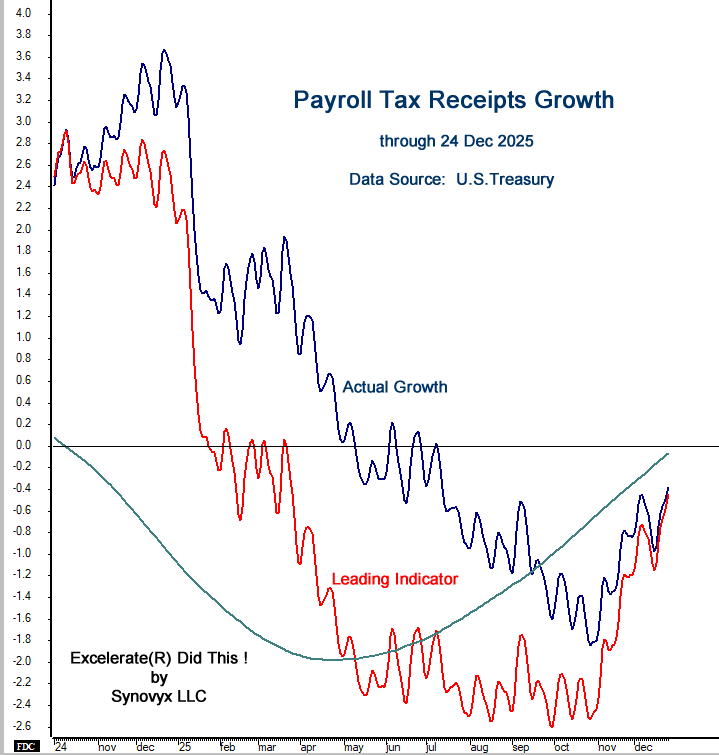
Monitoring the U.S. economy through job growth has been unusually difficult in recent months. Under normal circumstances, the labor data would offer a clean read on economic momentum. Instead, a politically driven government shutdown temporarily removed millions of workers from payrolls, distorting every major employment indicator. The strategy failed to achieve its political aims, but it forced millions of Americans to forgo paychecks until the shutdown ended—leaving analysts with a statistical mess to untangle.
The central question now is straightforward but critical: How much of the current job growth reflects genuine economic expansion, and how much is simply the reinstatement of furloughed workers—or seasonal part-time hiring for the holidays?
The next Non-Farm Payroll Report arrives Friday, January 2, 2026, and for the first time in months we may get a clearer signal. Our estimate points to a substantial increase in jobs, driven entirely by the behavior of Payroll Tax Receipts, which have long been our most reliable real-time indicator of labor market strength.
After a period of negative growth, Payroll Tax Receipts have turned sharply upward. As shown in the accompanying chart, the leading indicator (red line) has lagged the actual receipts (blue line) during the shutdown distortions, but is now crossing above and beginning to lead the series higher. This is not a temporary blip. It marks the beginning of a multi-year positive trend—one we forecasted months ago and which is now unfolding exactly as expected.
Our estimate for the January 2nd NFP Report: +162,000 jobs
If this projection holds, it will confirm that the underlying economy has regained its footing and that the Payroll Tax Receipt signal is once again pointing the way forward.
Sorry — 4.3% GDP Growth Isn’t Real
Several major outlets (Bloomberg, CNBC, Axios) recently reported that the U.S. economy grew at an annualized 4.3% pace in Q3 2025. The number comes from a delayed BEA release (12/23) that extrapolated partial quarterly data into an annual rate. But that headline figure simply doesn’t match real-time economic activity.
Payroll Tax Receipts Tell the Truth
Our most reliable indicator of economic momentum has always been Payroll Tax Receipts. They reflect actual wages and actual jobs — not model-based projections.
Here’s what the tax data shows:
During Q3 2025, Payroll Tax Receipt growth was never positive.
Annualized growth for the quarter averaged 1.42%, and that’s looking back over a full year.
Current annualized growth through Christmas 2025 is under 0.5%.
Those numbers are nowhere near 4.3%.
Why the BEA Estimate Misleads
The BEA’s figure is:
Annualized — multiplying a partial quarter by four
Distorted by the government shutdown, which delayed data collection
Contradicted by real-time tax flows that never showed a surge
Even the BEA notes this is an initial estimate, replacing two missed releases. It is unusually fragile and backward-looking.
Interpretations Will Vary — But the Data Doesn’t
Some may speculate that an unexpectedly high GDP print could influence monetary policy by suggesting renewed inflation pressure. Whether or not one believes that, the conclusion is straightforward:
The 4.3% GDP claim cannot be supported by real economic data.
Payroll Tax Receipts — the cleanest, least-manipulable indicator we have — show growth well under 1%, not 4%.
Larry Williams adds:
One of the best predictors of jobs is the stock market, which is also forecasting more people back to work.
Nov
22
Getting back to normal with Jobs data, from Bill Rafter
November 22, 2025 | Leave a Comment
Chart: Full-time vs, Part-time Employment Growth Rates
Oct
22
Government shutdown question, from Cagdas Tuna
October 22, 2025 | Leave a Comment
Are the furloughed government employees going to be counted as unemployed? I believe they will be which will be considered as a huge green light for 50bps rate cut in the December FOMC. This shutdown is the perfect storm for Trump’s “Fire Powell and get rates to 0%” scenario.
Bill Rafter responds:
The requirements for being “Unemployed” are that (a) the person is not working , and (b) that person is “looking for work”. I believe the latter qualification would disqualify those furloughed from being considered as unemployed. Not only the shutdown [will delay BLS releases], but the recently nominated BLS head, E.J. Antoni has withdrawn his name from nomination. So BLS is headless.
Alex Castaldo comments:
That is good news for all statisticians, I am sure he is a wonderful guy but he had a reputation for mistakes in calculations.
Aug
12
A deeper look at employment, from Bill Rafter
August 12, 2025 | Leave a Comment
Positive Economic News: Full-Time vs Part-Time Employment Growth
Over the past year the pace of full-time hiring has outstripped that of part-time positions. Both categories are growing, but full-time roles have seen a steeper upward trajectory once we normalize for scale. This signals that employers are increasingly confident in committing to long-term payrolls.
To compare growth on equal footing, we fit simple linear regressions to each series (full-time employment level and part-time employment level) over the same interval. We used monthly seasonally adjusted data from the Bureau of Labor Statistics. For each series, we calculated the slope (employees per month) of the best-fit line. Those slopes became our normalized growth measures, avoiding raw-level distortions.
Empirical Results
Full-Time Employees +2150.00
Part-Time Employees +950.44
The full-time slope of +215 K/month means that on average, net full-time headcount has risen by 215,000 each month. Part-time roles have climbed as well, but at roughly 44 percent of the full-time rate.
A faster acceleration in full-time positions suggests businesses are shifting from flexible or contingent staffing toward more stable, long-term commitments. This pattern often accompanies stronger consumer confidence and investment plans.
Hiring more full-time workers typically entails higher benefits, training, and overhead, so firms generally only follow through when they foresee sustained demand. The fact that part-time growth remains positive underscores broad underlying strength in the labor market.
Consumer spending power will likely rise as more workers move into full-time, benefit-eligible roles. Wage growth pressures may pick up if the pool of available long-term hires tightens further.
Capital expenditure plans may accelerate as firms brace for continued demand and aim to boost productivity.
Jul
21
CPI Data Quality Declining
July 21, 2025 | Leave a Comment
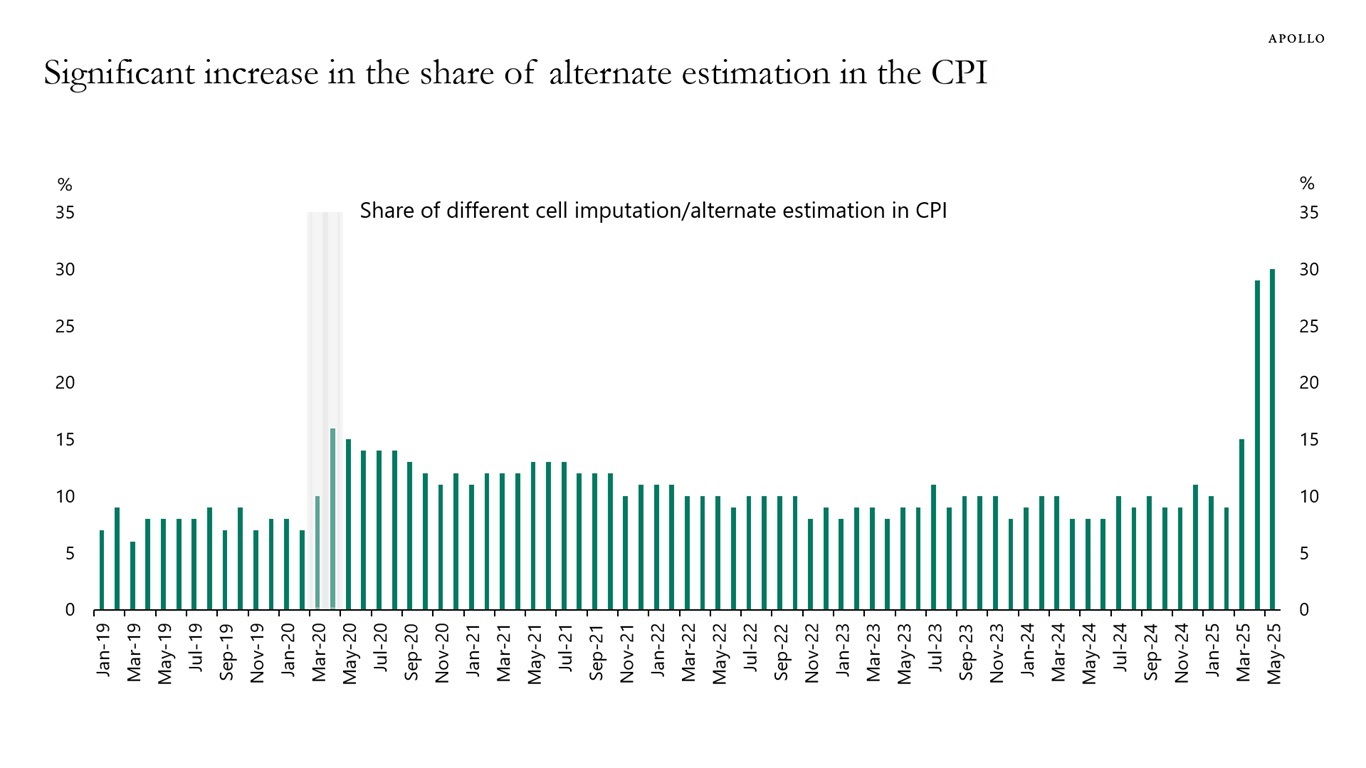
CPI Data Quality Declining
June 20, 2025
Torsten Sløk
Apollo Chief Economist
To calculate CPI inflation, BLS teams collect about 90,000 price quotes every month covering 200 different item categories, and there are several hundred field collectors active across 75 urban areas.
When data is not available, BLS staff typically develop estimates for approximately 10% of the cells in the CPI calculation. However, in May, the share of data in the CPI that is estimated increased to 30%, see chart below.
In other words, almost a third of the prices going into the CPI at the moment are guesses based on other data collections in the CPI.
Bill Rafter writes:
Would anyone in the data business be surprised by this? I’m not.
Peter Ringel wonders:
Doge related?
Big Al offers:
US Labor Department reducing CPI collection sample amid hiring freeze
By Reuters
June 4, 2025
The U.S. Labor Department's economic statistics arm said on Wednesday it was reducing the Consumer Price Index collection sample in areas across the country due to resource constraints, but the move should have "minimal impact" on the overall CPI data.
Jul
18
C & I loans, Large v. Small banks, from Bill Rafter
July 18, 2025 | Leave a Comment
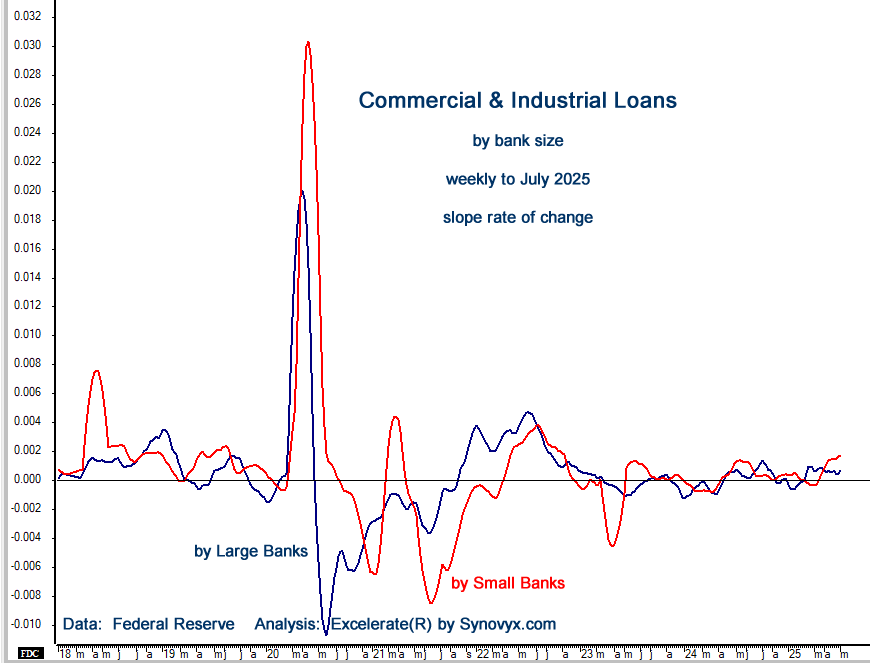
In the July 14 Wall Street Journal, an article argued that smaller banks—by virtue of their loan portfolios—are better positioned than larger banks to gauge the nation’s economic health. Intrigued, I tested that claim using Federal Reserve weekly data on Commercial & Industrial loans for both large and small banks going back to 1984.
As expected, small-bank lending proved more volatile, but it was consistently less “correct” than large-bank lending. Whether measured by simple rates of change or by shifts in their 12-month trends, large banks outperformed small banks in accuracy. This analysis does not include loan-performance metrics (delinquency or charge-off rates broken out by bank size), which — unsurprisingly — tend to peak during or immediately after recessions.
Jun
9
Analyzing Employment Trends: Full-Time vs. Part-Time Work, from Bill Rafter
June 9, 2025 | Leave a Comment

Within the Non-Farm Payrolls (NFP) Report, two key employment categories—full-time employment and part-time employment for economic reasons—offer valuable insight into the state of the labor market. By analyzing their respective growth trends and comparing their slopes, we can better understand shifts in employer confidence and economic stability. Historically, economic downturns have occurred when part-time job growth surpasses full-time employment growth, reflecting caution among employers hesitant to commit to permanent positions. Conversely, economic recovery typically begins when full-time employment accelerates faster than part-time hiring, signaling renewed confidence in long-term business prospects.
Full-time employment has been growing steadily for the past six months and increasing consistently for 11 consecutive months. Part-time job growth, though still exceeding full-time growth, has declined over the last two months. This shift suggests a potential turning point in labor market trends. While employers have not fully transitioned to long-term hiring, the upward momentum in full-time job growth indicates gradual economic stabilization.
If this pattern continues, we may see full-time employment overtaking part-time growth, solidifying economic recovery. Monitoring sector-specific hiring trends—such as whether certain industries are driving full-time job gains—can provide additional insight into the strength of this shift. Wage growth and labor force participation are also critical factors to watch.
Mar
8
Jobs, from Bill Rafter
March 8, 2025 | Leave a Comment
Despite what talking heads may say about Jobs and the current Non-Farm Payrolls Report, there are two items that suggest Recessionary times. The current (daily) Payroll Tax Receipts growth, and the dichotomy between Full-time and Part-time workers (monthly). Click on the charts to open them for full view.


Feb
11
Full vs part-Time employment growth rates, from Bill Rafter
February 11, 2025 | 1 Comment

Steve Ellison wonders:
Will NBER ever acknowledge there was a recession? Or maybe as in 2001, they will retrospectively announce a recession after the recession has already ended. The job market for white collar job seekers was horrendous in 2023 and 2024. But GDP never went negative. "Learn to code" is out; "Learn to weld" is in.
Bill Rafter responds:
Yes, there was Recession. If bureaucrats in power refuse to admit the obvious, or use obtuse metrics to define economic activity, then the Intelligent Man has to find another way to define or measure that activity. The chart below, of Payroll Tax Receipts Growth, matches the negative period you described.

Feb
3
Inflation and it’s Causes, from Asindu Drileba
February 3, 2025 | Leave a Comment
What causes inflation? Suppose we define inflation simply as the rise in prices of commodities, stocks, real estate etc. What causes it?
1) A generic explanation people offer (acolytes of Milton Friedman & Margaret Thatcher for example) is to blame monetary policy. Simplified as, inflation is caused by "too much money chasing too few goods."
Many people blamed President Trump's COVID stimulus packages for the rise of prices during that period. It seems specs in this list agree upon this when it comes to stock prices, i.e., lower interest rates (higher money supply) -> Higher stock prices (inflated stock prices).
2) An alternative explanation is that higher prices are caused by supply chain issues.
So they would claim that higher commodity prices were so because it was extremely difficult to move them around during lockdowns, let alone processing them in factories. A member also described that egg prices may be going up because of disease (a chink in the supply chain) not necessarily monetary policy. I am thinking that supply chain issues are more important to look at, than monetary policy.
Larry Williams predicts:
Inflation is very, very cyclical so maybe the real cause resides in the human condition and emotions. It will continue to edge lower until 2026.

Yelena Sennett asks:
Larry, can you please elaborate? Do you mean that when people are optimistic about the future, they spend more, demand increases, and prices go up? And then the reverse happens when they’re pessimistic?
Larry Williams responds:
Just that it is very cyclical— as to what drives the cycles I am not wise enough to know…though I suspect…some emotional pattern dwells in the heart and souls of as all that creates human activity—along the lines of Edgar Lawrence Smiths work.
Dec
9
This is what recovery looks like, from Bill Rafter
December 9, 2024 | Leave a Comment
Payroll Tax Receipts growth:

More charts (click for full view):
Payroll Tax Receipts growth with a leading indicator
Employment: full-time vs part-time
Nov
30
Productivity and AI, from David Lillienfeld
November 30, 2024 | 1 Comment
When do we start seeing the effects of AI show up in national economic data? If you had invested $5K in a laptop and a word processing program, you could replace a secretary at multiples of the cost. When the web came in, there was Amazon squeezing out the costs of the middlemen.
But I don't see the savings for AI. I see lots of talk, some free programs, but in terms of real productivity, not so much. I'm also told that it's early days and I'm asking for too much in posing such a question, but I think we're now getting far enough into AI that it's not an unreasonable matter to bring up.
One thing that's clear is that AI isn't going to generate employment the way the last tech push did. But if it's going to really change the world as its advocates suggest that it will, those productivity gains should be apparent by now.
M. Humbert writes:
However AI productivity gains are measured, it’ll have to account for the productivity loss due to its high energy consumption. For the Austrian economics fans here. I’ve found Copilot to be a helpful time saving tool, so others probably do as well, so time savings definitely are occurring from AI use today.
Laurence Glazier responds:
Using it all the time, huge experiential benefit. Chatting to GPT every morning while reading Thoreau. Instant context. The other big breakthrough is spatial computing. All in the service of art.
Asindu Drileba comments:
From my experience, co-pilot and other LLMs, have not solved anything that could not already be done via ordinary Googling. Looking up solutions to code issues on stack overflow is no different from LLMs. And stack overflow is still better for some tasks (fringe computer languages like APL for example). LLMs are impressive, but are mostly just gimmicks. The only thing it has actually saved me time on is generating copyrighter material and filler text.
Jeffrey Hirsch adds:
Just had that discussion today about ordinary google still being even better than LLM Ais in finding info. Had some fun with AI editing and embellishing copy.
Asindu Drileba adds:
I suspect that the bad SWE job market is due to high interest rates, no AI. The SWE job market is enriched mostly by VC money. And VC money dried up when LPs withdraw to earn risk free money in treasuries instead of betting on start-ups whose success is on probability. I expect it to recover if interest rates come down to previous levels.
I think the LLM narrative was just something that tech executives parroted to show they had an LLM strategy. It's, Like how in 2018/2017 every executive had a "Blockchain" strategy. A lot of businesses assumed that LLMs would replace simple customer support jobs but they just saw their tickets pile up. Even the $2B valued, Peter Thiel financed, code assistant that would make you money on Up work as you sleep turned out to be a blatant scam.
Steve Ellison writes:
I don't have an answer for Dr. Lilienfeld's question about when AI effects will show up in productivity statistics. But I do hear anecdotally through my professional networks that AI projects are adding real value.
At the same time, Asindu is correct that the bad job market for techies, myself included, is more a consequence of rising interest rates–and I would add overhiring during the pandemic–than positions being replaced by AI. As Phyl Terry put it, "But this company [that announced layoffs] wants to go public so the better story is 'we are smart leaders using AI to become more efficient and profitable' vs 'we were idiots during the pandemic and have to lay off some people because we messed up.'"
Gyve Bones writes:
I find that the AI's ability to interpret my request and put together a coherent synthesis of several sources to be very helpful. Grok is nice because it provides a set of links to sources relevant to the prompt, and to related ??-posts and threads.
Laurence Glazier asks:
I usually have audio conversations with GPT rather than the older typed-in input/output. I just subscribed to X Premium to get access to Grok. Any good links for learning good usage? How nice Musk names it from the Heinlein novel.
Gyve Bones responds:
Check out the sample prompts Grok supplies on the [ / ] section in ??. The news analysis prompts for trending items is pretty cool.
Bill Rafter writes:
My business partner and I are in the process of marketing a new software application. Although we are rather literate, we have been running all of our marketing materials through Copilot, and we are amazed at the improvements Copilot makes to our text. It results not only in improved communication, but is a real time-saver. We even asked it to write a business plan, and it came back with a better one than our original.
Peter Penha offers:
I have not (yet) been on Grok but have found that the prompts do not differ very much across LLMs:
A Primer on Prompting Techniques, June 2024.
Prompt engineering is an increasingly important skill set needed to converse effectively with large language models (LLMs), such as ChatGPT. Prompts are instructions given to an LLM to enforce rules, automate processes, and ensure specific qualities (and quantities) of generated output. Prompts are also a form of programming that can customize the outputs and interactions with an LLM. This paper describes a catalog of prompt engineering techniques presented in pattern form that have been applied to solve common problems when conversing with LLMs. Prompt patterns are a knowledge transfer method analogous to software patterns since they provide reusable solutions to common problems faced in a particular context, i.e., output generation and interaction when working with LLMs. This paper provides the following contributions to research on prompt engineering that apply LLMs to automate software development tasks. First, it provides a framework for documenting patterns for structuring prompts to solve a range of problems so that they can be adapted to different domains. Second, it presents a catalog of patterns that have been applied successfully to improve the outputs of LLM conversations. Third, it explains how prompts can be built from multiple patterns and illustrates prompt patterns that benefit from combination with other prompt patterns.
This is earlier/shorter February 2023 paper - I am also a fan/follower of Prof. Jules White’s classes on Coursera why I flag the shorter/earlier paper as well.

Separate on the subject of AI - Eric Schmidt has a new book Genesis with Dr. Kissinger as a co-author (his last work before his passing) but Schmidt did a Prof G Pod Conversation released Nov 21st - in the podcast Schmidt goes over the threat from LLMs that are unleashed and noted that China in his view has open sourced an LLM equal to Llama 3 and that China instead of a being three years behind the USA on LLMs is a year behind. That China comment can be found here at 26:30.
Finally if anyone wants a great book I have read, on the history of the race to AGI going back to 2009: the Parmy Olsen book Supremacy on the histories of Sam Altman and Demis Hassabis is a wonderful read. Also breaks the world down between the AI accelerationists and the AI armaggedonists.
Big Al adds:
I do use Bard to learn or refresh my memory with R. For example, I am trying to use the "tidyverse" set of packages, and Bard is very useful when asked to write code for some task specifically using, say, tidyquant. The code almost never works first time cut & paste, but I can see how things are done differently and figure out what needs fixing. And I get answers to simpler problems faster than on Stack Exchange which is better for more complicated issues.
Laurence Glazier comments:
It's an inverted Turing test situation. The things that AI can't do help identify our humanity, our birthright.
Nov
14
Crypto and the money supply, from Bill Rafter
November 14, 2024 | Leave a Comment
Should the market cap of crypto currencies be included in money supply for macroeconomic purposes?
William Huggins replies:
I'd you cant use it to pay taxes it doesn't count (just another asset, like a stamp).
Kim Zussman asks:
Why not? They add because if you pay taxes with fiat you can buy merch with crypto.
William Huggins responds:
you can barter wine or chocolate for a ton of things online too but we don't count those either. if money is "anything taken as payment" then we have to get very serious about "degrees of moneyness" (hence m0,m1,etc). in that spectrum, its pretty clear that the only things on the list are legal tender so unless you live in the land of bukele, it doesn't count (also, whose money supply does crypto count as exactly?)
Peter Penha:
I will volunteer that there is no moneyness to crypto as it was determined a 100% haircut asset by the DTC.
I think this leaves Blackrock and other crypto ETF managers in the interesting position that they cannot include crypto ETFs in one of their asset allocation funds or a target date fund, etc - inclusion would pollute.
Crypto in the USA appears to be a walled garden - the only contagion I can see to the financial world would be to holders of Micro Strategy Convertible Debt.
Stefan Jovanovich writes:
The question you all are raising here has a history - how far can "the law" go to monetize promises to pay? Originally, the answer was not one step. The Constitution says that legal tender can only be Coin. Article I, Section 8.
The lawyers have been working around that limitation ever since. Their greatest difficulty has been getting around the literalist non-lawyer Presidents who keep following the actual instructions the People established by vote as "the law".
Success came with the Aldrich-Vreeland Act which authorized banks with Federal charters to form "currency associations". Those were given authority to issue emergency currency could be backed by securities other than U.S. bonds, including commercial paper, state and local bonds, and other miscellaneous securities.
Section 18 of the Act: "The Secretary of the Treasury may, in his discretion, extend from time to time the benefits of this Act to all qualified State banks and trust companies, which have joined the Federal reserve system, or which may contract to join within fifteen days after the passage of this Act: Provided, That such State banks and trust companies shall be subject to the same regulations and restrictions as are national banks under this Act: And provided further, That the circulating notes issued under this Act shall be lawful money and a legal tender in payment of all debts, public and private, within the United States."
Everything since 1908 has been a variation on that theme - "lawful money" can be whatever Congress says it is.
Bill Rafter comments:
I started this question because I am working on a slight variation of digitally quantifying inflation. With the loose definition of inflation being “too much money chasing too few goods”, then the “money” part should include all that can conceivably buy the “goods”. Since one can increasingly buy a whole lot of stuff with crypto, then crypto deserves inclusion. If one were to fast-forward to a time of massive currency instability (this is just a thought experiment), having included the cryptocurrency might have facilitated greater forecasting.
Stefan Jovanovich adds:
For me the paradox of Bitcoin is that it has been a spectacularly successful asset - like a share of Berkshire Hathaway stock bought in the days before Buffett even went public - but it has never been a money. If I had Bill's brain and cleverness, I would try to include in the calculations the sum of personal and corporate credit that the lenders cannot easily pull away from the table (the potential moneyness supply) and the amount of credit actually used; and then seek the correlations to the fluctuations in that spread. In the days before central banking, speculators watched the net supply of commercial paper as such an indicator.
Sep
9
Full-time vs. Part-time Employment, from Bill Rafter
September 9, 2024 | Leave a Comment

Bud Conrad comments:
The US BLS understates inflation, which causes the calculation for Real GDP growth to become overstated. Thus, we have a recession going on, but it is hidden by the BLS's low inflation rate. The rich are doing well as asset prices have risen; the rest have lost ground because the cost of everything has increased more than the labor rates.
Ditto on jobs and employment that suggests there are lots of new jobs every month, but then restates the number downward in succeeding months, which accumulated to 818 K jobs that are overcounted in the year ending March.
The supposed Fed's being "data dependent" is a cop-out from thinking "How to stabilize the dollar", meaning that they claim they will use these corrupt numbers for policy decisions.
Jul
20
Looking deeper into employment, from Bill Rafter
July 20, 2024 | Leave a Comment

First the chart. The two data sets are of different magnitude, so to compare them they must be normalized. The chart represents the slope of the data divided by the trend of that data. Both are determined by regression over 12 months. Each point on the chart is effectively the expected rate of change of the data as determined by the moving trendline. As such, the data is NOT lagged, and presents a truer picture than that of lagged data.
Interpretation. Periods of higher part-time employment tend to coincide with recessions. However, if the employment picture is recessionary, then how would one explain the growth in Payroll Tax Receipts, which I have shown separately? Well, it turns out that the growth from January to June in Part-time employment matches the growth in Payroll Tax Receipts. Thus, the economy is growing solely by the increase of part-timers.
Zubin Al Genubi writes:
Many young people I know do gigs, seasonally or part time. Recent employment numbers (with temp way up and full-time way down)support the theory.
Humbert H. adds:
I’ve seen a lot of information on part-time vs full-time. Often it’s accompanied by foreign-born vs native-born, where the dichotomy is similar, in favor of the foreign-born.
Jul
4

Bud Conrad is not sanguine:
We avoided an official recession despite negative 2% to 3% tax growth. The Treasury and the deficits were pumping money into the economy in 2023. It now looks like no problem in Tax receipts, but I just don't believe that things are clear sailing. Wars, Debts, Foreigners cashing in Treasuries from their trade surpluses (our Trade deficit), Stock market toppy concentration in the Tech winners. Incompetent politicians. I think things are worse than I think they are.
Steve Ellison keeps the wall of worry updated:
Updated! Now 53 years of convincing reasons why the stock market should go down, superimposed over the 48x increase in the S&P 500 during the same time period (logarithmic scale). 2023: Nearly everybody expected a recession. That reason is added, along with the S&P's 24% increase.

Mar
24
An alternate understanding of a market being at all time high (market reaching new prices it has never encountered) is this: "Everyone that has ever bought that stock or instrument is now in profit". What might be the psychological implications of this?
Kim Zussman comments:
It is possible (and probable) to buy, then sell after a decline and stay out only to see it reverse and go up further. This (timing) is one reason it is so much easier to do better with B/H than trading.
Big Al adds:
The other advantage to B&H is that the opportunity cost viz time/attention required is basically zero. I have looked at various index timing approaches and have not found anything that beats B&H, especially when considering the vig and opportunity cost. However, should one need to scratch the itch, timing strategies may work better with individual stocks. But again, opportunity cost.
Humbert H. writes:
I've always been believer in B&H vs. trading. But even in B&H the debate between indexing and individual stock selection never dies. I don't like indexing, but I don't have a mathematical basis for that. It's a fundamental belief that buying things without any regard to their economic value has to fail in time, at least relative to paying some attention to it.
Zubin Al Genubi adds more:
Another aspect of buy and hold that Rocky pointed out is the capital gain tax severely eats into returns. The richest guys hold for years and have only unrealized untaxable gains.
Art Cooper agrees:
There was an excellent article in the Jan 7, 2017 issue of Barron's by Leslie P. Norton on VERY long-lived closed end mutual funds which have surpassed the S&P's performance. They have all followed buy and hold strategies.
Michael Brush offers:
Far more money has been lost by investors in preparing for corrections, or anticipating corrections, than has been lost in the corrections themselves.
- Peter Lynch
Steve Ellison brings up an important point:
And yet trading is one of the focal points of this list. The way I square this circle is to keep most of my trading account in an equity index fund at all times. When I think I have an edge, I make trades using margin.
Larry Williams writes:
B&H is the keys to the kingdom, but…the massive fortunes of Livermore were short term trades despite his comment about sitting on your hands. Even the current high performers, Cohen, Dalio, Tudor etc use market timing. When I won world cup trading $10,000 to $1,100,000, it was all about timing and wild crazy money management. One approach wins big the other wins fast. A point to ponder.
Bill Rafter writes:
What we found in studying only the SPX/SPY is that in the long run a buy-and-hold yielded 9.5 percent compounded annually. That was from 1972 to recent. Our argument is that studies before 1972 are flawed. That 9.5 was great considering there were several collapses of ~50 percent. However if you could just eliminate the collapses you could raise the return to 13.5 percent compounded annually.
Eliminating the down moves did not involve prescience. You did not need to forecast recessions, only identify them when you were in one. That was not difficult, and timing was not a critical as one might think. We identified several algos that worked well.
When you were out of equities, you could either simply hold cash, or go long the 10-year ETF. The bonds were better, but not by much. Interestingly, long term holding of bond ETFs yielded low single-digit returns. Best avoided. Which also means that the Markowitz 60/40 strategy was a sub-performer.
Taxes are investor/vehicle specific. For example, if you use a no-tax vehicle, there are no taxes. Regarding turnover, there are very few transactions, as there are very few recessions. The strategy is basically B&H, but with holidays.
Asindu Drileba has concerns:
My problem with buy & hold Is that it has no risk management strategy. If you bought the S&P 500 in 1929 for example during the wrong month. It took you 25 years i.e until 1954 not even to make profit, but just to break even. The real question is, how do you know your not investing in a market path that will take 25 years just to break even?
Humbert H. responds:
That’s why, dollar cost averaging. I don’t think anyone thinks buy once in your lifetime and never interact with the stock market ever again. I think if you had averaged in monthly or quarterly from the summer 1929 through summer 1959 and then held and lived off dividends or cashed out/interest in retirement, you did well.
Art Cooper adds:
The year 1954 is almost universally given as the "break-even" year to recoup losses for buy & hold investors who bought at the 1929 peak. It's wrong to do so. First, it ignores dividends. Had dividends been re-invested the recovery year would have been much earlier. Second, it ignores the deflation which occurred during the Great Depression. In this column Mark Hulbert argues that someone who invested a lump sum at the 1929 peak would have recovered in real economic terms by late 1936.
I'm not arguing against dollar-cost averaging, merely pointing out a historical falsehood.
Hernan Avella writes:
What people should do while they are young and have human capital left is to leverage!
Life-Cycle Investing and Leverage: Buying Stock on Margin Can Reduce Retirement Risk
The most robust research, incorporating lifecycle patterns and relevant time horizons for long term investors tells us that the optimal allocation is 50/50 all equities, domestic and international. But most ppl don’t have the gumption to be 100% on equities.
Dec
19
Arithmetic vs geometric average returns, from Zubin Al Genubi
December 19, 2023 | Leave a Comment

How does the arithmetic average differ from the geometric average in measuring returns?
The arithmetic average calculates the average gain per trade without accounting for the compounding effect. On the other hand, the geometric average (CAGR) considers the actual compounding from start to finish, providing a more accurate measure of the actual return.
Can positive arithmetic averages lead to losses or ruin in trading?
Yes, even with a positive expected arithmetic average, losses or ruin are possible due to the risk of ruin and the increased burden in recovering from drawdowns, . Geometric averages, considering drawdowns and compounding, offer a more realistic view of potential outcomes.
From quantified strategies.
This is the path dependency issue. Conclusion is position sizing is important to avoid risk of ruin or catastrophic drawdown.
Bill Rafter responds:
You are almost there. Think: can these two means be used to identify anything else?
Kora Reddy adds:
also called volatility drag:
vol_drag = mean(x) - exp(mean(log(x)))
or an approximated formula
Volatility Drag = -0.5* (Volatility)^2
PFA useful leteratrue
Zubin Al Genubi replies:
The expectation and the maximum drawdown can be used to compute optimum f, the fixed fraction of capital to risk on each trade.
I read the article [on volatility drag] and disagree with it. Ralph Vince says that a system will experience drawdowns equal to f and that is the only way to the highest compounding resulting return. It is impossible to get the return without the volatility. Diversifying systems can counter balance drawdowns if truly uncorrelated.
It is non-ergodicity of trading markets that make the geometric mean more important. A loss is not a straight line down, but convex because it takes a 100% gain to recoup a 50% loss. The geometric mean captures this. Arithmetic mean does not.
Big Al offers:
Shannon's Demon, or rebalancing between uncorrelated assets (they claim it's "little known", but that is doubtful).
Kim Zussman contextualizes:
"Say, your fund is down almost every year. What value do you add?"
"We're uncorrelated! (with buy and hold)."
Aug
19
Is America winning? from Bill Rafter
August 19, 2023 | Leave a Comment
In response to the President’s rant, the data shows that Payroll Tax Receipt growth turned negative in March 2022. Despite an “almost” rally last Christmas season, the Payroll Tax growth has been negative the entire time. The data shows the current rate of decline at ~2 percent per annum. Given the vehemence of the rant, any government official who might be tempted to say otherwise might lose his/her career. Reminds one of “The Emperor’s New Clothes”.
Ayn Rand: We can ignore reality, but we cannot ignore the consequences of ignoring reality.
Bud Conrad comments:
Your work on taxes is the best I've seen. It is a bit of a tle cycle indicator confirming economic slowing. as seen in the standard government numbers below.

So has the government hidden that we are in a recession with cooked up numbers, say from understated inflation so real GDP looks more positive than it really is? and that unemployment is low from birth death over additions to jobs, and disabilities not in the workforce?
Bill Rafter responds:
IMO it’s misdirection. The government picks something on which they want us (and the media) to focus. Usually it’s the unemployment rate, which is determined by a poll, and then they have the birth/death adjustment (i.e. the fudge factor). So it’s impossible to get a definitive “just the facts, ma'am” story if the gummint wants otherwise.
Regarding leads/lags, the payroll tax receipts numbers are accumulated electronically. There have been days when Treasury was closed, but the data was released anyway (automatically). That data is released with a one-day lag from when it hits the Treasury bank account.
The raw Payroll Tax Receipts data just looks like static. To make sense it must be seasonally adjusted (it’s highly seasonal). That is why it is ignored by gummint and the media, because they do not know how to seasonally adjust the data. MRL and DB have shops that work with the data and their output is barely intelligible.
Stefan Jovanovich adds:
As Bill knows better than any of us, "employment" is the category box that compels the people writing the checks to add contributions to the American-Prussian scheme that protects the worker through unemployment payments. Neither self-employment (i.e. real estate brokers) nor independent contractor (Uber drivers) is a worker category that requires employment tax payments or has eligibility for unemployment.
Larry Williams writes:
I would argue, with vigor, that stocks predict tax receipts; it is not the other way around. Lead time is a little over one quarter. Stocks (red) lead receipts:

Steve Ellison writes:
Anecdotally, having been removed from a payroll a few months ago, I am having the most difficult job hunt of my life, not at all what I would have expected given the headline unemployment rate of 3.5% (I'm an experienced data analyst with a passion for finding truth and extracting insights that lead to actions and better business decisions. I have thorough knowledge of data warehousing, SQL, optimizing queries in big data environments, and data visualization). Boston Consulting, where I know a partner, laid off 20% of its workforce this year.
Despite the sanguine reports from the BLS, Pete Earle examined state-level data in May and found rising trends in initial claims for unemployment and in WARN filings (advance notices of layoffs as required by the Worker Adjustment and Retraining Notification Act).
Stefan Jovanovich comments:
There is also the problem of delay. The Census produces a count of the receipts of what they call "Non-Employer" entities using income tax returns. Everyone who is self-employed and reports income as an individual separate from any business dba and everyone who is an independent contractor falls into this category. Today the Bureau proudly announced that "we tentatively plan to release the 2021 Non-employer Statistics estimates in the spring of 2024."
Aug
10
The Count, from Duncan Coker
August 10, 2022 | Leave a Comment
Rereading the Count of Monte Cristo with my highs schooler, I am struck by the fact the all the virtuous characters are failures at business (ship owner, tailor, inn owner), while all the evil ones are great financial successes (currency speculators, war profiteers, state bankers). Of course the Count rectifies this. His fortune comes by way of a cardinal in Italy, a secrete cave and 14 years in prison. Perhaps the author's ( Alexandre Dumas) message is that every great fortune has a dark past. Maybe that was true in his day, but ones hopes that is not the case today.
Kim Zussman comments:
Socialism is as old as the bell curve.
Gyve Bones writes:
I'm reading this book too, and have found it really interesting. I picked it up because I'd seen two different film adaptations of the story, one starring James Caviezel, who a year later would portray Jesus Christ in Mel Gibson's "The Passion", and an earlier one from the 1970s. The two were so different in many details that I wanted to see the real story in the book. Both movies were good, each in their own way.
Like Les Miserables, by Victor Hugo, the Dumas story is about French society dealing with the ripple effects of the French Revolution. Both have heroes who are sort of New Christ figures. Both characters are unjustly imprisoned. In the case of Danton, the "Count", it was a case of a corrupt prosecutor during a time much like now, where Napoleon is in exile, and his alleged supporters still in France are being hunted down and imprisoned. It reminds me a lot of this nation, which has sent a former president into exile on an island off the coast of Florida, and there is an official inquisition into his affairs which is imposing punitive political prison sentences on his political supporters, and making it a crime to speak with the former president on the phone, in order to thwart any attempt to organize a campaign to return to office.
There's a point where the Count uses and extols the virtues of hashish which you might want to be prepared to discuss with your teenager.
Project Gutenberg has a very nice illustrated edition of the book available, which is helpful in imagining the scenes described.
I had trouble with the size of the illustrated ePub version for my iOS Books app on my iPad. It's 76 megabytes with the images included and it would crash the app. So as an alternative workaround, I downloaded the image free ePub into the Books app, and keep a web page open on the index of the images, which are named according to the page numbers in the book, and I view them as needed as I'm reading along.
Stefan Jovanovich responds:
Dumas pere was anything but a socialist. He was an aristocrat who was beyond snobbery and sentimentality. Good people regularly get screwed by thieves, frauds and liars; but then, so do the thieves, frauds and liars by each other. That is the "moral" of the novel. The Count succeeds in his quest for revenge by turning the bad guys against one another. He is a truly great figure, and the wiki page does him proper justice.
Dumas was neither a monarchist nor a Bonapartist. He was a republican and a Freemason. The novel makes that very clear; and it got Dumas in real trouble when a second Bonaparte became Fuhrer. Dumas had to flee France for Brussels, which also helped him escape his creditors. Read the wiki page; it is a beautiful exposition of an extraordinary life.
Full disclosure: One of the Stefan's weird (academics don't even want to discuss it) speculations about Ulysses Grant is that he was reading Dumas' novels when he was at West Point when he was supposed to be studying "tactics". Grant did not have a full duplex brain when it came to language and music; he taught himself to read German and French, but he found it impossible to speak or understand the languages when spoken. He loved music, but could not play it or read it as anything but notation (i.e. he could not translate the symbols on the page to sounds in his head). Hence, his joking about himself that he only knew two songs - one was Yankee Doodle Dandy and the other was not. The biographers all assume that because Grant had no verbal fluency, he had not read Jomini. He had; he also knew it was complete crap, but why say so except to start an argument? (Grant definitely did not have the legal mind or temperament).
Gyve Bones counters:
Straw men are easy to knock over. I did not assert Dumas was either a monarchist or a Bonapartist. In the same way, Hugo, son of a mother of the ancien regime and a father who was a Revolutionary, he was a melding of the two, and the novel sort of becomes a Hegelian dialectic about the synthesis which emerges from the thesis (the old order) in conflict with the anti-thesis (the Revolution). Jean Valjean is his synthesis, the New Man, a man of Christian virtues without Christ and the sacraments of the Church He founded.
Steve Ellison adds:
Dumas lived a high life and was chronically in debt despite having a number of bestsellers. I still remember one sentence from the book, "He was denounced as a Bonapartist …" It made me think that the first totalitarian society was Revolutionary France, but I hesitate to make such a sweeping pronunciation in the presence of Mr. Jovanovich. In any case, current efforts to make modern denunciations similarly career-ending are a grave threat to liberty.
Stefan Jovanovich agrees:
Great comment, SE. The French revolution - as an event - has a scale and complexity that can only be matched by the global war that began in Spain in 1936 and China in 1937 and ended in Korea in 1954. What Dumas was describing was its net effect: everyone in France had become so kind of spy and snitch. So, yes, it was the first totalitarian society; but you need to give the Citizen Emperor the same credit that Stalin and Hitler deserve for so thoroughly organizing the tyranny.
Bill Rafter offers:
Pardon me for coming in late to this discussion, but there is a mistake: The tailor was Caderousse, one of the three co-conspirators against young Dantes. That failed tailor then became the owner of the Inn at Beauclaire, who then murdered the jeweler. The Inn itself failed because its location was bypassed by a newly constructed canal. That leaves Mr. Morrel, who failed because he was in a highly speculative business (the hedge fund of its time) and was not diversified. However his successors in the business, Emmanuel and Julie were certainly righteous and successful. They retired to a nice home in Paris.
Stefan Jovanovich writes:
Not mine. Dumas was very much someone who believed that an honorable life was the only one worth living, whatever its financial costs or rewards.
Henry Gifford writes:
When I was growing up in a part of New York City that was populated by about half Christians and half Jewish people, almost none of the Christian adults owned a business – they had jobs. The one Christian adult that I knew owned a business did not attend religious services. All the Jewish adults owned businesses except a few that were involved in organized crime (professional level: state senator, state assembly, etc.).
When I was a child attending a Christian school, they made us sing a song that included the words “oh lord, do until me as you would do unto the least of my brothers”. I didn’t sing it, even though I was required to, as I saw it as a request for the all the worst things that happened to other people to all happen to me. As a child I thought this included blindness, loss of multiple limbs, leprosy, locusts (even though I wasn’t sure what those were) etc.
I have never had a mentor in my life. The closest I came were adults who advised me to “make sure you learn a trade so you will have something to fall back on”, who I made sure to steer clear of after I nodded and smiled and made good my escape. When I was 16 I asked my father what he thought I should do when I grew up. He suggested I go on welfare. I never asked again, or brought up the topic of what I was doing with myself, etc. When I was about ten years into writing a book, I showed the almost-finished version to my parents, figuring they should see it while they were still alive. The only comment they had was a harsh criticism of the grammar on one page, which they insisted I correct. The “incorrect” grammar was part of an insightful and charming passage written by Benjamin Franklin in the 1700s.
A few years ago I was walking past a Jewish community center near where I live in Manhattan. On the bulletin board outside I saw a schedule of upcoming lectures. One was titled “The Five Risks Every Entrepreneur Should Take”. I picture a member of the community that sponsored that lecture stumbling in business a little while being surrounded by people who are supportive, and who applaud the person for trying, and then for getting up and going at it again. I doubt any member of that community would ask the person who stumbled if she or he had made sure to first learn a trade to fall back on, or demand that children sing a song like the one I and my classmates were required to sing.
I still manage to do OK financially. Among other endeavors I own or am part owner of property in nine US states, soon to be ten, all worth much more than I paid (including the properties I am contracted to buy on Monday). And I have never “paid my dues” by spending years doing something I hate, or by gaining all the easily available advantages of being dishonest. But the Christian kids I grew up with? I can’t think of one who owns a business, and I can only think of two who likely have enough investments to carry them for long if they didn’t keep working at their job. And I can’t think of any who seem to enjoy or gain much satisfaction from that which they spend their day doing.
As for the emotional toll religion has taken on people over the centuries, suffice to say that someone once summarized the difference between the emotional state of veterans of the US military during WW2 vs. those who were veterans of the Vietnam War as the emotional state of Vietnam War veterans being the embodiment of the result of one generation of young men being lied to by their father’s generation. Likewise, young people being lied to about what economic decisions they ought to make, meanwhile a different reality is there for the seeing, also has its cost.
When growing up I spent time in Jewish households when I could, as the people there seemed to me to have an upbeat and healthier attitude, compared to the funeral home ambience I sensed in most Christian households. But, of course, most people growing up in the US do not have that opportunity, and fewer take the opportunity if available. Most are simply beaten down by the forces of religious insanity and stay down for life. Just today I was waiting for a train and a person nearby was shouting into her phone on speaker, describing in an upbeat tone her life that struck me as horrible, while she periodically mentioned that “god is good.” Not to her, I think, but I didn’t argue with her.
Bo Keely responds:
henry, this is interesting from our comparative angles. I’ll bet the few kids like u and I would say the same thing. as a child, I also rejected the ‘do unto others…’ because it included negative things.
i also had no mentor throughout life. when I eventually took a teacher test that required answering, ‘describe your first mentor’ I wrote about an admitted imagined mentor.
likewise, when I was sixteen, my mother asked, ‘what do you want to do in life,’ on receiving a selective service notice. It had never donned on me, so I replied, ‘be a veterinarian’ since that was my summer job. that’s how I became a vet.
and, i also have never ‘paid my dues’ to society figuring i never owed any. The only real money I ever made was in rental housing in Lansing, MI with a strategy of buy cheap complexes, fix them up, and rent to tenants receiving monthly checks directly deposited into my account. i still do well financially with 25 published books that sell, on average, one each per month. my financial secret of life is to have negligible expenses. I have gained satisfaction from each of dozens of jobs too, and never lived hand-to-mouth. it’s long-term gratification.
I have reacted to the lies of my father’s generation by retreating from Babylon into an anarchic desert town. each is an independent citizen who thinks god is a stinking mess in the sky, and one should learn in youth to take care of himself.
Kim Zussman adds a coda:
After the revolution apartments and land was confiscated and living arrangements made equitably* by central committees.
Los Angeles voters to decide if hotels will be forced to house the homeless despite safety concerns
*government jobs, military, connections, etc.
Jun
5
Payroll Tax Receipts, from Bill Rafter
June 5, 2022 | Leave a Comment

How are they going to paint this as a strong economy?
[Data source. -Ed.]
Andy Aiken responds:
It's not, but it gives the Fed a pretext to hold off on rate increases in an election year.
Vic adds:
46 leaked the numbers in his speech on Powell. they get the numbers several days in advance.
A reader asks:
Bill, how have ten year yields reacted in the past when the number is both negative year over and continuing to accelerate down trend? It seems this could be the catalyst that causes the long end to flatten out/rally as the Fed continues to raise the short? Does that hypothesis bear out in testing?
Bill Rafter replies:
Thanks for the question. I will not know until I test.
George Zachar asks:
oddly, the y/y% change in private eci wages has roughly doubled since late 2020, now at 5%. can you square the circle?
Bill Rafter replies again:
I will have to look at it. The payroll taxes are most the macro I can tap, so I tend to put their veracity on top.
Paolo Pezzutti comments:
I was hoping an Api could download the file from the treasury website. There are a number of Api's in Python or R to download datasets in json, csv, xml from FRED and other websites as alternative data to find relationships and regularities with stock index prices. Some of these keys are premium. I wonder if this approach provides real added value with respect to counting based on the idea that prices represent the synthesis of all market players actions and views.
Apr
3
Term structure of rates, from Bill Rafter
April 3, 2022 | Leave a Comment

When looking back at the term structure of interest rates, certain periods stand out: 1998, 2001, 2006-7, 2018, and now 2022.
That history is displayed here, constituting the 2yr, 5yr, 10yr and 30yr rates shown as month-end closes. Note that the 3-month bill rate has been omitted, and that the 2-year is emboldened. All of the periods show an increase in rates prior to the congestion, and all subsequently resulted in economic difficulty. From basic economic education we have learned the causative connection and indeed current political “Policy” seems to be in agreement.
Kim Zussman asks:
Do you think the long term downward slope could affect the forecast ability of yield curves?
Zubin Al Genubi comments:
Its along the lines of "don't fight the Fed".
Bill Rafter responds:
IMO, the downward slope is a function of the Fed essentially trying to remove the US economy from the free market. So (1) yes to Kim for the observation that it will lessen the effect, and (2) yes to Zubin for the always true observation not to fight the Fed.
Had I take the picture back farther, say to the early 70s you would have seen much higher rates (i.e. 21% for the 3-month), so that downward trend is a long one.
Dec
14
Food Item
December 14, 2020 | Leave a Comment
Bill Rafter writes:
I was recently introduced to RICE GRITS, which are broken rice kernels. Due to the increased cooking surface, these gems turn smooth and creamy quite easily. I have had my starter pack three Days and have used them three times; once for breakfast, once as an understory for a sautéed scallop dish and once for rice pudding. Absolutely delicious. Their micronutrition content is very close to Irish oatmeal, and they are a nice morning change.
I received my grits from https://www.deltabluesrice.com a multi-generation family farm in Mississippi. Their website has lots of recipes.
Most recipes for rice grits call for frequent stirring of the pot. Fine if you have the time, but I’m too busy. My variation is using a crockpot. Although that means no stirring, you are left with some burn spots at the bottom of the crock. They come off with soaking in dish detergent letting chemistry do the work for you.
My crockpot version goes like this: Put a pat of butter in the bottom of the crock, and then add 4-to-1 units of water (preferably spring) to grits. Set the crockpot on low and return in 4 hours. Add cream if you want the ultimate luxury. Note that with a timer you can run the process overnight and have them for breakfast.
Ken Sadofsky writes:
https://preview.tinyurl.com/yy7dkdp9
From the women: oatmeal, eggs n a fruit or sugar. For world athletes, I get carbs n protein from eggs but oatmeal has lil protein. The Scottish have a sayin though about their men, oats n steeds (escapes me)
A Japanese Zojirushi rice cooker has fuzzy logic and requires no stirring for whole grain oats, groat oats, I believe. Perhaps counter-intuitive, or obvious, is that this part of the Orient would find the easiest way of soing what they're suppose to be expert at.
Dec
1
Middle East Power Politics
December 1, 2020 | Leave a Comment
Another Bold Strike Against Iran - WSJ paywall
By
This “Commentary” in today’s WSJ is a good piece about Middle East power politics. It is a refreshing challenge to the fake news of Iran’s claims that the recent attack on its nuclear scientist was done remotely, being somewhat pedaled by AP.
Jan
5
Article of the Day, from Victor Niederhoffer
January 5, 2020 | 1 Comment
 "A Clever New Strategy for Treating Cancer, Thanks to Darwin"
Relevant to big rises in a year in S&P?
Bill Rafter writes:
This is a fantastic article for anyone with cancer, particularly prostate cancer. Thanks for posting.
K.K Law writes:
A broader point is this is another excellent example of out-of-the-box thinkers and doers who create revolutionary innovations.
Dylan Distasio writes:
Unfortunately these innovations occur in spite of the current US system not because of it.
Gary Phillips writes:
Not unlike market analysis, the key to effective clinical observation is how the scientist conceptualizes the problem, and how he uses the information gathered. The dilemma presented with molecular targeted therapy using chemotherapy, is the very process that induces cell death (aptosis) can also promote (chemo)-resistance.This is quite the recursive paradox. Chemo drugs activate multiple signal transduction pathways which can contribute to either aptosis or chemo-resistance. One of the ways to circumvent this problem is to use a combination of drugs; employing another drug that targets the signal pathways that contribute to resistance. Of course, treatment varies from one patient to another, and the major challenge is to develop individualized therapy options that are tailor made to the patient.
Ever changing cycles and evolving markets dictate that traders must be agnostic and and adaptive. A tested, multi-variate approach tailored to the intrinsic nature of the current market regime will provide the best assessment of the market's context and offer the best approach to trading that particular market.
Dec
1
Go Champion Retires, from Jeff Watson
December 1, 2019 | 1 Comment
/cdn.vox-cdn.com/uploads/chorus_image/image/65783969/515689380.jpg.0.jpg) A Go grandmaster has retired because he believes that computers can never be defeated. What does that portend for individual, human participation in the markets? Are humans who manually enter trades destined to go the way of open outcry? Can humans have an edge over algorithms?
A Go grandmaster has retired because he believes that computers can never be defeated. What does that portend for individual, human participation in the markets? Are humans who manually enter trades destined to go the way of open outcry? Can humans have an edge over algorithms?
Bill Rafter replies:
The following is guesswork. Anyone with a different voice is welcome to comment. (i.e., no need to flame)
I believe that the AI trading of the markets to date has centered on trades that have an almost zero risk of failure. Thus they have mainly worked in the extreme short run, mostly by picking off the marketmakers or the spread. There are many trading shops who do not permit their traders to take a position overnight.
Therefore if you wish to beat the algorithms you must pick a different venue, specifically longer-term trading. Maybe that's 4 days, and maybe it's 400 days, but it must be different from what the AI shops use. That of course means greater risk, but specs are in the business of taking risks.
Sooner or later, some of the AI people will invade this longer-term space, and they will do so by picking portfolios rather than individual stocks. But they cannot eliminate risk, and as long as risk remains, profit opportunities remain for the individual.
Larry Williams writes:
The basis of all profits is trend.
Trend is a function of time.
The more time in a trade the more potential for profits.
As long as losing trades are stopped out so they are not turned to big ones by time/trend.
Zubin Al Genubi writes:
I believe humans can still beat computers in trading. Maybe one human can't beat one computer, but the computers as a group will have a distinct behavior that can be regularized and gamed. Its the group dynamic, as even computers will tend to a group think. This is especially true if they are learning, and if they are reactive. The fixed systems are still pretty easy to beat because they are still beating the same old dead horses. I've found, as Larry mentioned, that a longer time horizon seems to work better now days. Hard to out speed the computers. Probably easier to out wait them. For example I seem to use 4 hour / day bars now rather than 5 min/30min bars in years past.
Laurence Glazier writes:
Such factors lean me more seriously to composing music than playing chess. What defines us as human?
Ralph Vince writes:
I posit that about 50% of all human action is a feint, a misdirection of the opponent, a lie. Camouflage is the dress code on the planet, and we have a several million year jump at the game of deception the machines must learn, must catch up on.
The machines are so-far, trusted–trusted not to lie or deceive. Once they do, how will they be able to compete with us i that higher arena?
Even in music, Laurence, a variation on them, a little bending around of a melody, is a feint, an indirect lie, as it were.
Laurence Glazier writes:
I've found fractal mathematical techniques of structuring music that have a ring of truth, however writing from inspiration, like painting from nature, must be a battle and a humbling one, with no concession to vacuous prettiness - nature's colour schemes seem always to work in the visual world, and I posit also in music, though I try to figure out more accurate methods of transcription.
Oct
16
Book Review: The Murderbot Series, from Bill Rafter
October 16, 2019 | Leave a Comment
 I have recently finished a series of four novellas: The Murderbot Series by Martha Wells. The books are action/thrillers occurring in space sometime in the future. They also contain plenty of humor. What is particularly interesting is the attention to detail, and you will quickly learn that in the future certain things are too complicated to be entrusted to humans.
In the future there are robots for just about everything, but the hero is a Security Bot detailed to protect a team of humans. The hero has managed to hack into his own controls enabling him to seriously outperform, as well as watch lots of entertainment videos. Of course, he winds up saving the somewhat naive humans from an overly greedy corporate entity. But it's the detail of the author that makes the story, reminding me of other great authors. If you are thinking of doing anything with AI, you should read this series as a primer of things to come.
Aug
24
Unreliable Times, from Bill Rafter
August 24, 2019 | 1 Comment
Our experience with the last two weeks of August has been that the period resembles the time between Christmas and New Years. That is, it's best not to get too excited about market action during this time. Of course the ennui is increased by the G7 meet and Jackson's Hole get togethers.
However the NFP to be released will profoundly disappoint with regard to job growth. We know this because the August NFP report is based on data thru August 16, which is already visible. Noting how all of the media is engaged in piling on this Presidency, those bearish numbers will be ballooned up quite a bit.
Kim Zussman writes:
A bad jobs report could be bullish for Fed watchers.
Feb
10
Shipping Rates, from Anatoly Veltman
February 10, 2019 | Leave a Comment
 I wonder what Ralph, Larry, Bill and anyone with economic outlook have to say at this juncture. A quick 6-month drop from 1,800 to 600 is impressive: "Ocean Shipping Rates Plunge: Just a Blip or the End of Globalization".
Bill Rafter writes:
Funny that you should ask, particularly today as I am writing a missive about that to clients.
The macroeconomic numbers show NO negativity. They look quite good. But of course, that's not the stock market.
This past week we have liquidated some individual equities that had given individual squirrelly signals, getting down to 75% long. They had been good longs and we were surprised when they had to go. We had not replaced them, mainly because the buy list was not impressive. But we were anticipating going back to 100% long Monday or Tuesday. That was before I reviewed the current situation today. Now we discover that we must liquidate another 5%.
The big surprise is that a number of the "lesser" indices have given good sell signals, meaning at the very least that a further rally is not imminent. In addition to those public indices, several of our own constructed indices suggest the market has overrun itself, meaning at least a pause. We may find ourselves liquidating our entire long position.
But to reiterate, the macroeconomic numbers are fine.
Dec
18
A View, from Bill Rafter
December 18, 2018 | Leave a Comment
With regard to fundamental (macroeconomic data), none suggest recession. If there is any suggestion, it would be for a market correction. That specific data (a longer-term view of Treasury tax revenues) is complicated because there are only four historical examples, not enough for reliability. However even that data seems to have run its course, as a short-term view of Treasury payroll tax receipts has turned up, meaning that the December Jobs Report will be more positive than expected. You might wonder how we know that when we are only halfway through December, but in reality the end date for that data collection is last Friday (the 14th), which is already available. So, expect some bullish data.
A quasi-fundamental piece of data we examine is the relationship between debt and equity. Specifically, we monitor the moving correlation of stocks with bonds. We view this as a fundamental item rather than a technical one, although it originates within the markets. The most bullish scenario is when both stocks and bonds are moving higher, which is not currently happening. But it is not convincingly so; it could reverse in a heartbeat.
Our technical picture is weighted more on the bullish side. Of particular interest is the calm being exhibited by the volume in options, both that of individual equities and indices, the latter being particularly used to hedge bets. In short, there is no panic there. So the players there are either foolishly complacent or simply not worried. We also monitor the sentiment difference between professionals and amateurs. It is quite clear that the amateurs are those who are in panic mode.
If we were to go further and examine breadth, specifically the advance-decline series of both issues and volume, that data has turned upward.
Our long-term experience is that whenever there is a disagreement between fundamental and technical factors, go with the technical. The technical items measure decisions having been made by real players, which does not always describe the fundamental items.
The real problem is political. We have a much different journalistic environment that we have ever experienced. Not only does the press hope to bury the President, but also the economy. Hence the rise of Socialist “stars”. We do not know how to deal with that, other than it is wishful thinking on the part of the Fourth Estate, a group that historically never invests. We would expect such wishful thinking to go unrewarded.
My apologies for the lack of charts proving my points, but there is just too much data to represent.
Nov
1
Shoe Shortage? from Bill Rafter
November 1, 2018 | Leave a Comment
 I am always impressed with how speculation is crowd oriented. This is particularly true when one company in an industry is targeted for acquisition and its industry mates rise in sympathy.
OK, that's a given. However at this particular time there are a number of companies in the "footcare retailing" business giving similar signals. What happened? Did Americans wake up and realize that they were shoeless?
Sep
1
Flexion of the Day, from Victor Niederhoffer
September 1, 2018 | Leave a Comment
The flexion of the day stayed in Germany [8/30/2018]. Note how the Dax is down 110. Apparently they left for beer at 11. And the bunds are up 78.
Anatoly Veltman writes:
Note the reluctance to discuss or contemplate LEADING indicators that actually present economic sense. For example: everyone knows that EUR currency is associated with economic development and "order". While Swiss currency is associated with defensive posture and "calamity" hedge. The EURCHF pair doesn't move as much as other pairs in FX, because both currencies in the end are European currencies. Yet the pair has reversed since yesterday's SP record, and managed a straight 1% drop since…Now(?) Steve here is raising a possibility of a calamitous announcement over the weekend, but he wasn't raising it "before" the SP moved lower?
Cagdas Tuna writes:
Average short interest % to floating shares in FAANG is 1.64% and if we exclude Netflix it is 1.07% Does that kind of statistics provide any hint to market tops or bottoms?
Bill Rafter writes:
In our shop we have done a lot of work with short interest (SI). First, we noted that THE expert on SI (Erlanger) first identified "stocks to buy" and then screened them for any added benefit that could come from SI. Next, we worked the research from the opposite angle. That is, we first identified stocks with good SI potential, and then went on to screen them.
We were wrong. Apparently half of the stocks with high SI are truly good shorts. Of the remaining a relatively small percentage became good short-squeeze candidates. The others just went nowhere.
However we went further, studying stocks with extremely low SI. The theory is this: If you have a stock that even a damn fool idiot will not short, it probably means something. Assuming that certain fundamentals are unknown, we came to believe that it reflected on the quality of management. Of course we have no way of proving that, but still consider extremely low SI as bullish sentiment. That's intuitive, but at least we have some research to back it.
Aug
13
Reconciling the Data with the News, from Bill Rafter
August 13, 2018 | Leave a Comment
 "Payroll Tax Receipts Growth"
Reconciling macroeconomics and "job chatter", understand that the data do not support the enthusiasm of the news. Everywhere there are reports that the number of job openings outweigh the numbers of those looking to be employed. That may be the case, but the fact is that they are not being employed. Not yet at least. Maybe it is because the prospective American workers are unqualified (e.g. cannot pass the drug tests).
Whatever the reason, the jobs are not getting filled. That will change, but it may require some technology to assist the new workers. The trick is to make the job simpler for the unqualified, but no so much so that their jobs can be taken over by robots.
There are countries that have significant growth, and it is usually where the education system has provided the students with more than a sense of entitlement. Pardon my pessimism. We are actually quite bullish, but we would appreciate it if the numbers confirmed. Soon.
May
31
Anticipating Friday’s “Jobs” Report, from Bill Rafter
May 31, 2018 | 1 Comment
This is disappointing. It does not suggest a bad economy, but one in which the growth in jobs is proving quite stubborn.

Apr
11
Volatility Question, from Bill Rafter
April 11, 2018 | 2 Comments
In the last few days one of the economic talking heads commented on how he has "not seen volatility like this since" sometime in the past. I forget whether the former time was 1998 or 2008, but it doesn't matter, as there are many periods in the past with greater volatility.
My quick look at past volatility consists solely of looking at the height and duration of VIX in earlier periods. I took the standard measure (VIX) because of its relatively universal acceptance. I could use some of my own measures, but not without the risk of being flamed for subjectivity, despite the fact that they compare with VIX on a relative basis.
Question: Is there something I am missing? Is there some measure of vol that I am unaware of? Could the high volatility simply refer to the gentleman's equity balance? Could this simply be an effort to gain a headline, i.e. fake news? Any thoughts?
Gibbons Burke writes:
The VIX seems skewed to being more sensitive to downside volatility and not so much to upside volatility, and it is based on one instrument: the S&P 500 index calls and puts and their ability to speak to the volatility of the underlying index.
The standard Historical volatility calculation of the same underlying instrument used as the input for option pricing models is somewhat more flexible in that it can be applied to any instrument since all it requires is daily closing prices, and the S&P 500 retroactively before the VIX was created.
The two measures, VIX and SPX historical volatility correlate closely—and most interesting is when they depart from that correlation, which shows that the options market is anticipating something which has not shown up in the movement of the underlying. You know all this of course, and have developed some very interesting work on options and their open interest already as it relates to the underlying, no?
In technical analysis realms, average range, and Wells Wilder's Average True Range (which considers the previous day's close as part of the day's range if it is above or below the high or low of the day, which captures post-close volatility and gap moves) has been used as a volatility measure for input into risk allocation components in trading systems, and as breakout bands for trading systems like one made famous by Larry Williams and others like Steve Notis.
A newer volatility measure which came out of chaos theory ideas when they became popular measures the total range (or true range) over some n-period window of previous market activity, and measures the sum of all the individual period ranges (or true ranges) as a ratio. Two instances of this volatility measure are Adam White's VHF index (vertical-horizontal f-something) and CTA Ed Dreiss' Choppiness Index. Both are solid conceptually, easy to calculate, and are already implemented in many systems.
anonymous writes:
For the S&P, here is the mean daily High-Low range as a % of the Open, for each year since 1962:
year / mean daily H-L as % of Open
2018 - 1.44%
2017 - 0.51%
2016 - 0.95%
2015 - 1.10%
2014 - 0.86%
2013 - 0.85%
2012 - 1.06%
2011 - 1.62%
2010 - 1.36%
2009 - 2.00%
2008 - 2.74%
2007 - 1.17%
2006 - 0.85%
2005 - 0.88%
2004 - 0.95%
2003 - 1.41%
2002 - 2.08%
2001 - 1.75%
2000 - 1.84%
1999 - 1.54%
1998 - 1.58%
1997 - 1.42%
1996 - 1.01%
1995 - 0.72%
1994 - 0.82%
1993 - 0.71%
1992 - 0.82%
1991 - 1.11%
1990 - 1.31%
1989 - 0.95%
1988 - 1.22%
1987 - 1.77%
1986 - 1.12%
1985 - 0.79%
1984 - 1.00%
1983 - 1.01%
1982 - 1.60%
1981 - 2.03%
1980 - 2.21%
1979 - 1.55%
1978 - 1.60%
1977 - 1.37%
1976 - 1.60%
1975 - 2.16%
1974 - 2.58%
1973 - 2.06%
1972 - 1.53%
1971 - 1.54%
1970 - 2.09%
1969 - 1.74%
1968 - 1.78%
1967 - 1.62%
1966 - 1.77%
1965 - 1.26%
1964 - 1.16%
1963 - 1.26%
1962 - 1.73%
Sushil Kedia writes:
Mar
14
An Interesting Article, from Victor Niederhoffer
March 14, 2018 | Leave a Comment
 Interesting article on the cost of a loaf of bread in 19th century inspired by reading of David Copperfield where he bought a loaf of bread at 9 years old for a pence to stave off hunger.
Bill Rafter writes:
Let me assume that the costs of making bread by hand in 2018 is somewhat equivalent to making bread commercially 200 years ago. Since the bread of Victorian times was "wheaten", I will compare it with today's whole wheat.
I know these things because I make virtually all the bread we eat because it tastes better, looks better and is undoubtedly healthier.
When you make bread by hand (no electric mixers) you always make two loaves because it is more efficient. If the second loaf is more than you need, you will have no trouble giving it away and make a friend by doing so.
You start with 1000 grams (2.2 lbs.) of flour. If that is the supermarket brand it might cost you $1.25. To that you will add say 750 grams of water (free), 22 grams of salt (nominal) and ¾ teaspoons of yeast (~10 cents). You don't need to buy yeast, as you can make your own (that's what they call sourdough), but the latter is only efficient if you make bread daily. So all-in, your raw material cost for two loaves is less than $1.40, or 70 cents per loaf. To that add the cost of the oven, 475 degrees for an hour and you are probably looking at a dollar per loaf.
The result will be great-tasting with a nice crust, a fantastic peasant-type bread that is highly nutritious. The two loaves will weigh about 1040 grams, or 570 grams per loaf. You would think more, but all that water steams off. So for comparison to Victorian times, the two loaves will weigh about ¾ of the mentioned quartern loaf meaning that the quartern loaf today would cost you $3. BTW, The largest loaf I have made myself was 3 kilos (6.5 pounds) and a real pain (pardon the pun) to handle.
I have not included the cost of labor. although making bread requires skill, it is easily mastered. After all, everyone in the third world knows how to make great bread, and there's a company here that uses prisoners to make great bread. In Dickensian times the baker's assistant was probably not paid, but given bread as wages, which is contrary to the article. Note that a lot of the time involved in creating bread is in waiting, during which the breadmaker can be doing other things. For example, I can easily bake bread while trading the markets. Thus the cost of labor is somewhat hard to quantify.
Aside 1:
The above is the basic plan for great homemade bread. But limits can be pushed. For example, my personal favorite is adding 450 grams of Kalamata olives to the kilo of flour and substituting beer for water. My family's favorite adds 400 grams of chocolate bits, 200 grams of walnuts and uses pear cider instead of water. It's not too hard to imagine a loaf of homemade bread costing in the vicinity of $10. But of course, the taste is incomparable.
Aside 2:
The article mentioned "wheaten". In Victorian times the bread in England most likely included a fair amount of barley flour, which was more common and cheaper. Today, barley flour is not as common and more expensive. I like the addition of barley as it gives a sweeter flavor.
Mar
4
The Calendar on DailySpec, from Bill Rafter
March 4, 2018 | 3 Comments
If you look at the Daily Spec site you first see a calendar. Most people probably just breeze on by. But of interest this month is the correlation between stocks and bonds. In February those markets, which usually oppose one another, have been moving together. That is evidenced on the calendar by either Green days (both moving up) or Red days (both down). This month only 2 days have not been either red or green. Of the many market statistics we watch, the moving correlation of stocks and bonds is our oldest (i.e. time-tested) and a very important input to our basic market algorithm. It is valuable information.
Feb
27
Disregard, Disrespect, Defenestrate, from Bill Rafter
February 27, 2018 | 1 Comment
Well, as long as you are here, let's see what the entrails say:
Fundamentally, there is no recession in sight. Here's a look at one of our best indicators on that front, the comparison of Total Loans and Leases against Initial Claims. There were some fundamental data that foretold a problem, but they have dissipated with the recent selloff.

However, the current growth of Payroll Taxes is disappointing, meaning that the stock market should not get a boost from the next Non-Farm Payrolls (i.e. Jobs) Report. Many of the changes enacted by the new Administration have not yet taken effect. You will know that is underway when you see the Payroll Taxes accelerate. It will happen; just not yet. Use any weakness as an opportunity to get long and longer.
N.B. The effective date of the Non-Farm Payroll Report this month is February 16, but this chart follows through another week. We have several ways of showing the Payroll Tax data. The view here is the one we usually display, and it is illustrated for consistency. However other views are considerably more pessimistic. Rather than be alarmed, look at this as opportunity.

What you must watch out for is sentiment, or its partner "exuberance", which had a monumental effect recently. Here's an update on the "Smarts vs. Amateurs" which we had posted before.

As always, please feel free to contact us with questions.
Feb
14
Smart Money vs. Amateurs, from Bill Rafter
February 14, 2018 | 1 Comment
There has been some comment on the timing of the so-called "smart money". Just how good are our betters at trading these exciting markets?
While we have no specific knowledge of who bought when, we have an algorithm that identifies when the average "smart money" goes from bullish to bearish, and vice-versa, while at the same time the amateur money is betting in the opposite direction. This link will give you its recent history.

This is a sentiment indicator and it has its theoretical roots in the Efficient Market Hypothesis. It plots the best fit over successive N days, where N varies from very short term to say more than a year. The best of the best fits are the smarties, and the worst of the best fits are the amateurs. The smarts are attentive and the amateurs tend to be complacent. This model is not perfect but it tells some interesting tales. At the most recent peak, the smart money turned bearish as of the close on January 30th. They have not yet turned bullish as of February 12th.
Feb
3
Bubble, Bubble, Toil and Trouble, from Bill Rafter
February 3, 2018 | 1 Comment
 Markets can experience contagion. I remember from trading futures (nee commodities) that a crash in one market tended to bleed through to others. We would always remember it as though someone who had a great position in beans would sell it out to meet a margin call in silver that should have been dumped. That is, cutting your profits to let your losses run.
In that vein I wonder how much the recent hit in Bitcoin contributed to the equities decline.
Jim Lackey comments:
Ben K Green Horse Trading.
Jan
27
A Measure of Exuberance, from Bill Rafter
January 27, 2018 | Leave a Comment
As an observer/researcher I see that lately there has been an increase in unhedged options transactions. I believe the language would go something like, "Why hedge, the outcome is not in doubt."
I will see if I can put together a graphic over the weekend.
P.S. one bugaboo potentially is North Korea immediately after the Olympics.
Dec
2
Greatest Bubble Since Dotcom, from Anatoly Veltman
December 2, 2017 | 6 Comments
Infographic: Visualizing the Journey to $10,000 Bitcoin
How did Bitcoin jump 10X in value in the matter of just 11 months? This timeline visualizes the events in the journey to $10,000 Bitcoin. After dotcom popped, many companies lost 98% market cap - yet an operating concern remained (YHOO comes to mind). What's behind Bitcoin? I have removed 2000-3000 as an area of support following this weekend's madness. Clearly, she'll end below 1 Alas, as I always said, the hi print is likely prior to CME debut.
Andy Aiken writes:
"Clearly" and yet Anatoly claims to have no position. Evidently his net worth is tied up in airline vouchers.
anonymous writes:
Actually the "right" trade during the dotcom bubble was to be long and own low delta, far out of the money puts. The same was true during the silver bubble, the nat gas bubble and all exponential moves. What I find astounding is that some people never learn from their past mistakes. If you don't know who the sucker is at the poker table, look in the mirror…. Of more interest than calling the "top" or "bottom" in bitcoin (or anything else) for bragging rights and which are worthless, what do intelligent people expect the opening futures yield curve/implied interest rate for Bitcoin futures to look like? There is no real borrow market; so should futures be in backwardation? Or should it be upward sloping like a regular currency with a positive interest rate? My guess (based on learning from experience) is that speculative flows will swamp arbitrage flows and so it will be in backwardation so long at the market is rising strongly — and once the price has topped and it starts declining, the yield curve can/will go positive. My instinct is that the shape of the futures yield curve will provide a better clue about the status of the bear/bull debate than pulling numbers out of the air — and it's options on futures where the real fun will be had. Does anyone have a better perspective on this?
Andy Aiken writes:
Finally an interesting question on this subject. There could be some good spread trade opportunities, since I expect the term structure to move wildly in the initial stage of market development.
I expect it to be mostly in contango at first, but move to a modest backwardation that reflects an implied yield.
Bill Rafter writes:
From the cheap seats, bubbles tend to coexist with inversions (backwardation). Current uncertainty places a premium on the near month while the distant months play with the expectation of mean-reversion. Isn't that exactly what Bitcoin is all about? So you would expect Bitcoin futures to show backwardation. The only problem is that you cannot build an economically rational model for such a price structure. Thus it seems as though momentum and sentiment will rule the day. Appropriate quote from the Senator: "It is conjecture. When a researcher lacks hard evidence, conjecture is his greatest tool. Some conjecture better than others. Some conclusions are more conclusive than others."
Nov
20
One, from Bill Rafter
November 20, 2017 | 1 Comment
Seeing the news of Mugabe being deposed reminded of the scene in The Count of Monte Cristo in which Caderousse is the first of Edmond Dantes' tormentors to die. On that occasion the Count simply says "One".
Who will be "Two"? Maduro? Kim? A few years ago I would have included Assad, but not now. And what about the de facto coup in Saudi. That was nicely engineered.
These are exciting rather than scary times, IMO.
Nov
17
Liquidity Squeeze or Not? from Bill Rafter
November 17, 2017 | Leave a Comment
Today we had four people ask us about the likelihood of a current liquidity problem. Someone out there in Financial Journalist Land remembers the last line of the journalist in The Man Who Shot Liberty Valence: If the legend is more interesting than the truth, print the legend.
Here was our response (it's very short). As pictures and charts often do, these compel belief.
Mr. Theo writes:
Thanks Bill. I would also add that historically the flattening of steep yield has been the best environment for equities.
Oct
31
IQ, from Scott Brooks
October 31, 2017 | 2 Comments
Normal people can have extraordinary abilities. Prof. Haier writes about a non-savant who used memory techniques to memorize 67,890 digits of π! He also notes that chess grandmasters have an average IQ of 100; they seem to have a highly specialized ability that is different from normal intelligence. Prof. Haier asks whether we will eventually understand the brain well enough to endow anyone with special abilities of that kind.
The Neuroscience of Intelligence also includes a good introduction to the history of intelligence research, beginning with the development of the first IQ tests. Prof. Haier notes that a significant turning point was Arthur Jensen's famous 1969 article in Harvard Educational Review. Jensen wrote that genetic limits on intelligence meant that there were limits to what could be achieved through early education, and that there was a significant genetic contribution to the black/white gap in IQ. This so horrified liberals that for the 1970s, 80s, and part of the 90s, it was impossible to get grant money to study IQ. Even today, most research on the brain ignores intelligence, and instead concentrates on such things as schizophrenia, Alzheimer's, and other mental disorders. The Jensen article set in motion what Prof. Haier calls "a decades-old concerted effort to undercut, deny, and impugn any and all genetic studies of intelligence."
This campaign was a success. Despite the enormous body of evidence to the contrary, many people still think that no person has any inherent limitations, and that with the right role models, cultural sensitivity, and other mumbo jumbo, anyone can become a lawyer or scientist. Prof. Haier writes that one reason for this is that people who make policy are usually fairly smart and don't know anyone who isn't. They have no idea what life is like for stupid people. Prof. Haier adds that the other reason is that denying genetics is an attempt to explain away race differences in IQ.
Bill Rafter writes:
Did Will Haier suffer the same fate as Jensen?
Another money quote:
"As Prof. Haier notes, there are 51 million people in the United States with IQs of 85 or lower. Their poverty and social failure are not their fault. After 50 years of "programs" that do nothing, we should recognize that a huge part of the problem is stupidity and try to cure it."
Sep
13
Is it Different This Time? from Bill Rafter
September 13, 2017 | 1 Comment
We have an algorithm that we value greatly. I have written about it in this space and have produced a white paper on it. It uses macroeconomic data and has a record over the past 25 years of generating a 13+ percent compound annual ror with a 17+ percent maximum drawdown. The SPY's numbers are 9% and 55%, respectively. Clearly the positive returns come from dodging the drawdowns; there is no beta. BTW, the 75 year history is also very good; suffering only in the 1987 selloff.
At this time the algo is very close to going bearish. It has not signaled bearish yet, but there is a definite possibility. I would not exit long equities without that signal.
The problem is that the macroeconomic data (weekly) is reflecting the effects of two hurricanes. It is perfectly understandable that such data would mirror those unfortunate events. The circumstances clearly are different this time; when have we had two disastrous storms back to back? Because the data is macroeconomic, it is not a flexion fakeout. In fact the technical indicators all point higher. Admittedly we would like to have more information, but that's not forthcoming. An interesting and frustrating problem. At least, the signal has not yet been given.
Rocky Humbert writes:
I believe the market's reaction tomorrow to American Airline's post-close news this evening may be generally predictive. American guided earnings lower because of the hurricane effects and also because of fuel costs. If Mr. Market doesn't blink, then expect a slew of companies to use the hurricanes as a penalty-free way to guide earnings lower. That is, the teflon market just got a fresh coat of teflon….from the hurricanes.
Aug
29
Hurricane Related Question, from Bill Rafter
August 29, 2017 | Leave a Comment
 What is the composition of the rainwater dumped by the storm? The eventual source is the ocean, but is the means of getting into rainwater evaporation (in which case it's "fresh water"), or has it simply been sucked up into clouds? If the latter, then it must have significant salt, and therefore be detrimental to crops.
Stefan Jovanovich answers:
The rain is fresh water; Japan gets half its annual rainfall from typhoons. The salt water comes from storm surges - basically high tides aided by sustained onshore wind; but it is not the source of the flooding. The updrafts in typhoons are so destructive because they push the clouds higher and, when the storm comes against structures, create pressure differentials that can literally blow buildings apart from the inside. That is why, even though it is counter-intuitive, you have to have air vents that can be left open so that the pressures inside and out can equalize. The only "sucking up" of actual sea water is the wave action, but that is caused by the rotational windspeeds, not the updrafts.
As bad as Harvey may seem, Hato's effects will probably be even more damaging.
Aug
27
Volume Vs Range, from Bill Rafter
August 27, 2017 | 1 Comment
If you plot daily range versus daily volume for the S&P over a long time interval you get the following graph. I have included straight lines illustrating that 2 distributions (relationships) are apparent.

anonymous writes:
Bill: Excellent visualization! This double hump result is surprising. Vic's random walk explanation was elegant and intuitive.
How does one intuitively explain the two humps? The most intuitive way would be a regime change of some sort — and primarily affects the measured volume.
Regime changes might be changes in market structure (i.e. HFT, commission-rate changes, plus-tick shorting rule changes, growth of ETF's, the way exchanges calculate volume including dark pools, etc.) The commonality of these regime changes is that there is a before-and-after …. so the second hump may be more/less pronounced after a give date??? If one were to do this scatter plotter for each year and make a moving slide show from the result, the result might look very differently…and give some interesting avenues for further research.
Jul
12
Quants: Another Form of Faith? from Bill Rafter
July 12, 2017 | Leave a Comment
In our shop we consider ourselves "data monkeys" rather than quants, hoping that the disrespect of the moniker will limit wannabees. But if it looks like a duck and walks like a duck…
The problem of ever changing cycles/ figuring out the current regime/ the Church of What's Working Now is solved by most in a brutal fashion rather than a subtle one. Suppose you drive an old car from sea level to say 12,000 feet and it struggles. You could lift up the hood and tear the engine apart. You could also make an air-intake adjustment. Both methods work.
We data monkeys believe that the only things that count with regard to markets are sentiment and momentum. That is, it's all behavioral, and it's reasonably efficient. Sure we like to comment on fundamentals, but the fundamentals to us are only important because they influence the behavioral. When a market has been moving in a certain regime, sooner or later a market Watcher gets the inkling that a change is afoot. His action or inaction will disseminate exponentially to others, and then the regime really will change. The key to keeping up with this is to watch what the Watchers are watching.
To us this means that if you are monitoring data with human input (e.g. price) you had best be making your inputs adapt to what they are watching (i.e. usually the length of past data) and it should have an exponential component to it, rather than linear because human knowledge moves exponentially. If the in-crowd has switched to watching the last week and you are watching the last two months, a change will occur before you become aware. Non-human influenced data (e.g. most fundamentals) can be fixed and linear.
Rocky Humbert writes:
Roy Niederhoffer wrote a prescient piece 3 years ago. It's worth re-reading this as I think he makes some excellent observations: "CTAs Could Face Historic Challenges From Rising Rates"
anonymous writes:
Roy Niederhofffer's piece points out that the structure of futures markets for interest rate futures has favored those that didn't expect rates to rise. A large portion of the earnings of investors around these markets would make money because futures had a bias to be priced with an expectation of higher rates than eventually occurred. Those who took the bet that rates would rise lost, and the reverse. We've had a long run of this bias back to the rate peak in 1980/82. Certain types of investors made better than market returns because of this.
The source of this has been Fed led by their providing excess liquidity, and making pronouncements that they would continue the low rates so carry trades would transmit low Fed funds rates to other instruments. THese low rates provide under pinnings for other business investment, and for increasing stock multiples as the only game in town.
What's next?
Jan
19
Who is Watching What Data? from Bill Rafter
January 19, 2017 | Leave a Comment
One of the truest axioms of trading is that the thing you worry about least is the thing that will bite you in the rear. As others have noted, expectations are extremely positive now and few are worried about the downside. But whose expectations?
Something we have written about previously is the length of historical data being watched closely by professional traders, particularly when juxtaposed with that being watched by those who sit in the bleachers. The best bull moves occur when the pros are looking long term and the amateurs are nervous nellies. Right now we have the opposite. With tonight's close we see the amateurs being complacent; they are looking back at what has happened since Election Day. The pros meanwhile are monitoring prices in a 4-day window, a most tenuous stance.
Stefan Jovanovich writes:
One of my dubious theories is that the internal correlations that we all see in "the market" are largely a product of the development of the New York Banks becoming the clearing house for the nation and their converting that dominance into the "need" for official central banking. The data from the 19th century, which is limited enough to be within my meager mathematical capacity, suggests strongly that the business cycle was much more a matter of the fluctuations of particular businesses than one of the movement of the "economy" as a whole. Weyerhauser's fortunes and Swift's were not on the same cycle. The movements of "Timber" and "Pork" were largely independent.
I wonder if that is becoming the case once again. Optimism may be the general news, but the prices of retail companies, particularly those in the clothing business, very much fit the opposite of Bill's description of the general mood. The general assumption is that everyone will lose their business to Amazon.
Russ Sears writes:
"One of the truest axioms of trading is that the thing you worry about least is the thing that will bite you in the rear."
I call this the fundamental law of risk management: What risk you ignore or discount incorrectly are the risk you over-load your portfolio with, thinking you have found the "key to Rebecca"/free lunch or at least you have optimized your risk metric such as sharpe ratio. This is what happened to the modeler of RMBS, unknowingly overloading on model risk.
Alston Mabry writes:
I have often thought (but been unable to effectively implement) that if you could determine what factors the market is not paying attention to, you could place some profitable bets or at least put on some good hedges.
Which leads to a non-quantifiable definition of a bubble as a big move up that continues even after a critical mass of players have become aware of the fatal risks - everybody knows they're playing musical chairs, but it's too profitable to stop.
Jan
2
Jobs: Current and Future, from Bill Rafter
January 2, 2017 | Leave a Comment
 The December Jobs data is neither encouraging nor exciting. Admittedly there is considerable hope and some announcements of future hiring, but of course no change is yet visible. I will post a chart based on payroll taxes this week before Friday.
One particular concern for future jobs should be the minimum wage hikes. It is rational to expect that higher minimum wage rates in some locales will stifle employment increases in those locations while neighboring areas experience growth. The good side of these rules is that each changed location will in effect become an economic Petri dish, so we finally get to see unequivocal evidence on the matter. Local experiments that underperform are better than a failed national experiment.
It is also possible that reductions in regulations (among other changes) will create such a successful business climate that demand for workers will render minimum wage laws moot.
Dec
17
Odd in the Current Context, from Bill Rafter
December 17, 2016 | Leave a Comment
An anecdotal observation:
Recently there has been a STDV > 1 rise in the level of the Open Interest of Index Put Options. Historically this seems to be coincident with declining equity prices rather than rising equity prices.
If you know any students looking for a possible project, pass it on.
Dec
13
Easy Macro Timing, Jobs Division, from Bill Rafter
December 13, 2016 | 1 Comment
When the economy takes a turn for the worse, employment declines, right? Well, not all employment. Specifically, part-time employment tends to rise aggressively during economic downturns, somewhat concurrently with full-time employment declining. Because of that, one can play off the two types of employment and get decent broad brush investment timing decisions. The purpose here is to provide a general guideline to the "average Joe investor" (admittedly, a conundrum) to tell him when to be in and out of equities.
Quite simply, when the growth rate (annual rate-of-change) in part-time employment exceeds that of full-time employment, exit equities and only return when those numbers reverse. Doing so will enable an investor to avoid gut-wrenching declines. And of course the most valuable key to increasing wealth is to avoid getting behind.
The following chart illustrates what one's investment posture would have been. Employment differences should model the economy, something the stock market rarely agrees with. However in this case the employment differences seem to do a good job with the market. Again, this is not a trading plan, merely an illustration of what is possible.

Nov
17
Don’t Listen to Gurus, Listen to the Markets, from Bill Rafter
November 17, 2016 | Leave a Comment
When a virtual tsunami hits, the markets tend to thrash around for a time until they figure it out. If you individually tend to be prescient, go with your instincts. But if your opinions first need some direction from the markets, how long do you wait? Put another way, how many time periods does it take before the detritus left by the tsunami clears? There are several guidelines.
Is the tsunami a one-off event, or is it a rolling event. For example, we all thought Brexit was one-off, but now with court challenges it appears to have legs. One-off events clear faster, obviously, since the rolling ones have the possibility of reversal or modification.
With more "professionally-traded" markets, detritus clears faster. Those who take positions in forex, futures and options (particularly the writers) do not have the luxury of time. Or more to the point, they do not have the margin money. If you look at market-derived information you must be conscious of intra-day movement, particularly that from the two most important times of the day.
The more amateur the market, the more time it takes before you get a clear picture. In this case of course we are talking bonds and stocks, but particularly stocks. But even though those guys tend to act slowly, the markets clear remarkably fast. How long? Typically between 4 and 8 trading days. So we are just now getting there.
Obviously the lesson for the spec is to watch the leveraged markets.
Now, a sidebar question for the "technicians": what do you do with the information (i.e. prices) that occurred during the tsunami? One of our favorite gurus, a CalTech AI expert we call BikerBoy says, "You never, ever throw away information."
Nov
12
Election 2016 = Apollo 11, from Bill Rafter
November 12, 2016 | Leave a Comment
 During the Apollo 11 flight, landing and return, the entire planet was absorbed. This election had that same feel. It was that important.
Of course the difference is obvious: In 1969 there were only winners, and of course America was truly great. At this time there are winners and losers. If America does in fact become great again, the only losers will be those whose political bent does not allow them to accept it.
What was really cruel was the fact that the pollsters, Hollywood, etc. (which were tools of the Ds – willingly or inadvertently) conned the Ds that the race was theirs. Most people can accept losses as part of the game. But the Ds were led to believe they could not lose, and they are in shock like the people of Mudville who never believed The Mighty Casey could strike out.
Nov
4
Flexions Unite! from Bill Rafter
November 4, 2016 | Leave a Comment
I agree that the BLS number will be bullish tomorrow [2016/11/04]. Why was there recently an article from NYT singing the praises of impartiality of the BLS? Seems suspicious to me, who considers BLS nothing but a bunch of cronies.
The payroll taxes are shown. Not really bullish. However the recent rise covers the exact period that will be sampled in the Jobs Report. The subsequent downturn is not in that sample.
Note: this view of the payroll taxes views the [consequences for the] employment scenario. If we targeted the impact on GDP we would get a more bullish picture.

Oct
31
Post Human Investing, from Stefan Martinek
October 31, 2016 | Leave a Comment
The idea of systematic trading was not generally accepted 10-15 years ago. Markets were mostly viewed as efficient at that point. Or mostly efficient and any excess returns were just a compensation for risk taking – still efficient in a loose definition of efficiency. Today, trading systems are everywhere. Systems are now called "indexes" or "smart beta". Different strategies are now called "factors". Is 2/20 fee structure going the way CD, Dodo, floor broker, etc. If outperformance can be replicated by some "factors", who needs an expensive trader/manager?
Peter Pinkhaven writes:
"Strategies that have reasonable sharpe ratios are usually cyclical" - Asness
I believe AQR were one of the pioneers of the recent systematic factor investing.
Bill Rafter writes:
The automatic trading systems make the markets more efficient and more liquid. They are not predictive but extremely efficient in their reactivity. What the spec should do is view that as an advantage rather than a problem. It would only be a problem if he were a scalper. There is a very good solution to this for the spec (professional or near-pro), and it revolves around knowing which games to play and which to pass.
There will certainly be some professional specs who outperform, and they will be worth the fee. However that fee may continue to be 2&20 on the basis of value, or it may work lower for any number of reasons. Full disclosure: "someone we know" charges 1&10, as they want to keep clients forever rather than have the fee level be an issue in the future.
Oct
12
In Our Opinion, A Wind Shift, from Bill Rafter
October 12, 2016 | Leave a Comment
One of the off-the-radar things we watch is the length of time various subsets of options are held. The flip side of that is the turnover rate of those options. Several years ago I put out a white paper on the concept, and about a year ago there was a small WSJ piece. There is evidence; it's not anecdotal.
The general gist is that those who are more conscious of attuning their options positions (i.e. greater turnover) tend to be correct. Conversely, those who are complacent tend to pay for their complacency. Whoever is longest in a position tends to be "wrongest". As of this evening it is the holders of call equity options who are the more complacent.
One beautiful thing about this indicator is that it appears to measure portfolio shifts rather than mere trading shifts. That is, there isn't much fluttering back and forth.
Disclosure: we have been out of our longs for about 2 months (on the strength of other indicators) and we don't ever short equities.
Oct
5
Futures Settlement Price vs Closing Price and Subsequent Returns in a Volatile Environment? from Paul Marino
October 5, 2016 | Leave a Comment
Can anyone point me to research regarding Futures settlement price vs closing price and subsequent returns in a volatile market environment? I would like to see if settlement is more important (due to margin) during periods of high volatility which I foresee over the next few weeks. I'll try some back of the envelope tests over the weekend.
Bill Rafter writes:
We have tested many possible prices for importance with regard to generating signals (e.g. momentum, sentiment, etc.). In reality the only price you can guarantee for testing execution in retrospect is the settlement (subject to slippage), followed by the opening (greater slippage). But for signal-generating capability we tested highs, lows, midranges, etc. We also tested subsets, such as the ability of using lows to indicate up/down, vs. highs to indicate up/down. Nothing beats the settlement. Specific to your question, if the settlement differs from the last sale, take the settlement. "There's a reason why it is the settlement."
With regard to stocks we also tried VWAP. Same conclusion.
We also tested to see if the futures settlement influenced cash, or the opposite. In virtually all cases the futures dictated to cash. That conclusion suggests that cash can be manipulated by some clever futures transactions, which of course has happened. Certain markets were famous for it (eggs comes to mind). Anyone who has ever manipulated a market will tell you that you wait until the end of the day and pick your spots (i.e. low liquidity).
If however you are doing some "fuzzy" work, you might explore using something other than the settlement or close. That is, suppose you just needed a qualification as to whether a market was "up" or "down", without regard to actual changes. Consider the following: "The market was up all day, but closed slightly lower." Was it up or down and how do you code for that? This is not esoteric BS; it makes a difference.
The above is the benefit of our own testing. I am not aware of any academic work in this area. It seems too mundane a topic. A cash v. futures settlement thesis might be interesting but the conclusion would be anti-flexion and we know how that would be perceived.
Larry Williams writes:
Hold on…
In reality data providers have something they call the closing price. That's what we get when the market closes and that stays in our data until about an hour and a half, sometimes two hours, after the markets open in the afternoon when they change the closing price to the settlement price.
You have to be very careful because there can be a wide difference between the closing price and the settlement price. Unfortunately we don't have the settlement price until after the market is open when we have already begun trading. So most trading systems are developed using the official settlement price because that's what is in the historic data but for signal tonight after the market closed we don't get the settlement price until after trading has begun.
Whoever said the life of a trader is an easy one did not look into closing prices.
Sep
16
A Gedankenexperiment, from Bill Rafter
September 16, 2016 | Leave a Comment
The normal state of affairs is that 1-month expected volatility (i.e. VIX) is lower than 3-month expected volatility. In many ways this is similar to short term interest rates being lower than longer rates. The logic is that a lot more grief (random or otherwise) can happen over the long term and the market prices that in.
Let us suppose you believe that expected volatility is forward looking (the standard belief). Should you happen to find yourself in the (less common) situation where the market has priced 1-month expected volatility higher than the 3-month, the logical conclusion is that the market places a higher risk on the near term. Since higher levels of expected volatility tend to be bearish, your subsequent conclusion is that the market will get its butt handed to it fairly soon.
Hey, that means you could simply take the difference of the two expected volatilities. Sounds great, but the levels of 1-month and 3-month expected volatilities are not directly comparable. To make them comparable the geek/data monkey has to normalize them over the most representative period. To further complicate this, the last item (the representative period) is never static, but variable. However all of the above are minor items that can be dealt with.
Now the question is: Why am I telling you this NOW? Go figure.
N.B. I am deliberately choosing not to show this in chart form.
Aug
30
Payroll Taxes August 2016: Graphic, from Bill Rafter
August 30, 2016 | Leave a Comment
A cap-weighted or quality-weighted look at U.S. employment
Aug
29
An Antidote to Pessimism, from Victor Niederhoffer
August 29, 2016 | 1 Comment
 "Why can’t we see that we’re living in a golden age?: If you look at all the data, it’s clear there’s never been a better time to be alive" by Johan Norberg
Jeff Watson writes:
There's huge money in doom and gloom.
Ralph Vince muses:
A person should live each day of his life with the same mindset, the very same attitude of savor and gratitude for every minor thing, as if he got out of jail that morning.
Or, as the Old Frenchman himself would say, "If you have the same address as a thousand other guys, you don't have a lot going on."
Alston Mabry writes:
Pessimism is a strategy. People who have learned, usually from childhood, that they cannot act on their most important impulses use pessimism as a way to devalue what they deeply believe they are not allowed to want.
Bill Rafter adds:
Just a minute…
As we all know from trading, if you want to increase your profitability over time the most effective strategy is to limit losses. Possibly related to this is the result of several studies attesting that fear is a greater motivator than greed, buy a factor of 3 to 1. Furthermore, we all look at prices and know both instinctively and historically that those prices will not be constant over time. They may be higher or lower, but not the same. Thus, pessimism is historically justified, profit-saving and possibly life-saving.
But to want to trade these markets for profit, one also has to be optimistic, often excessively so in light of bad experiences. You need both.
Jim Sogi writes:
Jeff is right. Television causes pessimism. Don't watch TV. I haven't had TV for 47 years. It's not only the content. It does something to the brain. It's harmful.
Stefanie Harvey writes:
Exactly. Television, especially US news television, is the poster child for confirmation bias.
anonymous writes:
Many good reasons for worry exist. If you're not worried, you're not paying attention. All of the worries stem from something completely nobody talks about in polite company: population explosion. In 1804, the world's population was 1 billion. In 2012, it topped 7 billion. It's projected to reach 9 billion in 2042 — within my son's lifetime.
True, Paul Erlich got it wrong when he said we'd all starve by the end of the 1970s– but go back read his book. Then reflect on how much different life is.
All those people are unsettling policymakers, with these results (and they are what's secretly worrying us):
Unspoken Fear #1: War. Today's empire builders are intent on grabbing resources; nuclear weapons are in too many hands.
– China: rich and populous; thanks to the free-trade break we gave them in the 1970s, they've created a war machine and ready to go for our jugular.
– Islam: implacable and populous; we have spent trillions trying to establish a decent government, and the area keeps morphing into an empire that despises us and all we stand for; they want their old empire back, be it from Baghdad or Istanbul.
– North Korea: Our strategy is, "Let's all ignore that man in the corner, and maybe he'll quiet down."
– Russia: ruthless, and intent on restoring the empire of Rus.
Unspoken Fear #2: Dystopia.
– When people don't have honest work, nothing good can come of it. In America alone, 94 million people are out of the work force. We're not being honest about the impact of robots and artificial intelligence. It's this fear that gave Trump the nomination, not that he knows what to do with it.
Unspoken Fear #3: Central government that keeps growing.
– Confronted by the population explosion, the elites have decided that the masses must be controlled and pacified. This political philosophy shows up in the fear of liability for anything fun, in subsidies, in central banking. We see sledgehammer policy-making, from FDR to Obamacare.
– And the educated love it! Calls for authoritarianism are the norm among socialist youth, aging hipsters, authors and "educators" at all levels.
These memes and unspoken but rational fears show up in pop music, with its ugly pounding overamplified brutalist mindlessness; in contemporary academic music, with its screams and jaggedness; in art, with its sneering cynicism; in architecture, with its boxy Stalinist aesthetics.
It shows up in the piggishness of the powerful, with Hillary Clinton the prime example. The rich expect multiple homes in idyllic spots, bodyguards, private jets; the poor suffer in overbuilt, crowded, noisy, polluted cities.
I happen to be an optimist, and always see the glass as half-full. Please note I am not prescribing anything; for one thing, it's gone too far. Nor do I think that going to Mars will help.
Russ Sears writes:
First, human super-cooperation is built on trust. To evolve as a group, a high percentage of that group must be trustworthy for the compounding effect of the prisoners dilemma to work. As the group grows too big, it becomes too easy for a individual to feign cooperation. Hence the need for creative destruction and for power being placed in the smallest sized group necessary. It has always been easy to look at the big groups and see the corruption and assume that they are in control of the long term future. But the truth is they are dinosaurs and will lose out to the small but wise group/ businesses that still operates at the human individual trust one another level and are quite hidden from the spotlight, because of size. But these time and time again raise the tide for all.
Second, personally, it is too easy to dwell on the jerks that simply can ruin it for everyone but that fall into everyone's life. They can ruin many nights even if as a rule I try to avoid them. A single jerk can derail my perspective and keep me up at nights and easily crush my spirits if I let them. I found the best antidote for me is to turn the tables if I start thinking of the jerks and think instead of those in everyone's life that have blessed them with love, grace and patience. I think of my Dad's second wife, caring for a dementia patient at home for 13 years and weeping tears of love on his passing, the coach that helped me, the friend that's always there, etc. I try not to let the jerks own my mind rather than those loving, lovely (my spouse), good and virtuous people in my life. This also goes with those news makers, politicians and on the dole.
Aug
24
Quant only Vs. (Qual + Quant), from Alexander Good
August 24, 2016 | 1 Comment
 Should one follow a purely Quant approach, as seems increasingly popular today, or should one on the contrary combine quantitative and qualitative ideas for best results in trading?
Intuitively mixing qualitative judgment with quantitative signals matches pension funds' desire to blame someone if something goes wrong, so intuitively it should command higher fees and more assets. Less cynically qualitative judgment is harder to replicate. Theoretically. In reality I find most people's qualitative judgment is just a randomly executed quant system.
For similar reasons I can imagine purely quantitative processes performing better, when the sole mandate of the manager was to define methodologies to turn systems on then subsequently turn them off. But it's hard to ignore the effect of AQR on fees and industry events like Cohen plowing into Quantopian, as both worsening pricing and increasing competition in the quant space.
I'm trying to figure out what method is the best to pursue. Should I be reading the earnings transcripts, talking to management, using the software companies make and ad platforms of tech companies, doing my best to make a robust qualitative view? Or should I be improving my use of machine learning models and getting more proprietary data sets?
More simply, does the next 20 years in have asset management have a stronger bid for the qualitative, the quantitative or the hybrid?
I would be most grateful for your wisdom.
Bill Rafter writes:
Let's say you have a quant "system" that you have tested and it has a positive expected value that is of interest. Adding some qualitative/anecdotal tinkering on top of your tested program has a real risk of lowering your expected value (assuming you have no ability to test your tinkering.) So why tinker? Well, it's human nature to do so, and by tinkering you might find something better. Okay, then put 90 percent of the capital into the program with the tested positive expected value and experiment with 10 percent, or just hold that latter capital back for when you positively test another system.
BTW you might want to read Ralph's thoughts on how much to bet.
The tougher part is coming up with the "system". Obviously test everything, especially your assumptions. From reading your note I see that you might have some untested assumptions. For example do you think earnings are important, something which I myself do not know? I'm not saying they are unimportant, just that I don't know. For example we do a lot of macroeconomic forecasting, but we never trade based on it because we have learned that the market does what it wants to do, and not necessarily what the economic numbers suggest. And also we know that a lot of the macro releases are fudged.
One thing you should give serious consideration to is which time venue you will target. Unless you have the right infrastructure it will not be high frequency trading. So will it be days, weeks, or much longer? That will dictate the type of approach you pursue and your research. If it will be very long term, then you have to get deep into company research.
The people who care about earnings tend to look at the much longer time frame. Meaning that your capital is exposed for a long time during which lots of randomness can work their evil ways. [The factors that we are most capable of dealing with are momentum and sentiment, and consequently our time frame of interest is shorter, say 4 days to 6 months.] So identify your strengths and go with them, particularly if those strengths differ from that of the crowd. If you don't know what your strengths are, be prepared to put in a lot of time on research. Minimize your trading during that period otherwise you will not have seed capital to trade when you acquire the skills. You know that, but it bears repeating.
Be prepared for the counterintuitive. For example, when we first acquired the computer skills to do the research we did "test 1". Test 1 was "if you know the market is going to go up, which stocks do you buy?" We assumed it would be the high beta stocks, as they would go up more. But they didn't. Turns out that beta is backward-looking and going forward the high-beta moniker just means higher volatility, which is a negative. So test everything and assume nothing.
Aug
16
Captain Vic, from DailySpeculations
August 16, 2016 | Leave a Comment
 "Captain" Vic in Vinalhaven Maine, looking over the harbor and thinking about analogies between boats and trading…
Bill Rafter writes:
Observing boats can be very interesting because of the diversity of the boats. They are constantly being modified to fit circumstances. The phrase "different horses for different courses" holds very true for boats. It is indeed fair to say that the sea designs all boats as the unsuccessful designs wind up at the bottom.
The diversity of design is evident in ugly commercial vessels, but also true for sailing vessels. Observe the different positions of the masts. The Swiss mathematician Euler won several prizes related to naval architecture, after finishing second in the first contest about mast positioning. If you are lucky you will get to see a ship with the masts raked (tilted) sternwards, common with clipper ships and also a Chinese junk with the mast raked forward.
Interesting also is the trade-off between speed and stability evidenced by the ratio of length to beam (width). The tipping point between the two seems to be a ratio of 6 to 1.
There's a lot to see.
Aug
2
Book Review: “Who Needs the Fed?”, from Bill Rafter
August 2, 2016 | 1 Comment
 Book Review: "Who Needs the Fed?" by John Tamny 2016
What really attracted me to this book was the title, something I am in agreement with. I had not been aware of this author before reading a positive review in Forbes and the WSJ. Among other notables is a review from Andy Kessler, whom I have previously found to be objective, and of course a markets person.
First, in favor of the book: the author makes a very good case. Indeed it is safe to say that he finds nothing of value in the Fed's existence. Although a supply-sider, he criticizes them also. He is an adamant free-market advocate who favors no reserve requirements for banks and no FDIC. The Fed was originally created to provide liquidity to solvent banks, and has morphed into providing liquidity to insolvent institutions and even forcing solvent ones to take its money. The author favors creative destruction, whereas the Fed is a major player in central planning and the redistribution of assets to the "weak". "Why keep around that which intervenes in the natural workings of the markets? Didn't we learn in the twentieth century (often through mass murder and starvation) just how dangerous it is to empower central planners?"
The flip side: The tome is 180 pages whose points could have been successfully made in 45. There is so much repetition that it occurred to me the book could be an anthology of previous articles. Why else would the author repeat the exact same text over and over? Does he assume the reader to have Alzheimer's? In each of the 21 chapters he defines his meaning of "credit". He even repeats the exact quotes from Hazlett. Some text is occasionally difficult to read in that some sentences are too long to follow if only read once. He also frequently drops articles (e.g. "the"), probably because he thinks it sounds cool. It doesn't.
The book has no charts, graphs, tables or formulae. Undoubtedly someone told him that those things discourage readers. It is quite the opposite, as they can be used to illustrate a point. One chapter is devoted to how the price of oil responds solely to the price of the dollar with respect to gold. Being a "data monkey" I have the ability to check that out, and when I did I learned why there was no such chart. Yes, there is a sometimes relationship, but nothing to be relied upon.
His concept of real estate is that it solely constitutes consumption by households, not investment. Interestingly my best investment ever was when I acquired and improved a vacant lot 15 years ago for X dollars. Without any subsequent improvement that property currently produces 1.25 X each year in profits. If I were to characterize that as something other than an investment I would possibly call it a winning lottery ticket. I wish I had more of those.
My real reason for acquiring the book is that with a title like that, the author must have some idea as to what non-Fed variables might be of interest. That is, I agree that the Fed is detrimental, so if I had previously been a "Fedwatcher", what do I watch now? Fortunately I found one (just one) that might prove to be valuable.
If you need a guidebook on being skeptical of the Fed, get the book. His examples are great: Taylor Swift, Jim Harbaugh, Uber, etc.
Jul
22
A personal observation:
When a market has had a successful run and is ready to roll a seven there are several scenarios in which the turnaround occurs. A very interesting one is where the market in question does not initially falter and give a sell signal. Rather, what happens is that competitors or alternatives to that market start to look interesting first. It is almost as though those in control of portfolios start to move their cash into the alternatives before selling the primary market.
For those of you who play these markets by the numbers I suggest you check your signals for bonds, gold and equities. Observe if you are getting buy signals in bonds and gold, but not yet sell signals in equities.
This does not have to be a big move, just a portfolio adjustment.
Jul
11
Do You Stop Trading When You Reach Your Goal? from Leo Jia
July 11, 2016 | 3 Comments
Say that you have a yearly goal of 40% and you achieved in 7 months, or that you have a monthly goal of 10% and you achieved it in 11 days. Do you stop trading at this point? Or do you continue trading thinking the luck is on your side at the moment? Or do you adjust your goal and continue trading with the new goal?
Cheers, Leo
Victor Niederhoffer writes:
The market will sometimes go much below your goal and to even things out you have to make as much as you can above your goal. Furthermore, the market doesn't care whether you've achieved your goal or not, it will always go its own way, and if you can make a profit on an expected future value basis, you should go for it. Luck is random, but the skill will persist. Apparently you or a colleague has it. Don't throw it out.
Andrew Goodwin writes:
Your answer may rest in the structure of your money management operation. If it is a hedge fund structure, then heed the following points made in a post on the hedgefundlawblog.com. If you get behind you must know how you will deal with the moral hazard. Since you are ahead greatly, then your incentive is to take the money unless you know with some certainty that you cannot fall below a high watermark and will likely increase your gains.
1) The management fee, over time, usually does not generate enough income to operate and the profitable traders expect bonuses even when the overall fund loses.
2) The winning traders will leave to other firms or will start their own if there is no performance fee gathered to pay them.
3) If fund performance goes negative then high watermark provisions normally go into action. This can lead the manager to swing for the fences or simply close shop.
4) The wind down of the fund can deplete the investor assets and lead to general price markdowns of holdings especially if others had similar strategies and exposure.
5) The fleeing investors will enter into a new fund with a new high watermark and start the process over again.
Here is where the game gets interesting. The author suggests creating exotic option outcome provisions that he calls "Modified High Watermark."
These include A) Reset to zero under certain circumstances. B) Amortize the losses over a period so that the manager can still earn some incentive fee. C) Create a rolling period for the high watermark so that after a time the mark level drops.
His modified high watermark solutions might keep the manager from swinging when the performance fee looks too distant and might keep genuinely unlucky managers around until their skill manifests itself in due course.
Nigel Davies writes:
There's a case for reducing leverage as one's account size increases so as to reduce the 'risk of ruin', and for some this might be done in a very systematic way. Another question is if there's a point at which one's financial goals have been achieved, especially if one's dreams lie elsewhere.
Bill Rafter writes:
You did not specify if your annual goal of 40 percent is based on analysis that suggests a 40 percent return is the mean or maximum. Let me assume that the 40 percent is the maximum annual gain you have ever achieved, if only as an academic exercise. Thus the 40 percent is your quitting point based on perfect knowledge of a particular system.
How frequently have you been calculating your forecasts (or inherently, your position choices?) As was learned from the Cassandra Scenario, "that more-frequent forecasting is inherently profitable, even more so than some forms of perfect knowledge." So:
(1) If 40 percent is your mean annual gain, then continue to trade at the higher level. That is, if you started at 1000 and now have 1400, continue to trade the 1400. Obviously it would also be good to shorten your forecasting period. (2) If 40 percent is your maximum expected gain, then pocket the 400 and start over trading with 1000. Shortening the forecasting period is not a given in this case.
Phil McDonnell adds:
Let us assume the market has a normal distribution of returns and that the probability of making a 40% return or better, at random is 15%. Then if you decide to take all profits at the 40% level then your probability of a 40% gain will double to 30%. This result follows directly from the Reflection Principle.
The above assumes that your returns are random and implicitly assumes that you have no ability to predict the market. To the extent that you can predict then you should make your decision on your current outlook and not on any arbitrary price point like 40%.
Gibbons Burke comments:
It seems to me that one should be disposed to let the markets give you as much as it wants to give you without putting artificial limits on that phenomenon, but that practical limits should be enforced on how much lucre it can remove from your wallet. Is more return ever a bad thing, assuming that the distribution of returns is not serially correlated? As our gracious host has noted, the markets have no idea how much money you have made or lost, so the idea of reversion to the mean on an equity curve makes no sense in the same way that it makes sense for market prices which are making repeated excursions up and down seeking the implicit underlying value of the thing (the ever-changing "mean" to which the market is always reverting.)
So, setting a goal to achieve a 40% return seems a reasonable thing to do, but I submit that this goal should be accompanied by the qualifier "or more" and be willing to let a good thing continue.
Regarding the 'limiting losses' idea, in the Market Wizards interview with Jack Schwager, Paul Tudor Jones admitted to having risk control circuit breakers in place so that if he ever lost more than x% in a month he would shut down trading for the remainder of that month. Limiting and rationing losses in ways such as this seem like a reasonable discipline if one is going to set limits on how the market will affect your stake.
An old floor trader's trick I learned while reporting on the futures pits is that if a trader enjoys a windfall gain on a trade, and reaches a pre-figured goal (or more), he takes half the position off the table as a positive reward for being right and taking action on that conviction. Leave the rest of the position on to collect any further gain which the market might want to provide, but he raises the stop to break-even for the remaining position (not counting the profits already taken off the table) in order that a winner would not then turn into a loss. If he stop get hit, he still has half of a windfall gain return in the bank. If the market continues in a favorable move and another windfall gain is realized, the process can be repeated.
This tactic has an anti-martingale character which some more bold traders might object to.
All these thoughts are mostly elaborations on the first two fundamental rules of trading: 1) let your winners ride, 2) cut losses.
Stefan Martinek comments:
This loss avoiding behavior was well researched by Paul Willman and others. It is observed within traders of all levels approaching a bonus target; cutting off is generally viewed as irrational and Willman discusses how to adjust incentives to get a trader back to risk neutrality. Which reminds me more general but relevant quote from W. Eckhardt: "Since most small to moderate profits tend to vanish, the market teaches you to cash them in before they get away.
Since the market spends more time in consolidations than in trends, it teaches you to buy dips andsell rallies. Since the market trades through the same prices again and again and seems, if only you wait long enough, to return to prices it has visited before, it teaches you to hold on to bad trades. The market likes to lull you into the false security of high success rate techniques, which often lose disastrously in the long run.
The general idea is that what works most of the time is nearly the opposite of what works in the long run.
Jun
13
The macroeconomic Fates of Nations: the Patient Inherit the Earth, from Bill Rafter
June 13, 2016 | Leave a Comment
 Forgive the length, but I thought this was too good not to share:
Let's take their model, their parable, their most extreme case, and walk through it for a moment. It takes Frank Ramsey's basic model, in which savings equals investment equals capital growth, and extends it to a world in which capital can flow freely around the globe to wherever it earns the most interest.
If savings can flow across countries to wherever the interest rate is highest, and if people can borrow across countries without trouble (say, by mortgaging their home to a bank that borrows money from investors in Japan), then in the long run there's only one possible outcome: the most patient country owns everything. The most patient country owns all of the capital equipment in the world, all of the shares of stock, all of the government bonds, all of the mortgages, everything. What happens in all of the other countries? [the "Impatients"] Eventually they spend essentially all of their national income repaying debt to the most patient country. They literally mortgage their future through decades of high living, decades during which they borrow cheap money that is gladly lent by more patient countries.
…After years of enjoying a grand life of consumption, the average Impatient [country] eventually ends up spending its whole income on interest payments, forever.
Well then, who are the Patient countries? Those who lend and export. Who are the Impatient countries? Those who borrow to spend in the short term. Okay, that's definitional. But is there another way to define the Patients/Impatients? It turns out that national average IQ defines them well. And here's the shocker: The U.S. has an average IQ of 98. The U.K's. is 100. East Asia (i.e. China, Japan, South Korea, Singapore) have average IQs of 106. If we look say 25 years into the future, it's likely China's average IQ will have increased. What do you think will happen to the average IQ in America?
This is from "Hive Mind" an excellent book by economist Garett Jones of George Mason University.
anonymous writes:
Mr. Jones ignores a few minor problems. The first is default; the second is that Ramsey's equation only works in a world where Marx and monetarists are the only people who keep the tally sticks. The patient people may think they own everything but only until they discover that their debt claims are not going to be paid, that neither principal nor interest will be forthcoming. then there is all that investment in apartment blocks and bullet trains. they certainly cost a great deal; by labor theories of value they should be an enormous accumulation of wealth, except there are no actual tenants who can afford rents for the apartments and no travelers who want tickets for the trains. the last and worst fallacy of aggregation is the ranking of average IQs. the world tuns on the machinery and thought that the very smart people produce and the grunt labor that the rest of us do. we depend on the really smart people's discoveries and enterprise and the scut work done by people who stack the grocery shelves and vacuum the think tank carpets. Whether on average people score C+ or B on what is a school exam called an IQ test makes no difference, except, of course, to the people whose livelihoods depend on the rest of us paying ever increasing tithes to the priestly class of schoolies.
Jun
9
Performance Measures, from Stefan Martinek
June 9, 2016 | Leave a Comment
When we research strategies, there is a need to measure performance. Some techniques like volatility targeting tend to improve more the equity based measures (e.g. Sharpe, Sortino) but damage or not improve the trade based measures (e.g. Profit Factor, Expectancy). Some techniques like term structure used in asymmetric sizing tend to improve more the trade based measures. Is there any clear argument for or against equity vs. trade based performance statistics?
Rocky Humbert writes:
Ed Seykota was fond of saying "Everyone gets what they want out of the markets."
That's an elegant way of saying that every investor has their own utility curve.
So an answer to your question is it depends on what portfolio/trade parameters that you are trying to maximize and minimize. Each of the approaches that you describe involves some sort of a trade-off. Academics will talk about optimally efficient frontiers, but for practitioners who are in the markets for the long run, I believe it's a function of what you and your investors want to achieve and most importantly, maintaining the discipline to consistently apply the tools that you mention.
There are many paths to heaven. There is no free lunch.
Bill Rafter writes:
We prefer equity stats. Our primary metric for longer term research is (Compound Annual ROR)/(Max Drawdown). For example, the equities markets depending on the period chosen tend to have a CAROR in the single digits, while having max drawdowns of ~55 percent. With work and diversification you can invert those numbers such that the ratio is greater than 1. Most of your success will come as a result of reducing losses.
In theory one might argue that if you take care of the trade stats, the equity stats will take care of themselves. As in, fight the battles and the war will take care of itself. This is most exemplified by HFT. If that is the trading time frame of your choice, then by all means go with that. However it is hard for the individual to compete in the HFT framework, meaning that you will probably have to lengthen your trading, gleaning greater gains, but also larger losses. Eventually I think you will come around to preferring the equity stats. But your choice is going to be subjective or trading-plan-specific, which agrees with Rocky's every investor having their own utility curve.
anonymous writes:
The conception of Seykota's quote as a utility curve is Rocky's. Seykota might have been making a point about market psychology more akin to a Deepak Chopra quote. That's not to say that Seykota did not make money trading. My sense was that his idea about everyone getting what they want from markets applied to those who might have hidden motivations in things other than in optimized financial gain according to a risk adjusted measure.
Jun
2
It is interesting to consider whether certain month's employment announcements tend to be consistently bullish or bearish. A former employee, writes to me that the May employment numbers have been quite bearish for stocks.
Bill Rafter writes:
The NFP report is always murky to me. It always needs "interpretation" which is why it looks different several days after its release. The big interests (from the media, at least) are the unemployment rate and the number of new jobs. Both are the result of rather obtuse calculations. I prefer the growth of payroll tax receipts which require no interpretation. The source is the Daily Treasury Statement, effectively the bank account of the government. Attached is the data from last week; no change in appearance since. It may not agree with the early or late interpretation of the NFP report, but it speaks truth about the actual job situation.

Stef Estebiza writes:
Employment data are smoke and mirrors, are more a political need to do to accept further cuts/taxes and justify these policies. The new jobs are precarious and at reduced wages.
anonymous writes:
I suspect that I read about the Chair's views on the unemployment rate in years past, but is it safe to presume that the numerator smoke/mirror terms cancel out the denominator smoke/mirror terms?
Or does the science of people counting treat the employeds different than the idleds at the tabulation level?
I've generally treated the unemployment rate as a good bit more reliable than the overall jobs number.
May
31
Query for the Counters, from anonymous
May 31, 2016 | Leave a Comment
Those of us who love speculators but rarely trade wonder what the counters think of this comment from a market historian who is a complete hermit but (I think) a very smart guy:
1) DJIA has gone more than a month without setting a 20 day high or low
2) DJIA is confined to a range of less than 6%
3) DJIA is within 10% of a 2 year high
4) Shiller P/E is 18+
There are seven years in recorded history that fit these parameters:
1929
1937
1965
1973
2000
2008
Victor Niederhoffer writes:
The counters would say that depending on where you prospectively date such events, the expectation going forward is the same as the past. However, there are a number of special numbers used like 6%,18, 2, shiller p/e, that give so many degrees of freedom that it is amazing the hermit couldn't come up with a more bearish scenario. The hermit is an ignoramous.
Math Investors writes:
One of the first studies of the market that one does in one's career is to examine the immediate history of major moves, particularly up moves. What happened just before it took off? We found the usual precursor to an up move tends to be rather boring. For an example just look at one of John Bollinger's "Squeeze Plays". There is certainly not a V-shaped bottom or anything definitive; just a slow sideways drift, typically with narrowing volatility. But knowing that doesn't get you to first base. The fact that the market has been boring does not mean it is going to get exciting. You must have some other input.
But what should be your other input? From years of studying this, we have our favorites*. Although a superior input is indeed better than most, the mediocre inputs aren't that bad. Because when a market is really setting up for a move, the signals tend to be writ wide across the landscape.
For example, first-year nursing students tend to get erratic results when measuring patient blood pressures. But if you had five novices take the BP, and then took the average, it would be pretty close to what an experienced nurse would get. That is, combining multiple imperfect measures is more likely to provide a good estimate than none at all. **
*Our favorites can be seen (and played with) by going to www.mstwizard.com or www.mathsoftek.com.
** This example from a book I am currently reading, "Hive Mind" by Garett Jones an Associate Professor at George Mason University. I heartily recommend it.
May
18
2 Factor Models, from anonymous
May 18, 2016 | Leave a Comment
The Dow Theory, Big Cap, little cap, SPY/Russell, 2 factor theories are well tested on a variety of divergences. I think they work somewhat with interest curves as well. I'm wondering about currencies, and countries. Would global/US, or small/big two factor model be predictive at all?
Bill Rafter writes:
Two factor models work best when the two variables/inputs exhibit at least some negative correlation (obviously with changes, rather than levels). Equities v. Debt is a good example.
Also, we have noticed that in a competitive 2-horse race the overtaker is usually the first to move. That is, the buy signal in A is given before the sell signal in B. We have surmised this is because the smarter players start to acquire A while the complacent participants are reluctant to dump B until late in the game. Impossible to prove, but it makes some sense. This coincides with the experience that assets move up slower than they decline. As Matt Ridley puts it (Evolution of Everything), "Good things are gradual; bad things are sudden."
May
2
Why One and Not the Other? from Bill Rafter
May 2, 2016 | Leave a Comment
 This reminds me of the Sherlock Holmes short story called "The Silver Blaze" in which the mystery was the dog that did not bark.
Why would a practitioner have success with one stock (AAPL) and failure with another (FB)? How are they different (or is there something else) and what are the implications for price forecasting? For example, our tactical algorithms have most recently "nailed it" (AAPL) and "gotten nailed" (FB). Technical analyses sensed something in AAPL, but were 180 degrees off in FB. Why one and not the other? Could Apple's earnings (or at least an inkling of them) been in the market, whereas Facebook's were a total surprise? The market reactions suggest both were a surprise, but yet there were clues with one and not the other.
Here's a link to what we saw or didn't see.

There are many factors which can be used to explain price activity. Among them are price momentum and sentiment, both of which can be modeled by a practitioner or his computer. Somehow someone gets the inkling, real or imagined, that the wind is about to change direction, and either acts accordingly or just declines to follow the well-trod path. Then change happens. It is inexorable, almost evolutionary.
Freely traded markets are very efficient, but not perfectly efficient. That's why "technical analysis" or "counting" works, at least some of the time. Information leaks out and it shows up as a marginal change in the price. Could some companies better enforce a no-leaks policy than others? Maybe. But information can get out in other ways. For example, Apple has stores that are usually crowded.
Suppose all of a sudden they aren't crowded; that's a tell that can be modeled. The people who watch the stores will know before the earnings are released. Okay, then how do you do that for Facebook?
Facebook's revenues and earnings (i.e. fundamentals) are hard to model from the outside. We don't know of any tells. And they may have a rigorous no-leak policy. Which other companies have those same characteristics?
If you look in your program, both companies have similar profiles with regard to share statistics. That is, they have similar relative percents held by institutions and insiders. Their shorts as a percentage of float are similar. However their old school analysis characteristics are different; no one buys FB for the dividends.
Great quote from Robert Schiller: "We should not expect market efficiency to be so egregiously wrong that immediate profits should be continually available." That is both true and comforting when we are licking our wounds. If you have an edge, it's a small one, so diversify or watch the size of your bets.
But no matter how good you are at modelling momentum and sentiment, random things can screw up the forecast. Suppose that all of your algorithms identify a stock that is headed upwards. Then the company's corporate jet falls out of the sky with the executive team on board. That stock is going down, damn the forecast.
To us this is both a practical issue (our bank account) and a philosophical one (our minds). We would appreciate any and all ideas.
BTW, if you want to play with the algorithms yourself, send me an email and I will send you a link.
Apr
13
The Cassandra Portfolio, from Bill Rafter
April 13, 2016 | Leave a Comment
A few years ago there was a discussion on the site about an esteemed Dailyspecer's paper:
"Modeling the Active versus Passive Debate"
That article generated a considerable amount of hate mail from investment "professionals" who felt the piece threatened their buy-and-hold livelihood. I consoled myself with some rather unkind thoughts.
Roger Arnold writes:
This reminds me of the discussion we had here 15 years or so ago when Triumph of the Optimists was published.
When I discussed the subject of the outsized returns of equities versus other asset classes with the principal author, Elroy Dimson, he said that in his opinion the 20th century returns were unique and not likely to be repeated over the next century. I won't go into his reasoning here as we discussed it then and I'm not sure if It's been discussed during my absence from the list.
The gist of the conversation though was that everything that provided the positive drift to publicly traded equities has been exhausted.
The positive drift is what made passive management a plausible money management scenario.
Mar
30
Anticipating Friday’s Jobs Report, from Bill Rafter
March 30, 2016 | 1 Comment
The numbers on Payroll Taxes are quite bullish. However if the Jobs Report shows similar, the stock market response could be negative, anticipating hawkish Fed moves.
The big difference in the data is that the BLS Jobs Report indicates jobs without any discrimination as to actual earnings. That is, a $10 per hour job counts as much as a $1000 per hour job. Payroll taxes intrinsically reflect the quality of the job.

Victor Niederhoffer writes:
And yet Erica Groshen is still Commissioner of Labor Statistics and she's a very good friend of the Chair and they frequently speak together at testimonials and I believe coauthored an article on inequality together. However, unlike Erica, I have not been able to find evidence that the Chair sent her kids to Camp Kinder the way Erica did.
Bill Rafter writes:
Today's comments by the Fed Chair give us an interesting observational platform.
If the Jobs Report on Friday is bearish on the economy, then it would appear that the Fed Chair was informed and stepped in before the release to keep the party going. (Whether such response is good is debatable.) Note that the survey period for this month ended on Saturday March 12th, so there has been plenty of time to inform someone who has a need to know.
However if the Payroll Taxes are correct and the jobs numbers are bullish on the economy, then the Fed Chair must be either poorly informed or illogical. Neither is comforting. In such a case one might question the need for such a Fed.
— keep looking »Archives
- June 2026
- May 2026
- April 2026
- March 2026
- February 2026
- January 2026
- December 2025
- November 2025
- October 2025
- September 2025
- August 2025
- July 2025
- June 2025
- May 2025
- April 2025
- March 2025
- February 2025
- January 2025
- December 2024
- November 2024
- October 2024
- September 2024
- August 2024
- July 2024
- June 2024
- May 2024
- April 2024
- March 2024
- February 2024
- January 2024
- December 2023
- November 2023
- October 2023
- September 2023
- August 2023
- July 2023
- June 2023
- May 2023
- April 2023
- March 2023
- February 2023
- January 2023
- December 2022
- November 2022
- October 2022
- September 2022
- August 2022
- July 2022
- June 2022
- May 2022
- April 2022
- March 2022
- February 2022
- January 2022
- December 2021
- November 2021
- October 2021
- September 2021
- August 2021
- July 2021
- June 2021
- May 2021
- April 2021
- March 2021
- February 2021
- January 2021
- December 2020
- November 2020
- October 2020
- September 2020
- August 2020
- July 2020
- June 2020
- May 2020
- April 2020
- March 2020
- February 2020
- January 2020
- December 2019
- November 2019
- October 2019
- September 2019
- August 2019
- July 2019
- June 2019
- May 2019
- April 2019
- March 2019
- February 2019
- January 2019
- December 2018
- November 2018
- October 2018
- September 2018
- August 2018
- July 2018
- June 2018
- May 2018
- April 2018
- March 2018
- February 2018
- January 2018
- December 2017
- November 2017
- October 2017
- September 2017
- August 2017
- July 2017
- June 2017
- May 2017
- April 2017
- March 2017
- February 2017
- January 2017
- December 2016
- November 2016
- October 2016
- September 2016
- August 2016
- July 2016
- June 2016
- May 2016
- April 2016
- March 2016
- February 2016
- January 2016
- December 2015
- November 2015
- October 2015
- September 2015
- August 2015
- July 2015
- June 2015
- May 2015
- April 2015
- March 2015
- February 2015
- January 2015
- December 2014
- November 2014
- October 2014
- September 2014
- August 2014
- July 2014
- June 2014
- May 2014
- April 2014
- March 2014
- February 2014
- January 2014
- December 2013
- November 2013
- October 2013
- September 2013
- August 2013
- July 2013
- June 2013
- May 2013
- April 2013
- March 2013
- February 2013
- January 2013
- December 2012
- November 2012
- October 2012
- September 2012
- August 2012
- July 2012
- June 2012
- May 2012
- April 2012
- March 2012
- February 2012
- January 2012
- December 2011
- November 2011
- October 2011
- September 2011
- August 2011
- July 2011
- June 2011
- May 2011
- April 2011
- March 2011
- February 2011
- January 2011
- December 2010
- November 2010
- October 2010
- September 2010
- August 2010
- July 2010
- June 2010
- May 2010
- April 2010
- March 2010
- February 2010
- January 2010
- December 2009
- November 2009
- October 2009
- September 2009
- August 2009
- July 2009
- June 2009
- May 2009
- April 2009
- March 2009
- February 2009
- January 2009
- December 2008
- November 2008
- October 2008
- September 2008
- August 2008
- July 2008
- June 2008
- May 2008
- April 2008
- March 2008
- February 2008
- January 2008
- December 2007
- November 2007
- October 2007
- September 2007
- August 2007
- July 2007
- June 2007
- May 2007
- April 2007
- March 2007
- February 2007
- January 2007
- December 2006
- November 2006
- October 2006
- September 2006
- August 2006
- Older Archives
Resources & Links
- The Letters Prize
- Pre-2007 Victor Niederhoffer Posts
- Vic’s NYC Junto
- Reading List
- Programming in 60 Seconds
- The Objectivist Center
- Foundation for Economic Education
- Tigerchess
- Dick Sears' G.T. Index
- Pre-2007 Daily Speculations
- Laurel & Vics' Worldly Investor Articles
