Jan
31
Composition project, from Adam Grimes
January 31, 2022 | Leave a Comment
Given the recent music discussions on the list, I thought I would share a few things. First, I spent much of last year (as a pianist) digging into Bach. Over the past few months, I've been playing a lot of Chopin, and reading contemporary accounts of his teaching and playing–always trying to understand this music more like the composer himself might have.
I recently recorded this famous Nocturne. It's not a difficult piece by any means, but is a gorgeous aria for piano. (There's a little bit of sparkle at the end that often captures amateur performances off guard!) My performance of this piece isn't flawless, but I hope you enjoy it!
This piece also has some famous tie-ins with yesterday's Holocaust Remembrance Day which you can read about in the wiki.
Also, I'll be doing 100 days of composition, and sharing some of the progress daily. This is primarily a tool for myself to create some accountability, as I've been inexcusably lazy on the creative front over the past year. I invite you to follow along here. I'll update that post and probably share some snippets of work as I produce them. I've never done a project like this publicly, so I don't quite know what to expect–it may be a complete flop, but let's see what happens.
Vic replies:
very good and relevant post thank you
James Lackey responds:
Yea man awesome. So what’s the musical that beats describes this week? We had more dipsy than doodle weak close big up open ground hog days. My deal if trading I’d be so exhausted I’d be flat by lunch and not look at those screens again til Sunday night. I can only imagine how costly that was to Mr Vic and my bank balances years ago.
Stefan Jovanovich offers:
Sviatoslav Richter - Chopin - Etudes
Adam Grimes responds:
I absolutely love Richter's playing. His Bach was one of the biggest reasons I became a musician…as a kid, I was transfixed by some of his Bach recordings.
Jan
30
Loving and Loathing Kenny G
January 30, 2022 | Leave a Comment
Penny Lane on Loving and Loathing Kenny G
Love it or hate it, but you've definitely heard it: the so-called "smooth jazz" of saxophonist Kenny G. Filmmaker Penny Lane talks about her documentary, Listening to Kenny G, with EconTalk host Russ Roberts. They discuss the pursuit of perfection, the power of vulnerability in art, and why Kenny G is loved by the people and reviled by the critics.
Here is the trailer for the documentary.
Jeff Watson comments:
If I was forced to listen to Kenny G, I would welcome an increase in the rate of my deafness, in fact deafness would be my safe space.
Zubin Al Genubi writes:
In contrast to Kenny G I've really been into John Coltrane. Took a number of years to truly appreciate his music.
Adam Grimes adds:
I absolutely loathe smooth jazz and New Age music (Einaudi, et. al.). I'm not completely sure why, but I've always had a very strong visceral reaction to music like this. And I DO embrace a lot of simplicity and minimalism… so it's not that… Perhaps it's music that is obviously intended to be trivial.
James Lackey writes:
Well joy! Who loves listening to the same key trillion not low tech music? Kenny G blah blah blah. Charlie Parker on a 50s Miles album. If the ever frustrates me is because I can’t play it. Branford Marcellus probably the best ripper sax ever but whatever. Some may think taking pop tunes re sketch them into EDM is silly or lazy. It’s not hard but it’s hard to do and who wants women to dance anyways.
The point was Kenny G hit a note and held it then. Did not hit a note a rest then hit a note on same scale coming from and angle and your eyebrows raised. Damn!
And guys the emotional response to music rests rhythmic beats to each his own. Like the markets please remember the scientific evidence. Down 20% is always going to be emotional. The first 10, I’m not sure if any of us should lift a brow.
Jeffrey Hirsch writes:
I get into some of that old jazz from time to time. But I am a rocker at heart. Recent highlights:
Grateful Dead in Honolulu Jan 23, 1970, with Pig Pen and an extended Turn On Your Lovelight. It's on Dicks Picks.
Little Feat - Electric Lycanthrope – recent release of a live studio performance in 1974
Laurel Kenner responds:
I'm with Adam — I hate the phony sentimentalism/exhibitionism.
Antonio Porres Miranda suggests:
I end up always defaulting to what ever has to do with Antonio Carlos Jobim.
Laurel Kenner approves:
Jobim is impeccable — good choice!
Vic offers:
i always and continuously listen to Verdi. every aria is a perfect blend of instrumental music and singing. each aria is designed to please. and he's very innovative in his orchestration, sometimes 7 basses, other times 4 clarinets. beautiful augmentation of life for me, heartily recommend it.
Maria Callas - Early Verdi arias
Dec
28
Contrarian view, from Nils Poertner
December 28, 2021 | Leave a Comment
America is not what it used to be, it’s people are easily manipulated and weak. They do everything the government says without a 2nd thought. It’s sad.
from a chap on Twitter - his name is irrelevant. too many ppl go on about that easy to be bullish about many things in particular in the US of A in my humble view.
Stefan Jovanovich comments:
If that statement were made about any other country of any size from Denmark to China, it would not be taken seriously. What literally unites "informed" and "educated" people worldwide is the hope and belief that this country full of fat people who don't learn foreign languages and do not surrender to the metric system can somehow be brought to heal. What they cannot accept is the fact that the country is so large and various and so maddeningly Democratic that "policy" only gets decided for good after, as Van Buren said, Americans have taken the time to have "sober second thoughts". So, after nearly two years of stupidity, we are to the point where the rules for Covid will, as Biden just said, have to be made by the states. Just in time to disappoint all those "responsible" conservatives there is a majority who want to joinThe Anti-Federalist Society.
Nils Poertner adds:
each country, continent, etc faces its own unique challenges now - eg Germany (and the rest of EU - also UK) sitting on the tracks and the train is coming in form of an energy crisis, among others. and one can say to ppl 3 times that the train is coming  but better to walk away or profit from it. i don't live in the US. am sure you guys will manage - defeatism was never an American thing anyway.
James Lackey responds:
Hubbert Peak was 1957 and my dad god rest his soul made fun of that til the end of his times. There will never be an energy crisis. It goes against physics. Like jobs and government they can not be created nor destroyed just the way we pay or play is different.
What we fail to realize as American men is the women and children adapt quickly like a finger tap snap! They bitch moan complain and then say ok cool let’s do it differently
Just don’t ask first lol.
What’s remarkable about consulting for me is this general quote: "Everyone wants to know why why why!" I say yes sir so what? I get a death stare then quote von Steuben then shake my head Yes! As I state good enough for General Washington should be ok cool with us.
Nils Poertner replies:
Adapting to a new econ landscape, creating new jobs, finding new mkts, trading etc… and so on - is one thing and Americans are indeed quite good at this. that said…if you step back for a moment and look at the status of human beings around you with some compassion and benevolence - from the heart level - and at what level they are /we are - or society in general - then you surely see or sense that there is a lot of upside potential to say the least….
Dec
27
Beating the Stock Market
December 27, 2021 | Leave a Comment
Beating the Stock Market, by R. W. McNeel (1926), could have been written by Graham in 1950 and contains the worst advice for customers that could have been given 1000 years ago and is still being given today: "Stocks are to be bought at low price - and only by so doing can one make money." the idea is that when stocks are low, people get frightened and at these times they would not think of taking money out of their banks and buying stocks. the idea is to sell when stocks are high, get out of the market, wait for the inevitable decline and then get back in. This is almost like it was written by Alan Abelson and his current day followers except that even after the 1987 fall where stocks fell 30% to Dow 400 the former was still bearish and called the decline a start.
What are the problems with this approach? (1) the market is more bullish at a new high than at a new low. (2) the stocks that go up the most have a higher expectation than the stocks that are down the most. (3) the market has a 10,000 fold a century drift upwards and thus you can never never be successful if you get out and wait for the "inevitable drop". (4) growth stocks perform much better than value stocks.
Other bad advice in the book which reads like it was written today is never buy new flotations as Rockefeller and Morgan lost money. Rock and Morgan lost money when they didn't stick to their list and invested in railroads. New Haven and Colorado Fuel and Iron were their downfall.
all these counter to the terrible and destructive advice in the book and other uttered today in the media must be tested. I will endeavor to provide such tests here in the near future.
here's a more current version of McNeel but the original book that Alan Millhone gave me as present was written in 1926.
James Lackey writes:
My immediate question is why are these books sellable? We realized they get published because as Pam might say that’s what book sellers do. She’s one of the many book published experts on this list.
Perhaps Vic's advice which is granite rock solid is that it seems too easy! To be honest I thought that as a young spec. Now I realize this:
It’s hard to be bullish all the time.
Everyone calls us fools.
Then they point out our faults.
If we dare share logic and my goodness statistical data to prove why we are bullish all the time they weaponize our insecurities. The bears are smart and have very good arguments. They can be spiteful mean men. I’d be an old mean SOB too if I was wrong on average about everything.
Alex Castaldo adds:
It has been more than 25 years since I read this book in the reading room of the New York Public Library and I don't have a full recollection of it. I went to read it because it was mentioned in another book (or article) by Dean LeBaron and the library seemed to be the only place to find it. At the time I was reading as much as I could about investing, both recent works and what others considered "classics".
The main point of the book I thought was the importance of independent thinking in investment. The author points out that most people are like sheep and follow what they hear from others. A good investor should guard against this and try to come up with his own judgements. If I recall correctly the author coined the term "contrarian investing" to describe this. He explained that "contrarian investing" does not mean believing or doing the opposite of what everyone else does or believes. Rather it means doubting what others believe and being willing at times (but not all the time) to take a different position.
I did not dislike the book. I did think it perhaps a bit too obvious. If you are going to "outperform the market" almost by definition you have to do something different than what everyone else is doing. Also, it may be easier said than done. Some people, such as the Chair, seem to be good at coming up with their own opinions, but most people are somewhat conventional and it is not clear what they could do to change. Would just being aware of the need to think independently be enough?
I also thought the term contrarian does not seem the best choice for what McNeel is trying to describe. (It sounds like mulish opposition to what everyone believes). "Independent thinking" or the term coined by Michael Steinhardt "variant perception" seem more appropriate to me. But still it was interesting to see what the originator of the term thought it should mean.
Dec
21
Faith in the process, from Nils Poertner
December 21, 2021 | Leave a Comment
Most farmers plant a seed but don't constantly check every 5 minutes whether the seed has grown. They can live with some basic uncertainty called faith in the process. (may be changing now with new farming methods…)
Compare that with modern human behaviour of constantly checking a phone or a stock price or social media - that is not natural behaviour - it is normal though.
If enough behave unnaturally, perhaps we adversely effect the outcome? Too much attention then..? Am wondering whether constantly looking at a topic, or talking about something may adversely affect the outcome, e.g., way too many ppl talk about some strange health issue that started early in 2020.
Stefan Jovanovich comments
Farmers do, in fact, check their field crops regularly using GPS, moisture monitors and cross-checks against the prices of corn, beans and natural gas (used for drying). We humans with our opposable thumbs are permanently addicted to the use of tools. That is the one consistent behavior that has identified our species since we became one. Why? For the same reason sea otters play with rocks and then use them to break abalone shells - making things is fun and profitable.
Nils Poertner responds:
yes, I know modern farmers using more high-tech equipment to survey and manage their crops etc - not all bad - there must be some happy medium though? too much control or trying hard is a sign of deep rooted anxiety and lack of trusting the process. we may see that playing out in many ways now in politics etc.
James Lackey writes:
My brother created a work game. He hired our X bmx team kids that are now young men. He turned work into a game. The pay rate is a days labor. There is no time kept. Play all we want and there is 9 innings. Rain outs only happen in a hurricane. We play a full game. The slaughter rule is if we are up by 10 in the bottom of the 6th we pack up for tomorrow. 70% of the games are slaughtered. He never changes the rules of the game.
Dec
14
The market goes where it wants
December 14, 2021 | Leave a Comment

the bonds were up as usual on the inflation number, -10 today but up 48 ticks yesterday. but stocks went down on the ppi number which presumably has wholesale prices of 1 month ago. as always the market goes where it wants regardless of the news.
James Lackey writes:
Mr Vic Wrote: "calumniate, traduce - wrongfully accuse." the 6.8% inflation rate announced on the cpi for friday was good enough to raise the S&P futures to an ATH on a 1% rise. as mentioned repeatedly the inflation is not a problem. bonds and mortgages predict a 5 year rate of 1.5%.
what's worse is that the current administration is being wrongfully accused of driving inflation up by miles to this rate. when it comes down as will be seen on all future cpi's and eci, one should not credit with the great miracle of driving it down. its was front page news about the horrible spike. its not the fault of bbb so much, what's wrong with all these programs is the opposite of capitalism (i dare not use the word for fear of total cancelation). in any case a great opportunity to go long sp on future releases like last friday.
There is something I need to say. This statement took 20 years to pass. Guys I have never agreed with Victor Neiderhoffer publicly because I had to or for any other reasons than this one: He’s correct.
If we need a reason inflation isn’t ever a problem outside of the printing press or the rigged short term rates set by the central’s for their 12 and only 12 clients, when businesses are left alone to do their thing it is this one which probably comes from Vics books but the gist is: Business men drive profit to Zero!
If you can’t wrap your head around that one think of Trucks in transportation services. There are times in history where Trucks have lost money. It’s not that truck drivers cost too much or fuel or repairs. It’s the business. A truck will take a lower load vs no load at all dead head.
That’s easy to understand. What is driving me more insane, more crazy or best stated by my bmx racing kids is your crazier than usual Mr Lack. Why do industries as a whole seemingly lose on purpose? An example is BBBY or cars in general like Autonation, Sonic et al? Why would any business not.
Text book "pure competition" was described as agriculture in my old books. Why? How why what in the world are they doing driving profit to zero? Please help with anecdotal evidence and stats if we get them.
Here is why: Covid rigged shortage some of these old line businesses like food service Carz and others are running 10% non levered margin profit or triple of what was stasis and as usual driven to zero.
My hypothesis is men never learn as a people. A person is smart but people can be toxic as hades and let’s not forget Every day is better than the years 1942 to 45 at least for Americans.
Duncan Coker observes:
5-year TIPS yield -1.6%, with 5-year Treasuries yield 1.2%, implies a 2.8% inflation rate over the period. Wake me up when it hits 5%.
Dec
12
Arrival of the Queen of Sheba - G.F. Händel, from Nils Poertner
December 12, 2021 | Leave a Comment
A music piece by Händel - the Arrival of the Queen of Sheba. One could tell that the organ player is enjoying himself.
So many of us finance do terribly well - financially speaking. But then we see it as toil. Some go to the theater or listen to concert in the eve- but perhaps we got it all backward then?
Laurence Glazier writes:
Let’s remember that Handel was enjoying himself too.
Nils Poertner replies:
Wasn't he a pretty good investor as well?
Most (good) musicians experience life in greater fullness than ordinary folks (like us) and express it via their music, eg, the late US singer Johnny Cash…same thing with him. also good lyric with toil and feeling depressed and the sun comforting him etc. some of my more narrow minded friends are like: "I am rich, I can buy happiness." No, you can't. It is an illusion.
Vic adds:
i listen to verdi whenever i need cheer. every one of his arias and chorus pieces is bite sized to enjoy. verdi was a genius in all things like mozart and brahms. a great investor also was about the richest man in Italy when he passed. maintained amazing secrecy about his mistresses also.
Jeff Watson offers:
Whenever I need cheering up, I listen to Steve Fromholz sing his epic Texas Trilogy, and his Man With a Big Hat. (If that one doesn’t bring a tear to your eye, have someone check you for a pulse.)Beautiful music that celebrates real men, freedom, and the open range.
Adam Grimes writes:
Thank you for the share, Nils. This is a fun piece… I've played arrangements of it literally hundreds of times in church services and weddings, etc.
By the way, if any of you play piano, Handel's keyboard music is vastly underrated. Almost all of it is super accessible and a real joy to play. Worth checking out!
I've been more successful in the past few years finding a balance between my artistic, creative life as a musician and the markets. It's a terribly hard balance to maintain and I haven't quite got it right yet.
James Lackey writes:
The Blues Travelers Run Around, the blues brothers and the prison movies Shawshank Redemption, Clint Eastwood Alcatraz always cheer me.
Verdi is fantastic for its simple yet full and rich chord structure and the similar movie sound tracks. Or how about that chord and crescendo on the TDX patented movie surround sound vrrrrmph there is nothing like the sounds of a properly tuned full blown racing engine at idle then a single thump of the throttle and shut it down to silence.
Simon and Garfunkel the sound of silence is wonderful with the remakes of recent rockers.
The sound of silence trading is one thing, like sunshine itself that is either one of the most beautiful things a day or annoying. The sounds of a single fan on in a room across the hall, a car door, mumbled sounds of laughter on the next block. In a panic as your fingers cut plastic keyboard buttons and you search for an honorable retreat. A big rally, the escape with a proper reduction, back to even you laugh as your holding what you’ve got for the duration as we mumble we should have had the balls to hold all to close.
Then like the sun rising over a few covered manicured field of dreams. You whisper, Put some music on brother…Why is it so quiet in here?
Life without music is death.
Laurence Glazier responds:
Nicely put, Lack, with a great rhythm and turn of phrase. Music is a force of nature we cannot tame, but we can be its instrument.
A quote from the painter David Hockney's latest book, Spring Cannot Be Cancelled:
I intend to carry on with my work, which I now see as very important. We have lost touch with nature, rather foolishly as are a part of it, not outside it. This will in time be over and then what? What have we learned? I am almost 83 years old, I will die. The cause of death is birth. The only real things in life are food and love, in that order, just like our little dog Ruby, I really believe this and the source of art is love. I love life.
Larry Williams suggests:
Food and love?? How about air? How about something to be passionate about—like trading or whatever turns you on.
James Lackey :
Larry as you know "trading for a living" opens up self - I we me - to the world in a very simple output PnL and you can not fake it for long. To complete on the worlds stage full time is to immerse yourself. If you give the market 80% effort perhaps you’ll end up with a 20% loss. Give it 98% maybe you’ll get a 2% profit after expenses and paying yourself a working wage. Go all in and it’s literally limitless. All the money fame fortune a many can ever want.
Take back 2% of your time? The mistress of the market is a very jealous person. If she doesn’t kill you your cohorts running at 100% will.
Trading is one of the best things that has ever consumed me and mine. Yet it consumes me.
Laurence Glazier comments:
Better the passion is in the art than the artist.
Nils Poertner writes:
well said. there is nothing wrong with some healthy ego. but the ego that modern man (modern woman) has formed is perhaps way too narcissistic. We are co-creators in fife and that spirit is encapsulated in many religious books- even by Ralph Walter Emerson. one has to feel it - it has nothing to do with IQ.
In The Gospel of Emerson, Ralph Waldo Emerson is quoted as saying:
"There is a principle which is the basis of things . . . a simple, quiet, undescribed, indescribable presence, dwelling very peacefully in us . . . we are not to do, but to let do; not to work, but to be worked upon."
James Lackey adds:
The gist of whatever m saying comes from my dad and army guys and y’all:
Give a smart man time he finds problems.
Give a real smart guy time he finds solutions.
Give a genius time they find the right questions.
With leadership all 3!work together and create the undiscovered unlimited human potential. Alone without leadership and a dose of pain you get what my dad called "lost souls". Time is the 21st century issue most have too much time to think of problems. Those with solutions have no voice as they live in fear. The genius sit alone talking to the connections.
The genius around the globe never before without a middle man or government wishing some one would take charge and get it done. What is it? That list is now so long it’s an infinity symbol. No begging. No end.
Alston Mabry suggest:
Speaking of music, the Fresh Air podcast has a 3-part Sondheim
retrospective. It's really interesting to hear somebody at that level
talk about his work.
Nov
12
There’s a great deal of money to be made, from Larry Williams
November 12, 2021 | Leave a Comment
There's a great deal of money to be made being bearish…as an investment advisor or publisher.
There is a great deal of money to be made being bullish as a real investor.
Nils Poertner comments:
generally true agree. easier to sound scepitcal in life - no academic person normally wants to sound like a constant cheerleader
that said, maybe next 2 yrs different than last 2 yrs - and lots of refinement, creativity, imagination needed as in right hemisphere type of job
James Lackey writes:
Of course there is a lot of money made by doing nothing as well. Sell premium but the argument is not how to make money the argument was: What’s the cost? Time and price are currently market marked and what’s the mystery? The future time and prices. What’s the cost of carry the opportunity cost how many calories are being expended by being long short flat
Thermodynamics of the entire system comes to mind:
The market eco system
The firms eco system
Family
Your inner voice peace or
In my case: Brain damage from Cognitive Dissonance
Nils Poertner expands:
Health (incl mental health) is already a huge topic not just for ppl on this list. coz our lifestyle is often normal these days but still unnatural. And we have lost touch with what is natural a bit..
Eg. light. we need light - daylight eg. the amount of time we spend indoor is like 3pc on average in the US (compared to 10 many decades ago)- am speaking about kids - it is probably the same for adults or worse.. Also ppl chroincally jetlagged without ever having taken a flight as they use too much artificial light /don't get enough darkness /sleep at nite. (eg I used to trade Asian fx during European hours …. - you can imagine how my body clock got out of whack etc etc etc)
see Jacob Libermangood intro on light, vision and health
James Lackey responds:
This is fantastic! The Huberman Lab agrees a… The brain is the eyes and the eyes literally pop out of the skull during development. Light is s key to good mental health!
Andrew advises to watch the sunrise and sunset daily. My Lack Hack to reset or to maintain the body clock meme is Planet Fitness. My hypothesis is if we watch the fireball in the sky dip from horizon it’s about 2 minutes from bottom to top if your on a British Navy ship a few hundred years ago it was a simple task and all hands on deck. If we are on the equator this is 12 hour days.
Shakelton in his arctic voyages had a big problem. In Alaska Army guys have a point in the year of incredibly low sunlight or 24 hours of dark like an eclipse day and 24 hours of blue skies at night. The Army and the British navy always find life hacks to be fit for duty
Ok so you want to fall asleep by let’s say 9 pm tonight? Get up 3 am and blast yourself in stand up tan room at planet fitness! It’s close then a few minutes before dawn get outside and literally stare at the color change of the shy at nautical sunrise which is before the fireball
The Huberman lab falsified my hypothesis that’s it’s the 2 minutes it take for fireball to go from top to bottom. That doesn’t work. What does work is the change and range of colors of the sky the light refraction. Then why the lack hack do planet fitness 18 hours before exact bed night go to sleep in a cool dark silence room?
Because like trader it’s the duration and the magnitude of the sunlight daily! Ya see in S Florida a very light skinned person has to be careful due to the magnitude of the sun on skin cancer spectrum. Therefore the duration and Magnitude is imperative for physical and mental health. When I realize that I shut all lights off in my house when my daily sun limit was maxed out IR too much sun at beach and bmx track I said omg!
So the falsified hypothesis led to another it’s not only the eyes signal the brain chemistry the sun rise plus 16/18 hours you see sunset and boom you can sleep. You need f(X) amount of physical sunlight and duration and magnitude must be maximum for your body skin etc/brain chemistry and dna what ever the hades all that must mean.
I’m genetic white Nordic and I’m tricking my eyes to signal it’s brain to think it’s Summer Solatice in Fall or best Winter
PS trade the Dax vs SPU for a bit and live dad bmx dad life it was too hard until we used science!
Larry Williams adds:
Increase telomere length
[For example: Lifestyle Changes May Lengthen Telomeres, A Measure of Cell Aging]
Nov
8
J. S. Bach, from Nils Poertner
November 8, 2021 | Leave a Comment

JS Bach was once asked why he wrote so much music.
His answer:
1. "To the glory of God" (not sure whether he meant it, nevermind)
2. To amuse himself.
Maybe some like this piece here as well:
Bach - Concerto in D minor BWV 596 - Van Doeselaar | Netherlands Bach Society
In the first notes of the Concerto in D minor, performed by Leo van Doeselaar for All of Bach, it is immediately clear that this is not the usual Bach. This piece is an organ version of a concerto for two violins and orchestra from Antonio Vivaldi’s L’Estro Armonico. Vivaldi’s music was popular throughout Europe and Germany was no exception. During his years at the court in Weimar, Bach made a series of arrangements of Italian concerto music for organ and harpsichord, including six concertos by Vivaldi.
Gyve Bones adds:
From 20 arguments for the existence of God, from Prof. Peter Kreeft, Department of Philosophy, Boston College:
17. The Argument from Aesthetic Experience
There is the music of Johann Sebastian Bach.
Therefore there must be a God.
You either see this one or you don't.
Alston Mabry writes:
There is a scene in Professor T (Antwerp version) where T is talking to his cellmate and says very sadly something like, "Is there a God?". And his cellmate says something like, "There is Bach. Bach is God." And T smiles and says "Yes, Bach is God."
Peter Saint-Andre offers:
A quote from Pablo Casals:
For the past eighty years I have started each day in the same manner. It is not a mechanical routine but something essential to my daily life. I go to the piano, and I play two preludes and fugues of Bach. I cannot think of doing otherwise. It is a sort of benediction on the house. But that is not its only meaning for me. It is a rediscovery of the world of which I have the joy of being a part. It fills me with awareness of the wonder of life, with a feeling of the incredible marvel of being a human being. The music is never the same for me, never. Each day it is something new, fantastic and unbelievable. That is Bach, like nature, a miracle!
Nils Poertner responds:
that's great. I always try to listen in the moment - whatever works for ppl - life works a bit by invitation anyway. one can't force stuff. a basic sense of joy and harmony is certainly missing in our era (the media, the drama etc outside).
Jeffrey Hirsch recalls:
An English professor whose class I was in asked the question why people write poetry. Answer: Because they have to. Similar reason why Bach wrote so much music. Because he had to.
Richard Owen wonders:
Does Bach have an Onlyfans? I can't see it in the search.
Laurence Glazier suggests:
There are free versions of Sibelius. May I recommend the pleasures of composing now available to all?
Richard Owen admits:
Thank you Laurence, an answer from a real musician of note I think? I should therefore disclose, because you are a decent and proper individual of good character and standing… my question was touched with satire. Google Onlyfans via google news, and you might learn something about the debasement of our culture.
Nils Poertner makes a connection:
btw…I always wondered whether one could re-train a musician becoming good trader? Why? Coz good musicians (of any style) tend to enjoy the process of learning - and are the complete opposite of end-gainers. perhaps they are not interested in financial markets enough- otherwise it would be an interesting project. any idea?
Duncan Coker writes:
I am not in the class or universe of LG in terms of composing, but I do write country songs as a hobby. One thing I have found useful is, often I have to throw something away that I thought was good, a melody, a lyric and start from scratch. The more easily and quickly I scrap an idea, the easier it is to start over. You can't force it. This is true for trading.
James Lackey expands:
Dunc is not gonna get mad at me because we never argue. However sure we can force it and to add to the comment of "those people". As if a career makes a man!?)@“”
Anyways path dependence omg I sound like the geek I am. Ok in a sport or music the pleasure has to be the process of practicing or doing it every damn day. As parents we teach this as in brush your hair teeth good girl boy kiddo! The pleasure of rewriting written words must be higher than start from scratch or least effort kicks in no?
I do not care if she likes my poems. I love them. I’m not sure if it’s a coin toss but I can’t fathom whether I like the poems I wrote in one blast or over 6 hours weeks days or? Good is good and great is better than 6 years ago and awesome is when she says so.
I wrote an awful poem once. Many bad but awful because you can hear the blood hit the floor. I gave it to a song writer buddy and he said damn that’s awesome. I said write a song. He said no man you never write over another mans blood sweat or tears.
In trading the get the joke one liners or 5 lots are cute and won’t hurt anyone much can’t kill you but will never inspire romance. The all in big line can and will get you the one, the forever girl or death one way or the other every 7 years death to the marriage of business and of the romantic life.
They say you’ll get what you need out of trading the market. I think perhaps that’s what separates us from the other guys. We need we want we just can’t help ourselves, we need everything. We want it all!
Adams Grimes writes:
I do think there are some fairly intense connections between music and successful trading/investing. There are the obvious issues of "sticktuitiveness" and grit… I'm currently working my way through one of the Bach Partitas and spent about 4 hours yesterday on 2 measures of music. (For reference that's probably 4-6 seconds, when performed). That degree of focus on detail is absolutely normal for musicians, but is not normal for most peoples' experience, at least in the modern world.
In markets, we get kicked in the head (if we're lucky) or the balls (or, more likely, both) on a regular basis. Some degree of stubbornness and a willingness to just not give up.
I think there are also some profound tie-ins in terms of pattern recognition. For me, I think this worked both ways… after taking a decade away from music I discovered my "musical brain" and compositional skills were probably better than they were, in some ways, when I was focusing my life around music. (My keyboard technique emphatically DID NOT improve, as that's something that does take a fair amount of maintenance.)
Serious, important, and maybe even interesting epistemological questions lurk here.
It's hard to have a favorite Bach piece… his works are surprisingly even in quality across his output, but let me share one that is at the top of my list. This has always been one of my favorites:
Bach: Trio Sonata in G major BWV 530 - I. Vivace - Koopman
(And, for sounding so simple and transparent, it's a nasty little nightmare to perform!)
Gyve Bones harmonizes:
I first heard this performed in the 1970s by Walter/Wendy Carlos on the “Switched-On Bach” on Moog synthesizer, and it has remained a favorite piece of music since then. There are various settings of the piece for guitar and piano as well. Here is a full symphony rendition… It is a song of gratitude to God for his many blessings.
Bach - Sinfonia from Cantata BWV 29 | Netherlands Bach Society
Peter Saint-Andre responds:
I had a similar experience with one of the Bach Cello Suites last night. There is much effort (both time and concentration) involved in learning these pieces. And he probably just dashed them off!
BTW, many years ago there was a software company that specifically recruited music majors because they were highly trainable for programming. And music majors also scored quite high on the even older IBM Programmer's Aptitude Test.
Adam Grimes comments:
And he probably just dashed them off!
This, for me, is one of the biggest and probably eternally unanswerable questions in music history. I suspect our performance standards today are probably far higher than they were historically. It's possible we have an army of at least highly technically competent instrumentalists who've devoted more time to, say, the Chopin scherzi than he ever did himself. We know that Beethoven's playing of his own pieces was, according to contemporary accounts, thrilling but filled with mistakes. When Czerny (a student of Beethoven) proposed playing Beethoven's pieces from memory, Beethoven replied that it was impossible to get all the details without looking at the score… and then admitted he was incorrect on that assumption.
Reading between the lines of what CPE Bach wrote (the Essay on the True Art… is a must-read) I suspect contemporary performance practice was much more improvisatory and perhaps less detail-oriented than we'd expect. We know many of these Bach cantatas were written, rehearsed, and performed in a week. These performers were not super human… the only thing that makes sense to me is that our performance standards and expectations (which approach technical perfection, due to the advent and growth of recording) might be much higher than in past ages.
But perhaps I'm wrong on that.
Interesting on the programming front. I would think those are two quite different modes of thinking (and knowing the expertise is domain-specific in many cases), but I'm a far better programmer than I should be given my level of actual training in the discipline. Maybe there's something to that.
Peter Saint-Andre writes:
In his book "Baroque Music Today", Nikolaus Harnoncourt notes that before music was recorded, people most likely heard any given piece of music only once and didn't want to keep listening to the same music over and over as we do but instead continually sought out whatever was new. Perhaps there was a sense of discovery as composers explored the potentials of the tonal system; once those potentials were exhausted and composers started to produce extremely chromatic or even atonal music in the 20th century, listeners were turned off by the new and sought refuge in the old (thus Western art music ceased to be a living tradition for most listeners). Thankfully composers like Adam Grimes and Laurence Glazier are bucking that trend!
Laurence Glazier writes:
One would expect coding and music skills to be correlated. A symphony is partly an encoded instruction set, whether performed by a computer or an orchestra. The conductor is the "crystal", the timer that pumps the flow. But oh, so much more, than that.
It would be very hard to combine the music and trading fields. To be attentive to the Muse and the S&P at the same time? Surely both are all-consuming. But trading, with its psychological dimension, of self-awareness and development, is a fine path. Alexander Borodin managed to combine composing with a distinguished career in science, as did Charles Ives in insurance.
Oct
20
Energy - Things that make you go hmmmm, from Zubin Al Genubi
October 20, 2021 | Leave a Comment
The energy crunch in China and Europe may grow into a bigger trend worldwide. Its one of those small line notes you notice and go hmmm. Like the pandemic was in early 2020. Hmmm, shortage of masks. Hmmm, Shortage of gas, coal. Things that make you go hmmm.
Water shortages also coming up. See how this winter is. Reservoirs are quite low. Look at weekly chart of FIW water etf.
Jeff Watson adds:
I’m noticing many holes where product should be on shelving at every retail establishment we patronize. I’ve been waiting on a part for my Jeep that’s been on back order for 6months. Still see little to no ammo in stores. The system is full of hiccups.
Tim Melvin notes:
I saw a lot of empty shelf space at Costco last week. Very unusual.
Pamela Van Giessen writes:
No joke. We have a huge problem. This is what happens when the world gets shut down and everything is all covid fear all the time. No workers. Test school kids constantly and they will end up being sent home and parents won’t be able to work. Then stuff won’t get made or shipped to where it needs to be. Freight train, fully loaded, sat parked in Livingston MT for nearly 2 weeks. Just left the other day.
As someone running a business that relies on actual commodities (flour, sugar, etc) I find myself overbuying out of concern that I will not be able to get basic ingredients. I had a hard time getting boxes about 2 weeks ago. It’s ridiculous.
Laurence Glazier writes:
It’s getting reminiscent or the Atlas Shrugged movie.
Nils Poertner suggests:
UK is worth to watch as most things we are going to see here in Eurozone or you guys in the US are happening a touch earlier over there (UK being such a tiny, little, open, exposed, econ).
Laurence Glazier adds:
Yes, over here in London it's harder to get petrol (i.e. gas) for the car, less things available in online stores.
James Lackey writes:
I can get everything to build a car a bike or a motorcycle and mysteriously no spikes no single bearing or one simple chip - I call BS. This is almost as big as a Vatican scam.
Jeff Rollert adds:
The most common boat engine, the Merc Cruiser, is quoting deliveries of full engines for next summer.
Duncan Coker notes:
Motors being taken out of production. Sounds a lot like a book I know.
Oct
20
Sleep patterns and disruption, from Big Al
October 20, 2021 | Leave a Comment
How do traders deal with sleep patterns or disruption? Especially with markets in different time zones, etc.
Circadian Rhythm and Sleep Disruption: Causes, Metabolic Consequences, and Countermeasures
Abstract
Circadian (~24-hour) timing systems pervade all kingdoms of life and temporally optimize behavior and physiology in humans. Relatively recent changes to our environments, such as the introduction of artificial lighting, can disorganize the circadian system, from the level of the molecular clocks that regulate the timing of cellular activities to the level of synchronization between our daily cycles of behavior and the solar day. Sleep/wake cycles are intertwined with the circadian system, and global trends indicate that these, too, are increasingly subject to disruption. A large proportion of the world's population is at increased risk of environmentally driven circadian rhythm and sleep disruption, and a minority of individuals are also genetically predisposed to circadian misalignment and sleep disorders. The consequences of disruption to the circadian system and sleep are profound and include myriad metabolic ramifications, some of which may be compounded by adverse effects on dietary choices. If not addressed, the deleterious effects of such disruption will continue to cause widespread health problems; therefore, implementation of the numerous behavioral and pharmaceutical interventions that can help restore circadian system alignment and enhance sleep will be important.
Larry Williams comments:
That’s one of the hardest parts of this business 'secially when you live in 2 places.
Zubin Al Genubi writes:
Haha. I sleep when I trade. Wake up . Sell too soon.
Jeff Watson responds:
Sell too soon? My life story is that I always pay too much and sell too cheaply. It's a bad habit.
James Lackey adds:
In Ecuador your perfect 12 hours of sunlight all year 365 sure beats fall back to dark at 5pm here. The fall back time change and the further/ farther your from the equator is
More difficult than staying up 100 hours a few times a year.
Oct
12
Economists win Nobel prize for proving laws of economics don’t exist, from Duncan Coker
October 12, 2021 | Leave a Comment
No it is not the Onion.
3 economists awarded Nobel for work on real-world experiments
"The Royal Swedish Academy of Sciences said that Card's studies from the early 1990s "challenged conventional wisdom." By comparing what happened when New Jersey hiked its minimum wage to labor market conditions in neighboring Pennsylvania, he was able to upend the accepted theory that increasing the minimum wage would lead to fewer jobs."
Peter Saint-Andre adds:
Why don't we raise the minimum wage to $200/hr so everyone can be rich?
James Lackey relates:
True story: What is the probability old lack would sell a unit to University PhDs in Econ in a year? They both asked why I sell Carz. That I blew up again peaked their interest. What they didn’t realize is the Econ profession told me the exact same thing the Law clerks told me: Go trade lack.
Anyhoo they always bring up the big short movie book or some other mumbo story then they quote their book. I exhale and call bs.
I get very upset at men calling me a not ummm honorable man or imply that whether it’s Carz or trading for a living.
I blast them with a 11 minute data dump and why the street works and how and Mr Vics ecology the story of the elephants and like Gresham law they know they never read Albert K Nock and they do implicitly understand the law of least effort. I end my discussion with the same to all business men: It’s the pay plan man!
I’ve been asked to speak at MBA classes and seminars and for sure interviews for their next book. After blow up artist and hour interviews and a one line quote that was actually the get the joke true real deal about Mr Vic "he always found a way for all of us to make money". Which in bmx or drag racing terms means to win! I say no thanks have a nice day.
A year later I see the profs new book at the library. I flip through it and I’ll be damned. Ya can’t make a jackass drink the koolaid.
Henry Gifford comments:
The thing frequently referred to as the Nobel Prize in Economics is misleading, at best.
The original Nobel Prizes were established in 1895, and financed (the word "funded" implies "free" government money in some circles) by Alfred Nobel's will.
The prize in economics was established in 1968 by a donation from Sweden's central bank. Perhaps the central bank has some economic agenda to pursue, but if so, they didn't state that as their goal.
In 1995 the prize in economics was redefined as a prize in social sciences for the stated purpose of widening the field of possible recipients to include people who are not economists.
While the prize in economics is often called "The Nobel Prize in Economics" in the US, that has never been the official translation to English agreed on by the people giving the award. The official English translation of the name has changed eleven times since 1971 - perhaps they are striving for the most confusing and politically correct name possible. The official names in English usually include the words "Memorial" and "Alfred Nobel."
At a minimum, the prize should be referred to with the word "Memorial" in the name, to distinguish it from a genuine "Phone call from Sweden."
Oct
6
VIX term structure, from Nils Poertner
October 6, 2021 | Leave a Comment
in proper sell-off in equity, one eventually gets a massive backwardation - and we haven't seen this - almost the opposite- it slightly steepened yesterday - that is odd - and could mean a lot more stress but who knows, am not an equity guy just noticing it on the side and it needs to be tested more…
Zubin Al Genubi comments:
Decay of hi vol over time is a regular tendency. This leads to pennant like structures. The most dangerous time is at the expansion phase where the rate of expansion rapidly increases.
James Lackey responds:
This is a fabulous lesson for new specs that fall for the bear memes then get whacked post dip rally buying.
Look there are times for all things. We can make money short but it's so crazy risk dangerous and the vigorish is insane. I love Mr Vic's "never short" advice!
However if you must sell them without owning them I'd test when the vix is increasing in the short term ie today's vix is higher than 5 days ago then keep it to something like no more than a few trading days hod short et al.
My gist is paying huge vig and buying strength and selling weaknesses is the stupidest system ever! However I'm a man that made it happen and allot over many years even prior to my spec list school.
In closing don't lol but if you must: It makes sense to move all the contracts you can, all day every day when the vix is over let's say 25 and my hypothesis is when it's expanded rather than contracted.
With love honor and respect for those that trade for a living.
Nils Poertner adds:
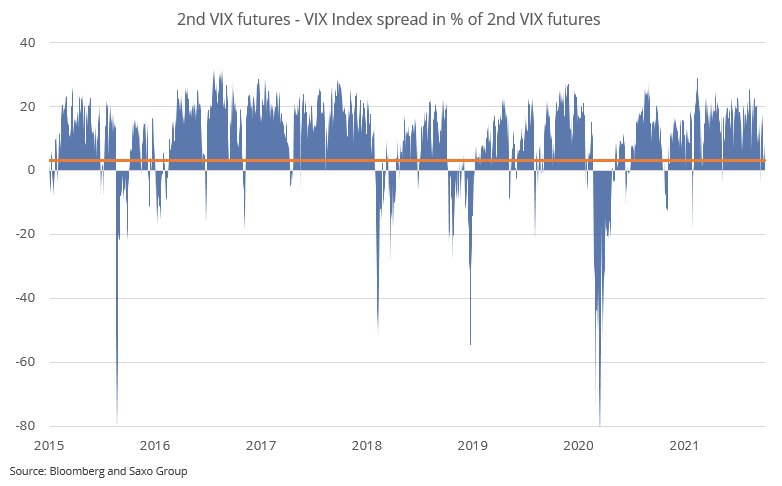
whenever this graph (from Peter Garnry at Saxo Bank) is -20 or -30, it is possibly a contrarian buy.- that is how I read it. in other wards, in strong backwardation in the vix curve…eventually one needs to switch and be bullish - in context perhaps with other indicators? treat with caution - have not done study myself. always test for yourself
Oct
6
Books, from Zubin Al Genubi
October 6, 2021 | Leave a Comment
1. Human Error, James Reason. A rather disappointing academic treatise on cognitive analysis of how humans make errors which is really dragged down by obtuse academia speak. Two major sources of error are lapses and slips, and secondly errors of reason and rules. Slips are when you forget steps, lose your place, get distracted, fall into a habitual practice inappropriate for the situation. Errors of reason are using the wrong rule for the situation, where the plan does not go as expected, or the plan was wrong. When the rule doesn't fit, the expert acts like a novice.
There are the raft of heuristics. One is how humans utilize familiar patterns rather than calculate or optimize a current new situation. It is cognitively difficult to consciously think through a new situation.
An interesting section was about how the brain uses "autodrive" to do many familiar things to make room for conscious thought. I was driving down somewhere thinking, and look up and arriving at my destination, realize that I basically had no recollection of the drive there - just on autopilot. A lot of daily life is on auto pilot thus ripe for error.
It's a difficult read. Better to rent, than buy.
2. The Genetic Lottery: Why DNA Matters for Social Equality, by Kathryn Paige Harden
A flawed book addressing a difficult subject. Galton's biggest failing was his theory on eugenics. One of Harden's main points is to debunk the misconception that the genetics of race has any meaning. Race is close to meaningless in genetics. For example, people with genes from people from Africa have a much larger variation in genes than in all the other races, and the categorization of Black and White becomes meaningless.
Genetics does have an effect on personal traits. It predicts certain diseases. The attempt at connecting genetics with achievement in education, life satisfaction, and wealth, suffers from too many variables to have any use.
Their statistical studies, not disclosed, I think will not be robust.
3. John Steinbeck, Sea of Cortez, recommended by Andrew Moe. A beautifully written book and a joy to read.
4. Yottam Ottolenghi, Plenty More. Highly recommended cook book with smashing recipes for vegetarian dishes with a mideastern influence. He has other cookbooks such as Jerusalem with recipes that are real home runs. I've made a number with great success.
5. Michael Lewis, The Premonition. Excellent book about the sad state of the lack of preparedness for a pandemic in the US. Outlines some of the goings on in California to deal with pandemics and disease. Lewis is a fine writer and easy to read.
Pamela Van Giessen comments:
Lewis is a facile writer who performs a parlor trick by bringing forward, in Vanity Fair like story telling, that which will convince you that his view is the correct view. He will not be remembered 100 yrs from now.
A reader writes:
There are three sentences in the short review of The Genetic Lottery that are utter nonsense:
"Galton's biggest failing was his theory [sic] on eugenics."
"Race is close to meaningless in genetics."
"The attempt at connecting genetics with achievement in education, life satisfaction, and wealth, suffers from too many variables to have any use."
These sentences could probably be accepted in, say, the NY Times given that and other leading publications' denial of much of genetic science, but not on this Spec List.
James Lackey appreciates:
Fantastic report! I dig Lewis because moneyball was a great movie lol but really love him because his Wife is so amazing that he must be a good dude to keep her.
Duncan Coker
Thanks for the list. Has anyone read the latest from Steven Pinker, Rationality? It seems like a more scientific analysis of what Kahneman failed to do. We humans have trouble with advanced probability in every day life, so appear to be irrational, but there is more to the story. Do the shortcuts we use help or hurt. Try doing Bayesian Analysis at the grocery story. I think Pinker is one of the best writers we have at present.
An excerpt from Pinker's latest:
Why You Should Always Switch: The Monty Hall Problem (Finally) Explained
By Steven Pinker
Oct
5
Could traders learn from other traders?
October 5, 2021 | Leave a Comment
"Decoded Neurofeedback (DecNef) is the process of inducing knowledge in a subject by increasing neural activation in predetermined regions in the brain, such as the visual cortex. This is achieved by measuring neural activity in these regions via functional magnetic resonance imaging (FMRI), comparing this to the ideal pattern of neural activation in these regions (for the intended purpose), and giving subjects feedback on how close their current pattern of neural activity is to the ideal pattern. Without explicit knowledge of what they are supposed to be doing or thinking about, over time participants learn to induce this ideal pattern of neural activation. Corresponding to this, their 'knowledge' or way of thinking has been found to change accordingly."
Nils Poertner comments:
interesting. personally, I found cross-training v helpful - so honing skills in non-work areas, too. eg, professional trader in equity who has singing as hobby might benefit a lot from taking professional singing classes to open up new pathways (also re creativity in trading. also) - am happy to be the subordinate then whereas in trading there can be some unconscious resistance in learning from others.
Jeff Watson adds:
Ben K Green wrote a book called Horse Tradin'. The entire book is cross-training and might even be on Chair's list of recommended books. If it isn't on a list, then it should be.
James Lackey writes:
I've been working on this for a while now 3 years. Path duration outcome based on neuroscience. Dr Andrew Huberman my skate park guy is one of the best - Prof from Stanford University and Army special forces fan. It's fantastic to study.
Nils Poertner responds:
yes excellent. the thing is it can't be an endgaining experience, one needs to have an intrinsic interest in something /also the learning part. if ppl love skateboarding for the sake of skateboarding and hire a teacher to get better, this enthusiasm may carry over for trading (learning /improve process here as well) too.
(our whole culture is way too much based on endgaining - maybe not in all areas - but in a lot of them which is part of the problem why are in this situation altogether)
Oct
5
An Armor Conspired: the Global Shipping Freeze, by Peter C. Earle
October 5, 2021 | 1 Comment
An Armor Conspired: the Global Shipping Freeze
First, the foundations. While bottlenecks are occurring everywhere, at present US ports are disproportionately affected. Docking locations along US coasts are among the slowest in the world: not because of size or technological capacity but collective bargaining hindrances. As Dominic Pino recently wrote,
Why are our ports so far behind? Not because we don’t spend enough on infrastructure, as the Biden administration would have you believe. The federal government could spend a quadrillion dollars on ports, and it wouldn’t change the contracts with the longshoreman unions that prevent ports from operating 24/7 (as they do in Asia) and send labor costs through the roof. (Lincicome finds that union dockworkers on the West Coast make an average of $171,000 a year plus free healthcare.) The unions also fight automation at American ports today, “just as they fought containerized shipping and computers decades before that.”
James Lackey adds:
Pete there is another one you can add to your list: The conspiracy to collude. The ftc is looking the other way whilst all car manufacturers minus Toyota Subaru and Mazda are limit up on next years ie 2022 sticker prices and it's not collusion - if you're not cheating, you're not winning in racing.
Oh, and the help wanted signs are bullshiza as they do not want to hire anyone as their wage offers are limit down. They can't pay back the ppp - they are all broke.
Bud Conrad comments:
The article is long on the sequence of events that colluded to a Perfect Storm of shipping delays. But he doesn't pick the specific culprit (Labor Unions? Government Port Investment? COVID Rebound? Trucking and intermodal capacity inadequacies? and I'll throw in another: Some kind of government or business sector conspiracy to get prices higher.
Regardless of the cause, the impacts on our economy are likely to be most felt in surprisingly high price inflation, for a broad range of products, that the US no longer knows how to make.
We will also see prices rising from the expanded money supply. Wage price inflation is already visible.
Pete Earle responds:
I don’t pick a specific culprit as the current state is not the product of a singular influence. Very simple, and the entire point of my article.
"Some kind of government or business sector conspiracy to get prices higher." [Not a reasonable theory.]
Bud Conrad clarifies:
I learned a lot in reading your article, and the problems you so well identify, including presenting the many charts. Yes: the world and its movements do work with multiple influences.
My challenge was rooted in my hope for identifying an overriding cause that could be addressed, and thus be the course of action to get things back into balance. Of course solutions will require many many efforts. And that was your point. What do you expect to happen?
I also threw out what I expected to be the consequence, that we would have very high price inflation, which will have obvious implications for all of us.
Aug
24
Wondering why the FTSE has lagged, from James Lackey
August 24, 2021 | Leave a Comment

One of the things that make me a poor manager but perhaps a leader mindset is to me pointing out problems with out a proper solution seems, well, silly.
At the trading desk here in Weston with Mr Vic, the one thing that caught my eye quickly was the FTSE and it's low prices. I have no clue so google landed the link below. any ideas?
Has the FTSE 100 really performed as badly this century as it appears?
Nils Poertner muses:
good spot - many other indices are rich (and firms, too, eg. Apple)?
long FTSE is probably the next big thing for Cathy Woods - am mentioning her name since she gets a lot of bad press in Europe but her calls have been quite good in last few yrs.
Paul O'Leary is skeptical:
FTSE an unlikely place for Cathie Wood to find the hyper growth she looks for.
A reader offers a critique:
The author shoots himself in the foot when he says if you bought all the companies in FTSE 100 in 2001 this is what you would have got…the constituents have changed. I skimmed the rest because it was clear the author didn't really know what was going on.
James Lackey clarifies:
Thank you paul, my apologies to all. My better question is what is wrong with English stocks or is that a bad question, i.e., nothing is wrong? I've lost so much money buying laggards and value, specs forgive me.
Big Al theorizes:
Here's a theory: The Digital Revolution has been one of the greatest expansions of human activity/productivity/wealth in history and it has been centered in the US, as have the stocks of the companies surviving the competition for doing the revolutionizing. The winners have been added to indices, and the losers dropped. This equity/index mechanism has far outperformed all others.
James Lackey responds:
Big, that is what I needed! I was lost (did not get the joke) and as usual was the last to know.
Stefan Jovanovich provides an historical perspective:
Big Al nails it, once again. The British invention of industrial production achieved the same startling results; within a third of a century, the center of the world's low-cost production of fabrics shifted from the hand-looms of India to the "infernal machinery" of the Midlands.
Aug
21
I adore NYC, from James Lackey
August 21, 2021 | Leave a Comment
I may have been born in Chicago. I may live in the NC mountains. However I belong in Manhatten. I can't understand how people do not understand NYC. The people are amazing and beautiful. There is every color size smell and that's absolutely wonderful.
Henry Gifford suggests:
Please do an experiment while you are in Manhattan. Go to the booth in the subway with the person sitting inside (some entrances do not have them). Ask for a subway map. They are free. Then stand on a corner and unfold the map and make believe you are trying to find out which way to go (it includes all the major streets, and is the best map of the city I’ve ever seen).
See how many people come over to offer help without being asked, and let us know.
Yesterday a neighbor asked me “If you could live anyplace, where would you live?” I told him “I can live anyplace, and I choose to stay here in Manhattan."
James Lackey runs the experiment:
Henry!
I had 6 people help just by over hearing I needed a route stop from a stop 135th street Harlem. That's absolutely amazing and wonderful.
The joke was the older the person the more complicated the answer. A young man said here, stop, grab that bus, 2nd stop hit subway the 2 or 3 train. The express gets off 30th street it's only six blocks dude.
Hahaha. Absolutely fantastic. People run over each other to be helpful! Post covid NYC is dynamite. People act as if they were locked up and forgot why they live in NYC and now absolutely love to share.
Bo Keely adds:
As usual, Henry Gifford is thorough, and takes you places no others will or can. I will never forget our boiler room tour of Manhattan.
The Manhattan map trick works not only in NY but around the world. I've used it in many cities in many countries. Holding a guidebook with a puzzled look works almost as well as long as there's a pic of the country on the front. The best method in no-English nations is to shout in a bus or restaurant, 'Does anyone speak English?' you will meet professionals and students. Another style is to wander a tourist spot with a backpack (travelers use backpacks while tourists carry luggage) that has your country's little flag sewn on it. Many travelers sew on the flags of all the nations they visit, immediately identifying them as an interesting person to approach for conversaation and invitation to dinner.
Aug
13
Trouble ahead?
August 13, 2021 | Leave a Comment
 Jeff Watson writes:
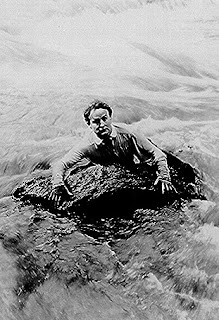
The market weathermen, self described sage like realists, always see trouble on the horizon and are compelled to give all knowing, logical reasons the market will get hit. Sometimes even invoking "science." To them the pressure is dropping hard, the seas are building, and we're about to get hit with sustained gale force winds. It's always doom and gloom to them. They want the little guy to get scared, pitch his position and make the broker money, rinse and repeat. Meanwhile, Steve provides some perspective and his chart lists 49 reasons for the market to get hit…while the S&P went up 35X during that time. Unfortunately the brokers don't want their clients looking at charts like this or reading Dimson.
James Lackey agrees:
Jeff says what we all learned the hard way. The market in stocks is an engine designed to go up. Any business decisions based otherwise are in between risk-based conservative - which in most cases is a good thing - and ruinous, as the vigorish will grind you to a long-term guaranteed loser.
Michael Cook responds:
I broadly agree with this but let’s not take it as written on tablets of stone.
One of the nastiest human failings in my opinion is recency bias and for investors in US stocks, an entire career (unless a very seasoned investor indeed) has been a basic bull market tempered by the bear markets of 1997, 2002 and 2008 and whatever the hell March last year qualifies as. Recency bias on steroids.
But it doesn’t mean it must always be like that. Just ask eg the investors in the Japanese stock market 40 years ago who pretty much are still waiting to be making money now…
Leo Jia adds:
Even if there is a sharp drop, it will only be shallow and short term. This is not a big bubble and there is no euphoria yet. If one suspects big money are selling, the question is what is the alternative to the US market. Perhaps the worry will be legitimate when Turkey and China become out of any concerns.
Nils Poertner writes:
what makes the difference between folks who are in the market - and trade successfully in the long-term and those who don't is often the acquisition of implicit knowledge. Things we know are true on some level, and that we need to experience personally many times to know that they are true - not in the absolute sense but more intuitively - and percentage-wise.
we live in a very explicit world now everything needs to be spelled out. but the "absense" of something is a better guide than the appearance of an event.
an example would be that SPX drops by 3pc one one day (after months of overheating) - AND the financial press is somwheat quiet aout the drop. as long as they are loud…one can normally relax a bit more.
not to be confused with long-term investing. eg, some of my English friends who bought prime real estate in the 90s in London, and levered up every year with new flats, are all fabulously rich now. was it being lucky or smart? who knows? implicit knowledge is underrated - was my point to say.
Leo Jia comments:
Even if there is a sharp drop, it will only be shallow and short term. This is not a big bubble and there is no euphoria yet. If one suspects big money are selling, the question is what is the alternative to the US market. Perhaps the worry will be legitimate when Turkey and China become out of any concerns.
Duncan Coker writes:
Agreed, it's worth noting that the 00's were the worst decade since the 30's for stocks. I'd propose there was a bearish recency bias going on during the 2010s.
I liked the video about carnival scams. I recall "winning" an album at age 13 from a darts game on the boardwalk at Asbury Park, NJ. No doubt I overpaid. It was a vinyl from a band I had never heard of at the time called the The Allman Brothers which forever changed my life in music.
Aug
10
Is Turkey a good buying opportunity now for holding 5 years?
August 10, 2021 | Leave a Comment
Leo Jia asks:
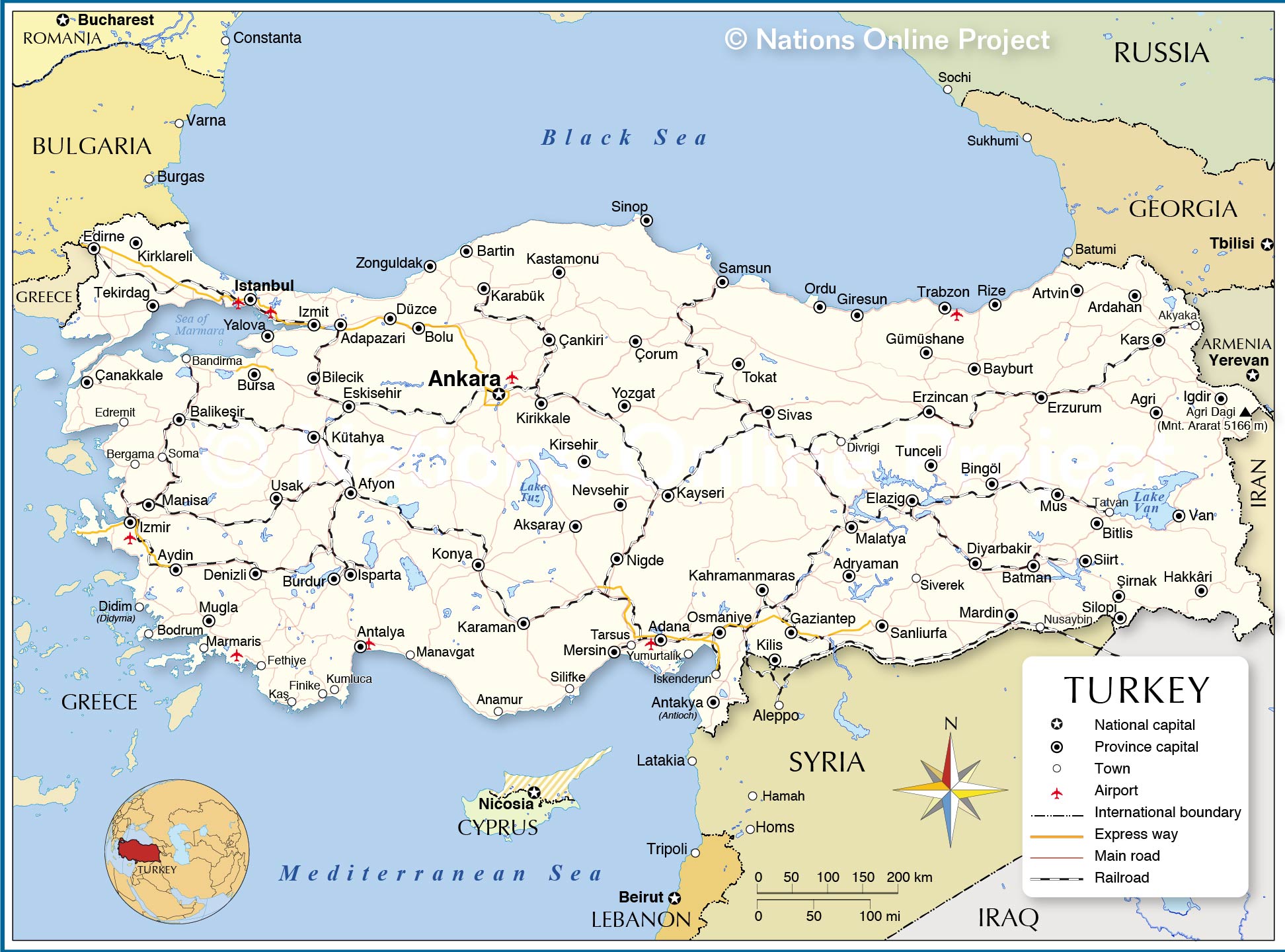
Any thoughts on the prospect of Turkish economy? Is Turkey a good buying opportunity now for holding 5 years?
Larry Williams clarifies:
Is the Turkish economy about the same as the Turkish stock market?
Some references:
The CIA World Factbook: Turkey/economy
iShares MSCI Turkey ETF (symbol: TUR)
Nils Poertner responds:
as we know from other EM countries, listed equity can be really a good play - even with fx tanking. see Latam and many Asian countries. a vast "play" on the USD (as lots of banks are financed in USD - and EUR) and a bet on the faith in the current regime. cap controls an issue.
understanding EM requires study of previous bull-and bear mtks for EM mkts itself- doing the tedious work - building implicit knowledge over time, cycles, mass psychology, whateever it takes - it is worth it, Jia and a lot of fun - as one learns from it and can share with others.
John Floyd writes:
Larry has somewhat taken the words out of my mouth on the economy and stocks in Turkey. I would expand on that somewhat given the unorthodox nature of the current Turkish administration and the expanding Taliban presence and thus likely growing chance of further friction with the US, following recent and historical comments by the head of Turkey on the topic.
As economy and FX it does sure have the potential to get things right and turn for the better. But, the odds of that happening and the headwinds against it seem rather large at the moment. The current path is one of further unorthodoxy in policy and leadership combined with expanding debt that will likely lead to a default or restructuring and FX going from 8.6 north of 10.
Reserves are tenuous at best, local capital outflows a perennial risk, and the need to continue to pump up the economy through credit, tourism headwinds given COVID, current account deficit of 5%, etc…
Given the circa near -20% returns for the Turkish indices there may be some gems within the them with careful selection, as is needed in China given the P-like oligarch crackdown there as the aim by X is to stay in power for life and control data and tech to do so.
James Lackey suggests:
As John clearly said the news risk..what about the derivative of the big Mac index and or the hot dog stand.
If I'm forced to value a stock on foreign exchange correctly, I'd go to Turkey, rent a flat, and open a food stand and sell Harley Davidson T Shirts. The McDs index of brands is HOG. I can sell merchandise like a roadie at a show and let's use the most recognized brands in the world.
Sell shirts for 6 weeks and my guess is you're going to learn exactly what's going on.
Larry Williams adds:
Bring lots of NIKE stuff to sell.
Jayson Pifer provides local insight:
Fwiw, I can offer some boots on the ground perspective. I spend a few weeks a year in Turkey and have done so for the past 15 years, missing last summer due to covid however please take the below comments with an appropriate amount of salt. Each time the conversations come up on investing in real estate there. And each year, I come away boggled at the lack of progress and steadfast in keeping money away.
If I were to hazard why the Turkish economy isn't more than it could be, I would suggest that it is the general absence of faith in any of the government constructs. Without commenting much on their current 'populist' leadership, I mean to say that the average person has little faith in the police, courts, and laws and work around or without them. (plied with a bit of scotch and I could relate some Keeleyesque tales of my encounters there with these systems )
Absent true legal financial recourse, trust stays in small personal circles that are difficult and slow to grow and this has various and deep side effects. As an example, if one were to meet a VP of a bank in the US or UK, you might assume they had interviewed for the role from a range of candidates and/or had been in the role for a while and knew the business and their area. One would likely be correct in those assumptions. In Turkey, you do not have that assurance as they will probably have gotten their role through a circle of acquaintances. They may be qualified or not, but they are almost certainly in somebody's inner circle.
The low trust and inner circle workings are seen in both the political and business environments. When new leadership comes in, it is typical and considered normal to bring in their trusted group, reward them for their loyalty and displace anyone they do not trust. Partisanship there compounds the issue, similar to the partisan wars in Google but with more serious consequences if one supports an out of favor party (eg. non-AKP).
Wrt the stock market, my impression is that it's a lottery. There is money to be made, for sure, by smarter and luckier people than me. But the risks are real.
I don't have numbers, but my anecdata shows a worsening brain drain with talented turks leaving the country and those that have returned are struggling.
Taking a further step back for the five year horizon posed originally, my impression like Mr. Floyd's is that Turkey has headwinds and not much to stop it from falling. My questions are what could change to reverse this trend? A change in leadership is often cited, but it would not create an overnight increase in trust. I could barely speculate how long it might take, but would guess decades if all went well. While it's not exactly fair and I'm out of my historical depth, I compare it with Iran when it went down the path of Islamic leadership in '79. How will Turkey not fall into the same trap?
Theodosis Athanasiadis comments:
Historically real exchange rates have been a good predictor of emerging market economies and equities through the mechanism of cheap exports, labor, external investments etc. they are a form of valuation for the whole economy. I see them currently at multi-year lows which has been bullish for equities in Turkish lira for the long term.
John Floyd responds
Yes, on real rates in Turkey that is true and can be seen in the standard OECD PPP, but that has been like that for ages and you need the positive catalyst for change…..move to orthodoxy one way or another….monetary, fiscal, and geopolitics…should gradually grow confidence in varying degrees and speeds and drive capital flows in a positive fashion if it occurs and given valuations you can find some gems I am sure…perhaps on well capitalized companies that can benefit from the inflows and cheaper FX…plenty of meals for a lifetime if you look at Argy, Venny, Russia, SA, Zimbabwe, etc…
If anyone is bored, I did an interview on Turkey last August - it somehow has gotten just under 20k views that highlights both contemporaneous points at the time and some of these longer term issues.
Alex Forshaw writes:
Erdogan is in bed with the asset heavy industrial elite of Turkey… this is China but with very ineffective capital controls (mainland Chinese stock performance has been terrible for 12+ years btw, altho indices don't include juicy dividend yields). They're all massively overleveraged, and basically long and wrong The only way is devaluation / financial repression (forcing inflation >> cost of capital) until they deleverage… but Erdogan can't really let them deleverage because the economy would implode, Turkey is poor, the opposition is highly organized with high recourse to violence (Kurds), so Erdogan would be dead. So they just keep building and building, but who's going to come?
Seems to me that Turkey is uninvestable until Erdogan is gone…but he's a de facto dictator…so he can't go.
Leo Jia offers more data:
New home sales are down lately, which may be caused by the pandemic:
Turkey: new home sales
But existing home sales shot up sharply in recent years:
Turkey: existing home sales
Aug
5
The Most Profitable Company, from James Lackey
August 5, 2021 | Leave a Comment
We try to never look at a new generator. This AM we noticed more masks. My brother mentioned they are trying to make covid a deal again to hold onto their corner. The brilliance of X traders is they look at everything as a hustle. "How are we getting it today and for sure we are the last to know."
The covid hustle is a two team teaser on the old meme, "we can not find qualified candidates." That was the 50's race bait turned into an econ pay class war keeping the man down. I turned many a biz owner red faced when they couldn't find qualified help by saying either let the moths out of your wallet or train them yourself. A day trader with a Union BA pops and all athletes we become difficult to convince it was about "they" and not You.
The covid hustle keeps them masked and the dining rooms closed. If you have x sales and you lose zero sales and can reduce labor costs by running the drive thru only, who blames them? Not me I don't like your food anyways. However when it comes to the DMV OMG you sucked at your job before allowing me to do all this online, cool! I hope this lockdown will close your store and keep the Churches open.
Okay I will not go that far as I do not want a new enemy, the brother in law of the law.
I found out that APPL is the most profitable company in the world. Here is how they do it! They win on skill. After all these years, 08 to 21 I have fought the good Android fight. I don't even know why except I despise closed systems. The libertarian in me lost to the artist in me. I bought an APPL 11 phone and a new carrier today. I called uncle to my uncle as he said, He Jimmie if you're so damn smart why are you trying youtube video production when all you need to do is buy an APPL and pay for their cloud. Done deal as uncle is 7 years my senior and actually taught my cousin and brother how to ride dirt bikes at 5-7-11 years old respectively as we went up in racing classes. At 16 he said I am done, turn pro. We did and today we turned on the Apple pro video.
Jul
28
Hedging the inventory, from James Lackey
July 28, 2021 | Leave a Comment
Someone said there is no way to hedge this, and I said why not sell some used car companies stocks just in case and….
A reader writes:
Yes, the difficult question is to find the correlation between the used car inventory and hence their aggregate values with the used car sellers' stock prices. I don't know which publicly trade companies only sell used cars. Once one knows the equivalent delta value of the inventory, then one can hedge the delta risk using various strategies as you have suggested.
James Lackey writes:
After a day, I think of ways I could as a day trader blow this trade up. The risk is car prices crash as they should and the used car big box store's stock goes up big on a squeeze. Therefore the way to protect that is to buy call options. Buying options is not businesslike as the vigorish is unbusinesslike. I do believe others must be in this trade as I'm always the last to know. I'm sure I'm not the only guy that thought of this trade. Yet so far the dealers and the vampire squid isn't pitching this trade.
Someone said to me there is no way to hedge this book. I laughed and called bs and said there is.always a way. Problem is the cost.
Duncan Coker writes:
The only part of Dalio's book I found readable was the first section where he
talked about his early consulting work prior to Bridgewater. One of his first
major accounts, McDonalds, needed to hedge chickens. Dalio came up with an
elegant solution with ratios of feed, energy and land. Futures were not a
ubiquitous as they are today and his ideas were quite good.
A reader adds:
Jake Powell also commented on the recent high prices of used cars shall come to pass in his congressional testimony this morning. Similar to the Dalio methodology, then perhaps auto parts stores like ORLY an/or AAP could be affected then.
May
20
Biz Question
May 20, 2021 | Leave a Comment
The daytraders know how to get money. X stockbrokers know how to.call and build the relationship to get.the money.
May
20
The Artist Question
May 20, 2021 | Leave a Comment
James Lackey writes:
I'm formulating a good question. The artist question.
I'll write an essay with my experience in management of artists. We can look at the brutal management of music movies from LA from the roaring 20s til today.
The bad question is how do we profit from artists? That's an apparent oxymoron. I get cognitive dissonance.
I lived in Nashville for 12 years. I made friends will all kinds. I met some rock stars current and retired. An interesting move was the logistics biz of the industry moved from LA to Nashville to cut costs.
A bad question was why not Indianapolis the best center that my race car brothers use.
The answer is obvious. Artists can not live in order. Artists turn chaos into order. The hood gets graffiti then Lack moves in and digs the vibe but I hold a job. I pay to improve my homestead . Then the kids see me and set up a bike shop A coffee shop.. Then as Jordan Peterson says the developer comes in and builds condos. The property values skyrocket all the yuppies move in…
The Artists bail. Chaos turns to order.
I've had enough helping my friends turn their paintings or tunes into production projects.
It's not emotionally profitable and we all know writing isn't financially feasible.
If I opened a body shop to fix cars I have an artist problem.
It's actually easier if I wanted to build 100k show cars!
The daily grind to do the backlog of let's say the current market you need painters.
Painters make 100k a year. The management are idiots and think that's too much.I fixed that by saying ""you paint it.""
The management quickly gets the joke.
The next problem is the talent is paid for 60 hours of labor rate at 50% of the payable. So for every dollar of revenue they collect fiddy cent. That kills management. I say that's the market let's focus on what we can change.
The logistics of the shop require let's say 100k of equipment per 1 million on gross. I quickly pointed out the under utilization of capacity is almost as bad as church buildings.
They said "we cant"
I know you can't but if you could how would you do it?"
""make these lazy guys that only work 50 hours a week and make 100k work more! ""
Umm omg no! They are happy. That's the point of life.
"Ok…lack hire more painters and keep this shop humming 24 7.
Now your on it!
""I can't find qualified techs.""
Omg stop! Quit blaming society or my goodness the markets for your losses or lack of problems.
I sound like my trading brothers here when I had losses or no profit when everyone else was doing fine.
The artist will clearly do his own thing
It's a bit more complicated lol
Yea Lack it's complicated Allright don't go into biz for profit when you need must have artist.
OK what if I have to?
Help! Haha.
Laurence Glazier writes
The most opulent road in London, The Bishop's Avenue, was once a trendy artist neighbourhood, and is now full of derivative mansions and lacks charm. The Studios where I am based, whose inception seems to have encouraged eateries and other studios to set up, have now been taken over by a developer. I think this will be good in the long term.
A relationship between agent and artist is often to the benefit of neither. Gombrich said "There is no such thing as art. There are only artists". https://tinyl.io/46hl
I met his wife once. She was an exponent of the Leschetitsky piano tradition and I think may have known the great man. She would take no money for showing me how to play a scale, and it was a great experience.
May
20
Dept of Guaranteed to Happen
May 20, 2021 | Leave a Comment
The day where bonds are limit up and stocks are limit down.
May
12
Which Daughter is the Shrink?
May 12, 2021 | Leave a Comment
My current project is mentoring. I take the perfect candidates for sales. The B C students from state school. I have two requirements for them to be hired.
May
12
My question is…
May 12, 2021 | Leave a Comment
The great question has yet to be formed. The question I have is young adults have some sort of mental issue. I believe every human does. To what extent can the Huberman labs explanations of the mind body contract be used to cure?
May
2
Losing
May 2, 2021 | Leave a Comment
Zubin Al Genubi writes:
The subject of Losing gets pushed under the rug in this woke world, but is an interesting subject and should be studied and examined.
Accepting loss, and understanding why is an important process. Was the loss due to a mistake, lack of training, improper technique. Was the other guy just a better human or did he just work harder and longer, and try harder,? Did you try your hardest? Was there some other mental stuff holding you back. There are some tough questions, but questions that need to be examined to improve.
Sports competition is good for young people because it teaches how to lose. A big part of sportsmanship is losing with grace.
Some people really hate to lose, and it holds them back. I hear people verbally arguing, and rather than lose, they will start escalating and go for the jugular, and making personal attacks. It's counter productive in life, in marriage, in business. Fear of losing causes people to not try their hardest for fear that it will not be good enough and that they are inferior. Fear of losing causes people not to take risks to avoid the pain of loss and the accompanying questions. Fear of losing is fear of realizing that you may not be good enough, and that your self delusion about yourself will be shattered.
Millennials grew up in the "everyone is a winner" generation, leading them to a sense of unjustified self entitlement and bewilderment at their lack of success.
A statistical approach to losing is an excellent way to understand losing. In a sample of trials, some will be losers, some winners. It has to happen. Hopefully you will have more winners over time, and the wins will be larger than the losses. The distributions of a few big wins, which total more than many small losses are hardest. A common distribution is lots of small wins, and a few big losses which is related to the fear of losing issue.
Was the loss due to bad judging, prejudiced judges, corruption, bad system, unavoidable (shit happens) type stuff. In ski mountaineering, you can be cautious, but there is unavoidable objective hazard, such as an earthquake while you are in the mountains.
There are some good tangents. Mitigation of risk is big. The subject of luck is a good one. There are many things you can't control: some are favorable, some not, and they affect you and your life. Was your so called success due to luck or skill?. Its the black swan thesis. What percent is luck, and what part skill? Did you overcome your circumstances, and handcaps, or did you squander your talents?
Though I don't about it gambling is a good field to study losing as discussed by Kelly, our friend, Ralph Vince..
James Lackey writes
What evidence do we have to support the statement about Millennials?
We know my kids yours brooks vics Stephan Gordon and I'm sorry how many others here..
Oh sure I knew your not talking about me us but….I've been mentoring just out of college kids or drop outs and I've never experienced the generalized view.
However my son does have cohort frustration.That's not a win loss handle it emotionally issue it's a work goal reality issue
Sorry if I hijacked your thread
Ken Sadofsky writes:
Is the list dissolving; the decency of adieSau. would have been appreciated.
Cheers for alice. 1939 5 top films n more. what would vic say?
James Lackey writes
Did you take my comments as not fit for British Navy dinner table?
I'm certain it is US Army Officers club cool.
Please explain why.
Mar
31
Starting with Industrial Revolution Say 1759
March 31, 2021 | Leave a Comment
Victor Niederhoffer writes:
How many of the great inventions were made for profit rather than government sponsored or the common good.
Peter writes:
If war is government sponsored great inventions (in some cases for profit as well) - I believe you will cover most of the great advances in medicine, aerospace, computers, etc…add the Cold War space race and most of the items in my kitchen can be added to the invention list.
Stefan Jovanovich writes:
The grand achievement of the American integrated freight system - now the world's logistical model - was almost entirely a product of the mass stupidity we call the Civil War.
James Lackey writes:
Mr Stephan,
You've got to admit that pure speculation in rail paper traded in NYC was important.
Victor Niederhoffer writes:
lets do some more justice to the influence of profits making on invention. I've only listed the ones where great industries were formed and there were patent fights. Newcomen– steam engine, John kay– flying shuttle, Hargreaves– spinning jenny, James watt steam engine, Cartwright –power loom, Whitney– cotton gin and interchangeable parts, Trevithick road steam locomotive, Stephenson–railways. Isambard Kingdom Brunel - revolvers, colt, brunel steam ship, singer, home sewing machine, Bessemer steel processing, more telegraph, Edison lightbulb Benz internal combustion engine.
Feb
3
Bubble, Bubble, Toil and Trouble, from Bill Rafter
February 3, 2018 | 1 Comment
 Markets can experience contagion. I remember from trading futures (nee commodities) that a crash in one market tended to bleed through to others. We would always remember it as though someone who had a great position in beans would sell it out to meet a margin call in silver that should have been dumped. That is, cutting your profits to let your losses run.
In that vein I wonder how much the recent hit in Bitcoin contributed to the equities decline.
Jim Lackey comments:
Ben K Green Horse Trading.
Jan
10
Observation on Cryptos, from Jeff Watson
January 10, 2018 | 3 Comments
I just got back from shopping at Publix for our dinner. While going through the checkout line, I overheard two of the baggers talking about cryptocurrencies. One kid was giving market tips and advice to the other. An exact comment from the young tout: "buy Ripple today, it will never ever go down." Is there a school where they teach people to be tipsters?
Anatoly Veltman writes:
Funnier yet: Ether did absolutely nothing the entire summer and fall while Bitcoin went bunkers. This winter, Bitcoin actually came down, while Ether is absolutely ballistic!
Andy Aiken writes:
Has it occurred to you that there are fundamental reasons for these price movements? If you simply observed the movement of people as units or particles in the Concourse of Grand Central Terminal, it would be baffling.
But if you understand that these particles are individual people, each with a home and a workplace, each with a will and an intent, then the movement makes sense.
The intentions aren't incidental to the movement.
James Lackey writes:
Your fantastic quote might be true for all public markets. That is all I see when I want to move. Path of least resistance ideal.
anonymous writes:
I agree with Lack on Andy's excellent observation. Is it true or useful to say that:
a) we often don't know the distribution generating price signals
b) better to go with empirical or nonparametric distributions when possible, as opposed to formula driven?
c) is there anything to simplified agent-based modeling?
Dec
12
The Future Corrupt Trump Administration, from Stefan Jovanovich
December 12, 2017 | Leave a Comment
Grant's reputation for "corruption" is based entirely on his committing two sins: (1) he insisted that the government actually keep accounts, and (2) he called the bluff of the St. Louis Germans who were furious at his being willing to allow the accounting to include a review of the excise tax accounts that had been their own private slush fund.
Trump seems to be going down that same path towards academic reputational hell. He is actually going to audit the DOD.
Vince Fulco writes:
Reminds me of that sub-plot in the movie last emperor when Pu Yi asked for an audit of the family's warehouses since he didn't trust the eunuchs who had been administrators to the family for decades (centuries?) and suddenly a day later, everything went up in flames.
Jim Lackey writes:
Mr. Stefan's point is this, Ralph. I was a rookie trading the Nazz. SOES, Daytek and my first backer now in heaven.
We had an amazing edge, in execution. There was five 25 year olds sayin, "this can't last! How do I pay the rent much less support my Austin, Lack?" Magic words… "The warehouses are full" Hugs tech bubble. Limit up every week. We make selling them only when we are certain. That was the point. You made the call. Plz. Never call the turn. We all know.
Dec
1
Miner Update, from anonymous
December 1, 2017 | Leave a Comment
I posted on a friend a while back that started out with 50 servers a year ago mining BTC. He recently found some investors and is scaling up to 2000 servers. Some metrics he follows; on his variable costs (electricity, rent, etc), he budgeted it would take 15 days of mining each month to cover, last month it took 5 days. Return of capital he budgeted 6 months, actually taking 3 months. Break even prices for BTC (marginal mining cost) is $1000 to $1200. Says scale is important, bigger processing capability of 2000 servers allows more profitable transactions. They will soon be #2 in their "pool". He has a good relationship with largest server producer in China and negotiated a power deal in the US with decreasing marginal cost based on usage. On ICO and cryptos in general he would not know a crypto-fork from a salad fork, but knows how to run a business and will ride this wave for as long as it goes, with a good cushion above BTC $1000.
Jim Lackey writes:
Why isn't Google Amazon or the valley locking this biz? Good question or as usual I'm last to know.
Anatoly Veltman writes:
I could never understand the ethics of crypto mining "biz". You certainly use up resources–to produce "what"??
J. Hales writes:
Would your friends ROI be positive without the rally? Or more simply: would his investors have done better simply just buying Bitcoin outright?
Years ago when Bitcoin was trading around $50 I did a lot of research on mining operations almost every single one was essentially equivalent to: long bitcoin - expenses of maintaining servers and operations. None the less, they were extremely popular 'investments' as people liked the cachet of being a technologically sophisticated 'miner.'
Nov
25
TSLA, from Julian Rowberry
November 25, 2017 | 1 Comment
 I was thinking about TSLA the other day after seeing the new promotional video with the truck and sports car. It's business trajectory reminds me of many tech business models, such as Uber. Which is create an app for an existing product that bypasses laws, regulations and taxes and then abuse ones competitive advantage.
The traditional car companies ceased to be car production businesses and became finance companies a decade or two back. Will TSLA cease to be a car company and become an energy company? TSLA can bypass consumption taxes on fossil fuels and god knows what else, while setting up 'refueling stations' to resell energy. They'll have a repeat business where they buy energy in bulk and resell it . To their clients and others. Being the first guys in, they'll set up a monopoly where they can. Energy will turn into their main business. The cars made will become rubbish and they'll exist like a business such as Verizon. How long will it take governments to cotton on? And when they do, will it be too late?
Jim Lackey writes:
Lack sees shades of 1999 when E brokers became higher market cap than brick banks. My buddies were 6 months too early. If or when AAPL trades 1/20th of US GDP it may be the csco of the year. One realizes no one ever made selling them. From the bleachers there is only tracking stocks missing from a lesson I do not wish my son to learn like dad, the hard way. Musk after pay pal was cut off by banks and the street in 2008. We were all busy fighting for our lives. The first guy through the door always gets bloody. I'm sure he does not care about his stock owner partners. He's said time and again, do not buy. Interesting why anyone would own this paper when they are fiduciary. I know why my old trading friends are caught short. Tis the season to squeeze.
Jun
22
 An old high school friend (who reads and has commented on DS) recently told me that he is burned out in his career and wants to trade FX for a living. Apparently he knows 2 people that make a living trading through one of those shops. I gave him more than several reasons why he should consider taking a pass on this new career, but he's going to a 4 hour seminar to learn why FX trading is the way to go. He is willing to invest $10K in this venture. My immediate comment when hearing about his limited bank roll was that he would need to generate an extraordinary return on his money just to make a living and that would be near impossible. I ask the list for some guidance….questions he should ask the FX broker, questions he should ask himself. I've tried to talk him out of this, but he is still considering taking the plunge. What are your thoughts about someone 60 years old, quitting his job and trading FX on a $10K bankroll. I know my thoughts, but ask the list to add some of their own.
Generally speaking, when casual acquaintances ask me this question, I tell them that they will do better going to Vegas….at least when one blows through the $10K bankroll, they might get a few comps….the mistress of the market will just take one's money without even a thank you kiss in return.
Stefan Jovanovich writes:
Cue Marcel Proust: We remember the stories of our lives but there is very little of the past that our nervous systems actually keeps in the present.
One of the lucky and tough survivors of the torpedoing of a merchant ship sinking in WW II described the part of the whole thing that stayed longest in his active memory.
It was the voices of the barely 20 year old seamen in their Mae West's calling for their mothers.
Jeff's friend seems to be another believer in the age-old faith that Mommy is still out there somewhere and will magically save us from the hardships of shipwreck.
Bud Conrad writes:
Read the opening personal story of Education of a Speculator for an example of how hard the high leverage can become. You could quote me as saying: "I wouldn't trade forex without a $300,000 portfolio." This kind of desperation often accompanies market reversals. For forex I don't know what the change will be, but I would warn your friend in the strongest terms.
anonymous writes:
I think risk of ruin is too high if you're under 100k bankroll. With 10k there is leverage needed to make a living, but with a 100k you can survive a couple bad streaks.
Jim Lackey writes:
Good afternoon, Chair, Brothers, ladies and gentlemen. Interesting post, I just caught a young man screen watching. It's the stare of hope. If one would focus enough the prices would go our way. I was asking him if he wanted to buy the truck or not. He cursed and I knew it was about something online. I said what is going on dude? He said "look at this. " He motioned me to look at his screen. It was forex quotes, I said, what is your position?. "Long the Euro and they said it is going up because….". I asked who are they and why would they tell you and what is their position? He looked up and………., huh? First off one must start with individual stocks 2-1 only. Secondly they always know and I was always the last to know. Huh? Do you want the truck or not? He looked back at the screen and said "but the Euro….." If he bought the truck I would have given him a few good books. I'm sticking with trading cars and trucks. It is not a very profitable business margin wise. It is a lot of physical work. I am in excellent physical shape. I can sleep at night. I'm not sure if it is a permanent disability, but I have lost my ability to take risk in the financial markets. However, I would never discourage anyone from speculating for a living. Buy them a cup of coffee and after an hour see if they would read the good books. Specs are honorable and benefit society in ways that I did not comprehend until years after I hung up the racing helmets.
Larry Williams writes:
While I've already agreed with the majority comment on the subject let me add this…
A few years back I got a letter at Christmas time from a guy who wrote basically saying, "Larry I bought your trading course I actually went to the blood bank and saw blood to buy it. I raise some capital while I was learning started trading now here I am in Vail Colorado. I'm a single father my kids are with me I'm living in a house beyond my wildest expectation, all because of learning to trade etc., etc."
Of course I replied that it had nothing to do with me was his success and good fortune but nonetheless this was a wake-up call in lesson for me it's hard to tell people know don't do this because this letter was not an exception have had others, not as extreme, but in a similar vein. Clearly there been other people who have lost money, some probably even shirts or shorts.
This is a hard-core to stop somebody so what I personally do is let them see the doors open but also all the dragons and monstrous just beyond the door. Full disclosure, brutal disclosure then if they want to pick up the craft they can.
I know you don't build good athletes by telling them they can't do something you have to encourage them so this trader, want to be trader need some encouragement.
Jim Lackey adds:
This is what happens in forex too: Cascading margin calls for so many and who was holding the other side after everyone was forced out of their positions? GDAX affiliates? GDAX?
A side point: a few million worth and the price is crushed. Small market. Any medium sized player can own the price action in that arena…
https://www.cnbc.com/amp/2017/06/22/ethereum-price-crash-10-cents-gdax-exchange-after-multimillion-dollar-trade.html 
Aug
15
If You are an Ex Pro and Currently Still Playing the Game, from Jim Lackey
August 15, 2016 | Leave a Comment
Sport? The one you were great at. Do you still play? Of course you will until the day….
Common injuries: shoulders, knees, ankles and every dude has broken a finger playing. Question:
What is the best non pharmaceutical pain management routines you have brilliantly created, yet no one before Lack has asked you. What and how do you complete this exercise for maximum efficiency? The outcome from this routine is to manage pain after vigorous exercise. Yea, like a 49 year old dude racing motocross a few weeks ago.
After a long weekend I pick up weights. An American born before 1920 would consider this a waste of time. Their advice is usually, pick up hay bales for the same 2 hours. I pick up and hold as much weight as able for as long as my threshold. It is far batter than massage therapy. Yet, never a happy ending.
Aug
2
The Future: Think about it … Imagine it…from Jim Lackey
August 2, 2016 | Leave a Comment
 Omgoodness 10 year projections! A joke.
Stephan, Ralph and all are correct about old Henry.
He gave 5 bucks simply to keep labor.
Our awful history books praise the 5$ yet neglect the labor strikes on later wage demands. Not sure if it's true that Mrs Ford ended that. What is certainly true is Ford inc was a total cluster @#$@ post WWII and the intel boys had to make order of the books.
Chrysler was a cluster in the BK as Iococca asked the accounting department their projection for the year. Apparently no one knew the math.
I want a Tesla! Enough said by the spec list car guy.
Engineers are always terrified by something. That's why they are working in engineering, certainty.
There is no certainty in the future of hybrid, batteries or hydrogen powered carz.
They all work, but at what cost/demand at offer prices. All traders know this. Always watch Toyota. T
hey go with certain bets before they sell fleet.
Jul
14
McDonalds USA, from Jim Lackey
July 14, 2016 | Leave a Comment
 In the depression, McDonald's has the best service, prices and clean restrooms.
In the boom, it's the opposite.
It's been that way since 92 when I came home from Iraq.
Simple labor anecdote, but perhaps predictive for the HR department of the mega cap.
Yet that has nothing to do with financial market, minus McD common.
Have the banks paid all their fines?
That's an observation of one.
Certainly the Feds customers need a shift in the curve.
Once the system filled the two trillion dollar hole and paid the Fed's bosses, regime shift.
Elections provide political cover.
Sep
3
Where to Start, from Jim Lackey
September 3, 2014 | 1 Comment
 I have much to explain, yet little time to give exact data, much less test a hypothesis. I have been working for a living for the first time since I joined the spec list. I will use the definition of work as per the tax code and my ability to deduct the costs of doing business. Trading is an amazing business opportunity defined by the tax-code or our latest definition of a good business, revenue/employee.
Today is the day to check in after reading, "financial story from Bo". I had to log in this A.M. after reading that post to my daughters last evening. Why isn't that post lit up with comments? Why in the world is economic mobility between class in the USA a good question? It does not pass the Lack S Side street view of the world B.S. test.
I will edit and submit my diaries, re-education of a salesman/street trader asap. I have bought and sold many tangibles from the age of 11 until I was hooked on trading paper. Supply and demand of any item in the zip code you trade is well known by all traders. Consumers, biz to biz or retail are grossly misinformed by the vast amounts of free data from the interwebs. Branding is and will remain what it always has been, the first shot for a trade/sale. The most loyal customer will bolt on price, attitude, availability and probably the most important quality today vs 20 years ago, ability of the customer service. The demands of all customers are unrealistic. I have read the quotes here on the Comcast thread months ago.
A couple quick notes: The profits share of most any sale in many industries to the man on the ground/ revenue are remarkably similar per unit. The best business is of course paper with recurring residuals and fees. If one didn't care, know the risks to the clients or have the ability to handle stress, it is a great business. That is why most here trade or manage paper for a living. Everything else is by unit, service contract and time/revenue= XX basis points payout. I crack up at the different pay plans, bonus structures that I am pitched. I show them the table and their reply to my objection is, "you're looking at it the wrong way".
Lastly, my feet hurt! It's easy for any of us to work easy 55 hour week (+5) homework= 60 The norm seems to be 65+5 or an average of 70… No big deal 6 days a week, 12 hours, a quick sandwich grab, off Sunday. The wife is working until her medical leave. She takes on the AM kid shift and takes them to school. I have, after 4 months off the trading screens, found the ability to sleep in til 7AM and be at any shop by 8am. This enables daddy to be with it 8-11pm for the kids' homework.
I learned a new skill, the ability to listen. Sure that is what sales is all about. No, I am talking about listening to my kids. After homework, we talk for a couple hours. They are very happy as daddy isn't always looking at a computer or a phone. There are not enough hours in a day.
May
14
Robots, from Garrett Baldwin
May 14, 2013 | Leave a Comment
 I have seen more and more of this story reiterated over the last few months… That hi-tech and robotic innovation are leading to greater displacement of the middle class in the United States and around the world.
"Think Your Job is Robot Proof? Think Again"
A Stanford professor recently commented that technology and scale are greater drivers of job displacement than previously expected. They are also the strongest drivers of significant wealth. The Forbes 400 is now dominated by innovation and those who have perfected scale.
I am surprised that so many economists have been commenting on this so often so recently, as if it's new news.
Ricardo noted this trend in technological unemployment long long ago, but it completely seemed to have disappeared as a story for 190 years.
Even Krugman admitted that if technology is such a significant driver of the divide between the rich and the poor, then surely it makes a mockery of any attempt to balance wealth in this nation since you cannot tear down innovation in the pursuit of balanced distribution.
How did economists ignore this? For fear of being labeled Marxist?
This reminds me of my first three minutes at Hopkins. I asked a professor who had worked at the DOE what would happen if a radical green innovation displaced oil…
He replied… "You don't want to go down that road…" Innovation has its downside, and to him, it was millions of angry young men in the middle east without a source of income from oil.
Stefan Jovanovich comments:
The principal argument of the intellectuals who supported slavery was that economics itself was an inherently "dismal science". Carlyle genuinely believed that a system of accounts based on money prices was far more vicious than any lash. His spoken corollary was that black people needed slavery because they could not otherwise compete. The unspoken corollary of his intellectual successors was that many other groups of people needed protections from the market because they, too, could not compete. That unspoken corollary became spoken when Progressives discovered Marx.
No believer in liberty in 19th century (the people who called themselves "liberals") had any doubt that machines could do it better, faster and cheaper. That was the point of inventing them in the first place. Those liberals also had no doubt that, in a world of scarcity, "better, faster and cheaper" was a good thing because savings and costs were more important than incomes. That is the same reason why they wanted Money to be made only out of the 16K tons of the one metal that was indestructible and, in milled coinage, impossible to fake. If prices had their unit of account determined by the supply of something that could only be produced with great ingenuity and industry, then the implicit fraud of government (we take money from you as an individual at the point of a gun so people you do not choose can receive benefits) would be limited;and thrift would be rewarded.
The liberals' faith was the presumption that, over time, thrift and family virtue would outrun the machines because accumulated capital would profit from the ever-lower costs that machines always produced. The Progressive/Marxist answer was that we could all speed up economic evolution if we just let the government keep the capital and define the costs. What is truly dismal about much of current academic economics is that the basic argument that produced the science itself is now considered to be a fully-settled question. Meanwhile, the economists on the street are filing for disability with the help of the friendly lawyers they found on TV, highly-penalized work (the stuff classified as "wage and hour" employment remains scarce, and yet per capita discretionary retail sales (what people buy after they pay for food, energy, communications and shelter) are once again rising.
As the Lackey would say, "Hah!"
The principal argument of the intellectuals who supported slavery was that economics itself was an inherently "dismal science". Carlyle genuinely believed that a system of accounts based on money prices was far more vicious than any lash. His spoken corollary was that black people needed slavery because they could not otherwise compete. The unspoken corollary of his intellectual successors was that many other groups of people needed protections from the market because they, too, could not compete. That unspoken corollary became spoken when Progressives discovered Marx.
No believer in liberty in 19th century (the people who called themselves "liberals") had any doubt that machines could do it better, faster and cheaper. That was the point of inventing them in the first place. Those liberals also had no doubt that, in a world of scarcity, "better, faster and cheaper" was a good thing because savings and costs were more important than incomes. That is the same reason why they wanted Money to be made only out of the 16K tons of the one metal that was indestructible and, in milled coinage, impossible to fake. If prices had their unit of account determined by the supply of something that could only be produced with great ingenuity and industry, then the implicit fraud of government (we take money from you as an individual at the point of a gun so people you do not choose can receive benefits) would be limited;and thrift would be rewarded.
The liberals' faith was the presumption that, over time, thrift and family virtue would outrun the machines because accumulated capital would profit from the ever-lower costs that machines always produced. The Progressive/Marxist answer was that we could all speed up economic evolution if we just let the government keep the capital and define the costs. What is truly dismal about much of current academic economics is that the basic argument that produced the science itself is now considered to be a fully-settled question. Meanwhile, the economists on the street are filing for disability with the help of the friendly lawyers they found on TV, highly-penalized work (the stuff classified as "wage and hour" employment remains scarce, and yet per capita discretionary retail sales (what people buy after they pay for food, energy, communications and shelter) are once again rising.
As the Lackey would say, "Hah!".
Jim Lackey responds:
Correction! It is Mr. Vic that says HA! Lackeys say, "get the joke", which is a joke as it takes me 3 times to get it… or the "get the joke is "we are the last to know" when it comes to the "news".
Apr
24
What Old Racers and Traders Agree On, from Jim Lackey
April 24, 2013 | 4 Comments
 Old racers and traders agree on quite a few things:
1. Do not look to get out even after a big loss of position. This is in regards to time. A runner, dirt bike rider, or race car driver would never consider an attempt to go back to the lead after a bad crash in the main event. Most realize it might take a couple weeks to regain strength before attacking for the victory.
2. Hold your place. The market or a race isn't about you. The gist is the ability to win a national event is the work you put in the prior 6-8 weeks to the event. Racers are either 'on top' or 'not feeling it' which is code for strength vs. the others or skill on that track.
If 'on top', you make a huge mistake and almost blow up. After such a near disaster we look to the front of the pack and we are still right there? Now most engineers or spectators will say, hold your place regroup. Go get them after you calm down. A racer is never, ever going to do that. The gist is if I almost crashed and my heart rate is pegged at 199, look up and we are close to the lead. We are going for it full throttle. The gist is you made a huge mistake and should have lost it. You're right there! This means everyone almost blew up and too many will, coast for a bit. You can go strait to the lead if you do not hesitate.
"Not feeling it'– That line is easy after a big mistake. We look back over the shoulder and see how much we must push to hold the position.
3. Take your loss. From the drop of the gate everything is wrong. Matter of fact the last laps of the past race everything was wrong. There are two codes in race results that team owners and managers always get upset about, DNS did not start/qualify DNF "did not finish". There is always a push to regroup and gain at least a point on the week. I am cringing as I write. It's so painful. Racers call it, do not get killed. Let's not make a bad weekend worse and ruin, destroy the season. Get back out there! You can do this! Ah, okay, but…..
It has always been easy for me to DNF, load up the trailer and spectate. I remember dad arguing with his best friend. We were at the track and we could not figure out why the engine was down on power then there was a leak in the transmission. Dad said "On the trailer" No, no! No, everyone else agreed we can fix it.. "On the trailer now!" and dad walked away. Later that week we were working on the race car and found 5 more problems. His buddy said, "good thing we put it on the trailer, let's make that a rule"
To be clear, I am talking about what everyone always talks about –"them or "I". The markets are either weak or strong. The position you have vs. the field or the market has nothing to do with how the rest of the field will perform that day. Unless you crash and take the leaders out.
If you're weak and they are strong and you make a huge mistake, take a step back for a lap. If you're weak yet they are weak, you might try standing on the gas. This does not come natural. We are trained from little ones to take a seat and rest after a fall.
There is the old athlete problem. Fighting them for the sake of respect and competitiveness, we all do it… Basically the trade is all risk for little to no reward. That happens to traders all of the time. We spot a window of weakness and go for a pass. We find ourselves boxed out and lose a few points on positions. We add, for no good reason! We didn't have the skill, power or traction to make the pass the first time. That was, with a good pattern window to make such a move. Now our only pattern is competitiveness, the will to win. We are weak, yet feeling it, or best we feel nothing at all because we are mad as Hades. We lay off for a moment build all kinds of speed and go at them with everything we have.
That is how that 30 minute window and a 2 point loss turns into 10 handles against us, all in. How in the world do we get our selves into such bad positions? OH I dunno the last 50 times we made the pass the first time and 4/5 we came back after a regroup and passed everyone back in a lap. We have do this so many times we never think, until it's too late. Then the boss comes on the radio… other than hope, why are you still out there? The pit window is open. Bring it in now! Please….. Good men act silly when they trade or race angry. The gist is we are weak and too upset or stupid to realize it.
There is old dailyspec line on losses. In a big move, in a panic, if they let you out for even, it goes much much more in your favor. Of course, that is big market moves or a huge crash on the track… stay out there and gain all the spots you can. In general that does not work in day trades. It's all your fault, you caused the pile up for self and or others. Perhaps that is where the bias is from, a baseball player pops up a perfect fastball to hit. A football player fumbles. A driver loses focus and hurts the car. Next time out we find the hole we stand on the gas and get boxed in and the will to win, never ever give up attitude takes over.
Which is where the old coach line must have come from "Come on lack use your head" and "are you okay– you have a concussion or something, that was not like you" or " usually you're much better than that".
Apr
24
Last Night at the BMX Track, from Jim Lackey
April 24, 2013 | Leave a Comment
 Years ago, Dr BO, the hobo, our kind of crazy genius, posted a report on the realization, he could live of a few $ a day by eating some 1,000 calories per serving at McDonald's, with that 2k a day calories plus a bit of walking he'd lose a few pounds per month. A couple memes destroyed and on the meme generators, He would never read newspapers again.
P.S. last night at BMX track a few asked about eating the AAPL. My comment was when the price of a good lap top is under the cost of the telephone/computer pad… got that?
Yesterday was a frustrating day. I took out all my frustrations on the starting gate. I have a few kids that can't get the hole shot, or 1st out of the first turn. To remedy this I announced let's see how many starts we can do in one hour. I managed 32, about double the kids. Which is silly, as interval training probably slows you down in the short term. Yet the proper form and muscle memory is needed for certain tasks. This comment is in regards to school or requirements of jobs to have a degree when nothing about the job or degree will help perform the task. "We had to do it so, you do to" the gist is the Chief of hiring requires the degree in X because we had to do it. That reminds me of running up the Indiana beach Sand dunes because Walter Peyton was doing it. Or, the silly habit we had as kids to run or walk around with ankle weights.
My cousin, same age, is like my brother and my best friend. He ran MX at Red Bud the famous track we raced as kids. He reported that his results of 15th of 18th last Sunday. He never quit riding but hasn't raced in forever. We had planned on racing the event June 8th. He reports that there is no way in hades we can run the vintage class (same bikes we had as kids 30 years ago) as the track is too difficult. Yet, if I really wanted to race, (he talked me into it in the first place) I can ride on of the practice bikes or 5 years or older bike in another class.
On race results that had import to excel. I then figured out why he was so concerned about me being run over. He had no clue how well he did vs. the current 30 and over Vet pros that ride for money cash awards. The top 5 in his moto or race won the 30 over and beat one of our old friends that run 40 over Vet pro. Plus my cousin is riding a 10 year old 125CC 2 stroke in the 250 4 stroke class. Yet he wasn't even in that class with the kids…as he didn't want to get run over. He exclaimed BUT the class was called Vet sport C class or 122CC and over bikes for riders just coming back.
Bobby I don't care what they called the class… that day it was 30 over open class and you were in there with the Pros X pros on 450's brand new technology bikes… Those guys ran two classes and a few of them finished better in the money race then in our open for trophy of the day. OH!
Which reminds me of yesterday and the flash crash. Guys had stops in 10, 15 and 20 under or trailing on their advanced computers. The problem was hours later they were getting fills and now ofcurse they were now caught short from waaay below.
The electronics and software of the markets remind me of the TPI or fuel injection that was coming on productions cars in the mid or late 80s. They didn't work right and were basically junk. Yet by the early 90s it was good and now it's awesome. My dad, frustrated, pulled the TPI off his vette and threw an old school carb, fuel pump on his mid 80's vette… For years he exclaimed how the computers and all was junk. For years I argued.
Today it's now about Turbo charging small CID engines or running direct injection into a V-6 that makes some 300 HP. For example my first good job and check I bought a 91 vette that had only 325HP.. By my second in 95 it was up to 350 HP with electronics and head designs alone.. Now a much smaller engine, a V-6 with 12-1 compression and variable valve timing makes 300+ HP and the little 4 banger engines are making 300 HP with turbo chargers. All of this was available 20-30 years ago but was junk. Now it works with computers.
So, if walstreet computers follow the time line of race carz to production car it will be 20 years since electronics were first introduced into market making about 97. In 4 years it will all run right and we will not even notice.
Apr
2
Dad Said Walk That Beam Kid, from Jim Lackey
April 2, 2013 | Leave a Comment
 "Jimmy, you can crawl or walk the beams all day without tools, or you can man up and walk the beam."
I was about 17 years old, not too high, 25', walking a steel beam, the crane just set as I tossed a couple of bolts in one side and walked the beam to set another. Dad was ribbing me, "you're not afraid of heights, son, walk it, let's GO!"
I may not fear heights but I sure do not like them. I just did a silly trade. I sold out before the book said to sell. It cost 1/7th.
Now you might say Oh Lack, a point or two is nothing. You silly day traders.
I'll explain it this way… in every racing school and many other sports the world champions teach "everyone looks for the one big edge, but the winners know it's a bunch of little things, done right is what makes the difference."
You know the guys that always win and make it look effortless.
P.S. in retrospect a "get the joke" was 3 am this morning, I was working and the Bloomberg guy said Oh just wait til the Dax opens. SPU was unchanged so I left it alone. Woke up to 7up.
Apr
1
FLA, from Jim Lackey
April 1, 2013 | 1 Comment
 The Family just returned from Florida. One can see a boom or a bust around every corner. On one hand (econ joke) you can see the boom– new real estate projects, Disney full to capacity as of noon. On the other hand the bust– the Space coast Condos at whole sale prices 89k a few hundred meter walk to the most beautiful beaches.
What is remarkable to me is to see and hear of old friends doing the same things as 11 years ago. Yes, the bucket shoppes are back with 50 men screen watching.
I love Florida. My family and friends are there. The weather was a bit cold for a few days, then it was perfect. The Atlantic waves were a blast with the full moon set to the West and the magnificent sunrise over the ocean. What a perfect way to start the day.
After a 12 hour drive into the Nashville rain, with the grass a bit greener, a few leaves on the trees, it is a very late spring here. I asked the wife, FLA? She replied, not a chance. Make some money honey and buy one of those condos with in walking distance and do learn how to surf.
Kudos to Watson and Sogi… what a workout those waves are! One may never forget how to ride a bike, but when it comes to the waves, I put on the towel. Not sure if I'll ever learn.
Mar
15
HFT, from Duncan Coker
March 15, 2013 | Leave a Comment
Despite what I have read I am not convinced the HFT in aggregate are profitable. Buying High, Selling low, and making it up on volume just does not seem like a good business model to me. The research on HFT seems unadjusted for survival bias. They study the biggest and most profitable firms to see how big and profitable they are. I personally know an HFT firm that made money 3 years in a row, then after 4 months of bad performance they realized their edge was gone and they closed shop. I am sure they were never included in HFT research. I use limit order so I suppose HFT is taking the other side and the jury is still out.
Jim Lackey writes:
Of course, Dunc, it should be like all things sports MX. Top 10 sleep in the Hilton and ride in the Factory rig and the next 10 best in the world sleep in their trailer in the pits 20-99 are part timers and lose money racing.
Mar
5
Car Sales Plunge 10% in Germany, 12% in France, 17% in Italy; US Plunge Coming Up, from Jim Lackey
March 5, 2013 | Leave a Comment
I see that headline from a finzv blog headline machine. It caught my eye as I am having one heck of a time buying used carz. To find deals to "trade for profit" forget about that last year.. To find one to buy, it's frustrating as all hades and I am wasting too much time looking for a good 10-12k 06-07 used BMX type vehicle.
Of course we know all of this as production fell from 18mm units to 8.5 mm in the crash. So off lease carz lets call them 09's and 2010's are very steep in price. What this does is causes all used cars to go up …seemingly… I talked to a guy this weekend. He had a clean car for me. When I looked up loan value… never mind dealer wholesale I asked him where in the world did you get 11k price? he said its +++ what he paid for it.. I asked what did you pay for it… "you don't want to know" but I guess he can make his 800 off the unknowing.
There is a flood of rebuilt titles due to the extreme high costs of rebuilds. That is a new business. Of course I don't want a rebuilt car… and after Sandy I am sure there will be a flood of flooded out carz.. So this problem is Nashville to Fla.. used car prices are a total rip off and its much better to buy new. Yet I have no idea what the +- over production is a GM vs F and the Koreans are giving cars away with very high residual values with leases. Reminds me of the Japanese when they built Lexus brands in late 90's.
Mar
4
How Things Fall Apart, from Jim Sogi
March 4, 2013 | Leave a Comment
 Complicated things of high quality don't just break down in a big cataclysm. Take a modern car. They are well built. The engine will last for half a million miles if properly maintained. However it is the little things that start breaking: the plastic ashtray falls out, the rubber seals wear, the bearing start getting loose, the fabric tears. These little things can get more serious. If the seal leaks, and the oil is low, the engine can wear prematurely. The shocks wear, and the ball joints go. The steering gets loose. Small things can lead to bigger problems. Take a modern city, like New York in the 70s. First it's some graffitti, then some broken windows, soon vagrants move in, garbage piles up and the city head to bankruptcy. It's the small things first. Take a huge economy like the US. The GDP isn't going to fall apart. Employment probably won't go off a cliff. It's going to be small things first. Take a corporation. The earning won't collapse right off. It will be receivables up, inventory up, sales down, or even smaller things. Maintenance up, or down. Take a market like the Nasdaq.
Leo Jia writes:
These are very insightful. Our bodies are about the same. And while the destruction process happens this way, it is interesting to note the creation process is also quite like this. First, small trivial things get created, then the large more significant things. All things seem to move like this in circles. Bubbles start small, grow big, then shrink a little, then burst.
Jim Lackey adds:
Hold on ther' hoss. The first thing we do, it wash, feed and stable the horses before the cowboys. This car post caught my eye. If the simplest part breaks, a mass air flow sensor, the engine runs rich and bad things happen. Yet we have a dummy light! Even back in the day we had dummy lights for high temp, or low oil pressure. These little 25-200 dollar parts break on brand new machines. Take the worn out 100k 7 year old car. Yes what you say is true. 35 years ago the 100k car may be dead in the crusher for scrap. Today what people thing of the heart of the car is the engine. With CNC , CAD and CAM all short for, computers do not have UAW contract for, tired nor sick nor go out of whack and slap together the last V-8 at the end of bowling night. Therefore the engines are designed and build and installed to Engineer spec. They do last for 250k. Most but not all of them do 250k except for the short cut copy cat Far East red flag waiving commies BYD my 6.
The little things that are build to spec yet cant possibly last for 7-12 years as you say rubber O rings, Balls joints, tie rod end,s brake rotors struts all must be changed or maintained. The most complex and weakest link of the chain on new cars is automatic transmissions. I made one the of the worst mistakes trading this week. I was taught about racing cars bikes and anything with an engine, failures. In a way we kept track of the max min wait time on a failure of a part. We change them at or before the median failure time. I forgot all about that for our trading. Didn't lose, it was much worse than that to a racer not winning is as painful as being on fire.
One spec posted a customer service report on cars and diamonds weeks ago. The gist was one man said change all parts. The other man said wait 5,000 miles. The implication was the second man said wait, and was best. What wasn't taken into account was two things. The performance of the car and his safety and time of a second trip to the shop. Other was the parts probably were not in stock at dealer B. There fore the guy simply told what most want to hear, no money today rather than we will have to keep your car over night as the parts are coming off the ship from Japan.
The discussion also goes to medical. too much of medicine is based on illness. When talking to my Docs and their ranges for normal I burst out and said, your kidding right? How do basic stats escape Medical training? How much better can we all feel if we did X and Y do the the people all wait until a breakdown and see the Doc for solution which prescribed as X. I know why. I did the same thing last week on my trading. I didn't consider wellness. I was waiting for the market to become sick then do trade X. My trading doc even warned me and kept me from having a bad loss. He was focused on wellness ( is best I can describe) I was looking for the illness. (Okay so the markets went 1530 to 1490 and I said why not wait for 1475 to come in? I pull my racing pits cap over my head and tell the wife, at least I didn't lose short)
How much better will a car perform with New tires brakes and rotors vs a car with 5,000 miles of anecdotal testimony to wait. I can give you the stats on new vs 20k or 40k miles and after one race on a real car. Racers change brakes and tires after each and every weekend. We rebuild engines most every weekend depending on class. In some pro classes we rebuilt engines after every single 1/4 mile run, new pistons, rods and bearings, Valve sprints and retainers, all seals and gaskets.
What the anecdote above states is the engine will run for 250,000 so then to should the car. Yet the car will not move with a broken ball joint. The engine will die with a broken timing belt and over heat with a bad water pump, that now last to 110,000 miles. So the engine system is still only good to run for 110,000 miles. The trans and rear end gears all die at 125-150 and the fuel pumps and all do the same. The catalytic converters die way before this. Most cars have a 5 year 100,000 mile warranty on the drive train. Its only 3/36 or 5/50k on bumper to bumper.. The emission control systems or parts are now only good for 80,000 miles.
So in theory your car is now worse than a 1969 model. It will break down and be non drive able 20,000 miles before the 1969 model died and went to the crusher. Yet your correct, at 80k miles your car will be fixed for 1,000 bucks and in 69 you needed a new engine trans and every hose belt and switch was dead.
This entire deal of failures was burned into my trading memory banks for life. I used it in some ad hoc way since MR Vic showed me in 2004. Yet the advances in his technology on how to quickly repair the trading engine and have it on the road to profitability was lacking by lackey.
The story I wrote about my teenager failing to appreciate the need for trans fluid made me dump the BMX van for 25% above scrap rates to a new friend. I am now shopping for a good used van. There is also a meme on pricing of used vs new cars. We try not use never always when it comes to life. Yet the financial advice out there has man a never and always do.
Too many men are all over the past 10 year return of stock at or about nil. The we are in a range trader calls have been falsified many times this decade. The SPU made a high in 07 the Russel or what ever made a high this year. Yet its true and maybe always is tr that not all stocks make a new high as the joke is many stocks fail to exist, survivor ship bias. Its all mumbo as they use all or this or that index.
Then to say all new cars have engines that run to 250k miles and do not fall apart all at once.. is also false. A brand new car has the ability to shit down or go into safe mode. Its broken according to our ladies who drive. It can only be idled at 35mph to your local shop. With palladium and platinum are such high prices the emission control systems are too expensive. The cars heart is not the engine, it never was the brain. It used to be the driver and the mechanic. Now its a computer. We have fire trucks that will not start if the diesel engines emission system is on soot burn mode.
Now we have computers in control of making markets for the global stock and futures markets. All economic reality seems to be lost in the short term. If political hack from Berlin says A and EU hack said confirm A and US is about to have a press conference you can forget about the next four hours prices being predictive. The markets computers go into safe mode. They will move and shut down quickly and we must, as traders idle at 35 MPH to our local dealer of data to find out what happens next after that part failure.
For what ever reasons I have gained my passion for markets back. Of course we know where we lost it. What makes men take risk? What makes risk takers skip a generation? Is that true? I had a friend as me this week about becoming a spec. I asked him to answer this one question. Would you rather trade your money and take risk per 500k account to eeke out a living or use another mans money and take 20% of profits yet no fees? I have asked this Q so many times and it reveals much about a mans capacity to take risk, yet most important to take pain. Ya see racers, we do not care about losing crashing or getting hurt. Its part of the game. We do not like losing, yet not winning that is so painful, like I said we wear fire suits and not winning is as bad as completely destroying your car on driver error and being on fire.
The gist of the answer is if your rather trad OPM you do not belong in the hours 1/2 day markets, ever. Do not do it..It has to be the hardest way to make a living. The easiest way if you have any capacity to sell or raise money is ride the tides and collect a fee. I am sure you can find a way to make a firm stand on the middle ground. Some fine research and pick some fine stocks and short some over plus commodities after the bubble has been busted and hold that roll that for years. Now you have the ability to take down a small fee and a profit incentive.
What has changed my attitude is being certain about one thing. These markets change direction and patterns change so quickly its fast, like racing and Fun! Where in the hades have I been the past few years not to look at all of this as a positive thing for, me. I love to go fast. lack
My motivational quotes for this week attached.
August 1908 issue of a periodical for bicyclists called "Bassett's Scrap Book". A short item contrasted the modern age to ancient times and presented a variation of the epigraph:
"Naram Sin, 5000 B.C. We have fallen upon evil times, the world has waxed old and wicked. Politics are very corrupt. Children are no longer respectful to their elders. Each man wants to make himself conspicuous and write a book."Johnson's often-quoted definition of genius, "the infinite capacity for taking pains."
"genius is inspiration, talent and perspiration." Kate Sanborn
The President of the Old Speculator's Club, Jack Tierney, writes:
I seem to recall the name
Carnegie's "Gospel of Wealth" idea took his peers by storm at the very moment the great school transformation began—the idea that the wealthy owed society a duty to take over everything in the public interest, was an uncanny echo of Carnegie's experience as a boy watching the elite establishment of Britain and the teachings of its state religion…Since Aristotle, thinkers have understood that work is the vital theater of self-knowledge. Schooling in concert with a controlled workplace is the most effective way to foreclose the development of imagination ever devised. But where did these radical doctrines of true belief come from? Who spread them? We get at least part of the answer from the tantalizing clue Walt Whitman left when he said "only Hegel is fit for America." Hegel was the protean Prussian philosopher capable of shaping Karl Marx on one hand and J.P. Morgan on the other; the man who taught a generation of prominent Americans that history itself could be controlled by the deliberate provoking of crises. Carnegie used his own considerable influence to keep this expatriate New England Hegelian the U.S. Commissioner of Education for sixteen years, long enough to set the stage for an era of "scientific management" (or "Fordism" as the Soviets called it) in American schooling. Long enough to bring about the rise of the multilayered school bureaucracy. But it would be a huge mistake to regard Harris and other true believers as merely tools of business interests; what they were about was the creation of a modern living faith to replace the Christian one which had died for them. It was their good fortune to live at precisely the moment when the dreamers of the empire of business (to use emperor Carnegie's label) for an Anglo-American world state were beginning to consider worldwide schooling as the most direct route to that destination.
Mr. Krisrock writes:
This happens when there is a world price for labor…that American foundations arranged for 100 years.
Jack Tierney responds:
I'll go along with the parts played by American foundations, but not the 100 years. In a recent book by David Horowitz, "The New Leviathan," he points out that many of the great foundations we still hear so much about have wandered substantially from the goals envisioned by their founders.
Among them are the Ford and Rockefeller foundations, as well as those of Pew and John MacArthur. Each accumulated substantial fortunes in very capitalistic endeavors…and expected their trusts to continue to promote efforts in that direction.
At first this worked as the initial appointed trustees were chosen by the benefactor. Over the years, however, (and this relates to my initial post) subsequent trustees went off in their own, very contrary direction. inevitably, they labeled these modifications as "progressive," a catchall phrase that seems to excuse almost any perversion of original intent.
Most of these changes in direction have occurred over the last 50 years as the original trustees passed away or retired. Only Olin was prescient enough to "sunset" his trust to forestall this drift.
Feb
15
A Housing Anecdote, from David Hillman
February 15, 2013 | Leave a Comment
 For about 3 years, I've been monitoring the trend in public notices of foreclosures and sheriff sales in the local newspaper. These have gone from nearly a full section 2-3 years ago, to several pages a year ago, to near zero today. Similar observations in other locals while traveling have been made.
It looked a couple of years ago that goo would be flushed from the system by the second half of this year. The upward trend in new construction, home prices and building materials in the last half of last year caught me by surprise as well.
Out here in the boonies [at least in my boonies], we were not hit nearly as hard as the coastal regions in either the housing or employment markets. In reviewing and measuring housing, let's not forget……geography matters, as does what is selling.
I wanna think maybe this is a combination of having paid down or reorganized our debt, learning our lesson about over-extending and being house-poor, having begun to save and invest and spend more wisely again, and with the market up we're feeling better about our fortunes and the future, we notice there are still vestigial housing deals out there as well as new ones, recognize they might not be there for long as home prices are increasing, and figure the time is right to buy again. Kind of like recognizing a market bottom has occurred and buying in at the beginning of the upswing.
I don't think this is a head fake, but a certain amount of prudence is not ill-advised, because, as we saw in 2007, nothing lasts forever.
Henry Gifford writes:
One time I was negotiating to buy a house and I told the seller "Your house is in mint condition." The broker in the background was cringing, and repeatedly recommended I hire a home inspector, and the only thing that would quiet her down was explaining that the home inspectors have an association, which has a magazine they read to learn about what to look for when they inspect a house, and the latest issue had a cover article I had written.
I told the seller I was going to make an offer to the realtor within the hour, and my offer would be contingent on me not dying. No mortgage contingency, no inspection, no nothing. We agree, we sign, we close.
My offer was lower than other offers that day. We closed soon after without hassle.
When selling property I generally ask for an "as is" contract, to avoid the games.
The legal side of it all says that a seller is more obligated than a buyer because "specific performance" says the seller is promising something very specific (a unique house) while they buyer is not. As a practical matter, a buyer can threaten to sue for some obscure term of the contract, tying the property up indefinitely if they are not refunded all their money.
It is all just another way honest people are at a huge disadvantage in life, but it is the life I have chosen.
Jim Lackey writes:
A hold back near nashvegas: rent exceeds the cost of carry here. Even @ 0% down FHA rate + tax tag and title (yet minus the unknowable maintain costs) if you rented it yourself, no management fees, i.e, rent 1500 per month, cost of carry 1200 on 4br all brick nice hood and schools. Yeah, if it was a cash buyer it is grocery store, wait AMZN margins so it can trade 100X earnings. lol. I just figured it out as a few of my friends have moved (bought new new) and held on to their old house and we have renters in the hood. Yet, it's still cheaper to buy new vs. used. Hipsters are in deep buying East Nashville tear down/ guy rebuild. My buddy told me it was dead 20 years ago. His new wife as a college kid bought dead homes for 3,000 bucks. Yes, you can imagine correctly.
Feb
4
“Pressed Men”, from Stefan Jovanovich
February 4, 2013 | Leave a Comment
 As near as I can discover, my first "American" ancestor was one of the Hessian soldiers rented to the British for use in fighting against the colonists during the Revolution. He was captured at Trenton and paroled and, instead of returning to his command, hired himself out as one of those "Pennsylvania Dutch" farm laborers whom Benjamin Franklin detested. Within 50 years his descendants were no longer Roman Catholics but Methodists living in Georgia; by the Civil War they were in Alabama and Mississippi — still on the losing side. One was with Evander Law's Brigade. The other, who was a rich man, somehow managed to spend 4 years in Barksdale's Brigade without even making it to the rank of corporal.
The Hessians were all "pressed men" — conscripts who were literally forced into service by the same recruiting techniques that the British Navy used (the very ones that were among the primary grievances that provoked the Southies in Boston to become Sam Adams' loyal followers). Even though most of the Southern branches of my family still prefer to start the genealogy with the Hessian's respectable children (which still qualifies everyone to be a Son or Daughter of the Confederacy), as an unreconstructed Yankee, I prefer the Hessian. I like to think that disgust for the draft is one of my better genetic inheritances. If I am fortunate enough to have grandchildren, I pray that neither the grandsons nor the granddaughters will have to break the law by refusing to participate in the charade now known as "Selective Service". If they take after their ancestors, they will be willing to volunteer: but they will not let the government tell them where their duties of service lie.
Jim Lackey adds:
The lack's first recorded Military was the civil war. He survived, so his dated service was near the end of the war. I wasn't an officer so I didn't attend war college or any true military history classes. I defer to Pete or the other officers and historians on this august site.
Yet one can still tell you a map and a compass can and will take you anywhere. With my manchild (17 year old) on a Bama trip he made fun of my in the van nav technique at 6am. I retorted kid we will be cold and tired and driving out of here at midnight. The phones did not work in the valley and I refuse to use GPS on carz.
One of the things about Chicago childhood was it was too easy to navigate by map or memory. For years I traveled by dirtbike on RR tracks or powerline dirt cuts. At Ft. Knox I had no struggle adapting to on foot map and compass…Yet in Germany on a fast moving tank one can out run his map in 5 mikes.
Point? In Nashville or anywhere S or East, one can visit any civil war battle field, take a history book and do the stage to battle advance and or retreat on foot. One can imagine an all day forced march into and out of a fire fight with bad food no sleep and my gauche, I have only explored these fields in good weather.
I admit to never reading one word of Civil word history until two years ago. I find the entire war too much to bear. However a few of the battles S Nashville, and the surrounding areas to be quite interesting on a topographic map reading exercise. I can imagine marching up from Bama, sending my cav due east then attacking on foot with a battalion. There was quite a few balzy moves by the South in the awful war. I find the short swift battles and counter attacks most educational. The huge mass of troops is in all of history, to me is boring. The outcome was decided before day break. The after the fact of what went wrong is almost a bad joke. Some of the recounts on 91 are so silly I laugh. I do wait to read the 2003 recaps in good books if there ever is one.
Yeah the battle of Cowpens in the revolution or the battles of the 1860's around these parts N Ga the Cav counter attacks or attacks on the egregious Union supply lies are very exciting to walk through. Only a history book can describe Grants Forging and engineering work on the rivers to attack mass in force are a bit interesting. WW2 I was forced to learn all about the Battle of the Bulge or Ardens as that was my units history. Patton is far less interesting as a commander when you see his route or axis of attack and know the situation of the German. One day I'd like to visit the Ukrane and or Russia to look at the actual lay of the land. Those were some wicked battles. Yet the history often blames the German command. I am sure there are some reasons on the Map that many have failed to mention.
When you actually walk that last mile and top the crest and imagine an entire Battalion (or Army) when your at Brigade strength after marching all night all day and then go strait into attack at supper time.One can only imagine… as after a full nights rest, then driving 20 miles and walking just 5 up the trail to the hill. Then thinking we will be here all night and all day tomorrow under fire. Good lord, war is hell..
Jan
28
Stocks Post Weekly Rally Amid Longest Advance Since 2004, from Victor Niederhoffer
January 28, 2013 | Leave a Comment
One doesn't recall seeing so many bullish things in a market recap in many years. It reminds one of the bearish lists that Alan Abelson would come up with in the complete enumeration of his weekly articles from 1956 to 2005 that collab and I read from 1956 to 2005, during a period when the market went up about five fold.
Jim Lackey writes:
If one was at The weekend meeting…
"Say, look fellas, this mumbo of 1000 point rallies and declines of the same on political mumbo jumbo must stop. We need the public in the game and moving their book to cover the eco system overhead of the US market. Look at Mr White, he had to take a pay cut! Why are we losing our friends when we lost many in the crash. This must stop. Let's agree to keep the declines at a swift 300, a gamber smash 20 day max to minimum in three. Yes and lets keep the news flow all declines are healthy and pauses to refresh. HFT keeps stealing? Lets do to hft what we did to the day trader in 2004. Work the open and close as gentlemen and from1030 to 330 lets agree to play it as tight as possible. If HFT does not have the big orders to front all the have is to catch a retail 100 share order at lunch or best fight each other to the death. All HFT not backed by us making markets will be gone in a year.
Hear here..cheers long live the US markets."
Jan
25
The Ease of the Hoax, from Victor Niederhoffer
January 25, 2013 | 2 Comments
 The ease with which Lance was able to maintain his hoax, and the difficulty that others had in breaking it, and the penalties they had to bear, and the great emoluments that were made from it by Lance and his crew should be generalized. What other hoaxes and conspiracies are there in the world? What is the dead weight and direct cost? I have been the victim of several such frauds and conspiracies but was smart enough in the last ones not to take legal action as I knew that my legal and opportunity costs would be many times greater than the possible recovery. I believe several on the list have also been so victimized. How prevalent is it? And how can they be defeated and fought against?
Anatoly Veltman writes:
Not a direct answer by any means, but the first time I heard Carl Lewis respond to a question on how good Ben Johnson was (question was posed way before Ben Johnson got publicly "discovered") — I was quite stunned by Carl's stern reaction. It was like you asked him if he could outrun a Martian in his prime. One might either conclude sour grapes from hints like that, or suspect that there is no smoke without fire. In any case, maybe one of the best ideas is to ask a competitor?
The question raised here, by the way, may be the most important question of the couple of decades. Every single one of you places your livelihood on the line daily in the system which is totally rigged against you in the worst way.
Jim Lackey writes:
I'll guess the opportunity cost of the lengthy background, due diligence to N^th, and flat out distrust of people, most of whom are benevolent and kind, would be something like the a 1,000,000% drift stocks give us per century. I'll flat out call it that being a skeptical, safe person is costly.
If it is too good to be true, it is, and we are not idiots. We all have some street smarts here. A well oiled con? I'll fall for it every time and I usually get the joke. To hell with them. To catch a thief one must be one or a good officer of the law.
David Hillman writes:
Some of the answers we know.
1] always get it in writing, 2] pigs get fat, hogs get slaughtered, 3] know thyself and resist your weaknesses, 4] invest in what you KNOW, 5] there's some business we just don't write, 6] most of us will make more money investing one's self than in someone else, 7] in the Shakespearian spirit…."neither a borrower or lender be", gifts are OK, but don't expect a return, 8] give at the office, 9] don't invest what you aren't willing to lose, 10] don't buy meat off the back of a truck, and 11] never buy anything with "Magic" in the name.
I have almost always found it best to be the "initiator" of an investment, an idea, etc. than to be "initiated upon". Also, when one is in the mud, it's usually better to hint at legal action, then settle rather than sue (The con often has the same legal and opportunity cost as you, at least the same amount of risk of losing and possibly more dire consequences.)
Even if one is optimistic and has faith in humanity, something I share with Lack and the chair, one of the best ways to avoid cons, scams, etc. is just to say "No, thank you" and go on about one's business. Except, of course, when the high school girls soccer team shows up at your door step in short uniform shorts and t-shirts, smiles all around, selling $1 candy bars to raise money. You say, "Sorry, ladies, I don't eat candy, but here…..", then you give them $20 and go on about your business.
Jim Lackey replies:
David,
First never let little ones have a coke out of kitchen or touch your computer. One of mine must have spilled soda in my key board.
Next I must differentiate a scam from a good con. A scam, as in Fla scams or any mumbo we see on buy it now sites, well, burn me once and the 2nd time I am a fool and we get that joke.
A well oiled Con, do not even try. Do not worry about it. These are men of genius and spend their lives dedicated to stealing. Cops are so silly. It takes the after the fact to catch most cons. Only a genius officer of the law with 100 years experience will catch these guys in the act.
If you ever read or see some of the cons these men come up with… yeah, I guess it's easy to see after the fact, yet I am amazed at the work, the genius the art and science, James Bond movie types.
They seem to prey on our weakness of love and benevolence. Give that up and ………….. well just don't.
I can see why a Mr or others are concerned. We try to warm family for their future. I guess that is what lawyers and trusts are for, to protect the pot.
Trying to prevent the next con is to me like attempting to predict the next tech innovation. We all saw the music deal and the Ipod, but we dissed or didn't get the Iphone's change of the world and laughed at a zillion Ipads later. Now my friends are trying to buy aapl on a pullback at 500. Umm it was 15 or 30 or 50 many baggers ago. Move along.
Anatoly Veltman writes:
Jim, yours is very good advice on relationships. My grandpa taught me exactly that. But when it comes to today's electronic financial markets, there are a number of caveats. And since you brought up drift again, let me try this: what if today's world heads have no interest in perpetuating the traditional drift? What if we're moving toward a reset, after which today's investors will not regain purchasing power in a generation or so? What statistics can you rely on, if the US has not conducted ZERP in many preceding decades? Nor has it ever experienced the current rate of deficit growth.
Gary Rogan writes:
To know about a large financial conspiracy for sure you either have to be present during its planning or see overwhelming and pervasive accounting irregularities. How can one ever be confident that some group has conspired for some wide-spread reset? Whose evidence can you trust? If any particular highly-placed person is saying "yes" or "no", or if someone is writing that it should be clear based on this or that, how can you be sure that any of this is a result of a conspiracy and not otherwise-originated processes or actions?
Anatoly Veltman clarifies:
I'm not saying there is conspiracy already in place as defined. There are certainly unusual goings-on:
1. The Fed has never entered the long-term market to this extent before.
2. The banks have never had access to zero-cost funds for this long before.
3. The employment data has never been groomed in particular fashion for this long before.
4. The US deficit has never been in this shape before.
5. The European experiment has not been really tested yet.
There will come a point, when only unprecedented last-moment multi-national "co-operation" will save the humanity. Figure out in which way, and you are golden.
Richard Owen adds:
I was recently thinking about just this topic and was considering penning something along the lines of "Conspiracy and the Scientific Method" — even if just to try and settle what I think.
My sequence of thoughts about the helicrash in London had made me think of the essays by actuaries about 9/11. How your correct statistical assumption for 9/11 upon first impact was a terror event. One of Goldman prop's guys in London protected his book with Eurodollar to good profit.
Like all complex topics, it is complex. On the one hand, conspiracy or, more often, functionally equivalent structures, are very important in business. On the other hand, I think for the most part "there is no they".
To precis one thought: I think Lance is a good case study: it wasn't an 'illuminati conspiracy': he was widely known to be doping in the right circles. A public charade was maintained by many parties involved. The message was packaged and diluted appropriately for the media. That sort of "widening circles" structure is what differentiates it from the nutty "illuminati" type conspiracy concept.
For a very interesting case study, see Richard Heckmann and China Water. If Heckmann can be taken for a fraud, after huge ground work to avoid so being, so can all of us lesser mortals.
Gary Rogan comments:
To quote Victor, "Market is pricing in inflation of 1 or 2% a year for the next 10 or 30 years. Yet every repub and every free market person predicts a catastrophic rise in inflation and interest rates. Who knows better?"
I can't agree that all will end well, but my theory of the market is that it doesn't really price what it has no idea about, so they just haven't figured it out. Under such circumstances, for anyone in particular, other than the guys planning it (paging Dr. Palindrome) plus some Free Masons and the Illuminati, it seems like figuring out how and if the unprecedented last-moment multi-national "co-operation" will save the humanity is too computationally intensive.
Jim Lackey writes:
Perhaps Mr. Stefan can overrule me as to when, but one doubts there was ever a time when the elite class wanted to perpetuate anything but the certainty of their own. Unless the rules in the USA go above and beynd the restictions of the EU, China and all, I can't see how anything but good can come out of our future. Less good or not as good as ones past or beliefs is relative. Yet I grew up in the 80s and saw the worst of it all for the good working men. Now we see the recession and depression of finance and perhaps the medical. Let's get the joke no way can the govie medical and finance command such a slice of the economy. It will be shared fairly by free market forces in new buisiness and growth. Construction is back and even oil refineries are being expanded again and never ending job at BP in Whiting IN.
I'll note the huge growth and investment now In Tulsa OK out to Nashville and building plants and things right here in US of A as even the advantage of current energy costs is enough to over come the rise in tax or any other threat. If you do not believe it, the Nordic EU venture boys are in deep buying all they can in Tulsa and kids are running Hass Machines out of their garage as start ups. The innovation is not in Silicon valley and instagram or new social…it's building real for the fracking that may or may not go global.
Tommy Ryan shot me an email back and once I figure out how deep this fracking can go global we shall have better answers to your questions. The DC boys are so far behind the kids. They are busy trying to regulate the white show firms that are already old line banks. From what I can tell, the kids already left for Singapore or some island to trade. I'll never leave the US, but if my kids were not in grade school I'd be Larry's neighbor.
Stefan Jovanovich writes:
There is only one reason to be optimistic about the future of the United States. It is that the country keeps redefining who the 'elites" are. It infuriated Henry Adams that a man with only a technical education could become the 19th century's most popular President. What was even worse was that a jumped up railroad lawyer's son could become the voice of all that Republican hard money. The Zinnistas, who never bother to do any counting, love the idea of the ruling class because that crude parody of Darwin's theory is as wonderfully tautological as the notion that a species' fitness determines its survival. The present Mandarin rule by believers in the pump theory of money spending is truly awful, but it hardly qualifies as a uniquely disastrous deficit ZIRP episode. One can argue that the country's entire history from the 1830s through the Civil War was comparably awful. We are not taught to see it that way because the extravagance, waste and fraud occurred not at the Federal level but among the states, not on Wall Street but among the country banks and state treasuries; but the country's government and official lenders were just as skint as they are now. All of this is now safely forgotten because of the explosion of wealth creation that occurred even in the defeated South in the last third of the 19th century; but no one visiting the U.S. in 1840 or 1850 or 1860 was writing home to tell everyone how marvelous it was. Dicken's sour descriptions were accurate, and Tocqueville's rosy forecasts were already an anachronism by the time they were published. No one was predicting that the Democrats' spoils system would do anything but continue. Yet within 2 decades the dollar had become an international currency and the marvels on display at Philadelphia were putting the Crystal Palace show to shame. We shall simply have to wait and see; the only certainty is that the Times (assuming they can get Mr. Slim to give them the money to survive) will be against whatever the future brings.
Gary Rogan adds:
 This is an interesting case of a hoax that refused to die even when exposed, it's illustrative of how no amount of denial will destroy a hoax that is sufficiently implanted prior to the denial.
The Indian rope trick is stage magic said to have been performed in and around India during the 19th century. Sometimes described as "the world’s greatest illusion", it reputedly involved a magician, a length of rope, and one or more boy assistants.
The trick, considered by western magicians as a hoax, was perpetrated in 1890 by John Elbert Wilkie of the Chicago Tribune newspaper. There are no known references to the trick predating 1890, and later stage magic performances of the trick were inspired by Wilkie's account.
Jan
21
What’s With the Drop Shots? from Craig Mee
January 21, 2013 | Leave a Comment
 I've watched a fair bit of the Aussie tennis open in week one, and it is amazing to watch the amount of drop shots that are getting played, with the net effect of approximately 30 played and 3 winning points against player 27 in the matches I've watched. Not good odds, some may say.
Is it that players are tired? And going for the easy out, or some 3 dimensional hiccup in the brain, which makes them think that it's a percentage play, with the opponent right down the far end of the court, even if it is rebound ace. Do they just want to mix up their game, knowing they will lose this point but provide unsurety in their opponent for the following points? Or is the RIO trade alive and well, i.e they just can't help themselves to go for the "get out of jail free" shot.
I'm not sure… I wish I knew the answer.
It seems unforced errors is possibly the most major stat to take interest in, along with 1st serve percentage. Winning, doesn't mean a great deal, if one has the same unforced errors, and in this day and age one needs a 70%+ 1st serve in, to give them some space.
If one doesn't following their trading plan suitably and manage risk appropriately, then winning a slam becomes a distant thought.
Victor Niederhoffer writes:
The same thing about the drop shot being non-percentage could be said about the lob. Both become even more non-percentage as the game wears on. It's almost as bad as trying to take a few ticks out of them near the close of a market. The mouse with one hole is quickly taken. The one thing that could be said is that the weak players don't have coaches who count. And the hard surface makes drop shots even less effective than usual. But of course, it does tire the opponent out, and set him up for when you need a point. And of course it is like the penguins jumping into the whale first in social learning, as the one shot that you hit with non-percentage makes the vast majority of your " colleagues" , the subsequent shots, that much more effective.
Jim Lackey writes:
 One that knows nothing about racquets, sees something similar in dirt bikes. We take the extreme inside line in a tight corner vs. the outside berm rim shot, it's much faster. It's about the line or exit of the corner. If you dive bomb on the inside you can cut off the exit of your opponent. This forces him to either take an inside line or a tighter line on the outside, thus slowing him down.
The wear out your opponent is a funny thing. Everyone that does count knows every single move and limit of the other riders… If towards the end of a race I know a guy gets "arm pump", which is literally your forearms swell up and it's hard to hand on the bikes, we use or force those boys to inside. One needs to stand on the brakes very hard to take the inside line. When you have arm pump it's very difficult to let go of throttle and put a couple fingers on the front brake to slam on. I'll put it another way… like tennis looks, it seems much easier to stand back in one box and hit it as hard as you can when you're exhausted vs. running around and using your touch. Same with MX. It's so much easier to stand on the gas and take the outside and go as fast as you can vs modulate.
I am doing BMX now here, it's a short 400 meter spring and to pedal. It's similar but a different training sport, but the counting goes on. I made a comment off the cuff to a 14 year old expert about changing a gear ratio 0.1-T or we use decimal gearing since it's single speed bikes. IT pinch ratio you can have the same gear ratio in a chart book. IE 41-18 X 24" circumference tire. At the big races towards end of day I would lose power. So I'd go down to a 40.9-t custom gear. It's still a 41T sprocket but the circumference of the gear is small, so it's a lower ration shorter roll out IE I crank revolution 2.277 vs. a 2.72222. t changes it just a tick and its enough to help.
Our friend, an MIT grad and racer, picked up on our questions to why the same gears felt a tick different on other bikes and he'd always say, "it's not same ratio," it's tire diameter or pinch in gear brands. So he invented a new business. Guys ask me if it works and I burst out laughing. I been doing that for 30 years. (Yet dad didn't have CNC machine so we have to mess with combinations IE got from 41-18 to 36-16 but we measured and charted ever, single combination on every race every track every time.)
Bottom line for MX, BMX, or any other sport. I never ran a 4.5 40' and can't run under a 22 minute 5k so I was always stuck in the middle and never a great athlete. The only reason I ever won a national event racing was counting, everything. Yet in baseball or the A pro level of all racing… "everyone does that".
Anatoly Veltman writes:
Drop shots are akin to those who try to "provide liquidity" against an Elliott Wave impulse (offering against the third wave, or early on against the fifth).
Jeff Watson writes:
Just exactly what is an Elliott wave???? Has anyone ever seen one, or do they only exist in hindsight?
Jan
7
Best Breakfast, from Jim Lackey
January 7, 2013 | Leave a Comment

You know what I love? A huge American breakfast!
No one around 'ere knows Steak and Shake does breakfast. I dunno about Belpre, but around these parts any Saturday morning the breakfast joints are lined out the door. Not that IHOP is great, but they always have a wait. Saturday AM, I take my young girls to breakfast. 1/3rd of the time Daddy's choice is Steak and Shake…I can get in and out of there quick. I am sure many here think of breakfast in terms of quickness on work days. Yet on Saturday AM's–Sunday noon just when Church lets out are for lunch and church picnics–Saturday AM is for breakfast!
P.S then go exercise for 10 miles to burn off the 1,000 cals.
Dec
30
Driving is like Trading, from Craig Mee
December 30, 2012 | Leave a Comment
 Driving a motor car or motor bike is probably the best analogy I can think of for trading.
Start, Stop, traffic lights, dogs and cats on the road, cows, give way signs, t intersections, signs saying "kangaroos for next 50 kilometres ahead–and that is just in the first few 100 metres of leaving home– and then when you hit the express way, and consider yourself in the clear, there may be road works, or fog, and unsighted hazards ahead.
It's very rare you can enter an express way…of start to finish, or finish a journey uninterrupted.
It is our jobs as traders to close down all risks as they appear, in whatever form, to cause minimal bumps and bruises to ourselves. Problematic situations will appear when you expect OR when you least expect them, and when you do get uninterrupted runs, you appreciate them, since it is what you have planned for, but see less often than one may hope for.
Be flexible, bend like the tree, always give way when on the road, and when you hear the sirens move top the left and beware of trouble ahead.
Peter Tep writes:
"Be like water" - Bruce Lee
Nice post Craig. I liken trading to Bruce's Jeet June Do methodology– using all the skills we have to move forward and strike the opponent down.
What worked yesterday may not work tomorrow. Especially with the presence of HFT, SMSF, central bank presence.
Chris Tucker adds:
If one were to "always give way when on the road" in NYC, one would never get anywhere. Cabbies will eat you alive if you let them, they will try to force their way in front of you and then look at you as if you are a criminal when you fail to yield.
Yes, always giving way is a much less stressful way to navigate, but there is no victory in it!
Jeff Sasmor writes:
Depends on how aggressive you want to be and what sort of car you are driving. If you are driving a beat up car and honk and go, they give way. I speak from personal experience on both sides of that transaction.
Jim Lackey adds:
Look where you want to go. Do not look where you don't want to end up. In a slide, if you look at the wall, you'll run right into it. If you look ahead down the race track it's amazing, you'll auto steer and correct your way out of the spin. In a crash, hold on, and do your best not to get hurt and head for the pits for repairs.
Last night during the 200 MI trip from the hill outside of Birmingham, AL, the transmission cooler lines on my BMX van broke. It must have been a sight as trans fluid was all over the engine trans and back of van in a cloud of smoke. Good thing we didn't have a fire. You know what I did? I eased it back to the pits. I exited, dumped some fluid into the trans and made it home. This AM all fixed.
I froze my tail off shooting weapons for 12 hours in the Bama country with my Sisters family. They have more weapons than anyone I know. My son did the walk balk with the AK-47 and I burst out laughing as another teenager was taking some hot brass as they ejected from the chamber. I told the kid to move. Good fun safe day. I can still hit a 300 meter tager with a .22 rifle 2nd shot after 20 years of no practice. Okay, it wasn't 300, but simulated as a 4" target X meters away…bing…
My nephew made the comment, all these weapons are so easy to use it's ridiculous. Yeah, that is how and why there are 10 year olds in the militia in Africa. The only reason I shot at all was the current news flow. I really have no interest in firearms. After shooting the 150MM main gun and killing tanks at 4,000 meters on the move, with F-15's as cover and the Apache on my 6 and MLRS destroying 1k by 1k boxes at a time… real war is reprehensible. All the arm chair warriors really need to tone it down a bit. The only comment I agree in the past 4 weeks of talk was Professor Stefan with his Bellini. If you want to put on the show of defense, that is the smartest idea I have ever read. Those shot guns are world class and perhaps I'd buy it from him. I own no weapons.
I am still thawing out after 13 hours outdoors then the 3 hour drive home then the work this am. My water heaters theromcouple died.. Lowes and HD are useless! Ugh, Ace hardware has all the parts they are amazing, but after inspection my buy American just bit me… Standard brands, made here in TN, has a special thermocouple. I asked the local heater man if he'd be kind enough to drop one off in my mailbox. He said sure, but the clerks said they have to charge me 69 bucks for the Sunday trip. I can wait a day. The part is 14.99. I can do it myself. It's already apart.
I am a man. The ladies must have hot water now. Ill sacrifice my McDonalds budget for Jan and have my man stop by. Perhaps he will find another problem as well.
Back to Carz racing and trading… it's not the one big edge that makes a champion…it's the 10,000 little things all done perfect that adds up to a big edge. The biggest edge of all is the drift over 100 years. After two crashes and a dozen panics the past 12 years, I find it hard to believe that buying every panic with prudence over the next decade will not produce a fine profit.
Dec
28
The Get the Joke Theme, from Jim Lackey
December 28, 2012 | Leave a Comment
 The "get the joke" theme works well when it comes to business and the trading of stocks and markets. My theory about why it doesn't work in politics, unless you have a man in DC, is that the political men have a two party monopoly over all. They will drive business or the country into the ground simply to disgrace their competition.
This would never happen with Coke and Pepsi or two MX racers or anything I can think of right now in life. The only thing I can think of this minute is when my dad was in Indianapolis for a convention and he went to the rest room. Quail and his cronies walked by and saw working man dad in a biz suit and didn't realize who he was. Dad overheard him say I told those A holes what they wanted to hear. Trust me when I say Dad was a very strong and able man. At the time he was 39 years old.
Dec
24
Dad Fixed That, from James Lackey
December 24, 2012 | Leave a Comment
 I had a few rants and raves vs. the Md's on these lists the past few months. My biggest beef is with congress. The VA has a very good system for those with certain illness. Currently if you have a job that pays above the minimum, congress didn't fund enough for X combat vets. They do not accept my insurance or cash! Huh? It turns out I am fine, and after seeing 4 MD's and the dentist I am worn out. Only thing I know for sure is MD's are fantastic. It's clear the insurance companies are in charge. Soccer moms are excellent at gaming the current system. They get the job done. Medical office management needs reform. They are not happy. I learned that with a big smile, a hello, a I hope you have a great day, you'll get more done with medical clerks than offering 100$ cash tips. I am fine, 100% healthy and back to myself.
Over the past many years we have had orders from Berlin or DC to NY markets. Let's just say I didn't cope well with my lack of sleep. A post a year ago was on how great men must have the ability to go weeks on 4 hours per night and retain their abilities. I can make it three days in a row and work a straight 48, then I crash hard. I need to sleep. The markets know this and turn just as we have hit our exhaustion point.
My Dad, the boilermaker, worked emergencies for power plants or the mills many times in his career. He'd get his over time, bust out 7-12's and run it the straight 48. This is what men do. Yes, this is what women with small children have always done.
I have no idea why it took so long, but dad finally asked me what the hades my problem was. I said its the shifts. Some nights 1 am, some 5 am, some we know there is nothing as of the open so we can be at work 8 am. He said ooooh son, you can't do that… He could never work nights, and never ever do shift work. Son, why don't you get up 0200 every day and work til the close? Take a break and do your research once the kids are in bed, then hit the rack. It's only 5 days a week and that will not be a problem for you. You're tough, go get them tiger. "It's better then 7-12's, welding 200' in the air in February at Bethlehem steel in Gary IN. Immediately my entire life changed. Thanks dad, as a kid I needed you. Now that I have kids, I need you even more.
p.s. Young traders you will read in Ed Spec you must exercise every single day. I don't care if you lace up your running shoes, hop on your bike, get to the end of the drive way and say, that's it for today… The next day you'll make it to the end of the neighborhood, a week later you'll run 2 miles or bike 5-10. The excuse, you're tired, you work 75 hours is the reason you must exercise. Sleep and a consistent schedule is imperative. Traders must work 2x as hard to make the same money we did 10 years ago. Hey, that is true in any sport, job or gig that is a free market. Once you get your head around these facts of life, the stress, the ability to deal with kiddy colds and school functions, the ability to walk away from work, and not think about Sunday night's opens your day of rest will return. You'll be back.
Nov
29
A Question About Politics and Trading, from Jim Lackey
November 29, 2012 | 4 Comments
Has anyone on this site profited from the political news flow the past year or two? I ask because I have found it has hurt my results. I am not asking how you do it. I am considering going back to where I began–simply ignoring all news flow. Problem for me is I had nice results on the "get the joke" on biz news flow from 99 to 2006 ish. Yet today I can't read a biz article with out the political being the theme.
Nov
26
Notes From the Field, from Alan Millhone
November 26, 2012 | Leave a Comment
 I have a renter and a good worker at our local Auto Zone. Many go there to do their own vehicle repairs. Due to an improving local economy his hours have been severely reduced. He tells me people don't have the extra cash at present to fix their own cars!
Regards,
Alan
Jim Lackey writes:
When I was a kid, the local parts store, like the local ace hardware, was owned by a neighbor. They knew what they were doing. It wasn't difficult. There was only a few brands and few suppliers. The first push to cheaper is better and super sized stores wasn't all bad. Chains of Western Auto/ Sears auto parts is now Autozone, O'Reilly's bought up the regional chains over a Pep Boys that attempted to take the service business from the local car dealers service department near affluent neighborhoods. My dad's buddy got rich by selling out. Those that fought the trend, went bust.
The prolific professor Haave has pointed out many times the local retailer didnt do much for the customers on his way to the country club. How many times have we heard, I can order that for you and it will be here in a couple of days? They cashed out, sold to the chain stores and went to country club full time.
The big box stores offered lower prices on the same brand names with a huge stock. The crash of 2008 changed the way Home Depot, Sears, and too many auto parts men stocked the stores. In the rush to reduce costs and raise margin, there is a limited lowest price stock. The staff is a kid that will run around in circles attempting to figure out the puzzle of where a tool, part, or product may be located. The nice working mom is best as she quickly goes for her radio. She calls the manager in charge and he replies, we are out but will have it in a couple of days.
The current box stores are worse than the local retailer that we lamented as kids. The new toy wasn't in stock 30 years ago. Now the simple tools that have been produced for 50 years are hard to find. No one works on their own stuff anymore. Everything seems to be produced as cheap as possible. When it breaks we toss it in the garbage. I've been married for 18 years and I have bought 5 vacuum cleaners and never once changed a belt. In their genius to lower costs and close stores, the auto parts men are circuit city- ing their way out of business. Auto Zone and O'Reilly have spent a fortune on their websites offering free shipping. Once a do it yourself shade tree mechanic is at that level, it's the same as shopping at Best Buy and ordering off Amazon, with a bonus. Now we find out where the auto parts are manufactured.
A problem with do it yourself, (DIY carz) was having the correct proprietary tool for each make and model car. Many can't comprehend why cars are so complicated and difficult to fix. They are designed to be produced cheap and quick. Car models have a different so called upgraded part for every model year. That, coupled with low cost aftermarket parts, did away with many rebuilt, remanufactured, go to the junk yard and buy a used part for your beater car. The cost of replacing a damaged car with goofy insurance rules on salvage titles has created a business. There is a flood of rebuilt titled cars on Craig's list. The demand for totaled cars by shops that rebuild a crashed out Camry with cheap after market Chinese knock off parts has left the junk yards picked bone dry. (This post was wrtten months ago before the storms, do not even buy a flood damaged car unless you rewire the automobile. That's a big job, I've done it twice.)
The dealer buys his network and charges premium shop fees for high skilled labor. The pep boys of the world or chained repair shops buy non branded premium OEM parts, with a skilled man and a few apprentices and offer slight discount. Many times a Honda dealer charges a lower price to change a timing belt than a chain store. A V-6 Honda timing belt, water pump and seals are the same in most Hondas. The dealer can buy in bulk and have a few mechanics that are so efficient they can do a few per day vs. all day yourself to save 200 bucks. Dealer, 499$ on mailer, me/parts 300, local guy, 500, chain shop, 800 bucks. The dealer is competitive on sale and puts the local guys and chains out of that service. DIY shade tree mechanic says, why bother. It's worth the 500.
For brakes, at over 100k miles you need, rotors, pads, some brake clean and maybe a few tools, impact driver to get screws out of rotors and a air hammer or drill bits when one strips out. We can do autozone duralast branded cheap parts, or made in China and save 50 bucks. O'Reilly brake best which are Affina same factory as Raybestos. You can buy good ceramic or premium Wagner coated rotors and your confusion and parts bill is 300-400 bucks vs 600-800 complete OEM from the local shop, which has their parts delivered from the local Napa store. There is no way a DIY guy will pay 400-800 to have his brakes done, when he can buy the OEM for 300 shipped to his door and have the job done in a few hours.
The DIY guys say give me the cheapest on sale brand for the beater 3rd car or truck. We go OEM for the daily driver and aftermarket premium for the hot rod. What we learned many years ago was a Western Auto parts store electrical switch or new cheapo alternator was junk. It was much smarter to buy a rebuilt Delco or new OEM. One would have never thought this would evolve to all car parts. What is a brake rotor? It's a cast chunk of steel machined to spec. My gauche, they have been making disk brake rotors for 60 years. Brake pads have evolved. The newest cheapo metallic pads slice up a cheap worn brake rotor in a year. Ceramic brake pads are awesome if the rotors are aligned. Guys claim all sorts of problems,with the cheapest pads and rotors from autozone, yet its usually a bad caliper frying one corner of your car. Mechanics swear what were premium brands years ago are now junk as they must file off bad stamping before install.So, what does a car guy do? Go to rockauto.com Now we can buy premium products at low prices. We can buy OEM parts at discount prices. We can know where the parts are made. They tell you strait up where the factory is that makes the parts.If the local parts store doesn't have OEM quality parts for the daily driver in stock, one can buy premium parts for daily driver for the same price. Most likely what I will do from now on is buy OEM quality for daily driver and now the beater eats OEM, no more junk. Buy all filters, seals, that we will need for fall and spring maintenance at once vs stopping at the parts store a few times a year.
The guy at the autozone may be suffering from the Internet. After all they tell you at the checkout to look at .com and the parts can be delivered right to your door for free. Once you go net, do you ever go back? In the old days you could go to the parts store and tell the guy the problem, show him your parts as we always had a core charge,so you took the car apart before you went to the store. They would look, test offer some advice on how to fix a big problem. Now a days we go strait to YouTube, bust out the list and have it shipped UPS or Fed X. One or two parts chains will survive. Perhaps napa as they supply the locals. I do not see a need for the three other big chains, Autozone, O'Reilly and Advanced auto parts. One will be around forever to sell the cheapest priced batteries, oil filters and brake pads and proprietary tools. There is demand for cars that need a jump start to drive directly to the parts store and have a new battery installed. I dunno why jiffy lube doesn't do it.
Every 3-4 years you need a battery. Kids with the subwoofers and amps need optima yellow top, 150-200 bucks and most likely a more powerful alternator. It's amazing how interested a 17 year old will be working on his own car vs the family truck. When he talked stereo equipment it took me an hour to figure out all he wanted vs how many amps of power it would use. Which reminded us how to calculate Mr OHMs how much power watts a stereo would really produce amps x voltage as they don't advertise the loss in heat. Talk about confusing! Car audio equipment is hilarious.
Sure son I can save you the few hundred in install fees and the overcharge on wiring kits and we can wire the car. Yet I have some bad news for you. The 600$ you were quoted turns out you need more electronics to be correct, so the boom boom doesn't drown out the vocals. Dad I do not want real loud. It doesn't matter, just add up the head, amplifiers max amperage and think of driving on a hot summer night with headlights and the air con running and explain to me how a big amp draw is going to work? Your boom boom with be a click click next time you go to start the engine. You need battery and alternator or go with low amps draw big buck class D. I think he has decided to save for a good car and listen to his headphones.
These stereo stores must make a fortune selling mono amps for subwoofers as the kids must come back for a good amp and speakers for the interior of the car then an alternator and battery for when it all dies. I see 2,000 dollar cars cruising around with 1500$ dollar stereo systems. These kids today! We had 1,000 dollar cars with 3,000$ engines. You may ask where did the other 500$ go? We didn't have cell phones.
Nov
22
I Wish, from Jim Lackey
November 22, 2012 | Leave a Comment
 I wish all the specs and families a Happy Thanksgiving. We all have much to be grateful for. We have many friends that have had a rough year. A few specs deserve a medal of integrity for their actions. I had a bit of family drama. One trip to visit the VA hospital removed any doubt that I am blessed. Some guys do volunteer work. Some do mission trips with church. Many on this site are stand up guys and would give anyone the shirt off their back. For me, to see these kids just back from war, in the hospital, was a life changing event. I give my word to never complain or sweat the small stuff. For that I am grateful.
P.S. meeting the WW2 Vet, that was a card and was smooth talking the ladies cracks me up. There are 90 year old men still marching around telling all that care to listen, how blessed we are to be Americans.
Sep
21
?!@_**#!, from Victor Niederhoffer
September 21, 2012 | 5 Comments
 One finds it very dysfunctional to lose my temper on all occasions, but especially when trading or with the children. It could even lead to tilt. So forgive me if I don't mount the high horse in my disapproval of talk about Fibonacci and Elliott wave and Gann waves on the spec list as our raison d'etre is almost as antithetical to such things as it is to politics, religion, and honeys (may they never meet).
Scott Brooks writes:
Losing one's temper is among the worst decisions you can make. Emotions supplant logic and all is lost.
I coach my oldest son's high school age baseball team. On that team we have a few hotheads. Those kids are the bane of my existence. They cause us more problems and are the source of 99.99% of the drama on the team.
Their inability to control their emotions only makes the situation worse. And even when I am able to calm them down, get them to reasonably understand that getting emotional was a bad choice, they still get emotional the next time something doesn't go their way.
They boys that have the most trouble when it comes to controlling themselves will likely, IMHO, have a very difficult life.
anonymous writes:
This recent book by John Coates, "The Hour Between Dog and Wolf" is certainly relevant to the topic of controlling one's emotions, though I disagree with some of the author's conclusions. He documents how our biological changes under conditions of risk and uncertainty impact our processing of information, often for the worst. His conclusion that markets would be less volatile if we populate the trading world with more females and older men strikes me as simplistic…some of the greater episodes of tilt that I've noticed have come from members of the fairer sex and those long past their biological primes!
Jeff Watson writes:
Jim Lackey writes:
A lack of emotion in sports or trading can be very dangerous due to lack of focus. If there was certainty, there wouldn't be an emotion. The most uncertain outcome and the greatest risk is quite often the best opportunity. The fight or flight emotions should not be ignored.
We will make mistakes following our emotions and that experience will teach us when to ignore the fear response. The best trades or moves on the race track are when we are fearful, yet we attack. The best saves are when we begin an attack with confidence, slip, then quickly withdraw. Learning by making mistakes in real time is the only way to gain the experience to overcome.
Deception is a funny thing as it's difficult to call someone on it, unless they are a friend. If you're wrong and call someone out, you make enemies. Which is part of the reason deceptions work on the inexperienced.
At the race track there is always someone mad as Hades. On the track he is as cool and smooth as can be. There is always some one sick, wounded or coming off an injury. On the track he is as strong as an ox. Every year a new pro says after the races, "I thought they were going to fist fight! or Wow! That was an amazing performance for a guy that was sick or coming off injury". The old pros burst out laughing, "ride your own race, kid".
Aug
14
Electromagnetic Markets, from Jim Lackey
August 14, 2012 | 1 Comment
 Until this week's news vacuum for the Olympics and Euro Vacations, in the last two months SNP 500 cash market has had a wave like behavior. Of course, the SNP futures trade all night in low liquidity and are influenced by overseas currencies and markets. Futures prices are more volatile and spotty than the cash daily, open hi low close levels.
If I was a conspiracy nut, I would think insiders know the news and influence the news hopper timing. It's easy to see how the HFT crowd with quick news reading machines jump to bid or offer the markets for an hour. At first I thought how easy it would be to have a buddy writing the news headlines, or drop a fed/ecb easy money story at my time and trade the futures by front running HFT, that is front running the shorts covering.
After looking at the cash charts, Oh my gauche, talk about making some real money. The billions that could be put to work in the cash markets on the big down for 4 days in a row, a small day in between, then rip it back up over a few days. It rallied just enough over the last rally highs, say 7-11 points or a whole percent this time to unload a massive inventory. (Especially easy as everyone remembers what happened last year at this time. We had the declines, but this time we get the fed/ecb news hopper rallies.)
It's not so much the Surfer Sogi's waves never happened before in markets past. It's more about the number of days and the way we rally, or magnitudes/time. The 4-5 downs in a row and the 2-3 fast ups, then straight back down, notice the magnitude! In SNP futures, I didn't catch on. Yet the cash markets look like some electronic or electromagnetic type wave. Could that be a computer model? Humans do not seem to be so passive and so aggressive so many times in a row. After all we seem to learn from our mistakes, right?
Okay, I have no idea what I am talking about in electromagnetic radiation waves or computer models for trading. Yet I see 'near field' with hft and news. Then, no action news black outs is the far fields, the wave patterns this week.
Not only were the magnitudes of the declines and rallies similar, the durations were similar to this wave pattern . vs 2 month SNP cash charts.

Give me 20 minutes and I'll come up with anything more fun than "markets rally on Fed Easing hopes", "markets decline because there might be a problem with the Euro banks", over, and over again.
Aug
6
Destroyed in Seconds II, from Jim Lackey
August 6, 2012 | Leave a Comment
 How many market maker jobs do you figure were lost in the past five years since HFT market making came in heavy? Could it be 2,250 jobs? What is that at 200k a year per man? 450mm?
The wealth was merely transferred. Even if all was lost to the industry, which it wasn't, the industry would still be a couple billion ahead. It is absolutely amazing how technology has reduced labor costs.
On that note, I see that production plants for cars remain open this summer (an excuse for good labor reports) when every GM car lot has cars and light trucks parked in the fields next to the dealer. I assume some economist at GM decided labor or housing would pick up so they built too many pick up trucks. Yet GM is not selling.
I understand why the GM econ team had issues, with their pent up demand market call. They sold 600-700k pick ups– wait, no, that is 850k a year on average from 2000-07, as we must add Chevy + GMC as its same chassis so their sales dropped 35-40% from mean to this year. They were down over 50% at the nadir. FYI ford F-150 looks to be down 27% off the 2000-07 average of 850k per year to a low of 413,625 in 2009.
Pick up trucks are the best selling vehicle in USA and very easy to classify. Also the gist is, people use trucks to work and play. We have such a long way to go before we come back to full strength. All this talk of feds and bond spreads and government reports, we need a big pick up… truck.
** take my comments as optimistic as to how far we need to grow and improve simply to regain what has been lost, since the crash of 2008, not to mention all the improvements we shall see over the next decade.
(One can argue MPG and fuel costs for 2nd vehicle pick up's 20MPG average vs 30 for a small car. Ford is testing a F-150 with all aluminum body! F is attempting to shave 700 pounds off their trucks. That should get them 24MPG's Yet it's not to sell more trucks. It's to meet EPA Cafe standards for fleet MPG that is at some astronomical number by 2017. It's a costly bad joke.)
Feb
1 Ford F-Series +16.9% February 2012 47,273 +25.9
85,766 February 2011 37,549
2 Chevrolet Silverado -1.3% February 2012 32,297 +1.8
59,147 February 2011 31,728
3 Ram Trucks +31.3% February 2012 22,595 +21.2
40,504 February 2011 18,644
4 GMC Sierra -6.7% February 2012 11,306 -3.3
20,823 February 2011 11,696
5 Toyota Tacoma
+30.2% February 2012 10,662 +35.3
19,560 February 2011 7,879
6 Toyota Tundra -9.6% February 2012 6,328 -9.7
July
Rank YTD Sales YTD vs. 2011
Year-Over-Year Monthly Sales vs. July 2011
1 Ford F-Series +11.9% July 2012 49,314 +0.4%
350,455 July 2011 49,104
2 Chevrolet Silverado +3.5% July 2012 28,972 -12.5%
223,480 July 2011 33,121
3 Ram Trucks +22.8% July 2012 23,824 +17.3%
162,405 July 2011 20,311
4 GMC Sierra +4.8% July 2012 11,105 -11.8%
84,050 July 2011 12,596
5 Toyota Tacoma
+27.0% July 2012 11,350 +27.1%
78,503 July 2011 8,929
6 Toyota Tundra +14.0% July 2012 9,176
May
14
Carroll Shelby RIP, from Jim Lackey
May 14, 2012 | 1 Comment
 My first memory of a car that I wanted to see as a pre-school kid was the Shelby Daytona Coupe race car.
That is one of the most beautiful race cars ever built.
Dad had a drag car so naturally I became a drag racing fan. Any kid in middle school would tout the quickest production car, in the 1/4 mile.. Some would say Jeff's 67 big block Mustang, A Dodge Hemi or the1967 L-88 427 Vette, or the big block Camaro with a ZL-1 all aluminum427 factory installed race engine that ran a remarkable 11.40 seconds in the 1/4 with those awful hard compound tires.. and that was the trick of the questions. The aluminum head L-88 that was rated at 425 HP was well over 525 Horsepower. Get this a ZL-1 68 Camaro was 7200 bucks.. a V-8 camaro was 3100$ The engine was a 4100 dollar option. They sold 50 cars. The legend was that the dealers pulled the other engines and sold them to race teams and put in a new motor and sold the car as a custom. In a way the dealers learned and became famous for specializing their cars. Yenko, a famous Chevy dealership that made the Yenko Camaro. Chevy and Ford had to stuff enough of these radical engines in a few hundred production cars and sell them to the public to meet the racing rules of the 1960's.
The Guinness World record when I was in middle school was held by the Shelby Cobra. It ran Zero to 100 MPH and… back to Zero, in 13.x seconds! Caroll Shelby stuffed the Ford racing 427 engine into the AC roadster built in England. So their trick was to sell 300 cars total vs the Factory teams that needed to dump a few hundred engines in a 35,000 production per year Corvette or the Millions of Camaros and mustangs that were sold every year in the late 60's. The Cobra was deemed the Corvette killer. Shelby was a great racer. The line is this, he built custom cars for individuals… sure he did a few hundred a year. I love racers and rule books.
Wiki is funny here: "Shelby American was also highly involved with racing".
Shelby American was founded by Carroll Shelby in 1962 to build and market high performance parts and modified cars for individuals. Some of the automobiles produced by Shelby American were the Ford Mustang-based Shelby GT350 and Shelby GT500. Shelby American also created the legendary Shelby Cobra which was an AC Ace with a Ford V8. The company was also highly involved with racing, with Shelby cars winning many races at the dragstrip, at the 24 Hours of Le Mans and America's first win at the World Manufacturers' Championship.[2] In 1966, the same year that Shelby American helped Ford Motor Company land America's the World Manufacturers' Championship, Shelby American also provided support to Ford for their successful campaign to win the 1966 24 Hours of Le Mans. Shelby American moved in 1995 to Nevada becoming the first automobile manufacturer in Nevada and began production.
Dec
22
10 Things You Can Learn About the Market from Greek and Roman Times and Myths, from Victor Niederhoffer
December 22, 2011 | 2 Comments
 1. There is a critical point in the market, a critical decision that the market gods weigh on a scale like Zeus with his balance scale deciding whether Achilles or Hector will win, that determines the market fate, and it is key and should be the focus of all news stories and market considerations but never is.
2. Never trust anyone but your family and best friend because everyone is disloyal in a pinch. Peleus was left for dead by his father in law after killing his brother in law to become ruler and this led to the Trojan war. Caesar trusted his best friends but they turned on him when an opportunity for power, money, and romance reared its ugly head.
3. Deception is key. The most successful Greek was the Deceiver Odysseus, and he tricked everyone he dealt with as the market tries to trick you with Odyssean power.
4. The goal is always to come home. Odysseus went home, as does the market. The only loyal ones were the wife and son and the best servant. The market retraces and comes home to break even an inordinate number of times.
5. Never mix romance with business or the market. The Trojan was was started by Paris intervening in romance and being swept off his feet by Aphrodite, and Achilles killed tens of thousands and prolonged the war by 10 years when Menelaus stole his mistress.
6. Don't try to walk with the Gods. Peleus married a half God and married her the last time the Gods and mortals mingled at a celebration and it caused him to be the most distressful of men. Trying to emulate Soros or the other greats is the seed of destruction.
7. Okay, give me the rest. And correct and tighten the above. I'm out of my depth but wanted to get the gist across.
Ken Drees comments:
 Like using a mirror against Medusa, one must plan against the adversary and sometimes use their expected attacks to beat them. Like shielding oneself from the siren song, one must be totally prepared, seek council before the journey (the trade) about what dangers are expected.
Also, it seems every entity in mythology had a weak spot. It's probably best to note these weaknesses in your thinking and in your emotions, not how can I beat the market, but how can the market beat me today?
Bill Rafter writes:
The greatest two rules:
(1) nothing to excess and (2) know yourself.
Pete Earle writes:
One lesson from mythology which resonates with me is the oracles/prophets/predictors almost always forecast correctly, but rarely in an obvious or immediately relevant way. The predictions made are usually realized, but not before taking extremely circuitous, and usually counterintuitive ways to reach fulfillment.
In my experience, predictions regarding the direction of equities or commodities inferred from option markets so often prove accurate…but only after traveling in the most wrong, most unanticipated ways.
Alston Mabry responds:
 Pete, I think of that as "shaking the tree", i.e., we're gonna get there, but we're gonna shake out as many weak hands as we can along the way.
Peter Earle replies:
Absolutely. Stop-running and the like as the "gods" way of seeing who's "worthy"; who can withstand the flood, the fire, the sturm und drang.
Jim Lackey writes:
In 2008 I learned from Ryan Carlson– Sisyphus. There is a little useless book Wit and Wisdom from Wallstreet. So many of the quotes are the exact opposite from 3 pages ago… yet for a day they are seemingly sage advice. Worse for the long term. It's all good advice, yet in the mean time we must eat, and in the long term we all end up dust in the wind.
Traders lament when we miss profits. We are miserable when we lose. If we are not careful we are never happy. I have the habit of having to work myself up into a fury to win a race, pass a test or trade. My wife calls it "business mode" everyone else calls it being a jerk. Finally this year I have the ability to take a loss and this week miss a glorious rally and profit… yet at 4:20 PM its over. I am done pushing the boulder back up the hill for the day. I will return at 1:30am or by 7am, all but two business days a year. It can be torture if you do not like to trade, but if you love it…
Here is a quote from my kids music, "This is Our Science" by Astronautalis: "Our work is never done/ We are Sisyphus".
p.s I notice that if I don't like the rap beats I miss quite a bit of new poetry. I hear my teenagers say random lines and say what! That is amazing. Then I hear the song and say no wonder I never heard that line before. Damn drum machines.
Jack Tierney adds:
Recently I've been reading up on complexity, system dynamics, and the unpredictable consequences that occur when tinkering with non-linear systems. The markets seems subject to all and, if I'm even remotely correct in interpreting the literature, there's only one certainty: expecting linear consequences (e.g, provide banks with more liquidity, bringing about an increase in business borrowing, resulting in a resurgent economy) is rarely, if ever, realized.
Instead, the unseen effects on unimagined factors, almost always derails the logic train. A source I've referred to on occasion is "Cassandra's legacy." Appropriately enough, the custodian of that site provides an interesting historical allegory, in the form of Goth Princess/Roman Empress, Galla Placidia, and her part in the demise of the Roman Empire. It's a very lengthy read and, unless history like this interests you, tough going. So, a few highlights:
"Managing any large structure is difficult and we tend to do it badly; a whole empire may be an especially difficult case. To do it well, we would need to use a method what I mentioned before: system dynamics; which is a way to describe systems and the relation of the various elements that compose them.
"…every time that the Romans fought the Barbarians, they could win or lose, but each battle made the Empire a little poorer and a little weaker. The empire was using resources that could not be replaced; non-renewable resources, as we would say today….the solution was not more troops but less troops. It was not more imperial bureaucracy but less imperial bureaucracy, not more taxes but less taxes.
"In the end, the solution was right there and it was simple: it was Middle Ages. Middle ages meant getting rid of the suffocating imperial bureaucracy; it meant transforming the expensive legions into local militias; have people paying taxes locally, in short transforming the centralized empire into a decentralized constellation of small states. Without the terrible expenses of the Imperial court and of the Imperial bureaucracy, these small states had a chance to rebuild their economy and start a new phase of prosperity, as indeed it happened during the Middle Ages.
"What Placidia could do as an Empress was, mainly, to enact laws….It seems that Placidia was acting according to her style; ease the unavoidable, don't fight it….Placidia forbade the coloni, the peasants bound to the land, to enlist in the army. That deprived the army of one of its sources of manpower and we may imagine that it greatly weakened it. Another law enacted by Placidia, allowed the great landowners to tax their subjects themselves. This deprived the Imperial Court of its main source of revenues."
Stefan Jovanovich comments:
As much as King George's scribbler Edmund Gibbon despised Christianity, he had the Middle Ages even more because its bureaucracies were the worst of all — local and mean and stupid.
Professor Bard should revise his history. What he wrote here — "Middle ages meant getting rid of the suffocating imperial bureaucracy; it meant transforming the expensive legions into local militias; have people paying taxes locally, in short transforming the centralized empire into a decentralized constellation of small states. Without the terrible expenses of the Imperial court and of the Imperial bureaucracy, these small states had a chance to rebuild their economy and start a new phase of prosperity, as indeed it happened during the Middle Ages." - is nonsense.
The Roman Empire's tax collections were always "local"; that is why Roman politicians were willing to pay such enormous bribes to be appointed provincial governors. The legions were also "local"; the Empire's expansion came from granting "foreigners" - i.e. the people we would today call Spaniards, French and Syrians - the privileges of citizenship, which meant they were also qualified to serve in the local legions. This was equally true under the Republic; "crossing the Rubicon" would not persist as a bad metaphor if Rome's soldiery had been centralized.
As for economics, whatever the "terrible expenses of the imperial court", they were nothing compared to the ravages of coin clipping. The solidus of the Eastern Empire maintained an unchanged weight and measure for 4+ centuries - a record that is likely never to be broken. (It exceeds the span of sound money for the British Empire and the United States of America put together.) After Princess Placida's day coinage, under the wonderful decentralization of the Middle Ages, effectively disappeared.
"Dearth of provisions, too, increased by degrees, and the scarcity of good money was so great, from its being counterfeited, that, sometimes out of ten or more shillings, hardly a dozen pence would be received. The king himself was reported to have ordered the weight of the penny, as established in King Henry's time, to be reduced, because, having exhausted the vast treasures of his predecessor, he was unable to provide for the expense of so many soldiers. All things, then, became venal in England; and churches and abbeys were no longer secretly, but even publicly exposed to sale." - William of Malmsbury wrote this in 1140 AD - the period that Professor Bard praises so highly for its progress over the degeneracies of the Empire.
Hume deserves the last word on this and most other subjects that interested him.
"Mankind are so much the same, in all times and places, that history informs us of nothing new or strange in this particular. Its chief use is only to discover the constant and universal principles of human nature."
Easan Katir adds:
The Greeks have fooled people since the Bronze Age. Instead of a horse, they now have Trojan bonds.
Steve Ellison comments:
Jack, the Atlantic had an article about why projects that had successful pilots often failed when rolled out to the general population.
Why Pilot Projects Fail– Here are some excerpts:
Promising pilot projects often don't scale … Rolling something out across an existing system is substantially different from even a well run test, and often, it simply doesn't translate.
Sometimes the 'success' of the earlier project was simply a result of random chance …
Sometimes the success was due to what you might call a 'hidden parameter', something that researchers don't realize is affecting their test. Remember the New Coke debacle? …
Sometimes the success was due to the high quality, fully committed staff. …
Sometimes the program becomes unmanageable as it gets larger. You can think about all sorts of technical issues, where architectures that work for a few nodes completely break down when too many connections or users are added. …
Sometimes the results are survivor bias. This is an especially big problem with studying health care, and the poor. Health care, because compliance rates are quite low (by one estimate I heard, something like 3/4 of the blood pressure medication prescribed is not being taken 9 months in) and the poor, because their lives are chaotic and they tend to move around a lot … In the end, you've got a study of unusually compliant and stable people (who may be different in all sorts of ways) and oops! that's not what the general population looks like.
Dec
13
Hammers and Nails, from Paolo Pezzutti
December 13, 2011 | 1 Comment
 On a sunny and breezy day she brought me to visit a blacksmith's workshop in the countryside of Tuscany. It was like being on the run for some reason. Far from our responsibilities. Far from our daily routine. I was living a parenthesis that would be forgotten the next day.
The place was quiet and took us a hundred years back to the past. The workshop was located along the course of a creek. It would produce electric power through a rudimentary water mill. It was intriguing how it would exploit the energy of that flow. I discussed with her parallels between the ever changing shapes and speed of water and trading. Even if characteristics and parameters would rapidly and unpredictably change, nonetheless there was energy in there that was transformed and utilized. That power was used to build something that you could touch, use. Something that you could see and weigh. Not some obscure and confusing virtual service.
Here was this old guy in a little village in Tuscany who would make a living manufacturing handmade nails, knives, tools. At times when in a globalized market you can buy nails from companies in China, which manufacture 600 tons of low carbon common nails per month. She gave me as a gift one of his nails. It looked strong and hard. But it was bent. And crushed.
She handed it over to me and did not say a word. She was waiting to see my reaction. That was her way of communicating ideas and feelings. Through objects. It was a fascinating challenge. Someone clearly tried to hammer that nail into something and failed. When you drive a nail into something you have to hit it hard several times and be accurate. You have to be determined. I thought she was referring to my long quest to be a better trader and my stubbornness. Regardless of my inability to professionally structure my trading operations. Even the hardest and quality nails could end up bent. That nail was about failure. My failure. I was somehow disappointed. I always wanted to be encouraged in my effort. She noticed it. "That is not the right answer", she said. "Unrequited love is very painful. It is something irreversible. You can be tough and strong. But you end up like a bent nail. You can try to straighten it up, but you will never fully succeed. It's like having butterflies in your stomach forever…".
This happened a long time ago, but I still have that nail. It reminds me that we can be hammers or nails and there's not much we can do about it.
Jim Lackey comments:
A post of greatness. Passion for the markets waxes and wanes over time and with results… but there is never anything more enjoyable or motivating to me as to read posts such as these. Thank you. lack
Nov
30
Crony Capitalism, from Jim Sogi
November 30, 2011 | 13 Comments
 "How Paulson Gave Hedge Funds Advance Word"
Paulson tips hedgies over lunch in '08.
Jim Lackey writes:
Looks like it just happened again. Last week an EU bank was in trouble… Monday they gap it to the moon on the relief nothing went under…and today the news.
All of this mumbo reminds me of Rocky's experiment on unemployment Fridays. Even if you know the number or have the inside scoop, do you have the whole story and or can you predict the markets move, since who else already knows?
My day trader's guess is too few knew about today's news… or we wouldn't have gone 10 over open prices. I used to let these things bother me. Now I just say, now you know…. Now you know why I gravitated to the counters. Win, lose, or draw, do your best.
Nov
22
One More All Nighter, from Jim Lackey
November 22, 2011 | 1 Comment
 Mistake: I was up at 130CST after a nap, and I look at quotes, and say to myself, okay, cool. But I must have shut off the alarm in a sleep walk as it's set to continue to go off every 30 minutes to 5am…ya know, to be sure you're on the job. I wake up in a panic at 3:30 am. I am still in the markets and knew I haven't moved any. I look at the quote now 2 points difference against me. I look at hi low which is 5 points worse. I worked it out and of course, but you're so mad after such a mistake you can't sleep.
I just told my buddy about that and he said, you ever wake up on a Saturday and think you're long and had a nightmare about a crash? Then you realize not only is it Sat am and you're flat? That is funny.
"Good luck": Luck in a casino is for… or let's say cards. Either you're good or not. In general as traders we do not wish each other luck often. I will in this market! In racing we wish each other luck, but its for all to not have a bad crash and get hurt. It is never good luck for your cohorts to win. Team mates, its understood, finish 1-2 and we usually say go get em. Yet in these markets I now consider luck as a very nice gesture and appreciated.
Nov
7
Complex Economies, by George R. Zachar
November 7, 2011 | Leave a Comment

MF Global “was felled by over-the-top leverage and bad derivative bets on debt-weakened European countries.”.
-New York Times.
(Quoted by ISDA)
The main issue is that some segregated funds are apparently missing. Complex economies rely on trust. If actors cannot trust counterparties, intermediaries or legal constructs, the scope and pace of activity will decline, and all actors will suffer.
The Lehman debacle's aftermath concentrated the commanding heights of US finance into a menagerie of TBTF above-the-law cronies.
The control frauds at the GSEs, AIG, and others have gone conspicuously unpunished.
A broad sustainable ramp up in living standards and asset values requires capital allocators to have faith laws and regs and rules and norms will be honored. (For some recent research on this see for example, Zingales: Measuring Trust ).
So don't blame the highly leveraged players. First they came for the highly leveraged specs, and I said nothing…..
James Lackey writes:
JPM could have said we have a couple billion here on Monday night, or on Tuesday Open; or even Tuesday at 3 would have been nice.. Wednesday goes by, Thursday, Friday.. Oh Friday how nice.. That was no, let's wait to report we have a few billion from MF here.. Let's imply it was lost or stolen. Of course this doesn't bother hedged unleveraged fee-collectors.
Oct
31
Driving in the Fog, by James Lackey
October 31, 2011 | Leave a Comment
 I took the young man child to work this AM. I realized I have no idea how to drive in heavy fog. We never raced anything in the fog. Let's call it 200 feet max, the ability to see a brake light ahead for danger. I was shocked to have cars passing me doing some 80MPH. I thought if they knew the risk they were taking…Then I realized I have no idea how far this car takes to stop from 55mph. All I knew is that in a couple hundred feet I could stand on the brakes hard, let off them, hard right and motor through the grass at some 25MPH to avoid disaster. (Last thing you want to do in fog is to stop in the road and get rear ended, you need to get off the path).
I figured out that driving on the HWY in fog is too dangerous. The slower side roads with traffic lights is the way to go. One thing racing cars taught me is how dangerous speed can be, even slow race speeds from 250mph at 70-80MPH it's slow motion but the crashes are the exact same as at very high speeds. There is nothing you can do. But if your at sub 40MPH there is everything you can do to avoid destroying your equipment.
What amazes me this year, after all these years of trading, is I am still learning how to avoid bending up my accounts. You'd think your at a safe speed after running 200+ mph all week, your cruising along at an easy 65mph on cruise and you have no idea how to drive in the fog. You must drive to get to your destination. The route and speed you take, just a tiny change in pace and route is a profitable one and avoids a disaster.
Oct
31
The Win of the Cardinals, by Victor Niederhoffer
October 31, 2011 | 2 Comments
 The win of the Cardinals in game 6 of world series combing from one strike away from losing in both the 9th and 10 inning of game 6 is very similar to the win of Djokovich over Federer in the open where he came from one service return away from losing to Federer in the semis'. Both the Djokovich and the Cardinals went on to win the championship. It should give us all hope that fighting to the end is possible, and can snatch victory. It should also teach us never to let up.
I have often seen people give up in the market when one strike away from total disaster, when winning was still possible. Also, much more common the trader who's ahead and relaxes. What did the Rangers and the Federer do wrong in the last service and strikes to give the other side the chance to snatch victory away? How can you and your kids prevent that from happening to you?
James Lackey comments:
In racing we are taught to attack get to the front and go as fast as you can go, push, push, push. However there is one small problem.. Its not that you relax or take a victory for granted.. Oh no.. Its not like traders that are afraid to lose so they book the week month or year and do not take any risk at all. Racers always push, push, push, but it's quite rare to take on a new big risk with a lead.
When we are going as fast as the bike or car vs the track can go.. it's rare to find a new line on the track that is faster when your in the lead at the end of the race. Its much easier to be in a close 2nd and judge your very aggressive risk taking, vs the leaders times on the track. The best ever is when a winless one is leading and thinking too much and the champion is hot on his tail, showing him a wheel in every corner. Hi kidm I am on your 6. From 3rd you can see both lines of the track. If the winless one chokes and bumps the champ you have the double edge.. you know the fastest and 2nd best line on the track and they were forced to slow down for a corner. Its the old joke of life, you win with experience, you gain experience by making mistakes. Mistakes cause losses.. A loss can be you could have won the race but finished second. In the markets there seems to be no shame in finishing way out of the top ten.. All the shame is from blowing up, losing more than X%.. The joke is if your 99th and up small, all your funding may be pulled. Your result is the same, your out of a driving job.
Which to any racer is not winning, at least one day or one qualifier race of a day in a long season. What drives me nuts about the markets is traders walk around and brag they have never lost. The joke is if you do not win or finish in the top three on the podium often in MX your sleeping in the trailer. If you win your sleeping at the Ritz. I am not a big fan of sports where men that finish 99th make millions. I look at it all if your top 3 your great… even once in your life that is awesome.. If your top 10 you get to sleep in the hotel. If your 11th 20th in the USA your sleeping in the trailer. If your 99th and your prospects do not improve by next season.. even if you do not crash and blow up , your done get a real job kid. The results are the same, with out winning, your done.
Mr Vic's examples are for the best in the world. I have never been in the position to be top two in the world and have it all go down to the last race. Yet, for the life of me I can't imagine any man, team or organization not laying it all out there for the win. There is no shame in finishing 2nd at that point and the only risk is blowing it from being too aggressive. I cant find fault in any man that is too aggressive going for the win and losing. Then again, I have been trained to go strait for the lead and push. I hate to attempt a comeback from way behind. There is too much risk for disaster. We do try to take losses like men. The most difficult is being stuck in the pack with all the indecision and not knowing if you have what it takes to get to the front for the race. One bad move and your going to 99th, with severe injuries after being run over by the field.. Even with savings your out for the next season as the injuries are too severe to over come.
There are usually happy endings to all racing stories. The best comebacks stories are from guys off injury, very strong, well rested, but an under capitalized privateer. Any top 10 finish is considered amazing by all. Its one of those times in a career where your satisfied with anything but first place. Only men that have won will understand this next line. It's the only time your happy.
Winning brings all the pressure to continue, therefore your never satisfied. Finishing 2nd is frustrating. Fourth is the worst plate you can run. Tenth is some what motivating as you know the ten kids sleeping in the trailer want your hotel room and are going to do what ever it takes to run you over to get to the top.
Oct
19
Racing the Stability of Markets, by James Lackey
October 19, 2011 | Leave a Comment
Years ago we used the weather as a anecdotal guide to describe the markets and attempt to predict. I went on about air temps, humidity (water grains) pressures to make engine power. Radiant heat for the intraday markets, like sun on the race track or track temps for traction. The gist was how to make more power and when and how to use it. Yet, in heavy weather in racing or trading most have more power than the track can hold.
The get the joke was and still is that small investors have a bit of an edge over the big fish in sloppy or heavy weather days. The gist is simple, we can move quickly and the big boys can't. When its beautiful, those with the most power have the edge. A very strong, steady up market those with the most money, can deploy their huge reserves and win the race. The smaller traders must use leverage, a tonne of leverage to make a living wage in a small range but strong and steady market. The big fish know this and we see little duststorms in the markets. It may cause the over leveraged spec or racers to make a pit stop at best or crash and burn.
I can see and tell the difference in most forms of racing or trading Not that any of us can't tell who has the edge in the trading world. They make money every single day and rarely if ever have a huge trading loss. The form for specs is either we make small money almost every day and have too many huge losses…or brag about never had a huge loss, but seemingly do not make much on balance as they take little risk.
When the rules boards set the parameters for the next season, we all scramble to adjust. For trading it can be a simple margin shift. For racing that is a change in engine specs to reduce power for safety and or to keep the costs of racing down. Perhaps in trading these shifts in margin rules cause as many bad accidents as they cause in racing.
If they lower the power of the race car, we will find another way to go fast and win. We will use aerodynamics and ofcourse, they always change the rules the 2nd race in the season. My gauche, they are going just as fast as last year with less power. How that is done is suspension tech and taking downforce out of the cars. All cars have wings, whether you can see them bolted on or not. A trunk lid can be a wing and normally you will see a spoiler bolted on the car to cause the pressure over the lid to push the car down for traction. The size and shape of the roof changes how the air moves over the rear of the car.. On an Indy car it is obvious. They have wings.
If the rules boards lower the engine power, rule on how much downforce you must have in the car and or how much wind you must push (aero drag) this forces the race car drivers to run in the draft. What isn't obvious is how fast 1-2-3 or 10 cars can run in a draft until you get them on the track. What looks good on paper or in the wind tunnel test, can be a disaster waiting to happen in a real live race.
The most dangerous situation is when only a two car draft is the fastest. A single car is some 2-3 seconds slower than a two car draft, yet three cars is slower than the two.. This causes the 2nd driver to tuck under the lead car. He cant see. The 2nd cars driver's job is run on the tail of the lead car all day long. He fights all day not to lose his drafting partner. If he does lose the draft, he is solo and can't run with 2 other cars to make three as that is slower and breaks up the 2 car draft. He is a dead duck as a solo race car and so is his old partner. It will take them 2 laps to recover top speed. That is only if they all have the same power and must run full throttle all the way around the race track. Let's call it 600HP. Where 800HP they would have to let off the gas before the corners or lose traction.
Now what is seemingly dangerous is a single car that can run 235MPH lap speeds solo.. Oh my gauche they will be going too fast in the draft, maybe 255! So, they get them to run 215 solo.. but then they run 225 in a pair and 229 is the best pair.. Now the best pair is going some 14 MPH faster than a solo car.. Throw in a dust storm, the driver in 2nd, tucked into the draft, has no idea the lead car is about to get off the gas and he spins him out and they both crash.
That is not the real problem, they are all pros, the best in the world.. The real problem is no matter how hard a driver tries and no matter how worn out the other cars tires or brakes are at the end of the races..its almost impossible to pull out of the draft and slingshot past for the lead with an underpowered race car…well….almost..
When you pass a truck on the HWY you can feel the turbulence… But there is a spot right before you pass the truck where a side draft feels like its going to suck you over into the semi.. At 200+MPH that same side draft is used to shoot past a car. That side draft in open wheel racing which unlike stock cars if they touch, two open wheels make contact, one race car can be shot up into the air.. When all have the same power the same set up its like trend following.. one little hickup causes a jam and the chain reactions, cascades, cause a big pileup and at times, loss of life.
Now if all cars had 750 or 800 HP and could go 235 on good tires but had to slow down when on old worn out tires by letting off the gas and perhaps tapping the brakes at some point during that race, the engines power would be a huge help in completing passing in racing. The regulations to keep the power down for safety, actually cause crashes! Its not unlike dry powder in trading during a duststorm on the prairie… or those years where we are all pinned full throttle long… a little zig and zag is required..others are hitting the brakes and have no horsepower to recover their momentum. Those with the reserves can stand on the gas and have the power to overcome the pack.
Oct
19
What Are You Waiting For, from Jim Lackey
October 19, 2011 | Leave a Comment
Gentlemen, unless your honor code keeps you from writing a program and co-locating to join the HFT club, what then are you waiting for, if the HFT has an edge for life. I have been racing one form or another ever since I was 10 years old. I can assure you that if too few have the edge they will change the rules. If they do not change the rules its only a matter of time until everyone has the same machines.
…"as if" it matters much or at all… As my drag racing instructor once taught me on the introduction of school, "everyone looks for the big edge, its the many tiny edges that add up to a razor thin edge, that, with some luck you can win a championship".
The best advice my dad gave me on racing, "son, no matter how much they cheat or race dirty, if you get a big enough lead no one can take you out". That was after leading one of my first dirt bike races when I was 12 years old and was taken out by a dirty rider. That was the only time I ever threw my helmet. The gist of Dad's words after my helmet toss, "I do not care what happened, and listen real close son. If you ever throw your helmet again there will be no more racing, got it?.
Oct
14
The Problem with Stock HFT Explained to Futures Traders, from Jim Lackey
October 14, 2011 | 1 Comment
A point about HFT that [Fred] is not quite grasping is stock vs. futures. I'll explain it this way. Let's say the CME allowed HFT to use penny quotes and made the rest of us use 1/4 point spreads for the SNP futures. Then let the HFT quote stuff a million prices and quotes within those quarter points as you're trying to route your orders to the CME. ( You think it's just the current bid and ask prices, no, they stuff the entire book all the way up 5 points of 50 cents in a stock).
Let's say you are buying a 100 mini lot on scale 1211.25 down to 1110, it gets to your 1st 25 lot but you are not filled and you say to hell with it, I'll take the 100 down here. The price is now offered at 1112 and normally you can simply take a 1112 offer or at the market get filled 1112.25.
But if your quotes are stuffed and we rally (so you were correct in cancelling and taking them down) your order to buy is so far back in the QUEUE of traffic it doesn't show up on the CME for a few seconds, and you're not filled and if you're using a market order let's say you're now filled (on stocks) 1116 or call it about 1/3rd of a % higher.
Now you'll say, well I was wrong originally and scale should have been… to 1111.5.. or if you don't get it forget it and never use market orders.
Okay now you can see my point [concerning] my 2010 trades when my no fill column in the spread-sheet was huge, or it was obvious that using a market order for as little as 500 shares was as usual an awful thing to use.
On other hand it's just trading. When you get [filled on] your full line you don't want them and when you get a partial fill you know you should be all in.
Oct
14
All You Ever Wanted to Know About HFTS…but were afraid to ask, from Steve Ellison
October 14, 2011 | 4 Comments
 Are HFTs like insider traders? Insiders have an edge because they know nonpublic information about their businesses. What edge do high frequency traders have? Do their fleeting orders that are pulled within milliseconds give them unique insight into order flow?
Victor Niederhoffer comments:
No. It gives them the insight to earn the bid asked spread which specialists used to earn and prevents others from doing the same. See Niederhoffer and Osborne on this point jasa 1966.
Vince Fulco comments:
HFT machines and their algorithms, competing fiercely amongst themselves to be the point of the cathode (bid, the electron receiver) and the anode (ask, the supply of electrons) across which a trade sparks, make it possible for a market order in size to be executed within the public bid-asked spread, which, in stocks is a penny. That means if the bid is 42.12 and the ask is 42.13, a buy order will likely be filled at 42.127566.
Compare to not too long ago when the minimum increment was a sixteenth (six and a quarter pennies) and before that an eighth (twelve and a half pennies.) As long as we aren't competing to be market makers, we the trading and investing public have benefitted from the machines duking it out in milliseconds and micropoints to sell at the ask and buy at the bid. It has narrowed the spread, speeded up executions, and facilitated ever larger trades which do not disturb the price.
This increased mechanical competition provides depth, though it is much less visible depth because the machines can flash in and yank bids and offers faster than the message can travel from your retina to your lizard brain. The supposed lack of depth is simply because the depth has gone stealth. It is there.
The franchises available to humans to make the market are gone are will be in the liquid equities markets. The machines have taken over. Our edges in humans, while they last, must span larger time scales.
anonymous writes:
This just seems like a better adaptation, right?
At least in stocks, the order book is locked until the order executes, and so there is no way to get into the book ahead of anyone else to provide liquidity for an order as it execute. Similarly, there is no front running possible as the order book is closed.
The NYSE Specialists saw the orders first and made the quotes, and so had an 'unfair' edge. Otoh, they had to buy on zero or minus ticks unlike the HFT guys who can take stock.
As an aside, I assume that much of the price spikyness is is HFT (generation something) gunning against each other.
Phil McDonnell adds:
 The edge they have is that their co-located servers get to see your order 30 milliseconds before it becomes marketable. This allows them to front run orders with a fast acting algorithm. Their orders are acted upon instantly but not yours. In effect they get a 30 ms option on your order.
The opportunity is very similar to the wire scam in The Sting where the results of the track races are delayed so that the scammers can appear to be picking winners.
Jim Lackey writes:
 I bid for 5,000 shares of a nazzy stock during lunch and watched the HFT gone wild. When ESRX was pre split and over 100 a share I fooled with it at lunch one day last summer of 2010. It's exactly like us back in the day watching instinet bids and offers and we soes the market makers. Problem is or the unknowing if they can see your market order (even if limit to take the offer) 1 millisecond before it goes public the HFT can take the offer and then be the next higher offer and make a cent or as Gibbons says 1/10th of a cent. That was flash orders that are supposedly banned but who the Hades knows.
However, if you know there is nothing in the dark pool throw a market order up for as little as 500 shares and watch them take it up .125 or .25 cents and right back down. It didn't upset me much but it was funny as back in the day the spreads on those stocks were always .25 and the 1/8th for the most liquid. Order handling rules of 1997 changed the game so market makers couldn't make a living they quit became day traders the bubble hit there were no adults in the nazz and well, you saw what happened.
Opposite was the 666 lows and flash crashes.
That isn't an edge we had that with ISLD exchange 13 years ago. First in line is no big deal, that is playing low or high tick of the day and or trying to take offers just as you know it's about to take off. We all operate on scales and if your no filled at all or enough it's because you were wrong not because your last in line for the penny or the 1/4 on the futures. Co location is the last thing I worry about. Even if you hide your orders or use limits at the offer prices or even above where your scale would be I do fear shortly the order sniffers would make my bid thru the ask the bid by the millisecond it takes my order to go from my machine in Nashville to the CME. Then see my order codes and say wow this lack is on the ball today and I go to buy 5es and they buy 50,000…
Yes that was a joke.
anonymous writes:
Hi Phil,
As I understand it, if I send an order to NYSE, my order posts to the NYSE book, and if it is marketable, the book is frozen (no new orders into the book) until my order becomes unmarketable. Are you saying that participants other than DMM's can see my order before it gets into the NYSE book? If so, I am headed to OWS.
Thanks! Jared
Tradercraft writes:
They simply see and can react to bids and offers more quickly. If you put in a bid to buy at 15.23, they will bid 15.232. You pull yours out, and they pull theirs. You can't compete with them at the sparking tip of the arc gap. They make their money by making the market, so the competition is to be the just-highest bid, and the just-lowest ask. They pocket the spread. Outside pay the spread. That is life in the markets.
Vince Fulco comments:
Trade flow for all non-HFTs gets screwed up. Inevitably you have to bid much smaller and with wider scales lessening the chance of a full fill. HFTs exist for no other reason than to goad one to pay up.
Jim Lackey adds:
I am not going to argue with time and sales whether or not HFT adds or takes liquidity for that second. However all day long they are simply market makers or short term scalpers, so at some point they add liquidity back.
Look at it this way, if a HFT decides to front run and buy and that next second the euro drops and the algoes whack all the bids then HFT is now a seller, which is good for us if we are looking to buy 5-50 or 5 hours later at lower prices. It's only bad when I am not long and we rise or I am long and it's a dramatic last hour decline. How you, me, and traders vs. investors scale is a function of the magnitude of ranges, day change/velocity and margin/firepower at the end of start of runs.
If you want my vote to kill off HFT or triple levered ETF's I say start with the ETF's first. What difference is it to me if its GSCO MLCO, Floorbrokers or HFT trying to rip me off? Yet the Triple nippled ETF's that are used to get around margin rules now make the stock it self a derivative of a ETF or an Index.
In a way its as wacky as that ABX intex or other mumbo that at first was a design to help and hedge a market and became a weapon. CDS ETF's all that off the book. Makes being a bookie a tough game…for what good reason? People gave up on the game as its so rigged now we have 5-10% air pockets in the entire US stock market. Kinda silly…
Anton Johnson adds:
Will the evolutionary terminus be that the pride of once cooperative machines turn on each other once their prey is pressured to extinction, or will there be equilibrium where the apex predators maintain both population and stress levels that permit sufficient sustenance for their prey to coexist?
Gibbons Burke comments:
They are doing that now. There are algorithms that are designed to exploit the patterns of the other algorithms. There are all sorts of games being played at the millisecond level which are predatory in nature, and adaptive.
Oct
10
Anticipation of Tomorrow’s Unemployment Figure, from Ken Drees
October 10, 2011 | Leave a Comment
The stock market today [Thursday 2011/10/06] is gunning it into the close ahead of a good jobs number tomorrow?
James Lackey responds:
I dunno Mr Ken, and I don't care about such things. The number will be produced by the random news generator at best or rigged by The Man at worst… but it's not a meal for a lifetime… Please do not send such comments! Thank you.
Anatoly Veltman writes:
Lack, this is not about the number. It's about expectation, based on market moves ahead of the number. The lesson to me is calendar-based trading - where money is made because the number is scheduled. Not because you know the number. Is there lesson in that?
Rocky Humbert issues a challenge:
You guys want a meal for a lifetime? How about this meal for the day:
Here are the most likely NFP numbers:
A) between -100k and -50k
B) between -50k and 0
C) between 0 and +50k
D) between 50k and 100k
The person who best assigns a 4pm SPX closing price to each of these 4 choices — and gets the answer right within 10 spx points — will receive a dinner voucher for 2 at my favorite restaurant. (That is, an acceptable submission would look like A=1102, B=1120, C=1160, D=1190.)
The purpose of this challenge is to demonstrate that EVEN IF you knew the NFP, you still won't be able to accurately predict the market's reaction (unless it's a complete outlier).
The judge's decision is final.
Sushil Kedia responds:
Without any intent to contest the judges decision, my two humble cents:
A reflexivist, who often is a winner in the markets, may need to put up an answer most of the time, as E = 1155, irrespective of where the NFP numbers come.
If the judge so wishes that it may be proper for a complete illustration on the futility of information being beyond markets, may consider providing such a fifth choice. Up to the judge.
The unemployment number is released at 8:30am Eastern Time on Friday. Rocky Humbert responds:
Mr. Collins: One notes that the NFP headline number was 103k — which was above the choice D range (+50k to +100k). The judges are conferring as to whether this constitutes a scratch. They will announce their decision forthwith.
Nonetheless, and for good order, here were the entries in the contest:
Anatoly: SP will drop 90 points
Jonathan Bower: 1125 1125 1125 1125
Mr. Rogan: 1130 1140 1150 1170
Tim Collins: 1099.22 1119.66 1131.24 1149.86
Sushil Kedia: An "unlawful entry" of 1155 in all cases. (Because of his "unlawful entry," from this day forward, Sushil shall be known as Mister Meanor.).
Alex Forshaw: 1155 - 25= 1130; 1155 - 35= 1120 ; 1155 - 45 = 1110; 1155- 55 = 1100
Rocky Humbert writes further:
I am penning this at 3:43pm — and due to the impending holiday, I need to leave early and hence will not know the final challenge result for about 30 hours. The point of this challenge was to convincingly demonstrate that EVEN IF one knows a macro data point in advance, it's frequently impossible to know Mr. Market's reaction. The signal-to-noise ratio is simply too low. Whether or not my primary point is accepted, (as of this moment) it looks like I've also convincingly demonstrated an equally important truth: "Even a blind squirrel finds a nut." (Or more accurately, it looks like Mr. Rogan has won the challenge.) But I cannot depart for my day of atonement on that note. Tomorrow (Yom Kippur) ends the Ten Days of Repentance (Aseret Y'mai Teshuvah).
It is a requirement that during this period, one must make amends to those whom we may have hurt in the past; and to ask for and to grant forgiveness to those who ask for it. It is not sufficient to ask God for his forgiveness. One must ask for the forgiveness from one's fellow man. Mindful of the fact that I've dished out some harsh words over the past year to some of you — and I apologize for that — and I hope that you forgive me. It's especially poignant that Mr. Rogan appears to be the winner of the challenge, as he has been the target of some of my more vituperative slings — I apologize to you Mr. Rogan — and I'll try to do better in the year, 5772.
Gary Rogan responds:
Hey Rocky, it appears that I may not have won after all, but I appreciate your apology although no offense had been taken. You made me realize how important it is to take the Prozac regularly instead of at random intervals and varying amounts so it's all good. Happy atonement!
Rocky Humbert responds:
I have re-emerged from atonement and post-atonement eating to find an envelope with the judge's FINAL decision. The winner is: Mr. Tim Collins who was within 6 points. The biggest loser is Sushil (aka Mister Meanor), who almost perfectly nailed the closing price, but because he was more interested in sounding smart than being right, he is guilty of a misdemeanor charge of "unlawful entry" s and walks away empty-handed. There is a meal for a lifetime here too. If Mr. Tim will mail me his US Mail address (off-site), his dinner voucher for 2 at my favorite restaurant will be posted forthwith. Thank you to all for participating and demonstrating many useful points.
— keep looking »Archives
- June 2026
- May 2026
- April 2026
- March 2026
- February 2026
- January 2026
- December 2025
- November 2025
- October 2025
- September 2025
- August 2025
- July 2025
- June 2025
- May 2025
- April 2025
- March 2025
- February 2025
- January 2025
- December 2024
- November 2024
- October 2024
- September 2024
- August 2024
- July 2024
- June 2024
- May 2024
- April 2024
- March 2024
- February 2024
- January 2024
- December 2023
- November 2023
- October 2023
- September 2023
- August 2023
- July 2023
- June 2023
- May 2023
- April 2023
- March 2023
- February 2023
- January 2023
- December 2022
- November 2022
- October 2022
- September 2022
- August 2022
- July 2022
- June 2022
- May 2022
- April 2022
- March 2022
- February 2022
- January 2022
- December 2021
- November 2021
- October 2021
- September 2021
- August 2021
- July 2021
- June 2021
- May 2021
- April 2021
- March 2021
- February 2021
- January 2021
- December 2020
- November 2020
- October 2020
- September 2020
- August 2020
- July 2020
- June 2020
- May 2020
- April 2020
- March 2020
- February 2020
- January 2020
- December 2019
- November 2019
- October 2019
- September 2019
- August 2019
- July 2019
- June 2019
- May 2019
- April 2019
- March 2019
- February 2019
- January 2019
- December 2018
- November 2018
- October 2018
- September 2018
- August 2018
- July 2018
- June 2018
- May 2018
- April 2018
- March 2018
- February 2018
- January 2018
- December 2017
- November 2017
- October 2017
- September 2017
- August 2017
- July 2017
- June 2017
- May 2017
- April 2017
- March 2017
- February 2017
- January 2017
- December 2016
- November 2016
- October 2016
- September 2016
- August 2016
- July 2016
- June 2016
- May 2016
- April 2016
- March 2016
- February 2016
- January 2016
- December 2015
- November 2015
- October 2015
- September 2015
- August 2015
- July 2015
- June 2015
- May 2015
- April 2015
- March 2015
- February 2015
- January 2015
- December 2014
- November 2014
- October 2014
- September 2014
- August 2014
- July 2014
- June 2014
- May 2014
- April 2014
- March 2014
- February 2014
- January 2014
- December 2013
- November 2013
- October 2013
- September 2013
- August 2013
- July 2013
- June 2013
- May 2013
- April 2013
- March 2013
- February 2013
- January 2013
- December 2012
- November 2012
- October 2012
- September 2012
- August 2012
- July 2012
- June 2012
- May 2012
- April 2012
- March 2012
- February 2012
- January 2012
- December 2011
- November 2011
- October 2011
- September 2011
- August 2011
- July 2011
- June 2011
- May 2011
- April 2011
- March 2011
- February 2011
- January 2011
- December 2010
- November 2010
- October 2010
- September 2010
- August 2010
- July 2010
- June 2010
- May 2010
- April 2010
- March 2010
- February 2010
- January 2010
- December 2009
- November 2009
- October 2009
- September 2009
- August 2009
- July 2009
- June 2009
- May 2009
- April 2009
- March 2009
- February 2009
- January 2009
- December 2008
- November 2008
- October 2008
- September 2008
- August 2008
- July 2008
- June 2008
- May 2008
- April 2008
- March 2008
- February 2008
- January 2008
- December 2007
- November 2007
- October 2007
- September 2007
- August 2007
- July 2007
- June 2007
- May 2007
- April 2007
- March 2007
- February 2007
- January 2007
- December 2006
- November 2006
- October 2006
- September 2006
- August 2006
- Older Archives
Resources & Links
- The Letters Prize
- Pre-2007 Victor Niederhoffer Posts
- Vic’s NYC Junto
- Reading List
- Programming in 60 Seconds
- The Objectivist Center
- Foundation for Economic Education
- Tigerchess
- Dick Sears' G.T. Index
- Pre-2007 Daily Speculations
- Laurel & Vics' Worldly Investor Articles
