Archives
Write to us at:
 (not clickable).
Please include your full name, and omit attachments.
August 2005 Posts
8/31/2005
Bullish on the Big Easy, by Andrew Moe
The New Orleans I know and love is no more. Images of destruction pour in 24/7 as the city gives way to epic disaster. It's hard to imagine Bourbon Street's not teeming with life but there will be no reveling in the submerged streets. Tonight the living commune with the dead as they cling to opposite sides of life in the rising water. Looters rage, fires burn and petrochemicals spill into the mix. Conditions seem to have reached runaway proportions.

They say night is darkest just before dawn. It is just before dawn in New Orleans.
I predict the Big Easy will rise anew, ushering in a wave of prosperity centered in New Orleans. Engineers, architects and builders will compete for hurricane-proof designs that will withstand extreme conditions. Plans will be submitted from companies across the globe but the work will be done locally. Unions, contractors, vendors, shops and suppliers will all benefit from an enormous increase in supply. Jobs will pour in. The South is about to go to work.
The effects will be felt through a far wider swath than Katrina cut. If I owned a business selling any kind of water removal/restoration/replacement products or services anywhere in the country, I would be headed to New Orleans right now. There is huge opportunity to be Johnny on the Spot. Contracts will be awarded based on how many able bodied workers you can bring. Prosperity will be felt in many surrounding communities as strong ties to the new city are built. The people that rebuild New Orleans will visit there for many years to come.
The major oil and gas terminals will be rebuilt to withstand a direct hit. Increases in efficiency that were not cost effective prior will be introduced to streamline processing. In the short term, prices will soar but the cleansing effect of removing inefficient parts and replacing them with state of the art will herald future profits. And as we have incessantly heard, this is a big percentage of US supply.
Naturally the lawyers will have a field day. Handshake deals, backroom bargains and wink-wink transactions have all been washed away. I suspect property rights to be active, especially for areas that remain under water. But in the end even they will play an important part in rebuilding one of America's finest cities. After all, this is Louisiana. We took it from the French and we're not giving it back to a hurricane! Deeper, darker and more mysterious than ever, New Orleans will rise anew as the jewel of the South.
Rui Grenho replies:
Being in Europe (Lisbon), the looting I see in New Orleans is more Iraqi than American. Does Mr. Moe's conclusion imply that it will even be more positive here as there will be more to recover?
The Assistant Webmaster adds:
On returning from Stew's with $100 of groceries, my wife discovered a pack of burger patties she hadn't paid for. Seems they were packed into her bag rather than that of the preceding customer, their rightful owner. Our thoughts naturally turned to New Orleans as we feasted on these looted (or found or taken) burgers..
8/31/2005
Musings on the Aristocrats, from Brett Humbert
For my birthday yesterday, Margie took me to a movie matinee before we went out with the kids. My choice of movies--which she tolerated admirably--was The Aristocrats. For those of you unfamiliar with this far-from-highbrow documentary, it features roughly 100 comics expounding upon and telling a single joke, which has the reputation as the world's filthiest piece of humor. It is, indeed, foul--so much so that even the traders at my firm recoiled in horror when I played them a clip off the movie website. Anything that can offend the sensibilities of prop traders is definitely worthy of exploration.
Well, it turns out that the movie really isn't about the filthy joke. It is about how superlative comedians improvise to create humor. The joke is their vehicle: it has a standard beginning and punch line, and all else in between is improvised. The result is a kind of creativity within structure, as the comedians follow the implicit rule that they can make up anything they want to fit the opening and punch line--as long as they don't repeat themselves.
So many exemplary achievements blend structure and creativity: a symphony, a sonnet, a building, a successful business. It got me to thinking about how the scientific method provides the structure for investigation, but the really great scientists improvise and create within that structure. It's not so different from John Coltrane, Michael Jordan, or any of the classic comedians. The blend of rigor and novelty is what makes for fine humor, drama--and, yes, market analysis.
Over the many years I've been privileged to be part of the List, many participants have expressed to me the point of view that the List's distinctive element is "counting". That's true, I generally reply, but what really makes the List is the analogical reasoning: the taking of truths from other disciplines--and from a keen observation of life--and applying them to everyday analytical concerns. Counting provides the rigor, but the genius of analysis comes from the ability to reason in fresh ways and count the right things.
8/31/2005
A Checkers Player Questions Gas Prices and the Government in Letters to the Editor
8/31/2005
Dr. Ross Miller Writes on
Dr. Sharpe and
His Ratio
Writing as someone who has never really taken to the Sharpe Ratio, it is generally the case that journalists and other nonprofessionals will mischaracterize theoretical work in finance. The Sharpe ratio is just one take on a reward/risk ratio it is popular because it has one neat geometric property that is wholly unrelated to the notion of "should." The definition quoted here comes closer to defining CAPM if one replaces "volatility" with "beta;" however, "should" is also out of place here because everyone "will" hold an appropriately leveraged version of the "market portfolio," which is, of course, an impractical abstraction commonly approximated by the SPX.
In defense of Bill Sharpe, in my recent retooling to get into "finance teaching mode," I have so far found only three financial theorists who are consistently correct, precise, and elegant. They are Stephen Ross, Philip Dybvig, and Bill Sharpe. These are guys whose written work (including several brilliant papers that were somehow never published) indicates to me that they have really thought through every angle that I could think of and then some. I am happy to take nominations for others to add to the list.
The bottom line:
- Read the original source and not a journalist's or textbook writer's take on it.
- All performance (and cost) measures are imperfect and they will be abused and gamed despite the best intentions of their inventor(s).
8/31/2005
Musings on Oil and Energy Markets
8/31/2005
Two of Bo Keely's Latest Adventures
8/31/2005
The Assistant Webmaster Visits Boston
- Harvard Book Store is always a wonderful treat. Not to be confused with the Harvard Coop, oft-lauded by Chair, which is affiliated with the University. The Book Store, a couple of blocks down Mass Ave from the Coop, is independent and much smaller (unlike Chair, I have a preschooler in tow so my peaceful browsing in big bookstores is limited.) The Book Store is just plain smart. A good selection of good books (excepting the Harvardiana such as this Galbraith encomium) and a beautiful array of well-worth-reading remainders. In homage to New Orleans I picked up a Ballard novel to read on the way home.
- Also the store has well-selected children's books. I have a good sense for what picture-books my boys will like. I can't pin it down, but I can rummage through a pile and find a few with the right Gestalt. Then I buy the other books by the same author and I'm all set for presents for the next birthday. This time I stumbled on A Camping Spree With Mr Magee and the boys loved it, so I bought Chris Van Dusen's other books online. Other favorites of my boys are Mark Teague and Dan Yaccarino.
- Returning to Boston after having been away for some years, it's jarring to walk the Freedom Trail and notice the almost spiteful way that recent generations of politicians have despoiled the memory of the Revolutionary greats by erecting massive Stalinist slabs such as Government Center cheek by jowl with the 18th century buildings that symbolize exactly the opposite. Reminiscent of the People's Palace in Bucharest erected by Ceausescu to replace or overshadow Romania's true historical sites.
- Locals are grousing about the Big Dig, still unfinished after all these years and all these $billions, and now said to be taking on water (literally). The "centerpiece" will go down as a monument of the dollarwise largest waste/fraud/abuse in human history. And of course, unwilling to waste only Bay Staters' money, the good politicians of Taxachusetts have arranged for US taxpayers in general to underwrite. All this for a city of 500-odd thousand, smaller in population than Jacksonville, FL.
- Durgin Park was maybe 20% full at 7pm on a Monday. I've never seen so few diners there at any time of day. Hard to guess why. True, the R#d S#x were playing at Fenway, but it was a rainy sloppy night for a ballgame.
- Harvard Square, and the University itself, is getting posher all the time. I dropped by Eliot House, and as I was pointing our where I lived to my (totally uninterested) boys, the super came over, introduced himself: "Let me guess, you're an alum.. I'm not busy, I'll show you around." The Eliot dining room has been re-done; tasteful blonde wood tables and chairs have replaced their dark, heavy predecessors, new hardwood flooring, and a massively upgraded kitchen area. "Now you can order your meal ahead of time." Quite a change from my day, when hungry undergrads were ladled copious mashed "p'tatuhs" by beefy middle-aged women working on a prison-style cafeteria line.
- The Museum of Science kept the boys busy for 5- 6 hours, although no one attraction really stands out in my (or their) mind. The IMAX movie Everest, playing at the Museum and elsewhere, depicts the chaotic 1996 Everest climbing season from the perspective of the Ed Viesturs party, and is a fascinating counterpoint to the Krakauer book, which recounts it from the Rob Hall perspective.



8/31/2005
Livermore's Words on Disaster and the Markets, Sent in by Kedrick Brown
The influence of energy price strength on the stock market may make this situation a little different from those that have occurred in the past. The energy markets are exhibiting clear bullish action, and they are very sensitive to the slightest disturbance (I've seen this type of action in stocks before).
Energy market action has the potential to break the equity markets, so I don't think pure hurricane vs. stock market stats alone can give full insight into this situation. In other words, the stock market action is not occurring in a vacuum, and there is already a limited sample on hurricane/stock market relationships, let alone hurricane/stock market/energy market relationships, so this situation may be unique.
Anyway, differing opinions is what makes a market. Livermore had both good and bad trades, but the insights in his book about both kinds of trades have been helpful to me as a trader.
Tom Ryan adds:

As we discussed yesterday it is always good to have some numbers rather than anecdotes. Looking back 50 years, taking the top 20 hurricanes, we find six where the market was making a 20-30 day low at time of landfall. Of the six, the market was up four times in the next 20 days (Andrew, Hugo, Camille, Carol) flat once (Ivan) and down once (Donna). And if you look at all 20 you get the same result for the next 20 days as the general 20 day sample over 50 years. So although its a small sample and you wouldn't trade based on that alone, its better than anecdotes from the book by a guy who went bust and shot himself in the bathroom seventy years ago.
8/30/2005
Converting Rotary Motion, by Victor Niederhoffer
An interesting museum near St. Mark's Square in Venice displays two models of machines designed by Leonardo Da Vinci's that convert rotary motion into vertical motion. In one particularly ingenious machine, a cam that is three-quarters of a circle is in continuous contact with another circle (two reduction gears) until the circle breaks and the smaller gear turns wildly by gravity, and a hammer falls. Are there markets that turn around and around a fixed point in revolution, such as soybeans and oil (note soybeans below $6 a few days ago, before oil topped $70), that lead to the vertical motion of a third market?


Many machines convert rotational motion into linear motion, the most common being the rack and pinion gears used, for example, in the steering wheels of many automobiles. As the wheel rotates, it slides a rack to the right or left depending on which way the wheel rotates. My favorite orange juice squeezer from Italy uses a similar mechanism.
It occurred to me that if such mechanisms are so common in useful machines, they might be applicable to market situations. I asked the Professor to study this. While the results aren't that useful, or else they'd doubtless be censored ("Vic, the readers are going to think I'm an idiot because you keep publishing non-predictive findings and keep the predictive stuff up your sleeve"), I find methods and ideas much more important than immediate useful tips, which are always ephemeral anyway due to the law of everchanging cycles.
The whole subject of gearing, starting with spur gears, is a useful way to think about markets. Two gears engage and maintain a constant speed times force (a smaller gear going faster with a lower force drives a larger gear going slower with a greater force (or vice versa). How many times do we see one market rotating faster but with less magnitude than another? The relation today between oil and stocks is one such example. Every little move in oil up and down creates a magnified effect in stocks, similar to a bike going up a hill in first gear.
 A pair of spur gears
The gear ratios and the different types of circular and linear motion that can result, especially the delayed reactions, seem to me to contain many meals for a lifetime. I recommend that all speculators buy gear toys.
Kim Zussman adds
When I was 12-13 I had an 8" Newtonian reflecting telescope. It had a German equatorial mounting, which is a kind of stand with axles that permits easy rotation of the telescope to follow object-drift due to earth rotation.
Adjustment was done by hand, nudging the telescope around the axis aimed at the point in the sky where the earth's north pole points. However the gold standard was a "clock-drive" motor; an expensive motor and reduction gear set which slowly rotates the telescope to compensate for earth rotation (the full circle is about 1440 minutes). With a clock-drive, not only would the object stay in view, but it could be possible to take time-exposures of astronomical objects!
We didn't have money for such a device, so I built one from parts. Sky and Telescope had an article giving various combinations of spur-reduction gears, in combination with 1-RPM synchronous motor and worm/worm wheels, which would result in good tracking. I ordered catalogs from Dynaco and other gear-makers, and tried to find gears with correct diameters, bore-sizes, and pitch to match the worm and worm-wheel I had found.
There was an outfit downtown that stocked gears that looked right, and I called them several times with various questions. Finally one day my father drove me there to buy the parts. The guy I had spoken with was surprised to see that Kim was a boy because my voice had not changed yet and he thought I was a woman!
The clock-drive actually worked; well enough for extended high-power planet observation, but not enough for astrophotography. Only later as an adult I learned that imaging required extremely precise drive gears, often diamond lapped, to keep periodic error less than 10 arc-seconds on the sky.
Easan Katir adds:
Following up on the Chair's recommendation, here is a Java applet of a motorcycle transmission, animated, viewable from any angle, shift able, perhaps illustrative of a market's changing ratios. put bike in high gear and go fast so your girlfriend will hold tight. When Katrina arrives, certain stocks (ie SGR, GLBL etc) shift to high gear. It takes a few minutes to download. worth it.
8/30/2005
Follow Dick Sears' weekly update of the
Gilder Technology here
8/30/2005
Big Al on Dynamic Capitalism
Traveling around the Rockies, I notice lots of Eastern European accents. The youngest ones are working in the hotel/restaurant business, while the slightly older are owners. Romanians in Estes Park, Russians running the UPS store in Vail. And this morning, talking to the general manager of the place I'm now staying, I find that Poles own the majority of motels in Gunnison and Salida. Amazing how entrepreneurs charge into a new opportunity space.
8/30/2005
Speculators Provide a Valuable Service, by
Jim Sogi
Speculators perform an indispensable service for the country and the world financial system. In times of panic, disruption or disaster, when many are looking for or need cash at any price, speculators provide the liquidity and take the merchandise. Cash money is worth more in times of panic or disaster when the funds are needed for other than capital projects. For this valuable and indispensable service, they are paid a higher rate of return to compensate for the valuable nature of their service. For the speculator, the service aspect can be as rewarding as the profits.
A friend commented that trading is very painful and stressful and a mistake can result in serious loss. Other professions are no less painful nor less stressful.. A mistake in any field will result in serious loss, even loss of life, or loss of the job. The stress is as great as are the length of hours or years spent mastering and performing the skills. Practice develops the mental and physical toughness to perform the daily task in any area.
Kim Zussman adds:

However the visibility of results in most trading reveals and drives home errors most unambiguously.
Less liquid forms of investing, such as real estate, do not provide moment-to-moment updates on the value of holdings. Consequently, there is less temptation to "cut the pain" when the disease destined to cause the pain is yet unrevealed and undiagnosed.
In health care professions there are many scenarios which result in pain and stress for patients and doctors. Since these reactions are emotions, good practitioners learn how to manage them to the benefit of all parties. Bad outcomes can be understood and endured with honesty and compassion.
I wish that worked for the cold-hearted numerical death spirals of markets.
8/30/2005
Jeff Sasmor Offers a H#mptons Price Report
93 Octane Premium = $3.16
In-town Day Parking = $20.00
Hamburger & Fries = $10.00
Small Ice Cream = $4-5
Localized Hoodie Sweatshirts = $40
Cavorting in the sun = Priceless
8/30/2005
Notes from Abroad, by
Roger Arnold
This morning's Wall Street Journal reports: "PARIS -- The French government, facing talk of a Brazilian takeover bid for French metals and mining company Eramet SA and interest from foreigners in a privatization of its large toll-road companies, plans new measures to keep important industries in French hands...
This is disturbing but not totally unexpected. The French announced intentions to privatize ~1,000 state controlled companies ~4 years ago. Since then however every deadline for bringing a company public has been postponed. But, they are still running television adds in the US for Areva, the massive French nuclear services firm and what was supposed to be the first major public offering equity of a state owned French firm. They have missed several self imposed deadlines for bringing the company public and are now about 2 years beyond what they had originally promised. The 3% of the existing stock that is publicly available through Paris has tripled during that period of time and shows no signs of receding. Investors still believe that the French will come through. With Schroeder's 2010 agenda in a shambles as he faces election the French privatization plans have been the hope that many investors have been watching for to show that western Europe is cognitive of the dire economic and social situation they are in. But with the entrance of Turkey now the front issue for the EU and France against it it is increasingly looking like status quo is their economic policy. It is like watching a car accident in slow motion.
8/30/2005
Annual Reports, by Sushil Kedia

When one is unable to avoid noticing how many companies after companies have brought out fat, heavy, glossy, picturesque, colorful, designer composed, nicely bounded, printed-on-luxuriant-paper, ensconced-in-personalized-envelopes annual reports it seems to be surely the final phase of a major expansionary cycle. This one would need corroboration from testing though. One might be able to devise segregation of companies that have picked up these tendencies only recently vis-à-vis the ones that have been indulgent for some years. Another feasible study could be to measure the survival times of such pomp. Might be interesting to hear from those who watched the types of Enron, Worldcom et. al. closely if they too deployed a similar tool?
Hubris aside, this one might have more to do with a degree of deception embedded in markets where the stated goal of Finance Theory of expanding shareholder wealth stretches in the domain of expanding shareholder feelings (and that too with their own money).
8/30/2005
A Flat-Earth Market, by Jeff Rollert
Does 100% transparency (complete lack of privacy) in human behavior lead to central planning??
My recent trip to Medford showed me the same thing I saw growing up on the Cape: that as more older/retired people moved into the area, the more they watched their neighbors and reported just about everything., either to the gossip circuit, police, or town boards. As a result, the list of local ordinances was enormous and out of proportion to the population size.
Were the markets to go fully electronic/screen based (from the NYSE in its current form):
- Would stock prices move toward a central statistical model based on whatever was the current academic thinking?
- Would prices be assisted in that direction, as pushed by new legal strategies against managers/brokers? I could envision a world where it was illegal for anyone to be something other than a "value" investor.
Jim Lackey adds:
- Did electronics make the S&P futures more volatile?
- How many of the S&P 500 are traded on the Nasdaq?
- Do larger cap stocks have lower beta, less volatility, and a larger correlation with the "market"?
- Do Nasdaq stocks have more volatility intraday, weekly or monthly than NYSE stocks with similar market cap and daily volume characteristics?
- Do stocks have ever-changing cycles and become more or less volatile?
Jared Albert comments
my opinion on #1 is that going fully electronic/screen based has made the NASDAQ significantly more volatile than NYSE with it's more orderly market. So just going to electronic doesn't seem to produce a single price.
Perhaps if everyone used the same models with the same inputs, stocks would trade at the same price. However from what I recall, non-linear systems like the stock market are very sensitive to different starting positions, so even if everyone used the same models, if we used even slightly different inputs, I think it's a fair hypothesis that stock prices might remain as volatile.
8/30/2005
A letter to Victor and Laurel on 'Fed Funds Probabilities' by Bill Konrad can be found in Letters to the Editor
8/30/2005
Thinking Outside the [Colors-Only] Box, by Rich Bubb
I found this interesting article about Venetian painters mixing glass micro-beads with their pigments to enhance the overall effects. lesson I see is to combine what would ordinarily be two dissimilar elements and get magnified effects.
They're also teaching me a lesson: to try to go beyond the bounds of what I know and what I think is right, Berrie said. It s a good trick for an old artist to teach a new scientist something.
-truer words rarely spoken, very wise in intent and darned hard to implement-
8/30/2005
Sushil Kedia on "Running Money"
I just read Kessler's "Running Money".
Kessler's basic premise is - US firms specialize in design and organization. The rest of the world then engages in production based on this design and organization. His favorite example is how the US designs chips on a computer and sends it Taiwan for manufacturing, which then goes on to Malaysia for quality control and finally to Singapore for assembling into a finished good (like a DVD player) and shipping to all around the world. The same story can be told about many other industries.
Since US tariffs are lower than US corporate taxes, one would imagine that imports into the US would be declared as close as possible to their final market price, resulting in a big import figure. At the same time, most of the value added originates from a foreign sub, thereby contributing zero to the export ledger because they don't cross US borders.
In the example of the chip, a design which cost several thousand electrical engineering PhD man-hours in Sunnyvale, CA gets emailed to a Taiwanese fab and turned into a chip for $2. It can then be sold to Toshiba for $10, which then puts it into a DVD player and sells it back to the US through Wal-Mart at $10.50 (5% margin to Toshiba). The US books $10.50 of imports, Taiwan books $2 of revenue, Toshiba books $0.50 of profit. The design parent books the cost of those PhD man-hours as an expense. The value creation of $8.00 is booked to a foreign sub of the design parent in the US. Because the design parent emailed the valuable design to it's foreign sub for no consideration and received no other cash, it pays zero tax. However, since it can consolidate the $8 on the foreign sub's books for GAAP it gets stock market credit for it each quarter.
This distortion created by tax differentials combined with the new world order of a separation between design and manufacturing is, he asserts, responsible for growing and permanent US trade deficit. The continued well being and employment of the US consumer is, he says, evidence that all is well.
If this version of reality is not widely supported, at least somewhat well known.
But I wonder if it has been examined? A simple way to examine this, I'd imagine, is to examine 10Ks of the S&P 500 to estimate how much of revenue and profit is due to offshore entities. Before Congress passed on the tax relief for repatriation of offshore profits, I'd imagine that a great deal of academic study must have gone into this topic. If anyone has a good study they know of, I would be most interested.
8/30/2005
Speaking of Disasters, by
Kim Zussman
Mandelbrot and the Expert show a graph of past 20 years of S&P500, with and without the 10 biggest 1-day moves:
Such divine interventions (from a scientific viewpoint G#d is the only one who can predict such days) result in final equity nearly double.
Curious about such outlying events, I looked at SPY daily returns (including dividends) from 1/93-present:
AVG 1.000446678 (0.04%)
STDEV 0.011061084
PRODUCT 3.392134831 (339% total returns)
3169 days total
Eliminating the days which were above or below 3, 4, or 5 STDEV from mean gave total return:
3SD 2.389453394 (41 days skipped)
4SD 2.779139806 (15 days skipped)
5SD 3.521641697 (6 days skipped)
So supernaturally eliminating outlier days from a buy/hold strategy hurt profits substantially unless skipping extremes beyond 5 SD. Perhaps experts in put buying are sad because their turns at the waterhole are something less than 6-days out of 13 years.
8/30/2005
Nothing New Here, by James Tar
Disasters, in this case the hurricane, are often a speculator's best friend. They often coerce the market to establish widespread consensus, and in such frenzy, reliably mis-price various instruments and asset classes to take advantage of. Naturally, disasters, either of the natural or man-made kind, should never, ever be on a speculator's wish list, but a speculator should always be prepared to act.
8/30/2005
The Forest Without the Trees, sent in by Will Huggins
I was checking into what successful PhD defenses had been submitted at the University I'm attending over here in pursuit of my own. I thought you might find the topic of interest to you, albeit with little vegetation.
I have no link, but I'll try to find a copy around the department.
Cheers from Holland,
Will
Dorota Piaskowska
Date of Ph.D. defense: June 27, 2005
Title of thesis: Essays on Firm Growth and Value Creation
ISBN: 90 5668 144 3
Promotor: Prof. dr. Harry Barkema
Abstract:
In an era of rapid technological progress and major political and economic transformations across the globe, changes in geographical and product portfolios of firms become more of a rule than an exception. Hence, prior research investigated which strategies and entry modes firms choose, and how they perform as a consequence. However, relatively little attention was paid to how organizational experience bases are developed and used as companies expand into a variety of countries and industries. In particular, the role of the novelty of an investment to be undertaken and the environmental conditions under which it is attempted, remained understudied. Studies presented in this thesis explicitly address these issues.
8/30/2005
George Zachar contributes to the 'Fixed Income Department'
Greenspan's valedictory remarks at the Fed's annual Jackson Hole boondoggle included his usual plea to recalibrate social security, and his standard warnings against fixed inflation targets and protectionism.
But he also rolled these two grenades into the tent he'll soon be leaving:
"Nearer term, the housing boom will inevitably simmer down. As part of that process, house turnover will decline from currently historic levels, while home price increases will slow and prices could even decrease. As a consequence, home equity extraction will ease and with it some of the strength in personal consumption expenditures. The estimates of how much differ widely."
"The surprisingly high correlation between increases in home equity extraction and the current account deficit suggests that an end to the housing boom could induce a significant rise in the personal saving rate, a decline in imports, and a corresponding improvement in the current account deficit..."
By hanging a bullseye on home equity extraction, Greenspan has brought it into the crosshairs every investor and speculator on earth.
The obvious parallel in Greespanography is this 1996 classic:
"...how do we know when irrational exuberance has unduly escalated asset values, which then become subject to unexpected and prolonged contractions..."
Rhetoric aside, on a summer vacation weekend in the mountains I lack the tools (and frankly, the inclination) to rigorously examine Greenspan's causation chain of home equity extraction -> personal savings -> imports -> trade deficit.
At the very least he has knowingly given the high-decibel doomsters yet another metric to obsess about. By Monday I expect the Street will have every conceivable aspect of this ready to launch in four color pdfs.
The spectrum of short-term outcomes ranges from a late-August shrug of ennui, to markets taking this as a signal that Greenspan's last act as Fed chair will be to kneecap the American consumer, and by inference, the global economy.
Monday's action will reveal a lot about positions.
8/29/2005
"Yes, I Admit It!" by Victor Niederhoffer
I was in Venice at 6 a.m. with canes in hand, and I woke up to receive a quote of 1196 on the S&P. It had been 17 days without a 10-point move up, and the cumulative drop was 42 points. The quote must have been a nightmare, but it was not; it stayed there, dead in the water for hours. It was like the funeral march that comes after the majestic first movement of Beethoven's Eroica. Surely all hope has ended...but then out of the ashes the scherzo comes like laughter. And the tempo picks up under pressure of interest rates so low relative to earnings yield and the inability of the doomsday boys to mount a sustained $1 trillion raid even in August. There is nothing to do in such a case except count. Do gaps of this nature tend to be filled? Perhaps the last 200 in a row don't count?
Easen Katir adds
Or as Larry Williams would say, "Oops". I remember reading a long time ago LW describing a pattern: gap down open on some catastrophe, causing the nervous brokers to call their clients advising them to get out, only to have the day end higher, whereupon they have to call their clients back and say "oops".
8/26/2005
B#ll Gr#ss
Flunks Professor Miller's Course
The lack of understanding of basic finance in this article is breathtaking. I guess the SEC must have forced him to disclose that he got a C- in the course where he learned CAPM. No wonder he predicts that the Dow is going to 5000.
Gr#ss's theorem seems to be that the average return for capital assets must equal the average growth of GDP and he seems to think that this is CAPM. Somehow the concept of equity as a residual claim on the assets of a company (a.k.a, a call option) is lost on him. How does he reconcile the historical fact that U.S. GDP grows in the range of 2% to 3% a year and stock prices grow at least triple that rate?
Every time I read B#ll Gr#ss, I appreciate Caroline Baum that much more. She has a grasp of macroeconomics.
Tim Humbert replies:
Not to defend Mr. Gr#ss, but he did say nominal GDP, which has grown at a much higher rate than 2-3%. By that argument, however, a rise in nominal GDP as a result of inflation will increase stock prices. Seems unlikely, with the 1970s being the laboratory case.

The Assistant Webmaster notes:
The Prudent Premiumseller has been crowing about his profits -
P#mco's Default Swaps Betting on GM Debt Beat Funds
Aug. 26 (Bloomberg) -- Pacific Investment Management Co., manager of the world's largest bond fund, says it profited at the expense of hedge funds by betting that General Motors Corp. and Ford Motor Co. bonds would rally.
P#mco sold "several billion dollars" of insurance against defaults on the automakers' debt in April and May to hedge funds and securities firms holding the bonds, Mark Kiesel, an executive vice president who runs P#mco's investment-grade bond trading, said in an July 27 interview from his Newport Beach, California office. He declined to identify the hedge funds or how much P#mco made in fees from the transactions.
George Zachar adds:
- I wonder if P#mco owned the paper in question, and was therefore "doubling down" its bets on the auto credits.
- This crowing should be kept in mind the next time a P#mco spokesman claims the firm doesn't comment on its trades.
8/26/2005
Tranchant Analysis from
George Zachar
Fannie Mae's portfolio shrank at a 25.3% annual rate in July, largely by not replacing mortgages that prepaid. Prepayments ran at an annual rate equal to 29% of its portfolio last month.
Despite the GSEs' absence from the buyers' pool, mortgage spreads remain near (though not at) historic narrows to Treasuries.
Concurrently, there is a brazen press campaign to talk down the housing market, newfound regulatory zeal targeting mortgage lenders, and a flattening yield curve taking the carry incentive away from potential mortgage bond buyers.
Despite this perfect storm hitting the MBS sector, there's been little (reported) disruption, ex the grumblings of accounts looking for low-risk profits.
The next "looming crisis" is that of MBS sector duration extension, as folks opt for fixed over floating borrowings, resulting in a surge of new issuance. The best estimates I've seen, however, peg this issuance at less than $50 billion thru year end, with sector extension of a fraction of a year, looking at option adjusted measures.
Note that with the agencies no longer buying MBS, most of the buyers are folks who do not need to micromanage/hedge their durations, making for far less volatility and risk in the overall financial system.
Foreign and domestic commercial banks, foreign central banks, and yield hungry global insurance companies are all buyers of the of the various carved-up cashflows spun off US mortgages. At these spreads/carry, hedge funds are not reported to be major players. The buyers are "real end users".
Recall the meta-context of the global savings glut, the paucity of good investment opportunities in ossified Europe, the Wild West nature of Chinese capitalism, a Japan that is actually shrinking population-wise, etc etc etc.
8/26/2005
A Good Poker Book, by Nick Marino
Far from a typical poker book, Barry Greenstein's Ace on the River is more of an EdSpec for professional poker players. Much about the philosophy and psychology of being a pro. Not a how-to, and not a memior. Something more, and better.
8/25/2005
Ask The Senator, a Continuing Series

Q: What do you think of the recent academic paper that finds hedge-fund managers from high-SAT colleges have better risk-adjusted performance?
A: There's more to life and success than SAT tests. I have a good many friends with near perfect SATs who have not been able to even hold a job. I'll take desire and hustle over SAT tests for most any job. In hiring people I've never looked at test scores.
Send queries for the Senator to senator<at>dailyspeculations<dot>com
8/25/2005
Jasper Johns, by Tom Ryan
Last year I visited MOMA when it was housed in its temporary dwelling in a warehouse across the river. MOMA had converted this warehouse into six or seven large rooms with dividers. In one room I noticed the way people were interacting with the work of Jasper Johns. The room, as is typical of any gallery, was fairly quiet but there was chatter coming from people who were viewing Johns's work. About half the patrons seemed to have negative things to say about the two paintings of his that were on display, "little Johnny could have done that in kindergarten" or "I can buy some paint and make something like that." Yes. But the interesting thing was that of all of the work in the salon, and there were many other very fine and famous works in the same room, it was the two paintings by Johns that people spent the most time looking at. So his works were the most engaging, if not the most popular.
Today, when the stock market is trading in such a tight range after making a substantial new 30 day low yesterday on rising volatility, reminds of that day in MOMA. People are fully engaged staring at the market but can't quite bring themselves to buy into it. A buying opportunity? I call this the Jasper Johns Effect.
8/25/2005
Unshod, by Kim Zussman
Collab and Kim share a close moment
Research shows that man's lesser toes (the four excluding the big toe) develop smaller if he wears shoes. Which stands to reason since toes need not develop as much for grip and stability once hard soles were adopted.
Other research suggests that early man began widespread wear of shoes about 35,000 years ago; the same era when stone tools, art, and jewelry developed. Presumably these accoutrements supplanted primitive but effective mating incentives like club and hair-pull.
The transformed bone structure is not evolution. Bone is a dynamic organ which increases in size and density with increased loading and exercise. Even the mild pressure of teeth in jaw-sockets stimulates bone formation. When teeth are lost, jawbone resorbs and in extreme cases becomes thin and fracture-prone.
Fossil bones which are enlarged and thickened evidence of the historic strains before man was shod..
8/25/2005
Today in Letters to the Editor
Leonard Lerer Writes About the Holy Grail of
Speculation: Prediction
8/24/2005
Relativity, by Dr. Mike Ott
A friend and I discussed whether Einstein would be a genius if he lived today. My friend said that Einstein would have been a genius no matter what time period he lived in. I disagreed, saying that any discovery is predicated on the knowledge leading up to it. Einstein took a radical step and formulated a revolutionary new way of looking at the world. If he hadn't done it, perhaps no one would have. His math was severely lacking, but perhaps computers would have helped to overcome this shortcoming. This led to a discussion about how tools lead to new discoveries, and that new tools are potentially more important than new discoveries based on old tools. Somehow this discussion led to the topic of music. We wondered if there were songs that would be popular no matter what era they were released..
8/24/200505
Reflections on
Leda and The Swan, from The Swan's Point Of View, by
Peter Gardiner

Deception, Thy name
Is Mistress; Hussy Vixen
Conception time's here.
8/24/2005
The Proper Equipment, by Jim Sogi
HydroEpic boards look cool, but I've tried similar and also made a number of carbon fiber boards. I usually get custom made boards to suit. Like a suit, hard to get off the rack.k.
8/24/2005
A Perspicacious Spec Reads the Newspaper, a New Feature
Woman Offended by Doc's Obesity Advice
Aug 24 9:28 AM US/Eastern
ROCHESTER, N.H.
As doctors warn more patients that they should lose weight, the advice has backfired on one doctor with a woman filing a complaint with the state saying he was hurtful, not helpful.
Dr. Terry Bennett says he tells obese patients their weight is bad for their health and their love lives, but the lecture drove one patient to complain to the state.
And if he said nothing and she died of heart failure, her estate would sue for his not having warned her...
8/23/2005
Ask The Senator, a Continuing Series
Q: Has Dan Norcini found a potential trap in relying on COT data?
A: He misses the entire point of commercials vis a vis open interest and price levels, but also makes some very good points. COT is not a be-all end-all indicator, but certainly what the commercials own of total open interest can be most revealing. The commercials' long position as a % of open interest dipped this week into the area close to market highs. I find that looking at the COT position long or short vs total open interest is a good way to evaluate what this bunch is really doing.
Having used the COT data for more than 30 years, I'll tell you it is not a perfect timing tool but it is a very good setup tool.
Scratch the notion from your noggin that commercials make money trading. They don't. They don't trade as we do. They are hedgers, so the lower prices go, the more a user will buy, which lowers the cost of his product made from the commodity. The higher prices go, the more a producer will sell, if that price is above cost of production.
The large specs are funds, hence you see lots of them come in at 25, 50 and 255 day highs/lows where the major breakout buyers are to be found.
Send queries for the Senator to senator<at>dailyspeculations<dot>com
8/23/2005
Big Al Contributes to The Dept.
of Chronic Bears
When I left Arizona a few weeks ago, regular gasoline (87 octane in AZ) was in the 2.40's. Now in the Rockies regular (85 octane in CO) is 2.80. However, nowhere is there any indication that this has put a crimp into anybody's summer spending plans. The campground, motel and business owners say it's been a "very busy" summer. And Gene, the camp host at Irwin Lake outside Crested Butte for fourteen years, says it's been "the busiest season ever".
Part of this could be ample water and few fires this year in Colorado. This compares to 2002, when fires and smoke and extremely low water levels made the summer a disaster. (A useful planning tool for summer trips is NOAA's spring snowpack data. More snow generally means fewer fires, nicer creeks and rivers, ample drinking water. Note how dry the Pac NW is this year -- not a good thing.)
Yesterday I did a quick survey of motel parking lots here in Gunnison. At the Comfort, Quality, Super 8 and a few local brands, there were 71 vehicles (not counting motorbikes), of which 46 were trucks or SUVs and 25 cars or minivans. Now, this is 4WD country, but with SUVs and trucks coming in at 65%, travelers are guzzling as much gas as they need.
It appears that people are not spending their marginal dollar on gas, so the price of gas doesn't restrict their budget. (Maybe credit has relaxed so far beyond demand that for most people there just isn't a marginal dollar at all right now.)
Real estate: Crested Butte is where everybody wants to be. Old Victorians in town that went for $300K as recently as 2002 now sell for $900k. Which creates an interesting disconnect between the value of residential vs commercial real estate. People might pay $900k for an old wooden house on a small lot, but they won't pony up $30 for a hamburger, so the commercial building owners can't just triple their rents (unless they're renting to real estate firms?).
Back when the National Forests were being put together, there were private mining claims scattered around within the NF lands. No provision was made for these claims to revert to the USFS when the claims ran out. Instead, they would wind up on county rolls for unpaid taxes and could have been had for the balance. But they sat there for years because few thought the claims worth buying. Now this same property can easily go for $100K/acre or more.
In sum, from here it looks like hotels/motels and restaurants are doing just fine this summer, maybe even having a banner season.
But this from the Dept of Ursine Voodoo: Gene at Irwin Lake reports that for the first time in fourteen years they have had a bear raiding the campsite. And it's not because times are hard for bears. Yogi is coming down for the dumpsters because the fat and happy humans are tossing so many goodies from their pick-a-nick baskets.
When times are good, people get sloppy and wasteful. True for markets, too?
8/23/2005
James Tar on
The March of the Penguins
This is a masterpiece in film-making. It has been some time since I have seen a film where the cinematography, narration, and soundtrack are so perfectly matched that the sum is far greater than the parts. It exemplifies that nature is the superior plot to man-made stories, and reminds the speculator of many many things:
- Even with perfectly matched partners, disaster always lurks.
- Odds and probabilities guarantee that not everyone can win.
- The market's elements are never static. Conditions change, and thus does your chance of success.
- Not everyone survives.
8/23/2005
Summer Fishing Holes, by
Jim Sogi
Always looking for those secret fishing holes. Another good Hawaiian fishing technique is palu palu using a hand line, a heavy cord with a big treble hook about 2" across, and a 6" rag tied near the hook, with a weight. The chopped fish parts are wrapped in the rag and loosely looped off, enough to hold it together as the hook, line, sinker and bait bag drops deep into the water, say 60 fathoms, till it hits the end of the line, then with a jerk, the palu (bait) is released when the bag opens at the correct depth. The fish, upon smelling the bait, start eating the hook, and hopefully 20-170 lb. tuna comes up. Sometimes after a big fish ball runs in the morning, the fish don't bite the rest of the morning. They go deep. Just like the market today...
Reading the news Sunday the reporter said that trading would be slow summer doldrums Monday. Assuming that they will be 1000% wrong is usually a good bet. Anyway, they were wrong, as today showed, both in volume and these big liquidity holes, nice summer fishing holes. Main thing is to put your bait at the right depth so that the sharks don't steal your bait and your fish down deep. It happens. Here is the data showing the lunch hour fishing hole. Might be some big ones down there, just watch out for the big sharks waiting to eat your bait and take your whole fish.
SP Globex Sept 05, Central Time
Cum Sum of Trades at        bid          ask     price
8:40-9:12                  47887        57318  1230.50
9:12-12:15:               206151       193684  1218.75
12:15- close               78841        93564  1223.50
vol Monday 789k
vol Friday 484k
(Just for the record, I never look at daily volume except to show here how wrong the reporter was.)
8/22/2005
Three Variations on Duplicity, by Victor Niederhoffer
When I read anything by O'Brian I learn a million things about duplicity, economics, medicine, food, strategy, geography, and the eminent traditions of the British Navy that made the world free.
Most recently I read the Ionian Mission, and found that Jack had to take the helm from Pullings. The Admiral had ordered his ship to head out on the tide but Maturin was late as usual, this time because Yagiello had been howling in the Armenian manner at his horses, and a lower class horseman from England had not deferred. But Jack had too many hands on board who were masters at deception and he was afraid that they'd overdo it under Lieutenant Pullings, and they'd be smoked. So he had to master the extent of deception so it wasn't too obvious that they were trying to make it look like they were working hard by doing nothing. This is at least a third-level form of deception.
It's practiced by Gail Niederhoffer's dog Lucy as well as the proverbial monkeys. Lucy likes to feign a bark and a rush to the front door to greet a visitor when good food is on the table so the dinner people will get up and she can rush back to steal the food. Apparently this is common among high-IQ dogs. My four year old niece is very good at doing this, pointing to the apple juice when her mom isn't looking so that my mother will give it to her without arousing suspicion and then giving her back the package so she won't be smoked by her mother.
There is a certain rule of law to the level of deception used in Naval morality. It's acceptable to feign a flag of a friendly county when you're a belligerent, but never to surrender and then fire, or indicate you're drowning on a rock and then start shooting. That would get you executed or ostracized.
I finds the same kinds of deception on the floor. There's the first level, where you put an order in and the member immediately puts his order in at the same price and you can get filled only after after him, when it goes bid or offered against you. And there's the second level deception, where the member knows you are going to have to buy or sell more and runs ahead of you to telescope the ultimate price. Then there's the third level, where the member tells you he has a big order or an announcement is coming and it's good to get out before the announcement comes because it's going to go against you, a process that will enable him to extricate from the position he's put on against you.
Of course many of these processes are indirect, and not done with agita but are merely the final outcomes of the mysterious and horrible workings of the mistress of markets, and one hastens to add that even with this duplicity, the customer gets an infinitely better deal amidst this den of vipers than he does on the gentlemanly rings and booths of the monopolistic specialists on the white-shoe exchanges where individual shares are traded.
As for how the levels of morality of deception on the floor and how it corresponds to not pretending surrendering, I have never known a broker to overtly pretend he is bankrupt and then wait for you to put on a small position and then bury you with big size. That, if it occurred, would be done with indirection.
Big Al adds:
We have two Australian shepherds, Dignan and Trevor. One night, around midnight, the two humans are asleep in the bed, and Dignan, is curled up in the space between, near the foot of the bed -- the only available dog space. I wake up to see Trevor casing the bed on each side and snorting quietly in disgust that Dignan occupies the prime spot. So Trevor goes down the hall into the TV room and lets out a there's a cat in the back yard bark. Immediately, Dignan leaps up, runs down the hall, through the TV room and out the dog door, barking at the non-existent cat. Whereupon Trevor trots down the hall and into the bedroom and hops up into the warm, vacant spot. And Dignan prowls the back yard wondering where that darn cat is. I try not to fall out of the bed from laughing silently....
8/22/2005
Like an Old Friend, by Victor Niederhoffer
On a trip back from Maine, the first thing that comes to mind is that McDonalds has saved more lives from car accidents than all the safety rules since the beginning of time. Their coffee is excellent and after billions of servings in tens of thousands of restaurants, they've come up with the perfect blend for taste and staying awake. I had such a coffee on my journey and it kept me awake infinitely better than the comparable cups at competing places.
Some other great things about McDonalds:
- It's like an old friend. You always know you're going to get the same food and of a high quality anywhere you go. Their limited menu from which billions of people have been served makes the incentive that McDonalds owners and customers alike have to create a better product. This means that each product has evolved so it fits the know-hows and tastes, and aptitudes of all humanity.
- Everything is special, unique. The natural flavor in their French fries. The vegetable oil they cook them in. The flavor of their fish fillet. The variety of the goods served range from tofu and ginger salad to yogurt with fresh strawberries and a granola, fruit and walnut salads -- at all of their restaurants now.
- Thousands of businesses and millions of employees have prospered and learned about customer service and responsibility from working for or running one, (or many), of the 30,000 McDonalds restaurants.
- How many people have been made happy and clean by their clean restrooms, been able to go into a safe well lit establishment for their ease of mind, had their deals closed by young lawyers working late at a 24 hour establishment, had a chance to enjoy a family dinner with their kids or a meeting with their friends without being chased out or harassed, been able to read a book with good lighting -- or in the case of a McDonalds in New Haven, had an opportunity to run a club of antique car hobbyists in their parking lot without hassle and in complete safety.
Not to be minimized is the freedom that McDonalds provides for all families to allow a two wage earner family where the cooking doesn't have to be at home every day. And related to this are all the men that don't have to worry about messing up their home and cleaning the dishes for a breakfast. I once read that something like 15% of the population eats breakfast at McDonalds each day. And considering the opportunity cost of cooking, and cleaning the quality of the Egg McMuffin, this seems like a reasonable choice.
It's a litmus test for the servile people to hate the fast food restaurants because as Durkheim said, such restaurants take away the conspicuous consumption that they were able to achieve by being able to afford a meal away from home that their lower status neighbors or competitors were not able to afford. Don't tell me however that the lack of alcohol at McDonalds, the cleanliness, the lack of smoke, the ability to be with their kids has not done more for the happiness and good of the world than all the do-gooders and tree-huggers combined.
Jason Schroeder Adds:
Having eaten too many times, too young to know better, at my slow food haven years past near Spring & Sullivan, I lost the desire for the McDonalds near-taste.
(South African radio advertises the safety effects of a frequent snack break or free cool water break during the insane Easter weekend driving.)
When I have traveled, I have traveled alone without performing any initial research of my destinations. Everything is totally new, very raw. I want to interact with a place like I might belong there. But one McDonalds break in Tokyo or Rome or Reykjavik brings order to a jumble of senses and experiences. Every expectation is unchanged. There is no need to worry that the liturgy of ordering changes. There is essentially no barrier to satisfaction save the noises one utters. ("Minding the gap" of maddening nuances introduced by McDonalds in England.)
I found that I needed a McDonalds about once a week to recharge for the adventure.
J. T. Holley adds:
My McDonald's stories, diatribes, and opinions:
- I once got to sit and listen to Lou Holtz speak to a bunch of recruits at PaineWebber. He mentioned that he wasn't a good investor, he thought of buying a McDonalds' franchise but once he saw the sign Millions served he thought he was late to the party.
- Being a father of three, I agree with Vic that it has brought families together and given a environment to enjoy a meal in between whatever activity is being done i.e.. Football, soccer, church, pool
- The one point that I will disagree with Vic and suggest that cleanliness just isn't there is during flu season. Being a father of three, my wife knows now that when our children go play in the Playground or Spacestation provided by McDonald's then three co-pays totaling 75 bucks and Amoxicillin totaling 15 bucks must be added to the tab. Those play area's are Petri dishes. That is close to a 100 dollar meal!
Kim Zussman adds:
As kids we inadvertently infuriated our mother with our enthusiasm for McDonald's hamburgers and indifference to hers. She made the case that they used low-quality meat whereas hers was ground sirloin. But they had made a science of taste and economy, and poor mom couldn't overcome our animal instincts.
These days at airport and mall food-courts there are various "healthy" fast-food alternatives, including pasta, salads, and wraps. Usually only the McDonald's line is long as preferences, convenience, and economy demonstrate ecology.
Years ago I met Betty Agate, who with her husband opened one of the first McDonald's franchises in the midwest. She loaned me Ray Kroc's book which described their franchise. On the morning of the inaugural opening, Betty's husband put their last $50 in the cash drawer for change. And they needed it since there was a half-block line at the door by the time they opened. Ray Kroc used the Agate's busy, clean restaurant as a showpiece in selling additional franchises. This McDonalds was very successful but eventually the Agates had a falling out with Kroc and sold the business.
Andrew West comments:
On a recent vacation in China, in Shanghai the golden arches lured my daughter to lunch a couple of times. The menu had more variety there, and the localized new items tasted reasonably good, more interesting than a Big Mac at this stage of my life. Do not believe what people say, a public restroom with commode is still hard to find even in Beijing and Shanghai, when out and about, and that in itself is worth the inexpensive price of a meal at a Chinese McDonalds, though I would recommend having only a taste so as to save one's appetite for an evening banquet.
Even more interesting was that KFC in China is superior in almost every way to American KFCs. Not only do they pay greater respect to Colonel Sanders than Americans, their menu offers much more variety, and better quality fried chicken as well.
Thomas Miller comments:
A movie you might not like is Supersize Me, where Morgan Spurlock does a Michael Moore type documentary about what happened when he ate nothing but McDonalds. for a month, and had the clerks supersize him every time they asked. The big surprise was that doctors told him that his health was suffering from this stunt.
If you eat nothing but the calorie and fat laden menu items at McDonalds your health would suffer, but they also have added more healthy choices to choose from. I understand Spurlock ate about 5,000 calories a day which is way more than anyone should eat. Because of this, his "documentary" was slanted. He must have learned from the other "documentary" maker who looks like he eats 5000 calories a day at McDonalds. A woman reportedly ate nothing but McDonalds for 90 days and lost 37 lbs. by watching calories and eating healthier choices. .
Management is smart. The stock stumbled from March to July but has recovered nicely since with comparative sales increasing due to new and healthier menu items. They are the 800 lb gorilla of fast food, and although sometimes slow to adapt, when they do they are tough to compete against.
Steve Ellison adds:
Regarding the "servile people", there is an excellent article by Anthony Daniels in the current issue of National Review. Commenting on the Live 8 concerts, he makes the following excellent points:
- Ostentatiously showing one cares about African problems gives one an appearance of virtue that is a counterfeit and may in fact prevent one from the much more difficult (but less socially praised) task of showing real kindness to the people with whom one is directly in contact.
- It is not at all clear that aid from wealthy nations has benefited Africans at all. Simply handing out money has enabled monstrosities such as Tanzania's forced resettlement of 75% of its population into communes (a 1960s initiative much praised by Western "progressives" at the time). Africa's problems, by and large, are internally generated, and there is little or nothing that residents of wealthy nations can do to solve those problems.
- The spectacle of aging rock and rollers waxing moralistic is quite strange.
8/22/2005
International Consumer Prices: Magic
Numbers, by Nick Marino
The Euro has held the $1.20 through $1.24 range more often than any other since 2001, which leads me to believe it will continue to bounce in that trading range. Note how popular the .?8's - 0.88, 1.98, 1.08 - seem to be.
   0.86   19 xx
   0.87   51 xxxxx
   0.88   86 xxxxxxxxx
   0.89   78 xxxxxxxx
   0.90   65 xxxxxxx
   0.91   58 xxxxxx
   0.92   41 xxxx
   0.93   15 xx
   0.94   15 xx
   0.95   10 x
   0.96    7 x
   0.97   48 xxxxx
   0.98   83 xxxxxxxx
   0.99   74 xxxxxxx
   1.00   40 xxxx
   1.01   33 xxx
   1.02   15 xx
   1.03   14 x
   1.04   13 x
   1.05   20 xx
   1.06   22 xx
   1.07   51 xxxxx
   1.08   70 xxxxxxx
   1.09   41 xxxx
   1.10   28 xxx
   1.11   21 xx
   1.12   28 xxx
   1.13   30 xxx
   1.14   48 xxxxx
   1.15   33 xxx
   1.16   40 xxxx
   1.17   53 xxxxx
   1.18   61 xxxxxx
   1.19   64 xxxxxx
   1.20  100 xxxxxxxxxx
   1.21  131 xxxxxxxxxxxxx
   1.22  121 xxxxxxxxxxxx
   1.23  125 xxxxxxxxxxxxx
   1.24   99 xxxxxxxxxx
   1.25   61 xxxxxx
   1.26   53 xxxxx
   1.27   51 xxxxx
   1.28   57 xxxxxx
   1.29   70 xxxxxxx
   1.30   71 xxxxxxx
   1.31   48 xxxxx
   1.32   38 xxxx
   1.33   43 xxxx
   1.34   25 xxx
   1.35   19 xx
   1.36    5 x
   1.37    2
8/22/2005
The DailySpec Dept of Education Continues, With a Second Market Tutorial, by Phillip J. McDonnell. To see the
his first tutorial,
click here.
Q1: Correlated Markets
There are two concerns when trading correlated markets. First if you trade both markets or spread them somehow, then you are doubling the vig. Make sure that any edge you have is large enough to overcome the double vig.
Second, when making positively correlated trades it is necessary to reduce position sizes. The reason is that if one loses the other is more likely to lose than if it were uncorrelated. On the other hand if you are trading assets which are negatively correlated then it may be safe to increase the position size because they are less likely to lose at the same time. The amount by which you change position size is a function of the covariance (not correlation) between the two assets. There is a whole theory of portfolio management which deals with this and any reference on Sharpe - Markowitz portfolio theory should be helpful.
Q2: Optimal Trade Size
The maximum trade size f as a fraction of net worth is that f which will maximize the sum:
sum[ p(i) * ln( 1 + f * r(i) )  ]

where:  r(i) is the return number i (expressed as a fraction and derived
from backtesting or theory)
        p(i) is the probability of that return
For counters the inputs to the above formula are relatively easy to obtain. Take each backtesting outcome as r(i) and set each p(i) = 1 / n where n is the number of outcomes in your sample. Then find the f which maximizes the sum.
Note that this f is only optimal in the sense that it maximizes the compounded return if one looks at this as a series of trades. In that sense it should be thought of as 'maximum f'. One should be especially cognizant of the fact that it assumes a utility function which is indifferent to risk.
One simple way to use the above formula is to calculate it as is and then back off from the maximum f. If we graph the above formula it looks like an upside down letter U. The peak of the graph is the point of maximum compounded return, but the graph is relatively flat around the top. So reducing one's f from the maximum will cost little in return but can often greatly reduce the oscillations, risk and drawdowns of trading. Ultimately the decision as to how much to back off is a personal one. If you are more a risk taker back off only a little, if more conservative reduce the f even more.
The above formula is preferred to the Senator's because it takes into account every outcome from backtesting and weights each appropriately by both probability and the natural log which represents that outcome's contribution to long term compounding. Note that the formula gives the largest drawdown the heaviest negative weighting because of how the log function works. It provides a more robust estimate of the compounded return than just using the largest loss. It's a bit like estimating the average size of a basketball team by only looking at the shortest player.
The Kelly formula is often touted as the ultimate scientific money management formula. Unfortunately it is only correct for two outcome games of chance such as coin flipping. For such games the maximum f and the Kelly formula will yield the same result. For multiple outcomes such as trading the Kelly formula is just plain wrong. It can literally lead to ruin as demonstrated by numerous simulations. Traders should avoid.
The max f formula directly deals with the question of how much to trade each time. If you are on a losing streak using a fraction will automatically reduce your trade size as your account size diminishes. If we recall Zeno's paradox - take 1, divide by 2 to get 1/2, then 1/4, 1/8 .... We never quite get to zero. In the same way using a fraction of net worth also avoids ever getting to zero and thus eliminates the gamblers ruin problem. Thus the formula directly deals with the issue of successive losses.
8/22/2005
The place where we all got drunk, by Jim Sogi
The word broker is derived from the French Brochier who were ones that bought kegs of wine from the farmers and tapped them and sold the wine in cups at the fairs in twelfth century EU. The name 'Manhattan' is derived from the Delaware Indian language word "Manahachtanienk". Indian legend has it that when trader speculator Henry Hudson came to Wall Street, He sat in a circle with the Indians. Hudson produced a gourd and poured liquid into a cup from which he drank. He refilled the cup and passed it around, but the next Indian smelled it, and passed it and the responsibility on to the next in line. The cup went almost all the way around the circle when a chief jumped up and lectured the tribe on the discourtesy and the consequences. He bid farewell to the group, and drained the cup. The chief staggered and fell and was soon sound asleep. The chiefs began to mourn him, whereupon he jumped up, declared how well he felt, and asked for more. Soon the others joined him and all were intoxicated. The Delawares and the Mohicans called the place, Manahachtanienk, which means, "the place where we all got drunk". A very fitting name, especially considering the open bar at Delmonico's at the Spec Party where Yale Hirsch practiced Kung Fu moves wearing a Chinese outfit, which will pass into the legends of the Spec-list. From The Lore and Legends of Wall Street, Sharp.
8/22/2005
Errol Morris Gets Inside People's Heads,
by Ross Miller
Errol Morris is not the world's most popular maker of documentaries. That honor belongs to someone else who is unworthy of being plugged by me. Errol Morris is, on the other hand, arguably the best documentarian and I have never seen anyone willing to argue that the other guy is the best. Morris does not rant, he does not rave, he interviews.
In the early part of this century, Errol Morris did a series for the cable network Bravo (now part of GE) called "First Person." The show lasted for just two seasons, with the second season being noticeably shorter than the first. The show then dropped out of sight until coming out on DVD a few weeks ago. Well, it didn't drop out of sight entirely. One of the subjects for the series, Robert McNamara, did so many hours of interviews that they could not be condensed into a form that would fit in the cable series. Instead, his interviews were turned into a feature film, "The Fog of War." That film won the most recent Oscar for best documentary-an award that had already been devalued by the other guy.
Robert McNamara, former head of Ford Motors and the alleged architect of the Viet Nam War in his days as U.S. Defense Secretary, lies at the intersection of genius and death. These two topics are the parallel themes that run throughout First Person. This makes sense because Errol Morris is one of the few certified geniuses running around-he is a recipient of the McArthur Foundation's five-year genius grants-and he harbors a morbid (is there any other kind?) obsession with death. Most of his feature-length documentaries involve death front-and-center: murder, euthanasia, pet cemeteries, etc. The notable exception is "Fast, Cheap, and Out of Control," a series of intertwining interviews that clearly contains the embryo of "First Person".
I first ran into "First Person" on IFC, the abandoned cable sibling of Bravo at the start of the series' second season. IFC would later rerun the first season, so I saw most of the interviews before their recent reincarnation on DVD. I even taped a few of the better ones. The show was hard to ignore because it was so visually arresting.
Morris specializes in creating two kinds of images. The first kind is that of the subject being interviewed. These images are as "in your face" as you can get. Morris does the interviewing, but rarely appears on-screen and when he does he is on a television monitor. Being a genius, Morris has invented an interviewing machine called an Interrotron in which he conducts the interview as an image on a monitor that is placed adjacent to the camera that is filming the subject. This creates the illusion that as the subject is talking to Morris that he is really talking directly to the audience. It is an effect that works, possibly too well. Morris uses a second kind of image to illustrate the points being made by the subject. These images generally have a mid-twentieth-century army instructional film flavor to them, though there is enough variety in them that they wear only a bit on the viewer (at least this viewer).
As for the content of the interviews themselves, I would say "disturbing" is an adequate one-word description. More than adequate. Picking the most disturbing of the seventeen interviews makes for good cocktail-party conversation and I would give the nod to "Smiling in a Jar," an illustrated chat with the curator of a museum of medical oddities. It is the only episode that I stopped in the middle of and have no intention of returning to. Ever. And I don't consider myself squeamish.
The best interview in the sense that people would actually enjoy it and find it interesting is "Leaving the Earth," which features airline pilot Denny Fitch. He tells the story of finding himself as a passenger on a DC-10 whose center engines explodes and takes the plane's navigation system with it. Fitch goes to the cockpit and manages to crash-land the uncontrollable aircraft in a cornfield purely through seat-of-the-pants improvisation. Fitch manages to save over half the lives on the plane, but continues to feel guilty about those who perished. This is the perfect interview to watch after a "hard day at the office."
Another tale of impressive human accomplishment is "The Little Gray Man," the story of the CIA's master of disguise, Antonio Mendez (assuming that we can believe anything he says). His stories of how to avoid detection in exotic foreign surroundings would seem to have direct application to the financial markets.
Two interviews that have a lot to do with genius and little to do with death involve two men, Rick Rosner ("One is a Million Trillion") and Chris Langon ("The Smartest Man in the World"), who are geniuses as measured by standardized tests. While one might expect such smart guys to be professors or hedge fund management, both spent much of their working lives as bouncers. Apparently, bar bouncing is a career that, between fights, gives one a lot of time to think.
Rick Rosner is by far the more interesting of the two geniuses. Just as Cameron Crowe did to write the book (better known as the movie) "Fast Times at Ridgemont High," Rosner went back to high school as a young adult. Unlike Crowe, however, Rosner did not obtain the permission of the school officials and also unlike Crowe he did it not once, but several times. Apparently, Rosner did not enjoy his first excursion through high school and wanted what he calls a "do over" (in golf, this is known as a mulligan). This is the central theme of his interview because when he lost as a contestant on "Who Wants to be a Millionaire" he also wanted a do over because the question that he was eliminated on was "flawed."
I found Rosner's desire to return to high school as long as he could get away with it to be rather curious because I have long subscribed to the popular theory that "real life" is nothing more than an endless recapitulation of high school. Rosner also subscribed to this theory and refers to high school as "abridged real life," a form of living that goes on in a controlled setting. Rosner seemingly prefers the abridgement to the genuine article and so continued his secondary schooling until he could no longer fool the authorities.
Both Langon and Rosner are amateur physics. Rosner's take on physics, which he calls "lazy voodoo physics," is particularly enchanting. He posits an absurdly long age for the universe by the standards of contemporary science, presumably because the extra time is required to provide each particle with the requisite number of do overs.
The magic of Morris' interviews is that one really gets the feeling of looking inside people's heads and what is in there is, like in real life, not always attractive. It makes sense that the subjects are more narcissistic than the average person is; however, these subjects also come off as a rather pathological bunch. If psychology classes are anything like they were in my student days, it is easy to see this DVD collection being used as instructional material. (I sat in on a psych class at Cornell in 1972 where tapes of famous alum Allen Funt's "Candid Camera" TV shows were used to illustrate several points.)
Next time, I get back to serious stuff. The beginning of my summer was spent finishing up the first round of research that I was doing on mutual fund expenses and writing the results up as a working paper. My next piece looks at how some basic financial engineering tricks can be used to gain new insights into what mutual funds really cost their investors.
8/22/2005
Disruptive Technology, by
Jeff Sasmor
Fujitsu has developed what it claims is the world's first electronic paper that can be flexed, can display colour images and can do so when the power is turned off.
Analysis. The end of conventional print media approaches
8/22/2005
Brain Damage = Investing Success, by Nigel Davies
Better still may be to have a fully functional brain yet be able to overcome emotional responses with strength of will. There's a good example of this in the sci-fi novel Dune in which Paul Atreides faces the 'Gom Jabbar'. Also in every sporting contest devised by man in which the winners are those able to push themselves beyond the pain barrier.
It's a pity that so many people believe that the only way to overcome emotional responses is to have brain damage. It seems a bit like the efficient market hypothesis in which the academics decided the markets had to be random (and that anyone who succeeded was a lucky monkey) because they, in their wisdom, couldn't find any pockets of non randomness themselves.
Nigel
'Dune begins on the planet Caladan, which is ruled by Duke Leto of the House of Atreides. The House of Atreides is one of the families that rules over the planets and planetary systems of the universe. Duke Leto s son, Paul, is in bed when his mother, Jessica, and Reverend Mother Mohiam check in on him. The old reverend mother mutters that Paul may be the Kwisatz Haderach, the one who brings about important changes in the universe. Reverend Mother Mohiam says that the next day, Paul will meet her gom jabbar, an instrument that poisons and kills instantly, unless he passes her test. To test whether Paul is human, the Reverend Mother Mohiam has him put his hand into a small box. The box brings great pain to Paul, but he knows that if he moves, the Reverend Mother Mohiam will stab him with the gom jabbar. He passes Mohiam s test, which means he is a human being and not an animal. He then discovers that Jessica took the same test long ago; the reverend mother was her teacher at the Bene Gesserit school. The two women reveal to Paul that something terrible will soon happen to the House of Atreides and that his father will die. The two women tell Paul that the duke s death will happen soon after the Atreides move to Arrakis, the desert planet, now ruled by the Atreides s mortal enemies, the Harkonnens.'
Taken from sparknotes
8/22/2005
Fish Finders, by Jim Sogi
The fisherman have fish finder sonar that can see how deep in the water the fish are. The computer display shows the fish there. You bait your hooks and drop them as deep in the water to where the fish are going to bite, and wait. One rig fisherman use is called 'damashi' where several hooks are tied in a series along the line, so as to cover different depths on one dunk.
Traders have their statistics to find where the fish will be. They can bait their orders and lower them to the correct depth and hope for a fill. Some time ago the writer posted a study that gaps over 4 points have a good chance of getting to the prior open price during the day. The 'gap gets filled' is standard trader's lore which tests well. If one was bullish, and wanted to add to longs, or enter, dropping some bait to around yesterday's close in the gap area might have yielded some nice fish without suffering a draw down by chasing the open.
8/22/2005
Why graphical Analysis is important, by Jim Sogi
M. F. Osborne in "The Stock Market and Finance From a Physicist's Viewpoint" and Francis Diebold in Elements of Forecasting , two recent favorites, recommend graphing and eyeballing the data before doing any statistical analysis or choosing a model to use. Everyone looks at the price charts, the basic workhorse of the time series, but when detrending and looking at the first and second moments, "the human eye is a far more sophisticated tool for data analysis and modeling than the most sophisticated modern modeling techniques. Graphical analysis alone will not get the job done, but it is the best place to start." Diebold.p 49. Osborne suggests looking for and studying the outliers, the points of failure as areas rich with new insights.
Anacombes quartet data provide a striking illustration of the need for statistical graphics. Here is the data, (From Diebold) . Nothing seems amiss looking at the data chart. The R2 = .67 and SE of the Regression = 1.24 and is identical for each set. However by looking at the graphs, it is clear that different processes are at work and different models are needed.
A histogram or stem and leaf provides a simple estimate of the probability density of a single variable. Relational graphics, such as Bivariate scatter plots used in Practical Speculation show the relation of two variables. Under certain conditions the conditional mean is a good estimate of the forecast. Diebold says changing the aspect ratio may reveal new information.
Tufte wonderfully discusses graphical style in his series. . See also prior reviews in Daily Speculations.com.
Even Diebold advises, avoid chart junk and non data ink. R has an extensive set of graphic tools which beats the pants of the chart junk heaped in commercial packages which lack even the most basic useful tools. Defenestrate the chart junk! Its ballyhoo.
8/22/2005
Recursive Estimation Procedures for Diagnos, by Jim Sogi
Diebold, in Elements of Forecasting, suggests a procedure and some tests for model selection and testing parameters in the chapter on Recursive Estimation Procedures for Diagnosing and Selecting Forecasting Models for univariate series, in which he begins with a small data sample, estimates a model, adds an observation, and re-estimates the model, and continues until the sample is exhausted. The recursive residuals are computed one step ahead on out of sample data at a 95% interval forecast. He uses a a series of tests and a CUMSUM of the standardized residuals to learn about inadequacies of various models. this estimates out of sample forecasts using in sample residuals. The model is then tested on out of sample data more than one step ahead..
Why is this not curve fitting? Good models fit signals, not noise, because by construction, noise is unforecastable ... if it is it is not noise. The noise is what remains after accounting for component signals. Data mining expeditions, in contrast, lead to models that fit very well offer the historical sample, but do not predict well because they tailor the model to fit the idiosyncrasies of the in sample noise, which improve fit, but not predictive power. Presumably this can lead to what the right questions are to ask and the appropriateness of the parameters estimated.
R-Cran has the suggested tests:
F- test, R Squared
Schwarz Information criterion
Box.test(): Ljung -Box test used to determime the mull hypothesis for
independence in a given time series (stats)
dwtest(): performs the Durbin-Watson test for autocorrelation of
residuals (lmtest)
Akaike information criterion.
Charles J. Geyer
discusses model selection a bit differently than Diebold.
Is this a red herring or a worthwhile avenue of further research?
Phillip J. McDonnell adds:
"Why is this not curve fitting?" is a deep philosophical question underlying all of statistics. In essence everything we do is curve fitting in some form or other. Sometimes people will warn of the dangers of curve fitting. Although the dangers are real they usually come from one simple source - too many degrees of freedom. Too many degrees of freedom can lead to spurious results even if the curve you are fitting is a straight line.
The real issue is better understood of one thinks in terms of fitting too small a data set with too many variables. The key to avoid this is to have enough data and the most parsimonious choice of parameters possible. The tests to understand whether a given study has overfitted the data are: F-test, Schwarz Information Criterion (SIC), and the Akaike information criterion (AIC). It is notable that each of these three tests explicitly includes a correction for degrees of freedom.
In Diebold's sub-chapter on recursive diagnostics the process starts with a fit of k parameters to k observations. Obviously this fit has zero degrees of freedom and no statistical validity. But that's not the point! The point is to look at what happens as we add on more observation (k+1) to estimate the k parameters and then k+2 and so on. What we want to know is if and how the fitted parameters and residuals change as we add more data and as we vary the time frame. The purpose is as a diagnostic only, not as a way to fit a model per se. Note that Diebold makes no reference to F tests, SIC or AIC statistics because they aren't relevant to the diagnostic intent.
This sort of technique has applicability in models where the underlying model is known to change with time. In particular the vix index changes with time and appears to cycle in a semi predictable fashion. The time varying nature could be identified using the recursive diagnostic techniques suggested by Diebold. If one believes in everchanging cycles, one believes in time varying parameters.
8/22/2005
100 statistical tests, sent in by Sushil Kedia
100 Statistical Tests by Gopal K. Kanji, Sage Publications comes in as a much sought relief helping to simplify Statistical Testing as much as possible.
Exactly a 100 Statistical Tests are compiled in this paperback. The high degree of utility apparent in this publication comes from:
- A list of these 100 tests briefly explaining the objective of each test.
- A classification of each of these tests as numbered in the said list in a single table, helping narrow down between relevant choices of tests.
- All the relevant Statistical Tables that help finding the critical values at one place in the book.
A short introduction to Statistical Testing at the beginning of the book is sufficient elaboration for not only newbies but possibly enlists critical parameters that advanced practitioners would also like to bear in mind.
Each of the 100 tests has a page or two devoted wherein the object of the test, limitations, method and data-specific examples are provided succinctly.
For this massive subject of testing I feel that this book definitively lives up to the Einsteinian idea that, "Things should be made as simple as possible, but not any simpler."
Not only those specs who are coaching neophyte under-studies in the practise of counting, but also the experienced and seasoned counters could find this volume a handy, short & sweet reference.
8/19/2005
Dick Sears Weekly Commentary:
The Bear Days of August
8/19/2005
In Defense of B#ll Gr#ss, by
George Zachar
The lawsuit against P#mco over allegedly b0rking the ten year contract is a comical put-up job.
Page 2, Part II, paragraph 5, of the complaint says the accuser lost some money on a one-lot.
At one level, this is just funny. At another, obviously, it now pays for a predatory law community to take tiny offsetting stakes in every conceivable instrument, waiting for the chance to hit the lawsuit jackpot every time an event beyond the comprehension of a simpleton juror occurs.
The Assistant Webmaster adds:
B#ll Gr#ss vs the ambulance-chasers brings to mind Henry Kissinger's quip about the 1980 Iran-Iraq War: "It's a pity they both can't lose."
A Distinguished Attorney replies:
Please, the facts, the numbers!
While the legal profession has many areas for improvement and valid areas of criticism, and some in the profession perhaps do not live up the the highest professional standards, the large majority do. The members of the profession follow a strict set of professional and ethical guidelines. They are licensed and subject to review. The Assistant Webmaster might do well to show the numbers to prove the case. Name calling does little to prove a point. The investment business profession would be also wise to be sensitive the the many ethical issues that the legal profession has struggled with over the centuries.
How would you, on behalf of the investment profession, plead to the Citigroup $2.65 billion settlement on the WorldCom fiasco? Without legal action would the investment profession have voluntarily admitted fault, and paid the money back to bilked investors? Perhaps it is good that the lawyers are there to oversee the investment profession, and other areas. It is a balancing act for the good of society. There are criminals out there doing bad things: Kozlowski, Ebbers, Fastow, Skilling. Who else? Who will protect the uninitiated? The SEC? I doubt it. I am willing to debate this issue. Bring out the facts.

Do you personally know whether P#mco cornered the market or not? Do you have the figures for those trade dates specified in the complaint? Do you know whether or not it is possible for P#mco to corner the treasury future market and affect the futures price? Please, provide the facts, the numbers proving that the complaint is groundless.
George Zachar responds:
The Treasury note futures market is perhaps the most transparent market in the world. Anyone can readily obtain the basic information as to the open interest in the contract, and the issuance/supply of securities available for delivery into the contract. It is 100% public information.
Someone deliberately entering that market who then claims to be surprised by price action driven by the dynamic of deliverable supply/demand is either a fool or a liar. In no case does he have a basis for accusing another party of being responsible for his losses.
Position sizes in that market are very closely watched by both the CFTC and relevant exchange. P#mco would needlessly expose itself to substantial reputational risk by engineering an illegal squeeze.
Do I personally know the hard numbers here? No. But the specifics are irrelevant to the larger point: An investor who makes an unforced error by not doing his homework and ignoring obvious public warning signs can't have standing against professionals who are, by all accounts, playing within the known, public rules.
8/19/2005
A Three Hour Tour, by
Kim Zussman
The Russian River cuts splendidly through redwood forests of northern California's wine country . "Russian" because in 19th century, California north of San Francisco bay was colonized by Slavic trappers and colonists who erected Ft. Ross, short for Rossiya, which is how they pronounce the motherland.

Today it is more a chimera of river-bottom hermitages and natural formations teeming with fish, flora, and aquatic birds and the bald eagle. You can rent a canoe and paddle downstream for several idyllic hours in sweet air to the pick-up spot, stopping at inviting shores for a swim or nibble. On such a recent venture, the teen girl attendant asked if we had canoed before. We had not, but were comfortable with kayaks and rowboats.
Unlike lakes, rivers have currents and the floating center of mass presented a disequilibrium realized within the first five minutes. Unable to steer in moderately fast water, we struck the rocky bank and our own reflexes, meaning to stabilize, instead oscillated for two cycles past the tipping point.
The splash and shock were moderated by the comfortably cool water under an August sun, and it was only chest-deep. We dragged the listing ship ashore and set about to dry the camera and cellphone. Remarkably the digicam was damp but operational. However the squawkbox had clearly drowned and showed no sign of life.

Bundling our courage with the positive psychology to jump right back, we set out again. This time careful to position ourselves defensively, within the canoe and upon the river, in order to anticipate dangerous currents. Over and over we encountered such currents. Wherever the river became shallower the water accelerated in order to maintain constant volume flow and total kinetic energy. Navigation of acute directional change in tight bends would spin the boat like a propeller.
At one rapid bend, we were jammed against a felled redwood log; stuck on a submerged limb and unable to push free. The Mrs. shouted "Lets get out!", but I insisted we wait and try to break free. After several minutes of tense rocking and pushing off with paddles, we spun away and floated safely onward. We discovered that the canoe does not intend to tip -- we did it ourselves. We learned to ride in the boat and trust that it will float over daunting currents and turns, all the better for lack of our fearful efforts.
These lessons gelled as the downstream river became wider and deeper in the lowering sun. Here and there children splashed on rocky shores and anglers trolled their jerky bugs. Snowy egrets speared fishes, and ducks dried their feathers sprawled on smooth boulders.
We lunched on a rocky beach, where the phone was disassembled and set on hot rocks to dry. Once the condensation inside the screen had evaporated, it was re-assembled and -- still dead. Back at the hotel, plugged into the charger in hopes the battery had discharged -- dead. Hairdryer for five minutes -- dead. With all hope lost, the defunct talkie spent the night in penance shackled to the charger.
In the morning as we packed, I shouted when noticed the phone had been resurrected. "It lives!". On our journey we learned to go with the flow, not to fear the below, and that the dead tend to remain dead unless acted on overnight by battery chargers.
8/18/2005
A Meditation On Leptokurtosis As Viewed From The Wrong End, by
Peter Gardiner
How I long to be
Long of thee, sweet S&P
Not hopelessly short.
8/18/2005
Venal Sinners, Venial Sins, by Ryan Humbert
Even though most of the CME floor has emptied out, the fines and comic relief of violations continues. My favorite from the past is a fine of $5000 for "leaving the CME parking garage and repeatedly creating a public nuisance." Here are the highlights from the July report:
B####r brought a shaving cream pie on the trading floor. $250 fine
B#####o shoved another member while in the Eurodollar options pit. $2000 fine
D#####t provoked R. G######g which resulted in an altercation. $2500 fine
F#y participated in hitting another member in the face w/a shaving cream pie. $250 fine
G######g engaged in a physical altercation with P. D#####t. $5000 fine
H#######s threw a shaving cream pie in the face of another member. $1000 fine
K##n directed highly offensive, profane language at a non-member employee in the Eurodollar Options pit. $10000 fine
O####r left the trading floor approximately the same time as an Exchange member and then initiated a physical altercation with that member on CME premises. $5000 fine and 15 day floor privileges suspension
Generally it's the same people every month making the violations list.
8/18/2005
Competition, by J. T. Holley
As far as romance and competition go, it is worth mentioning the old sayin' "when a man walks into a room he is lookin' at all the women for potential opportunities, but when a woman walks into a room she is lookin' at all the other women to see her competition."
8/16/2005
In Memory of James H. Lorie (1922-2005)


University of Chicago professor who helped start stock research database.
Instructor and dean who also helped apply a new method to teaching business management.
By Tonya Maxwell, Chicago Tribune staff reporter
Published August 11, 2005
Much of the mystery shrouding the stock market dissolved when James H. Lorie began documenting the historic rise and fall of stock prices.
The idea was simple but laborious: chart stock prices from 1926 to1960 and beyond. Dr. Lorie, a University of Chicago professor, helped establish the Center for Research in Security Prices at the Graduate School of Business.
Dr. Lorie, who lived in Chicago's Lincoln Park neighborhood, died of pancreatic cancer Saturday, Aug. 6 in Northwestern Memorial Hospital in Chicago.
He was 83.
"He was responsible for building up the stock exchange database," said economist Milton Friedman, a fellow professor at U. of C. "It provided the information of various stock prices. It allowed researchers to analyze stocks in ways that couldn't be done before."
The data, never before compiled, gave researchers the ability to understand the long-range performance of the market and eventually gave rise to the field of index funds.
It was one of many accomplishments in Dr. Lorie's 45-year career at the University of Chicago.
He is credited with bringing top business scholars, many of them eventual Nobel Prize winners, to the university.
While associate dean of the business school from 1956 to 1961, Dr. Lorie helped apply a new method to business management education. Known as the Chicago Approach, it introduced students to other disciplines, such as sociology and anthropology, to make them more effective managers.
But Dr. Lorie would have been just as happy being a cowboy.
About 35 years ago, he and his wife, Vanna, built a house in Tesuque, N.M., just outside Santa Fe. The couple spent half the year there, and half in Chicago while Dr. Lorie taught.
Although the house recently was sold, few things gave Dr. Lorie more pleasure than riding for hours with his wife's uncle, Melvin Pfaelzer, like a couple of ranchers.
The two were full of bawdy jokes--Dr. Lorie had a knack for telling the goofiest ones--and good conversation, said his stepdaughter Erika Bartelstein, who often rode with the men as a teenager.
"This man was a great thinker. He brought in all those guys [to the U. of C.] who won all those Nobel Prizes," she said. "But he was just as happy sitting on his horse telling stupid jokes."
He was also quick to rib his family with his brand of gentle humiliation, said stepdaughter Victoria Lautman.
When students went into Dr. Lorie's office, pictures of the girls, then in their 20s, faced potential young suitors. "He always had our pictures facing out, and he would actively set us up with these young lions of finance," Lautman said. It never took, she joked, adding that Dr. Lorie and their mother, Vanna, wanted the kids to experience a love affair like their own. They were married 38 years until her death in 2004.
Victor Niederhoffer, who received a doctorate in 1969 from the U. of C. Graduate School of Business, studied under Dr. Lorie. He is just one of hundreds of students who owe their business development to the professor, said Niederhoffer, a futures speculator living in Connecticut.
They remained lifelong friends, bonding beyond their academics. Together, they won the 1966 squash doubles Western championship held in Chicago. Niederhoffer won 10 national titles, but Dr. Lorie ribbed that he was the better player, though his younger partner was the one diving on the court.
"He always used to say he was the better man and he was the coach, because I hit all the balls," he said.
Off the court, Dr. Lorie was a giant of business, building the foundations of modern finance through stock databases, Niederhoffer said. Without that knowledge, he added, other profound thinkers never would have been able to begin their work.
But always, Dr. Lorie was gracious, never considering himself a giant of anything.
"I went to chemo [therapy] with him about three weeks before his death," Niederhoffer said. "He said, `Thanks very much for coming, Victor.' I said, `It's the least I can do.' He said, `No, it's the most you can do.'"
"A very tearful moment was that," Niederhoffer said.
Other survivors include a stepson, Karl Lautman; another stepdaughter, Katharine Wexler; and four grandchildren.
A memorial service will be held at the University of Chicago, but a date has not been set.
I would add to the above the following:
Lorie was the consummate businessman, the perfect loyal friend, the ideal family man and a man of infinite hobbies and interests. Among his many accomplishments was building the Graduate School of Business starting from a budget of $500,000 and 10 professors; it is approximately 500 times as big today. This growth was even greater than the returns he documented, of some 300-fold, that would have been achieved by a buy-and-hold strategy for randomly selected stocks on the NYSE during a comparable period. His strategy in building the school with Dean Alan Wallis was to hire the best professors in each discipline who were waiting in the shadows in lower level positions in at other graduate schools. He would invite these potential recruits to Chicago, get a great hamburger at a Polish dive in a rundown section of town, leaving his keys in the car as they greased it. "I lost a few cars that way but I managed to dispel all the fears that those guys had heard about back home," he would say in one of his characteristic witticisms. Among those he hired in this way were the Nobel Prize winners George J. Stigler, Merton H. Miller, Myron Scholes and Robert Emerson Lucas Jr.
It is a fitting tribute to Jim that the Graduate School of Business will fly its flag at half mast for the 10th of September in memoriam.
He was a pillar and founder of the Chicago business community, which forms the backbone of Chicago's cultural and commercial life to this day. He and Bob Gwinn of Sunbeam; Irving Harris of Standard Shares (later Pittway); Ben Heineman of Chicago & North Western Railway; Edward Levy, dean of the Chicago law school; Peter Peterson of Bell & Howell; Jay Pritzker of Hyatt; Alan Muchin, founder of Katten Muchin Rosenman LLP; and Bill Jentes, the arts philanthropist met regularly along with others on a social and business basis and were responsible for countless projects that have made Chicago and its environs the vibrant community it is today.
Jim served on the boards of many companies during their most dynamic stages including Merrill Lynch, NASDAQ, Standard Shares and The University of Chicago Press. His integrity and wisdom was such that whenever an outside view of a crisis was necessary, he was the point man and arbiter par excellence.
He was an expert on Winston Churchill, Mark Twain and Conservative political philosophers. His extensive collection of books of these statesmen has augmented the University of Chicago's collections, and his frequent lectures on these subjects has introduced their greatness to many an aspiring student. His lecture on Churchill upon his death in 1965, which was attended by some 1,000 students at the U. of C's biggest lecture hall, and his talk before the American Statistical Association on the pioneering statistical insights of Mark Twain were two major exemplars. Another one of his hobbies was backgammon, which he played for fun and pleasure, and used to pay his way through school.
One of Jim's favorite activities during the last twenty five years of his life was to lunch at the University of Chicago's faculty club surrounded by his friends, Ronald Coase, Milton Friedman, George Schults, George or Steve Stigler and Arnold Zellner, Peter Dembowski, Ted Cohen, Richard Stern, Charles Grey, Robert Ashenhurst and Bernard Meltzer . After some lively conversation about the day and fray, and how all problems would be solved if only government were to go away and competition were extended, Jim liked to shoot an hour or two of pool to sharpen the wit, pocketbook and eye.
Jim's academic career may be compared to that of Linnaeus or Mendeleyev. He established the database, fomented the research center and performed the first studies from which all subsequent work in biology, chemistry and, in his case, finance flourished. He wrote three books about his work, one on agricultural cycles, another on marketing and a third on stock market behavior. [Lorie: Causes of Annual Fluctuations in the Production of Livestock, 1947. Lorie and Roberts: Basic Methods of Marketing Research, 1951. Lorie, Dodd and Kimpton: The Stock Market - Theories and Evidence, 2d ed. 1984. He also wrote a pamphlet, "Public Policy for American Capital Markets," 1974, which advocated centralizing stock trading electronically by means of a Consolidated Limit Order Book or CLOB]. Each of his books was widely used. And whenever a dean or professor at the U of C called for more elegance, or more simplicity, or more beauty in writing, Jim's books and articles were the model.
Jim's rules for writing were to create short, simple declaratory sentences with each getting over a point that led to the next sentence. I once spent a year researching an article on insider trading with him that ultimately appeared in the Journal of Law and Economics. I still remember that Lorie wrote and completed that paper in one and a half hours in his office dictating one short and simple thought after another. That was his way.
Along these lines, he carried the same elegance in his ability to tell stand-up jokes of an academic nature a la his beloved Johnny Carson. All who knew him always marveled at how, as soon as he came into a room, no matter how exalted the attendees, a crowd formed around him and he told one pointed joke after another to elevate the spirits and provide a benevolent and pro-U. of C., pro-conservative ambience.
Always Jim loved his wife and family. They were never apart in the 40 years since they met, they never argued, they always reached out to new friends in the communities they lived in with dinner parties, introductions and recommended books. Jim derived the greatest pleasure during his last years from spending his time with his children and his four grandchildren.
Characteristically, he put some money aside for each of them when they were at an early age and saw that it was invested 100% in stocks throughout the period. He practiced what he preached, buying stocks on margin with whatever money he had and letting it ride, placing it in index funds or investing on tips he received from friends.
He is certainly the key force behind the multitrillion-dollar index fund business. His studies and consultancies fomented the first such funds at Wells Fargo in the 1960s, Vanguard in the 1970s and the Ford Foundation. His directorships and wisdom and databases at the stock exchange-related firms where he served provided the backbone, the emphasis and rudder that enabled these firms to play their proper role in the buy-and-hold, get-extra-return-for-risk field.
Two index funds were founded in 1973: the Wells Fargo Index Fund sparked by John McQuown and the Dimensional Funds sparked and headed by Rex Sinquefield, who now manages $40 billion in index funds. McQuown was a steady fixture at the University of Chicago where Jim and his students, including myself in a very minor role, guided him in every aspect of setting things up. Rex describes Jim's contribution to the Dimensional Funds in this way.
It was Lorie who persuaded them (American National Bank), who persuaded them to bring in a couple of MBAs [including himself], let them run around the place, and apply their ideas ...[and he continued to] persuade some of the senior management that you ought to embark on this path.
Jim is most remembered as the founder of the Center for Research in Security Prices. Everything in finance was changed and fomented from that database. It wouldn't have happened if Jim weren't there to field a random call from Louis Engel of Merrill Lynch in 1959. Engel, who later became one of Jim's best friends, wanted to know how well investors performed in stocks relative to other investments. Only Jim would have had the temerity and vision to say that Merrill should finance a database to answer the question. It started with a $300,000 grant, and the rest is history.
Always he was reaching out to someone. If a student needed a loan, if a student needed an investment, if a student needed a scholarship, if a student was down on his fortunes and needed a break, Jim was there to provide it. Countless such students owed their start to his generosity, including myself and Gary Hoover, the founder of mass marketing of books and Hoovers, among others. The students came together in 2002 to commemorate and establish the James Lorie Professorship at the U. of C., while he was still living, a very unusual and appropriate memorial.
Above all Jim was kind and humorous, brilliant, scholarly and decent. He lived a long and happy life, always surrounded by friends and family, never having to dissemble, always augmenting his own knowledge and others'. All who knew him would be the first to say that he was their mentor, their second father, the key link in their subsequent path to success. He would just say something like, "I just prevented you from hurting yourself too bad."
8/16/2005
Carly Haiku, by George Zachar and Steve Wisdom
She left last winter,
charisma and consultants.
HP up a third.
Hewlett and Packard
worked in their garage. But she
worked the Davos crowd.
8/16/2005
A Shocking Day, by Victor Niederhoffer
It was a shocking day in commodities, with commodity indices down 4% and the dollar up 2% in last two days, trends reversing, soybeans near a three month low, copper down 4%, gold down 1% and Berkshire within 2% of a two year low. Guaranteed to happen in conjunction with the worst-looking PPI in the last few years.

Dept of the Shadow:
"What do you mean they're all down? They told me the number was going to be up a full percent."
"Well, it's just a temporary move. There's a worldwide shortage."
"Call up Hank and tell him to put out one of those 'research' pieces on oil."
What evil lies in the hearts of the market mistress? Only the Shadow knows.
8/16/2005
Summer Recommendations
Click above for a growing list of late-summer reading and listening suggestions, with contributions so far from Tim Melvin, Jim Sogi, Larry Williams, Andrew Moe and T. M. Ryan. Keep them coming ...
8/16/2005
Stocks as Mosaics, by Victor Niederhoffer
In the excellent book Evolution: an Introduction by Steven Stearns and Rolf Hoekstra, they describe the origin of the maple tree as the unfolding of various events that precede its first appearance 60 million years ago. Its predecessors included the first flowering plants, the first appearance of wood 350 million years ago, with roots and stems that first appeared 450 million years ago, chloroplasts 1000 million years ago ... the ability to photosynthesize 4,000 million years ago. "Like all organisms, the maple tree is a mosaic of parts of different ages."
What is the mosaic of a company like Pfizer? What a history the all-seeing eye could tell. It would include events like the search for colorings for paints that led to the first biocides, the wartime work that revved up backing for Fleming and the development of penicillin, the 30% decline during the October 1987 crash, the reaction to the multiple comparisons and ignorance and failure to weigh the benefits against recurrence of myriads of diseases that led to the pulling of Vioxx. The advance information about PPI that presumably led to the decline yesterday, the influence of oil price hikes and inventory numbers on the epidemics of selling and worry about their influence on consumer spending without reference to monetary policy, the Judge's weighing of the validity of the patents for Lipitor, the recent efforts to gain an upwards trajectory for earnings by spending $5 billion to cut costs of substantially more.
A few years later, the myriad of lifesaving drugs in various stages of development balanced against the need by the benevolent regulators to show they're tough and responsive vis-a-vis the consumer protection organizations and their clients on the Beltway. The constant acquisitions, the repatriatization of earnings of the very profitable offshore subsidiaries ... why, it's a story that is almost as big as the maple tree itself.
One might think that such a impressionistic mosaic would be more suited for an aesthete than a speculator. But that would not take into account the myriad evidence that the years in which companies are formed and their key demographic events are correlated with future hazards.
8/16/2005
Drowning, by Jim Sogi
In the Perfect Storm Sebastian Junger describes in detail the process of drowning. When drowning under water, the mind is clear, but the reflex to breath overcomes the conscious mind after several minutes even with knowledge that inhaling means drowning. The irony is that the body can survive for up to 4-5 minutes without breathing without serious brain damage, yet the reflexes cause one to give up, or drown because of panic.
Surfers train and practice and think about getting hammered in big waves, getting held under and the possibility of drowning. We practice swimming under water, running deep underwater holding rocks. Yet one technique stands out in my mind to avoid panic. This is the trick: consider that even 20-foot monster waves have a period of 20 seconds max. So if you are held under one wave, you have a good chance to come up for air in 20 seconds. Most people can hold their breath for 20 seconds. The danger comes if you get held down for two waves. Avoid panic by remembering that you will probably pop up after 40 seconds at most. Though it seems long when tumbling underwater in the dark, it's only 20-40 seconds.
For trading .... mental preparation might help to avoid the panic reflex to give up at the bottom of the trade. Remember while under water that 6 out of 10 doctor's studies show the market is only going to drop x points, not forever, and will soon bounce back up; that its only some short time until the panic ends. The irony is that most drawdowns ought to be survivable. It's good to know your strength, know the size you can handle mentally and financially, or when you feel strong or weak. Don't get in over your head. Chair recommends reducing risk in inverse proportion to your edge.
The market is up 108 points the last four months. I hear people say now they are long. A secretary told me today how much money she made in stock x, stock y and stock z. An acquaintance tells me all his stocks are up except only one. Things are good, the weather is warm. It is good that people are making money in the market.
John Lamberg adds
I discussed this with my son James during a break from his MCAT preparations.
The main reason your body forces you to take a breath is due to the increase in CO2, which is the mechanism that tells your brain to breathe. By holding your breath your blood is using up all the O2 but not able to remove CO2 from your blood. Not only does your primitive hypothalamus force you to breathe but your blood becomes acidic due to the CO2, which triggers a panic response.
It takes some serious training to try and overcome your primitive brain. A trick swimmers use is to hyperventilate before diving in...this expels most of the CO2 in your blood allowing you more time before your hypothalamus decides it needs to get rid of the CO2 build-up.
8/16/2005
Panics of 2005, by Shui Mitsuda
Yesterday (a little panic day) was Aug. 16. Most people receive wages on 25th day of each month. Doesn't this tell us something valuable? The market often behaves like a beautiful lady dancing in front a man, but the man cannot touch the lady. As soon as he reaches the lady, he finds out the lady is a witch.
What do I mean by that? Between the 17th and 24th of August, the market will show an up move. People become eager to buy but have no money because they only receive monthly salary on Aug. 25.On Aug. 26, people manage to buy stocks, but that is the time near the highest high of the month. (This is one of the studies I received from my yakuza friends who are working as pimps and prostitutes. I shall write more on this in future posts.)
To conclude, yesterday's panic seemed a good set-up for an up move for the next week.
I apologize in advance if it doesn't. Happy trading. : )
8/16/2005
The eBay Auction Structure, by Jim Sogi
My son tells me an interesting fact about the eBay auction rule, but have not verified the info. Let's say a Rembrandt is bidding at $50. A buyer can come and bid $125 but that high bid is not revealed on the site, but that high bidder will get the item at bids above the current bid of $50. So if some one comes in the last moment and bids $60.00, the $75 bidder gets the item at $60. This presumably protects a high bidder from the last minute minimum higher bid, encourages high bids, but allows the seller to receive incrementally higher prices. Interesting micro structure twist on a market exchange.
To see a continued discussion on the pros and cons, ins and outs of eBay, click here.
8/16/2005
A Book Recommendation by V. R. Ghazarian
The Treasury Bond Basis, 3rd edition by Galen Burghardt and Terry Belton is an essential for anyone involved with the Treasury cash and futures markets. It contains up to date analysis of the cash and futures market, and I would argue that this is the best book on the topic.
8/16/2005
Flipping Flippers, by Andrew Moe
Flipping seems to be a hot topic these days, be it burgers, babes, properties or stocks. Tuning into a higher frequency, Americans lead the global conquest of time by shortening the delay from inspiration to outcome. In doing so, we pour liquidity onto the global market, demanding larger and faster returns than ever before.
Our media have been more than cooperative. If there's one thing I know from Oprah, it's that anyone can benefit from a makeover. Ugly ducks become swans overnight. Flip your appearance, your style, your image. A whole new you in less than 30 min. The crowd roars. And it's not just for individuals. We're flipping entire countries in Afghanistan and Iraq.
In real estate, you can be in and out before the paint dries - sometimes even before the ink dries. Skyrocketing values have propelled the likes of hotel bellmen, waitresses, schoolteachers and retirees into real estate moguls intent on flipping their way to Trump-like riches. Even whisper flipping apparently adds value as recent studies of proposed high buildings attest.
In the markets, high frequency trading has ushered in a new era where massive machines crunch high probability trades by the millisecond. They're not just flipping, they're flipping as fast as they can. Well documented success at the tick level (see RenTec and Dr. Brett's firm) has spawned a slew of competitors seeking to split the atom anew. Even as volume steadily rises, volatility compresses as increased liquidity has made the markets more efficient.
Like a warm summer rain, flipping brings life to the jungle. New species have sprung into existence to feed on this liquidity with alarming rapidity. Each must carefully observe it's predator/prey relationship to the jungle as new growth often encourages predators. The newest entrants seem especially vulnerable, both in real estate and in the markets. It's not quite clear that they've evolved into something good.
But those who have tuned in to the higher channels to ply the craft of statistical analysis are backed by mountains of observations. Like a casino, they derive a small edge from a large number of regular occurrences. Regularity tends to be a good thing in many aspects of life, but is especially true in statistics and the markets. And for that we can increasingly thank those flipping flippers.
The Flipping Flippers
Among the hipper of the hippers
Are fantastic flipping flippers
Catching blips from bigger shippers
They are profit snipping clippers
As volume drips, they are night skippers
They prefer the fast round trippers
Number rippers, data strippers
In the end are profit sippers
8/15/2005
Competition, by Victor Niederhoffer
Competition in its many aspects -- markets, trees, companies, old heartedness, protection of consumers, romance -- is the main force responsible for our high standard of living. It brings out the best in us and provides the consumer with the price and quality he wants. James Lorie, along with Franklin Fisher, was one of the chief consultants for IBM in the antitrust action against it in the 1970s. I came across this quote by Fisher vis a vis the similarities to the Microsoft case:
Every practice that the government complained of had to do basically with the offering of better products or lower prices. The government did not understand that that is the way competition works.
He then goes on to show how IBM had developed a better and smaller disk and the government complained it was a predatory device.
If only the public were educated to realize that there is always someone waiting around to provide a product at a more attractive price or quality or time or convenience, then so much wasted envy and loss would be averted.
In the last few decades scientists have begin to realize the important and beneficial effects of forest fires. A phenomenon which had been previously understood as a purely deleterious and calamitous event is now known to have positive benefits. When a forest fire strikes it clears the forest floor of brush. The opening of the forest floor benefits many species and allows the replanting of the forest. In particular the small fragile seedlings of the great trees often flourish only in the short period after a fire.
In fact the entire life cycle of some trees is determined by the forest fire cycle. Perhaps the greatest of all trees - the Giant Sequoia of California - is completely dependent upon forest fires for its propagation. Not only do the seedlings benefit from the clearing of the forest floor but the pine cones will not germinate except at extraordinarily high temperatures. A tree may drop its cones for years, but they will only become active during the intense heat of a forest fire.
The government's prosecution of IBM was undoubtedly intended to save certain mainframe computer hardware manufacturers e.g. Control Data, Burroughs, RCA, Sperry/Univac, GE, Honeywell. As is common with heavy handed governmental intervention the main goal was not achieved and the law of unintended consequences reigned supreme. Notably the companies which were to be saved were ultimately driven out of the computer business leaving only IBM as the dominant player.
The government's main argument was that the operating system developed by IBM, O/S 360, was dominant and allowed the company to unfairly retain its customers. Once customers had developed software for O/S 360 they tended to become locked in and it became uneconomical to switch. In effect the government forced upon IBM a fundamental choice as to whether it wanted to sell hardware or software. IBM chose hardware.
This was the economic equivalent of the government initiating a forest fire. This forest fire cleared the forest floor. The seedlings could spring up. Most importantly IBM had been intimidated and had chosen to eschew the software side of the business in favor of the hardware. Thus the way was improbably cleared for the young Harvard drop out - Bill Gates.
In effect the government action was a forest floor clearing action which promoted the success of Microsoft. It is notable that in subsequent years AT&T chose to license its Unix operating system for a very low price. In my opinion this was the result of the intimidating effect of the governmental action against IBM. In any event the clear result is that the forest floor was cleared for the seedling Microsoft to prosper. It is clear that IBM chose Microsoft on the basis that it was a small flaky company which could offer no immediate threat.
The ultimate irony is that Microsoft ultimately exceeded the market value of IBM. Naturally it's success attracted the attention of a Democratic Attorney General. And the rest is anti-trust history....
8/15/2005
The Incidence of Epidemics, by Victor Niederhoffer:
Everybody has epidemics on his mind these days as we worry about infections introduced by bad people and we endeavor to eliminate all viruses, colds, and childhood diseases. The basic model for studying epidemics was developed by Kermack and McKendrick in 1927 and it's well covered in such books as Models in Biology by D. Brown. An excellent discussion of the slight extensions that have been made in the last 80 years is covered in The Mathematics of Disease by Matt Keeling. I also like Compartmental Models in Epidemiology in Wikipedia.
These models start with dividing the population into three compartments. Susceptibles, Infected and Recovered (immune). The susceptibles (S) get infected and that reduces the number of S for the next period. The Infected gets increased by the S that caught it and reduced by the number that recover. The key to the model is the relation between the infection rate, b and the recovery rate ( usually the Greek gamma) For example if there are 50 S and 50 I and 10% of the susceptibles get the disease then there will be 5 new infectives. But if the 50 old infectives take 10 days to gain recovery, at a constant rate, then 5 of the old infectives will no longer have it. The net result will be 0 new infectives, and the disease will be stable. The key variable that determines growth than is the relation of b to gamma. This is sometimes combined in the reproductive rate (R) which is the number of infectives produced by a single infective in a population. For high values of R the disease spreads like wild fire but quickly dies out with a proportion of susceptibles remaining at 1/r.
This simple model leads like most of the chaos and catastrophe and predator prey models to fantastic mathematical properties as the assumptions change about the relation of b to gamma and the initial population size changes. In most models, there are oscillations which get smaller and smaller, with the level of infections eventually reaching a constant. Various thresholds must be crossed for the epidemic to spread and there is a tipping point. The key assumption in all the models is how the rate of infections varies with the number of susceptibles and infectives in the population. The usual procedure is to assume that the number of infections varies linearly and directly with the product of S and I as this is used in physics for gas molecules. This leads to an approach to a maximum when the S and I are equal, but with the change in infectives reaching 0 at that point and increasing as the proportion of s to i approaches 0 or 1 according to the normal formulas for the product of s, and t-s which can be worked out starting with derivatives or the difference between two squares.
As to how this relates to markets, we're exposed to epidemics all the time. A rumor spreads about coming Fed or corporate action. A brokerage house infects some of its customers with an earnings estimate. A new system is sold to the masses , or an existing system is believed to work and is used by practitioners to establish a position until the number of new infectives dies out.
I like to work out some of these outbreaks of infections in markets with the following table
        Period
          1         2       3        4       5    ....           10
   S
   I
   R
   T
By varying the assumptions about the recovery rate, i.e. is the hazard rate increasing or decreasing as time elapses, and giving the recovered a chance to reenter the susceptible pool ( hope springs eternal for followers of systems), or those who adopt the latest nostra concerning bull or bear markets, growth versus value etc, many insights can be gained into the spread of these diseases.
Jim Sogi Responds
But The Chair wrote last week, "There is no evidence that it is possible to come up with a retrospective depiction of turning points that is inconsistent with randomness. Thus, ideas regarding sluggishness, selectivity, increasing highs and lows must be taken as untested and unproven."
The market opened the year at 1211.92 SPX after a 120 point rally in December, dropped 90 some points over the next 4 months, and in the 4 months since April is up 108 points. Can the tipping point be predicted non randomly?
Here is the famous story of John Snow who used spatial representations and statistical analysis to cure a great cholera epidemic in London.
"In 1854, when Cholera struck England once again, Snow was able to legitimate his argument that Cholera was spread through contaminated food or water. Snow, in investigating the epidemic, began plotting the location of deaths related to Cholera (see illustration). At the time, London was supplied its water by two water companies. One of these companies pulled its water out of the Thames River upstream of the main city while the second pulled its water from the river downstream from the city. A higher concentration of Cholera was found in the region of town supplied by the water company that drew its water form the downstream location. Water from this source could have been contaminated by the city's sewage. Furthermore, he found that in one particular location near the intersection of Cambridge and Broad Street, up to 500 deaths from Cholera occurred within 10 days.
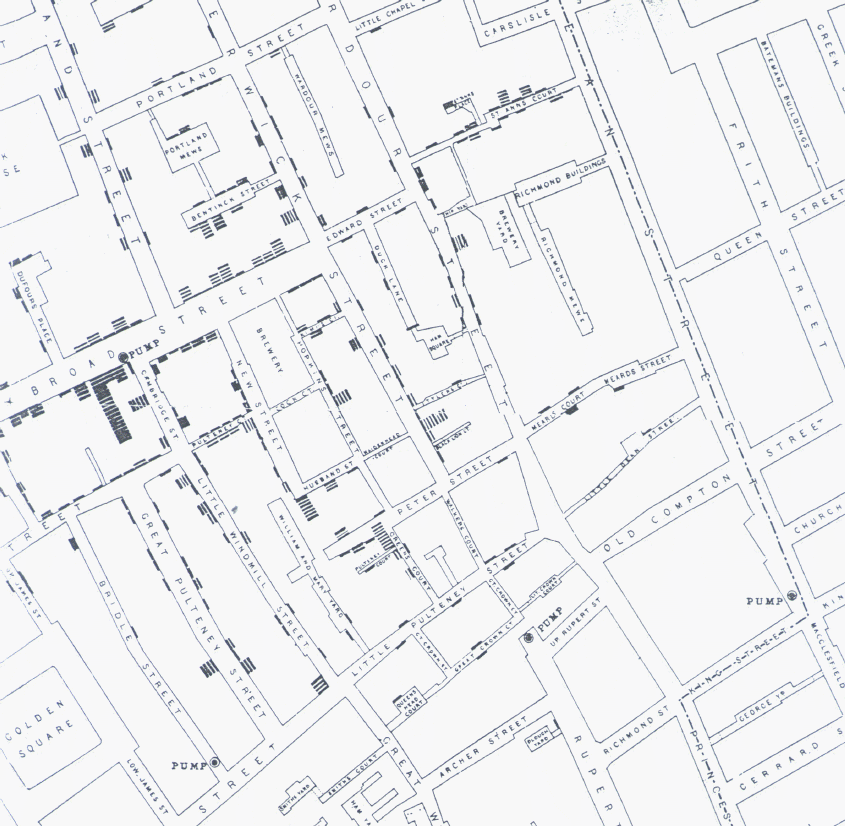
After the panic-stricken officials followed Snow's advice to remove the handle of the Broad Street Pump that supplied the water to this neighborhood, the epidemic was contained. Through mapping the locations of deaths related to Cholera, Snow was able to pinpoint one of the major sources of causation of the disease and support his argument relating to the spread of Cholera.
Snow's classic study offers one of the most convincing arguments of the value of understanding and resolving a social problem through the use of spatial analysis."
John Snow: The London Cholera Epidemic of 1854 By Scott Crosier
Spacial analysis and statistical use of available data might describe and predict the tipping points. See here
Despite sage advice by my betters not to waste my time, I hypothesize that when bulls gets infected with bearitis they no longer trade at the ask, but trade at the bid, and at the tipping point, the market goes down. Using spatial analysis of the spread of bearitis, it should be possible to describe the tipping point.
8/15/2005
Great Causes and Everyday Commerce
Editor, The Washington Post Book World
Reviewing Irresistible Empire (August 14), Andrew Bacevich shares author Victoria de Grazia's scorn for 20th century commerce. Finding the ordinary business of buying and selling to be "hollow and deeply unsatisfactory" - a process that he describes as "selling out and settling for less" - Bacevich longs for "epic grandeur." Why disdain people's workaday efforts to improve their lives? Why crave Great Causes in which people inevitably become means to elites' end du jour - ends, such as communism, that sound fine to ears clogged with romantic gunk but too often are terrible? And who, exactly, in the 20th century "settled for less" where markets were reasonably free, living standards skyrocketed. People of 100 years ago would envy our indoor plumbing, electric lighting, home refrigeration, telephony, automobiles, air travel, multimedia entertainment options, and the many other fruits of commerce that are spread most widely in precisely those places where "epic grandeur" was held in check by the quotidian business of buying and selling.
Sincerely,
Donald J. Boudreaux
Chairman, Department of Economics, George Mason University
8/15/2005
Victor Niederhoffer on
Brokerage Stocks and the Market
An example of positive feedback is the concurrent effect of the stock market and fixed income moves on the performance of brokerage stocks. There's always a big mystery about the trading income of these brokers as if it requires great skill in challenging markets or something but really it's 99% correlated with the bond and stock move in the relevant period. Most of these firms have so much money borrowed long in these markets that when there's a rise, their earnings go through the roof and when there's a fall they face " difficult trading conditions". It's interesting to see how the estimates of brokers profits surprisingly goes up in these periods " when the bankers overseers know they are very busy."
The other aspect of this relation is the one described by Loeb and quantified in EdSpec where during 1929, there was tremendous boom in brokerage houses on yachts and fancy offices right before the crash. This relates to the volume of corporate underwriting made during the period which is up substantially this period as well, a positive feedback relation with past prices. Eventually the supply weighs on the market, a tipping point is reached if you will, and the relation between higher stock prices leading to higher profits is counterbalanced by the negative feedback between stock prices leading to higher underwritings which leads to lower prices. All these relations should be quantified in sapient ways for better understanding of market dynamics, and the deflation of trading profits ballyhoo.
8/15/2005
Market Ecology, by Tim Melvin
As I have had frequent houseguests over the past two weeks, I finally got around to cleaning the joint. The primary activity in this endeavor: clearing the stacks and piles of books around the apartment. During the course of the project I found a copy of EdSpec and put it aside to put back on the bookcase. Naturally it remained on the table for the duration. Last night, after a typical mid Atlantic August weekend of fast boats, loud music, cold beer and hot women, I found myself sitting on the couch, a nightcap in hand, perusing the pages of this classic once again. As always, it triggered many thoughts, especially the section on market ecology.
Many talk of how closely the market follows nature, with predators (hedge funds, large traders) and prey (the public, mutual funds), the inevitable cycle of boom and destruction, those who feed off the destruction (short sellers once a decade and distressed funds), those whose existence depends on their ability to nimbly dance around the large dangerous beasts (sharks and pilot fish, the oxpeckers that flit around rhinos) that remind one of arbitrage traders. Perhaps not perfectly but to a large degree, nature is replicated in the stock market.
So here we are now, in the sweet spot. The grass grows lush upon the plains, the forests verdant and full of life. The grazers are well fed and the herd grows with plenty of food and positive 410k statements. The predators feed with ease picking off the weak (dollar shorts and bond shorts). We've been here before many times. The careful observer and participant knows that at some point, the fire (geopolitical event), the flood (sudden spike in interest rates) or sandstorm (oil prices) could come along and wreak the traditional havoc needed to sustain markets and ecologies alike for the long term. The undergrowth must be burned off lest it choke out the forest, the herd thinned lest they eat themselves into drought. It is the way of nature.
I examined market selloffs and storms over the past 30 years. In every case, there was an event, a warning that allowed one to seek higher ground. The April '87 interest rate spike, the US Air takeover in '89, H#llary's healthcare and the Fed in '93, falling earnings in '00 are a few examples. The browning of the grass portends a fire (slipping earnings), the darkening sky (Fed tightening) a possible storm. In virtually every major selloff, the market was in fact high by traditional measures (price to earnings, price to book, dividend yield etc). However (and this is where a lot of the current "market too high" crowd is off base) they had been that way for sustained period of time. Just reaching overvalued is not enough. Something has to happen to upset the balance. I originally thought prices would tell us, that the first 5% down month in the market preceded further sell offs. As Primal Scream would say: wrong. With the exception of the 2001, the market has been higher six months after a 5% decline in every case since 1980). The grass grows too high, the predators too fat; nature will correct but not until there is fodder for a fire, or sufficient moisture buildup for storm-causing flood. The fact that it's going to happen does not mean we should take all our money out and start starving today. Today, we continue to feast, we watch the skies. We map out the trail to higher ground for a fast exit, we guard our stockpiled reserves. But we feast while we can. We observe the Fed, the supply of IPOs, and may other factors, but we stay long until the storm approaches. The feast most often continues long after the gloomy boys slipped a few dinner rolls in their pockets and left the party.


8/15/2005
India Not Such a Bear After All, by Sushil Kedia
Bear Stearns, in association with a local Indian research brokerage, co-hosted an India conference specifically aimed at hedgefunds in New York in early August. The number of hedgefund attendees is widely held to be around 800. Such an unprecedented interest in Indian stocks comes against this backdrop:
- Nearly 75% of the free float of most large cap and mid cap names is now owned by Foreign Investment Institutions (FIIs), creating an unprecedented scarcity of floating stock, a situation that is a general precondition to a large spike.
- Strong economic growth (GDP rising by 10%) for the third year in a row..
- Corporate Earnings growth continues to gallop, with the average rise in profits in excess of 40%.
- Valuations on a trailing 12 month basis on the key indices continue to remain much lower than all previous bull market tops. While such calculations of average P/E are also suspect, what with the key multibaggers being commodity cyclicals (which typically are to be bought at very high P/E nearing 30-50 and to be sold when the trough nearing 4-6 arrives), they are actually near to their historically low P/Es. That undoubtedly is making the indices appear undervalued.
- The radical drop in long and short term interest rates from 14-18% a few years ago to 7-10% now has produced an unrelenting boom in consumption. Auto sales, construction, consumer durable and non-durables continue to meet an unabated demand curve.
Prices of equities at all time highs have come into an uncharted territory, providing little help from the historical patterns and relationships. In this new dynamic many wonder if a saturated holding distribution, unparalleled liquidity growth and investment interest is going to lead to a super-spike or it could be a recipe for sharp knockouts and drawdowns, with a frenzy likely.
8/15/2005
Shui Mitsuda on the Magic of International Consumer Prices
I have just come back from T###land. Here are some of the prices I came across on my trip:
- One bowl of noodles : 30 baht
- One CD : 150 baht
- Taxi, 15 min ride : 80 baht
- Fried vegetables with meat, three pieces of BBQ freshwater shrimp and one bowl of rice on the street : 150 baht
- Five star hotel teppan yaki dinner : 750 baht
- Five star hotel room : 2,700 baht / night
- 1.5 liter Pepsi : 25 baht
- One room condo in downtown : 3 mil baht to buy, 7000 baht / month to rent
- Luxury bungalow next to a golf course : 8 mil - 25 mil baht
- Karaoke with a hostess's accompaniment : 2,000 baht
- Undergraduate's starting salary : 25,000 baht / month
- Underground short ride fare : 25 baht
The current exchange is approximately BT41 = US$ 1, so in dollars,
- One bowl of noodles : $0.73
- One CD : $3.65
- Taxi, 15 min ride : $2.00
- Fried vegetables with meat, three pieces of BBQ freshwater shrimp and one bowl of rice on the street : $3.65
- Five star hotel teppan yaki dinner : $18
- Five star hotel room : $66 / night
- 1.5 liter Pepsi : $0.61
- One room condo in downtown : $73,000 to buy, $171 / month to rent
- Luxury bungalow next to a golf course : $195,000 - $609,000
- Karaoke with a hostess's accompaniment : $49
- Undergraduate's starting salary : $608 / month
- Underground short ride fare : $0.49
The consumer prices are quite attractive, aren't they? But this is not why I chose the word magic. I just listed all the prices in baht. Let me just divide them by 10, and put "$" in front. Do you see the magic?
- One bowl of noodles : $3
- One CD : $15
- Taxi, 15 min ride : $8
- Fried vegetables with meat, three pieces of BBQ freshwater shrimp and one bowl of rice on the street : $15
- Five star hotel teppan yaki dinner : $75
- Five star hotel room : $270
- 1.5 liter Pepsi : $2.50
- One room condo in downtown : $300,000 to buy, $700 / month to rent
- Luxury bungalow next to a golf course : $800,000 mil - $2.5 mil
- Karaoke with a hostess's accompaniment : $200
- Undergraduate's starting salary : $2,500
- Underground short ride fare : $2.50
Aren't these prices more or less what you'd pay in the US? My fellow Singaporeans can substitute "S$" for "$" and they represent our prices. For Japan, instead of dividing the baht by 10, multiply by 10 and then put "¥".
So what do these magic numbers tell us?
- In any country, people spend more or less proportionately to their income, and we all use similar numbers for the same products.
- For a majority of people, it's impossible to as earn a lot and spend a little. That's how a healthy society functions.
- Forex is mostly emotional rather than logical. It works to the advantage of countries with monetary power. The current exchange rate tells me I am supposed to be five times more productive than a T###, with which I definitely disagree.
- Astute consumers will take advantage of this imperfect world, by earning money in countries where the currency is strong and spending it in countries where it's weak.
I have traveled to over 40 countries, and this magic observation is true in all of them except Britain, maybe due to Britain's high income tax and good social security system. Anyway, the British always maintain their own traditions.
8/14/2005
The Scarcest Input: Human Capital, by
George Zachar
CALGARY -- The jobless rate in Alberta, the biggest oil-producing province, is so low that doughnut shops are offering iPods and university scholarships to attract workers.
The weekend edition of Calgary Herald had 10 pages of help-wanted ads, two more than The Toronto Star, which has five times the circulation. Calgary's unemployment rate was 3.2 per cent in July, less than half Toronto's, and below Houston's 5.6 per cent.
8/14/2005
Victor Korchnoi on profit taking, sent in by Nigel Davies
Victor Korchnoi is always full of insights. On the second DVD of his collected games he opines that flaws in character (as opposed to flaws in technique) are the hardest to correct. And he revealed that one of his own was to try and convert an advantage too quickly.
Nigel
8/13/2005
A Pretty Potential Indicator, by Victor Niederhoffer
Consider data on daily high and lows only. For example, in S&P:
                  date    hi      lo
                  7 22    1238.0  1228.5
                  7 21    1238.8  1227.2
                  7 20    1239.8  1225.6
                  7 19    1233.8  1227.7
                  7 18    1229.2  1224.0

                  7 15    1233.2  1226.7
                  7 14    1237.2  1228.0
                  7 13    1228.3  1223,0
                  7 12    1229.5  1220.0
                  7 11    1224.8  1216.7
Let's focus on the last week starting 7/18. Neither high nor low was a five-day extreme (i.e., more extreme than the previous four days).
7/19: Neither.
7/20: The high of 1239.8 was a five-day high.
7/21: Neither.
7/22 Neither.
I hypothesize that the cumulative number of new highs in a day compared to the number of new lows, and the durations between such numbers, is predictive of future expecations and variabilities.
Someone's going to say that this is just like what someone else has always done. But I believe by counting, hand studies, and a bit of creativity, a meal for a lifetime is there.
8/11/2005
Taking Out the Cane at Spec Party

Vic's granddaughter Magnolia practices taking out the cane at the age of 1 for the sake of overplus and posterity at the concluding session of last weekend's Spec Party festivities. (Photo by Ming Vandenberg)
8/11/2005
Accounting Risk, by
Jim Sogi
In addition to other exogenous risks to the market, companies and investors face accounting risks. Accounting risks include not only the specter of internal accounting fraud but of tax law legislative changes and changes to accounting rules under FASB which can materially affect the real after tax cash flows more than inflationary factors. EBITDA is nonsense. Real after tax returns are the ultimate gauge.
WorldCom and Enron are examples of internal accounting risk and fraud to the tune of billions of dollars. Analysts' and regulators' failure to uncover fraud on such a massive scale fraud shows their superfluity. Enron's downfall was described in Prof. Miller's book What Went Wrong at Enron. Super smart guys sometimes miss the big picture or suffer from hubris. The risk extends beyond fraud, to arbitrary rule changes. A good friend educated me on the effects of overseas profit repatriation breaks and accelerated depreciation, and how these might affect market prices.
The sword cuts two ways. In a stroke the tax change increased real returns from dividend paying companies and, under a Fed type model, increase the value of stocks and presumably their future real after tax rate of return in comparison to other assets,. Yet this does not seem to be reflected (yet?) in market prices, nor has it been factored into the Fed model analysis.
Gains on futures receive favorable tax treatment and favorable tax accounting preference over ETFs, yet that several hundreds of basis point advantage in real after tax is a real advantage in taxable accounts in the analysis of returns on market operations.
Sec. 302: Dividends of individuals taxed at capital gain rates. Under the Act, dividends received by an individual shareholder from domestic and qualified foreign corporations generally are taxed at the same rates that apply to capital gains. This treatment applies for purposes of both the regular tax and the alternative minimum tax. Thus, under the provision, dividends are taxed at rates of 5% (zero, in 2008) and 15%. The provision applies to dividends received in taxable years beginning after 2002 and before 2009.
To qualify for the capital gains rates, the shareholder must own the stock for more than 60 days during the 120-day period beginning 60 days before the ex-dividend date. Also, the capital gain rates are not available for dividends to the extent that the taxpayer is obligated to make related payments with respect to positions in substantially similar or related property. Other anti-abuse rules apply.
Two links for IRS dividend information are listed here and here.
Under this theory, dividend paying stock prices, and the market in general, should rise faster than normal as a result of tax law through 2008, all else being equal.
The legislature in Hawaii raised the sales tax 1/2%, in effect lowering the entire value of the state by the cap rate times the decrease in output being nationalized by the socialists. These are the same people that legislated a cap on gas prices using a formula that will result in higher gas prices due to a faulty formula to compute the cap. This does not understand that it will lead to the oil companies' pulling out of Hawaii and not refining or retailing gas, creating an artificial shortage. So even as prices are cheap, huge gas lines will build up, just as at the food stores in the Soviet Union. I should buy all of them a copy of Paul Heyne's The Economic Way of Thinking.
Accounting is not a rigorous science, nor does it appear to have the kind of testing of our laws and common law, and it is more subject to arbitrary change and mischief wherein lays the risk.
Yishen Kuik adds:
Accounting standards are a valient attempt to standardize the rules we use to keep score for a business.
Leaving aside outright fraud for a moment, the rules for keeping score have great difficulty dealing with genuine subtle issues that don't lend themselves well to rule based systems : examples might be revenue recognition issues, when does a transaction become a loan? and how should recognition of revenue and balance sheet be split among interested parties?
This often leads to decisions being made that have positive accounting but negative economics. Companies that move things off balance sheet usually face fees and a higher funding rate. Companies that want to raise capital that doesn't show up in the capital structure also tend to face fees and a higher embedded funding rate. Opacity has its cost.
Companies that are very focused on quarter end results inevitably risk having salespeople give concessions to customers, usually with hidden and delayed consequences. A high performance sales culture has a tendency to make the salesmen weak and the buyers strong at the negotiation table. Just like how unscrupulous traders mark up their books at quarter end by placing strategic trades, salesmen mark up their books by agreeing to strategic concessions. These borrowings from the future will have to be reversed in time. And so impatience also has its cost.
In addition, the quality of information coming out of the business deteriorates, hurting the ability of management and investors to make decisions about the company and asset allocation in the economy respectively.
Just as how no amount of fancy position sizing or money management can turn around a strategy that just plain doesn't work, no amount of meetings with structured finance types and accounting whizzes can add to the economics of a company (although there are exceptions)
8/11/2005
Another Use for a Cane, Excerpted from A
Hell of a Woman by
Jim Thompson,
1954
I punched the bell again. I held my finger on it, listening to its dimly shrill clatter inside the house. I pulled the screen open and began pounding on the door. You did things like that when you worked for Pay-E-Zee Stores. You got used to people who hid when they saw you coming.
The door flew open while I was still beating on it. I took one look at this dame and moved back fast. It wasn't the young one, the haunted-looking babe I'd seen peering through the curtains. This was an old biddy with a beak like a hawk and close-set, mean little eyes. She was about seventy -- I don't know how anyone could get that ugly in less than seventy years -- but she looked plenty hale and hearty. She was carrying a heavy cane, and I got the impression that she was all ready to use it. On me.
"Sorry to disturb you," I said, quickly. "I'm Mr. Dillon, Pay-E-Zee Stores. I wonder if --"
"Go 'way," she snarled. "Get out of here! We don't buy from peddlers." "You don't understand," I said. "Of course, we would like to open an account for you, but what I really stopped by for was some information. I understand you had a Pete Hendrickson working here for you. Did some yard work and so on. I wonder if you could tell me where I can find him."
She hesitated, squinting at me craftily. "He owes you some money, huh?" she said. "You want to find him an' make him pay."
"Not at all," I lied. "It's the other way around, in fact. We accidentally collected too much from him, and we want to --"
"I bet you do!" She let out an ugly cackle. "I just bet you collected too much from that drunken, lazy bum! No one ever got nothing from Pete Hendrickson but a lot of sass and excuses."
I grinned and shrugged. Usually, you had to do it the other way, because it's damned seldom that even a man's worst enemies will tip him off to a bill collector. But once in a while you find someone real low down, someone who just naturally likes to see a guy get it in the neck. And that's the way it was with this old witch.
"Mean and lazy," she said. "Wouldn't do nothing and wanted two prices for doing it. Sneaks off an' gets hisself another job when he's supposed to be working for me. I told him he'd be sorry..." She gave me Pete's address, also the name of his employer.
8/11/2005
Examination, by Sushil Kedia
Examination of average news reporting in financial media would on any average day bring up story lines like, "stocks stage a late rally despite high oil prices" etc. etc.
Now if analysts, traders, dealers & just about nearly every other role in the markets have to clear through a battery of examinations administered by market regulators why is it that the shenanigans of the pink press escape such testing?
How come when research analysts (a bunch of journalists / reporters really) have been pinpointed in the recent past at drumming up prices in the markets, their more general brethren from the commercial publications have been spared.
May be until the market community shrieks in unison at such newspapers and rants for coverage of the commercial columnists to have a minimum criterion of passing some suitable examinations mass brain-washing would continue and that too with hogwashed waters.
Additionally, it may someday be made mandatory that each of the writers in the commercial press has to go through continued professional education.
8/11/2005
Oxygen Addiction, by Jeremy Lyter
Casinos and markets use a myriad of tricks to keep participants off-guard. It's even been rumored that certain casinos introduce extra oxygen into the atmosphere to keep players in a constant state of euphoria. The effects of this high can be experienced shortly after leaving a casino. Ever wonder why after 10-15 minutes you start feeling so tired? Traders often experience a rush or high after a successful trade due to an increased flow of oxygen to the brain.
Could we all be addicted to oxygen?
8/11/2005
A Word From the President of the Old Speculators Association
I report this only because so many on the List have sworn off CNBC and its corrosive influences (this despite the fact it happens to be the most formidable bull habitat in North America). This morning CNBC gave about 5 minutes to a gold bull! The manager of the Midas Fund was able to spout off for roughly that length of time without the usual gold-bear or carping Marie offering a counterpoint. I don't know if this of any forecasting significance but its occurrence is highly unusual. As to the orgy of bearishness that continues to be discussed, I ask again, where is it taking place? Were I asked to provide an orgy of bullishness I would point to the many world bourses that are at or near their highs, world-wide bonds remain high, commodities continue to flirt with record levels, many stock sectors (even those that are traditionally non-correlated) are showing any strength, the demand for ABS remains very strong, and cash in mutual funds stands around a very low 4% (last seen around early 2000). The most interesting article I've read recently speaks of the difficulty asset allocators are having in diversifying; with most everything high, and much at all time highs, non-correlated diversification remains difficult if not impossible to achieve. I'd be interested in discovering the credible sources of the bearishness (the usual permabear suspects have been long discounted by the List). My interest is sincere since I, too, am bullish and this has been, traditionally, a very negative indicator.
8/11/2005
As usual, 'Letters to the Editor' have been amongst the most valuable contributions to the site in the recent months.
In order to augment this, to enhance reader feedback and encourage the muse of good thinking about
the markets, we are instituting a prize of $1000 each month for the best
contribution from a reader to 'Letters to the Editor'. The final decision will be
made at the end of each month, starting August, by the Chair and the Collab.
8/11/2005
Maureen O'Hara, from her book Market
Microstructure Theory
Market microstructure is the study of the process and outcomes of exchanging assets under explicit trading rules.
The research examines the structure provided by specific mechanisms to model how price-setting rules; evolve in markets. This provides the ability to characterize not only how different trading protocols affect price formation, but also why prices exhibit particular time series properties.
Traditional economics looks at the macro economic intersection of supply and demand and the analysis of equilibrium, but ignores the trading mechanism.
The London Spot gold fixing mechanism in 1993 provides a striking example of a market mechanism. AT 10:30 am five London bullion houses meet at N.M. Rothschild's to determine the spot price for gold. The chairman suggests a price. The representatives indicate whether they would be net sellers or buyers at that price. The process continues until buying and selling are equal. The representatives indicate their approval by lowering a small British flag on his desk.
The NYSE exhibits another anachronistic and bizarre set of trading rules where the specialist take a position in the asset.
In Tokyo, there are no specialists, only saitori or order clerks who raise or lower prices until there are balanced orders, but takes no position.
Microstructure theory yields theories for empirical research using the detailed record now becoming available since the publication of the book in 1994.
Jim Sogi comments:
In the NYMEX pits, the brokers phone booth is about three feet from the top edge of the pit where the big boys stand. A order comes in by phone and a paper ticket is hand written, passed to the floor trader who then shouts and waves the order till filled, marks it down in his paper pad, copies to the order clerks at the bottom of the pit, copies to his desk about three feet away. Location is critical. Locals like to stand a shoulder below on the next pit level down from the big boys, to hear, see and deal with the "order flow". Physical set up and location is paramount. Its good to know not only where you stand with your broker, but where your broker stands.
On Globex, the price has a very mechanical and machine like way of ratcheting down one tick at a time in very regular range spread bars, presumably the side effect of a computer algorithm and algorithm traders and market makers gaming the execution platform. This type of information is good for an astute trader to know when slipping in between the giant cogs of the monolith.
Effective execution requires an understanding of the processes to set price and to change price in the exchange where you operate. Data and a display that reveals the data in a clear tuftian manner without distorting assumptions and without distracting screen rubbish are essential to see the mechanisms at work. Common bars do not reveal needed information about the microstructure nor do bars or lines clearly display the relationships of price and price movement adding unneeded uncertainty to an already precarious endeavor.
George Zachar adds:
I agree that a solid understanding of the microstructure and mechanics of a market is essential to successful trading.
I would caution, however, against over-thinking all this.
Scalpers who live and die by each tick must be intimate in all respects with this material. But folks playing for longer time horizons/profit targets sometimes become so wrapped up in the parry-and-thrust of the process, they can lose sight of the different issues that are relevant to the time scale in which they operate.
The notion of "penny wise, pound foolish" works in budgeting time and energy, as well as capital.
8/11/2005
The DailySpec Department of Education Receives Its
First Contribution: A Report From the Option Trenches, by Phillip J. McDonnell
Could the term overvalued be more subjective than objective?
Sometimes there is subjective judgment required to value options. This is especially true if there is some known event coming up which has not occurred in the past and thus won't show up in historical volatility.
For the most part such events are somewhat rare. Usually the historical vol is a pretty good estimate of future volatility. This fact is a cornerstone of why the Black Scholes model is so successful. The beauty of the model is that an option can be reasonably valued by both buyer and seller without either having an opinion on whether the underlying asset is going up or down. The main factor in valuation is the volatility which can be objectively and reliably estimated from historical data available to all.
The formula for volatility is essentially just the usual standard deviation formula from basic statistics with a natural log term thrown in to make it work for a log normal distribution.
v = sqrt(  sum( x(i) - xAvg) ^2 )  /  (n-1)

where:

v    -  volatility
x(i) -  ln( p(i)/p(i-1) ) read as natural log of today's
         price divided by yesterday's
xAvg -  Average of the x's over n days
n    -  number of days
Multiply by the square root of the number of trading days in a year to get the annualized volatility. In this case multiply by sqrt(252) =~ 15.87 to get the result. This gives you the annualized continuously compounded standard deviation of return. It is also variously called the historical vol, the actual vol, or the realized vol.
Implied volatility is that volatility which the market must have assumed to get the current option price. Suppose the historical vol is 20%. We plug in 20% to the Black Scholes formula and get an option price of 2. However the market is pricing the option at 2.50. Assuming the market is always right we can reverse the Black Scholes formula using Newton's recursion to find that the market consensus must be using a volatility estimate of 24%.
If there are 20 different options on a stock or futures contract then there are 20 different estimates of implied volatility. They rarely agree. Complicating the disagreement issue is the fact that there is usually a systematic skew. For example out of the money calls might have implieds of 20%, at the money might be 24% and in the money might go up to 27%. When people talk about the market vol it usually means a weighted average using a formula available from CBOE.
I use implied vols together with historical on a relative basis. I also look at the skew. Taken together they tell me whether a particular option is out of line or not.8/11/2005
James Lackey on Motocross and the Markets
There is nothing more difficult to judge then a train coming at you at 65mph while you are running 60 on a dirtbike in between the rails. I was well aware of the Amtrak schedule on the South Shore lines from Chicago. I rode my motocross bike, very slow and quiet through the local park, to the baseball fields, then onto the railroad tracks. I rode the RR-tracks to the huge water retention berms we turned into a motocross track.
Once the bike is in between the rails, on the fast track built for Amtrak, I could do the 6th gear 60mph boogie to the motocross practice track about 5 miles from my house. The ties and the stone were laid perfect so you just rode on the ties in between the rails and you could literally ride as fast as you wanted.
The problem with big trains is you cant tell how fast they are coming at you. The problem with riding on the rails is you had to come to a complete stop, put the front wheel of the dirt bike against one of the steel rails, then hit the throttle and it will shoot you strait off the tracks. Then you could ride over as many sets of tracks, even jump the tracks.
One day after school I was riding to practice. All the warning-lights were a go and I was in full throttle mode. Out of nowhere a pick up truck, train employees, come flying towards me. I have had trains come from behind me, but never head on.
My perception of the pick up truck doing 60mph towards me was not my problem. Stopping was, they laid new rock and some was over the perfectly laid ties. I almost went down, pulling the front brake, they lock up the wheel turns and as usual I let off the brakes and back on several times.
You see, it was a panic. I didn't want to scare the railroad workers. They knew where my practice-track was. The cops knew to wait in my driveway after 6:30 CST time, when my dad returned from the mill. I never expected a truck on the tracks.
I had no fear of being injured. I had no fear of the railroad cops, the local boys, just my dad. My dad knew how I rode to practice everyday. He didn't like it one bit. I risked getting busted riding in the park, riding on the rails or worse getting smoked by Amtrak. Of course, his worst fear was me practicing alone, laying on the track hurt.
My worst fear was not winning. The happy ending here was the train men were motocross fans. The waved to me as they passed. They saw me bail off the rails, then sit on the side. I took my helmet off to talk my way out of this one. They just passed on by and waved. Later, I saw them sitting in their truck on the rails watching me jump.
Last year, I was riding the rails here in Fort Myers. There is only one freight train a day. They have an old locomotive and a few cars where they run a "murder mystery dinner train." I rode up to the yard, to check the operation out. Some mechanic came out screaming. I stopped took of my helmet as he screamed "you can't ever ride here." I said cool, sorry, wow, hey bitchin' train, what year is the engine? A little fuse blew in his head, his face turned red and said "you'd better get out of here before I call the cops, and you go that way" as he pointed to a paved road.
Obviously not a motocross fan, he had no idea the rooster tail of rocks, mud, and dirt knobby rear tire can throw, 30 feet into the air from a dirt bike. You don't want to stand behind a motocross bike at the starting line. Lucky for him I am not a kid anymore.
There are so many things that we do not know. That poor mechanic could have, should have, been roosted on with mud for talking to me like that. Secondly, the seemingly safer route, rusty rails, that show no train traffic is the absolute worst routes to take on a dirt bike. The railroad ties are rotten, there in not enough smooth gravel in between the ties to ride over 3rd gear. Even with a kidney belt and standing, your gizzards are bruised and it hurts for days. However there is no risk of being killed by a train on rusty rails.
They say, "you cant out run a radio" well on a dirt bike, woods and railroad tracks you can't get caught unless you panic, crash, or run out of gas. The irony is the most dangerous route is the best. To stop and talk to the cops or railroad men is often best. They are so appreciative that you don't run. They know they can't catch you. If you are polite they let me go every time.
There are few lessons for trading here. Never panic, take it easy when being chased, have ample fuel (reserves) talk nice, do not try to judge speed or distance of a freight train (don't play chicken with big market moves) Never forget the little things, like the distance between the railroad ties, tracks, the woods and the trails. How much underbrush has grown since last trailride?
Don't upset the local cops they know where you live (don't upset regulators) Have a backup plan: I had a truck and trailer to take to the practice track or any race track. Always look for "law of least effort": it took and hour to load, drive unload and ride my gear and bike for practice, but it took me only 10 minutes by bike and rail.
Once "they" all see you training, riding everyday, rain or shine working hard, "they" allow you to get away with things that the other guys don't. However to this day, "talking nice to the market" has never helped me a bit. last note, I have never been hurt, that is broke a bone in an actual race. I have always been injured, goofing off or in practice. Always keep focus as though a freight train is coming strait at you.
Please realize an important factor is not upsetting your backer when you are not a pro. In my case as a racer, not having the police waiting for my father. All the practice in the world will not get you your new bike, fuel, entry fees and a ride to the races. The force times distance to what would push my dad over the edge was always a consideration.
That preconception of distance is a changing cycle between fathers and their children. I never realized it until today. My boy is practicing football every day for 2 hours in the 95 degree heat.
8/10/2005
The Queen's Curse, by
Bo Keely
How hot is it today?
The slanting rays of sunrise amuse. In early morning, I open the refrigerator and a three-foot rosy boa crawls in to wait on the milk shelf for the door. By noon, chipmunks, lizards, ants and bees compete at the gallon waterer. Sting me, I threaten the bees, and I'll kick the queen's butt!
It's not hot for August 1 in Sand Valley, California - about 110 F. I shoulder a pack and a bee stings me on the penis and flies off. I get tweezers with an attached magnifying glass, find it, pull the stinger and forget the incident. You think you come here to the end of the world to find that's how simple life can be.
Sand Valley is a desert basin like a round sandbox, crosscut by 10-yard wide dry washes and ringed by 600-foot mountains. Cumulonimbus clouds occasionally butt these and dissipate in the hot target uplift. The skies are not cloudy all day. Rainwater may flow into the Valley, but rarely does a drop hit the five-mile radius.
In late afternoon, I step from my trailer to hike the largest wash that's a sandwalk edged by ironwood, palo verde and smoketrees. It narrows in the mountains to a stubby canyon where thousands of cicadae buzz. Bees hive up in small caves in the sidewalls. A tailwind spins me and I peer at angry clouds rolling west, an anomaly. Soon the wind almost pushes my face in the wash. Sand pelts the skin like a shotgun and thunder sounds.
In minutes, my world is lightning and water. I veer up a feeder canyon for safety, and thirty minutes later lost halt at a budding trickle. Thousands of creases in these hills join into hundreds of tiny dry creeks that fasten into a few major washes into the Valley. The pool in front of my boots becomes a revelation: The answer to how flashfloods start! Yesterday it rained short but hard to saturate the ground. Today the water waits under a baked surface. As rain strikes the shell, it cracks open before my eyes and water oozes to meet the forming trickles. Today's rain siphons yesterday's reservoir.
I quiver in the freezing shower and dip into pools where the defiant, hot ground heats the water to bathtub temperature.
At sunset an hour later, the downpour abates but lightning flashes my way. A bolt hits just behind me. Lost, I take the jungle wisdom of following small creeks to larger ones to civilization. The basic course is downhill. Brimming washes block the path every few minutes. Some I wade and others run too deep or fast.
Out four hours, I drop my shorts to examine the member. It's swollen triple-size distal to the sting. Like the Nutty Professor. I place a compression bandage of duct tape tight around it. In a flash, I recognize a peak and take a bearing home. Water flows madly in the honeycomb hills.
Yet the sky is clear and stars emerge. The trailer sits a mile off on the shore of the widest wash in the Valley. I wade through a premature one and discover it's not like fording a river. The cut is ten-yards wide, two-feet deep and swift as an Olympic sprinter at 18 mph. I point my toes upriver to watch for a water surge or floating limbs and start to cross sidestepping. Unforeseen, the current undermines each boot on the bottom a half-inch per second. I slowly sink in the center while submerged limbs entwine my legs so I can't lift them. Suddenly the tide spins and nearly knocks me downstream where, miles and years ago, a car in the same general wash was swept and the driver drowned.
I scramble up the far bank and, a quick learner from that starter, hang the pack in a tree. The trailer is silhouetted a quarter-mile away, yet before it lie three major washes. The first is the size of the last and is easily crossed without the ballast by pointing the heels upstream and stepping quickly. The second is wider, deeper and the push almost takes me. Exhausted, I sit at the edge of what's ahead, the last and largest torrent. And wait.
The moon rises in a star dusted sky with the chief wash at my toes as a measuring stick. I pull twine from my pocket for a sling to elevate the member and throw it over my shoulder like a continental soldier. Damn the Queen! After thirty minutes, the water ebbs from the toes but is risky. I will discover from the locals that a funnel cloud kissed the Valley, roofs blew off the three dwellings, and the washes ran the highest.
In an hour, the river is safe and I cross to home.
The next day dawns cool in Sand Valley. The washes dry, the member shrinks, and the Queen's rage assuredly likewise.
8/10/2005
Coincidental Reading, from
Tim Melvin
Whilst in NYC at this year's Spec Party, I had a chance to take a long walk and talk along the pier with Rudy Hauser and ask his opinion of the current economic situation and outlook. An opinion I have learned to pay close attention to over the past several years. In addition to being a truly great guy, Rudy is a learned and knowledgeable student of economics. At the end of our stroll as we prepared to board the boat, I asked him what, if anything ,scared him about the current world situation. He admitted his one fear is a worldwide outbreak of avian flu that would cripple world healthcare systems and economies.
Upon arriving home from the Spec Party, with a short stop to introduce Fred Crossman to the wonder that is the Red Eye's Dock Bar Sunday bikini contest, I found on top of the reading pile from June's plunder of Ocean City's used book stores a book written in 1977 dealing with the fallout of a worldwide outbreak of a new influenza strain for which there is no vaccine. "The Mustard Seed" by Charles and Charles Mottley, a father and son duo, goes too far at some points, as disaster novels tend to, but takes a good look at the possible scenarios and the rush to develop a vaccine. Good characters and decent subplots add to its readability. Written almost 30 years ago, so the technology is outdated, but it is still timely.
8/10/2005
Victor Niederhoffer: Briefly Speaking
- The DAX is at a four-year high at 4971, approaching the magic number of 5000, during a seasonal period where since 1994 there has not been a good summer rally since 1994. At this time the cumulative gain during the two months was about 5%. The average move since summer 1996 during these summer months is about -4% and the current change since June's month end is 2.5%.
- A learned gentleman informs me that that he has read the paper Momentum Investing and the 52 week high by George and Huang and that he may update it with a current enumeration. The key variable the authors find indicative of superior returns is the proximity of the current price to the six month high. They show that portfolios based on this variable are slightly better than the standard banal momentum results found in the literature. The paper uses CRSP data from 1970-2001 and it certainly provides an opportunity... on the other side.
- Regarding the idea that there is such a thing as a bull and bear market on a prospective basis: As indicated in our tests of the depiction of market cycles formulated by my tennis partner Mr. L. B., there is no evidence that it is possible to come up with a retrospective depiction of turning points that is inconsistent with randomness. Thus, ideas regarding sluggishness, selectivity, increasing highs and lows must be taken as untested and unproven. Like so many good things, it is impossible to select the wheat from the chaff.
8/10/2005
Gaps, by Jim Sogi:
S&P mini morning gaps this week:
8/ 4  -4.75
8/ 5  -3.00
8/ 8  +2.25
8/ 9  +3.00
8/10  +3.75
The discontinuity is one of the weak points of many mathematical market models assuming a continuous process. The gaps are a good percentage of the open to close move. Definitely worth study. Given the worldwide markets, the electronic markets, what is the purpose of market breaks?
Markets by their very definition are completely discontinuous. The basic auction process of bid and ask requires a jump from one side to the other to make a deal. There is no split the difference, meet in the middle. It's either bid or ask. There are no real economic reasons for the size of the spread, other than artificial internal market rules for stoppages that mandate spread sizes. The purpose of the exchange is to narrow spreads to attract customers, but not so narrow as to squash profits. The market makers need to gap price to maintain liquidity and not run out of either cash or inventory of stock to maintain a bid an offer at reasonable spread and maintain volume. Gaps are their way to let off steam and adjust the market price for maximum action and profit. This is another example of how price is not necessarily a metric of value, but rather 'a metric of liquidity or risk adjustment and allocation.
Hong Kong, Tokyo and Osaka markets close for lunch break. What a joke. Even more opportunity for mischief, with no real purpose, but to shake more shekels loose from the customers.
Vinh Tu responds:
In Trading and Exchanges, Larry Harris says the safe thing for market makers to do is raise prices when they need inventory, and lower prices when they need cash. Otherwise they risk being gamed by better informed traders. This is the opposite of the model I had just proposed. Both models therefore need be tested. Which brings us to an ecological hypothesis: I'll posit three market-making strategies, which I'll dub "rational", "perverse" and "counter-perverse".
- ("rational" model) lf the market makers are trading against a perfectly rational population, of the sort described in textbooks, then the market makers gap only to the extent needed to balance supply and demand, which in turn take into account all the available information. The market makers may set the price slightly higher if they need to replenish inventory, or slightly lower if they need to unload.
- ("perverse" model) If the market makers are trading against a naive population that trades at the price given them (lambs being believers in efficient markets), prone to using stops, and being spooked, etc., then the market makers can gap in the direction of their desired price. In other words, move price up when you want to sell, and move price down when you want to buy, in contradiction to the normal laws of supply and demand. In this situation, the market makers fleece the lambs... until some wolves eventually appear and start fading the gaps.
- (the "counter-perverse" model) If the market makers are trading against a large population that deliberately fades the gaps, the market makers can occasionally reverse the strategy in 2. By moving prices in the same direction as in 1, but perhaps gapping further than necessary, to draw out the wolves, and then skin them.
I.e., once again we find the phenomenon of ever-changing cycles. Being a wolf all the time you get skinned. But if you wait till the farmer is busy shearing his sheep, then you might get a meal. Unless the other wolves get there first. Then you had better run because the farmer's out to get you. And so forth.
Unfortunately, the more complex the model, the harder it is to concoct an adequate test.
Thus, we have two explanatory theories for why gaps happen. If we take Mr. Sogi's model (which, if I understand correctly, is that market makers cause a down gap if they run out of inventory and need to buy low or, conversely, gap up if they need cash and want to sell high), then we would expect gaps to close more often than by randomness. Hence the popular technician's counsel to fade the gaps. On the other hand, Mr. Kuik points out an alternative explanation, i.e. that gaps are due to information being generated exogenously while the market is closed. I'll call the theories the microstructure explanation versus the exogenous explanation.
For a given gap, if the exogenous explanation predominates, one would expect that correlated price movements would have occurred overnight in other time zones. Conversely, a market-maker induced gap would be uncorrelated to overnight moves. And so,
Hypothesis: gaps preceded by big moves in similar overseas instruments will close less often than gaps not preceded by such overseas instruments.
Test #1: From Nasdaq gaps following similar move in Japanese techs, count probability of gap closing. From Nasdaq gaps following an opposite move in Japanese techs, count probability of gap closing. Is the latter statistic significantly higher than the former, as predicted by the above line of reasoning?
Test #2: Do same for a market with known egregious market makers. Is the apparent opportunity, if any, larger where an oppressive vig prevents one seizing it?
P.S. Speaking of Lobagola, I was looking for a picture of him on the web, and could not find any. So if anyone has an image or illustration of Lobagola, I would be curious to see it. In my mind's eye, I imagine him astride a stampeding elephant, surrounded by chattering monkeys. Bulls and bears scatter before the herd's approach and lick their wounds as the dust settles. I am willing to be disillusioned by a much more prosaic picture.
Phillip J. McDonnell adds:
Much of M.F.M. Osborne's book, A Physicist looks at the Stock Market, is about market making, especially from the NYSE specialist's stand point. The key point that Osborne makes is that market makers do not care where the market goes. What market makers really seek to do is to remain flat.
If a market is trending up then the market maker is presumably going short at increasing prices as he is "forced" to sell at his ask price. If the market subsequently does a Lobagola the market maker will be forced to buy at ever lower prices as he covers his shorts on the bid. Assuming an equal number of buys on the way up and sells on the way down the specialist will automatically profit by the amount of his spread times the number of round trip orders.
For a market maker his ability to profit is largely determined by his capital and the spread. His capital translates into how much inventory he can carry before he gets in trouble. So his only real goal is to get his inventory flat at the end of the day. Profit will take care of itself. He just needs to keep from going broke.
When a new day starts there is rarely an equal balance between buy and sell orders. So the market maker is required by exchange rules to make up the difference. As long as he can justify a gap based on the imbalance to an exchange official he is relatively free to pick his own price - the price at which he is willing to equalize the imbalance. He is also constrained by any limit orders on his book. If he gaps the price too far he may possibly bring in more competing limit orders.
Quite often the gaps go too far simply because the market maker has extended his position too far and wants to help insure a reversal movement. Learning to read what gaps mean in terms of whether the market maker is long or short can be a very profitable exercise. Remember that the 1962 SEC study of NYSE specialists showed that they made over 100% per year on their capital. So the question becomes do you want to trade with the market maker or with the excitable public who caused the order imbalance?
8/10/2005
Notes from Abroad, by Shui Mitsuda:
While it is wrong to set exit points by percentage grain, and right to set stop losses by percent loss, I observe that stocks that are seemingly played by big players have typically shown 15% gains per trade two or three times a year within the same stock. I looked back at my past 11 years' trading record and sure enough I find that I was producing a consistently good trading average, 15% gain per trade, when I was a humble beginner, an amateur, cautious and scared. Then things started go wrong when I tasted a few 150% gainers. The magical number, 15%, became not attractive at all.
I forgot that if I make two successful trades of 15% gain per year I can make my living already. Eventually I became a ambitious fisherman searching for a big tuna only. No thank you, small cod or mackerel! But how many times one can catch such big fish? I was out there at sea, wasted five years without a catch. Worse, I caught bloody garbage, kept on pulling the thread, believing I finally got it, patience paid off, then looking at the catch! Now once again I am out at sea as a fisherman, back to the very humble beginning, knowing that I am not a fantastic fisherman but I will make sure I catch mackerel. Actually mackerel tastes better than tuna, and a 15% gain per year is better than a 150% gain once in 200 years.
8/10/2005
Subway Turnaround, by
James Sogi
Have you ever come out of the subway completely turned around? Last weekend in NYC I came out of the #6 line going uptown at 59th St completely turned around. The internal rudder told me that uptown was downtown and vice verse. Even after seeing the street signs, it took a few minutes for the internal rudder/compass to turn around. Weird sensation. Most people have an internal rudder that tells them generally which way is north and south, east and west. It must be a holdover from caveman days. Having spent the last few weeks on a boat and an island got me used to the natural cues, the sun, wind and stars. But going into the subway and winding down and up the stairs really spun me around.
Chair talks about having a rudder in the markets. Have you ever been turned around in the market; bearish when the market is bullish? That's where the scientific method comes in. It acts as the signs, or the sun, wind and stars to navigate the market. Without a good rudder and compass, you'll end up on the rocks. Airplane pilots on instrument rating experience the vertigo of flying in a cloud, but have to orient to the instruments to get their bearing. Navigators in a featureless ocean need a compass, a star, the moon or sun to guide them. Speculators lost in the market need a rudder, a good compass to guide them.
Ken Smith adds:
There is a sixth sense that will guide one in a fog. It is not so common but exists in a few ocean navigators.
On land if you are in the dark and turned around you can know where you are if there is a pig farm in the area, and the prevailing wind is blowing.
There are animals on Wall Street. Bulls and bears. And pigs. If one can determine who the pigs are, and has been around long enough to know which from direction the prevailing wind blows, then in the midst of chaos it is still possible to know where you are.
8/10/2005
The Economics of Disaster, by Ming Vandenberg
 What
do Bali, the Philippines, Phuket, and Egypt have in common? All had thriving
tourism industries which were badly affected by disaster, either natural or
man-made. In the case of Bali there were bombings in 2002, the Philippines had
and continues to have a nasty problem with Abu Sayyaf kidnappings of foreigners
and Filipinos alike, Phuket was ravaged by the tsunami, and Egypt's Sharm el
Sheikh region also had a bombing. Clearly these places are unsafe and it would
be foolhardy to visit them. Or at least this is what the majority of people
might think, swayed as they are by official embassy warnings and media hype. In
reality, in my experience of having visited most of these places soon after the
events that made them seem unappealing, lightning doesn't strike twice, and
places that have been attacked by terrorists are likely to be the safest, as
security will have been beefed up. In addition, there are great benefits for the
discriminating traveler in the form of immensely discounted airline fares and
hotel rates. If we think about this in terms of the market, brave travelers to
bombed and otherwise barraged places are like the old men with canes who hobble
down to Wall Street when stock prices fall. And so, if you're thinking about
taking a vacation anytime soon, Egypt is wonderful in December and January and
the diving in the Red Sea is the best in the world. Please join me there.
What
do Bali, the Philippines, Phuket, and Egypt have in common? All had thriving
tourism industries which were badly affected by disaster, either natural or
man-made. In the case of Bali there were bombings in 2002, the Philippines had
and continues to have a nasty problem with Abu Sayyaf kidnappings of foreigners
and Filipinos alike, Phuket was ravaged by the tsunami, and Egypt's Sharm el
Sheikh region also had a bombing. Clearly these places are unsafe and it would
be foolhardy to visit them. Or at least this is what the majority of people
might think, swayed as they are by official embassy warnings and media hype. In
reality, in my experience of having visited most of these places soon after the
events that made them seem unappealing, lightning doesn't strike twice, and
places that have been attacked by terrorists are likely to be the safest, as
security will have been beefed up. In addition, there are great benefits for the
discriminating traveler in the form of immensely discounted airline fares and
hotel rates. If we think about this in terms of the market, brave travelers to
bombed and otherwise barraged places are like the old men with canes who hobble
down to Wall Street when stock prices fall. And so, if you're thinking about
taking a vacation anytime soon, Egypt is wonderful in December and January and
the diving in the Red Sea is the best in the world. Please join me there.
8/9/2005
Yuan-na Bet? by George Zachar
With no discernable market discussion, one year Chinese Yuan forwards have drifted down (dollar up) since the much-ballyhooed recent reval. Recall the deafening chorus of "first of many" and "way too small" etc, confidently forecasting a clear path of higher Yuan/lower dollar. This is a veritable textbook example of the often inverse relationship between "noise" and price action.
Press hysteria remains a useful metric at potential turning points.

8/9/2005
Get Them While They're Hot, by Phillip J. McDonnell
We often talk about the effect of publicity on markets. Particular instantiations of this might include The Cramer Effect or the Barron's Effect.
Publicity can have a similar effect on the value of, and volume of trading in, artwork. In particular, one young artist has specialized on a single subject for dozens of her portraits. She was assigned the topic of money for her thesis in art school, which evolved into a full blown study of the face of Alan Greenspan. At first blush the face of the money czar may seem to be a most unlikely subject for portraiture. Yet, most who have seen the works describe them as surprising good with intriguing expressions captured with light and shadow. Apparently more wrinkles renders one more interesting.
CNBC has been airing a piece about this exhibit at The Gallery in Sag Harbor, NY. Since it began airing this morning, six of the 24 works have been sold.
8/9/2005
A Philosopher Looks at the Market, by James Sogi
Every theory or model we make relies on certain assumptions. Such basic assumptions as the correlation between our senses and realty form the basis for our models of the world. In the analogy of the cave, Plato described cave dwellers seeing shadows on the cave wall and pondered what did they know, what did they conclude. What was the relationship of what the cave dwellers conclude from the shadows to things outside the cave?
During a recent visit to the NYMEX trading floor arranged by a generous Spec during the recent bangup successfully and enjoyable Spec Party in NYC, it became clear how similar we screen traders are cave dwellers watching shadows.
When testing a theory or model, it is best to look at it points of failure to understand the limitations of the model. ignoring, smoothing, or otherwise transforming data to fit our assumptions is a recipe for erroneous conclusions and missing key revelations.
The action in the pit is the essence of the auction process and encompasses the stages of negotiation, bid, offer, and working out the meeting of the minds and results in changes to the price in the heat of the face to face action in the pit. After the deals are made, (sometimes broken) negotiated and recorded by the pit traders and brokers, the paper goes to the clerks and then to the official time and sales records which then are available for public view and data dissemination. However, the tale of the tape can differ in sequence, and time than the actual meeting of the minds, especially during chaotic opens, as the result of the normal auction and clerical processes. What may appear as a high volume cluster of orders, might in fact be a result of the back room processes or clerical functions rather than some "market" anomaly. Price moves may often reflect liquidity rather than supply and demand. This is a good example of the divergence between the "market" and the data.
The basis assumption of price and value or assumption that price is right and reflects the markets knowledge may not be a reliable conclusion, any more than the cave dwellers belief that the shadows accurately reflect the world outside the cave. Price may in fact be more often wrong than right and moves for reasons other than value more than the former assumption would justify.
As cave dwellers it is important to understand the structures of the markets before concluding that the shadows on our screens reflected the actual reality. This may avoid erroneous conclusions and missing key revelations.
8/9/2005
Random Thoughts on the State of the Market, by Victor Niederhoffer
We enter a period when canes are being used, but not only for markets. The Grandmaster is visiting us from England, and he tore a tendon in a game of punch ball. He's now hobbling about on a cane -- like the rest of us, for other reasons.
Amidst the terrible lagging performance of the U.S. market year to date and the last five years on absolute basis, it is interesting to consider previous periods like this. Why this orgy of bearishness? Ten-year bond yields are up to 4.4 % from a 30-year low of 3.9%, which certainly reduces the Fed Model forecast by 0.5% to a mere 19.5 % for the next year. This must be counterbalanced by the fact that, according to Bloomberg, 88% of S&P 500 companies have reported and only 71% have exceeded forecasts. The rate of profits increase is a mere 13% per quarter over the corresponding quarter.
Today is Fed day, of course, and on a recent tour of Wall Street our tour guide pointed out the former offices of Townsend Greenspan. He noted with zeal that a member of the Ayn Rand group said with veneration that the fake doctor is the only person in the world that knows how taking three lug nuts or a rivet from the hull of a domestic car would affect the U.S. economy. That's just the problem. Input/output analysis doesn't work. The mix of consumer tastes and producer inputs changes because of technology and growth. Regardless of the fact that the clerisy at the central banks are the last bastion of central planning in the world outside Cuba and North Korea, it is good to note the moves of the market on the days surrounding their actions: a very good 2/3 up, with slightly more than the usual volatility. Is it relief? Or merely the fundamental rule of markets -- that you can't make extra returns without extra risk.
Victor adds:
There are certain key events in the market that determine the ambience until the next one comes along. One such event occurs today, and this doesn't mean the fake doctor's swan song. The West Virginian reports earnings of his company today, after the close. For many years, he has been a poster boy for pomposity, gilding the lily and overestimates of strength, greatness and integrity in his own company and the market. The mere sight of him with his power photographs making him look 15 feet tall, with references to his virtual closings, academic background and transfer is enough to bring back a sense of loathing and recall for the bad days of 2000. Some recent announced earnings came after the close on:
  5/10/05
  02/08/05
  11/09/94
  08/10/04
  5/11/04
  02/03/04
The earnings the last five times are always 5% over the estimate which today is forecasted to be up a nice round 1/6 over the corresponding August '04 quarter of 0.21 per share. The market overcame its normal tendency to revulsion and recrimination on the last West Virginian gilding and that was very healthy. If, and it is just an if, it could overcome once again, then why do the words tech and back resonate?
8/9/2005
Oh What Those Trees Can Teach Us, by J. T. Holley
Hawaiian researchers discovered that hala trees and hibiscus help catch rocks and dam water when tsunamis begin their ascent onshore. Are our canes not only symbols of wisdom with age but also strong roots that keep us firm to the ground? The headlines praised Richard Whitney after Black Thursday after he dispatched his Morgan broker to put in a bid for 10,000 shares of U.S. Steel at 205 when it was trading well below 200 and an ocean of sells was flooding the floor. Was this a hala tree trade? The Panic started to subside when other posts got orders for other blue chips. Could buy limits be an undergrowth of hibiscus?


8/9/2005
Trading the News, by
Tim Melvin
Give me news, lots and lots of news
Let's see how the headlines affect the Spooz
Terror attack? Short some stock, get long some oil
Greenspan? Short the 10 year, watch the market boil
Why count or read, just trade the news
The talking heads are my trading Muse
But wait! Terrorist caught, oil's down
Stocks, bonds up giving me a frown
Losing ground, my whole line to oil
Stocks keep rising, myself I'll soil
The news said it'll do this, it'll do that
I traded the news! My account should be fat!
The phone, ringing, margin call
News was wrong and profits fall
Oh how the talking heads were wrong
And now no more I sing a happy song
Trading the news has ended really bad
Maybe I can move back in with Mom and Dad
8/9/2005
Still No Inflation, by
George Zachar
With no reported evidence of wage inflation this morning, the market will continue to expect no meaningful change in the inflation rhetoric of this afternoon's Fed statement.
Q/Q, ann rt               2Q     1Q
                         2005   2005
Unit labor costs         1.3%   3.6%
Unit non-labor costs     4.0%   2.1%
Price deflator           2.3%   3.0%
8/9/2005
Some Spec Party Memories, from Easan Humbert
8/9/2005
Saudi Zealots Razing Islam's Holy Sites, sent in by
Laurence Glazier
I was surprised to see such an article in The Independent which usually appeases terrorism through its columnist Robert Fisk among others. I once tried to find out the source of its political bias by looking up its owner. Tony O'Reilly, an Irish entrepreneur, bought it in 1998. I was unable to discern any motive for the newspaper's tone, however I now observe that one Tony O'Reilly Jr. has been appointed chief executive of oil exploration company Providence, which was founded in 1997.
There was also a good article on the House of Saud in The Business.
8/8/2005
Briefly Speaking, by Victor Niederhoffer
- We return to our roots here because Briefly Speaking was inspired by the Sage's admonition that he was never briefed on anything illegal relative to the transaction with AIG. However, an article about Berkshire read '"... the government is inquiring about its bookkeeping. BRK has always been viewed as a company that's above the fray and operates on a higher level" said Christopher Bebel, a former prosecutor.' Yes, who else could refer to this investigation as a bookkeeping problem. '"It is inconceivable to me that Buffett would have allowed any improper accounting" said Fairholme's Trauner.' May I suggest that the worst taskmasters are often your former greatest admirers.
- Henry Gifford made a nice contribution to the Spec Party by describing the random behavior of the flows and spouting of a fountain that seemingly contained patterns. He's augmented his real estate with stock investing and says he gets many insights from the plumbers that he associates with as the world's leading expert on boilers. They're always talking about how their broker told them this, and they told their broker that and that taught him a lesson. It seems they get more satisfaction about having the most prestigious brokers and outsmarting them then they do about making profits. Henry bought a stock where he spends most of his money.
- More and more I believe Babson's theory that the state of happiness is a key to stock market movements. We've had a terrible spate of bad weather in New York, with a run of four days with a high above 90. The heat is such that in France there would be many excessive deaths. I hypothesize that excessive runs of miserable weather in New York are associated with inordinate future instantiations of large multi-day declines.

8/8/2005
A Strange Incongruence, by Victor Niederhoffer
Note the congruence of various market performances over the year, as it is well known that there is a master market personage above who doesn't like one market to get too much out of line with the others. Alternately, there is a high coterminous average correlation between any randomly selected pair of markets, and when during the year one diverges from the predicted relation, it is profitable to play for a movement back to the mean. Alternately, there is a gravitational attraction that all markets show and when one gets out of line it is pulled by the force of gravity back toward the others. But note how the US market continues to lag all the other markets this year. Indeed, except for the rare birds like Venezuela, Brazil and Costa Rica, we seem to be bringing up the rear. Here are some approximate returns, year to date:
Canada 14%          Spain 10%           Philippines 8%
Mexico 12%          Switzerland 16%     New Zealand 9%
Argentina 10%       Italy 7%            Indonesia 17%
Brazil 1%           Netherlands 12%     China -10%
Chile 20%           Norway 16%          Taiwan 4%
UK 10%              Japan 2%            Australia 8%
Europe500 12%       Hong Kong 6%        India 17%
Germany 13%         Korea 21%           Singapore 13%
France 16%          Pakistan 19%        Malaysia 4%
The US markets range from -2% for the Dow, to 1% for the S&P, to 7% for the Midcap.
I conjecture that such a divergence in the middle of the year is bullish for the big laggards. But it must be tested.
George Zachar responds:
In bondland, folks are being urged to pile into paper issued by "emerging market" nations who happen to be oil producers. In the course of equities counting/testing, I would suggest examining the proportion of each nation's bourse that is clearly petrol-oriented, to see if that is a factor that needs to be isolated before drawing conclusions.
As an aside, for all the hype surrounding "emerging market" debt, their credit default swaps (complex puts) are putting in new recent highs, unlike swaps on high-yield and investment-grade paper.
8/8/2005
A Recommendation From Sushil Kedia
The Oxford Dictionary of Statistics by Prof. Gram Upton and Prof. Ian Cook is a very handy reference for the whole range from the beginning level to the advanced level practitioners of statistics.
A neat compilation in all of four hundred pages, alphabetically arranged of cause, covering brief and sufficient explanations of each and every topic anyone involved with statistics would come across.
About 150 personages who have contributed to statistics find a brief biographical paragraph.
Cogent quick references to reasonable exactitude of various statistical terms, concepts, formulae, ideas and applications is readily found in this single volume. Illustrations and diagrams have been used liberally in explaining ideas and concepts better, wherever that is possible.
Interesting appendices that provide brief history of statistics, contact details of various statistical associations and academic institutions from world over, and references to statistical treatises in print and on the web, make the volume even more useful.
A liberal explanation of terms from related fields such as zero-sum game, Euler's constant, Cartesian co-ordinates, form a wholesome background in understanding the inter-related fields of mathematics with statistics too.
A useful and value-for-money addition to speculators' bookshelves.
Imagine reading an academic paper you just downloaded and finding the terms kriging and co-kriging. Where do you quickly check what they mean? One source for sure is this dictionary.
8/8/2005
A Simple Deception, from Big Al
When the Egyptians were planning their attack across the Suez in 1973, they faced the problem of how to move a large force up to the canal without signaling their intentions to the Israelis. So, for a period of time before the October offensive, they moved their army into attack positions several times, only to withdraw the army again, as if on some training maneuver. The Israelis became accustomed to these movements and were far less prepared when the real attack came.
8/7/2005
Ever-Changing Cycles, by Hany Saad
For trading purposes, stay away from any data going back more than six years. They are useless. I always marvel at the great operators who have data going back 150 years on commodities and so forth. These titans treat the market as a static animal that never evolves. Through curve-fitting, they manage to find similarities between 1860,1940 and 2005, disregarding ever-changing cycles. Even though the great baseball maven has data as old as the hills, I did enough testing to conclude that such data are irrelevant.
8/7/2005
Ever-Changing Circles, by
Laurence Glazier
I am sitting in a flattened circle of grass, connected in a cereal maze to other squares and circles to form a large star-shaped pattern. At the centre of my circle (as in many component shapes) stands a twirl of crop still standing, as if to disavow any notion of a central post attached to a roller.
We are in Wiltshire on our way home from a wedding on Dartmoor. It is two years since we visited a crop formation, and this year there are very few tourists. It's unclear why, as hotel bookings were unusually low well before 7/7.
At the Barge Inn there is a nice cutting from the Toronto Star, which I found amusing because the author coined the term hoax theory.
In parts of the circles this year one hears a crackling, static-like sound, simultaneously to the rustling of the wind. We have checked this does not occur outside the design, in other areas of corn flattened by walkers en route from the tram-lines.
This interesting development undermines the hoax theory, and in addition means aerial photography cannot convey the full experience. There is no substitute for physically entering the structures.
For the first time, we have also noticed blackened, charred ears of corn in the upright areas of the design, interspersed among the more numerous unaffected stems.
As with trading, new theories, scientific or esoteric, are expounded every year. People look for Fibonacci ratios and have discovered references to musical scales and in one case new geometrical theorems (Hawkins). A while back, billionaire Laurence Rockefeller set up an institute to study the phenomenon. I am unaware of any outcome.
8/05/2005
Dick Sears Weekly Commentary:
Teddy & Chappy
8/5/2005
One for the Body Snatchers, sent in by Brett
The following link is to an article from truthout.org
None of these analyses mention human creativity and adaptability: how the free market's higher pricing of oil creates incentives for researching and developing alternatives that will be abundant (fuel cell, solar, nuclear, etc). Witness the emerging boom in hybrid vehicles...might $5 gallon gasoline spur consumer demand for fully electric vehicles?
If an individual person consistently extrapolated current challenges to future calamities, we would say that they have an anxiety disorder. If a writer does the same, they become a pundit. Go and figure...
8/5/2005
6th Annual Spec Party Kicks Off
Vic and Laurel's traditional summer party (no relation or resemblance to the justly famous Predator's Ball of bygone days) opened today on the East Coast with the traditional severe losses in the market as speculators from all over the globe convened to exchange ideas on natural philosophy, economics, music, literature and barbecue for mutual benefit and enjoyment.
Some pictures from a pre-party dinner at Picholine, in New York
8/4/2005
Notes from Abroad, from Mr. Ckin:
Adi said: "How many free countries have matched China's economic growth over the past ten years? Certainly, far from a majority. "
I am skeptical of the methodology used by control economies to guage their economic activity. Although some aspects of the gross national production equations are known, such as the "Exports minus Imports" term, China (and the USSR and former Eastern European satellites, back in the day), it is not known the degree to which industrial production yields useless items that simply become state-owned inventory. Do all of those multi-square-mile steel mills, car companies, and chemical plants produce the value that the government says they produce?
Can we truly get an accurate, third party assessment of government spending? Or of the money supply?
My confidence in the official figures is low because it seems intuitively unlikely that an economy can grow so fast for so long without markedly improving the living conditions of the bottom 90% of Chinese consumers. My understanding from a relatively small number of people who have tried to develop opportunities to export consumer products to China is that virtually nobody outside the coastal districts has any significant purchasing power at all. None. Much of the rural population has a choice of working in a factory as a near-slave, or they can subsist as little more than a sharecropper.
8/4/2005
Yellen from the rooftops: Moral Hazard, by
George Zachar:
SF Fed Prez Janet Yellen, whose niche in the overlapping sets of government/political and academic economists makes her someone worth watching, flat out announced the Fed's role in writing a permanent put option under American real estate.
"...if a sizable reversal in house prices were to occur, it probably would affect the economy mainly through the lagged effects of declines in wealth and increases in interest rates, rather than through widespread financial disruptions. This would give monetary policy time to react to any resulting economic weakness by lowering interest rates."
This largely explains the public's willingness to gear up on property.
At some visceral level, ever-alert, perpetually mis-underestimated American consumers believe the Fed will never allow a serious decline in real estate.
And looking at their expenses with food and energy, they also assume that mere cash "savings" won't cut it, going forward.
Delightful, Palindromic reflexivity: the Fed puts a floor under housing, consumers lever themselves therein, and the Fed can't unlever them without rubbishing the economy, because an increasing percentage of the economy hinges on real estate.
Visualizing the Fed chair gliding along the high wire, listening to his internal dialogue, reminding himself that he only has to stay aloft until he retires in January 2006.
George Zachar
8/4/2005
Central Banks, by Victor Niederhoffer
Did I hear an advance word from the Enquirer today that England had lowered a discount rate? Isn't it still true that all the central banks are in a penguin clutch of shared information and resources to increase their p and p; and that they do things in a coordinated fashion with the bank of Malaysia -- often the pilot fish. Perhaps they acceded to England this time as taking the first step in tribute to their pacific overtures to the terrorists and the resulting decline in the present and prospective infrastructure?
George Zachar Replies:
The Bank of England move was universally expected, best as I can reckon. And Bank Negara has not changed its 2.7% official overnight rate for many months.
The Malay CB did reval their currency up, concurrent with China's little reval, a couple of weeks ago.
There certainly is a clerisy of Central Bankers who share information and priorities and intellectual frameworks. This priesthood is, if anything, strengthened and made more cohesive by the increasing integration of fiat money-based capital markets.
8/4/2005
Briefly Speaking, by Victor Niederhoffer
The oak is well described in its contributions to civilization and survival strategies in the book Oak, The Frame Of Civilization by William Logan. While the oak is not the record holder in any niche, it seems to survive in all niches. "They are so successful because they never found a niche". They can survive everywhere, and their distribution throughout the world seems to be coterminous with civilization and trade. Further the oaks preceded the growth of trade and civilization everywhere rather than the other way around. In short, they are generalists that seem to survive with many of the same flexible strategies that humans have.
I was led by reading this book to conduct a study on generalist strategies in stocks in the OEX 100. I looked at the two months with the largest declines over the last 2 years: July 2004 and Jan 2005 (both about 6 percent). I next looked at the 10 companies that showed the greatest rise during those months. I found that during these two months, the average rise of the 10th largest gainer was approximately 5 percent. A list of the companies with their subsequent performance over the next five months to yearend for the July gainers, and the next six months for the 10 best January gainers is as follows:
| July 2004 Gainers | Jan 2005 Gainers | ||||||||||||||||||||||||||||||||||||||||||||
|---|---|---|---|---|---|---|---|---|---|---|---|---|---|---|---|---|---|---|---|---|---|---|---|---|---|---|---|---|---|---|---|---|---|---|---|---|---|---|---|---|---|---|---|---|---|
|
|
The gains for the average stock for the next 6 months in both periods was approximately 12 percent. The gains for the July gainers appear to be about 1.5 as great as the average stock during the subsequent period. Note that this is a hand study, made during the period of the spec party, when invariably this firm loses considerable money but it is suggestive nevertheless and I believe the extensions of the strategies of the oaks to stock research with related more extensive studies might be fruitful.
8/4/2005
The One Percent Solution, by
George Zachar
The NY Post's John Crudele is that tabloid's answer to Barrons' Alan Abelson.
Displaying cynical bearishness buttressed with sneeringly presented cherry-picked data, Crudele somehow has managed to maintain a following in the capital markets.
Today's piece breathlessly asserts bond price strength is due to the market's seeing through government misrepresentation of the true (meaning weak, of course) state of the economy.
But more important, and this was missed by many, the government admitted that many of its GDP reports over the previous two years overestimated growth... In all, the economy grew at $100 billion less than Washington had previously announced... One hundred billion dollars! There isn't a conundrum after all, just some bad bookkeeping from our government.
There's really nothing to do but note that the revision represents less than 1% of GDP, whether you measure it in real/chain or nominal terms. I look forward to the follow-up articles on the public's economic illiteracy.
8/3/2005
The Difference Between Gaps, by
Saurabh Singal
We checked if a gap below the previous N days' low is significantly different from a gap which is of similar magnitude but not below the previous N days low. The gaps were divided into four groups based on magnitude. Two cases for N, N = 3 days and N= 5 days were considered. We examined the move from open to the close and performed the Wilcoxon rank sum test. The Wilcoxon rank sum test examines whether the medians for the two cases -- gap when N days' low breached vs. gap of similar magnitude when N days’ low is not breached -- are different. We also considered the scenario of up opens. In the tables below, the H is 0 if the medians of the two groups are not significantly different, and 1 if they are significantly different. Regrettably, there does not appear to be a significant difference between the medians of the two groups except in one of the sixteen pairs considered
                    Gap NOT Below the 3 days low        	GAP Below 3 days low
                           N       ExpVal   Tstat               N    	ExpVal     Tstat       H (1 if different)
 -99.00 < GAP < -9.00      71      0.14      0.08         	50       1.44       0.45         0
  -9.00 < GAP < -6.00      75     -0.14     -0.10         	30    	-1.53      -0.72         0
  -6.00 < GAP < -3.00     221      0.83      0.97         	24    	-1.52      -0.75         0
  -3.00 < GAP < 0.00      369      1.22      2.06         	18    	 3.13       1.24         0
                    Gap NOT Below the 5 days low        	GAP Below 5 days low
                             N      ExpVal    Tstat              N        ExpVal      Tstat        H (1 if different)
 -99.00 < GAP < -9.00        78     -0.61      -0.35          	43         3.02        0.85         0
  -9.00 < GAP < -6.00        85     -0.46      -0.38        	20        -0.84       -0.32         0
  -6.00 < GAP < -3.00       228      0.77       0.92         	17        -1.65       -0.70         0
  -3.00 < GAP <   0.00      373      1.17       1.99         	14         4.99        1.80         0
Now for the opposite scenario, that is, up opens.

                    Gap NOT above the 3 days high               GAP Above 3 days high
                            N      ExpVal   Tstat               N      Exp Val   Tstat         H (1 if different)
  0.00 < GAP <   3.00      381     -0.76      -1.37            35        -1.21      -0.79         0
  3.00 < GAP <   6.00      216     -0.82      -0.86            61         0.66       0.50         0
  6.00 < GAP <   9.00      97      -1.10      -0.81            23        -3.71      -1.87         0
  9.00 < GAP < 99.00       69       2.83       1.31            51         2.60       1.13         0
                    Gap NOT above the 5 days high              GAP Above 5 days high
                            N     ExpVal    Tstat             N    ExpVal   Tstat            H (if different)
  0.00 < GAP <   3.00      389     -0.84    -1.53             27    -0.23       -0.14            0
  3.00 < GAP <   6.00      230     -0.74    -0.82             47     0.74        0.48            0
  6.00 < GAP <   9.00      100     -1.01    -0.76             20    -4.57       -2.13            1
  9.00 < GAP <  99.00       85      4.39     2.27             35    -1.32       -0.51            0
8/3/2005
Victor Niederhoffer on the Euro
The recent release of tension in the euro, dropping below one euro = $1.20 then rising to a two-month high at one euro = $1.23, raises numerous questions:
- Is this a setback for certain followers who have been reaping considerable profits by playing the dollar from the long side, after losing heavily on short dollar positions in the $1.30 area? Let us hope not. All levels of the market ecosystem are sorely needed for it to function smoothly and accomplish its role of continuing its existence and enabling the strong to prosper and increase.
- Is this a terrible instantiation of the market's tendency to punish those who have the hubris to truly believe that whenever they have a drawdown of 30% or 40%, there is a prospective tendency for a tremendous bounceback?
- The unrealized losses to the Sage in the second quarter on his dollar position from the first quarter will now be reversed by at least 25%.
- Will this change in trend be a pilot fish for many other changes in trend, and which will be the next to turn?
- Is there an inordinate tendency for trends to change given:
- A change in a widely followed trend
- The start of a month
- A period of excessive profits or losses by following
- An unusual extreme in stocks
- Seasonal factors relating to the summer

8/3/2005
Safety, Risk and Reward, from Laurel Kenner
I'm passing along this exceptional insight on the space shuttle from an 81-year-old aerospace engineer who has seen it all. It applies so beautifully to markets and life.
Safety is not a binary function. You are not either "safe" or "unsafe", as you are well aware. You are "safer" or "less safe". Reliability analyses are attempts to determine where on a distribution curve a given system lies.
The statistics say that one Shuttle out of about 57 has failed disastrously. If we flew another 113 completed Shuttle missions and none blew up or crashed, it would be lowered to about one in 114. I think Dennis Tito is aware of this, and that is why he said on Fox News that he would not fly on the Shuttle "if they paid him $20 million to do so".
The Crew has little choice but to fly anyway ... that's the bargain they made to become members of a very select group. I would not be enthused about flying on a Shuttle mission, even to break John Glenn's age record!
But my perception is less driven by fear than by a lack of enthusiasm for the Shuttle as a space vehicle, per se. I would (as I told a group that was discussing "risk") jump at the chance to participate in a one way trip to Mars. After all, my life expectancy at the age of 81 is probably less than ten years in any case. If I spent those years on such a mission and then died as my expendables were all consumed, what a way to go! As I pointed out to the group, it is not the risk that is important. It is the ratio of risk to reward!
And that is true for the Shuttle and for flights to the Moon or Mars. The trouble is that because current NASA manned space flight has degenerated into a make-work project, the rewards are no longer adequate for justifying the risks. Read an exchange of views on this topic
8/2/2005
See Our Buyback Study Update
8/2/2005
Fed Model Update, by Victor Niederhoffer, Laurel
Kenner and Tom Downing
As of Tuesday, August 2, the S&P was at 1240, expected S&P 500 earnings for the next 12 months were 75.56 (from Bloomberg), and the yield on the 10-year T-note was 4.32 percent. Dividing expected forward earnings by the yield on the 10-year note results in a "Fair Value" reading of 1749 ( 75.56/.0432).
This implies that the S&P 500 is 41 percent undervalued at these levels (1749/1240-1). However, one cannot really interpret this as an expected return for the market, because 'equilibrium' may also be brought about through adjustments to interest rates and expected earnings. Therefore, we prefer to base our forecasts on the spread between the forward earnings yield (consensus estimated 12 months earnings divided by the S&P 500 level) on the S&P 500 and the yield on the 10-year Treasury note. The forward earnings yield is currently at 1.8 percent premium to the 10-year note yield. On the seven occasions when this differential has been greater than 1 percent, the S&P 500 has risen seven out of seven times for an average of 16.5 percent in the subsequent 12 months. Our regression model (which is based on the aforementioned differential) currently forecasts a 19.9 percent return for the next 12 months.
See full details.
8/2/2005
Structural Analysis, by James Sogi
Market analysis has been categorized as either fundamental or technical. I propose a new school of market analysis: Structural Analysis. Structural Analysis looks to the mechanical and legal structures of the markets and the structures of those trading the markets to interpret how and why price action, volume and various derivatives thereof change as they do. Straight forward examples of structural interpretation would be:
- The ratcheting action of the market caused by the market making functions, both in the NYSE specialists corner, and in the Globex market computer algorithms restraining the market to inside market transactions (for the most part) and the orderly transitions form one price level to the next as a auction structure.
- Gaps caused by the formal market closing and opening at fixed times.
- Market stopping rules and other structure rules of the exchanges that affect markets.
- The transition from fractions to decimalization and attendant results on markets, such as reduced volatility due to increased continuity and smaller step size.
- Daily patterns of pit traders, hedge funds, mutual funds, day traders and their internal policies for entering and exiting positions.
- Seasonal and tax and accounting risks, requirements of hedgers, speculators, pensions which may affect market positions of these participants.
- Currency hedging requirements of large cap international companies.
- Financing/political structures of G7 and lesser nations such as their central banks,a nd relations to political mechanisms.
- Commodity hedging requirements of farmers, nations, oils companies.
- Behavioral finance studying psychological structures of market participants. Price is imaginary, as is money, and not determined by strict causal and mathematical functions, but rather by fluid mental processes for which there are structural models.
- International currency structures. i.e. breakdown of gold standard, Bretton Woods, floating yuan, EU constitution approvals. Artificial trade barriers, tariffs, trade wars, deficits, interest rate adjustments.
Each of the above provides an artificial causal effect on the markets caused by major structures both legal and mechanical or psychological, which if understood, can lead to advantages over those looking the other way or understanding of what the market tends to do over time. Of course, as should go without saying, testing required, but this provides good ideas for model building. Before lawyers go to any court, we carefully read all the rules of that court, and the local rules, to understand how they may affect the case, and often determine the outcome irrespective of the merits. This is the distinction between a substantive ruling on the merits of the case or a procedural result. Same for the markets: know the rules, all of them. Know the operations of the opponents, how they operate, why they do what they do. Avoid being blindsided. Use the rules to your advantage over the opponent who may be looking at lines on a chart.
Adi Schnytzer adds;
There's a whole subject called microstructure that deals with much of this already. Two examples of texts:
Trading and Exchanges: Market Microstructure for Practitioners by Larry Harris
Market Microstructure Theory, by Maureen O'Hara
Behavioral finance is also well known and dealt with elsewhere.
8/2/2005
Watch my Hands Deceive You, sent in by John Lamberg:
A message arrives. Fan mail from a flounder?
..Over the past year of using the MarketClub +100 Giant Footprints as the basis for my trading, my portfolio is up +100% with an over 80% win ratio. I am very pleased to be a subscriber...
But this article is more interesting:
Watch my Hands Deceive You
Magicians have been using a clever mix of dexterity and deception for centuries to astound and captivate their audiences.
But how do they fool people who know they are going to be duped?
.."The really good performers," he said, "the ones who know what they're doing, have an incredible grasp of psychology", and use it to convince you to see their version of events...
..scientists Daniel Simons and Christopher Chabris are keen students of what is called "inattention blindness"...
..Instead, Brown offers a rational explanation dressed up in science to explain the tricks he does. He presents himself as having amazing powers of memory and psychological manipulation and so offers the audience a "believable" solution, albeit often the wrong one...
Continued here.
8/1/2005
An Open Letter to Doomsdayists, by Victor Niederhoffer
Is it possible, worthy sirs, that you credit the existence of palfreys, damsels-errants, serpents, dragons, giants: all the wonderful battles, furious encounters, enamored princes, witty dwarfs,--- in short all the absurdities which books of chivalry contain? Miguel Cervantes, Don Quixote
Dear Composite Doomsdayist.
For more than eight years you have been proclaiming, hoping and averring that the end of the Dow and the American economy is near. You have adduced and set forth innumerable reasons, hopes and fancies for this downfall, as far from truth as the rise of the S&P to 1240 is from Dow 5000 itself.
Is it possible that human reason can credit the existence of black swans, can make comparisons to the Bronze Age when interest rates were twice their current levels, can countenance fears about the growth and quality of jobs, savings, current balances, outsourcings, competition from our Asian brothers, unsustainable levels of real estate prices, P/Es above 10, declining risk premia, evidences of speculative enthusiasm in IPOs, excessive debt levels, returns to the golden age of feudalism because of the energy crisis, imminent earthquakes, jihads, viruses, el Ninos and other natural disasters set off by the age of tsunamis, terrorism, conspicuous displays of excessive earnings and pay of high executives, defaults by our leading remaining industrial manufacturers, conflicts of interest between investors and investment bankers at the major brokerage houses, evidences of impropriety in the accounting and ethics of corporate leaders, ugly and grotesque yield curve shapes, Fed tightenings, negative views from ascetic noble investors -- in short, all the absurdities and fears about imminent collapse that books by academic economists such as Bodie, Graham, Krugman, Shiller, Sornette and Soros contain?
I confess that I have read all your books and listened to all your fears, and find that they do not contain any reason to think that the conditions of today are considerably worse than they ever have been before -- or, if they were, that this would be bearish. When you consider the record of the proponents of these views, who have been proclaiming them since S&P 300 in 1987, all through the regularly occurring implied volatilities of 25 in 1998 and the 30s in 2002, and their hopes and wishes that America will be doomed unless we scale down consumer spending and retaliations against those who would destroy us, increase our funding of the United Nations and support of the Kyoto agreements, I would commit their books to the flames and indeed insist that they return to the monastic and austere existences and sabbaticals that many of them have threatened to retire to since the falsity of their views has been made manifest -- for they want common sense and do not take into account the resilience of the enterprise system nor the many good things that counterbalance all their misinformed emphases and hopes for the negative.
Nay, the very prevalence of your views, the extent of the belief that comparisons of the present times to the 1920s and 1970s when there were crashes, without reference to any other decades, might be predictive of anything, is evidence that the prospects for future returns are even greater than they have been during the 20th century when markets throughout the world scored a 1.5 million percent return.
As the canon said to Don Quixote, who suffered from similar fancies and disturbances and was carried from place to place in a cage like some lion or tiger exhibited for money, in a fashion very similar to the way you exhibit yourself at the endless round of seminars, and fund raisers for hapless investors in funds of funds that you endlessly entertain at, I would urge you to have pity on yourselves, shake off your follies, leave your proverbial and literal monasteries and employ the talents that heaven has blessed you with in the enjoyment of your wealth and the opportunity that others might have to duplicate the great feats that you have obtained in the past through the investment in equities on high leverage during a period of declining interest rates with favorable sheltered rates of sharing with the Service.
It is true that you are a man of great talents. You teach many multidisciplinary classes at the greatest liberal universities, you do not initiate public appearances or submit papers to academic journals but only respond to scholarly requests from editors of major academic or intellectual sites, you collaborate with great scholars and self-proclaimed Nobel Prize manqués who share your envy of those who have been making fortunes on the bull side of real estate, buyouts or buy and hold; you stoically demur from investing in stocks or running your previous hedge funds or citing your results for the last 5 or 10 years because of the embarrassment of invidious comparisons concerning the amount of money lost directly in most cases or indirectly through the concept of opportunity costs, and most of all you read books only in the languages they were originally written in, for example, the Iliad and Zorba the Greek in Greek, the Aeneid in Latin, and the path-breaking work of Bachelier in the original French of that great nation of risk takers , international diplomats and devotees of leisure time from work, and abhorrence of hot deterrence.
If a strong natural impulse still leads you out of a feeling of lost opportunity and reduced wealth to books about the good old days, read The Triumph of the Optimists or its updates, in which Dimson, Marsh and Staunton document the 1.5 million percent-a-century returns in all markets, including that of the great United Kingdom, which during this period lost its empire, moved from a free market to a socialist economic system, was exposed to terrorism from its enemies on a unprecedented scale, was almost destroyed by two world wars and lost its position as a leading financial center among other disasters which make the woes of our current time look tame.
I would also commend you to the works of such heroes as Julian Simon in such works as The Ultimate Resource, where he documents the inevitable tendency of commodity prices to fall relative to equities, for standards of living and environmental quality to rise, and the work of Sidney Homer in A History of Interest Rates so that you can see that the current level of long-term interest rates, which are the best estimates of those with trillions on the line as to where they will be in the future, at which all future cash flows should be discounted, are about two-thirds the levels of those that have prevailed in the past.
My friend, these exercises would lead you to become well instructed in history, aware of the economic principles that determine value, able to apply the lessons of decision-making under uncertainty that are used in every other field where uncertainty reigns, enamored with the prospects for the future and improvement in your financial fortunes; and would enable you to acquire, in the words of Cervantes, "improvement in morals, valor without rashness, actions without cowardice,” and would at the same time redound to the glory of the muse of markets and your own profits.
A Major Quant adds:
Bravo. Yes, the resilience of the system makes such analyses entirely static. And add to that the endlessly accelerating, entirely unpredictable pace of innovation within the free world. unfathomable to the intelligentsia.
Read more comments on this post
8/1/2005
Changing Conditions by James Sogi;
Shane Dorian, wave riding master, made another astute comment about Cloudbreak surf spot. He said that the conditions are always changing, from day to day, from minute to minute with the change of the swell size and directions, swell quality... whether the swell is clean lines or are lumpy swells, the direction and intensity of the winds, storms in Antarctica, the tide, the number of surfers in the water, your own physical condition - tired, recent wave, recent wipe out, the water currents, board size, the sun angle in the eyes, the clouds, sharks, sea snakes, temperature. Each wave is different. The surfer has to adapt or wipeout.
Compare the ergodicity of the markets and the interplay of so many factors. So many changing conditions affect the trade, from day to day, minute to minute. Each trade is different. Each market is different. Different and changing factors from the around the world, and even your own trading room, affect the market and each trade. How foolish to try to use the same tools, the same trade, the same correlations, the same indicators, the same approach for the ever changing conditions. Flexibility and adaptability are paramount. No fixed system can compete in different changing conditions. The astute trader must always be looking ahead at the shape of the market forming to anticipate how it will form up as the trade takes shape and adapt his approach, adapt the technique the position to each situation, anticipate the ebb and flow of the market, even during a trade. Its very difficult without a broad range of knowledge and experience in markets.
Wave size and wind are the main factors for wave riders. In the markets, our Bondmeister cites the Doctor in naming "3 forward risks: labor costs, energy prices and bond yields" for market riders to look at, and to react to. My 'board' shows energy and rates picking up. Unit labor costs increased 3.3 percent during the first quarter of 2005, following a jump of 7.1 percent in the fourth quarter of 2004. Normally when the swell is bad, and the wind picks up, we wait for better conditions. At Cloudbreak Fiji, there is a 3-5 day swell cycle which seems, oddly enough at eye check, to compare with market conditions. (needs testing)
8/1/2005
Department of Free Market Solutions, noted by George Zachar:
Ship captains navigating the Malacca Strait no longer have to depend on the slow response of government or sheer luck to safely pass through the pirate- and terrorist-infested waters since private navies have begun providing escort services for ships through the strategic seaway.
8/1/2005
'Who's Progressive' by Donald Boudreaux, Chairman of Economics at George Mason University
I sent this letter to the editor of the New York Times this morning;
To the Editor:
With neither fact nor argument, Anuradha Mittal alleges that freer trade in the Americas will impoverish workers throughout the hemisphere (Letters, Aug. 3). This from the "executive director of a progressive think tank."
What's so progressive about ignoring the overwhelming empirical evidence showing that trade promotes prosperity? What's so progressive about policies that restrict consumer choice in order to give domestic corporations monopoly power in their home markets? What's so progressive about a program - protectionism - that was all the rage in the 17th century?
Sincerely,
Donald J. Boudreaux
I include a link to a tale about my Grandfather/Father's ways of life
8/1/2005
Trust the Wave, by James Sogi:
Shane Dorian, one of the top surfers in the world surfs on a level far above the average surfer. On a recent surf trip to Fiji, after seeing him ride on a large wave so deeper and further in the wave than I have ever seen done before, I asked him how he did it. He told me "You've got to trust the wave." What he meant, is that most surfers will bail out of a position on a wave long before the waves forces them to do it, and cut short a much lengthier "tube ride", which is the ultimate surfing maneuver. Taking his advice, I pulled into a tube and told myself, "trust the wave", trust the wave will not collapse, not throw you down and crush you, trust the wave to continue to push you forward. Don't dive off the board in the middle of the ride out of fear, panic and lack of confidence. In fact it is safer to ride inside the tube, as most of the violent impact of the lip of the wave passes over your head and when the wave ends, you float out the back of the wave after its energy is spent. Its quite a scary proposition to pull into a tube as the wave is moving at about 20 miles and hours and the water weighs tons, and is pitching out in a thick concrete like slab of water inches from your head, and you can see the violent force of the wave crashing white water 10 feet into the air as it hits the reef just a few feet below the surface. On our trip one surfer broke his leg in the water due to the force of the impact.
This is my new mantra: "Trust the market". Have the confidence to ride the full length of the trade, to take the maximum amount out of the trade. Don't bail out of the trade early out of fear that the market will collapse, that you will wipe out. Don't be a pessimist and lose a valuable opportunity once in a good trade. Ride the wave.
8/1/2005
The Significance of Significance, by Phillip J. McDonnell
We often talk about statistical significance in this forum. To a statistician the meaning is fairly clear. He uses it to measure the probability that his null hypothesis might still be true even though the data indicate that he should reject the null hypothesis. For a typical 5% significance level this means the given test might incorrectly reject the null hypothesis about one time in 20. It would correctly reject the null about 19 times out of 20.
Some specs have argued that a trader need not be concerned with significance testing but should focus on the edge or average profit per trade. Others argue that the focus should be on percent up or down as a more robust statistic. The thinking here is that a single large outlier can skew the average and even cause it to change sign, whereas the single observation has minimal impact on the percent right figure.
For my money the answer to this latter question is that the average is more important. Ultimately the average amount made is what determines the P & L at the end of the period. Thus the average profit should be significantly positive. In this context the probability is meaningful as a confidence booster. For instance if the market is usually up 53% of the time and we find a trading event which raises that to 60% and has a significant expected profit then that is a good event to trade. The probability merely adds to the confidence in the trade.
Sometimes it is the case that the probability of a profit is less than 50% and yet the expected profit is still positive. For example any winning strategy which buys puts or calls will likely have this sort of distribution. However the payoff to options is very skewed and often the large wins will swamp the smaller, more numerous losses.
Finally what of the significance test itself? For me the significance test is of critical import. It tells the odds that my study might have found a result which is simply due to chance. Certainly part of this is simply whether a given study has found a strong enough effect in the data to become a profitable trade.
However there is a subtle and perhaps more important effect at work. It goes variously by such names as curve fitting, data mining, over fitting, multiple hypotheses, over determined equations and loss of degrees of freedom. Without getting overly technical, what it comes down to is that if we do too much analysis, try too many variables or patterns we will not get the statistical significance that will inspire confidence. For my money that is the real significance of significance - it tells me when it's time to review my methodology.
8/1/2005
The Significance of Significance Part II, by
Mark Mahorney
More important than any statistical number crunching is having the right hypothesis in the first place. This is not so obvious or easy as it sounds. It's the hardest part. The rest is formulaic. I recently compared sentiment data against gas prices. The result was a modestly positive correlation, meaning that gas prices and sentiment spend more time running in tandem than inversely.
It could be that there's no real causal relationship between gas prices and sentiment being up simultaneously, but I suspect that the connection is that good times equals high demand and similarly bad times means low demand.
It's easy enough to rationalize that high gas prices would hurt sentiment. This begs the question of whether I'm asking the right questions. A plot of the data clearly showed that some large moves in gas prices have been associated with large declines in sentiment. In other words, gas prices primarily impact sentiment when there are sharp moves. Also, factoring out the inversely correlated sharp moves leaves behind a more positive correlation for periods of low price volatility than the data for all periods showed. I didn't go so far as to break out the data and rerun the numbers because I found out as much as I wanted to know about the relationship between the two.
8/1/2005
The New ETFs, by
Kevin Depew
Sector funds and ETFs must be losing fashion. No worries. Lifestyle/philosophy funds and ETFs must be imminent. If not, then I can propose a few I'd like to see:
- The Rand ETF (RND), which only invests in companies seeking to pursue their own goals of rational self-interest, or truly "reasonable" growth-oriented companies.
- The Kant ETF (KNT), which only invests in companies that "appear" sound, but which may occasionally to be unsound given the limits of human understanding, though certain data can always be restructured to seem normal depending on your senses, which would make their quarterly results rather OK, as far as anyone knows.
- The Organic ETF (ORF), which only invests in companies where all employees, officers and directors consume foods produced without the use of artificial pesticides, herbicides, and genetically modified organisms.
- The Popper ETF (KPO), which only invests in companies whose annual reports can be quickly falsified - in an open forum, naturally.
- The Hegel ETF (HEG), which only invests in Yoga centers.
- The Deconstructionist ETF (DER), which only invests in companies whose results are indeterminable; perhaps positive, but necessarily, even simultaneously, negative; self-referential, a contradiction that reveals itself in the price of the underlying securities as secondary concepts that are themselves grounded in hierarchies that cannot be easily extracted from the cultural texts which both constrain them and, paradoxically, give them their meaning.
8/1/2005
Not So Easy, by GM Nigel Davies
Authors of books on markets and chess tend to have one thing in common; they present edited highlights of a particular technique showing how it works when things go right. They shy away from presenting the full complexity of the issue because readers don't like it. Complexity is hard work.
Accordingly there's a whole host of chess players who have seen a few flowing games with plans such as the minority attack in a Queen's Gambit Declined and think this is much stronger than it is. And even the authors themselves are not immune, as I learned when I saw Jeremy Silman try to demonstrate the strength of this plan to Anatoly Lein (subnote: we were all attending a junior championship in Gaurapuava, Brazil, where there was only a beetle museum and the chess board for entertainment).
Lein learned his chess in Moscow. He made sure he played ...a7-a6 so as not to leave himself with a weak a-pawn, got one pair of rooks off. He then put his other rook on the third rank, defending the pawn on c6 whilst harassing White's king.
"Not so easy." was what Lein kept saying, enjoying every minute of it. If you're going to spend half your life under communism, there's got to be some kind of payback
8/1/2005
Dept. of Doomsday, by Yuri Skrilivetsky
The belief that America is about to collapse finds new expression from James Howard Kunstler in a Rolling Stone article titled "The Long Emergency." Kunstler, author of "The Geography of Nowhere," predicts an imminent permanent energy crisis that will bring on an era of hardship, war, anarchy, despotism, the return of agricultural feudalism, epidemic disease, overpopulation and worse. Alternative energy will not fill the gap, he says.
A Hedge Fund Manager wonders:
Is James Kunstler related to huckster-lawyer William Kunstler? I remember looking into this a while ago, and surprisingly found no relationship.